The concept of the ‘German Band’ is familiar to many Australians through such things as the extroverted ‘oom-pah’ music of present-day Oktoberfest in Australia or live and recorded oom-pah music in the ‘Bavarian’-themed venues that became popular from the late 1950s in Australia and, in some cases, continue to operate.Footnote 1 But what were the mysterious itinerant ‘German’ or ‘Bavarian’Footnote 2 bands that began to appear ubiquitously during the 1850s gold rush and remained a common feature of Australian streetscapes, public events and popular entertainment until their sudden disappearance one hundred years ago at the commencement of the First World War?
In 2003 the Australian traditional (folk) music and dance researcher and musician, Peter Ellis, and this author published a short article, ‘German Bands’, in the Currency Companion to Music and Dance in Australia. Footnote 3 This necessarily left many questions unanswered, and the primary purpose of the present article is to add some flesh to the bare bones presented in the 2003 article and address some of its unanswered questions. These questions include where the bands came from and when they first entered the colonial musical landscape, who they were, what they contributed to colonial entertainment and musical culture, how they were stereotyped, and whether they marketed their ‘German’ or ‘Bavarian’ ethnicity through their appearance and music. The primary questions, however, concern the German bands as musical entities: what they played, how they might have sounded in street and other performance contexts and why contemporaneous and retrospective assessments of the German street bands and their music seem so contradictory.
The German Band as a Globalized Entity
Colonial Australian perceptions of German or Bavarian bands, especially as ‘street bands’, were no doubt shaped to some extent by globalized popular perceptions and mythology, especially those emanating from the home country of Britain, where German bands were a particularly familiar feature of urban street life and seaside resort promenade entertainment. In the 1850s, the English journalist and pioneer sociologist, Henry Mayhew, interviewed a ‘young flaxen-haired and fresh-coloured’ German street bandsman for his massive ethnographic study, published as London Labour and the London Poor, thereby providing a minute but detailed glimpse of the work and life of these itinerant musicians.Footnote 4 Mayhew’s informant revealed that he left Oberfeld near Hanover at age 14 to come to Britain with his band, that its members lived communally to save money and that they did not associate at all with English people but, instead, gathered socially at German-run venues. He mentioned that they mostly played opera selections in the street and were also hired for private parties and balls (being paid ‘so much a dance’). He explained that they were despised by local musicians for working cheaply, but that his core ambition was to return home with a good sum of money. He stated that there were four other German bands in London and probably several others elsewhere in England.
Like the itinerant Italian street bands from Viggiano discussed by Alison Rabinovici elsewhere in this issue, German bands also travelled to North America and other countries around the globe where they could most profitably ply their trade. Barry Trinder’s research shows that itinerant German musicians hailed from various parts of what became the German Empire in 1871.Footnote 5 Tobias Widmaier’s 2007 study of the itinerant German bands,Footnote 6 however, explains that a large proportion of them came from the Western Palatinate region of Bavaria where, for economic and other reasons, joining an itinerant band to travel overseas as an economic sojourner (as opposed to economic migrant) was a regional way of life and a means of economic survival that also embraced band uniform- and instrument-making and musical training.
A 1907 Australian newspaper article, ‘Music in the Streets: Melbourne’s German Bands’, based on an interview with of members of a local German band, provides closer insight into the wanderings of these musical sojourners:
It might be asked how they came together. ‘Oh we just find one another’, says one man. Another bandsman is more explicit. All the members of his band, he says, come from one small German village. They are all members of a musicians’ union and in their own country they play only in the beer gardens. … a party is formed and, the amount of their fare being made up, they start off on a tour, which may last several years. Their average stage in a large city is two or three years but sometimes before that time a longing comes over them to see their parents or their children, and they return home for a time. Very often, in the case of wind instrument players, it is a matter of being literally ‘blown out’. A few years even of ‘Tannhauser’ and ‘Lohengrin’ played on street corners in all kinds of weather, with intervals of monotonous tramps are apt to wear on the sturdiest constitution.Footnote 7
Regardless of their origins or wanderings, German bands quickly became globalized figments of folklore and popular imagination, often reflected in the comedic stereotyping and ridicule of German bands, German bandsmen, their music, and German-English vernacular in numerous published jokes, cartoons, poems and popular songs that often characterize the band music as intrusively noisy. Most of these songs were also published under licence in Australia and performed in Australian music hall, vaudeville and musical comedy.Footnote 8 For example, ‘Dot Leedle German Band’ (1872) by American music hall artist, Gus Williams, describes in malaprop German-English what would have been a fairly stereotypical small German band lineup: ‘De instruments dot we have got, Is a drombone und cornet. An alto horn, a big bass drum, Und a B flat glarinette’.Footnote 9 ‘Has Anyone Seen a German Band’ (c. 1907), a popular song with ribald double-entendre humour (often featured by the Australian-born music hall star, Florrie Forde), tells the story of a lonely German girl, Katrina, who came to England to pursue her bandsman sweetheart, Fritz, because ‘his trombone is divine’ but finding she has been ‘two-timed’ by him in England she vows to ‘jump two times on his trombone’.Footnote 10 A post-war example, ‘Hi Lee Hi Lo’ (1923), goes beyond humour to absurdity, depicting a German band that goes to China and starts a jazz craze: ‘Now every little Chinese sheik will shout. Me lov-ee sweet ma-ma like sour-kraut’.Footnote 11
A 2010 study by Tobias WidmaierFootnote 12 documents a large number of these German-band-themed popular songs and includes a discography of recorded examples. He also mentions six comedic pre-1915 American short films about German bands, including ‘Dot Leedle German Band’ (1907), ‘Mutt and Jeff and the German Band’ (1911) and ‘Buster Brown and the German Band’ (1914).Footnote 13 Some or possibly all of them were screened in Australia.Footnote 14
‘Germans’ in Colonial Australia
The very concept of colonial era ‘Germans’ is problematic since Germany was not a formally, let alone culturally, unified nation until the late nineteenth century. A confederation of separately ruled German states or principalities, led by the most powerful of them, Prussia, became formally unified into the (second) German Empire in 1871, following the defeat of the French in the Franco-Prussian War. Before 1871, German-speaking migrants or visitors to Australia, including Austrians and Swiss, mostly thought of themselves as, for example, Prussians, Bavarians, Hanoverians or Moravians, according to their principality of origin. There were also certain perceived cultural, linguistic and other differences between these German-speaking migrants such as the staid or dour Prussians or the Bavarians with their idiosyncratic regional dialects and colourful folk traditions. But early Australian colonial sources citing visiting or migrant Germans often referred to the overarching concept of the ‘Fatherland’ and the brotherhood of all those who spoke German. These unifying concepts, Vaterland and Deutsche Bruderschaft (or Deutschtum, the expression of language and culture in common), were especially meaningful and popular for German-speaking people whose circumstances had brought them together far from pre-unified Germany and its seething rivalries.Footnote 15 These concepts were, at least initially, to the advantage of itinerant German bands who visited Australia, because of the growing presence of an industrious German-speaking population.
Substantial migration from pre-unified Germany began with the successful establishment of German Lutheran communities in South Australia from 1838. South Australia’s Barossa Valley region retains the most concentrated German-Australian population to the present day. A mostly Moravian community was established in Victoria from 1849, and late nineteenth-century rural New South Wales and Queensland gained many German-speaking settlers. The Victorian gold rush saw a huge influx of German-speaking people, including entertainers like the virtuoso violinist, Miska Hauser, and the German bands seeking a share of the gold-generated wealth. Others came for adventure, scientific research, lucrative professional, artisan or rural work, or business opportunities, while the so-called ‘Forty-Eighters’ were escaping retribution for their involvement in the abortive 1848 liberalism and nationalism driven revolution. By the 1890s, Germans were the largest non-Anglophone migrant group in Australia with nearly 45,000 German-born counted in 1891.Footnote 16
An important feature of German-speaking society in Australia was its enthusiasm for rapidly forming clubs, associations, cultural societies or ‘German Unions’ wherever there were sufficient individuals to do so.Footnote 17 The German bands were therefore able to gain part of their livelihood from engagements for German organizations, German Biergärten (beer gardens) and hotels and other German-run venues. Anglo-Australians also shared the enjoyment of German celebrations, picnics, Biergärten and other German-speaking functions with brass bands and other entertainment. From 1871, however, the newly unified German Empire became a world power and expatriate pride in the Vaterland increased proportionally, at least among urban based German-Australians: ‘After 1871, the term “German” took on a political meaning for the first time’.Footnote 18 Growing rivalry between the British and German Empires was accelerated by the Boer War and this rift was reflected very negatively within Australian society, despite the tremendous previous success of German migration and its massive contribution to Australian prosperity and culture. By late 1914, the rift had become a chasm that swallowed up the German street bands and tore apart German-Australian society.
German Bands Reach Australia
‘Then the old German band serenaded us with the “Blue Danube”, and other beautiful waltzes’. Footnote 19
A ‘German Mining Brass Band’ reached Adelaide in November 1846 and presented a public concert of ‘national airs, of the ancient and modern school’, including Haydn, Weber, Strauss, Beethoven, Mendelssohn, Handel and others, at the New Queen’s Theatre, before leaving for the South Australian copper mines where a week or so later they were observed entertaining at a race meeting to the puzzled delight of some local Indigenous Australian bystanders.Footnote 20 A continuous influx of German bands does not seem to have commenced until the early 1850s, however. In early 1851, a German musical family, ‘Smith (Schmidt) and Sons’, briefly hosted balls in a Sydney hotel dancing saloon and then travelled to Maitland (possibly attracted by reports of gold discovery in the district), where they are recorded as having given ‘musical soirees’ in hotels with ‘Mr Smith and his four sons playing in excellent time, and with a unity which add[ed] greatly to the effect’.Footnote 21 Their repertoire was ‘chiefly foreign’ but included favourite British airs, some by request. On returning to Sydney in early 1852 they began hosting hotel saloon balls as the ‘English and German Quadrille Band’ and later as just the ‘German Band’ or ‘splendid German Band’Footnote 22 that could provide any number of musicians for ‘balls, picnics, weddings and other parties of amusement’ with three days’ notice.Footnote 23 The family built their own dance venue, Pavilion de Belvue, in 1855, but by 1857 their dance music was being provided by ‘ZIEMS’S splendid German Band, consisting of eleven musicians’.Footnote 24 An unnamed ‘German Band’ had reached Geelong, Victoria, at the end of 1853 and was hired to attract attention to a big land auction with a champagne lunch.
1854 brought the indisputable commencement of what might be described as Australia’s ‘German band era’ and the increasing identification of ‘German’ or ‘Bavarian bands’ as street bands, despite their numerous other substantial functions in colonial cultural life.Footnote 25 Even before the end of 1854, German bands had been reported as hired for an extraordinary variety of events in various Victorian goldfields region population centres as well as in Hobart, Launceston, Sydney, Adelaide and Melbourne. Busking was no doubt the default activity of most of the itinerant bands that came to Australia when they were not being hired for higher status work. As one 1854 goldfields report puts it, ‘of concert rooms there is more than enough, and German bands infest the streets daily’.Footnote 26 Melbourne’s newspaper The Argus reported in October 1854 that ‘German bands are to be met at every point on a walk through the city’.Footnote 27
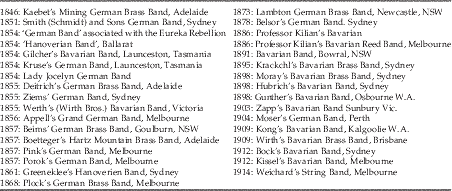
References to German or Bavarian bands mostly fail to identify the band in question. Yet the working names of many of the bands that reached Australia can be determined from the aggregate of available sources, such as reports of street incidents or public events or public event promotions in the colonial press. The bands listed in Table 1 are among those mentioned in the colonial press by their working name, which was commonly the family name of their leader/manager preceded by ‘Herr’.
Bands Cited in the Colonial Press 1846–1914

‘German’ or ‘Bavarian’ bands are documented in the colonial press as having been hired for a remarkable range of functions besides street playing. These included picnics, circus parades, circus pre-show concerts and ring accompaniment, balls, dance competitions, colonial celebrations, German club functions, German National festivals, German Biergarten entertainment, indoor classical and promenade concerts, stage accompaniment, race track and other sporting event entertainment, regattas, ploughing races, church and funeral services, roller-skating rink music, major exhibitions, hotel entertainment, aquarium, zoo and botanical garden entertainment, all manner of public processions, charity fund-raising events, temperance meetings, shipboard and ferry cruise entertainment, political rallies and protest meetings and marches.Footnote 28 Perhaps the most socially significant colonial event that a German band musically engaged with was the 1854 Eureka Rebellion that transformed Australia’s political and social landscape and remains a huge Gallipoli-like inspiration to the left of Australian politics.Footnote 29
Band Size and Instrumentation
German bands varied in size and makeup for economic or other reasons. Greater numbers could increase the volume and quality of street music and the physical safety-in-numbers of the group, but a 12-piece was obviously less profitable per head than a smaller but popular band. Moreover, those seeking to hire a band for a function, such as an indoor quadrille party, might only want a small low cost ensemble. Therefore we find, for example, Smith and Sons band offering ‘any number of musicians’, an 1857 Ballarat hotel proprietor advertising for a three to five piece German Band,Footnote 30 Beims’ German Brass Band expanding from eight to 12 players when it became contracted to Ashton’s Circus in 1857,Footnote 31 and the 1861 Hanoverian Band offering from four to 12 players,Footnote 32 among many other documented examples. This also suggests that the contingency (especially pre-1870s) of limited pools of competent colonial musical talent would have often required intercultural musical collaboration, as in Smith and Sons ‘English and German’ band mentioned above. Of 18 Australian examples where the number of musicians in a German band are cited or graphically depicted, membership ranged between four and 12 members.
From all available accounts and images of German or Bavarian bands in Australia, including sketches, it is clear that wind instrumentation varied to the extent that it can only be characterized in a limited way. This problem is compounded by the fact that the period 1850 to World War I saw the transition in Australia from so-called ‘brass bands’, comprising mixes of reed and brass instruments, to standardized all-brass bands comprised entirely of the piston-valved saxhorn family of brass instruments.Footnote 33 On the rare occasion on which a German band actually describes itself as a ‘saxhorn band’, it is certain to have been a mostly brass or all-brass band.Footnote 34
The earliest description located of full German band instrumentation was that of the German band involved with the 1854 Eureka Rebellion comprising F flute, E-flat clarinet, B-flat cornet, E-flat horn and B-flat bass.Footnote 35 A photo of the Werth (Wirth) brothers’ (of later Wirth’s Circus fame) German band in the 1860s shows three cornets of ancient design and a euphonium with its player doubling on clarinet.Footnote 36 Beim’s brass band, mentioned above, comprised three clarinets, three cornets, four (unspecified) horns, tuba and a tenor and bass drumFootnote 37 , while a German band photographed in Bourke Street, Melbourne, in 1895 appears to comprise two cornets, two clarinets, a horn, an E-flat tuba, and three other instruments hidden from view.Footnote 38 Despite such inconsistencies, however, the aggregate of accessible Australian and overseas images and descriptions of itinerant German bands in street playing suggests that the optimum core instrumentation – especially where influenced by Prussian or Austrian military models – was along the lines of one (or two) woodwinds, one (or two) cornets or flugel horns, an alto horn, tenor horn (or euphonium) and tuba.
Objections to German Bands
‘I give them money when they play, I give them more to go away’.
‘That Little German Band’, 1913. Footnote 39
As street musicians, German bands sometimes set up outside selected establishments or private homes in their quest to extract or even extort donations. This latter role as musical extortionists helped to give rise to perceptions of the German bands as a public nuisance. There are, for example, colonial court and other reports of bands deliberately setting up outside the residence of a sick personFootnote 40 or else the offices or homes of people needing to concentrate on their work, so that someone would have to come out and pay them to go away. For example, a 1905 letter from a ‘Merchant’ to Melbourne’s The Argus complains as follows:
Sir-the German Band is no doubt appreciated in its proper place, but when they play outside offices they are most distracting and in fact become a positive nuisance for all who have serious work to do. Often we give the band money to get rid of them, so as to obtain the necessary quiet, more especially when we are in the middle of a board meeting.Footnote 41
Observations of Melbourne street music by Oscar Comettant, a visiting French musician serving as an 1888 Melbourne Exhibition judge, include this description:
The Germans, who know that unity is strength and that the Gods of war are always on the side of the biggest battalions, form themselves into groups of eight to ten brass players and seek to delight the ear. They have strong lungs … Their method is to line up in front of their chosen victim, and … reduce him to a state where he pleads for mercy. First of all they play … not too badly; but if their victim does not immediately search his pockets for the ransom money, they start to play out of key, out of time, and so horribly that at last the exhausted, despairing, almost maddened listener gives in and hands over money without even counting it.Footnote 42
The most common reason that brought the bands into conflict with the law was, however, causing an obstruction. For example, the Bendigo Advertiser reported in 1905 that ‘Six members of the Bavarian band were arrested today on a charge of obstructing the thoroughfare, in contravention of the city by laws’.Footnote 43 Yet the bandsmen themselves faced considerable danger, along with the hardship of all-weather street work. Court reports show that even before the First World War they were sometimes verbally abused and physically attacked by street thugs and drunks.Footnote 44
Other serious objections to the German bands eventually came from Anglo-Australian band musicians, the Australian [amateur] Bands Association and the Professional Musicians Association, who claimed that these ‘foreigners’ were stealing all the work from local amateur bands (they could be hired for a fee) and professional musicians by undercutting their prices. Part of the band movement’s argument was that these ‘Bavarians’ took all the money they gained with them to Germany and contributed nothing to the local or Australian economy.Footnote 45 In 1905, the Professional Musicians Association applied to invoke the Immigration Restriction Act in order to ban a Bavarian band on its way to Australia, but the Minister for Customs’ response was that the act only applied to those coming to perform manual work.Footnote 46 There were also arbitration cases about leaders grossly underpaying their own band members.Footnote 47
Appearance and Ethnicity
Street band uniforms depicted in photographs and sketches often show, or appear to show, the musicians in relatively plain and serviceable-looking (probably weather hardy) dark trousers and jackets with peaked or un-peaked (and sometimes embroidered) cloth caps. There are, however, various reference to bands appearing in ‘full’ uniform or ‘regalia’. Kissel’s Bavarian Band, for example, assured patrons that, if hired, the band would appear at balls, picnics and sporting and other events in ‘full uniform’.Footnote 48 It therefore seems probable that ‘full’ Bavarian or German uniforms, costumes or ‘regalia’ worn for significant balls and other important engagements were – along with the German or so-called ‘Germania Bill’ military-style moustaches seen in most images of German bands – somehow distinctive as ethnic markers.
An evocative unidentified photograph captioned ‘A Typical German Band from the 1880s’, reproduced in the Australian Bicentennial publication, Two Hundred Dancing Years,Footnote 49 shows a band of clarinet, cornet, flugel horn, alto and tenor horns, E-flat tuba and a boy bass drummer (which was not uncommon in German bands). The six mostly young adult musicians are neatly dressed in simple but distinctively cut dark uniform jackets and trousers and wear bow ties.Footnote 50 All have modest moustaches except for the lusher versions sported by the older clarinettist leader (who also wears a white vest under his jacket) and the tuba player. Their caps are similar to those seen in many images of German street bands but they are circled by attractively embroidered cloth bands which appear to be removable. The embroidery appears to be some sort of ethnic marker as in the costumes worn by present-day Bavarian-themed venue musicians. The name of Boetteger’s ‘Hartz Mountains Brass Band’, which proudly claimed ‘to not perform in the street’,Footnote 51 evoked the picturesque Hartz (or Harz) Mountains Alpine region of Northern Germany. But even the title of so-called ‘Bavarian’ bands, which in many cases were indeed of Bavarian origin, brought to the public mind the distinctive and colourful Alpine folk culture of Bavaria, which continues to have very wide global appeal.
The itinerant bands brought with them their knowledge of their so-called ‘national airs’, which were in demand at German-speaking events or venues and also part of their more general repertoire. An illustrated poster for the Seventh German National Festival in Sydney in 1900 depicts a lively scene with German musicians in national costumes, what appear to be traditional German festive activities, a German brass band and a ‘Tanz Pavillon’.Footnote 52 Attending a Biergarten, German picnic or German festival of this kind with ‘national airs’ by the band would have been an exciting cultural tourism experience for young colonial Australians living half a world away from Continental Europe. However, stirring ‘national airs’ such as ‘Die Wacht am Rhein’ played in streets and public places eventually became emblematic of growing and ultimately deadly national rivalry and were therefore less and less popular with clientele of British background.
Repertoire and Street Music Sound
Numerous references gathered for this study, such as detailed event reports and concert programmes, demonstrate that the German bands were constantly adapting their repertoire to local popular taste, including the increasing influence of American popular music such as ragtime.Footnote 53 Tobias Widmaier discusses ethnic acculturation associated with this commercial imperative-driven and popularity-seeking process in relation to pre-1914 German bands in America.Footnote 54 The 1907 article ‘Music in the Streets: Melbourne’s German Bands’ offers some direct insight into this process in the Australian context:
The German players attract far more notice than their Italian brethren. Perhaps that is because they make more noise, or, perhaps the reason is the extent of their repertoire is large, and their appreciation of the popular taste is so keen that they instinctively hit upon the melody which is best suited to their audience. One cannot help shrewdly suspecting that behind those … Teutonic features which betray no emotion, there is a shrewd perception at work which tells them what is wanted. A German bandsman admitted, when questioned as to his choice of selections, that it was a question of following the popular taste. ‘Lately’, he said, ‘we have been playing ‘Tannhauser’ and ‘Lohengrin’, but now, again, it is something else – perhaps ‘Fishing’ or something like that’.Footnote 55
The repertoire played by the German bands over the period 1847–1914 is fairly well documented in reports and programmes in the Australian press. Opera themes and dance music were an especially important aspect of their repertoire, but it seems that they could play whatever was required of them, including classical and sacred music and, as already noted, whatever was currently popular. The following programme of Karl Wirth’s Bavarian Brass Band in 1909 is typical of the breadth of German Band popular repertoire:
Two-step: ‘Yankee Girl’ (Lampe)
Pantomime potpourrie: ‘Yankee Girl’ (Moulton)
March: ‘Unter den Freiheltbanner’ (Nowowski)
Overture: ‘To Montrose’ (Bishop)
Waltz: ‘Mein Thüringer’ (Kethler)
Waltz: ‘The First Rose’ (Kannasch)
Selection: ‘Gondoliers’ (Sullivan)
Selection: ‘Rigoletto’ (Verdi)
‘La Serenata’ (?)
‘Der Engel Leider’ (Brager)Footnote 56
But what did the German bands actually sound like as street bands? I have cited Oscar Comettant’s description of the bands using music as violence: menacing pedestrians with horrible discordance to extort donations. Gold-rush era chronicler, William Kelly, colourfully described their music as able to ‘drive swine into anguish’.Footnote 57 Another ranting gold-rush era commentator claimed that the goldfields were ‘infested by a horde of barbarians (I don’t mean Chinese, but lanky haired Germans), who literally make the night hideous blowing through their fearful ear-stunning infernal machines’.Footnote 58
While these particular observations are probably apocryphal (and ethnically biased in the case of the Frenchman, Comettant), the pre-1914 German band undoubtedly became globally synonymous with loud and extroverted music, or (depending on individual aesthetics and taste) blaring or noisy music, just as the Bavarian-style venue oom-pah bands of today maintain a similarly divided reputation. Yet while the bands were loud and did sometimes use their musical presence to extort donations, the notion of their band music as unpleasant noise is very rarely expressed in published reports and is contradicted by numerous primary source references to, for example, their ‘dulcet’, ‘delightful’, ‘beautiful’, ‘dreamy’, ‘softly toned’, ‘excellent’, ‘pleasurable’, ‘appreciated’ and ‘good’ music and, in particular, their ‘sweet’ music. Among many examples are: ‘listening to the sweet strains of the Bavarian band … soothed into forgetfulness of rain and muddy streets’ (1898), ‘the sweet strains of the Bavarian Band mingl[ed] with the “music” accompanying the merry-go-round’ (1898), ‘And down from above, over all, floated the sweetly modulated strains of a dreamy waltz, softly toned by the Bavarian Band, to suit the surroundings’(1899).Footnote 59
It is perhaps risky to generalize about the ability of the bandsmen since little is known about their individual musical backgrounds, which no doubt varied considerably. But to the extent that individual bandsmen or some of their leaders were, as various sources suggest, former military bandsmen, their German military-band training would have fostered an aesthetic of precision and the strong projection of their collective sound. When a brass ensemble sounds a chord with machine-like collective precision, it produces an almost bell-like (or perhaps sweet) ring with much greater dimension and projection than one in which respective players hit the chord tones in a staggered manner.Footnote 60 German-speaking instrumentalists, including former German bandsmen, were held in high esteem in the colony, and Harold Love points out that they were the backbone of colonial theatre orchestras.Footnote 61 Various German band musicians such as the Wirth musical family (of Wirth’s Circus fame), Herr (Henry) Von der Mehden or Herr (Henry) Greeneklee of the Hanoverian Band were deeply respected within the Australian band movement. Herr (Adam) Plock became a celebrity German dance band and concert orchestra conductor. Even by the late 1850s several German bandsmen had left their bands to lead local brass bands.Footnote 62
The calibre of various German band leaders, the contexts for which they were hired and the repertoire they were required to play as hired musicians suggest beyond much doubt that they were generally competent, if not highly skilled, musicians with good sight reading ability. It seems likely that most of those bands that were known by their leader’s name were led by competent and demanding leaders.
How the bands played in the street to solicit donations is more difficult to speculate about. Committing a small repeated programme of music to memory would have been practical for all-weather street playing and mobility, but various Australian images and reports reference music stands in street playing. There are clues regarding the perceived characteristics of ‘typical’ German band arrangements and performance in the accompaniments to published songs about German bands and recordings of these songs, such as extended oom-pah passages.Footnote 63 But there are also brass band arrangements that directly imitate the stereotypical nineteenth-century German band, such as the 1875 quickstep march, ‘Little German Band’, by Chas. Cayworth.Footnote 64
A primary commercial function of outdoors brass band music in the colonial-era absence of public-address systems was to attract attention over long distances and thereby draw patronage attention to commercial events such as circuses, stage productions, land sales, or, for that matter, donation collection by the band. In these circumstances, the ability to play sustained loud, blaring or showy outdoor music was a commercial attribute, and itinerant German bandsmen playing in street conditions were especially dedicated to commercial success. A journalist referred to an 1893 German street band in New South Wales as ‘a fair specimen of their kind – blaring and noisy and yet correct in their time … from long practice’.Footnote 65 The complex sonic environment of busy thoroughfares and public spaces, moreover, greatly mediated and distorted sounds projected by a band. A 1903 article based on observations of Sydney street life expresses this perfectly:
The street minstrels who play baby harmoniums and sing comic songs in front of hotels might just as well call themselves musical mutes, and even the German bands, two or three of which struggle manfully against the roar of the trams, are only able to gratify the public love of music with the occasional top note, too shrill for even an electric tram to kill. And how edifying is the puzzlement of the bystanders attempting to decide, between trams, whether they are listening to oratorio or the latest comic opera!Footnote 66
An 1893 poem referencing the noisiness of the urban Australian soundscape also comments upon music played by a German band being unrecognizable in the distance:
While two short blocks away,
At least for half the day,
A German band discoursed Mozart -
So that it sounded like a part
Of ‘tara-boom-de-ay’.Footnote 67
The texture of the wind music of a small itinerant German band such as the ‘typical’ one mentioned above (clarinet, cornet, flugel horn, alto and tenor horn and tuba) would have comprised melody, counter-melody, off-beats and in the case of the tuba, on-beats. In a noisy street soundscape, and especially from a distance, the most audible sound would be the oom-pah of the on and off-beat or oom-pah-pah of the On-off-off beat in the case of waltz time, with occasional high notes cutting through the street noise as described above. The particularly strong melody and accompaniment texture of German band music was ideal for opera theme music, marches and Strauss waltzes, polkas and other dance music. Australian colonial dance researchers, Shirley Andrews and Peter Ellis, state that the strong oom-pah rhythm of the German bands ‘undoubtedly led to their popularity as excellent dance bands’.Footnote 68
A 1908 Australian book of verse called The German Band and the Morning Minstrels was composed by a Robert Caldwell who clearly had some insight into the experience of itinerant German street bandsmen in Australia, possibly through a personal connection and/or observations. In the poem, ‘The Leader’s Prelude’, Caldwell has the bandleader referring to the band’s need to produce music that was ‘strong and sweet’:
You ask what for we thus all times
Must wander up and down,
And make our music strong and sweet
In city and in town.Footnote 69
The evidence overall, and especially the many references to the ‘sweet’ music of bands when on hire, points to ‘strong and sweet’ being the core aesthetic of the German or Bavarian bands. However, this aesthetic was probably not reflected very well in the challenging sonic conditions of street music performance, or received very well, as German bands were increasingly perceived to be a public nuisance, employment thieves and, eventually, potential mortal enemies.
Endings
Patriotic resentment of the German bands almost caused a Sydney riot in 1909 when it was discovered that one had been hired over an Australian band to perform ‘God Save the King’ for the visit of the Governor General.Footnote 70 The declaration of war in late July 1914 brought fierce and sometimes violent hostility towards the bands and their now detested German music. Some bandsmen sought and failed to become naturalizedFootnote 71 and, one after the other, the bands vanished from the streets as members were arrested and interned as enemy aliens.Footnote 72
At one level, the German street band can be characterized as a distinct mid-nineteenth century to World War I global phenomenon, and the preliminary research presented here suggests that this phenomenon was mediated by various changing localized conditions, contingencies, demands and attitudes. The story of the German bands in Australia is one of a cultural gain that greatly enriched colonial music-making, popular entertainment, street soundscapes and the broader cultural landscape. But it ends with the abrupt and tragic cultural loss of the bands and their music and musical influence. Much is said about the transformative power of music, but what is so chilling about the story of the German bands is its illustration of how the power of prejudice, hatred and fear can retrospectively transform perceptions, recollections and the meanings of music that was once heard as ‘strong and sweet’ into those of music that was dissonant and demonic. One Australian clearly identified this process five years before the war:
A lively waltz is being played, and you begin to wish you could dance. … At the parrot-cry of ‘German band’ all your interest has vanished. It is the fashion to regard these Teutonic bandsmen as representing everything that is execrable in music, and you feel you must be in the fashion.Footnote 73
Yet, less than two decades later, some Australians began to recall with nostalgia and perhaps regret that ‘The “German Band”, which used to discourse sweet music in the suburbs, and even in the city, was one of the things swept away by the war’.Footnote 74
The music of the Deut[s]cher Band
They want not any more;
And far away must we depart
From Australasia’s shore.Footnote 75