Introduction
Post-traumatic stress disorder (PTSD) is common (Kessler, Wai, Demler, & Walters, Reference Kessler, Wai, Demler and Walters2005) and associated with functional impairment (Erbes, Westermeyer, Engdahl, & Johnsen, Reference Erbes, Westermeyer, Engdahl and Johnsen2007). While evidence-supported treatments exist, many patients either fail to respond or suffer relapse following successful treatment (Bradley, Greene, Russ, Dutra, & Westen, Reference Bradley, Greene, Russ, Dutra and Westen2005; Imel, Laska, Jakupcak, & Simpson, Reference Imel, Laska, Jakupcak and Simpson2013; Schottenbauer, Glass, Arnkoff, Tendick, & Gray, Reference Schottenbauer, Glass, Arnkoff, Tendick and Gray2008). It is therefore important to develop alternative treatments. Here we test the efficacy of attention control therapy (ACT), a novel intervention (Badura-Brack et al., Reference Badura-Brack, Naim, Ryan, Levy, Abend, Khanna and Bar-Haim2015; Lazarov et al., Reference Lazarov, Suarez-Jimenez, Abend, Naim, Shvil, Helpman and Neria2019) that targets aberrant fluctuations of attention towards and away from threats in patients with PTSD (Shechner & Bar-Haim, Reference Shechner and Bar-Haim2016).
In anxiety disorders, attentional threat patterns typically manifest in an attentional bias toward threat (Armstrong & Olatunji, Reference Armstrong and Olatunji2012; Bar-Haim, Lamy, Pergamin, Bakermans-Kranenburg, & Van IJzendoorn, Reference Bar-Haim, Lamy, Pergamin, Bakermans-Kranenburg and Van IJzendoorn2007; Cisler & Koster, Reference Cisler and Koster2010). In PTSD, the evidence for threat-related attention biases is variable. Some studies find a bias toward threat (e.g. Bryant & Harvey, Reference Bryant and Harvey1997; Buckley, Blanchard, & Neill, Reference Buckley, Blanchard and Neill2000; Fani et al., Reference Fani, Tone, Phifer, Norrholm, Bradley, Ressler and Jovanovic2012), whereas others find threat avoidance (e.g. Bar-Haim et al., Reference Bar-Haim, Holoshitz, Eldar, Frenkel, Muller, Charney and Wald2010; Beevers, Lee, Wells, Ellis, & Telch, Reference Beevers, Lee, Wells, Ellis and Telch2011; Constans, Vasterling, McCloskey, Brailey, & Mathews, Reference Constans, Vasterling, McCloskey, Brailey and Mathews2004). One explanation for this inconsistency is an aberrancy in PTSD concerning mechanism responsible for detecting and monitoring threats (Shechner & Bar-Haim, Reference Shechner and Bar-Haim2016). In this scenario, situations involving extreme and irregular traumatic threats may overload and unbalance a core capacity to monitor threats (Das et al., Reference Das, Kemp, Liddell, Brown, Olivieri, Peduto and Williams2005). This aberrancy may manifest as fluctuations of attention between threat vigilance and threat avoidance (Schoorl, Putman, Van Der Werff, & Van Der Does, Reference Schoorl, Putman, Van Der Werff and Van Der Does2014; Shechner & Bar-Haim, Reference Shechner and Bar-Haim2016), causing distress as well as incompatible cognitive and emotional responses (Shechner & Bar-Haim, Reference Shechner and Bar-Haim2016). Such attentional fluctuations correspond with two primary clusters of co-occurring PTSD symptoms: alertness, hyperarousal, and hypervigilance, on the one hand, and avoidance and dissociation on the other hand. Indeed, previous studies have shown that fluctuations in attention, quantified on cognitive tasks as attention bias variability (ABV), are elevated in patients with PTSD but not in patients with other anxiety disorders (Alon, Naim, Pine, Bliese, & Bar-Haim, Reference Alon, Naim, Pine, Bliese and Bar-Haim2019; Bardeen, Tull, Daniel, Evenden, & Stevens, Reference Bardeen, Tull, Daniel, Evenden and Stevens2016; Iacoviello et al., Reference Iacoviello, Wu, Abend, Murrough, Feder, Fruchter and Charney2014; Naim et al., Reference Naim, Abend, Wald, Eldar, Levi, Fruchter and Bar-Haim2015; Swick & Ashley, Reference Swick and Ashley2017). In addition, ABV positively correlates with post-traumatic symptom severity (Naim et al., Reference Naim, Abend, Wald, Eldar, Levi, Fruchter and Bar-Haim2015). Hence, elevated ABV may represent a target for clinical intervention.
ACT is a computerized protocol based on a probe detection task thought to normalize ABV through repeated training (Badura-Brack et al., Reference Badura-Brack, Naim, Ryan, Levy, Abend, Khanna and Bar-Haim2015). In this task, two stimuli, one threat-related and one neutral, are shown briefly on each trial, and their offset is followed by a small probe in the location just occupied by one of the two stimuli. Participants are asked to respond as fast as possible to the probe without compromising accuracy. Biased attention toward threat is inferred from faster reaction times to identify probes appearing at the location of threat stimulus compared to neutral stimulus (MacLeod, Mathews, & Tata, Reference MacLeod, Mathews and Tata1986). ABV is calculated as within-session variability in threat-related attention bias normalized to individual task performance (Naim et al., Reference Naim, Abend, Wald, Eldar, Levi, Fruchter and Bar-Haim2015). In ACT, a specific version of the dot-probe task is applied, where response targets appear with equal probability at neutral and threat locations. It has been proposed that during this training, patients may be prompted to ignore cues in ways that spread their attention equally across neutral and threat information, by that regulating ABV levels (Iacoviello et al., Reference Iacoviello, Wu, Abend, Murrough, Feder, Fruchter and Charney2014; Naim et al., Reference Naim, Abend, Wald, Eldar, Levi, Fruchter and Bar-Haim2015).
Originally, ACT was used as a control condition to active attention bias modification (ABM) designed to shift attention away from threat in anxious patients (Bar-Haim, Reference Bar-Haim2010). However, accumulating evidence suggests that ACT is more effective in reducing PTSD symptoms than standard ABM. Specifically, four RCTs contrasted the efficacy of ACT and ABM for PTSD (Badura-Brack et al., Reference Badura-Brack, Naim, Ryan, Levy, Abend, Khanna and Bar-Haim2015 two RCTs; Lazarov et al., Reference Lazarov, Suarez-Jimenez, Abend, Naim, Shvil, Helpman and Neria2019; Schoorl, Putman, & Van Der Does, Reference Schoorl, Putman and Van Der Does2013). Schoorl et al. (Reference Schoorl, Putman and Van Der Does2013) found ACT and ABM to be equally effective in reducing PTSD symptoms. The other three trials found ACT to be more effective than ABM (Badura-Brack et al., Reference Badura-Brack, Naim, Ryan, Levy, Abend, Khanna and Bar-Haim2015; Lazarov et al., Reference Lazarov, Suarez-Jimenez, Abend, Naim, Shvil, Helpman and Neria2019). Badura-Brack et al. (Reference Badura-Brack, Naim, Ryan, Levy, Abend, Khanna and Bar-Haim2015) further reported that ACT but not ABM reduced ABV in a way that partially mediated clinical improvement. Taken together, these RCTs suggest that ACT may be superior to ABM for PTSD. The transition of ACT from the status of a control condition in trials for anxiety disorders to active treatment in PTSD trials calls for alternative control conditions in the context of PTSD. Here, we contrast ACT with a control condition presenting only neutral stimuli and eliminating attentional competition.
The primary goal of the current study was to examine the efficacy of training informed by personalized threat content using the probe detection task. One of the primary challenges in PTSD research is the heterogeneous nature of the disorder. Some disorders besides PTSD concern scenarios where threat content is homogeneous (e.g. social content in social anxiety disorder; separation from primary caregivers in separation anxiety disorder). However, in PTSD, particular feared threats widely vary among patients, reflecting the varied nature of each patient's traumatic experiences. Content specificity also manifests for attention bias in PTSD, where trauma-related stimuli generate greater attentional bias relative to general threat stimuli (Pergamin-Hight, Naim, Bakermans-Kranenburg, van IJzendoorn, & Bar-Haim, Reference Pergamin-Hight, Naim, Bakermans-Kranenburg, van IJzendoorn and Bar-Haim2015). Thus, using specific threat content, as opposed to general threats, in patients with PTSD could more strongly provoke threat responses and potentially enhance effectiveness. A recent RCT testing the efficacy of a mobile-based ABM for PTSD using personalized word stimuli (Niles et al., Reference Niles, Woolley, Tripp, Pesquita, Vinogradov, Neylan and O'Donovan2020) found no benefit of such personalized training. Importantly, however, remote delivery of ABM has limited efficacy as indicated in two meta-analyses (Jones & Sharpe, Reference Jones and Sharpe2017; Linetzky, Pergamin-Hight, Pine, & Bar-Haim, Reference Linetzky, Pergamin-Hight, Pine and Bar-Haim2015). Here, we utilize an alternative in-person-training design, comparing personalized to non-personalized ACT and a neutral control.
Finally, the current study also explores three potential moderators of treatment outcome: time elapsed since trauma (Cloitre, Petkova, Su, & Weiss, Reference Cloitre, Petkova, Su and Weiss2016; Duffy, Gillespie, & Clark, Reference Duffy, Gillespie and Clark2007; Keane, Marshall, & Taft, Reference Keane, Marshall and Taft2006), symptom severity at baseline (Karatzias et al., Reference Karatzias, Power, McGoldrick, Brown, Buchanan, Sharp and Swanson2007; Van Minnen, Arntz, & Keijsers, Reference Van Minnen, Arntz and Keijsers2002), and ABV and Stroop interference at baseline (Kuckertz et al., Reference Kuckertz, Amir, Boffa, Warren, Rindt, Norman and McLay2014). Testing moderators of treatment outcome is an important additional pathway toward personalized protocols. Through the identification of specific characteristics that distinguish patients who respond positively to treatment v. those who do not, and circumstances under which a specific therapy works best, we expect to shed further light on the efficacy of ACT for patients with PTSD (Kraemer, Wilson, Fairburn, & Agras, Reference Kraemer, Wilson, Fairburn and Agras2002; Schneider, Arch, & Wolitzky-Taylor, Reference Schneider, Arch and Wolitzky-Taylor2015). It is conceivable that ACT exerts a greater impact on recently-acquired as opposed to longer established maladaptive threat-related attentional patterns. Such recently acquired patterns may be less deeply entrenched and more malleable. Thus, ACT delivered closer in time to the trauma may produce better cognitive target engagement and treatment response. Symptom severity at baseline may also differentiate patients' response to treatment. For example, in social anxiety disorder, the effect sizes of cognitive bias modification treatments were found to be larger for subclinical samples relative to clinical samples, suggesting that cognitive bias modification protocols may be more effective for those with lower symptom severity (Heeren, Mogoașe, Philippot, & McNally, Reference Heeren, Mogoașe, Philippot and McNally2015b). Finally, it was found that the magnitude of baseline attentional bias moderates the relation between ABM and treatment outcome (Amir, Taylor, & Donohue, Reference Amir, Taylor and Donohue2011; Heeren, Mogoaşe, McNally, Schmitz, & Philippot, Reference Heeren, Mogoaşe, McNally, Schmitz and Philippot2015a; MacLeod & Grafton, Reference MacLeod and Grafton2016).
We expected that: (a) personalized ACT would produce a greater reduction in PTSD symptoms relative to a non-personalized ACT, and that both ACT conditions would be more effective than the control condition; and (b) ACT would be associated with a reduction in ABV and in Stroop interference. Based on prior research, we also expected longer time elapsed since trauma, higher baseline symptom severity, and elevated baseline threat-related attention biases to moderate treatment outcome and to be associated with lower treatment efficacy.
Method
Participants
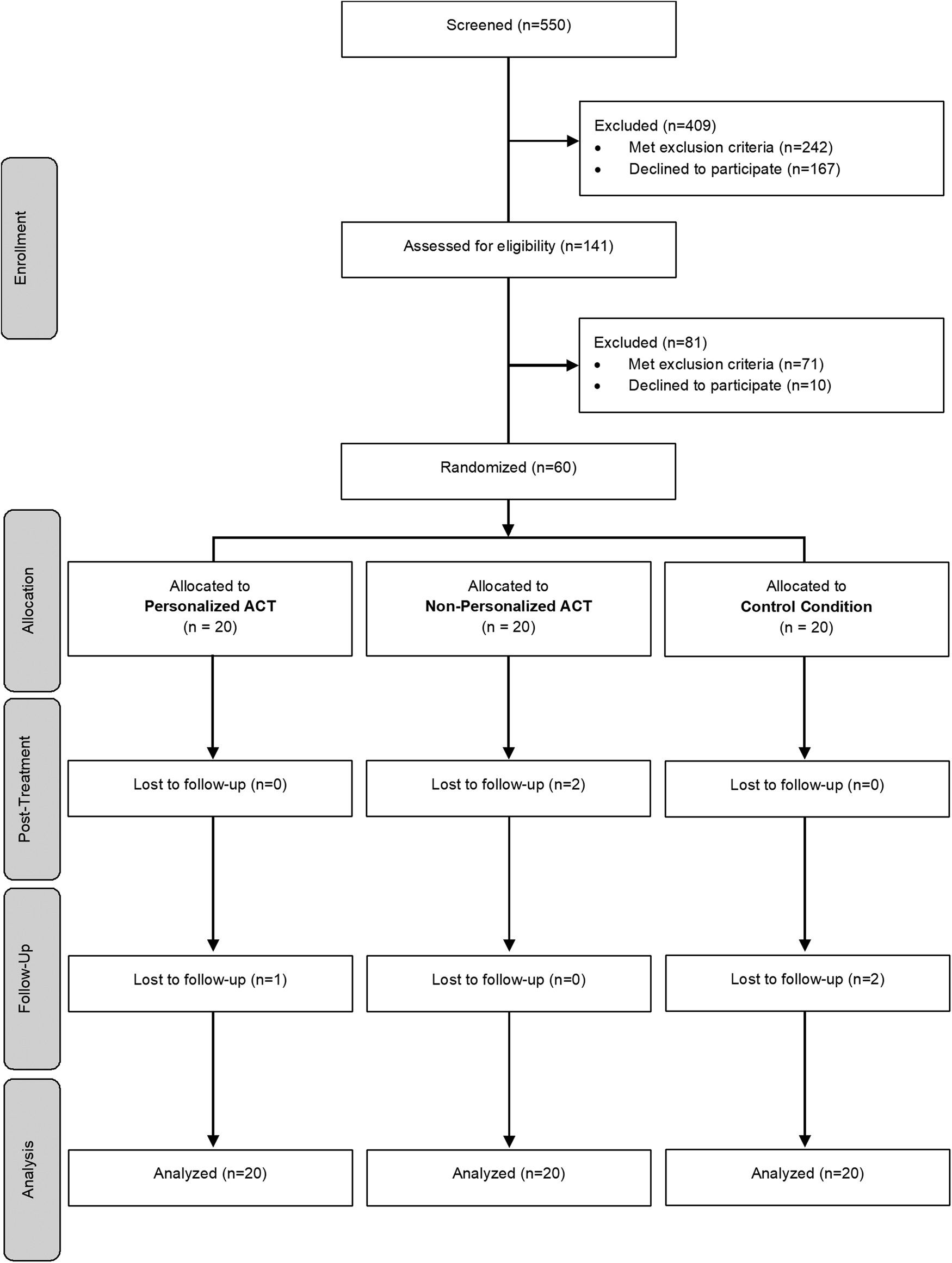
CONSORT Fig. 1 describes participants' flow through the study. Recruitment for the study involved advertisement in social media, search engines, and national newspapers. Potential participants who responded to the advertisements were screened over the telephone for PTSD symptoms using the PTSD Checklist-5 (PCL-5; Weathers et al., Reference Weathers, Litz, Keane, Palmieri, Marx and Schnurr2013b). Those who reported a traumatic event corresponding to criterion A of the DSM-5, and had a PCL-5 score >30 (indicating probable PTSD) were invited for a full clinical assessment. Out of 550 applicants, 141 were assessed in-person; of those, 71 did not meet inclusion criteria and 10 eligible subjects declined participation. Sixty patients (mean age = 41.58 years, s.d. = 13.80, range 21–67, 65% female) were randomized to either personalized ACT (n = 20), non-personalized ACT (n = 20), or a control condition (n = 20). Inclusion criteria: (1) PTSD diagnosis and (2) 18–70 years of age. Exclusion criteria: (1) psychotic or bipolar disorders; (2) epilepsy or brain injury; (3) suicidal ideation; (4) drugs or alcohol abuse; (5) non-fluent Hebrew; and (6) unstable pharmacological/psychosocial treatment in the past 3 months. A stable treatment was not a reason for exclusion as long as it remained stable throughout the study. One participant reported color blindness and his emotional Stroop data were excluded from the analyses.
Consort diagram.

Some participants reported receiving stable treatment in the community during the study period that started at least 3 months prior: 11 participants in the personalized ACT group (55%, four with medications, four with psychological treatment, and three with a combination of both); 13 in the non-personalized ACT group (65%; two medications, five psychological treatment, and six a combination of both); and 13 in the control group (65%; seven medications, four psychological treatment, and two a combination of both). Mean time in treatment prior to the current study for the patients who received stable psychosocial therapy was 3.17 years (s.d. = 4.51). No changes in these treatments were reported during the trial.
Trauma experiences that were reference indexed in the CAPS-5 interview were: childhood sexual abuse (18), childhood physical abuse (5), sexual assault (12), motor vehicle accident (5), terror attack or war (10), violent assault (3), medical incidents that involve sudden and catastrophic events (5), the tragic death of a close relative (1), repeated and extreme exposure to aversive details of traumatic events as part of work (1). Fifty-five percent of the participants reported that their main trauma, as indexed in the CAPS-5 interview, was prolonged and repeated (e.g. child abuse or during combat deployment). In total, 23.3% of the participants reported that they had experienced other traumas than the main trauma encoded in the CAPS-5 interview.
Participants provided written informed consent. The Institutional Review Board of Tel Aviv University approved the study. Clinicaltrials.gov identifier: NCT02945709.
Measures
Primary outcomes
The primary outcomes were clinician-evaluated changes from pre- to post-treatment, pre-treatment to follow-up, and post-treatment to follow-up in: (a) total PTSD severity score; and (b) categorical PTSD diagnosis, both derived from the Clinician-Administered PTSD Scale-5 (CAPS-5; Weathers et al., Reference Weathers, Blake, Schnurr, Kaloupek, Marx and Keane2013a). The CAPS-5 is a structured interview used to determine a diagnosis of PTSD according to DSM-5 criteria (Bovin et al., Reference Bovin, Marx, Weathers, Gallagher, Rodriguez, Schnurr and Keane2016; Weathers et al., Reference Weathers, Bovin, Lee, Sloan, Schnurr, Kaloupek and Marx2018). Interviews were conducted by two independent evaluators, graduate-level clinical psychology students, trained to 85% reliability with an experienced clinical psychologist. The independent evaluators were blind to group assignment. Cronbach's αs for CAPS-5 items in the current sample were 0.71, 0.87, and 0.90 at pre, post, and follow-up, respectively.
Secondary outcome
Changes from pre- to post-treatment, pre-treatment to follow-up, and post-treatment to follow-up in the total score of the PCL-5 (Weathers et al., Reference Weathers, Blake, Schnurr, Kaloupek, Marx and Keane2013b) served as a secondary outcome. The PCL-5 is a 20-item self-report inventory assessing the severity of PTSD symptoms corresponding to DSM-5 criteria. Scores range 0–80 with higher scores reflecting greater severity. The PCL-5 has good test-retest reliability, and convergent and discriminate validity (Armour et al., Reference Armour, Tsai, Durham, Charak, Biehn, Elhai and Pietrzak2015; Bovin et al., Reference Bovin, Marx, Weathers, Gallagher, Rodriguez, Schnurr and Keane2016; Liu et al., Reference Liu, Wang, Cao, Wang, Zhang, Zhang and Elhai2014). Cronbach's αs in the current sample were 0.65, 0.92, and 0.93 for pre, post, and follow-up, respectively.
Additional clinical outcomes
The Patient Health Questionnaire (PHQ-9; Kroenke, Spitzer, & Williams, Reference Kroenke, Spitzer and Williams2001) is a self-report depression scale consisting of nine items on which the diagnosis of DSM-IV of major depression is based. Scores range 0–27 with higher scores reflecting greater depression. The PHQ-9 has good validity, test-retest reliability, and internal consistency (Kroenke et al., Reference Kroenke, Spitzer and Williams2001). Cronbach's αs in the current sample were 0.81, 0.86, and 0.86 at pre, post, and follow-up, respectively.
Clinical Global Impression Severity and Improvement scales (Guy, Reference Guy and Rush2000) were used to assess participants' global clinical condition. The CGI-S and the CGI-I are single items, assessing severity and improvement of illness, respectively, using seven-point scales. CGI-S was scored by the independent evaluators, whereas the CGI-I was self-reported by participants. The CGI-S was collected at pre-treatment, post-treatment, and follow-up, while the CGI-I was collected only at post-treatment and follow-up as it evaluates the change in clinical status over time. The CGI-S/I have good sensitivity to clinical change (e.g. Berk et al., Reference Berk, Ng, Dodd, Callaly, Campbell, Bernardo and Trauer2008; Hedges, Brown, & Shwalb, Reference Hedges, Brown and Shwalb2009; Kadouri, Corruble, & Falissard, Reference Kadouri, Corruble and Falissard2007; Leon et al., Reference Leon, Shear, Klerman, Portera, Rosenbaum and Goldenberg1993).
Behavioral tasks
The Word Rating Task was used to determine participants' idiosyncratic evaluation of threat and consisted of 170 words (85 threat, 85 neutral) reflecting threat–neutral pairs with each pair member having the same number of letters and the same frequency of use in Hebrew. The words were presented one-by-one in random order. Participants were asked to rate how threatening each word is for them using a sliding locator on a visual analog scale presented below the word. The scale was virtually divided into 30 equal-sized partitions rendering scores between 0 and 30 (Abend, Dan, Maoz, Raz, & Bar-Haim, Reference Abend, Dan, Maoz, Raz and Bar-Haim2014a). One edge of the scale was marked ‘not threatening’ and the other ‘very threatening’.
The threat and neutral words used here were selected based on a pilot with 20 healthy volunteers who rated a larger list of words. To be included in the current task, threat words had to have a mean score higher than 15 (the high-threat half of the analog scale) and the neutral words had to have a mean score lower than 5 (reflecting minimal threat). One-week test-retest reliability of the selected 170 words was r = 0.87. Importantly, words applied in the ACT protocols (see below) were selected based on the specific ratings of these 170 words by each patient enrolled in the current study.
An emotional Stroop task was used to assess attentional interference of threat information. The stimuli were the 170 words used in the Word Rating Task, Ariel font, size 28 (85 threat and 85 neutral), presented one at a time in the center of a 15.6” screen. Participants were requested to identify via keyboard press the color of each word (‘Blue’, ‘Red’, or ‘Green’) while ignoring its content. Words were presented until a response with an inter-trial interval of 250 ms. Threat-related interference score was calculated as the mean RT of neutral word trials minus mean RT of threat word trials, with positive values reflecting attention salience of threat.
Treatment conditions
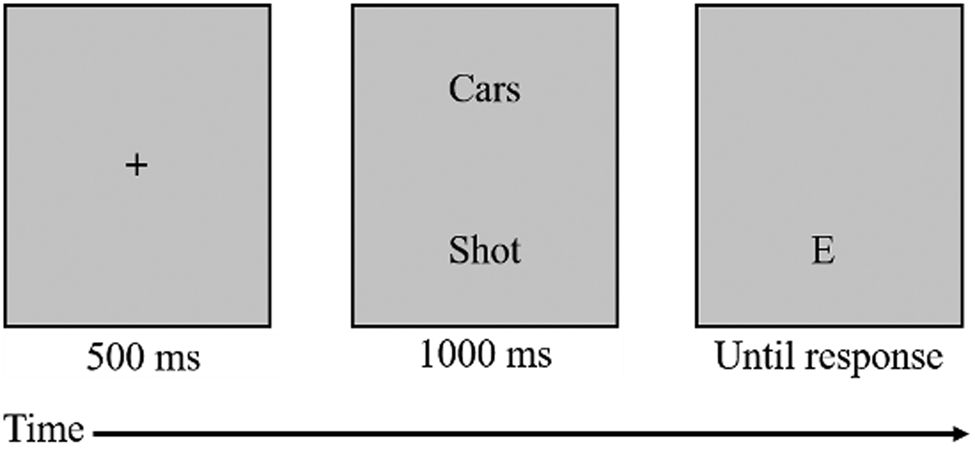
Participants were randomized to one of three treatment conditions: personalized ACT, non-personalized ACT, and a control condition. The two ACT arms involved sixFootnote 1Footnote †, weekly, word-based dot-probe sessions as in Badura-Brack et al. (Reference Badura-Brack, Naim, Ryan, Levy, Abend, Khanna and Bar-Haim2015). Each session consisted of 160 trials (128 threat–neutral trials and 32 neutral–neutral trials). Each trial began with a centrally presented fixation cross (500 ms), followed by a pair of words presented simultaneously above and below fixation (1000 ms). Following the words display, a target (‘E’ or ‘F’) appeared in the location previously occupied by one of the words, and participants had to discriminate probe type via button press. Target probes remained on the screen until response, after which the next trial began. Target probes appeared with equal probability at the locations of threat and neutral words, intending to attenuate fluctuations in attention allocation toward and away from threat (Iacoviello et al., Reference Iacoviello, Wu, Abend, Murrough, Feder, Fruchter and Charney2014; Naim et al., Reference Naim, Abend, Wald, Eldar, Levi, Fruchter and Bar-Haim2015). Words presentation duration of 1000 ms was chosen to ensure the prospect of participants cognitively registering, and attentionally responding to, the content of the stimuli. Figure 2 depicts the sequence of events in a single threat-congruent dot-probe trial. ABV was calculated as in Naim et al. (Reference Naim, Abend, Wald, Eldar, Levi, Fruchter and Bar-Haim2015), reflecting the within-session variability in threat-related attention bias normalized to individual task performance. ABV data were collected only for the two ACT groups.
An example of a dot-probe congruent trial.

In the Personalized ACT condition, each patient was trained with the probe detection task presenting a set consisting of 32 word-pairs that were rated by the specific patient as the most threatening in the Word Rating Task. For a word-pair to be included in the training stimuli, the neutral word had to be scored by the patient as <10 (reflecting low threat). Mean threat score of the training words was 25.64, s.d. = 4.48. In the Non-personalized ACT condition, patients were trained with the same task except that the threat words were randomly fitted for each participant. Finally, in the Control Condition, participants performed a computerized task similar to the probe detection task. However, in each trial, only one neutral word was presented centrally, and participants were asked to discriminate the target probes also presented centrally. This condition does not include the essential ingredients thought to drive symptom reduction in ACT: exposure to threat content and competition for attentional resources.
Procedure
Following a telephone screening verifying preliminary inclusion and exclusion criteria, eligible candidates were invited for an in-person interview. Study procedures were explained, and participants provide written informed consent. Participants were informed that the purpose of the study was to evaluate the efficacy of a novel computerized treatment for PTSD. Then, diagnostic interviews and questionnaires were administered. Subjects meeting the inclusion criteria were randomly assigned to one of the three treatment conditions and were evaluated at three time points (pre-treatment, post-treatment, and a 3-month follow-up). Randomization was applied using a computer-generated set of random allocations overseen by a supporting researcher who did not perform data collection and was not involved in the study in any other capacity. The allocation set was prepared in advance of the start of the study, and allocations were consecutively allotted irreversibly to each new patient once included in the study. The study design was a double-blind RCT, such that both the independent evaluators, personnel staff, and participants were blind to group allocation, which was coded with an array of numbers for each condition. Before the beginning of the intervention phase, a pre-treatment assessment session was held, including the Word Rating Task and the emotional Stroop. One week later, a 6-week treatment phase ensued with one session per week. One week following the last treatment session, a post-treatment assessment was held, including the emotional Stroop and the same clinical evaluation as in baseline. Three months later, the same clinical evaluation was conducted to examine long-term therapeutic effects.
Data analyses
ANOVAs were used to examine differences between the study conditions in clinical, cognitive, and demographic measures at baseline. A χ2 test was used to assess group differences in gender distribution.
Treatment effects were tested with random-effects time-series models in generalized estimating equations (GEE; Zeger & Liang, Reference Zeger and Liang1986; Zeger, Liang, & Albert, Reference Zeger, Liang and Albert1988). This enabled consideration of correlations between repeated measurements and addressed missing data via estimated marginal means relying on the entire sample of randomized participants, incorporating data collected at any time point, and handling missing data. The GEE models examined Time (pre-treatment, post-treatment, and follow-up) by Group (personalized ACT, non-personalized ACT, and control) effects on PTSD, depression, and clinical global severity (CGI-S). These analyses specified an unstructured correlation matrix to model the correlations between participant-specific intercepts and change slopes in outcomes. The interaction terms between Time and Group (regressed on symptoms) reflect the outcomes of interest as recommended for clinical trials (Vens & Ziegler, Reference Vens and Ziegler2012). In addition, ANOVAs were used to test the effect of Group (personalized ACT, non-personalized ACT, and control) on clinical global improvement scores (CGI-I) at post-treatment and follow-up; and χ2 tests were used to explore differences in PTSD diagnosis rates between treatment conditions at post-treatment and follow-up.
To test for change in emotional Stroop interference from pre- to post-treatment, we applied a GEE model with emotional Stroop interference scores as the dependent variable and Group (personalized ACT, non-personalized ACT, and control) and Time (pre-treatment and post-treatment) as independent variables. We also tested the change in ABV from the first to the last treatment sessions using GEE with ABV as the dependent variable and Group (personalized ACT, non-personalized ACT) and Time (session 1 minus session 6) as independent variables.
Finally, to test the moderation effects of time since trauma (based on the main trauma indexed in the CAPS-5), baseline PTSD symptoms severity, and baseline attentional factors (i.e. Stroop interference and ABV), we conducted exploratory hierarchical multiple regression analyses using the PROCESS macro in SPSS (model 1), Version 25.0 (Hayes & Rockwood, Reference Hayes and Rockwood2017). The moderation effects were tested on the change in clinician-rated (CAPS-5) and self-reported (PCL-5) PTSD symptoms from pre- to post-treatment (treatment effect) and from post-treatment to follow-up (maintenance of treatment effect). Introducing the interaction terms of group-by-moderator to the models is taken to index differential effects of treatment as a function of the moderator (see Amir, Taylor, & Donohue, Reference Amir, Taylor and Donohue2011; Kraemer et al., Reference Kraemer, Wilson, Fairburn and Agras2002; Pergamin-Hight, Pine, Fox, & Bar-Haim, Reference Pergamin-Hight, Pine, Fox and Bar-Haim2016). To graphically disambiguate the nature of significant interactions, we plotted the results based on median splits of the continuous variables. Importantly however, the reported results relate to the continuous measure. To facilitate interpretation of the results, the continuous moderators were centered at the grand mean before analyses.
Cohen's d effect sizes for the different analyses in the study are based on the estimated means and standard errors rendered from the GEE analyses. Power calculation was based on the combined effect size of a meta-analysis we conducted on the reported effects of the four published independent RCTs of ACT v. ABM in patients with PTSD (Badura-Brack et al., Reference Badura-Brack, Naim, Ryan, Levy, Abend, Khanna and Bar-Haim2015, two samples; Lazarov et al., Reference Lazarov, Suarez-Jimenez, Abend, Naim, Shvil, Helpman and Neria2019; Schoorl et al., Reference Schoorl, Putman and Van Der Does2013; see online Supplementary Material). Based on findings in these past trials, the current study also examined two active conditions (personalized and non-personalized ACT), to test if the personalized version is more effective than the standard version. We further expected to increase power in the current study by the addition of a robust neutral control condition. Siding on an approach at the lower bound of effects reported in prior studies, we powered our study to detect a medium between-groups effect size of 0.50. With an α set at 0.05 and power (1-β) set at 0.80, a sample size of at least 17 participants per group was deemed necessary. We pre-registered 20 participants per group.
Results
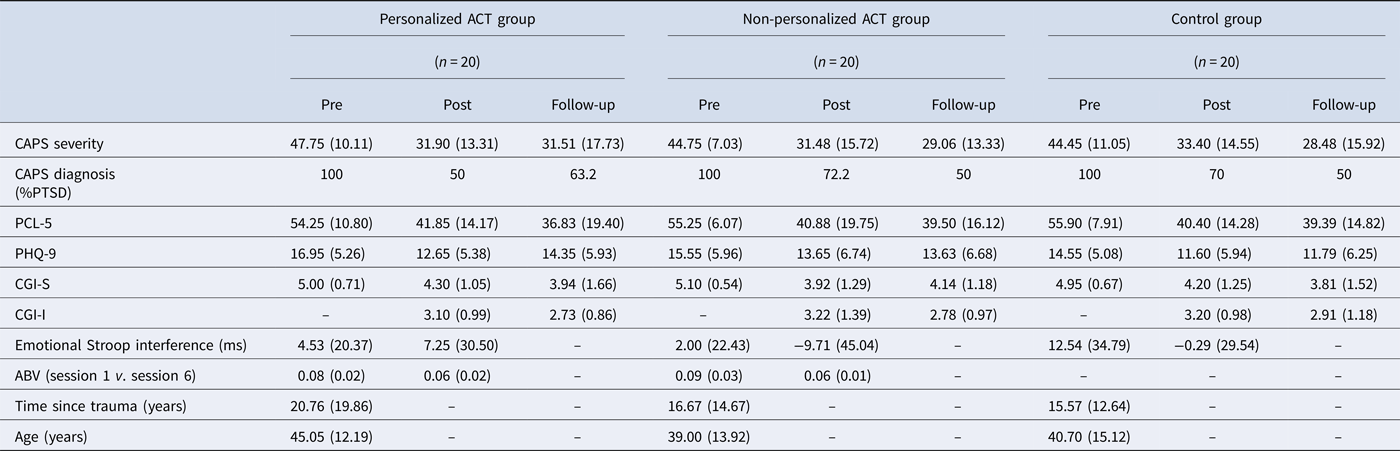
Descriptive statistics for all variables are provided in Table 1. Analyses of baseline characteristics revealed no group differences in time elapsed since trauma, F (2,57) = 0.58, p = 0.56; age, F (2,57) = 1.02, p = 0.37; gender, χ2 = 0.44, p = 0.80; CAPS-5, F (2,57) = 0.69, p = 0.50; PCL-5, F (2,57) = 0.18, p = 0.83; PHQ-9, F (2,57) = 0.93, p = 0.40; CGI-S, F (2,57) = 0.27, p = 0.76; ABV, F (1,37) = 1.89, p = 0.18; and emotional Stroop interference, F (2,56) = 0.11, p = 0.90.
Estimated means and standard deviations (in parentheses) of clinical, cognitive, and demographic characteristics as a function of group and time

ACT, attention control therapy; Pre, pre-treatment assessment; Post, post-treatment assessment; Follow-up, follow-up-treatment assessment; CAPS-5, The Clinician-Administered PTSD Scale-5; PTSD, post-traumatic stress disorder; PCL-5, PTSD Checklist-5; PHQ-9, Patient Questionnaire-9; CGI-S/I, Clinical Global Impression Severity/Improvement; ABV, attention bias variability (units reflect the standard deviation of attention biases scores divided by the mean overall reaction time, s.d.AB /MeanRT)
Adherence with treatment
Participants completed a mean of 5.7 out of the six offered training sessions (s.d. = 0.94, range = 2–6). Fifty-three participants (88.3%) completed all the sessions: 100% in personalized ACT, 80% in non-personalized ACT, and 85% in the control group. Online Supplementary Table S1 provides reaction time, accuracy, ABV, and attention bias data for each of the training sessions by group.
Clinical outcomes
Primary outcomes: PTSD symptoms severity and PTSD diagnosis post-treatment (CAPS-5)
GEE analysis of clinician-evaluated PTSD symptom severity change indicated a main effect of symptom reduction over time, Wald χ2 = 128.45, p < 0.0001. Symptoms decreased from pre- to post-treatment (p < 0.0001, d = 1.94) and from pre-treatment to follow-up (p < 0.0001, d = 2.18). No change was noted between post-treatment and follow-up, p = 0.12. The time-by-group interaction and the main effect of group were non-significant, Wald χ2 s = 3.2 and 0.34, ps = 0.52 and 0.84, respectively. PTSD diagnosis rates at post-treatment and follow-up were not significantly different between the three conditions, χ2s = 2.53 and 0.87, ps = 0.28 and 0.65, respectively, with a total of 36.2% and 45.4% of the patients no longer meeting diagnostic criteria for PTSD at post-treatment and at follow-up, respectively.
Secondary outcome: change in self-reported PTSD symptoms (PCL-5)
GEE analysis of self-reported PTSD symptom severity change indicated a main effect of symptoms reduction over time, Wald χ2 = 93.38, p < 0.0001. Symptoms decreased from pre- to post-treatment (p < 0.0001, d = 1.69) and from pre-treatment to follow-up (p < 0.0001, d = 1.89). No change was noted between post-treatment and follow-up, p = 0.16. The time-by-group interaction and the main effect of group were non-significant, Wald χ2s = 1.26 and 0.07, ps = 0.87 and 0.96, respectively.
Change in additional clinical measures
GEE analyses of depression symptom severity change (PHQ-9) and of clinician-rated clinical global severity (CGI-S) indicate main effects of symptom reduction over time, Wald χ2s = 19.52 and 68.96, ps < 0.0001, respectively. Ratings decreased from pre- to post-treatment (ps < 0.0001, ds = 0.98 and 1.39) and from pre-treatment to follow-up (ps < 0.003, ds = 0.70 and 1.51). No changes were noted between post-treatment and follow-up, ps = 0.42 and 0.28, respectively. The time-by-group interactions were non-significant, Wald χ2s = 2.06 and 3.64, ps = 0.72 and 0.46, and neither were the main effects of group, Wald χ2s = 2.02 and 0.09, ps = 0.36 and 0.95, respectively.
ANOVA analyses of clinical global improvement (CGI-I) as reported at post-treatment and follow-up revealed no significant differences between the three conditions, as indicated by the main effects of group, F (2,55) = 0.06, p = 0.94 at post-treatment and F (2,52) = 0.11, p = 0.89 at follow-up.
Pre- to post-treatment changes in emotional Stroop interference
GEE analysis of the emotional Stroop interference scores revealed a non-significant group-by-time interaction, Wald χ2 = 2.38, p = 0.30, and non-significant main effects of group and time, Wald χ2s = 2.20 and 1.75, ps = 0.33 and 0.18, respectively.
Change in ABV from session 1 to 6 in the ACT conditions
For patients receiving ACT, GEE analysis indicated that ABV scores similarly decreased from pre- to post-treatment in both the personalized and non-personalized conditions, Wald χ2 = 16.37, p < 0.0001, d = 0.91. The time-by-group interaction and the main effect of group were not significant, Wald χ2s = 2.47 and 0.52, ps = 0.12 and 0.47, respectively.
Moderators of treatment outcomes
Time since trauma
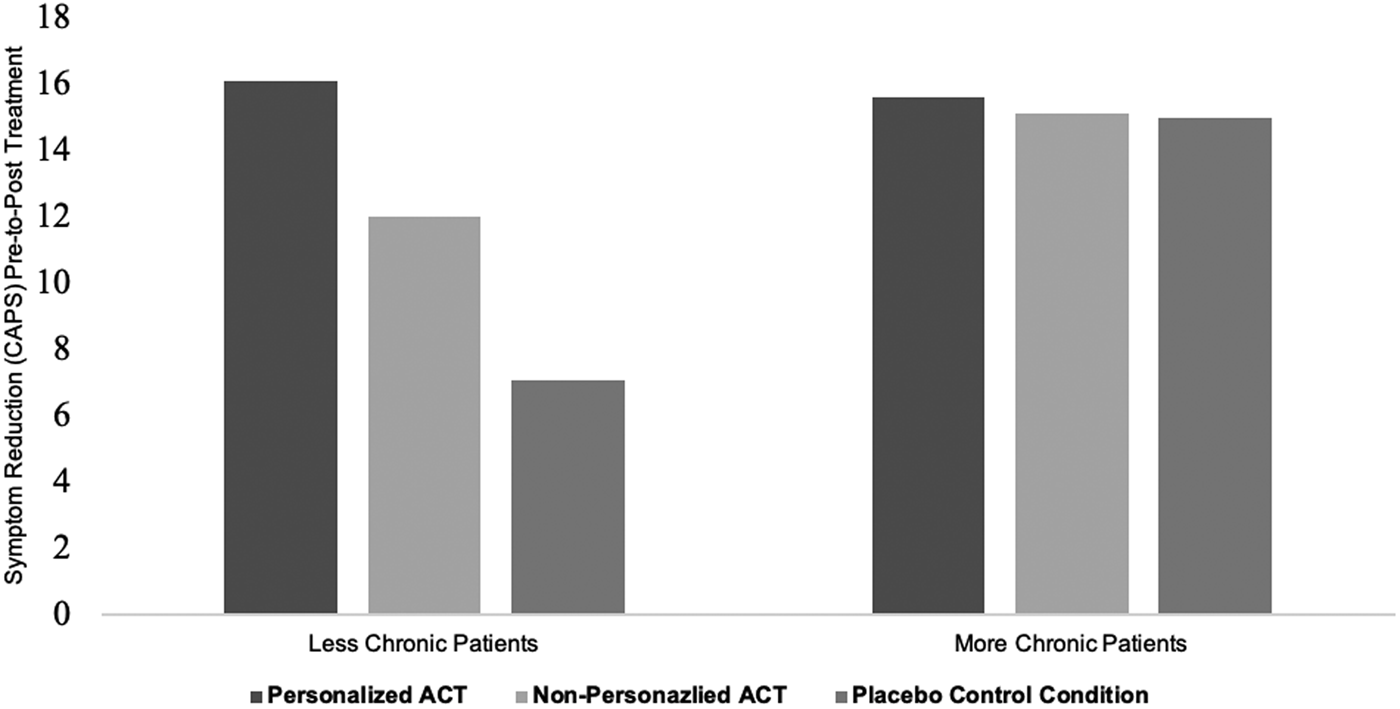
The hierarchical multiple regression on change in clinician-rated PTSD symptoms severity from pre- to post-treatment revealed that time since trauma was significantly associated with PTSD symptoms change, b = −0.4, s.e. = 0.19, β = 0.42, p < 0.04, and this effect was qualified by a significant group-by-time since trauma interaction, F (2,52) = 3.63, p < 0.03, R 2 change = 0.12. See Fig. 3 for an illustrative decomposition of this interaction effect based on a median split on the time since trauma variable. Personalized ACT was associated with greater symptoms reduction in patients who experienced the trauma more recently relative to the control condition, whereas the non-personalized ACT and the control condition did not differ.
Clinician-reported PTSD symptoms (CAPS) change from pre- to post-treatment, as a function of the interaction between time since trauma and group. CAPS-5, The Clinician-Administered PTSD Scale; ACT, attention control therapy.

Analyses of symptom change from post-treatment to follow-up revealed that neither time since trauma (b = −0.29, s.e. = 0.23, β = −0.37, p = 0.20) nor treatment conditions (personalized ACT v. control, b = −5.21, s.e. = 4.05, β = −0.20, p = 0.21; non-personalized ACT v. control, b = −2.27, s.e. = 4.06, β = −0.09, p = 0.58), nor the group-by-time since trauma interaction [F (2,49) = 2.47, p = 0.09, R 2 change = 0.09] predicted clinical change.
Self-reported changes in PTSD symptoms severity (PCL) from pre- to post-treatment and from post-treatment to follow-up were not affected by time since trauma (bs = −0.15 and 0.12, s.e.s = 0.25, βs = −0.18 and 0.15, ps = 0.53 and 0.63, respectively). The group-by-time since trauma interactions were not significant [Fs(2,52 and 49) = 1.10 and 0.66, ps = 0.34 and 0.52, R 2 changes = 0.04 and 0.02, respectively].
Baseline symptom severity
Analyses of clinician-rated PTSD symptoms change from pre- to post-treatment and from post-treatment to follow-up revealed no moderation effects for baseline clinician-rated PTSD symptoms severity, indicated by non-significant group-by-baseline CAPS scores interactions [Fs(2,52 and 49) = 0.55 and 1.38, ps = 0.58 and 0.26, R 2 changes = 0.02 and 0.05, respectively]. Similarly, no moderation effects were observed for baseline self-reported PTSD symptoms severity, indicated by non-significant group-by-baseline PCL scores interactions [Fs(2,52 and 49) = 1.54 and 1.29, ps = 0.22 and 0.28, R 2 changes = 0.05 and 0.05, respectively].
Cognitive factors
Analyses revealed non-significant moderation effects on clinician-rated and self-reported PTSD symptoms severity change from pre- to post-treatment for baseline ABV reflected by the non-significant group-by-ABV interaction [Fs(1,31) = 0.02 and 0.33, ps = 0.89 and 0.57, R 2 changes = 0.001 and 0.01, respectively]. Similarly, baseline emotional Stroop interference score did not moderate the clinician-rated and self-reported PTSD symptoms severity change from pre- to post-treatment [Fs(2,51) = 1.00 and 1.29, ps = 0.37 and 0.28, R 2 changes = 0.04 and 0.05, respectively].
Discussion
This three-arm RCT compared the efficacy of two versions of ACT for PTSD, one including personalized stimuli in training, one including generic stimuli in training, and a control condition. Results indicated similarly large improvements in PTSD, and significant improvements in depression, and clinical global severity at post-treatment in all three arms of the trial. Treatment effects maintained at a 3-month follow-up for all conditions. Neither personalized ACT nor generic ACT provided benefits for PTSD symptoms beyond the benefits of the control condition. ABV scores were significantly reduced in the ACT groups following treatment suggesting successful cognitive target engagement in these groups.
These findings converge with another, similarly-designed RCT of ABM in PTSD (Niles et al., Reference Niles, Woolley, Tripp, Pesquita, Vinogradov, Neylan and O'Donovan2020). The current results are also consistent with those of other mechanized attention training studies reporting that both active and control conditions had similar and significant treatment effects (e.g. Enock, Hofmann, & McNally, Reference Enock, Hofmann and McNally2014; Linetzky, Pettit, Silverman, Pine, & Bar-Haim, Reference Linetzky, Pettit, Silverman, Pine and Bar-Haim2020; McNally, Enock, Tsai, & Tousian, Reference McNally, Enock, Tsai and Tousian2013; Pergamin-Hight et al. Reference Pergamin-Hight, Pine, Fox and Bar-Haim2016). Together, these studies leave unanswered questions about the mechanisms underlying ACT/ABM efficacy.
One possible explanation for the current results is a strong expectancy/placebo effect generating similar reductions in symptoms in all treatment conditions. The applied computerized protocols offered the possibility of improvement without intense emotional involvement or repeated exposure to trauma triggers. This might have created a positive expectancy in our patients resulting in an equal reduction of symptoms across groups. Indeed, treatment dropout rates in the current study were lower than usual in this population (Imel et al., Reference Imel, Laska, Jakupcak and Simpson2013). However, an effect explained purely by expectancy is not consistent with the durability of symptoms change; approximately half of all patients no longer met PTSD diagnosis 3 months post-treatment, a remission rate that is at par with remission rates in first-line treatments for PTSD (Bradley et al., Reference Bradley, Greene, Russ, Dutra and Westen2005). In severely afflicted patients with potentially chronic conditions, long-term symptom improvement is generally inconsistent with the effects of expectancy.
Unlike previous RCTs showing higher efficacy of ACT relative to other active ABM conditions (Badura-Brack et al., Reference Badura-Brack, Naim, Ryan, Levy, Abend, Khanna and Bar-Haim2015; Lazarov et al., Reference Lazarov, Suarez-Jimenez, Abend, Naim, Shvil, Helpman and Neria2019), the current study applied a carefully designed ‘inactive’ control condition. The current control condition was specifically designed to neutralize both non-specific attentional competition effects and threat exposure effects, two factors that have been suggested as potential contributors to clinical outcomes (Linetzky et al., Reference Linetzky, Pergamin-Hight, Pine and Bar-Haim2015). However, observations of symptom reductions following this control condition raise questions on other potential active properties shared among the three conditions. To perform the three training tasks optimally, patients need to suppress irrelevant information (i.e. the words) and focus their attention on the task of discriminating probe type. In PTSD, the capacity to control attention and remain focused on goal-oriented behavior is diminished (Aupperle, Melrose, Stein, & Paulus, Reference Aupperle, Melrose, Stein and Paulus2012; Polak, Witteveen, Reitsma, & Olff, Reference Polak, Witteveen, Reitsma and Olff2012; White, Costanzo, Blair, & Roy, Reference White, Costanzo, Blair and Roy2015). It is conceivable that the three conditions of the current study equally train the capacity to monitor and direct attention to a relevant goal while ignoring conflicting information, described as attention control (e.g. Eysenck, Derakshan, Santos, & Calvo, Reference Eysenck, Derakshan, Santos and Calvo2007; Posner, Snyder, & Solso, Reference Posner, Snyder and Solso2004). The observed clinical effects may reflect the general enhancement of attention control capacity not necessarily in a threatening context (e.g. Basanovic, Notebaert, Grafton, Hirsch, & Clarke, Reference Basanovic, Notebaert, Grafton, Hirsch and Clarke2017; Chen, Clarke, Watson, MacLeod, & Guastella, Reference Chen, Clarke, Watson, MacLeod and Guastella2015; Lazarov et al., Reference Lazarov, Suarez-Jimenez, Abend, Naim, Shvil, Helpman and Neria2019; Linetzky et al., Reference Linetzky, Pergamin-Hight, Pine and Bar-Haim2015; Mogg, Waters, & Bradley, Reference Mogg, Waters and Bradley2017; Pergamin-Hight et al., Reference Pergamin-Hight, Pine, Fox and Bar-Haim2016). Such an explanation is in line with prior studies suggesting that improved executive attention abilities may produce clinical benefits (Bomyea & Amir, Reference Bomyea and Amir2011; Heeren et al., Reference Heeren, Mogoaşe, McNally, Schmitz and Philippot2015a; Linetzky et al., Reference Linetzky, Pettit, Silverman, Pine and Bar-Haim2020). For instance, a recent study in clinically anxious youth showed that improvement in attention control was noted following neutral as well as emotional attention training and that this improvement was associated with symptoms improvement (Linetzky et al., Reference Linetzky, Pettit, Silverman, Pine and Bar-Haim2020). Similarly, Bardeen et al. (Reference Bardeen, Tull, Daniel, Evenden and Stevens2016) found that attention control moderated the association between PTSD and ABV, with poor attention control and PTSD diagnosis associated with greater ABV. Such findings suggest that general attention control may play an important role in PTSD and therefore enhancing it may result in symptoms reduction. To further explore this possibility, future research may need to control for general attention control enhancement throughout the training, possibly by contrasting the current ‘inactive’ condition with an active waitlist condition as control.
ABV scores were high in our patient sample reflecting similar elevated values to those previously reported in other PTSD samples (Naim et al., Reference Naim, Abend, Wald, Eldar, Levi, Fruchter and Bar-Haim2015). This finding converges with the notion of attentional fluctuations between threat vigilance and threat avoidance in PTSD (Alon et al., Reference Alon, Naim, Pine, Bliese and Bar-Haim2019; Bardeen et al., Reference Bardeen, Tull, Daniel, Evenden and Stevens2016; Iacoviello et al., Reference Iacoviello, Wu, Abend, Murrough, Feder, Fruchter and Charney2014; Naim et al., Reference Naim, Abend, Wald, Eldar, Levi, Fruchter and Bar-Haim2015; Segal, Wald, Pine, Halpern, & Bar-Haim, Reference Segal, Wald, Pine, Halpern and Bar-Haim2020). The results also indicate a reduction in ABV following ACT, suggesting successful engagement of the pre-determined cognitive target (see Badura-Brack et al., Reference Badura-Brack, Naim, Ryan, Levy, Abend, Khanna and Bar-Haim2015). ABV was not evaluated in the control condition before or after treatment to avoid low-dose ACT effects. Hence, we cannot rule out the possibility that ABV may have reduced also in the control condition. To allow ABV measurement in control conditions, future research may consider including an alternate ABV measurements at baseline and post-treatment.
Although the current results do not indicate a specific effect of ACT on treatment outcomes in the overall sample, the exploratory moderation analyses reveal that time since trauma moderated pre- to post-treatment reduction in clinician-reported PTSD symptoms, with greater benefits from personalized ACT relative to the control condition the less time elapsed since the trauma. Given the exploratory nature of this analysis, only tentative conclusions are possible. However, findings could suggest that ACT, like other psychosocial treatments (Duffy et al., Reference Duffy, Gillespie and Clark2007; Ehlers et al., Reference Ehlers, Grey, Wild, Stott, Liness, Deale and Manley2013), has limited impact on chronic and entrenched PTSD. Moreover, this moderation also is consistent with treatment-related expectancy effects, which typically are greater in less established as opposed to chronic conditions. Cognitive theories (e.g. Ehlers & Clark, Reference Ehlers and Clark2000; Foa & Kozak, Reference Foa and Kozak1986) suggest that processing the traumatic information in maladaptive ways combined with avoidance lead to persistence and chronicity of the disorder. Such maladaptive processing could become more stable and resistant to modulation. This RCT is the first to examine the role of time since trauma as a moderator to clinical outcomes in cognitive bias modification treatments. Yet, this exploratory analysis is based on a relatively small sample size, and more studies are needed to replicate and validate these preliminary findings.
The results of the current study should also be viewed in light of several limitations. First, although the current sample size resembles previous RCTs of ABM/ACT in PTSD (Badura-Brack et al., Reference Badura-Brack, Naim, Ryan, Levy, Abend, Khanna and Bar-Haim2015; Lazarov et al., Reference Lazarov, Suarez-Jimenez, Abend, Naim, Shvil, Helpman and Neria2019), the current sample size is not large and might still lack the power to detect smaller therapeutic effects and the hypothesized moderation effects (Linetzky et al., Reference Linetzky, Pergamin-Hight, Pine and Bar-Haim2015). Larger samples would be needed to definitively evaluate the effectiveness of ACT for PTSD and the role of the moderating factors of treatment outcome highlighted in the current study. Second, and related to the previous limitation, due to the limited sample size, we were unable to examine the potential moderating effect of specific trauma types on treatment outcome. Although the current findings extend previous research that was mostly focused on males with combat-related traumas (Badura-Brack et al., Reference Badura-Brack, Naim, Ryan, Levy, Abend, Khanna and Bar-Haim2015; Schoorl et al., Reference Schoorl, Putman, Van Der Werff and Van Der Does2014), future studies comparing the efficacy of ACT for PTSD resulting from different types of traumas are warranted.
In conclusion, this RCT systemically examined the potential benefits of personalized ACT relative to a generic ACT in PTSD patients with diversified traumas. Considerable clinical effects were observed in all conditions suggesting that personalized threat content may not be a key factor in treatment outcome. Although ACT successfully targeted its cognitive mechanism (i.e. ABV reduction), it appears that other mechanisms of change such as expectancy and enhancement of general attention control may be at play. Future research could focus on understanding the underlying mechanism of therapeutic change in ACT through the design of highly specified control conditions. Finally, the moderating effect of time since trauma on treatment outcome points to the potential benefit of personalized ACT for less chronic patients. This lead could be followed more systematically in future research.
Supplementary material
The supplementary material for this article can be found at https://doi.org/10.1017/S0033291720004304
Financial support
This research was supported by the Israel Science Foundation, grant number 1811/17.
Conflict of interest
None.