Gratitude has been widely conceptualized as a moral virtue, an emotion, and an affective trait (McCullough, Emmons, & Tsang, Reference McCullough, Emmons and Tsang2002). Of these conceptualizations, gratitude as an affective trait, or dispositional gratitude, may be defined as “a generalized tendency to recognize and respond with gratefulness to the role of other people’s benevolence in the positive experiences and outcomes that one obtains” (p. 112) (McCullough et al., Reference McCullough, Emmons and Tsang2002).
The most widely used instrument to measure gratitude is the Gratitude Questionnaire (GQ) (McCullough et al., Reference McCullough, Emmons and Tsang2002). The GQ is a self-report questionnaire comprising six items designed to assess dispositional gratitude. The GQ has exhibited adequate internal consistency, reliability, and stability (McCullough et al., Reference McCullough, Emmons and Tsang2002). However, some studies have observed a problem with the factor structure of the GQ.
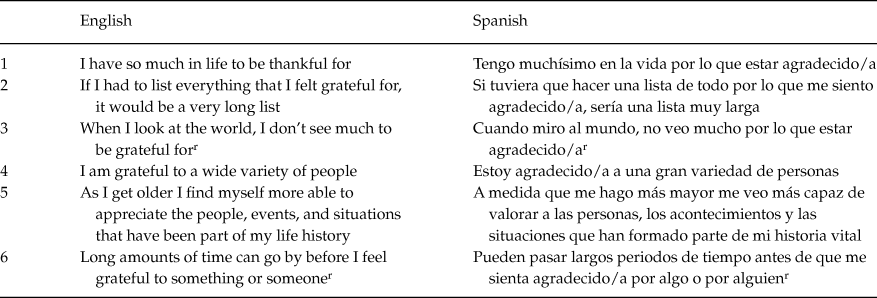
In terms of studies with younger populations (university students), one of the most significant adaptations was removing item six (see Table 1) which showed low correlations with the questionnaire as a whole (Bernabé-Valero, García-Alandete, & Gallego-Pérez, Reference Bernabé-Valero, García-Alandete and Gallego-Pérez2013). In the Chilean adaptation of the GQ a five-item version for the younger population and a six-item for older participants were found (Langer, Ulloa, Aguilar-Parra, Araya-Véliz, & Brito, Reference Langer, Ulloa, Aguilar-Parra, Araya-Véliz and Brito2016). Furthermore, in the Taiwan (Chen, Chen, Kee, & Tsai, Reference Chen, Chen, Kee and Tsai2009), Turkey (Yüksel & Oğuz, Reference Yüksel and Oğuz2012), and China (Zeng, Ling, Huebner, He, & Lei, Reference Zeng, Ling, Huebner, He and Lei2017) versions of the GQ a five-item model was found to have a better fit compared to the original six-item model. However, validations conducted in Poland (Kossakowska, & Kwiatek, Reference Kossakowska and Kwiatek2014), Hungary (Martos, Garay, & Désfalvi, Reference Martos, Garay and Désfalvi2014), Japan (Hatori, & Kodama, Reference Hatori and Kodama2014), Belgium (Jans-Beken, Lataster, Leontjevas, & Jacobs, Reference Jans-Beken, Lataster, Leontjevas and Jacobs2015), and Italy (Caputo, Reference Caputo2016) supported a six-item version of the GQ. For this reason, the main goal of this study was to contrast the six and five-item GQ models using data of two different Spanish samples from a cross-validation approach.
Items of the GQ: English and Spanish Versions

Note: r Reverse scored
Gratitude is a concept that has become widely recognized in recent years, as a result of the emergence of the Positive Psychology movement, which has a focus on the strengths of people, rather than on their problems. Several studies show that a positive relation between gratitude and well-being exists (for a review, see Wood, Froh, & Geraghty, Reference Wood, Froh and Geraghty2010). Furthermore, gratitude has been extolled as a beneficial influence on well-being across cultures (Watkins, Reference Watkins2014). Recent works carried out in Spain show the positive relationship between gratitude and well-being among university students (Salvador-Ferrer, Reference Salvador-Ferrer2017). Taken together, the reviewed studies not only suggest that gratitude plays a fundamental role in determining well-being, but also show that the GQ is a reliable and valid tool for measuring gratitude.
There are two approaches in the study of well-being, which can be named hedonism and eudaimonism. From the hedonic approach, well-being is labelled as subjective well-being (SWB). Hedonic researchers claim that SWB contains an affective, and a cognitive component. The affective component entails predominance of positive over negative affect (or affect balance), while the cognitive component refers to evaluation of the satisfaction with one’s life as a whole (Diener, Reference Diener2000). It has been found that gratitude is positively correlated to life satisfaction (Caputo, Reference Caputo2016). In addition, gratitude predicts a better affect balance, which means that people who feel gratitude report more positive affect and experience less negative affect (Jans-Beken et al., Reference Jans-Beken, Lataster, Leontjevas and Jacobs2015). From the eudaimonic approach, it is suggested that although people report being happy, it does not necessarily mean that they are psychologically well (Ryff, Reference Ryff1989). Thus, from this perspective a person is considered to be psychologically well when developing his/her true potential, or there is congruence between the proposed goals and his/her true self (or daimon). The well-being understood in this way is often labelled psychological well-being (PWB). Research indicates that gratitude is positively linked to SWB (Wood, Joseph, & Maltby, Reference Wood, Joseph and Maltby2008). Therefore, in order to analyze the convergent validity of the Spanish version of the GQ, associations between gratitude, SWB, and PWB were examined.
Previous studies conducted in Spain (Bernabé-Valero et al., Reference Bernabé-Valero, García-Alandete and Gallego-Pérez2013; Martínez-Martí, Avia, & Hérnandez-Lloreda, Reference Martínez-Martí, Avia and Hernández-Lloreda2010; Salvador-Ferrer, Reference Salvador-Ferrer2017) have used a translated version to Spanish of the GQ–6 (available at the “Authentic happiness” site from the Pennsylvania University webpage). Although Spanish is the official language of numerous countries worldwide, no Spanish-language adaptation of the GQ has been conducted so far. We believe that a Spanish version of this well-validated and widely used measure of dispositional gratitude would facilitate examining the cultural universality of the gratitude construct. Therefore, the purpose of this research was also to adapt the GQ to Spanish-speaking populations.
Method
Participants
Sample 1 (Calibration Sample). Participants consisted of 957 individuals (80.1% women) aged between 18 and 65 years (M = 37.14, SD = 9.93).
Sample 2 (Validation sample). Participants were 920 individuals (68.6% women) aged between 18 and 65 years (M = 32.21, SD = 10.82).
Participants from both samples were students at the Universidad Nacional de Educación a Distancia, UNED.
Recruitment procedure
Information on the study was posted on the virtual course taught by one of the researchers in order to request participation by students from the UNED that may be interested. The participants in both samples had to complete the questionnaires trough Qualtrics, an online survey environment. All of them voluntarily agreed to participate in the study.
Ethical concerns
Participants consented to participate in the study, and they were allowed to withdraw from the study whenever they wanted. The data were collected anonymously and results were reported in aggregate form only, and could not be identified individually. Upon completion of the survey, participants were debriefed online about the purposes of the study.
Adaptation procedure
The GQ has been adapted following the norms of the International Test Commission (Muñiz, Elosua, & Hambleton, Reference Muñiz, Elosua and Hambleton2013). The first Spanish translation of the original questionnaire was performed by a professional bilingual English translator (Gudmundsson, Reference Gudmundsson2009). This Spanish translation was independently reviewed by one of the authors of this research, who worked with the first translator to reach an agreed-upon translation of the items, especially those which posed the most difficulty from the semantic and/or grammatical standpoint. Afterwards, another bilingual English translator back-translated to English this agreed Spanish translation, with no knowledge of the original scale in English in order to preserve the reliability of the back-translation. Finally, this translation was discussed with experts in the field of Positive Psychology. Items can be seen in Table 1.
Instruments
Sample 1
To measure gratitude, the Spanish translation of the GQ (McCullough et al., Reference McCullough, Emmons and Tsang2002) was used. Participants indicated the extent to which they agreed with each item on a seven-point Likert scale that ranged from strongly disagree to strongly agree.
Sample 2
The Spanish translation of the GQ (McCullough et al., Reference McCullough, Emmons and Tsang2002) was used.
To measure the cognitive component of SWB, the Satisfaction with Life Scale (SWLS) (Pavot & Diener, Reference Pavot and Diener1993; Spanish version: Vázquez, Duque, & Hervás, Reference Vázquez, Duque and Hervás2013) was used. SWLS is a five-item measure with a good reliability in our sample (α = .88). A seven-point Likert scale that ranged from strongly disagree to strongly agree was used.
To measure the emotional component of SWB, the Positive and Negative Affect Schedule (PANAS) (Watson, Clark, & Tellegen, Reference Watson, Clark and Tellegen1988; Spanish version: Sandín et al., Reference Sandín, Chorot, Lostao, Joiner, Santed and Valiente1999) was used. PANAS is a 20-item instrument that evaluates positive (10 items) and negative affect (10 items). Respondents answered the items on a seven-point Likert scale that ranged from never to always. The negative affect score was subtracted from the positive affect score to obtain a measure of affect balance. Cronbach’s alpha coefficient in our sample was .88 for the positive affect subscale and .89 for the negative affect subscale.
To measure PWB, the Psychological Well-Being Scales (PWBS) (Ryff, Reference Ryff1989; Spanish version: Díaz et al., Reference Díaz, Rodríguez-Carvajal, Blanco, Moreno-Jiménez, Gallardo, Valle and van Dierendonck2006) were used. PWB is a 39-item self-report instrument which is based on six dimensions that point to different aspects of positive psychological functioning: Self-acceptance (6 items), positive relations with others (6 items), autonomy (8 items), environmental mastery (6 items), purpose in life (6 items), and personal growth (7 items). A seven-point Likert scale that ranged from strongly disagree to strongly agree was used. Alpha coefficients obtained for present study were: .85 for self-acceptance, .83 for positive relations with others, .76 for autonomy, .79 for environmental mastery, .70 for purpose in life, and .85 for personal growth.
Data analysis
Firstly, the five and six-item models of the GQ were tested using Confirmatory Factor Analysis (CFA) with maximum likelihood parameter estimates. Because chi-squared test (χ2) should not be used to assess the fit of a model (because this test is very sensitive to sample size), the evaluation was carried out with a combination of indexes. Root Mean Square Error of Approximation (RMSEA) was used as absolute fit index. Values below .05 indicate a close fit, from .05 to .08 a fair fit, from .08 to .10 a mediocre fit, and above .10 an unacceptable fit (Hu & Bentler, Reference Hu and Bentler1999). As incremental fit indexes, Normed Fit Index (NFI) and Comparative Fit Index (CFI) were used. Both CFI and NNFI are bound between 0 and 1 and values between .90 and .95 indicate an acceptable model fit, with values greater than .95 indicating a close model fit (Hu, & Bentler, Reference Hu and Bentler1999). Loose, moderate, and tight cross-validation tests were studied based on the progression of invariance constraints described by MacCallum, Rosnowski, Mar, & Reith (Reference MacCallum, Roznowski, Mar and Reith1994). To model comparison, χ2, CFI, and RMSEA between nested models were compared. However, because the change in χ2 is sensitive to large sample size, the major indicators for testing model invariance were the changes in CFI and RMSEA. Following the recommendations of Chen (Reference Chen2007), when sample size is adequate (n > 300) as in our case, values of ΔCFI and ΔRMSEA smaller than or equal to .01 indicated that the null hypothesis of measurement invariance should not be rejected.
Secondly, the reliability of the GQ was analyzed. For that purpose, the Cronbach’s alpha of the questionnaire was calculated. A reliability index ≥.70, .80, or .90 can be interpreted as acceptable, good, or excellent, respectively. In addition, as recommended by experts (Brown, Reference Brown2015), the Composite Reliability (CR) was also calculated.
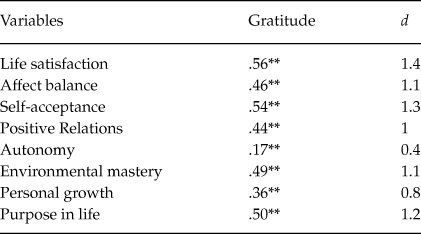
Thirdly, to analyze the convergent validity of the GQ, the relationship between gratitude and SWB (life satisfaction and affect balance) and PWB (self-acceptance, positive relations, autonomy, environmental mastery, personal growth, purpose in life), was studied using Pearson’s correlations. Cohen’s ds were also estimated to determine the effect size (Cohen, Reference Cohen1988). According to this author, ds around .20, .40, or .80 are usually considered small, moderate, or large, respectively.
The SPSS 24.0 and Amos 24.0 software packages were used to perform the analyses.
Results
Data were screened for normality and several multivariate outliers were detected. Specifically, Mahalanobis’ distance revealed 18 and 22 multivariate outliers in calibration and validation sample, respectively, and these were subsequently deleted.
The multivariate normality was evaluated by Mardia’s (Reference Mardia1970) multivariate kurtosis coefficient. According to Bollen (Reference Bollen1989), if Mardia’s coefficient is lower than P(P + 2), where P is the number of observed variables, then there is multivariate normality. Mardia’s coefficient was 17.44. As in this study, we used five observed variables, therefore, we can affirm that there was a multivariate normal distribution of the data, which allowed us to use the Maximum Likelihood estimation method in the CFA (Raykov & Marcoulides, Reference Raykov and Marcoulides2008).
Calibration sample analyses: Factor structure
An initial CFA on the six-item GQ was conducted. As it can be seen in Table 2, the results of this first-order CFA (6 item model) showed that the fit of the model was improvable. Therefore, item six was removed and a CFA without this item was conducted again (5 item Model A). The model fit did not improve substantially, because CFI had an acceptable value but RMSEA indicated a poor fit (CFI = .95, RMSEA = .14). Finally, a five-item model with errors of item four and five correlated (5 item Model B) was tested. Such correlated errors can occur due to specific item content (Gerbing & Anderson, Reference Gerbing and Anderson1984). Indexes of global fit indicated good fit: CFI = .99, NFI = .99, and RMSEA = .02. As it can be seen in Figure 1, all the parameters of the model were statistically significant (p < .05) and the standardized coefficients presented adequate values.
Fit Indexes for CFA on Calibration Sample Data

Note: CFI = Comparative Fit Index; NFI= Normed Fit Index; RMSEA = Root Mean Squared Error of Approximation.
First Order CFA. Standardized estimations of the model. The values of the arrows are the standardized regression coefficients (β).

Cross-validation sample analyses
A series of progressively more restrictive models were tested to assess the cross-validity of the final model from the calibration sample (see Table 3). Firstly, a loose cross-validation was performed (Model 1). In this baseline model, the equality of the number of factors and the pattern of factor matrices is forced. The next step was to fix the factor loadings (Model 2), and adding the factor covariance (Model 3), to analyze partial cross-validation. Tight cross-validation adds a constraint that error variance associated with each residual is equal between groups.
Fix Indexes for Cross-Validation and Invariance Analysis

Note: Model 1 = loose cross-validation: equivalent factor structure; Model 2 = partial cross-validation: fixed structure and item loadings; Model 3 = partial cross-validation: fixed structured, item loadings and factor covariances; Model 4 = tight cross-validation: fixed structured, item loadings, factor covariances and measurement residuals.
Considering the results of the four models separately, it can be seen that goodness of fit indexes are appropriate in all the models to be evaluated (NFI and CFI, above .90 and RMSEA below .08). These indexes are very similar in the first three models and slightly worse adjusted in Model 4.
Taking into account the comparison between models, there were significant differences in Δχ2, possibly because this index is very sensitive to sample size. Considering ΔCFI and ΔRMSEA between Models 1, 2 and 3, in none of the cases exceeds .01, so model fit did not deteriorate when invariance constraints were placed on either item loadings or factor variance-covariance.
The only case in which there were significant differences was in Model 4 (ΔCFI and ΔRMSEA above .01), which is the most rigorous support for cross-validity, establishing the combination of factor loading equivalence, factor variance-covariance equivalence, and error variance equivalence. This level of equivalence may not be realistic in its practical application (MacCallum et al., Reference MacCallum, Roznowski, Mar and Reith1994). Therefore, evidence of partial cross-validation is usually considered quite acceptable for a measure, provided that item loadings and factor variance-covariance can be constrained to equality between calibration and validation samples as in Model 3.
Reliability
Cronbach’s alpha of the five-item version of the GQ in Sample 1 was .79 and .78 in Sample 2. Estimates of the reliability of the questionnaire were slightly higher using the CR procedure instead of the alpha coefficient, as the alpha statistic underestimates reliability in ordinal data. Given that the minimum value considering suitable for composite reliability is .70, the value found (CR = .81) reflected an appropriate accuracy of this measure.
Furthermore, an estimation was also made of the average variance extracted (AVE), as the amount of variance that is captured by the construct in relation to the variance due to measurement error. AVE was appropriate (.48) which indicates that the latent factor is well explained by its observable variables.
Convergent validity
It was found that the five-item version of the GQ was positively related to life satisfaction, affect balance, self-acceptance, positive relations, autonomy, environmental mastery, personal growth, and purpose in life (see Table 4). Effect sizes may be considered large, except for autonomy which is just moderate.
Correlations

** p < .01
Discussion
Firstly, the GQ was successfully translated to Spanish. We believe that cross-cultural studies are important in demonstrating the generalizability of questionnaires to measure gratitude. Despite the problems of cross-cultural equivalence, the adaptation of a questionnaire to be used in another country than that in which it was originally developed allows the possibility to compare results from a distinct context (for a review, see Epstein, Santo, Guillemin, Reference Epstein, Santo and Guillemin2015).
Secondly, evidences of construct validity among a Spanish population were obtained. The results of the current study indicated that the one-factor with five items model of the GQ possessed a more satisfactory factor validity than the six-item model. The five-item solution was consistent with other GQ validations with university students from different countries (Chen et al., Reference Chen, Chen, Kee and Tsai2009; Langer et al., Reference Langer, Ulloa, Aguilar-Parra, Araya-Véliz and Brito2016; Yüksel & Oğuz, Reference Yüksel and Oğuz2012; Zeng et al., Reference Zeng, Ling, Huebner, He and Lei2017). In addition, a previous study conducted in Spain comparing the two models of the GQ by means of CFA showed that the 5-item approach was the most parsimonious (Bernabé-Valero et al., Reference Bernabé-Valero, García-Alandete and Gallego-Pérez2013). According to some authors, the fit of the five-item version of the GQ was also confirmed by the fact that participants had difficulties understanding the meaning of item six (Froh et al., Reference Froh, Fan, Emmons, Bono, Huebner and Watkins2011).
Thirdly, the five-item model demonstrated partial cross-validity based on an analysis of factorial invariance across calibration and validation samples (Bandalos & Finney, Reference Bandalos, Finney, Hancock and Mueller2010). We first tested three competing models with a calibration sample, and then cross-validated the best fitting model with an independent validation sample. This approach allows us to be sure that the best fitting model is not specific to a given sample (Jøreskog, Reference Jøreskog, Bollen and Scott Long1993).
Fourthly, the reliability of the GQ was appropriate given Cronbach’s alphas and CR found. In addition, the five-item GQ presented a similar reliability to those reported in other validation studies, with Cronbach’s alphas between .70 and .80 (Chen et al., Reference Chen, Chen, Kee and Tsai2009; Langer et al., Reference Langer, Ulloa, Aguilar-Parra, Araya-Véliz and Brito2016; Yüksel, & Oğuz, Reference Yüksel and Oğuz2012; Zeng et al., Reference Zeng, Ling, Huebner, He and Lei2017).
Finally, the GQ was correlated with several theoretically related constructs. Evidences of convergent validity were obtained by analyzing the relationship between the five-item version of the GQ and SWB and PWB. These correlations with measures of well-being provide further support for the validity of the Spanish GQ. Previous studies have found a relationship between gratitude and different forms of well-being (for a review, see Wood et al., Reference Wood, Froh and Geraghty2010). According to these authors, experiencing gratitude tends to foster positive feelings, which in turn, contribute to one’s overall sense of well-being.
It is important to stress that the GQ is not the only questionnaire to measure gratitude as a disposition. Other instruments are the Gratitude Resentment and Appreciation Test (GRAT) (Watkins, Woodward, Stone, & Kolts, Reference Watkins, Woodward, Stone and Kolts2003) and the multifactorial Appreciation Scale (Adler & Fagley, Reference Adler and Fagley2005). Regardless, we believe that the GQ presented in this study may be used with guarantees in Spain for measuring gratitude, as revealed throughout this article, although we shall advice professionals to be aware of the existence of other questionnaires.
As it has been previously stated, gratitude appears to be one component that contributes to an individual’s well-being. The relevance of this research is supported by evidence that suggests that gratitude can be enhanced and trained to promote PWB (for a meta-analysis, see Davis et al., Reference Davis, Choe, Meyers, Wade, Varjas, Gifford and Everett2016) and that it may serve as a psychological buffer to increase SWB (Lin & Yeh, Reference Lin and Yeh2014). In addition, it has been suggested that gratitude may be capitalized upon for beneficial outcomes in therapeutic settings (Emmons & Stern, Reference Emmons and Stern2013).
This study has at least three limitations. Firstly, samples were only composed of university students. However, students of an Open University like the UNED have an average age higher than other university samples. Consequently, our samples were closer to the general population than samples composed exclusively of young college students, so common in psychological research. Secondly, the ratio of women/men of our samples should be more similar to the one in the general population. Thirdly, it is an online study. Some researchers have expressed concern about Web-based studies, but following experts recommendations as we did these problems may be overcome (Reips & Birnbaum, Reference Reips, Birnbaum, Proctor and Vu2011). Despite these limitations, we believe that the Spanish version of the GQ may be an appropriate tool for measuring gratitude.
Gratitude is a sense of wonder, thankfulness, and appreciation for life that may be expressed giving thanks to benefactors for their help. The GQ is an instrument designed to assess individual differences in people’s disposition to experience gratitude in everyday life. According to our results, it is recommended the use, by the Spanish-speaking scientific community, of the five-item version of the GQ. However, it is suggested that future studies should add further cultures to increase the generalizability of the GQ (e.g., South America). Finally, more studies that investigate whether interventions focusing on gratitude may enhance well-being are recommended.