Nearly all behavioural and mental health issues for children have educational ramifications (Shaw, Glaser, & Ouimet, Reference Shaw, Glaser and Ouimet2011). Reports of interdisciplinary or interagency initiatives in the literature support the growing belief that collaboration between normally separate service providers in the health and education arenas can provide more comprehensive, appropriate, and ecologically valid support to children in need than independent agency work alone (Abbott, Jordan, & Murtaza, Reference Abbott, Jordan and Murtaza1995; Bunger et al., Reference Bunger, Collins-Camargo, McBeath, Emmeline, Perez-Jolles and Wells2014; Ervin, Reference Ervin2004; Finello, Reference Finello2011; Green, Rockhill, & Burrus, Reference Green, Rockhill and Burrus2008; Horwath & Morrison, Reference Horwath and Morrison2011; McPherson, MacNamara, & Hemsworth, Reference McPherson, MacNamara and Hemsworth1997; Sheridan et al., Reference Sheridan, Warnes, Woods, Blevins, Magee and Ellis2009; Walter & Petr, Reference Walter and Petr2000). Agreeably, certain conditions can exist that necessitate different agencies providing similar services, and could even serve as an ongoing rationale for maintenance of agencies with unique identities, despite service overlap; for instance, a large geographical area and/or large number of clients, the presence of distinct and/or multiple funding and planning bodies driving related agencies in different directions, and variation between agencies in their models for service delivery (Abbott et al., Reference Abbott, Jordan and Murtaza1995; Bradshaw, Reference Bradshaw1997; Germundsson, Hillborg, & Danermark, Reference Germundsson, Hillborg and Danermark2011; Walter & Petr, Reference Walter and Petr2000).
However, research repeatedly cites a number of themes as being both the impetus for and result of collaborative initiatives between agencies providing services to children and families. Successful interagency collaboration is credited with facilitating increased (effective and efficient) client access to resources, and reducing the impact of otherwise fragmented service delivery systems, which can cause clients to ‘fall between the cracks’ as they attempt to move from one agency to the next (Horwath & Morrison, Reference Horwath and Morrison2011; Leathard, Reference Leathard2003; Woodland & Hutton, Reference Woodland and Hutton2012). In a similar vein, overlap or replication between different agencies in their service definitions — resulting in wasted efforts and resources as agencies inadvertently provide the same services to the same clients — can be minimised or eliminated. For example, collaboration between agencies can result in reduced duplication of services to clients (Bradshaw, Reference Bradshaw1997; Leathard, Reference Leathard2003). Further benefits of interagency collaboration appearing in the literature can be summarised as follows (Grace, Coventry, & Batterham, Reference Grace, Coventry and Batterham2012; Horwath & Morrison, Reference Horwath and Morrison2011; Leathard, Reference Leathard2003; Nicholson, Artz, Armitage, & Fagan, Reference Nicholson, Artz, Armitage and Fagan2000; Polivka, Kennedy, & Chaudry, Reference Polivka, Kennedy and Chaudry1997):
• better decision making among those involved in service delivery;
• increased quality of case monitoring and support;
• improved and more timely provision of needed resources;
• more effective use of limited resources;
• reduction of competing or otherwise overwhelming agency demands on a family;
• ensuring a consistent message is presented;
• comprehensive and coordinated client care;
• increased efficiencies in the administration and delivery of services, including the co- development of new policy and practice;
• reduced anxiety for agency workers/practitioners.
As Green et al. (Reference Green, Rockhill and Burrus2008) state, too: ‘collaboration can also improve the overall effectiveness of services . . . by moving parents toward a greater state of ‘readiness to change’ through provision of ample emotional, psychological, and tangible support’ (p. 58).
Yet, while the value of and need for collaboration is firmly established in many disciplines, the actual practice of interagency collaboration in child special education and mental health settings remains ambiguous (Collin, Reference Collin2009). Of the several forms of interagency collaboration mentioned in the literature, most have been subject to variation in definition and blurring in distinction, often more reflective of simple cooperation, co-opetition (defined elsewhere by Bunger et al., Reference Bunger, Collins-Camargo, McBeath, Emmeline, Perez-Jolles and Wells2014), or even parallel or sequential efforts of participating agencies (Arredondo, Shealy, Neale, & Winfrey, Reference Arredondo, Shealy, Neale and Winfrey2004; Bradshaw, Reference Bradshaw1997; Bunger et al., Reference Bunger, Collins-Camargo, McBeath, Emmeline, Perez-Jolles and Wells2014). At a very basic level, the implications of this ambiguity are that well-meaning practitioners, eager to instigate an interagency collaborative offering in their services to children and their families, may accordingly be left without even a conceptual framework from which to anchor their efforts. Mattessich and Monsey (as cited in Townsend & Shelly, Reference Townsend and Shelley2008) provide a useful — though still somewhat amorphous — definition of interagency collaboration:
Collaboration is a mutually beneficial and well-defined relationship entered into by two or more organisations to achieve common goals. This relationship includes a commitment to mutual relationships and goals, a jointly developed structure and shared responsibility, mutual authority and accountability for success, and sharing of resources and rewards. (p. 102)
Certainly, concepts within definitions like this (e.g., mutually beneficial and well defined, and commitment) would benefit from being operationally defined in order to become amenable to robust or consistent application across interagency initiatives and, in turn, evaluation. For instance, various studies go so far as to caution that a collaborative initiative will only succeed if those involved are committed to the requirement, explicit or implicit, for collaboration (Bradshaw, Reference Bradshaw1997; Bunger et al., Reference Bunger, Collins-Camargo, McBeath, Emmeline, Perez-Jolles and Wells2014; Grace et al., Reference Grace, Coventry and Batterham2012; Nelson & Pearson, Reference Nelson and Pearson1991; Sheridan et al., Reference Sheridan, Warnes, Woods, Blevins, Magee and Ellis2009; Tonelson & Waters, Reference Tonelson, Waters and Billingsley1993; Walter & Petr, Reference Walter and Petr2000) — commitment being defined as the state or quality of being dedicated to or believing in a cause or activity (Stevenson & Waite, Reference Stevenson and Waite2011), or having what Bradshaw (Reference Bradshaw1997) describes as a group of ‘believers’. However, in the absence of clear markers to operationalise these ideals, objectively managing-for (and in turn measuring) this clearly desirable state is problematic. Collaboration theory, too, offers us another lens through which to examine the development of an interagency partnership, identify preconditions for collaboration, recognise predictable challenges, and evaluate progress (Leathard, Reference Leathard2003). For instance, studies examining the lifespan of collaborative initiatives have found that the process of establishing an interagency collaboration is developmental and incremental (McLaughlin & Covert, Reference McLaughlin and Covert1984; Sheridan et al., Reference Sheridan, Warnes, Woods, Blevins, Magee and Ellis2009; Woodland & Hutton, Reference Woodland and Hutton2012), though perhaps more akin to a spiral than a straight line (Bradshaw, Reference Bradshaw1997), as partners balance their long-term goals with flexibility to respond to and manage change. Throughout the life of a collaborative initiative, some members may more or less formally function as boundary spanners (Bradshaw, Reference Bradshaw1997) — participants who communicate frequently within and across agency boundaries, and participate in a range of activities that either support the collaborative team, protect their own agencies, or link the agencies together (see also Bunger et al., Reference Bunger, Collins-Camargo, McBeath, Emmeline, Perez-Jolles and Wells2014 and Nicholson et al., Reference Nicholson, Artz, Armitage and Fagan2000).
However, some literature suggests interagency collaborations may not be the panacea for service delivery and support to at-risk child populations that they are currently portrayed as, and that elements of organisation and administration, and even mismatch or misunderstanding of collaborative goals between participating agencies, may actually be detrimental to — or even unintentionally excluding of — those they are aiming serve (Hodges, Ferreira, Mowery, & Novicki, Reference Hodges, Ferreira, Mowery and Novicki2013; Leathard, Reference Leathard2003). For instance, Knight, Knight, and Teghe (Reference Knight, Knight and Teghe2007) highlight the apparent variation in how different community agencies define behavioural and emotional issues, and how each use these definitions to establish their own service eligibility criteria. They go on to caution that systemic failures in collaborative initiatives occur when information is misplaced, there is an absence of leadership and coordinated help, and children and their families are left in ‘assessment limbo’ (p. 52). It comes as no surprise then, that inquiries into interagency collaborations involving at-risk children in the United Kingdom and Australia (as cited by McPherson, MacNamara, & Hemsworth, Reference McPherson, MacNamara and Hemsworth1997) have found that poorly run collaborative efforts resulted in failures to communicate critical information to field-workers, and inappropriate and untimely risks to the children and families involved, despite intensive involvement in each case by a range of support agencies.
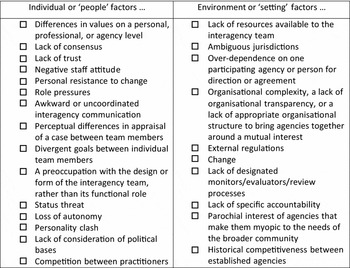
Clearly, however, promoting interagency collaboration is more complex than merely implementing templates for ‘what works’ (Bunger et al., Reference Bunger, Collins-Camargo, McBeath, Emmeline, Perez-Jolles and Wells2014). Sources of conflict, barriers, and potential problems associated with establishing and maintaining effective interagency collaborations appear as practical warnings throughout the literature (Arredondo et al., Reference Arredondo, Shealy, Neale and Winfrey2004; Bradshaw, Reference Bradshaw1997; Germundsson et al., Reference Germundsson, Hillborg and Danermark2011; Hodges et al., Reference Hodges, Ferreira, Mowery and Novicki2013; Horwath & Morrison, Reference Horwath and Morrison2011; Idol, Nevin, & Paolucci-Whitcomb, Reference Idol, Nevin and Paolucci-Whitcomb2000; Nicholson et al., Reference Nicholson, Artz, Armitage and Fagan2000; Shaw et al., Reference Shaw, Glaser and Ouimet2011; Tseng, Liu, & Wang, Reference Tseng, Liu and Wang2011), and are summarised in Figure 1.
Sources of conflict, barriers, and potential problems associated with establishing and maintaining effective interagency collaborations.

In an early article that has resounded in subsequent collaboration research, McLaughlin and Covert (Reference McLaughlin and Covert1984) stressed the critical role of some of the above human or people factors in the success or failure of an interagency collaboration, highlighting in particular — though from something of a deficit perspective — the contributions of role clarification, leadership, and a positive collaborative group atmosphere in the interagency formula. Others cite personality conflicts as the greatest risk to group cohesion and accomplishment of a collaborative mission (Nicholson et al., Reference Nicholson, Artz, Armitage and Fagan2000; Tseng et al., Reference Tseng, Liu and Wang2011). The practice of interagency collaboration in the context of child wellbeing almost always necessitates the confrontation of disparate assessment and intervention paradigms between practitioners (e.g., the ecological orientation favoured by school psychologists vs. the medical model orientation of their clinical psychologist counterparts), and the need to reconcile both ideological and practical differences to facilitate presentation of a unified service without functional compromise would seem critical. An article by Idol and Baran (Reference Idol and Baran1992) with illustrative relevance here spotlights role conflicts, differentiation of function among subgroups, and power struggles between school counsellors and special educators supporting the same children, families, and schools. Not surprisingly, communication between collaborative team members features as one of the most salient aspects in facilitating successful interagency service delivery (Arredondo et al., Reference Arredondo, Shealy, Neale and Winfrey2004; Bradshaw, Reference Bradshaw1997; Bunger et al., Reference Bunger, Collins-Camargo, McBeath, Emmeline, Perez-Jolles and Wells2014; Finello, Reference Finello2011). Echoing the significance of communication and interpersonal relationships in establishing and maintaining collaborations, Collin (Reference Collin2009) and others (Bunger et al., Reference Bunger, Collins-Camargo, McBeath, Emmeline, Perez-Jolles and Wells2014; Ervin, Reference Ervin2004; Finello, Reference Finello2011; Germundsson et al., Reference Germundsson, Hillborg and Danermark2011; Grace et al., Reference Grace, Coventry and Batterham2012; Green et al., Reference Green, Rockhill and Burrus2008; Horwath & Morrison, Reference Horwath and Morrison2011; Tseng et al., Reference Tseng, Liu and Wang2011) posit that successful collaboration involving two or more disciplines and/or agencies is hinged upon collaborators:
• addressing basic differences between members in terms of concepts, areas of assessment focus or questions, perspectives on those questions, methods, skills, language, and culture, and having mutual trust and respect;
• agreeing at the outset on the objectives of their project, negotiating its boundaries, and developing protocols and communication systems; and
• having extensive and effective communication at all stages of the project.
However, conflict itself in an interagency-collaboration context may simultaneously present us with a useable catalyst for change (Leathard, Reference Leathard2003; Woodland & Hutton, Reference Woodland and Hutton2012). For instance, discrepancies between existing and desired conditions can lead to modifications that will actually improve the collaborative effort (Idol et al., Reference Idol, Nevin and Paolucci-Whitcomb2000; McLaughlin & Covert, Reference McLaughlin and Covert1984).
Where to Now?
Collaboration between normally separate agencies continues to be promoted at both local agency and government level as the answer to providing intervention to children in need in a more ecologically valid manner. Yet, a clear-cut evidence base supporting interagency collaboration in practice — and operationally defining the ingredients for success — is still clearly hindered by continuing variation in how collaboration is defined, collaborative initiatives are established and run, and how the success of widely varying programs is interpreted or evaluated. Despite this variation, perceptions of interagency team relationships, commitment of members to interagency initiatives, and member perceptions of collaborative efforts continue to be invoked as useful qualitative indicators on the success of programs designed to support children. A limited selection of interagency evaluation tools has appeared in the literature that attempt to render descriptions of program success or otherwise by agency outcomes (e.g., those described elsewhere by Harbin et al., Reference Harbin, Pelosi, Kameny, McWilliam and Kitsul1993; Hall & Hord, Reference Hall and Hord2006; Harbin, Ringwalt, & Gaskill, Reference Harbin, Ringwalt and Gaskill1994), family outcomes (see for examples, Harbin & Neal, Reference Harbin and Neal2004; Hoffman, Reference Hoffman2006; Koren, DeChillo, & Friesen, Reference Koren, DeChillo and Friesen1992; Blue-Manning, Summers, Frankland, Nelson, & Beegle Reference Blue-Manning, Summers, Frankland, Nelson and Beegle2004; Harbin, Rous, & McClean, Reference Harbin, Rous and McClean2005), but, notably less often, child outcomes. However, with the practice of interagency collaboration gaining momentum, there is now a need to move beyond descriptive analyses of participating practitioner or family perceptions of operational success, or even somewhat teleological deficit-focused reasoning. Most likely, the litmus test of the success or suitability of any interagency initiative in this area must rest with methodologically robust interagency evaluations comparatively examining authentic child outcomes against the care received in collaborative versus non-collaborative service receipt conditions.