Existing applications of bargaining theory to the study of civil war suggest that rebel groups should pursue concessions commensurate to their size. Small groups, in particular, should be hesitant to make large demands of their governments. However, less-capable rebel groups often make outsized demands. From 2003 to 2004, for example, the Sudan People's Liberation Movement/Army (SPLM/A), the Sudan Liberation Movement/Army (SLM/A), and the Justice and Equality Movement (JEM) were all actively making claims against the government of Sudan. However, the number of demands the groups made did not seem to match their capability of extracting concessions, nor did they match the concessions eventually received. The SPLM/A, by far the largest group (estimated at 40,000 troops) made ninety-three demands and was able to extract about thirty moderately sized concessions from the al-Bashir government during this time.Footnote 1 JEM made seventy demands and received nine concessions while the SLMA made a total of 140 demands and received zero concessions. Both these groups were estimated to have about 6,000 troops. The same pattern is also evident outside Sudan. Throughout its conflict with the government of Uganda, the Lord's Resistance Army (LRA) was offered concessions on as many as one quarter of its demands while the Ugandan government yielded to no demands from smaller groups such as the Allied Democratic Forces (ADF) or the West Nile Bank Front (WNBF). In Algeria, the government offered numerous significant concessions to the 12,500-strong Islamic Salvation Army/Front (AIS/FIS) while offering the tiny Armed Islamic Group (GIA) none. In January 1995, however, the GIA still made a greater number of demands than the much stronger AIS.
What explains this pattern? Why do rebel groups sometimes make large demands that are inconsistent with their fighting capacity, especially when governments almost always reject such demands? Making large demands, even if ultimately rejected by the government, makes sense for rebels faced with a credibility dilemma—that is, when they may not be able to credibly threaten to continue fighting if the government rejects their demands. This problem is greatest for militarily weak rebel groups facing a government of uncertain strength, where the groups can credibly promise to fight on only when they believe the government is also likely to be weak. This results in a counterintuitive set of strategic incentives for weak rebel groups who choose their demands to ensure that the government will reject them even when it is weak, not just when it is strong. Only then can the rebels retain sufficient optimism about their military prospects to find it in their interest to continue the war. Therefore, to make their threat to fight credible, weak rebels must make large demands that, when rejected, result in inefficient fighting. Since most civil wars are characterized by weak rebels bargaining with a much stronger government,Footnote 2 it is important to understand how this particular feature of civil war shapes intrawar negotiations between rebels and the state. We seek to better understand bargaining between governments and rebels by concentrating attention on the demands rebels make from the government, analyzing a game-theoretic model of bargaining between governments and rebels. The implications of the model are evaluated with historical data on civil conflict in Africa from 1989 to 2010. The results suggest that the tendency for the government to be significantly stronger than the rebels shapes the nature of bargaining. In particular, it creates credibility problems for the rebels that can make it difficult to reach peace settlements, since it induces some rebel groups to make unrealistically large demands that are likely to be rejected.
We make several contributions to the scholarly literature on civil war and bargaining. First, the theoretical model highlights the rebels’ credibility dilemma and shows that factors such as fighting capacity and the expected costs of war can have different effects on rebels’ demands, depending on whether their credibility is at stake. When the rebels’ credibility is not at stake, their demands increase monotonically in their fighting capacity, as is typical in the majority of related models. However, when the rebels’ credibility is at stake, their fighting capacity has a nonmonotonic effect on their demands. When the weakest rebels make demands from the government, they make large demands, ensuring that sufficiently weak types of government reject, preserving their optimism about their chances of victory. As these weakest rebels grow stronger, they are freed to demand less from the government because the credibility of their threat to fight is no longer in question; they no longer need to believe that the government is very weak to credibly threaten to fight. Thus, we show that some common results from the standard approach to crisis bargaining, which assumes the credibility of threats, do not hold when credibility is an issue for uninformed players.
Second, we use new data on rebel demands to evaluate the expectations from the theoretical model. All past empirical tests of bargaining and civil war have focused exclusively on the outbreak and termination of civil conflict. These new data provide a unique opportunity to unpack the bargaining between rebels and the government that is a precursor to the termination of conflict and that has remained unobserved in previous research. Since the type of demands made by the rebels is an important empirical implication of bargaining models of civil war, the analysis in this study, to the best of our knowledge, provides the first empirical evaluation of this component of the bargaining model. Finally, two clear prescriptions for the rebels’ credibility dilemma are discussed. First, weak rebels can become so strong that their credibility is no longer at stake. Alternatively, rebels with a credibility dilemma can organize such that they suffer reputation costs from backing down if the government rejects their demands, allowing them to solve their credibility dilemma without making outsized demands of the government. Therefore, the peaceful settlement of civil war is difficult when rebels are weak and face little or no accountability for their bargaining behavior.
Rebels’ Demands
Although all models of bargaining between government and rebels recognize that rebels’ demands are endogenous and an important determinant of civil war outbreak and settlement, few studies examine the determinants of rebel demand size. Although a fair amount of research focuses on the conflict behavior of groups with specific types of demands—secession and self-determination in particular—studies do not address the way in which rebels come to choose their demands. Some work offers conjectures over the strategic nature of rebel demand size but does not systematically examine this logic. For example, some scholars suggest that rebels often demand more than they are actually willing to accept to gain more favorable settlements from their governments.Footnote 3 Yet this is true of belligerents in general, whether rebel or government, weak or strong. Even if all rebels demand more concessions than they will realistically settle for, it is not clear just how much farther demands will rise in the face of their search for credibility and why the weakest groups should be associated with some of the most extensive demands. Therefore, it is essential to study explicitly the strategic process by which they set their demands.
Some studies do consider how the strategic setting shapes rebel demands, but even these are limited. Jenne, for example, considers how nationalist groups choose the size of their demands and determines that demand size fluctuates with the groups’ perceived level of external support.Footnote 4 Groups are likely to radicalize their demands when they believe external supporters will intercede if their demands are rejected. If minority groups revise their beliefs about external support downward, they are likely to adjust their demands downward as well. Although this argument explains when nonstate groups make larger (or smaller) demands from the government, it only offers an explanation for groups with ethnic ties to states with the potential to intervene. Further, it follows the logic of linking the size of demands to groups’ expected values for civil war and does not explain why groups with no outside support and clearly low expected payoffs from fighting still make large demands.
In a similar vein, Buhaug argues that rebels’ demands are a function of their strength, where weaker groups demand less than groups that are stronger.Footnote 5 Assuming that the state is the prize, stronger groups will demand control over the state, while weaker groups will opt to fight for only a piece of the state, or separation. As rebel capability changes, so do their demands. Jenne, Saideman, and Lowe also examine how separatist minority group demands vary as a function of their capabilities, where large groups are expected to make larger demands relative to smaller groups because stronger groups have more leverage and can make more credible threats.Footnote 6 They employ indirect measures of minority group leverage, including concentration and external support, but do not provide results examining the effect of rebel group size on their demands once the decision has been made to rebel.Footnote 7
Hirshleifer posits that a paradox of power often exists such that both weak and strong groups are likely to pursue costly conflict.Footnote 8 In cases of severe power imbalances, the weaker side often has a comparative advantage because they have considerably less to lose by pursuing conflict to redistribute resources over cooperation. More capable groups are also expected to pursue conflict as they become better able to impose decisive settlements on opponents, yet there is no suggestion that demand size should follow this pattern. Butler and Gates also argue that a power paradox exists but suggest it can be in part explained by a group's demands.Footnote 9 Particularly, they argue that groups aiming to take over the state are likely to fight only when there is a significant chance they will prevail since their aims are completely incompatible with their opponent's, making negotiation highly unlikely. Thus, only strong groups or those not needing negotiation to accomplish their goals will fight for such an aim. Weak groups, on the other hand, are still able to fight when their aims are for secession because they do not need the government to yield power to achieve their aims. Thus, while we might observe both weaker and stronger groups fighting, weaker groups are still expected to make demands that are substantively smaller than their large counterparts.
We build on this existing work by examining the relationship between rebel capacity and demand size in light of an unexplored factor: the link between rebel capabilities, beliefs over government fighting capacity, and the credibility of the rebels’ threat to continue fighting if their demands are rejected. We use measures of rebel group capacity to proxy rebels’ expected costs of fighting, since more capable rebels face lower costs than less capable rebels. We differ from previous studies in several important ways. First, rather than looking at minority groups,Footnote 10 we examine groups that have already made the decision to rebel. We also do not confine our study to groups seeking forms of self-determination only; the groups in our sample can pursue a wide variety of aims ranging from military integration and power sharing to resource redistribution. Another important difference is our measure of rebel group demand size. Here we examine two measures of rebel demand size. First, we generate a measure of rebel demand size based on the substance of rebels’ claims. We code whether rebels make maximalist demands regarding changes in government or self-determination. Second, we examine the number of demands rebel groups make and demonstrate that it accurately depicts the concept we are interested in examining.Footnote 11 Most importantly, we demonstrate that the results are consistent across these two operationalizations.
The Model
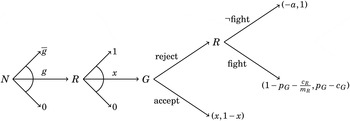
Suppose that a rebel group R and government G bargain over some benefits worth one to each side during an ongoing civil conflict.Footnote 12 Their attempt to divide the benefits can end in either continued civil war or a peace settlement, though if the government rejects the rebels’ demands, the rebels must choose to fight rather than back down if the civil war is to continue. The rebels are also uncertain over the government's fighting effectiveness; while they know their own military effectiveness, they do not know the government's, rendering them uncertain over which peace settlements the government will reject and, as a result, whether their threat to continue the fight in the face of rejected demands will be called in.
Figure 1 presents the sequence of play, where Nature begins the game by drawing the government G's military effectiveness (or type), g, from the uniform distribution
 $g{\rm \sim} {\rm U}(0,\overline g ]$
. Military effectiveness is the government's ability to use its material capabilities efficiently, such that G is ineffective when g is low (a “low type”) and effective with g is high (a “high type”). While the government is informed of this choice, the rebels are not, such that the rebels begin the game with prior beliefs informed only by the distribution from which g is drawn. Next, R proposes some division of the benefits, which G controls all of at the outset, such that it receives x and G receives 1 − x. The government then chooses whether to accept the proposal, implementing (x, 1 − x) and ending the war, or to reject it, forcing R to choose between a full-scale civil war or backing down after its failed proposal.
The game in extensive form

If R chooses to back down, it gains none of the benefits but pays an audience or reputation cost, a > 0, while the government retains the benefits, such that terminal payoffs are ( − a, 1). If, on the other hand, the rebels do not back down, they fight a costly full-scale civil war against the government. The outcome of the war, which transfers all the benefits to the victor, depends on each side's military capabilities (m G > 0, m R > 0) and marginal military effectiveness (g > 0, r > 0). As such, the government wins with probability
 $${\,p_G}({m_G},{m_R}) \equiv \alpha + g{m_G} - r{m_R},$$
where α ∈ (0, 1) is an underlying probability of victory modified by each side's capabilities and effectiveness, gm G and rm R ; and where r and g are bounded to ensure that p G (m G , m R ) ∈ (0, 1).Footnote 13 The rebels win with the complementary probability 1 − p G (m G , m R ).Footnote 14 While the government pays costs c G > 0 for fighting, we tie the rebels’ total costs of fighting to their military strength, such that they pay costs c R /m R , where c R > 0, such that the costs of war decrease in rebel military capabilities.Footnote 15 In other words, it is less costly for rebels with large military forces to continue fighting a full-scale civil war with the government than for rebels with fewer combatants. Therefore, the government's expected payoff for full-scale civil war is p G (m G , m R ) − c G , while the rebels’ is 1 − p G (m G , m R ) − c R /m R .
This setup captures each side's strategic problem in simple terms. The government, wishing to retain as much of the benefits it can at the lowest possible cost, weighs the credibility of the rebels’ threat to fight a full-scale civil war when considering the terms of their proposal. The rebels, on the other hand, can choose the size of their demands and (possibly) control which types of G accept and which types reject. This, in turn, may affect the rebels’ beliefs over G's type, which influences their expected value for full-scale civil war—and thus the credibility of their threat to continue the fight—at the final node.
Our model is similar to extant treatments of crisis bargaining under asymmetric information, though it differs in one notable way from similar work concerned with the credibility of threats. While other models begin with an informed side sending a signal to observe the target's response before fighting or backing down,Footnote 16 we render the first mover uncertain over the responder's type, placing the informed party in the middle of the sequence. This allows for the introduction of screening dynamics similar to that found in models of endogenous war termination,Footnote 17 and since the source of uncertainty affects both sides’ war payoffs (that is, since types are correlated),Footnote 18 the uninformed side exhibits some unique incentives in choosing just how many informed types it wishes to screen out with its proposal. In fact, endogenizing the credibility of threats to demands and subsequent beliefs reverses some of the more fundamental relationships found in standard treatments of bargaining in the shadow of war. Specifically, where players would like to screen their opponents by military strength in other models, even if potential ratchet effects prevent them from being able to do so,Footnote 19 we show that the uninformed side may wish to screen out as few opponent types as possible.
Analysis
We look for a Perfect Bayesian Equilibrium (PBE), which stipulates that all strategies are sequentially rational and consistent with beliefs that are updated according to Bayes’s rule wherever possible. Thus, a PBE of the game must include (1) a rule defining which proposals G accepts and which it rejects, (2) R's equilibrium proposal x* and its choice over fighting or backing down, and (3) R's posterior beliefs following G's response to its proposal. After characterizing equilibrium strategies and the conditions that support them, we discuss the equilibrium informally, then conduct comparative statics analysis to assess how two exogenous parameters—the rebels’ military strength and their costs for backing down—affect two quantities of interest: the demands they make in equilibrium and the probability that the civil war continues.
Proposition 1
The following strategies and beliefs constitute a PBE. When capabilities are very small (
 ${m_R} \le {\underline m _R}$
), R makes no demands (
x* = 0); for middling capabilities (
 ${\underline m _R} \lt {m_R} \le {\overline m _R}$
), R demands just enough to sustain a credible threat to fight (
x* = x
c
); and when sufficiently capable (
 ${m_R} \gt {\overline m _R}$
), R proposes its risk optimum (
x* = x
r
) for which its threat to fight is automatically credible. R always fights. G accepts iff g ≤ g*. R believes
 $g{\rm \sim} {\rm U}({g^ *}, \overline g ]$
after rejection and g ~ U(0, g*] after acceptance.
Footnote
20
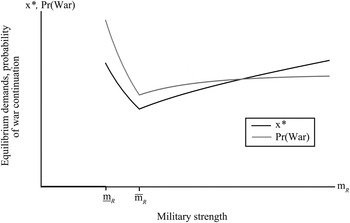
Proposition 1 characterizes a PBE in which R makes no demands (x* = 0) when its capabilities are too low, but any x > 0 separates types of G by those that reject (g > g*) and those that accept (g ≤ g*). This allows R to revise its beliefs by observing G's behavior, believing after a rejection that only those types with sufficient military effectiveness, g > g*, will have rejected its proposal.Footnote 21 Notably, since R can set demands that determine which types of G reject, it can gain valuable information for its subsequent choice over fighting and backing down; as its demands increase, ever lower types of G reject. Even as the probability of rejection increases, this has the second-order effect of raising R's expected value for war and increasing the credibility of its threat to fight. In equilibrium, R always chooses a demand for which it will refuse to back down in the event of rejection, making credible its threat to fight by increasing the range of government types that reject. However, at times it must raise its demands to an extreme level, ensuring that at least some types that it would be willing to fight remain in the game when the time comes to carry out its threat. Figure 2 plots R's demands as a function of is military capabilities, showing that it tends to demand the most when it is moderately weak, as opposed to when it is strong as in conventional models of bargaining and war.
Equilibrium demands and the probability of war continuation by R's military strength

To see how R's demands affect its willingness to fight at the final node, begin with the government's response rule, which stipulates that it reject an arbitrary proposal x when
 $${\,p_G}({m_G},{m_R}) - {c_G} \gt 1 - x \Leftrightarrow g \gt \displaystyle{{1 - x - \alpha + {c_G} + r{m_R}} \over {{m_G}}} \equiv {g^ {^\ast}}, $$
or when G is sufficiently strong that it can secure more by fighting than accepting—that is, when R's demands are too extensive. Since g* is the type of G that is indifferent between acceptance and rejection, R can then update its beliefs over the government's type after a rejection, narrowing its estimate to include only those types
 $g \in ({g^ *}, \overline g ]$
. Inequality (1) also shows that the range of government types rejecting the proposal grows as R's demands (x) grow larger. In other words, the more aggressive R's demands, the more willing are low types of G to reject its proposals, and the more optimistic R is about its chances in a continued war. If, on the other hand, R were to have demanded less, only higher, more militarily capable types of G would have rejected, making R relatively pessimistic about its chances of victory when faced with the choice of fighting on or backing down; fighting is more attractive the more, and lower, types of G reject R's proposal.
If R's demands affect its subsequent beliefs over G's type, how does this affect the credibility of its threat to fight? R will fight rather than back down at the final node as long as it is sufficiently optimistic over its chances of winning, and its optimism is tied directly to the range of government types it believes will have rejected its offer. Specifically, R continues the war following a rejection rather than back down when
 $$\int_{{g^ {^\ast}}} ^{\overline g} \left( {1 - {\,p_G}({m_G},{m_R})} \right)\left( {\displaystyle{1 \over {\overline g - {g^ {^\ast}}}}} \right){\kern 1pt} {\rm d}g - \left( {\displaystyle{{{c_R}} \over {{m_R}}}} \right) \gt - a,$$
and since the lower bound on its beliefs over G's military effectiveness decreases in x, there exists a range of possible demands,
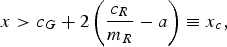 $$x \gt {c_G} + 2\left( {\displaystyle{{{c_R}} \over {{m_R}}} - a} \right) \equiv {x_c},$$
for which it is optimistic enough to fight on rather than back down. Any positive demand x > 0 that R makes in equilibrium must satisfy this constraint if it is to avoid backing down. Notably, these minimum demands decrease in R's military capabilities, where in most similar models such minimum demands tend to increase in the uninformed player's strength.Footnote 22
Weak rebels are thus in a difficult situation. They must make large demands from the government to ensure their credibility, yet at the same time these large demands are likelier to be rejected by the government than more moderate demands. To see why, compare a situation in which R proposes x c , ensuring that its threat to fight is credible, and one in which it proposes some x′ < x c , for which it will back down in the face of rejection. In the first case, with a credible threat to fight, R's expected utility is a weighted average of x c and 1 − p(m G , m R ) − c R /m R , while making the smaller demand in the second case would lead all types of G to reject, since 1 > 1 − x′. Therefore, the costs of backing down encourage R to make strong demands to avoid them, because a stronger initial bargaining position ensures that some types against which R expects to do well if it continues the war will be present when the time comes to make good on its threat.
However strong R's incentive to make large demands, which ensures a better deal if G accepts, it must also weigh them against the risk of continuing to fight a costly war. Balancing these risks and rewards produces an optimal proposal that we call the risk optimum,
 $$x = 1 - \alpha - r{m_R} - \displaystyle{{{c_R}} \over {{m_R}}} \equiv {x_r}$$
in which R tolerates a positive risk of continued war, provided that its threat to fight is credible. As is common in similar models of bargaining under asymmetric information,Footnote
23
the risk optimum implies more aggressive demands as R grows more powerful. However, and critically for R's demand behavior, for low levels of military capabilities (
 ${m_R} \le {\overline m _R}$
), its risk optimum is not aggressive enough to ensure that its threat to continue the war remains credible. In these circumstances, that is, when x
r
< x
c
, R must raise its demands above its risk optimum, proposing x* = x
c
to ensure that it can credibly threaten not to back down in the face of rejection; otherwise, the relatively moderate risk optimum, x
r
, would leave only high types of G in the game that R is unwilling to fight after rejection.
As Proposition 1 states, this implies that R's equilibrium proposal, if it makes one at all, is the higher of the two proposals derived earlier, or x* = max{x c , x r }. When x r ≥ x c , then its optimal demand supports a credible threat of war, and we say that R has no credibility problem; but when x c > x r , it must raise its demands above the risk optimum, and we say that R has an underlying credibility problem. Figure 2 shows that the credibility dilemma emerges when the rebels are sufficiently weak and have a greater temptation to back down in the face of rejection, which proves that the government is stronger than believed. This generates a U-shaped relationship between rebel strength and the demands made of the government. As indicated by the positive slope of x r where R can safely propose the demand that optimally solves the risk-return trade-off, demands in the absence of credibility problems increase in capabilities, albeit at a diminishing rate. This is standard in models where threats to fight following rejection are assumed credible. However, where the rebels are weaker, they cannot credibly commit to continue the war unless they make demands so aggressive they ensure that weaker types of G will reject and remain in the game. Thus, they raise their demands ever higher above the risk optimum as their capabilities diminish, falling below levels sufficient to maintain credibility at the risk optimum. As R grows more powerful and credibility problems diminish, it moderates its demands, eventually reflecting the risk-return optimum proposed when there is no credibility problem, before increasing confidence again causes demands to rise as capabilities increase further.
Proposition 2
Rebel demands decrease through low levels of military capabilities and increase through high levels of military capabilities.
Figure 2 also plots the equilibrium probability that the civil war continues (the gray line), which is simply the probability that G is of a type that rejects R's equilibrium proposal, or
 $\Pr (g \gt {g^ *} \vert {x^ *} )$
. Once again, the presence or absence of credibility problems determines the effect of rebel capabilities on the probability of war continuation; when military capabilities are low and credibility problems exist, the probability of further fighting is high and decreases in m
R
. Once capabilities are sufficiently large that credibility problems disappear, the probability of further fighting increases as the rebels grow more powerful. This produces a similar U-shaped relationship between m
R
and the probability of full-scale war, which peaks at low values of rebel capabilities and declines as the rebels become credible before increasing again for highly capable rebels.
Proposition 3
The probability that the war continues decreases through low levels of rebel military capabilities and increases through high levels of rebel military capabilities.
Finally, our model also allows us to consider the effects of rebel accountability, or the costs of backing down from their demands, on the rebels’ credibility problem and, as a result, the probability of further fighting. Proposition 4 re-expresses the conditions defining the rebels’ credibility problem in terms of a, or their costs for backing down. When backing down is relatively cheap, then temptations to retreat in the face of rejection are greatest, necessitating aggressive demands that screen out very few government types; on the other hand, when backing down is expensive, then R can safely propose the risk optimum and run a lower risk of war.
Proposition 4
When
 $a \lt \hat a$
, the rebels must demand x* = x
c
to preserve credibility but they propose x* = x
r
when
 $a \ge \hat a$
. Therefore, the probability that the civil war continues decreases in the rebels’ costs of backing down.
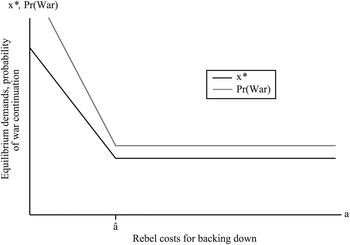
As before, R's choice of demand also shapes the probability of further fighting, presented in Figure 3. When
 $a \ge \hat a$
such that there is no credibility problem, there is no relationship between the costs of backing down and the chances that the war continues, because R's risk optimum x
r
does not depend on a; it is solely a function of the costs of fighting, military capabilities, and effectiveness, and its beliefs over G's type. However, when
 $a \lt \hat a$
and R must raise its demands above the risk optimum, the probability that the war continues is highest when a is lowest, falling as it approaches
 $\hat a$
before bottoming out when the costs of backing down are so high that the rebels need not manipulate their demands to enhance the credibility of their threats. Therefore, the greater the costs rebels expect to pay for backing down from threats of continuing the war, the more moderate their demands and, as a result, the less likely the war is to continue.
Equilibrium demands and the probability of war continuation by R's costs for backing down

These results suggest that there are two paths out of the credibility dilemma for the rebels. The first and most obvious solution to the rebels’ credibility problem is for the rebels to become more powerful, enhancing the credibility of their threat to fight on and eliminating the need for outsized demands. These credible rebels will be much more likely to get what they want from the government and the government will be much more likely to agree to their terms at the bargaining table. However, it is possible for relatively weak rebels to become credible if they can appear accountable for backing down from their demands of the government. In addition to becoming more powerful, the rebels can maintain their credibility if the government knows that it is very costly for the rebels to back down. This is the well-known audience costs effect discussed in the international politics literatureFootnote 24 playing out in civil war, and it suggests that it is in the interests of rebel groups to appear cohesive and have leaders that are held accountable.
Before assessing the model's empirical implications, it is worth pointing out how these results relate to the literature on bargaining in the shadow of conflict more generally. As noted earlier, most such work assumes that threats to fight are exogenously credible or incredible,Footnote 25 which produces some standard comparative statics common to a broad family of models,Footnote 26 chief among them that demands tend to increase in a player's military capabilities.Footnote 27 This relationship depends, in part, on whether players can alter the credibility of their own threats with their choice of demands. If the credibility of threats is fixed, then players with credibility problems will not make more aggressive offers than those without such problems; in many cases, they refuse to make demands at all, as those players do in the left-hand side of Figure 2.
However, when credibility of one side's threat to fight is a function of its own beliefs, then players can enhance the credibility of threats by making demands such that weak types of governments remain in the game. Rather than attempt to “screen out” those types with which they would like to settle by making a relatively enticing offer,Footnote 28 ensuring that weak types accept and the strong reject, players with a credibility dilemma choose not to screen out weak types but to keep them in the game. Otherwise, a more generous offer would ensure that only strong types reject, undermining the rebels’ subsequent threat to fight and, finally, unraveling any equilibrium in which they have some chance of securing a favorable deal. In a similar model where the government is uncertain over the rebels’ military strength, Fearon shows that rebel fears of revealing weakness can lead to periods of nonserious bargaining and screening-through-fighting,Footnote 29 but we show that rebels can make large demands not out of a fear of what they might reveal by taking a particular negotiating position but by what they might learn.
Thus, the typical link between high war payoffs and increasing incentives to risk war in screening opponents exists only when the uninformed player is sufficiently strong. When it is weaker, then demands may not fall. In fact, when raising demands can keep weak types in the game and preserve the credibility of threats, the incentive to screen out weak government types disappears, and demands can also increase as military capabilities fall. Incentives to discriminate types are common in many models of bargaining and war, especially those with endogenous war termination,Footnote 30 but we show here that a pervasive problem—the difficulty of making credible threats in light of asymmetric information—may play a heretofore unappreciated role in determining bargaining positions and the probability of war.
Empirical Strategy
We focus on two hypotheses that follow directly from the theoretical model. First, rebels are expected to make demands only when their prior belief about their value for fighting is sufficiently favorable; otherwise, as shown in Figure 2, their proposal reflects the status quo (at which x = 0). Therefore, we expect that the probability of making any demand will be increasing in the rebels’ fighting capacity, which is directly related to their initial optimism about their military prospects in a continued war.
H1
Stronger rebel groups are more likely to make demands from the government than are weaker rebel groups.
Given that a rebel group decides to make a demand of the government, we expect the size of that demand to be influenced, in part, by the rebels’ concern about their own credibility. Specifically, when rebels are weak enough that their credibility is at stake, they should be expected to make large demands to guarantee their threat to fight remains credible in the event that their demands are rejected. Although maintaining their credibility remains a concern, as rebels grow in military capacity they are able to make smaller demands and still remain credible if their demands are rejected. Based on this logic, we expect rebels’ demands to decrease with increasing fighting capacity when their credibility is at stake. That is, demands will begin high but decrease through low levels of military capacity. However, when military capacity is higher and the rebels are sufficiently strong so that their credibility is not a concern, increasing fighting capacity will result in more demands by the rebels.
H2
A marginal increase in rebel fighting capacity will decrease demands at low values of fighting capacity and increase demands at higher values of fighting capacity.
Sample
To test the predictions of the theoretical model, we utilize an original data set on rebel group demands issued during African civil conflicts from 1989 to 2010. Since coding data on rebel demands is both time and resource intensive, we restrict our sample to include only African rebel groups listed in the Uppsala Conflict Data Program (UCDP) Dyadic Armed Conflict Dataset (ACD). Although a global sample of conflicts would be preferable to a study of one region, we nonetheless believe our sample is appropriate for several reasons. First, during the period of study, Africa experienced the greatest number of civil conflicts by far.Footnote 31 Although the incidence of civil war decreased substantially across all other regions after the Cold War, Africa was the only region that experienced an increase in domestic conflict.Footnote 32 Because civil wars have been most common in Africa over the past several decades, focusing on conflict in the region has value.
Scholars also find that wars in the region have been some of the bloodiest contemporary conflicts and are notoriously difficult to settle decisively.Footnote 33 Particularly germane to our research is that other scholars have linked the demand-making process to the protracted nature of African conflicts. Rothchild argues that, in the African context, “nonnegotiable” or maximalist demands have elicited belligerent reactions from states and have given rise to perceptions of zero-sum bargaining, which has led to some of the most devastating conflicts.Footnote 34 Conflicts over demands like the removal of a regime or group from power tend to be perceived as fights for survival and are less likely to be accommodated. As a result, such demands have led to many bloody and protracted conflicts in Africa such as those in Burundi, Rwanda, South Africa, Ethiopia, and Algeria.Footnote 35
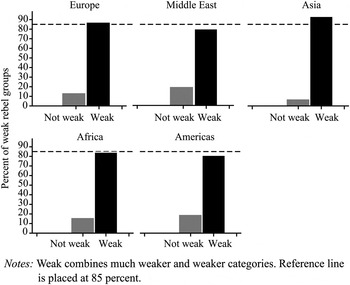
Although we argue that Africa is an important region to focus on and we restrict our tests to a sample of African civil conflicts, there is still reason to believe that the credibility dilemma rebels face is common among non-African organizations as well. From Figure 4, it is clear that Africa is not an outlier in terms of its proportion of weak rebels. In fact, Africa appears to be in the middle because Europe and Asia have only a slightly larger proportion of weak rebels and the Middle East and Americas have only a slightly smaller proportion of weak rebel groups.Footnote 36
Global distribution of weak rebels

Coding Rebel Demand Size
We evaluate how rebel fighting capacity affects the size of the demands made of governments. Here, a demand is coded when a rebel group mandates their government make a concession on an issue in exchange for peace.Footnote 37 We employ a dyad-month unit of analysis; an observation is included for each month a rebel group and their government are actively engaged in fighting as defined by the ACD.Footnote 38
After identifying 106 African rebel-government dyads, we coded each concession a group publicly demanded from their government for each month. These demands were coded utilizing news articles from Lexis-Nexis, information from Jane's Terrorism and Security Monitor, Keesing's Archive of Contemporary Events, rebel political statements, as well as from historical accounts of civil wars. In total, rebels in the sample made 3,291 demands. These data capture a range of demands including those for self-determination, military integration, and power sharing, as well as calls for the opening of peace processes through negotiation, withdrawal of foreign troops, and increased property rights. Rebels in the sample have also demanded that governments honor election results, offer cultural autonomy, respect religious rights, and redistribute state wealth and resources. We use these disparate demands to generate our main dependent variables.
To capture “demand size,” we measure the scope of rebel's claims in two ways. Our first response variable records whether rebels make substantively large demands. Particularly, we capture whether rebels make maximalist demands regarding changes in the government or self-determination. maximalist government demands are coded when rebels issue demands for the resignation of the head of state, or dissolution of or control over the entire state. For example, demands made between 1993 and 2007 by the National Council for Recovery (CNR), Movement for Democracy and Justice in Chad (MDJT), United Front for Democratic Change in Chad (FUCD), Rally of Democratic Forces (RAFD), and Union of Forces for Democracy and Development (UFDD) rebel groups for the ouster of Chadian President Idriss Deby are all coded as maximalist demands. Similar demands have been made by groups in Cote d'Iviore, Somalia, Democratic Republic of Congo, and Eritrea. Beyond demanding the removal of the head of state, groups also demand the ouster of an entire government. Examples of such demands are the Revolutionary United Front's (RUF) demand for removal of the All People's Congress (APC) in Sierra Leone and the National Democratic Alliance's (NDA) demand for removal of the National Islamic Front (NIF) in Sudan. In these data, 47 different rebel groups made 162 maximalist demands for changes in the government.
We also identify maximalist demands for self-determination, labeled maximalist self-determination, which occur when rebels issue calls for independence or secession from the state, for example, as opposed to lesser demands for autonomy or more general calls for self-determination. This type of demand was issued by the Angolan organizations, Front for the Liberation of the Enclave of Cabinda-Armed Forces of Cabinda (FLEC-FAC) and Front for the Liberation of the Enclave of Cabinda-Renewed (FLEC-R), which both demanded to become a protectorate of Portugal; the Djiboutian Front for the Restoration of Unity and Democracy (FRUD) rebels, who demanded the creation of an Afar state; and the OLF in Ethiopia, which demanded an Oromo state. Nineteen different rebel organizations made 107 maximalist demands for independence or secession in this sample.
Our main response variable aggregates these two types of maximalist demands. maximalist demands, a dichotomous variable, is coded “1” when rebels issue any demand regarding radical changes in the government or independence in a given month, and “0” when rebels make at least one other nonmaximalist demand. Although this variable codes only very large demands for changes in the government or secession, there is significant reason to believe that these two categories represent the types of large demands most rebels make. First, existing scholarship argues that demands for complete control over the state should be considered “larger” than all other types of demands, even those for self-determination.Footnote 39 Second, scholars argue that demands for territorial autonomy and those for changes in political power constitute the most common types of rebel demands.Footnote 40 Finally, among the demands issued by groups in this sample, demands for changes in the government or self-determination account for nearly 40 percent of all demands and more than half of the political demands issued.
To account for the full range of demands made by rebels, we code a second dependent variable measuring the number of demands issued by rebels each month.Footnote 41 We include this alternative measurement of our dependent variable because we acknowledge that it can be difficult to conceptualize and measure with accuracy the size of a demand.Footnote 42 Although it may be relatively straightforward to record what concessions a group demands, weighing how big or small those demands are is not as simple. For instance, by categorizing large demands as only maximalist demands for independence or state control, we are unable to gain an accurate assessment of how significant early demands for a united, inclusive “New Sudan” ensuring religious freedoms for all Sudanese people were to the SPLM/A and moreover, how controversial those demands were to the Sudanese government. Although we believe that examining maximalist demands is generally an accurate way to measure whether rebels issue outsized demands, we understand it may not suit every case. Counting rebel demands, however, may also allow us to assess the aggressiveness of a rebel organization's overall bargaining position, and to do so without relying on subjective judgments about which claims constitute large demands.
The major consequence of large rebel demands is the effect they have on bargaining. In particular, large demands are expected to impede bargaining processes and make compromise unlikely.Footnote 43 Although this should certainly be true of “total” or maximalist demands, large numbers of demands should provoke a similar reaction; issuing an exorbitant number of demands should stall bargaining. Existing research demonstrates that governments are reluctant to offer any concessions to challengers,Footnote 44 therefore it is reasonable to expect that states should be even more resistant to offering large numbers of concessions to rebel groups. When rebels issue large sums of demands, negotiations should be less likely to succeed, as they are in cases where rebels issue maximalist demands.
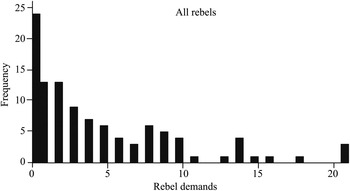
The number of rebel demands is a count variable, which ranges from 0 to 21 with a mean of 0.83. Figure 5 shows the distribution of the maximum number of demands rebels made in a single month. Twenty-four groups made no demands through the life of their conflict and thirteen groups made a maximum of one demand, whereas only three groups (AIS, National Union for the Total Independence of Angola [UNITA], and LRA) made twenty-one demands, the maximum number of demands made in a month in these data.
Distribution of rebel demands

To test our first hypothesis, that rebel organizations decide strategically whether to issue any demands, we code a dichotomous variable, any demand, that examines whether rebels make at least one claim in a month and 0, otherwise. We also include a binary indicator, any government or self-determination demand, that records whether rebels issue at least one demand regarding changes in the government or self-determination, regardless of the size of that demand.
Explanatory Variables
To assess rebels’ strength, we rely primarily on rebel capability data from the Non-State Actor (NSA) data set.Footnote 45 We utilize two variables from this data set, rebel troop size and rebel relative strength. rebel troop size is the best estimate of the number of rebel fighters in an organization. In our sample, this variable ranges from 165 to 70,000 where North Mali Tuareg Alliance for Change (ATNMC) in Mali is the smallest group and Ethiopia's Ethiopian People's Revolutionary Democratic Front the largest. We take the square of Rebel Troop Size to capture the nonmonotonic effect of rebel capability on demand size. We also include a dyadic measure of rebels’ strength, which records how strong a rebel group is when compared to its government opponent. rebel relative strength is an ordinal variable, corresponding to the categories much weaker, weaker, at parity with, stronger and much stronger than the government.
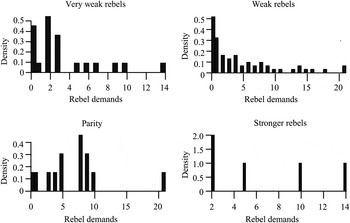
Figure 6 plots the maximum number of demands made in a month by rebel relative capability. Since only one rebel group is coded as much stronger than the government, two categories, stronger and much stronger, are combined in this figure. Here, the curvilinear relationship between the number of rebel group demands and their size is evident.
Balance of forces

In addition to these variables, we control for a series of factors that may also account for the size of a rebel group's demands.Footnote 46 Extant literature suggests that the multiparty context of a conflict may influence both conflict and bargaining between rebel groups and with the state.Footnote 47 Particularly, whether a group is more powerful than others in a multiparty conflict may also affect the size of rebels’ demands. To capture this effect, we code whether a rebel group was the main group imposing costs on the government in a year using the number of battle-related deaths listed in the UCDP conflict encyclopedia. We code as the Main Group any group that inflicts the largest number of casualties on their government relative to other groups involved in the same conflict in a year. If rebels are the only group fighting the state, they are automatically coded the main group. Relatedly, we control for the number of rebel groups involved in conflict with the state because rebels’ demands may fluctuate as they face increasing domestic competition from other organizations, or as they gain more allies in their fight against the state. A government's strength is also likely to be attenuated by increases in the amount of opposition it faces.Footnote 48
Groups that have external supporters may also make larger demands. Jenne argues ethnic minority groups will be emboldened to make greater demands of their governments when they are supported by external backers, particularly other states.Footnote 49 We use the rebel support variable from the NSA data set to capture whether rebels have explicit outside support. The duration of a conflict should also affect rebel demands as should the number of episodes of conflict a dyad has experienced. Specifically, as rebels and governments have increased interaction, whether through fighting or negotiation, they should be more aware of rebels’ credibility. We include two measures to this effect. The first, Length of conflict episode, records the duration of the fighting spell the dyad is involved in.Footnote 50 This variable ranges from 1 to 192, with a mean of 36.32 months. The number of conflict episodes captures the number of fighting spells between the rebel-state dyad. This variable ranges from 1 to 6 with a mean of 1.38.
We also control for the political environment in the state because rebel demands may also be influenced by traditional politics. We include polity2 Footnote 51 to measure the state's regime type as well as a dichotomous measures examining the type of autocratic government rebels are fighting. We include binary measures of whether the state in question is an autocratic personalist regime, autocratic military regime, or an autocratic party-based regime from the Autocratic Regimes Dataset.Footnote 52 These are important controls given that responses to rebels’ demands may vary by the type of regime,Footnote 53 and rebels may choose the size of their demands in anticipation of how they will be received. Rebels may also increase their demands ahead of elections, and after a leadership turnover. We record whether executive or legislative elections take place in a given month using the National Elections across Democracy and Autocracy (NELDA) data set.Footnote 54 We also record whether the state experienced any leadership turnover using data from Mattes, Leeds, and Carroll.Footnote 55
Econometric Specification
The theoretical model suggests that rebels make a strategic choice to make any demands from the government based on their fighting capacity. The weakest rebels will be reluctant to make a demand and suffer the costs of backing down since no threat they might make to fight is credible. Thus, we expect a positive relationship between rebel capability and the probability that rebels issue at least one demand. We utilize a logistic regression model to test the effect that rebel troop strength has on the dichotomous dependent variable, any government or self-determination demand.
Weak rebels who opt to make demands still face a credibility dilemma. As such, we expect to observe weak rebels putting forth relatively large demands to compensate for their concern over their credibility. In addition, more capable and confident rebels should also make large demands given their beliefs about their chance of prevailing in a fight with the government. Therefore, we expect to see both weak and strong rebels making large demands while those in the middle opt for more moderate demands. This suggests a curvilinear relationship between demand size and rebel capability. Our main models, which test our second hypothesis, examine whether a group's strength influences its choice to issue maximalist demands for changes in the government or self-determination once it has decided to issue at least one demand. We utilize logistic regression to test the binary dependent variable, maximalist demands.
An alternative specification of our empirical analysis examines the volume of demands as the dependent variable. Here we conceptualize the size of rebel demands as the number of disparate concessions rebels demand from the government. Following the prediction from the formal model shown in Figure 2, we model the number of demands made by rebels conditional on the probability that they make any demands at all. We employ hurdle regression models to capture this dynamic.Footnote 56 The hurdle model is a modified count model that recognizes that zeros and positive counts come from different data-generating processes. This econometric specification is consistent with our theoretical model because it allows for the possibility that rebels’ military capacity may have a different effect on the probability that they issue even a single demand and the number of demands issued after deciding to make demands at all. The likelihood function for this statistical model has two parts:
 $$L = \prod\limits_{t = 1}^n {[Pr({y_{1it}} = 0)]^{{y_{1it}}}}{[1 - Pr({y_{1it}} = 0)]^{1 - {y_{1it}}}}{[Pr({y_{2it}} \vert {y_{2it}} \gt 0)]^{{y_{1it}}}}$$
where y 1it = 1 if a rebel group i makes a demand at time t and y 2it is the count of demands made by a rebel group i in time period t.
The first column in Table 2 shows the first stage of the hurdle model, which examines a rebel group's decision to make any demand using logistic regression. The next stage examines the impact of rebel capability on the number of rebel demands issued using a negative binomial model, which appears in the second column of Table 2. All results display coefficients, robust standard errors, and p-values in the first, second, and third rows, respectively. The standard errors are clustered on the conflict since demands issued by rebel organizations fighting in the same conflict are likely to be related.Footnote 57
Results
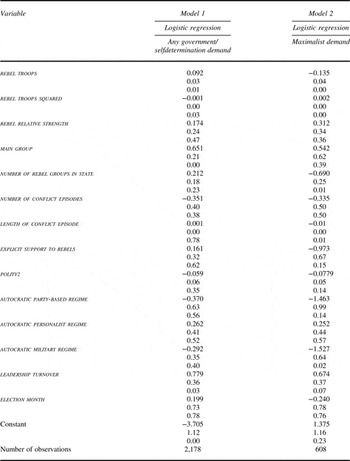
The results of our statistical analysis clearly support our argument that credibility is important for rebels and that it affects the size of the demands they make of governments during civil wars. First, the theoretical model suggests that rebel groups make demands only when they are sufficiently optimistic about their chances of enduring in a full-scale civil war. Restricting our analysis to only demands made for self-determination or government change, Model 1 in Table 1 demonstrates that the probability of rebels issuing at least one demand related to one of those issue types increases with both their absolute and relative military capabilities. This is demonstrated by the positive and statistically significant coefficients on the rebel troop size and rebel relative strength variables.
Logistic regression models examining the effect of rebel strength on the probability of any demand and maximalist demands

Notes: Logistic regression models presented with coefficients, robust standard errors clustered on the conflict in the second row and p-values in third row.
Consistent with our second hypothesis, Model 2 in Table 1 shows that both weak and strong rebels are likely to make larger demands than rebels in the middle range of capacity. In this model, large demands are measured as maximalist or absolutist claims calling for either the complete removal of the leader or regime in power, or for complete independence. With their credibility at stake, weak rebel groups are forced to make considerably larger demands than they can reasonably expect to extract from the state. As rebels become stronger, and credibility becomes less of a concern, they are likely to moderate those demands. However, as rebels become sufficiently strong such that they are no longer concerned about their credibility, the probability that they will again make large maximalist demands increases. This curvilinear relationship is demonstrated by the negative and statistically significant coefficient on the rebel troop size variable and the positive coefficient on the rebel troop size squared measure. This empirical pattern mirrors the relationship between rebels’ capacity and their demands shown in Figure 2.
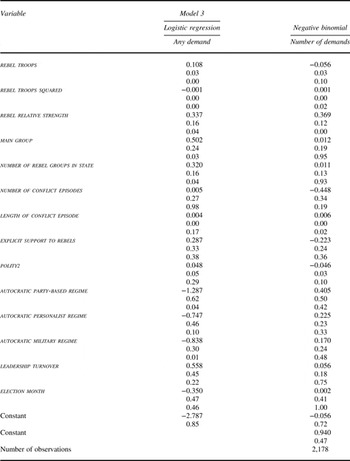
We further examine the impact of rebel strength on demand size by reconceptualizing the size of rebel demands as the number of claims they make in a month.Footnote 58 Here, we examine whether rebel groups are likely to make more numerous demands on any substantive issue when they face a credibility dilemma, or when they are militarily weak. Although this analysis does not examine the substantive size of a single demand, it does reflect the size of rebels’ package of demands and may still capture whether rebels adopt an aggressive bargaining position. The hurdle regression model in Table 2, which models the interrelated processes of making any demand and making large numbers of demands, is consistent with the results reported in Table 1.Footnote 59
Hurdle regression model examining the effect of rebel strength on the number of rebel demands

Notes: Coefficients, standard errors, and p-values are presented in the first, second, and third rows. Errors clustered on conflict.
The first stage of the hurdle model reveals that the probability a rebel group making a demand increases in its strength. The rebel troop size measures show that the weakest rebels are less likely to make even a single claim on any dimension. The second stage confirms that once rebels have overcome the initial “hurdle” of making demands, however, weak rebels make more demands than their medium-sized counterparts. Large rebels make more demands than all other types of rebels given their increased confidence in their ability to extract settlements from the state.
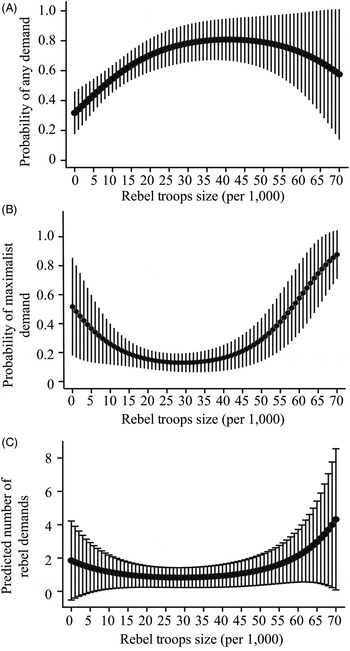
The statistical results demonstrate clearly that groups with credibility dilemmas are more likely to issue both maximalist demands as well as more numerous demands. Figure 7 displays the predicted probabilities from Models 2 and 3 in Tables 1 and 2.Footnote 60 The substantive effects show the clear positive relationship between rebel capability and the likelihood a group makes a demand proposed in the formal model. Figure 7A demonstrates this effect. If rebels have 5,000 troops, for example, the probability that they issue at least one demand is about 0.43. At 15,000 troops, the probability that rebels demand at least one concession is 0.64. When rebels amass about 40,000 troops, there is an 80 percent chance that they will make a demand. The probability that rebels issue a demand begins to decrease again at the highest levels of rebel troop size, which could be consistent with potential diminishing returns for rebel troop strength. At 70,000 troops, for instance, the probability rebels will make a demand is again 0.58, only a slightly higher probability of issuing a demand than a rebel group commanding only 10,000 troops.
Predicted probability of maximalist demand or number of demands by rebel troop size

Figure 7B displays the nonmonotonic effect of troop size on the probability that rebels issue maximalist demands for complete resignation of the government or independence. From this figure it is evident that groups in search of credibility are likely to issue maximalist demands. As groups become larger and less concerned with their own credibility, they become less likely to make such large demands. For example, when a rebel group is made up of only 200 troops the probability they issue a maximalist demand is about 0.51. When a group includes 1,000 troops in its ranks, however, the probability of a maximalist demand decreases to 0.48 and decreases even further to 0.37 when a rebel group is composed of 5,000 fighters. The probability of a maximalist demand is at its lowest when rebels reach 35,000 but begins to increase again beyond that size since groups that are more capable of imposing costs on their opponent are also likely to make very large demands. In fact, when rebels reach 60,000 troops, they are more likely to make a maximalist demand than even the weakest group that is concerned about their credibility.Footnote 61
Figure 7C demonstrates a very similar but slightly weaker curvilinear relationship. In particular, it demonstrates that weak rebel organizations with their credibility at stake tend to issue larger numbers of demands than groups that are less concerned about their credibility. In fact, Figure 7C shows that some of the weakest rebels in the sample make demands on par with some of the larger rebels in the sample, albeit not the very largest. The results suggest that the predicted number of demands of a rebel group of about 200 troops is 1.83, larger than rebels with about 57,000 troops. Rebel groups larger than 57,000 troops are expected to make more demands while rebels that are even slightly smaller make significantly fewer demands.
There is little consistency across the models with regard to the effect of the control variables on the size of rebels' demands, with a few exceptions. When examining a rebel group's decision to make a demand from the state, for example, whether rebels are the main group waging war against the state influences their willingness to issue at least one demand. Rebels that have inflicted the greatest number of casualties on the state are more likely to make a demand than other groups that may be fighting the state. In Table 2, the results suggest that a rebel group is more likely to make a demand against the state when the government is facing more opposition or when the number of rebel groups in the state is larger. The type of autocratic regime rebels are opposing also influences the probability that rebels will issue a demand. Rebels that challenge party-based, personalist, or military regimes are less likely to issue formal demands. These results are evident only in Table 2. When demands are restricted to demands for changes in the government or self-determination, on the other hand, there appears to be no relationship between the type of autocratic regime rebels challenge and the probability they issue a demand (Table 1). When regime type is measured using Polity, there is no effect on the probability of a demand in either model. While leadership turnover increases the probability that rebels issue at least one demand regarding government change or some form of self-determination, the relationship disappears when all types of demands are considered.
When focusing on the size of rebels’ demands, the results demonstrate that the number of rebels in the state decreases the probability that rebels will issue maximalist demands, but does not affect the number of concessions they demand. In Tables 1 and 2, the duration of the conflict influences the probability that rebels will make larger demands.Footnote 62 Only in Table 1 does leadership turnover influence the probability that rebels issue substantively large demands.
Conclusion
Although numerous studies examine the challenges both governments and rebels face when attempting to credibly commit to peace settlements, the analysis in this study is the first that we are aware of that focuses on the challenge rebels face when attempting to credibly commit to continue fighting the government if their demands are rejected. This article makes an important contribution to the applied bargaining theory literature because it shows that some the most robust comparative statics from these canonical models depend on a credibility constraint. This is an important step forward for the study of civil war and yields some counterintuitive empirical implications. Moreover, because these implications are consistent with patterns found in data on African rebels’ demands, policy implications can be drawn to suggest a path to civil war termination that is independent of the government's commitment problem. The analysis shows that the government's willingness to take rebel demands seriously depends crucially on the credibility of the rebels’ threat to continue fighting if their demands are rejected. The rebels’ credibility dilemma is not relevant when rebels can threaten to fight a full-scale civil war without fear of facing consequences from their demands being rejected. Since rebels are almost always significantly weaker than their governments, credibility is likely to be of central importance in most civil wars.
Understanding the rebels’ credibility dilemma has practical import. We highlight weak rebels’ propensity to make large, unrealistic demands that are unlikely to be accepted by any type of government. If rebels fight after the rejection of their demands, resulting conflicts are likely to be longer and more costly. Because rebels often fight wars to advance their political aims and governments infrequently concede to the demands of weak challengers or those unable to impose significant costs, we should expect that rebels involved in asymmetric conflicts will have to fight longer wars to see their demands met.Footnote 63 Indeed, some scholars find that weak rebels are significantly less likely to gain concessions from the state,Footnote 64 while other scholars demonstrate that dyads including weak rebels tend to fight considerably longer wars;Footnote 65 we provide a credible explanation for both facts by endogenizing both rebel demands and credibility. Existing research also finds that contests between weak rebels and much stronger states tend to involve higher levels of civilian victimization.Footnote 66 Since weak rebels find it increasingly difficult to force concessions using conventional military tactics, they often target civilians as a way to increase their leverage over the state. Together, research demonstrating that wars fought by weak rebels tend to last longer, involve more civilian abuses, and culminate in fewer concessions suggests that when rebels face a credibility dilemma, conflicts are likely to be more severe. Our research complements these findings by explaining how rebels’ search for credibility can lead to the breakdown of formal bargaining between weak groups and their governments, leading to these costly enduring wars.
Understanding the dilemma rebels face is also important because it is likely to be particularly prevalent in the post-Cold War era. Kalyvas and Balcells show that the ending of the Cold War led to a marked increase in the number of weak rebels, as dissident organizations throughout the world lost access to essential support from the superpowers. The retraction of external support also affected weak states since they were no longer capable of deterring the challenges of weak rebel organizations.Footnote 67 That many states became significantly weaker after the Cold War means that weak rebels may have more cause to be optimistic that their government is a weak type than before. As such, the end of the Cold War is likely to have emboldened more weak groups to challenge their states, while also creating situations where rebels have to be concerned about how to make their threats to fight credible.
Given that the rebels’ credibility is a significant concern for the analysis of bargaining during civil war, making prescriptions for policy-makers becomes complicated because any recommendations will depend on whether the rebels face such a dilemma. As such, there are two ways to change the incentives of the bargaining dyad in the hopes of resolving civil war and reaching a peaceful settlement. One possibility is to alter rebel fighting capacity through the provision of military and financial support. However, this strategy will help the dyad reach a peace settlement only when the rebels are sufficiently capable such that they make demands but sufficiently weak that they still have a credibility problem. If credibility is not an issue, providing such aid may prolong the civil war and make settlement less likely. Likewise, analysts have argued that increasing rebels’ costs of fighting can constitute a path to peace. Although the analysis in this study shows that increasing the costs of full-scale conflict for the rebels without credibility problems can increase the chances of settlement, it also suggests that increasing the costs of continued conflict for rebels with a credibility dilemma only makes settlement less likely.
It is also possible for rebels to take steps toward enhancing their credibility. By increasing their fighting capacity, rebels can make their threat to fight a full-scale civil war believable, thereby resolving their credibility problem. Rebels may also resolve their credibility dilemma by generating reputation costs that are incurred if they back down from their threat to launch a war. Such accountability allows rebels to solve their credibility dilemma without improving their capabilities. In sum, the rebels’ credibility dilemma is an important barrier to the settlement of civil war that deserves more attention from both academics and policy communities that are developing and implementing programs to resolve ongoing civil wars.
Appendix
Proof of Proposition 1
To prove the existence of the equilibrium, we first establish the range of player-types of G that reject some proposal x. Since R's strategy dictates that x is chosen such that it never backs down, G rejects when p G (m G , m R ) − c G >1 − x, or
 $$\alpha + g{m_G} - r{m_R} - {c_G} \gt 1 - x \Leftrightarrow g \gt \displaystyle{{1 - x - \alpha + r({m_R}) + {c_G}} \over {{m_G}}} \equiv {g^ {^\ast}}. $$
Therefore, G rejects when
 ${g^ *} \lt g \lt \overline g $
, where
 $\overline g = (1 - \alpha + r({m_R}))/{m_G}$
such that p(m
G
, m
R
) < 1, and accepts when g ≤ g*. As a result, R believes
 $g{\rm \sim} {\rm U}({g^ *}, \overline g )$
following rejection and g ~ U(0, g*] following acceptance. Since both acceptance and rejection occur in equilibrium, there are no out-of-equilibrium beliefs to specify.
Next, we derive x c , or the minimum demand that R can propose and still have a credible threat to fight. Following a rejection, R's updated beliefs dictate that it will fight when
 $$\int_{{g^ {^\ast}}} ^{\overline g} \left( {1 - {\,p_G}({m_G},{m_R})} \right)\left( {\displaystyle{1 \over {\overline g - {g^ {^\ast}}}}} \right){\kern 1pt} {\rm d}g - \displaystyle{{{c_R}} \over {{m_R}}} \ge - a \Leftrightarrow x \ge {c_G} + 2\left( {\displaystyle{{{c_R}} \over {{m_R}}} - a} \right) \equiv {x_c}.$$
Otherwise, if R proposes x < x
c
, it backs down. Next, to verify that R always proposes some x ≥ x
c
, note that if x < x
c
, all types of G would reject, leading to a certain payoff of − a, while any x ≥ x
c
ensures a lottery between 1 − x
c
and war, which given inequality (4) is sure to be greater than − a. To complete R's strategy, we next derive its risk optimum x
r
, which satisfies
 $\mathop {\max} \nolimits_x \{ E{U_R}(x)\} $
, or
 $$\mathop {\max} \limits_x \left\{ {\left( {\displaystyle{{{g^ {^\ast}}} \over {\overline g}}} \right)x + \left( {\displaystyle{{\overline g - {g^ {^\ast}}} \over {\overline g}}} \right)\left( {\int_{{g^ {^\ast}}} ^{\overline g} \left( {1 - {\,p_G}({m_G},{m_R})} \right)\left( {\displaystyle{1 \over {\overline g - {g^ {^\ast}}}}} \right){\kern 1pt} {\rm d}g - \displaystyle{{{c_R}} \over {{m_R}}}} \right)} \right\}.$$
The first-order condition is
 $$- \displaystyle{{{c_R} + {m_R}\left( {\alpha - r{m_R} + x - 1} \right)} \over {{m_R}\left( { - \alpha + r{m_R} + 1} \right)}} = 0,$$
yielding an optimum of
 $$x = 1 - \alpha - r{m_R} - \displaystyle{{{c_R}} \over {{m_R}}} \equiv {x_r}.$$
To verify that x r represents a maximum, note that the ∂2 EU R (x)/∂x 2 with respect to x is − 1/(1 − α + rm R ), whose negativity ensures that any x that solves the first-order condition is a maximum. Provided that R proposes some x > 0, its proposal rule is x* = max{x c , c r }. First, x c > x r when
 $${m_R} \le \displaystyle{{\sqrt {{{\left( { - 2a + \alpha + {c_G} - 1} \right)}^2} + 12r{c_R}} - 2a + \alpha + {c_G} - 1} \over {2r}} \equiv {\overline m _R},$$
and x
c
≤ x
r
when
 ${m_R} \gt {\overline m _R}$
. Next, when EU
R
(x
c
) ≤ 0, R's simply proposes x = 0 and ends the war. Substituting x
c
into EU
R
(x), R's expected utility for proposing x
c
is nonpositive when
 ${m_R} \le {\underline m _R}$
, where
 ${\underline m _R}$
is a nonnegative real number less than
 ${\overline m _R}$
that satsfies EU
R
(x
c
) = 0. Therefore, when
 ${m_R} \le {\underline m _R}$
, R proposes x* = 0; when
 ${\underline m _R} \lt {m_R} \le {\overline m _R}$
, R proposes x* = x
c
; and when
 ${m_R} \gt {\overline m _R}$
, R proposes x* = x
r
.
Next, we address the extent to which this equilibrium is unique by checking for the existence of pooling equilibria in which all types of G either accept or reject R's proposal. Suppose first that all types of G were to reject. This leads R to fight when
 $$\int_0^{\overline g} \left( {\left( {1 - {\,p_G}({m_G},{m_R})} \right)\left( {\displaystyle{1 \over {\overline g - 0}}} \right)} \right){\rm d}g - \displaystyle{{{c_R}} \over {{m_R}}} \ge - a,$$
or when a is sufficiently large, and back down otherwise. If R is sure to back down, then no type of G has an incentive to deviate. Therefore, when R's costs for backing down are sufficiently low, there also exists a pooling equilibrium in which no type of G accepts any proposal x ∈ [0, 1]. However, if R will fight, then any G for which g is sufficiently low to ensure 1 − p
G
(m
G
, m
R
) − c
G
< 1 − x has a profitable deviation of accepting some x ∈ [0, 1] that undermines the credibility of its threat to reject. Finally, suppose that all types of G accept. R's best response is to set x* = 1, yielding a payoff of 0 for all types of G. Rejection, however, leads at worst (if R fights) to p
G
(m
G
, m
R
) − c
G
, which is a profitable deviation for all g satisfying p
G
(m
G
, m
R
) − c
G
> 0, and at best to 1 (if R backs down), which is G's best possible payoff. Next, suppose that R proposes x* = c
G
, which all types of G accept. For this equilibrium to exist, it must be the case that R will not back down off the equilibrium path because otherwise all types of G would have a profitable deviation to rejection (1 − c
G
< 1). For R not to back down, it must be the case, following the logic of inequality (5), that it believe that any rejecting types of G be sufficiently weak—that is, that it truncates the upper bound on its beliefs from
 $\overline g $
to
 $${\overline g ^{\prime}} \lt \displaystyle{2 \over {{m_G}}}\left( {1 - \alpha + r{m_R} + a - \displaystyle{{{c_R}} \over {{m_R}}}} \right).$$
We reject this out-of-equilibrium belief as implausible because relatively weak types do strictly worse by deviating than stronger types would and because all types could benefit equally from R's only other possible strategy (backing down). This would give R no reason to prize lower types over high even using the intuitive criterion,Footnote 68 but retaining its priors would lead to a violation of the rule that it will not back down. Therefore, there exists no equilibrium (supported by reasonable out-of-equilibrium beliefs) in which all types of G accept.
Proof of Proposition 2
Recall that x* = x
c
(defined in inequality (2)) when
 ${\underline m _R} \lt {m_R} \le {\overline m _R}$
and that x* = x
r
(defined in inequality (3)) when
 ${m_R} \gt {\overline m _R}$
, while R makes no demand when
 ${m_R} \le {\underline m _R}$
. To show that x* decreases through low values of m
R
and increases through higher values, it is sufficient to show that
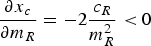 $$\displaystyle{{\partial {x_c}} \over {\partial {m_R}}} = - 2\displaystyle{{{c_R}} \over {m_R^2}} \lt 0$$
and
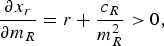 $$\displaystyle{{\partial {x_r}} \over {\partial {m_R}}} = r + \displaystyle{{{c_R}} \over {m_R^2}} \gt 0,$$
which establishes the nonlinear relationship posited in the proposition.
Proof of Proposition 3
Since R is sure to fight in the face of rejection, the probability that the war continues for a given x* > 0 is
 $\Pr ({\rm War}\vert {x^ *} ) = \Pr (g \gt {g^ *} \vert {x^ *} ) = (\overline g - {g^ *} )/\overline g $
. When x* = x
c
, which occurs when
 ${\underline m _R} \lt {m_R} \le {\overline m _R}$
,
 $$\Pr ({\rm War} \vert {x_c}) = \displaystyle{{2\left( {{c_R} - a{m_R}} \right)} \over {{m_R}\left( { - \alpha + r{m_R} + 1} \right)}}$$
which is sure to decrease in m
R
, since m
R
increases the denominator and decreases the numerator of the expression. Next, when x* = x
r
, which occurs when
 ${m_R} \gt {\overline m _R}$
,
 $$\Pr ({\rm War} \vert {x_r}) = - \displaystyle{{{m_R}\left( {\alpha + {c_G} - r{m_R} - 1} \right) + {c_R}} \over {{m_R}\left( { - \alpha + r{m_R} + 1} \right)}},$$
and the first partial derivative with respect to m R is
 $$\displaystyle{{\partial \Pr ({\rm War} \vert {x_r})} \over {\partial {m_R}}} = \displaystyle{{r{c_G}m_R^2 + {c_R}\left( { - \alpha + 2r{m_R} + 1} \right)} \over {m_R^2 {{\left( { - \alpha + r{m_R} + 1} \right)}^2}}}.$$
As long as the components of p
G
are bounded to ensure that p
G
< 1 and as long as war is sufficiently costly for R, this expression is positive, ensuring that the probability of continued war increases in m
R
when
 ${m_R} \gt {\overline m _R}$
.
Supplementary Material
Supplementary material for this article is available at http://dx.doi.org/10.1017/S0020818316000175