INTRODUCTION
The nemertean fauna of Spain, despite the latter having more than 7800 km of coastline, has been neglected for a long time, with only 14 species recorded until the last decade of the past century (Saiz Salinas, Reference Saiz Salinas1987). More recent studies (Gibson & Junoy, Reference Gibson and Junoy1991; Junoy & Gibson, Reference Junoy and Gibson1991, Reference Junoy and Gibson1992; Vernet & Anadón, Reference Vernet and Anadón1991; Rogers et al., Reference Rogers, Junoy, Gibson and Thorpe1993; Herrera-Bachiller et al., Reference Herrera-Bachiller, García-Corrales, Roldán and Junoy2008; Junoy & Herrera-Bachiller, Reference Junoy, Herrera-Bachiller, Ramírez and Asensio2010; Puerta et al., Reference Puerta, Andrade and Junoy2010; Junoy et al., Reference Junoy, Andrade and Giribet2011) raise the figure to 52 species, still a low number when taking into account that approximately one-third of the 1275 nemertean species recognized (Kajihara et al., Reference Kajihara, Chernyshev, Sun, Sundberg and Crandall2008) have been reported from European waters (Junoy & Herrera-Bachiller, Reference Junoy, Herrera-Bachiller, Ramírez and Asensio2010). Information about Spanish nemertean species is needed to match marine biodiversity knowledge with other countries in Europe.
Nemertean specimens collected between intertidal mussels from Galicia (north-west Spain) revealed the presence of two Emplectonema species: the common Emplectonema gracile (Johnston, 1837) and the newly recorded Emplectonema neesii (Örsted, Reference Örsted1843). The aim of this paper is to document this record and provide new morphological data about the species.
MATERIALS AND METHODS
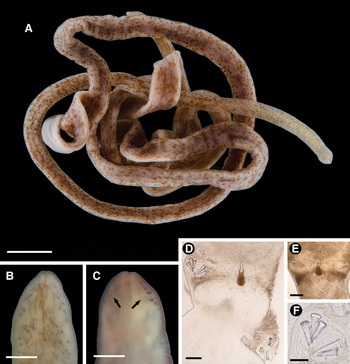
Five specimens of E. neesii (Figure 1A) were collected intertidally among the byssus threads of Mytillus galloprovincialis Lamarck, 1819 in the Ribeira's marina (42°33.75′N 8°59. 31′W) on 28 and 31 October 2013. The specimens were examined alive both before and after anaesthetization in 7.5% MgCl2. The proboscis of three specimens was dissected to observe the stylet region.
Emplectonema neesii: (A) photograph of a complete specimen; (B) photograph of the head (dorsal view); (C) photograph of the head showing the cephalic furrows (arrows) (ventral view); (D) microphotograph of a squeezed specimen showing the central stylet and its basis and the six pouches of accessory stylets; (E) microphotograph of a squeezed specimen showing only two pouches of accessory stylets and the anomalous asymmetrical basis; (F) microphotograph of the spirally-grooved stylets. Scale bars: A, 1 cm; B, C, 30 mm; D, E, 100 µm; F, 50 µm.

RESULTS
Galician specimens are 40–60 cm long, 4–6 mm wide. Head is orbicular in shape (Figure 1B), not demarcated from the adjacent trunk region. It bears up to 60 small eyes irregularly disposed, being more numerous along the head sides. Two shallow furrows are observed ventrally in the head of one specimen (Figure 1C); no dorsal transverse grooves were observed.
The body is long, cylindrical at the anterior and posterior ends, flattened in the middle part. Colour is light brown, dorsally marked with irregular dark brown pigment streaks; ventrally is uniformly flesh or light brown. The specimens coil and twist their bodies.
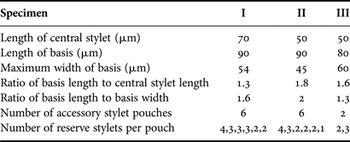
The proboscis apparatus occupies only the anterior part of the body. The proboscis is divided into four distinct regions: the anterior chamber, provided with papillae; the bulb region; a small spherical chamber that follows the bulb region; and the slender posterior chamber. Measurements of the stylet apparatus of these specimens are shown in Table 1; an unusual characteristic of the stylet is that its surface is grooved (Figure 1F). Two of the dissected specimens have six accessory stylet pouches (Figure 1D) containing up to 4 stylets each; both specimens showed a waist basis and similar measurements of the stylet apparatus. The other specimen has two pouches and an anomalous asymmetrical basis (Figure 1E).
Measurements recorded for the stylet apparatus of three specimens of Emplectonema neesii.

DISCUSSION
Emplectonema neesii has been recorded in Atlantic cold waters of Greenland (McIntosh Reference McIntosh1873–1874; Coe, Reference Coe1944), Iceland (Friedrich, Reference Friedrich1958), Sweden (Sundberg et al., Reference Sundberg, Gibson and Strand2007), British Isles (records in Gibson, Reference Gibson1994), Holland (Faasee, Reference Faasse2003) and France (Joubin, Reference Joubin1890, Reference Joubin1894; Gontcharoff, Reference Gontcharoff1955). The only record of E. neesii from the Mediterranean was made by Hubrecht (Reference Hubrecht1879) based on a single specimen from Naples that ‘unluckily got mislaid before further examination was possible’, leaving the possibility of misidentification. The nemertean fauna of Naples has been subsequently investigated by Bürger (Reference Bürger1895) and Iwata (Reference Iwata1965), but both failed to recover E. neesii, suggesting that the occurrence of the species is doubtful. The Mediterranean was referred into the distribution of the species by subsequent authors (e.g. Joubin, Reference Joubin1890, Reference Joubin1894; Coe, Reference Coe1944; Friedrich, Reference Friedrich1958; Gibson, Reference Gibson1994), but its presence in this warm sea is, in our opinion, doubtful. If this is the case, the present Atlantic Spanish specimens constitute the southernmost record of the species.
Previous literature about E. neesii (McIntosh, Reference McIntosh1873–1874; Bürger, Reference Bürger1895; Gibson, Reference Gibson1994) described a proboscis apparatus with only two pouches of accessory stylets, as observed in one of the present specimens. The other two dissected specimens have six pouches each, a morphological character observed for the first time in E. neesii. A similar variation was also observed in the congeneric Pacific North American species Emplectonema buergeri Coe, Reference Coe1901. This species has a similar colour pattern to that of E. neesii, and was described from Alaskan specimens as having two accessory stylet pouches (Coe, Reference Coe1901) while specimens from Washington State have six pouches (Roe et al., Reference Roe, Norenburg, Maslakova and Carlton2006; Junoy, personal observation).
There is also a discrepancy in the literature about the stylets. McIntosh (Reference McIntosh1873–1874) describes E. neesii as having grooved stylets but Gibson (Reference Gibson1994) depicted them to be smooth. To the contrary, E. buergeri was originally described as having smooth stylets (Coe, Reference Coe1901, Reference Coe1905) but the Washington form has spirally-grooved stylets (Roe et al., Reference Roe, Norenburg, Maslakova and Carlton2006; Junoy, personal observation).
Riser (in Gibson, Reference Gibson1995) suggested that some species of Emplectonema Stimpson, 1857, for example E. neessi, should be transferred to the genus Paranemertes Coe, Reference Coe1901. Moreover, the original type species of the old genus Neesia Girard, 1893 is Amphiporus neesii Örsted, Reference Örsted1843 (= E. neesii). This might constitute the basis to justify the usage of the name Neesia as a valid name because E. neesii does not likely comprise a monophyletic group with E. gracile (Sundberg et al., Reference Sundberg, Chernyshev, Kajihara, Kånneby and Strand2009), the type species of the genus Emplectonema.
In this discussion, we retain the name Emplectonema neesii until more data clarify its taxonomic status.
ACKNOWLEDGEMENTS
We are extremely grateful to the referee Dr H. Kajihara for his constructive comments about the original manuscript. This research was supported by the Franklin Institute, Universidad de Alcalá (Project IUEN2010-001). Juan Junoy thanks Dr Gonzalo Giribet for his invitation to and the hospitality at his laboratory.