Self-harm encapsulates a set of behaviours which involve an individual deliberately and directly causing harm to themselves (Nock, Joiner, Gordon, Lloyd-Richardson, & Prinstein, Reference Nock, Joiner, Gordon, Lloyd-Richardson and Prinstein2006). It is seen to be a behavioural manifestation of heightened distress, and represents efforts to escape, regulate negative emotional states, and communicate psychic pain (Taylor et al., Reference Taylor, Jomar, Dhingra, Forrester, Shahmalak and Dickson2018). Self-harm includes incidents of non-suicidal self-injury (NSSI), which involves harm to one's self without an attempt to die; and suicidal behaviours, which involve intent to die. Despite differences between these sets of behaviours, NSSI is a strong risk factor for future suicide attempts (Muehlenkamp & Gutierrez, Reference Muehlenkamp and Gutierrez2007; Ribeiro et al., Reference Ribeiro, Franklin, Fox, Bentley, Kleiman, Chang and Nock2016). Self-harm can be persistent, with an individual capable of engaging in hundreds of self-injurious incidents and up to 16% of those who self-harm have been estimated to continue the behaviour repeatedly (Hawton, Zahl, & Weatherall, Reference Hawton, Zahl and Weatherall2003; Muehlenkamp & Kerr, Reference Muehlenkamp and Kerr2010). If left unchecked self-harm can also become persistent, in some cases with incidents occurring for up to 10 years (Lilley et al., Reference Lilley, Owens, Horrocks, House, Noble, Bergen and Kapur2008).
Self-harm is a considerable burden to health care systems, and continues to be a leading cause of death worldwide (Kinchin, Doran, Hall, & Meurk, Reference Kinchin, Doran, Hall and Meurk2017). Despite the attention it has received in recent years, rates of death due to self-harm have risen in some nations (Australian Bureau of Statistics, 2018; National Center for Health Statistics, 2018). There are two limitations of research to date which serve as the basis for the current study: first, prediction of self-harm in longitudinal research has been poor, which limits the ability to prevent incidents; and second, there is a limited knowledge of evidence-based targets for interventions when risk of self-harm may be evident. The current study looks at addressing both limitations through a short-term longitudinal assessment of dynamic risk factors for self-harm in a clinical setting.
Self-harm is prevalent among general and psychiatric populations and is a leading cause of preventable death internationally (James, Stewart, & Bowers, Reference James, Stewart and Bowers2012). It is estimated that over 90% of those who self-harm meet the criteria for a mental health disorder (Haw, Hawton, Houston, & Townsend, Reference Haw, Hawton, Houston and Townsend2001). Psychiatric populations therefore are a particularly high-risk population, which presents difficulties in monitoring and preventing self-harm within psychiatric hospitals. The period following discharge is also associated with heightened risk of suicide among inpatients, which highlights the importance of directing preventive efforts towards targeted patients (Gunnell et al., Reference Gunnell, Metcalfe, While, Hawton, Ho, Appleby and Kapur2012). An advantage of an inpatient setting is that at-risk patients are already within care, which provides an opportunity for targeted intervention.
The efficient allocation of clinical resources is hampered by limited methods to prospectively predict who will self-harm and when it will occur, with risk assessments by clinicians often being over-inclusive (Belsher et al., Reference Belsher, Smolenski, Pruitt, Bush, Beech, Workman and Skopp2019; Kessler, Reference Kessler2019; Woodford et al., Reference Woodford, Spittal, Milner, McGill, Kapur, Pirkis and Carter2019). Risk assessments using self-report measures are a cost-effective method to predict adverse outcomes; however, there is a shortage of research that presents refined and effective methods to predict self-harm. A recent meta-analysis by Large et al. (Reference Large, Myles, Myles, Corderoy, Weiser, Davidson and Ryan2011) assessed the accuracy of risk categorisation in predicting psychiatric inpatient suicide. They found the positive predictive value (PPV) of risk categorisation over six cohort studies to be an unremarkable 0.43%, indicating that one out of 230 inpatients predicted to self-harm would do so before discharge. Likewise, other clinical studies have noted poor ability to discriminate between those who engage in NSSI or suicide attempts and those who do not when using isolated risk assessments (Saunders, Brand, Lascelles, & Hawton, Reference Saunders, Brand, Lascelles and Hawton2014; Waern, Sjöström, Marlow, & Hetta, Reference Waern, Sjöström, Marlow and Hetta2010), particularly when history of prior self-harm is not evident (Roaldset, Linaker, & Bjørkly, Reference Roaldset, Linaker and Bjørkly2012). Such disappointing findings over the past decade have lead commentators to conclude that risk assessments are fraught (Large, Ryan, & Nielssen, Reference Large, Ryan and Nielssen2011). Basing clinical decisions on inaccurate risk assessments can profoundly impact clinical resources and create restrictive and intrusive conditions for patients unlikely to self-harm during their stay.
There are inherent difficulties in predicting self-harm due to variability in the daily experiences of patients (Kleiman et al., Reference Kleiman, Turner, Fedor, Beale, Huffman and Nock2017). Self-harm in many instances likely eventuates due to predispositions to engage in self-harming behaviours (e.g. low distress tolerance and poor emotional regulation) and day-to-day negative experiences or stressful triggers (Fliege, Lee, Grimm, & Klapp, Reference Fliege, Lee, Grimm and Klapp2009; Nock, Reference Nock2009). Indeed, increases in interpersonal adversity, such as conflict with friends and family, negative affect, and suicidal ideation have been shown to increase prior to self-harm (Armey, Crowther, & Miller, Reference Armey, Crowther and Miller2011; Kashyap, Hooke, & Page, Reference Kashyap, Hooke and Page2015; Kyron, Hooke, & Page, Reference Kyron, Hooke and Page2018; Muehlenkamp et al., Reference Muehlenkamp, Engel, Wadeson, Crosby, Wonderlich, Simonich and Mitchell2009). It is difficult to capture such variability through isolated measurement (Bryan & Rudd, Reference Bryan and Rudd2016), and efforts to reduce self-harm within inpatient settings may benefit from routine monitoring of dynamic risk factors over time.
Routine monitoring has become increasingly prominent within psychiatric settings, providing valuable information regarding self-reported changes in mental health throughout treatment (Boswell, Kraus, Miller, & Lambert, Reference Boswell, Kraus, Miller and Lambert2015). However, its integration into clinical research to enhance prediction of self-harm among psychiatric populations has been minimal (Czyz, King, & Nahum-Shani, Reference Czyz, King and Nahum-Shani2018; Plener, Schumacher, Munz, & Groschwitz, Reference Plener, Schumacher, Munz and Groschwitz2015). Early research suggests benefits in its implementation to predict increases in risk of patient self-harm over short-term periods. A recent study by Kyron et al. (Reference Kyron, Hooke and Page2018) tracked inpatients' suicidal thoughts and interpersonal circumstances on a daily basis, finding short-term increases in all factors predicted a notable proportion of self-harm events. In addition, a daily diary study of a small sample of individuals with a history of NSSI found daily sadness to predict incidents of self-harm (Bresin, Carter, & Gordon, Reference Bresin, Carter and Gordon2013). Short-term changes in a combination of mood, interpersonal, and escape-related correlates of self-harm may therefore be useful in the prediction of outcomes and assist in identifying patients with difficulties coping with their current circumstances. This follows theoretical perspectives from the Interpersonal Theory of Suicide (Joiner, Reference Joiner2005), which suggests that interpersonal adversity generates significant psychological distress as to drive suicidal thoughts and self-injurious behaviours. Specifically, it suggests two dynamic interpersonal constructs are central: perceived burdensomeness, which reflects beliefs that an individual is a burden to those around them; and thwarted belongingness, which encapsulates feelings of isolation and a perceived lack of support from others. Interpersonal adversity has exhibited cyclical relationships with symptoms of poor mental health over short-term periods, which may have important implications for preventing positive feedback loops prior to self-harm (Kyron et al., Reference Kyron, Hooke and Page2018; Rogers & Joiner, Reference Rogers and Joiner2019).
The current study assesses the effectiveness of routine monitoring in predicting incidents of self-harm within an inpatient setting. The study conducts daily assessments of patients using a brief, but diverse daily index capturing psychological factors linked to suicide and self-harm in prior research (i.e. interpersonal adversity, wish to live and die, and psychological distress; Bryan, Rudd, Peterson, Young-McCaughan, & Wertenberger, Reference Bryan, Rudd, Peterson, Young-McCaughan and Wertenberger2016; O'Connor et al., Reference O'Connor, Jobes, Yeargin, FitzGerald, Rodríguez, Conrad and Lineberry2012). Building on prior ecological research, we expect: (1) changes in self-reported psychological distress and interpersonal circumstances to predict incidents of self-harm; (2) a history of self-harm to be associated with an increased risk of future self-harm; and (3) interpersonal, mood factors, and a wish to live/die to be reciprocally related over time.
Method
Participants and procedure
The current study was conducted as part of an ongoing assessment and treatment of inpatients at a 100 bed psychiatric facility in Perth, Western Australia. Patients were presented with the opportunity to self-report their mental health on a daily basis. Daily response rates were high (78%) and questionnaires were completed at consistent times daily, with an average of roughly 2.8 h difference from day-to-day (s.d. = 1.55). Patients were selected for inclusion in the study if they had a length of stay of 5 days or over to allow sufficient time to collect self-report and self-harm data. In total, data from 3740 patients were selected for the study. Patients were referred to the facility by their physician to receive specialised treatment for a range of mental health issues regardless of a history of self-harm. That is, patients were not referred to the facility solely due to self-injurious behaviours, and the sample reflects a diverse range of psychopathology.
Information surrounding self-harm events was provided by clinical staff, who logged reports regarding each incident as part of routine reporting undertaken for risk management purposes within the facility. Staff outlined the nature of the incident, the time it occurred, the outcome (i.e. transferred to external medical hospital and minor intervention), and perceived intent (i.e. suicidal or non-suicidal). When a patient who self-harmed completed self-report measures, they were completed in the hours prior to self-harm incidents in the majority of cases (88.6%), with the remaining proportion occurring after an incident had occurred (11.4%). Consent for the data to be used for research purposes was provided by patients at admission, and all procedures were approved by the University of Western Australia's Human Research Ethics Committee.
Measures
Thwarted belongingness
Belongingness was measured by summing two items, ‘In the past 24 h, I have felt that people care for me’ and ‘In the past 24 h, I have felt close to others’. Both items aimed to capture sub-constructs of belongingness (i.e. perceived support and loneliness, respectively) and have shown good predictive qualities in prior research (Kyron et al., Reference Kyron, Hooke and Page2018; Kyron, Hooke, & Page, Reference Kyron, Hooke and Page2019). Responses were reverse scored so that higher scores indicated a greater sense of thwarted belongingness. Items were adapted from the Interpersonal Needs Questionnaire (INQ; Van Orden, Cukrowicz, Witte, & Joiner, Reference Van Orden, Cukrowicz, Witte and Joiner2012), and were measured on a 7-point Likert-type scale (1 = Not true for me at all, 7 = Very true for me). These items were selected based on their strong factor loadings in clinical samples (Van Orden et al., Reference Van Orden, Cukrowicz, Witte and Joiner2012) and had acceptable internal consistency in the current study (α = 0.78).
Perceived burdensomeness
Two items in total were used to measure perceived burdensomeness. One question assessed global feelings of burden, ‘In the past 24 h, I have felt like a burden’, and a second assessed perceptions of liability, ‘In the past 24 h, I have felt like my death would be a relief to people’. These items were taken from the INQ, and were measured on a 7-point Likert-type scale (1 = Not true for me at all, 7 = Very true for me). Item scores were combined, with higher scores representing higher perceived burden. Both items had acceptable internal consistency in the current study (α = 0.74).
Psychological distress
Psychological distress was measured through the use of the five item daily index (DI-5) developed by Dyer, Hooke, and Page (Reference Dyer, Hooke and Page2014). The scale measures feelings of anxiety, depression, worthlessness, suicidal ideation, and difficulty coping, with each item measured on a 6-point Likert-type scale (0 = At no time, 5 = All the time). Higher scores on the scale indicate higher psychological distress. The scale has shown strong psychometric properties in prior research (Dyer et al., Reference Dyer, Hooke and Page2014), and good internal consistency in the current study (α = 0.86).
Wish to live and wish to die
Single items were taken from the Scale for Suicide Ideation (Beck, Kovacs, & Weissman, Reference Beck, Kovacs and Weissman1979) to measure patients' wish to live and wish to die in the 24 h prior, measured on a 4-point Likert-type scale (0 = None, 1 = Weak, 2 = Moderate, 3 = Severe). Wish to live was reverse coded, with higher scores representing a lower wish to live. There was a medium-strong correlation between the two variables in the current study (r = 0.64).
Analytical approach
Missing responses
Although daily response rates were high, missing data are expected in intense longitudinal research. In total, 13.7% of self-report data included in analyses were missing. An analysis of these patients found no systematic difference between their demographic and clinical characteristics when performing Little's Test of Missing Completely at Random (χ2 = 2.54, df = 4, p = 0.11; Little, Reference Little1988). Multiple imputation, using fully conditional specification, was used to estimate missing responses on self-report measures using SAS Version 9 software. Fully conditional specification has been shown to produce low-bias estimates of missing data, accommodate for non-normality and non-linearity, and also handle categorical and continuous missing data (van Buuren, Reference van Buuren2007). Analyses were performed on the 10 imputed datasets, and regression coefficients and prediction statistics were subsequently pooled. In total, 50 cases were excluded from analyses due to no available self-report data, and were found not to differ in terms of age, length of stay, sex, or primary diagnosis from the entire sample. Although the rate of missingness was low, analysis results when excluding participants with missing responses have been reported in the online Supplementary material, with no substantial differences identified.
Predicting self-harm from day-to-day
For patients who self-harmed, self-report data were selected on the day of an incident (T2) and the day prior (T1). For the comparison group (i.e. patients who did not self-harm), data were selected from the point they completed self-report measures 2 days in a row (T1 and T2). Hierarchical logistic regressions were performed to assess relationships between daily self-report, stable patient characteristics (i.e. prior self-harm and primary diagnosis), and self-harm. The first model assessed the predictive utility of self-report at T1, while the second model added changes in self-report from T1 to T2. This was to assess whether changes in circumstances could be used to alert staff of potential increased risk of self-harm. The third and fourth models saw the inclusion of demographic and clinical information, respectively. These sets of information were included after self-report due to a desire to assess whether self-report measures on their own could predict self-harm.
Training the model
Evaluating a model requires testing its parameters on a new dataset. Often a model is trained or developed based on a large proportion of a dataset and tested for predictive capabilities on the remaining portion. However, bias may be evident in the data randomly selected for training and testing (Kuhn & Johnson, Reference Kuhn and Johnson2013). A solution is to use k-fold cross-validation, which divides the dataset randomly into ‘k’ approximately equally-sized parts. The model is trained on k − 1 parts, and tested on the remaining data. This process is repeated until all parts have acted as a test set once. In the current study, repeated cross validation was used, consistent with prior research (Kuhn & Johnson, Reference Kuhn and Johnson2013). This procedure was performed using the caret package in R. The caret package was designed to simplify the process of conducting supervised machine learning by identifying optimal model hyperparameters to enhance prediction of outcomes. This reflects the benefits of machine-learning approaches over the standard use of regression, with an emphasis on maximising prediction, rather than interpretability.
Evaluating model performance
A number of statistics were computed to assess model fit at each step: sensitivity, the ability to detect a self-harm event; specificity, the ability to determine whether a patient did not self-harm; PPV, the ratio of correctly identified self-harm incidents to falsely detected events; and negative predictive value (NPV), the ratio of patients accurately predicted not to self-harm, and those falsely predicted not to self-harm. Each statistic is a function of the probabilities of an event produced by the model, and the cut-off used for classification of an event. Reductions in probabilities tend to be associated with increases in sensitivity (which is of benefit to clinical practice), although it comes at a cost of increased rates of false positives (Royston & Altman, Reference Royston and Altman2010). After training the model on 70% on the total sample, optimal cut-off points for balanced classification of events (i.e. high sensitivity and specificity) were defined on a small validation portion of the total sample (10%). The model was then tested on a larger test proportion (20%) using these pre-defined cut-off points. Standard logistic regression was also performed to assess whether using machine learning to find optimal parameters impacted prediction accuracy.
Temporal relationships between predictors
Cross-lagged panel models were performed to assess associations between self-report measures across the 2 days of assessment. The cross-panel model controls for stability in factors through the inclusion of autoregressive relationships, and is regarded to be an effective method to assess ‘causal’ relationships between variables prone to change (Hamaker, Kuiper, & Grasman, Reference Hamaker, Kuiper and Grasman2015). Several panel models were performed to assess how interpersonal factors were associated with the aspects of mental health (i.e. psychological distress, wish to live, and wish to die). An additional model assessed relationships between psychological distress, wish to live, and wish to die. Separate models were performed to assess how specific interpersonal factors readily targetable through therapeutic interventions may affect change in other related mental health outcomes, with the inclusion of correlated outcomes in the same model potentially acting to obscure associations of interest. All models were performed using Mplus Version 8 software.
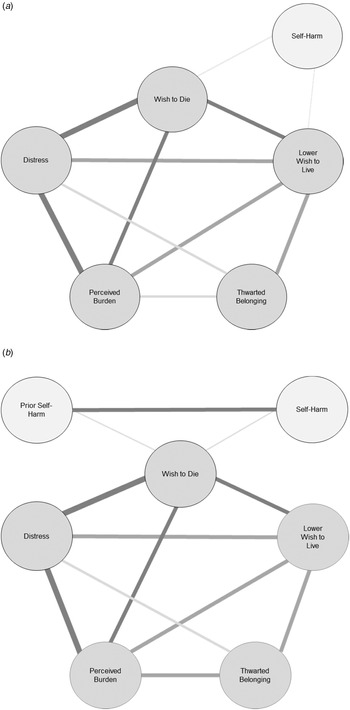
Cross-sectional network models were performed (using JASP software) to assess simultaneous relationships between self-report measures and self-harm. A mixed graphical model estimator was used to accommodate for categorical and continuous variables (Haslbeck & Waldorp, Reference Haslbeck and Waldorp2015). Network models allow for patterns of covariance to be examined under the assumption that factors can mutually influence each other (van Zyl, Reference van Zyl2018). Least absolute shrinkage and selection operator regularization was used to shrink small weights to zero to avoid issues of multiplicity, and represent partial correlations that control for the influence of other factors when determining associations between two variables. Nodes represent self-reported risk factors and self-harm, while edges (lines) represent partial correlation weights between two variables. Three statistics were calculated to assess the importance of variables to the network: degree, the extent to which a node is connected to all other nodes; closeness, how well a node is indirectly connected to other nodes; and betweenness, how important a node is to the average path between two nodes (Epskamp, Borsboom, & Fried, Reference Epskamp, Borsboom and Fried2018). To assess stability of the model to sampling variability, 1000 bootstrap samples were drawn.
Results
Sample characteristics
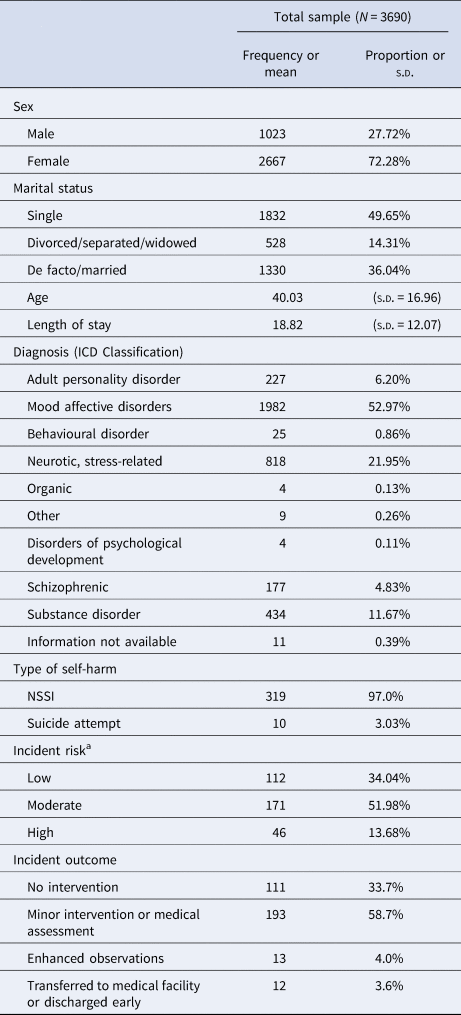
Descriptive statistics of the sample are reported in Table 1. Of note, patients in the sample were predominantly female and not in a relationship, with the highest proportion of patients having a primary diagnosis of an affective disorder. The majority of self-harm events were not associated with an explicit intent to die as per staff reports. However, over 60% of all cases required a medical response from inpatient nursing staff (e.g. applying dressing over wounds).
Demographic characteristic of the total sample

s.d., standard deviation; Incident risk, likelihood of another incident and severity.
a Incident risk, as per Riskman software guidelines, is a judgement made by nursing staff based on the severity, intent, and number of self-harm incidents for an individual.
Prediction of self-harm using daily self-report
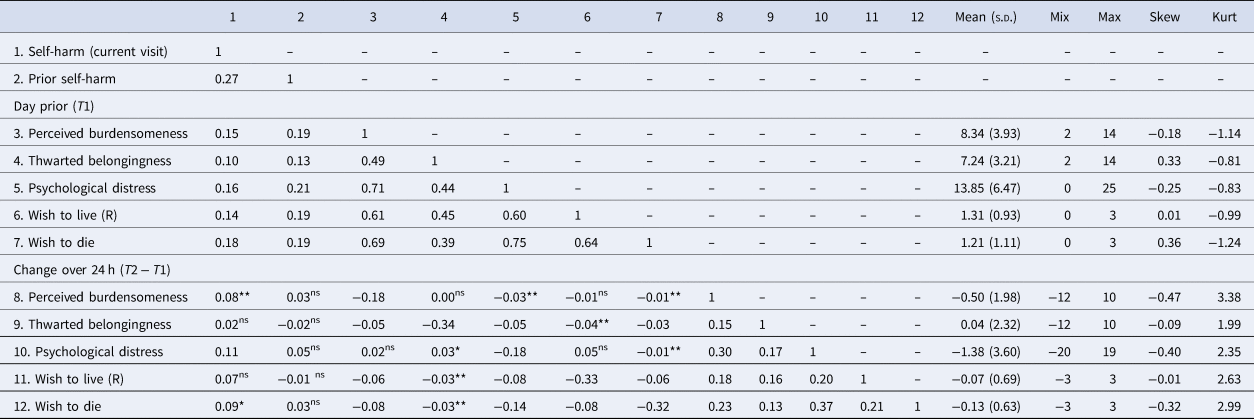
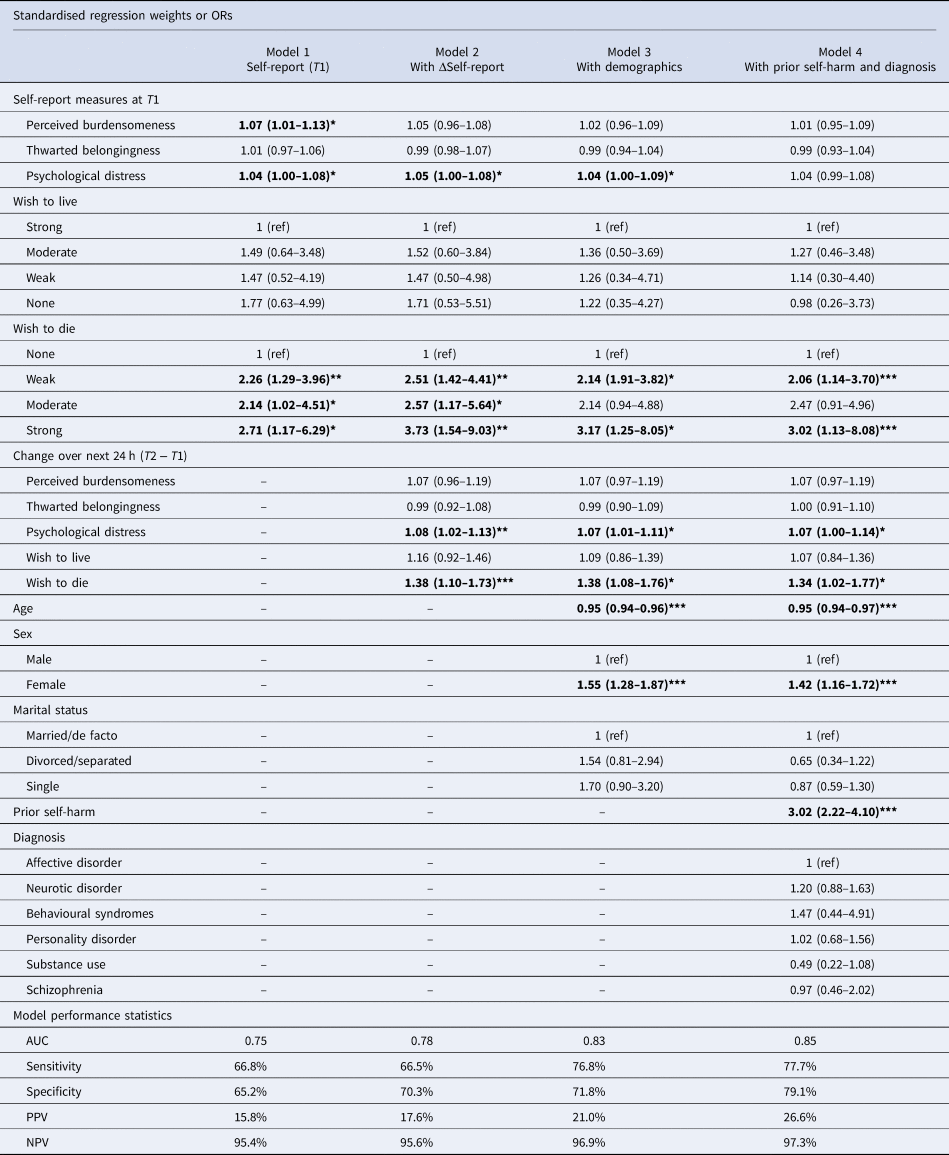
Hierarchical logistic models were fit to the data to assess whether self-report measures and patient characteristics could predict self-harm. Bivariate correlations between predictors are reported in Table 2. In Model 1, perceived burdensomeness [β = 1.07, 95% confidence interval (CI) 1.01–1.13, p = 0.015], psychological distress (β = 1.04, 95% CI 1.00–1.08, p = 0.033), and a wish to die on the first day of assessment (T1) significantly predicted next day self-harm (Table 3). In particular, a strong wish to die was associated with higher odds of self-harm on the next day [odds ratio (OR) 2.71, 95% CI 1.17–6.29, p < 0.023]. In Model 2, increases in psychological distress (β = 1.08, 95% CI 1.02–1.13, p = 0.003) and a wish to die (β = 1.38, 95% CI 1.10–1.73, p < 0.001) from one day to the next (T2 − T1) significantly predicted self-harm. In the final model, younger (β = 0.95, 95% CI 0.94–0.97, p < 0.001) and female patients (OR 1.42, 1.16–1.72, p < 0.001), and also those with a history of self-harm within the facility (OR 3.02, 95% CI 2.22–4.10, p < 0.001), had significantly higher rates of self-harm. Multicollinearity, as measured through variance inflation factor and tolerance statistics, was found to be within acceptable limits (Hair, Black, Babin, & Anderson, Reference Hair, Black, Babin and Anderson2010).
Correlations between predictors and self-harm

Note: (R), reverse coded wish to live score, with higher scores indicating a lower wish to live. Fifty cases were excluded due to missing variables. Unless otherwise noted, correlation significant at p < 0.001. ns = non-significant at p = 0.05, *p < 0.05, **p < 0.01.
Hierarchical logistic regressions predicting self-harm using daily self-report

Note: Primary diagnoses with insufficient cell sizes (i.e. less than 5) have not been included in the model. Model performance represents prediction on the test portion (20%) of the full sample. Predictive performance of logistic regression without machine learning: sensitivity = 71.4%, specificity = 77.8%, PPV = 23.9%, NPV = 96.5%, AUC = 0.84.
Δ = change over 24 h; T1 = day prior to a self-harm incident or the first day of assessment of comparison group; PPV = positive predictive value; NPV = negative predictive value; AUC = area under the curve.
*p < 0.05, **p < 0.01, ***p < 0.001. Significant relationships are boldfaced.
Model performance
Each step was associated with improvements in model performance (Table 3). Specifically, area under the curve scores increased with each model, indicating an increased ability to discriminate between patients who self-harmed and those who did not. The model detected the majority of self-harm incidents (77.7%), and correctly identified when 79.1% of patients would not self-harm. While a PPV of 26.6% was modest, it indicates that the model still produced a high number of false-positives. On the other hand, NPV was high (97.3%), suggesting that the model rarely incorrectly specified that a patient would not self-harm. The final model showed marginally poorer predictive qualities when standard logistic regression was performed (i.e. without using machine learning), with slightly lower sensitivity (71.4%), specificity (77.8%), and PPV (23.9%) statistics.
Relationships between dynamic variables and self-harm
Temporal relationships between predictors
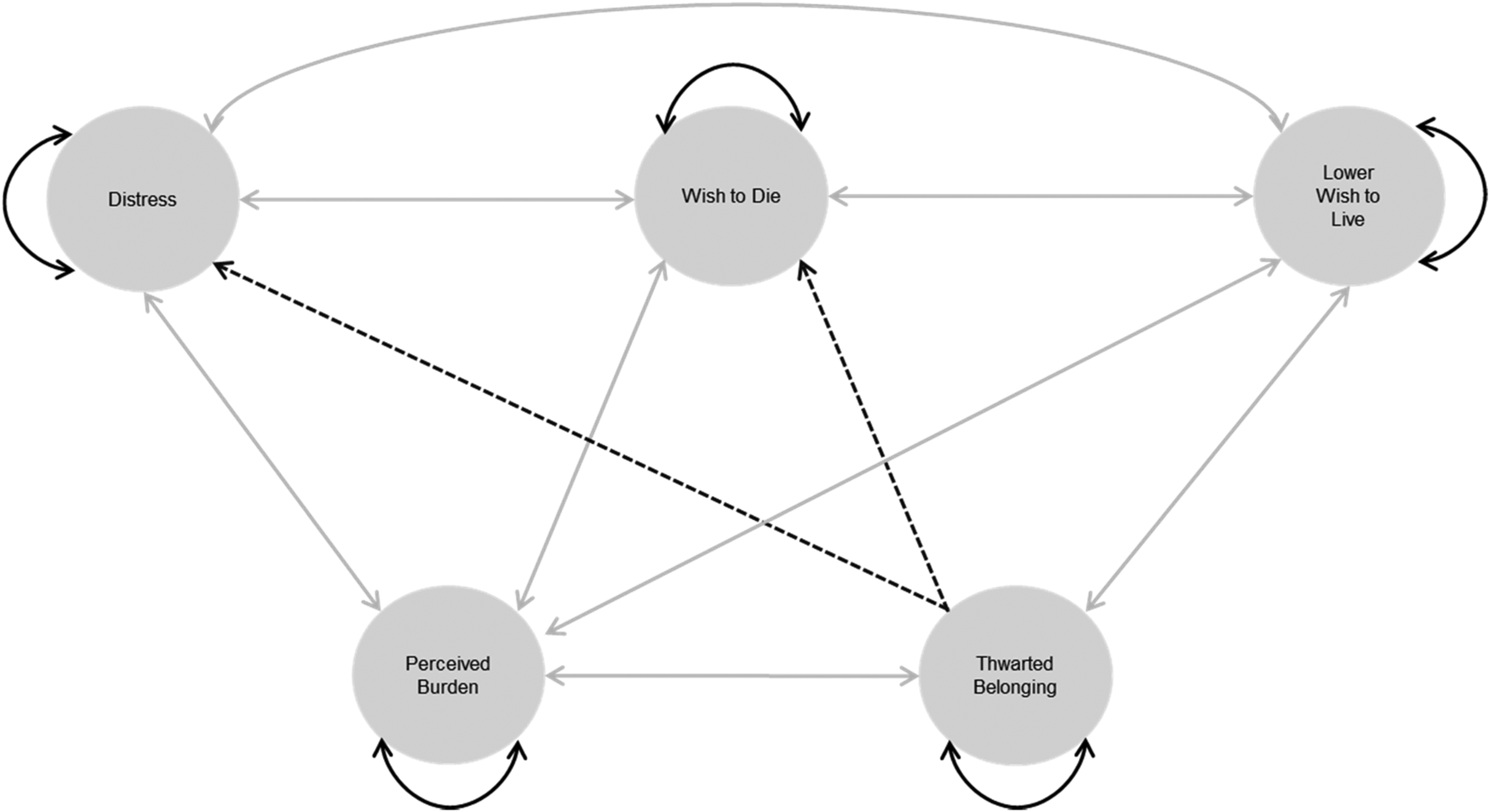
Cross-lagged panel models identified various reciprocal relationships between variables across the 2 days of assessment (Fig. 1). Of note, perceived burdensomeness was reciprocally related to psychological distress, wish to die, and wish to live, indicating they may influence each other day-to-day (online Supplementary Table S1). Thwarted belongingness, on the other hand, had unidirectional relationships with psychological distress (B = 0.13, β = 0.06, p < 0.001) and a wish to die (B = 0.01, β = 0.04, p < 0.001), and a bidirectional relationship with wish to live. As expected, psychological distress, wish to die, and wish to live were all reciprocally related from T1 to T2.
Cross-lagged panel model assessing associations between psychological risk factors across the 2 days of assessment (T1 and T2). Grey bi-directional lines indicate reciprocal relationships between variables from T1 to T2, while black dotted arrows indicate unidirectional relationships. Black curved arrows indicate significant autoregressive correlations.

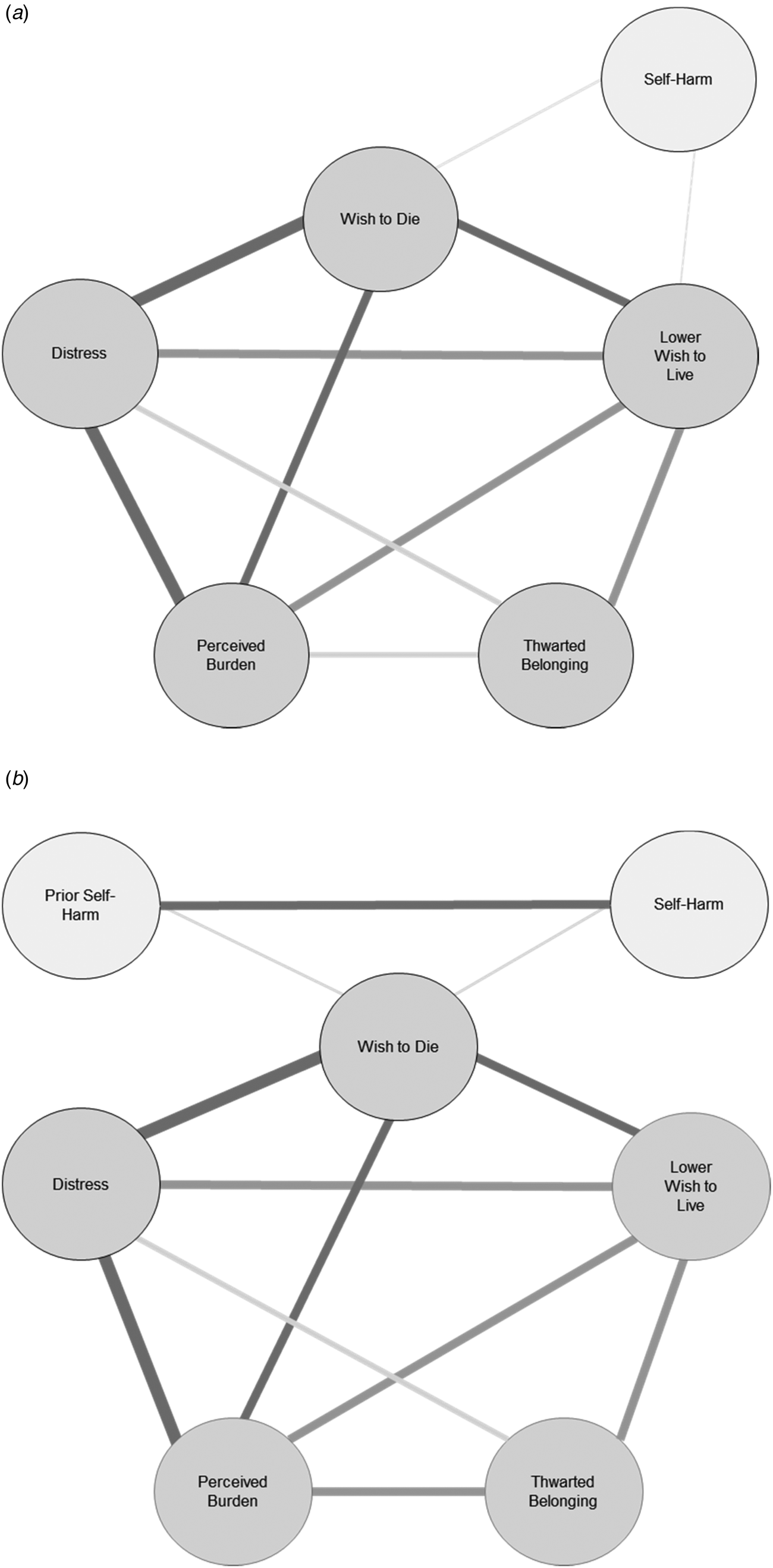
A network model assessed associations between self-reported factors, measured at T2, and self-harm (Fig. 2, panel a). As expected there were strong associations between a wish to live, a wish to die, and psychological distress. Wish to die had the highest strength (0.76), closeness (1.01), and betweenness (1.87) statistics, indicating strong direct and indirect associations with other variables within the network (online Supplementary Table S2). In addition, only a wish to die (r = 0.08) and wish to live (r = 0.04) were associated with self-harm in the model. Both burdensomeness (r = 0.20) and belongingness (r = 0.20) were associated with a wish to live, while only burdensomeness had a notable association with a wish to die (r = 0.24). In addition, psychological distress was strongly associated with both burdensomeness (r = 0.35) and a wish to die (r = 0.41). A second model included prior self-harm, which was associated with current self-harm (r = 0.20) and a wish to die (r = 0.04) (Fig. 2, panel b). Network patterns among self-reported psychological factors were found to be identical regardless of whether individuals self-harmed or not, indicating consistent associations between variables.
Two network models assessing cross-sectional relationships between risk factors at T2. Model A assesses relationships between self-report measures and self-harm, while Model B includes prior self-harm. Thicker and darker lines indicate stronger relationships.
Discussion
The current study explored the effectiveness of psychological factors and prior self-harm in prospectively predicting self-harm over short-periods. A key finding was that assessing a small index of items on a daily basis assisted in detecting a high number of self-harm incidents, and suggests various risk factors may be important targets for interventions. Specifically, daily increases in a wish to die and psychological distress were associated with an increased risk of self-harm. These findings are consistent with those from Kyron et al. (Reference Kyron, Hooke and Page2018) and Bresin et al. (Reference Bresin, Carter and Gordon2013) who found daily changes in suicidal ideation and negative mood significantly predicted self-harm. The current study synthesises the findings from both studies, and evaluates their effectiveness within a notably larger sample. These findings may reflect difficulties in regulating emotions, with self-harm being a behavioural manifestation (Anestis, Soberay, Gutierrez, Hernández, & Joiner, Reference Anestis, Soberay, Gutierrez, Hernández and Joiner2014).
The current study found a wish to live and die, and psychological distress were centrally related to self-harm and interpersonal adversity. A wish to die, like self-harm, may represent a desire to escape from psychological pain, and therefore it is unsurprising that the association between these variables was stronger in the current study (Baumeister, Reference Baumeister1990). A concurrent wish to live may represent an ambivalence between living and dying that may be an important aspect to consider in future self-harm research (Bryan et al., Reference Bryan, Rudd, Peterson, Young-McCaughan and Wertenberger2016). Changes in a wish to die and psychological distress were also significant proximal predictors of self-harm incidents, which suggests their potential benefit to prediction. Interventions which increase distress tolerance and problem solving may be an effective means to minimise risk of self-harm amidst periods of heightened distress (Joiner, Van Orden, Witte, & Rudd, Reference Joiner, Van Orden, Witte and Rudd2009).
Interpersonal factors were interrelated with changes in a wish to live and die, and psychological distress from one day to the next in the current study. This is consistent with research identifying reciprocal daily relationships between thwarted belongingness, perceived burdensomeness, and suicidal ideation (Kyron et al., Reference Kyron, Hooke and Page2018; Rogers & Joiner, Reference Rogers and Joiner2019). Thwarted belongingness and perceived burdensomeness represent specific interpersonal cognitions which can be targeted during interventions to minimise psychological distress and associated escape related thoughts and behaviours (Joiner & Van Orden, Reference Joiner and Van Orden2008; Joiner et al., Reference Joiner, Van Orden, Witte and Rudd2009). On the other hand, targeting psychological distress directly may be difficult, as identifying underlying causes may be require substantive exploration. Based on findings from the current study, fostering positive interpersonal relationships may strengthen a wish to live, and also reduce psychological distress and a wish to die linked to self-harm (Bryan et al., Reference Bryan, Rudd, Peterson, Young-McCaughan and Wertenberger2016).
A significant predictor of self-harm in the current study was a history of self-harm within the facility, consistent with prior research (Muehlenkamp & Gutierrez, Reference Muehlenkamp and Gutierrez2007; Ribeiro et al., Reference Ribeiro, Franklin, Fox, Bentley, Kleiman, Chang and Nock2016). Identifying prior self-harm may help in flagging patients with difficulties regulating emotions when confronted with daily stressors. It is important to note that the current study relied on a historical database of self-harm incidents within the facility, rather than self-report. While this in part overcomes the issue of socially desirable responding evident in self-report (Podlogar & Joiner, Reference Podlogar and Joiner2019), it prevents identification of self-harming behaviour prior to initial admissions at the facility or between visits. Regardless, the findings indicate that daily stressors and history of self-harm may assist in flagging at-risk patients.
A consistent problem with predictive models of self-harm is a low detection rate or a high number of false positives. The current study was able to detect the majority of self-harm incidents on the day they occurred. While the PPV in the current study was above that identified in some prior studies, there was still a large amount of false positives. Within a clinical setting, false positives represent a relatively small proportion of overall patients when assessed daily. Patients falsely predicted to self-harm may nonetheless benefit from support, and could also be at-risk of future self-harm. Preventative efforts within a clinical setting may benefit from sensitive, rather than specific models in order to ensure that those at risk are identified and receive immediate care. The costs of not detecting self-harm both inside and outside of clinical settings (i.e. litigation and medical expenses) are significantly greater than the cost of providing support to an individual who may not be at-risk of self-harm (Kessler, Reference Kessler2019). Daily monitoring provides insights into who and also when incidents may occur, and a real-time alert system may be of benefit to timely interventions (Whipple et al., Reference Whipple, Lambert, Vermeersch, Smart, Nielsen and Hawkins2003).
The current study assessed associations between primary diagnoses and risk of self-harm. Compared to a primary diagnosis of an affective disorder, no significant associations were identified between other diagnoses and future self-harm. An important caveat is that information regarding comorbid diagnoses were not available in the current study, and may be an important confounding factor. For instance, concurrent borderline personality and anxiety disorder symptoms have been linked to increased rates of self-harm when compared to either alone (Turner et al., Reference Turner, Dixon-Gordon, Austin, Rodriguez, Rosenthal and Chapman2015). Future research into prediction and understanding of self-harm may benefit from the evaluation of comorbid diagnoses.
Limitations and directions for future research
There are several limitations to the current research. First, the use of brief measures to assess cognitive and emotional risk factors may not have fully captured aspects of a patient's mental health, although they have shown to be strongly related to more comprehensive measures in prior research (Dyer et al., Reference Dyer, Hooke and Page2014). Second, there was some inconsistency with regards to when a patient completed self-report questionnaires. The majority of patients answered questionnaires at similar times each day, yet, differences in the periods between assessments may have impacted results. Third, self-harm events occasionally occurred before self-report measures were completed (11.4%). However, Armey et al. (Reference Armey, Crowther and Miller2011) found negative affect tended to remain heightened for several hours following self-harm, which suggests the findings from the current study still hold merit. Fourth, it is difficult to determine the intent behind some self-injurious behaviour, and reliance on nurse's reports may have led to the incorrect classification of NSSI. In addition, self-harm may have gone undetected within the facility, which may understate predictive qualities of the model. Where suicide attempts were explicitly made aware, however, the model was effective at predicting each case.
The current study assessed a combination of proximal (i.e. daily self-reported interpersonal adversity) and distal risk factors (i.e. history of self-harm) for self-harm. However, other factors may prove useful in prediction, particularly when there is limited information available to clinicians upon preliminary admissions. For instance, distress tolerance measured at admission may increase predictive capabilities by indicating patients at-risk of relying on maladaptive self-harming behaviours as a means to regulate their emotions (Anestis, Pennings, Lavender, Tull, & Gratz, Reference Anestis, Pennings, Lavender, Tull and Gratz2013). This may capture information not acquired by clinical staff during initial appointments, particularly with patients hesitant to open up to their diagnosing physician.
Conclusion
The current study suggests that routine monitoring of patients may prove useful in identifying short-term fluctuations in mood and interpersonal circumstances linked to an increased risk of self-harm. Such information may not be available through isolated risk-assessments, and could account for the inadequate capabilities of predictive models in prior research. Further, keeping comprehensive records of self-harm incidents within psychiatric facilities may help in predicting those at-risk in the future. These findings may be generalisable to high-risk psychiatric settings that lend themselves to routine monitoring, and should be replicated among the wider population. Despite promising signs, more research is needed to aid in efforts to reduce the ever-present issue of self-harm.
Supplementary material
The supplementary material for this article can be found at https://doi.org/10.1017/S0033291720000744.
Financial support
This research was supported in part by an ARC Linkage Grant (LP 150100503) and the Young Lives Matter Foundation – UWA.
Conflict of interest
None.