1. Introduction
The Magellanic Clouds have long been recognized as testbeds where we can explore the evolution of massive stars. Early studies showed that there was a progression in the number ratio of WN-type to WC-type Wolf-Rayet (WR) stars in going from the SMC to the LMC to the solar neighborhood, an observation that is consistent with the effect that metallicity should have on the evolution of massive stars (see Neugent & Massey Reference Neugent and Massey2019 for a recent review). Similarly, the relative number of WRs and RSGs have recently been compared to modern evolutionary models by Massey et al (Reference Massey, Neugent and Dorn-Wallenstein2021). Other examples are discussed by Drout & Massey (Reference Drout and Massey2015).
However, what we would really like to do is to compare the number and types of evolved massive stars (WNs, WCs, RSGs) with the number of unevolved massive stars as a function of metallicity. Diagnostics such as the “O/WR” ratio have long been presented by theoretical work, begging for comparison with observation. (An early example can be found in Maeder & Meynet Reference Maeder and Meynet1994; a more up-to-date example is Georgy et al Reference Georgy, Ekström and Meynet2012.)
Here we encounter a significant gap between what observations tell us and what we need to really evaluate modern models. The number of O-type stars is extremely difficult to determine–much harder than that of WRs or RSGs. (Of course, the number of WRs and RSGs are not easily determined either; our knowledge of the evolved massive star content of nearby galaxies has been built on decades of studies.) If what one is really after is the number of unevolved massive stars as a function of luminosity, then that is harder still, as you have to be able to estimate the temperatures well enough to get the bolometric luminosities. Photometry alone is not enough; spectroscopy is needed, but photometry is needed as a starting point for target selection. For details, see, for example, Massey (Reference Massey1998).
To remedy this, we have undertaken a UBVRI photometric survey of the SMC and LMC, using the 1-meter Swope telescope on Las Campanas. The CCD field of view is large, 29.7’ by 22.8’, but these nearby galaxies are quite impressive in angular extent, and complete coverage for the SMC and LMC requires 121 and 171 fields, respectively. We have now completed the broadband imaging part of the survey, and are re-imaging the galaxies using on-band and off-band H
 $\alpha$
and [OIII]
 $\lambda 5007$
interference filters. These will help identify previously unknown H
 $\alpha$
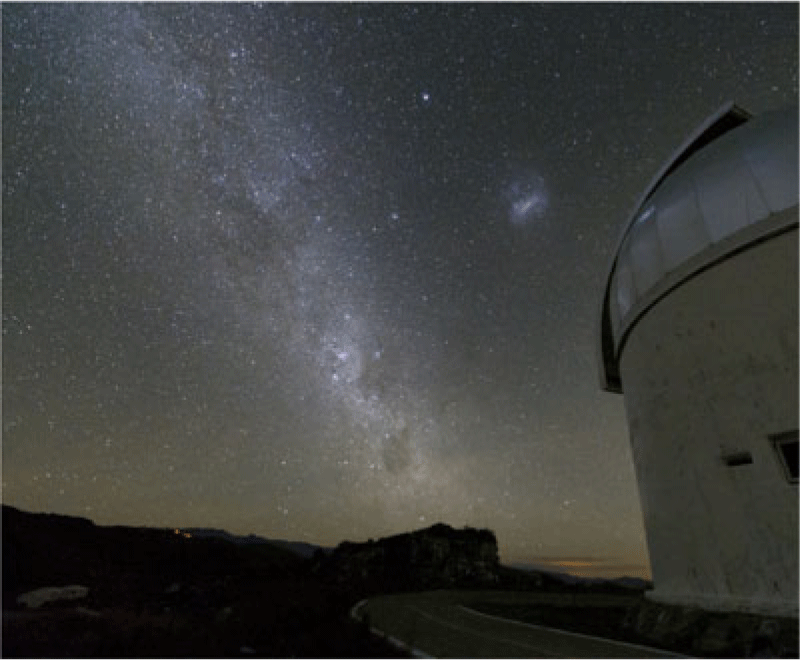
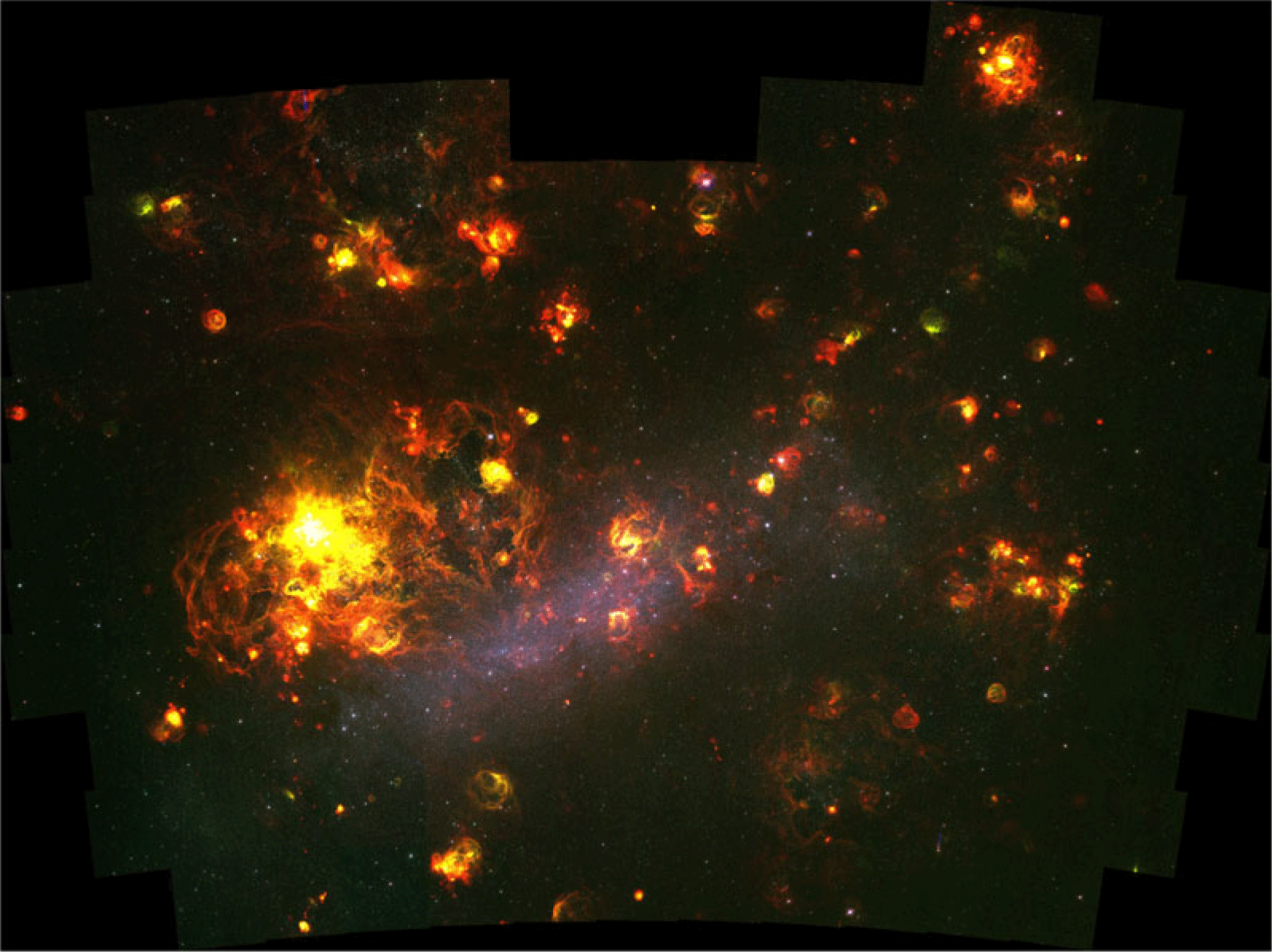
emission stars, including Luminous Blue Variable candidates. A mosaic of 150 of our fields is shown in Fig. 1, and a picture of the Swope in action is shown in Fig. 2.
Mosaic of 150 of our LMC fields. The resolution of this image has been degraded by a factor of 6; the individual images have a resolution of about 2". In this color composite, H
 $\alpha$
is red, [OIII] is yellow, and the V-band is blue.

The Swope 1-meter telescope observing the LMC. Photo by Kathryn F. Neugent.

We are grateful, as always, for the excellent help we receive on Las Campanas Observatory, and for support from the National Science Foundation through AST-2307594.
 α