The founding of the Ben Shemen Youth Village, in 1926, halfway between Tel Aviv and Jerusalem, is considered a landmark in the history of Zionism. Its founder, Siegfried Lehmann, a key figure in the history of education in Palestine-’Ereẓ Yisra'el, was awarded the Israel Prize for Education in 1957.
A great deal has been written about Ben Shemen, and academic literature indicates a number of ideological currents that influenced Lehmann's visionary educational perspectives. Among the influences usually cited are the teachings of the German Jewish thinker Martin Buber; socialist ideas and elements from anarchist theory; A. D. Gordon's theory of work; and finally and perhaps most importantly—the German youth movement, whose thinkers, such as Gustav Wyneken and Siegfried Berenfeld, inspired Lehmann's ideas of “youth culture” (Jugendkultur) and rural education.
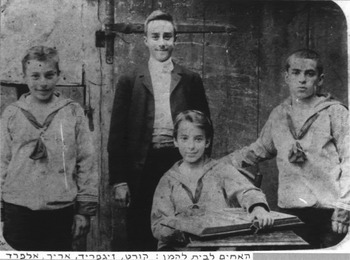
The brothers Lehmann, from right to left: Kurt, Siegfried, Erich, Alfred. Courtesy of Chanan Lehmann.

Surprisingly, the extensive literature about Ben Shemen fails almost entirely to recognize a major source of influence on Siegfried Lehmann: the works of his elder brother, Alfred Lemm. Lemm was a writer and essayist, close to expressionist and avant-garde circles, and later to the sphere of Buber and other Jewish Zionist intellectuals in Berlin. His premature death in 1918, at the age of twenty-nine, of the Spanish influenza, put an end to a unique intellectual career, and his writings were all but forgotten. And yet, a direct line leads from Alfred Lemm's vision to that of his younger brother Siegfried Lehmann, who put the ideal to practice in Ben Shemen, linking Ben Shemen's origins with the ideological preoccupations of German expressionists in the beginning of the twentieth century, and with a uniquely Jewish point of view regarding the crisis of the modern urban experience.
The connections between the cultural and artistic climate of early twentieth-century Germany and the Land of Israel, as seen through the story of Lehmann brothers, reveal German Zionism as more than a reaction to antisemitism and identity dilemmas following assimilation—as it is usually viewed. It was also a solution to the overall stress of modern life, and a means for channeling messianic, utopian energies that bubbled up in European avant-garde circles at the beginning of the twentieth century. As a growing body of research has shown in recent years, the cultural and ideological climate in central Europe played an important role in the development of ideas and trends in the Yishuv in the first third of the twentieth century.Footnote 1
Lemm the Expressionist Writer
Alfred Lemm was the pen name of Alfred Lehmann, who was born in 1889 to an assimilated German Jewish family in Berlin. While the two younger brothers (out of four)—Alfred and Siegfried—did eventually find their way to the cultural circle of Martin Buber, Jewish identity was not emphasized in the Lehmann home.Footnote 2 Indeed, Lemm's literary writing—unlike his later essays—did not explicitly engage with any Jewish issues or themes. Its subjects are rather those typical of expressionist writing of the first two decades of the twentieth century: a pessimistic portrayal of modern urban life, themes of alienation and violence, and the denunciation of dehumanizing aspects of bureaucracy and industrialization.Footnote 3
It is important to note that although Lemm is hardly mentioned in scholarly discussions of German literature, and only one of his short stories was ever included in an anthology of expressionist prose,Footnote 4 he actually was, during his short lifetime, a well-known figure in Germany's literary circles. His literary articles were published in highly esteemed journals, and he maintained ties with many writers and thinkers, including Buber, Annette Kolb, Kurt Hiller, and Hermann Kazac.Footnote 5 Thomas Mann found “something grotesque, filled with spirit,” in his short stories. At times, Mann even identified in Lemm “the traces of a disciple or a successor.”Footnote 6 Franz Kafka was familiar with Lemm's writing, and in a letter to his fiancée Felicia, wrote that Lemm “is fantastic to the point of evasiveness … yet sincere, consistent and capable.”Footnote 7
Like many of his contemporaries, Lemm's literary work reflects a personal quest to break away from his bourgeois upbringing and find refuge in the avant-garde margins of European society. One of his best-known stories, and the only one that was included in a later anthology of expressionist prose, is called “Flight from the World” (“Weltflucht,” 1914).Footnote 8 It opens with the funeral of Henry, a gentle twenty-six-year-old man who had committed suicide. None of his acquaintances saw it coming, and none of the characters is directly responsible for Henry's death. In fact, it is not entirely clear what pushed him to do the deed, “throughout his life, there was no dramatic experience or great event that oppressed him. It was what little he saw when looking right and left from his tranquil path, small but highly significant tastes of reality, that contained enough for the decision to take shape in his heart. Carrying it out was far easier than the commitment to maintain his existence, an existence that incessantly demanded a downscaling of the exalted kingdom of his soul.”Footnote 9
The story was originally included in a collection entitled Murder (Mord), suggesting that Henry only apparently committed suicide. Rather, his sensitive soul was a victim of modern life. The “small but highly significant tastes of reality,” which affected Henry so terribly that he decided to take his own life, were daily events in the city: the obtuse workings of a legal firm; people fighting to the point of bloodshed over a place on the last train. Modern people are so inured to such things that they no longer notice them, but a sensitive soul like Henry's is incapable of bearing the successive shocks that come with the tumult and alienation of a big city.
Lemm's good-hearted, naïve heroes experience modernity as a double trauma: on the “objective” level, they are shocked by the new technologies and intensity of urban life; and on the “subjective” level, they experience modern manners as a moral disaster.Footnote 10 They do not have the necessary tools for coping with reality; they lack the ability to distance themselves emotionally, and above all lack the willingness to compromise. A sense of suffocating in the world is common to most of Lemm's heroes, and death is often their sole escape.Footnote 11
Lemm wrote most of his stories between 1912 and 1917, before and during the First World War.Footnote 12 Like many other expressionists, he often chose marginal figures who symbolize the social crisis, such as prostitutes, or sick or crazy people, as the protagonists of his stories. Drawing attention to these marginal groups enabled writers to sharpen the relativity of bourgeois norms and values, so that normative society was presented as sick while those at its margins were depicted as “speakers of truth.”Footnote 13 Lemm's characters live on the borders of society. They come from the bourgeoisie, but choose to live according to other codes. They include, for example, Salomea, a Jewish medical student who willingly becomes an unpaid prostitute for soldiers in World War I, and Reinhold, a young sales clerk, who finds himself lonely and miserable because of his refusal to adjust to accepted norms.Footnote 14
To this rather typical pathos, Lemm adds a singular touch and a unique irony in his only novel, Felician the Fugitive (Der Fliehende Felician).Footnote 15 The book, which was published in 1917, deals with the hero's self-exploration and with the alternative lifestyles available to his contemporaries. Whereas in his short stories Lemm criticized modern life and bourgeois society, in the novel he targets his critical arrows at the nonconformists themselves.
Felician, a young man belonging to the bourgeoisie and destined to marry soon—who in several respects can be seen as Lemm's double—is disgusted with the Gemütlichkeit (coziness) that characterizes the lifestyle of the German middle class, and flees to Paris. In the French capital, he joins a group of intellectuals from all across Europe. The group represents the artistic and political avant-garde of the era, namely everything that Felician always aspired to, but did not find in Germany: an uncompromising search for artistic and intellectual truth and a desire to change the world.
In Paris, too, Felician is quickly disillusioned with his new friends. Their art and their theories amount to nothing; there is no coherence in their ideologies, only a rejection of accepted norms and a permanent search for a new lifestyle. Their good intentions lead to moral dead ends, and all their initiatives end up in symbolic absurdities: the architect plans a house with no windows because “inwardness is more important than outwardness,” the poet's poems lose all structure and continuity, and the painter seeks to detach himself from material, “until he completely ceases to paint.”
Felician is disappointed with what the contemporary avant-garde intelligentsia has to offer, and as we shall see soon, this disappointment echoes to a certain extent Lemm's own feeling during the years the novel was written, just before the outbreak of World War I. But this is not the end of the way, and Felician's next station in his journey of discovery brings us closer to the utopist visions Lemm developed in his later essays regarding a possible future for European Jews.
After his disenchantment with Paris, Felician finds refuge in a rural colony. This colony is a rather faithful representation of the vitalistic ideology of the new reform movements (Lebensreformbewegungen) that were active in Europe around 1900. These held up the forces of life and untamed nature, as against those of science and reason, as a source of renewal and creativity. The “Philosophy of Life” (Lebensphilosophie) worshipped youth, body, and sexuality, and influenced both the expressionists and reform movements that turned to entirely different directions, such as the German youth movement and the educational reform movements (Reformpädagogik). These movements were also among the major influences on Siegfried Lehmann when he founded Ben Shemen. As we shall see, the idea of a rural colony also played a central role in Lemm's own program for the reeducation of German Jews, and appeared in several forms in many of his later essays.
Unlike the Parisian avant-garde, the rural colony is described in Lemm's novel as idyllic, with no sarcasm or irony: “In wise moderation they met here once or twice a week. … When they were at the colony, their specific professional areas of interest were pushed aside, and made room for the shared humanity that underlay them.”Footnote 16 For Felician, all this comes too late: he is a dismantled subject, and feels he is no longer capable of becoming a whole person. The happiness of the colony is not his; he is unable to share it, unable to be as simple and uncomplicated as the others. Brokenhearted, he leaves the colony and sets out on a journey of self-destruction; when he finally decides to return to Germany he is financially, physically, and emotionally ruined. His fiancée, who waits for him at the train station, receives only his dead body, frozen from snow in the railway car.
In his discussion of Felician the Fugitive, critic and author Max Brod (1884–1968) wrote that “Lemm does not offer us a way to escape…. we close this enthused book, rich and spectacular with nightmares, amazed that we were born on this planet.”Footnote 17 And indeed, a sharp sense of entrapment arises from the book. Lemm seems to say that the new century's avant-garde and reform movements have reached a dead end in their search for a new man and a new utopian society, but the path to the old bourgeois home was no longer an option.
War Brings a New Interest
Until 1916, Lemm hardly occupied himself with Jewish questions, and it seems that his Jewish identity was not particularly significant for him.Footnote 18 It was only in the middle of the First World War that he began to publish articles on Jewish subjects, joined the circle of cultural Zionists that gathered around Buber in Berlin, and became involved in the activities of the Jüdisches Volksheim, which his brother Siegfried had founded there. The change in subject came together with a change of tone: whereas Lemm's literature invariably leads the modern man to a dead end, in his essays concerning the Jews he refused to succumb to this kind of pessimism, and tirelessly endeavored to formulate new solutions for the “rootlessness” of urban Jewry. This transformation is closely related to Lemm's experiences during the war.
In its early stages, war spurred Lemm into action. Broad sections of the German population, including the intelligentsia, welcomed the war as a possible means of renewal and change. Like many of his fellow expressionists, Lemm initially supported the war, and volunteered to serve as a medic in Galicia during 1914 and 1915. After a few months, however, the numerous casualties and lack of decisive outcome, together with the unprecedented brutality of the fighting, caused many, including Lemm, to give up the illusion that the war might make way for the new world and social order they had hoped for. In 1915, the mood had already changed, and the expressionist press began to display, insofar as was possible within the limitations of censorship, antiwar and pacifist opinions.Footnote 19
Whereas prior to the war, explicit political stances were commonly avoided, and writers' conceptions of world change remained in the realm of literary utopia, the war drove many writers to crystallize their concepts of reform in concrete terms. Some turned to pacifist, antinationalist socialism, and participated in the socialist revolutions of 1918–19. Others turned to mysticism and Catholicism, and several turned to extreme right-wing ideologies.Footnote 20
Lemm, too, started looking for practical social solutions. His new activism was expressed in pacifist antiwar activity, which peaked with the publication of his essay “Concerning True Love of the Fatherland” (“Vom Wesen der wahren Vaterlandsliebe”).Footnote 21 The essay presented a moderate national outlook that recognizes the value of the German nation, as well as the value of other nations. Lemm even attempted to have the essay translated into French, so that it could be available to a foreign (“enemy”) audience.Footnote 22
But mostly, Lemm started expressing himself concerning the Jewish question. This new Jewish awareness can be traced to several circumstances that arose during the war. In two of his articles, Lemm himself described the growth of Jewish nationalism as a counterreaction to the antisemitic currents that characterized German nationalism during the war. Alfred wrote that German Jewish soldiers hoped that shared service at the front would strengthen the sense of cooperation between themselves and their non-Jewish comrades, and would prove German Jewish patriotism once and for all. Ironically, the nationalist revival only intensified the hatred of Jews, highlighting the differences between the groups.Footnote 23 The “Jewish Census” conducted by the Prussian government in late 1916, which was intended to examine the extent of Jewish participation in the war effort, was insulting to Lemm and his fellow Jews.Footnote 24
It is evident from Lemm's account of the events that growing antisemitism and a sense of insult drove him, along with other Jews, to explore their Jewish identity. This declared motivation does not exclude other explanations, which offer deeper insights into the nature of Western cultural Zionism. Dealing with the question of Jewish identity enabled Lemm to escape from the ideological dead end in which he had found himself before the war, as was reflected in his literary works. The war only deepened the existing crisis and stressed the urgency of finding a solution to the problems of modern life. Lemm's feeling that German and European society was caught in a blind alley, an opinion he had held before the war, along with the realization, during the war, that Jewish integration in Europe was unachievable, led him to seek new solutions. Like expressionist writers, who, in the wake of the war, directed the messianic utopian drive that characterized their movement towards socialist ideologies, Lemm directed his utopian reform drive toward Judaism.
Lemm's wartime experience also had a direct impact on his world view. During his military service in Galicia and Poland, Lemm had witnessed, for the first time, the religious communal lifestyle of eastern European Jews. As was the case with other Austrian and German Jewish intellectuals who encountered eastern Jewry (Ostjuden) for the first time during the war, such as Arnold Zweig, this contact left a deep impression on Lemm. It reinforced his Jewish awareness, and inspired him to envision a possible escape route from a previously hopeless situation. Lemm's enchantment with the “authentic” lifestyle of the Ostjuden was typical of certain circles of young educated German Jews. The leader of this trend was, of course, Buber.Footnote 25
Yet it is important to note that the war did not lead Lemm to lose interest in the questions that occupied him previously. It served as a catalyst and compass of sorts, directing him to turn his attention to the issues of Jewish identity and the future of German Jews. At the same time, he was active in the general German cultural scene to his last day, both as a writer and as a publicist commenting on social issues. The non-Jewish German press also published his articles on Jewish subjects, suggesting perhaps that his vision was of interest to those outside the German Jewish community as well.
Lemm the Jewish Thinker
In 1916, Lemm chose to publish his first article on a Jewish subject, “We German Jews” (“Wir Deutschjuden”), in Die Tat, a non-Jewish magazine run by editor and publisher Eugen Diederichs.Footnote 26 Both Lemm and Diederichs considered the issue to be within the paper's area of interest, and in line with the paper's platform, as defined by Diederichs, “[to include] whoever sincerely aspires to renewal of life” and to be open to innovations and ideological experimentation. Many other works, sometimes ideologically clashing, were published in this framework, including Buber's essay on the German mystic Meister Eckhardt, Gustav Wyneken's newspaper, and a series of articles by German volkist writers.Footnote 27 In Wilhelmine Germany, volkist/nationalist ideas could be published side by side with socialist ideas and Zionist ideas. But these movements all had something in common—they all rejected the bourgeoisie and sought an alternative order, while accepting the nonrational element of the universe.Footnote 28
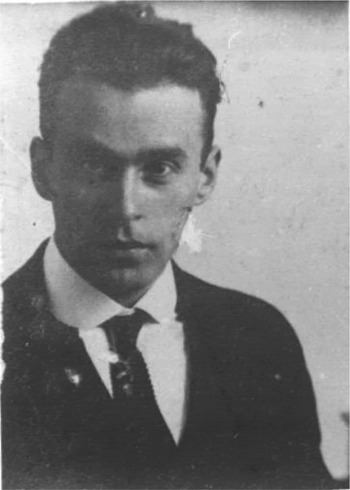
Alfred Lemm. Courtesy of Chanan Lehmann.

This choice of platform also demonstrates that Lemm conceived of cultural Zionism as an integral part of European reform movements. He even interpreted the romanticized attitude of the Buber circle toward eastern European Jews as a “Jewish translation” of pan-European tendencies to look to the “authentic” and “primitive” East in search of solutions to the cultural crisis. “Just as all western Europeans will turn to the East, apparently toward Russia, in order to gather from there new powers of healing, so too will western European Jews turn to their brothers in the East,” Lemm wrote in 1916.Footnote 29 While artistic avant-garde movements, from Paul Gauguin to expressionists, turned to “primitive” cultures in search of a preindustrial “natural” lifestyle, and the political avant-garde embraced the “gospel” of communism from Russia, western Jews' interest in eastern Jews did not represent the abandonment of European trends, but was more an act of integration. The Ostjuden were perceived as the “primitive,” “authentic” East of Judaism.Footnote 30
There is one more noteworthy factor explaining Lemm's turn to Zionism; while Lemm himself mentioned it just once, it illuminates his interest in Zionism in a different light. At the end of his last essay, “The Path of German Jewry” (“Der Weg der Deutschjuden”), Lemm contemplates an apocalyptic possibility: that German Jews may not be able to detach themselves from German culture and the detachment would be imposed on them, “If throughout the entire European Western world there would remain after the present war of destruction only … that same belligerent sort that brought about the current war, and that in the future will also rely always on external force, then Europe can no longer be considered [as a place for the development] of inner culture. [In such a case] the yearning of Jews today for Palestine already includes a notable part of Europe—as well as an escape from the world.”Footnote 31 In this final pessimistic contemplation, written in 1918, Lemm chose to describe the Zionist option as an “escape from the world” (Weltflucht, a term which could also mean “escapism”). This is also the name of one of Lemm's stories, in which the hero's suicide is the sole path of escape from the ills of European culture. Zionism, then, also serves as an escape route, an attempt to realize a European utopia outside ailing Europe.
Modern Jews and the Crisis of the Big City
As soon as Lemm turned his attention to the Jews' situation, he realized that they were suffering far more from the problems of the modern era. He described their special problem in the article “The Anticulture of the Big City and the Jews” (“Grossstadtunkultur und die Juden”).Footnote 32 In the modern world, wrote Lemm, God had been replaced by technology. Man discovered that technology functions better than divine powers, and subsequently cut all ties to heaven. Nothing is holy; everything comes with a price tag. Technology replaced metaphysics, politics replaced spiritual guidance, and everything is measured by the parameters of fortune and success. These changes are felt all the more in big cities, where the sheer mass of people drives individuals to live and act in order to maintain a certain image, rather than in order to meet their inner needs. Eccentricity is expressed in every aspect of one's life, in clothing, in language, and even in the way one seeks culture.Footnote 33
Lemm argued that Jews had become typical representatives of the ostentatious, artificial culture of the big city. However, contrary to widespread claims, the Jews did not cause these phenomena, but rather were their victims. Jews, according to Lemm, were especially vulnerable to modern distortion, as they had no anchor, neither in religion nor in the soil of a homeland, to validate their relevance.Footnote 34 Lemm then concluded that Jews needed a concrete plan of action, which they could attain by gradually disengaging from modern German European culture, strengthening their ties to the Jewish people, and in the future—returning to the soil of their homeland in Palestine.
Encountering the Ostjuden
Lemm's conclusion that Jews suffer twice as much from the maladies of modern life did not deepen his cultural pessimism. Although the war shook his world view, it also suggested, through his encounter with Galicia's Ostjuden, a way to Jewish renewal. In a series of travelogues published in the German press in 1916, Lemm described his experiences during his service in eastern Europe.Footnote 35 The Galician villagers appeared to be naturally rooted in their surroundings, Lemm wrote; in contrast, German Jews seemed to Lemm “rootless.” Nonetheless, he perceived the Jewish villagers' existence to be less detached than that of modern Jews in Germany, since “for religious Jews, religion compensates for the lack of a homeland and the lack of security in their existence. By means of the commandments and traditions they anchor themselves to life.”Footnote 36 While Lemm did recognize shortcomings in the Ostjuden’s lifestyle, he also perceived that the encounter between eastern European Jews and western European Jews held potential for the enrichment and renewal of Jewish life. “Jews from the East and the West will grant one another what each of them has lost over time: they will provide us with the capacity for growth without doubts together with the people's land; we will offer them unlimited humaneness,” he wrote.Footnote 37 His impressions of Jewish life in eastern Europe led Lemm to crystallize his utopian vision for solving the problems of German Jews, for which he coined the name Mittelland.
The Strains of German Jewish Identity
Lemm repeatedly argued that in order to preserve Jewish uniqueness, the Jews must detach themselves from German culture. Yet, underlining his deep ambivalence, he also felt that the majority of German Jews, including himself, were permanently attached to German culture (though not to German soil). “What can replace the German language for us?” he asked, and failed to find a reasonable answer.Footnote 38 Out of this dichotomy, a tragic, tortured position evolved.
In one article published in 1917, Lemm presented the deep involvement of Jews in German culture in a positive manner, as a somewhat messianic mission. Since Jews embody a synthesis of Eastern and Western traits—the practical and extroverted Western mind, together with the spiritual and introspective Oriental soul—their task is to bring about the spiritual renewal of Europe. (Buber's influence is clear here; Lemm had met him that same year, perhaps for the first time.)Footnote 39 However, this optimistic attitude seems to be the exception; most of his previous and later essays present Jewish involvement in German culture as a primarily negative phenomenon, which one should aspire to end. Unlike other thinkers of his era, and in contrast to narratives in contemporary research, Lemm did not view the German Jewish hybrid identity as ideal, but rather as a tragic reality, describing it with harsh words like “tragedy” and “curse.”Footnote 40
In his last essay, published in 1919, “The Path of German Jewry” (“Der Weg der Deutschjuden”), Lemm called on German Jews to choose between Jewish identity and German identity. Choosing German-ness means total assimilation, he explained, and this will eventually lead to the untraceable loss of Jewish uniqueness. Preserving Jewish uniqueness, claimed Lemm, is an instinct that stems from the self-preservation drive of man and race. In this last essay, Lemm made the distinction between Deutschjuden (Jewish Germans) and deutsche Juden (German Jews).Footnote 41 The former are emotionally tied to Germany, as is represented by the combination of Deutschtum and Judentum into one inseparable word, and emphasized by using a capital D, which signifies the priority of the German part of the complex. The term deutsche Juden, on the other hand, gives priority to the Jewish part, represented by the capital J, and this Jewish identity retains its independence. Symbolically, Lemm's goal can be described as turning as many Jewish Germans as possible into German Jews.
Having rejected the possibility of assimilation, Lemm called for immediate action to reinforce Jewish identity. He wanted to reform those Jews who had not lost touch with their past on eastern European or Palestinian soil, warning, however, that German Jews themselves will not succeed with the task of settlement:
From the Jewish German character, which was formed over generations … it is impossible to disconnect without maiming ourselves … even if we do not feel as German as the ethnic Germans [Volksdeutsche] [w]e have inhaled German-ness too deeply to be able to simply exhale it without damaging the airways.… We have not forgotten Jerusalem. But Germany, too, we cannot forget. Who will grant us a real homeland? Palestine is a precious memory for us, not a space that can be put to use … that we are as we are cannot be changed in one lifetime: if one portion is allowed to die, the whole will atrophy completely. We cannot shake off a tragedy that was slowly piled up over us in one swift motion, even if it takes a whole lifetime.Footnote 42
Gradually it becomes clear that Lemm did not strive to separate the Jews of Germany from German culture, but rather to separate the Jews of Germany from their children:
We ourselves, who are alive, have lost our way and are cursed. Only our progeny have some hope of redemption. What the Jews of Germany cannot realize for themselves, they must obtain for their children. … Spiritual separation between German Jews and their children is the conclusion they must draw if they wish to act for the health of the nation and still maintain their own spiritual integrity … they must sacrifice for the ideal of the future nation … in such a way that a certain spiritual distancing will prevail between them and their children.Footnote 43
The Mittelland
The idea of an intergenerational separation is the sole motif that recurs in all the versions of Lemm's vision, published in a series of articles in the Jewish and non-Jewish German press between 1916 and 1918.Footnote 44 In the earliest version of his plan, published in February 1916 under the title “Wir Deutschjuden,” Lemm proposed sending five- and six-year-old children to be educated in ’Ereẓ Yisra'el.Footnote 45 But already in the epilogue of the article, written six months later, Lemm made an important change in his position. During these six months, so he wrote, he had encountered eastern European Jewry. This inspired him to suggest that Jews from eastern and western Europe could collaborate to renew and strengthen Judaism, and he consequently proposed that eastern Europe could serve as an “interim land” (Mittelland), a transition station between Germany and the Land of Israel.
In the Mittelland, the Jews would establish a settlement and a Jewish educational system where German Jewish children would study from the outset of their formal education until they began university. The location of the Mittelland would allow the Jews of Germany to develop their Jewish identity gradually, without total separation from European culture and soil.Footnote 46
Lemm's critics argued that the idea of a Mittelland was “detached from reality.”Footnote 47 The Zionist writer (and Buber's future son-in-law) Ludwig Strauss attacked Lemm severely in the pages of the Allgemeine Zeitung des Judentums: “Regarding everything connected with the idea of a Mittelland, it seems to me that the evolutionary thoughts of the writer have distanced him from the factual picture. Eastern European Jewish culture is just as remote from western Jews as the new Hebrew culture that is now developing.”Footnote 48 Strauss went on to assert that the great differences between eastern European and Hebrew cultures prevent one from serving as a bridge to the other. Aside from these reasons, Strauss said the idea is impractical because it will not attract an adequately large public. He concluded his criticism by stating that for Zionists, the original option proposed by Lemm, sending their children to Palestine, remains available.Footnote 49
Lemm's ideas drew attention not only from the press: the radical students' group Der Aufbruch held a meeting to discuss Lemm's article in the Settlement House (Siedlungsheim). The group founded the Settlement House in Charlottenburg to serve as a meeting place for bourgeois students and the local working-class population. The house later served as a model for Siegfried Lehmann's Jüdisches Volksheim, the main difference being that Lehmann aimed his project at the Jewish public, with the additional goal of strengthening their Jewish identity.Footnote 50
Important figures from the literary expressionist circles and from the leftist factions of the German youth movement, among them Buber, socialist thinker Gustav Landauer, expressionist writers Kurt Hiller and Rudolf Kayser, and Ernst Joël, founder of Der Aufbruch, attended the discussion. All of them were Jews, and all of them had some sort of connection to avant-garde circles. The participants criticized Lemm for forgoing the attempt to redeem the current generation from its split identity problem, and choosing to “dump” the problem and its solution onto the next generation.
In a letter to Buber, Lemm responded to this critique and argued that in his view, the problem that requires treatment is not the redemption of individuals, but rather the redemption of the nation. “As for myself,” he added, “I am personally satisfied with my mixture. I do not wish to change myself at all.”Footnote 51 This declaration is inconsistent with other statements by Lemm, and shows the extent to which he was a man of many contradictions.
In his article titled “The Lack of Culture of the Big City and the Jews,” published in Buber's newspaper Der Jude several months later, Lemm continued to develop the idea of the Mittelland. He called for the establishment of a village (or city) in eastern Europe that would function as an exchange point between the East and the West. Jews from eastern and western Europe would rub elbows together in “colonies of the New Spirit,” in his words, in mixed communities of students, workers, and merchants, and develop the “future religion,” which would be based on the religious, supernatural inclinations of eastern European Jews, along with the humanistic thought of the West. Schools and universities would be established for German Jewish children in the new settlements, where western Jews with highly developed national awareness would teach, alongside Ostjuden with a Western education.Footnote 52 Classes would be taught in Yiddish, an interim language between German and Hebrew.Footnote 53 “That land will be a great filter through which, in a process of clarification that will last decades, a pure Judaism will trickle out once again,” Lemm imagined.Footnote 54
Whether due to dialogues he conducted with others about his ideas, or due to his personal experience, Lemm modified some of his positions, and eventually arrived at the conclusion that the gap between eastern and western European Jews was still too great to be bridged immediately. In “The Path of German Jewry,” he wrote that eastern European Jews are not sufficiently “advanced” in terms of religion, culture, and language. The Ostjuden had yet to internalize the developments of the (west) European spirit, and must develop further before German Jewry can join them without experiencing a spiritual regression.Footnote 55
In his last essay, Lemm actually retreated from the idea of a Mittelland, and instead suggested the establishment of educational centers in Germany itself, near the big cities. “In order to expose the youth to a living, popular influence, the educational institutions should be set up in a closed, rooted Jewish setting,”Footnote 56 detached as much as possible from the German environment, he asserted. The institutions would be built in a rural setting, since the urban environment did not permit spiritual renewal, yet in the immediate vicinity of cities with large Jewish populations, so that the children would be able to return to their parents' homes each night. Authentic eastern European Jews, who for some reason are not able to or are not interested in leaving Germany, would live in the educational settlement. Owing to their spatial and cultural separation from the German (and urban) environment, the process of their Germanization will be slowed, and these eastern Jews would serve as role models for the children. These centers would gradually become small settlements that would serve as the natural center for all those in Germany working for the future of the Jewish people. “The Jewish school colony [die jüdische Schulsiedlung] is the meeting and gathering place, indeed the center of life, of those coming and going to Zion,” Lemm wrote.Footnote 57
Lemm's Jewish educational center was to have two major functions. First, to provide Jewish education for young Jews; and second, to be a center for forming and promoting new lifestyles. Lemm envisioned that these youths would introduce innovations in the fields of religion, art, and science, and would propagate these innovations to the German Jewish world.Footnote 58 Lemm's view of the educational center as a “cultural laboratory” for the development of a new culture was influenced by the German pedagogue Gustav Wyneken. Many of Wyneken's students and followers were young Jews of bourgeois origin (including Walter Benjamin, Ernst Joël, and Siegfried Berenfeld). Lemm stated explicitly that the educational institution he advocated would resemble the school community envisaged by Wyneken.Footnote 59 Moreover, the rural colony Lemm described in the novel Felician the Fugitive bears a striking resemblance to the characteristics of Wyneken's school. But Lemm adopted only general ideas from Wyneken, not the details of ideal education, and his vision also differed in its overall clear goal of strengthening Jewish youth's identity.
During the years in which Lemm consolidated his vision, he proposed some alterations to his project, primarily regarding its physical location, but the core idea remained the same. Lemm's goal was Jewish renewal and reinforcement of Jewish identity among the future generation of German Jewry, by means of separation from modern German culture and the creation of an alternative nonurban lifestyle that will be shared by eastern and western European Jews. This goal was to be realized by building Jewish educational settlements, where German Jewish children would be educated by “Western” and “Eastern” Jews from a young age. According to Lemm's vision, the message of a new Jewish culture would stem from these settlements.
It was precisely Lemm's indecisive, compromising tendency that caused both “militant” Zionists and bourgeoisie to treat his proposals as a mere curiosity. However, within cultural Zionist circles, the project won serious attention, and his vision was mentioned in the same breath as other central ideas for strengthening Jewish education.Footnote 60 Lemm aspired to fulfill his vision, and even wrote Buber that he would be pleased if a man like Berenfeld would head the educational center in the future settlement.Footnote 61 At the time, the young Berenfeld was active in the Jewish youth movement in Vienna and in socialist organizations. Like Lemm, he too was influenced by Wyneken. Eventually, Berenfeld became an educator, a youth researcher, and a psychoanalyst. His writings and ideas influenced Meir Ya‘ari and Yaakov Hazan, who were among the leaders of the Hashomer Hatzair movement, through whom his educational ideas filtered into the kibbutz movement.Footnote 62
Lemm apparently intended to fully develop his vision of an educational settlement in a book entitled On the New Life Style and Its Realization in Settlements near the City (Vom Neuen Lebensstil und seiner Verwirklichung in der Siedlung neben die Stadt).Footnote 63 Unfortunately, the manuscript has been lost, and the content of the book can only be guessed at. Lemm failed to publish it before his death, and his widow's attempts to do so were unsuccessful.Footnote 64 From various extant references hinting at the work, it is impossible to conclude whether it dealt with a further development of the Jewish settlement idea, or with the crystallization of a universal, non-Jewish version of his vision.Footnote 65
At Lemm's funeral one of his friends eulogized: “The settlement idea was his Utopia, his theory of redemption, the declaration of his Garden of Eden … he was not impelled by a desire to flee from the world (as one of his stories is called), but rather by love of mankind: his settlement was to be located next to the city, there being no route of ‘return to Nature’; one can and should just proceed, according to our nature.”Footnote 66 But somewhat in contrast with this eulogy, Lemm's vision does not appear to have a utopian dimension; rather it is one of compromise: not the very best that could be imagined, but the best that can be aspired to in the present situation—a compromised utopia, born of the need to find a realistic solution, as it were, for those Jews who were unable to detach themselves from German culture.Footnote 67 To them, Lemm offered a compromise that was both spatial (only partial physical separation from Germany) and temporal (the vision was intended to be realized only in the next generation). His vision gradually retreated from the utopia of ’Ereẓ Yisra'el and grew closer to his intended German Jewish audience. Accordingly, Lemm's settlement proposal moved first from the Land of Israel to eastern Europe, and then from “the East” to a semirural settlement near the central European city.
Alfred Lemm and Siegfried Lehmann
Had Lemm been prepared to further compromise about the geographic location of his vision, the next requisite stage would be to found a Jewish settlement within a German city. In fact, on one occasion, his brother Siegfried presented the Jüdisches Volksheim, which he founded in Berlin in 1916, precisely in this way. The Volksheim was based on the model of settlement houses (somewhat equivalent to current-day community centers) that were established in that period in English-speaking countries. Their goal was to advance the living conditions of the working class, and to overcome class distinctions by means of “settlements” of middle-class students in poor neighborhoods. In the case of the Jüdisches Volksheim, a national goal was added to the social goals—to constitute a meeting place for eastern and western European Jews in a way that would be advantageous to everyone. Ostjuden would receive assistance and guidance in education, vocational training, welfare and leisure time activities, and western European Jews would have an opportunity “to join with these masses [eastern European Jews] from whom we wish to learn the Jewish language, Jewish customs, Jewish songs.”Footnote 68 In the establishment of the Volksheim, Lehmann and his colleagues were influenced by Buber's Zionist and Jewish teachings and by the socialist and communal ideology of Landauer.
In an article published by Lehmann in Der Jude upon the opening of the Volksheim, he explained that such centers provide not only social services, but also participate in building the nation by advancing the spiritual and physical renewal of the people. “Once we have accumulated experience and become established,” Lehmann wrote, “we will send our men and women assistants to eastern Europe, so they can use the knowledge they have acquired for establishing more Jewish settlements with the aid of local youths.”Footnote 69
“The missions that the German Jewish settlements will fulfill in the East are not yet sufficiently clear,” Lehmann admitted, but added that “a spectacular area of action has been opened here.” In a footnote, he refers to an article by Lemm (without noting that he is his brother), dealing with “the cultural significance of German Jewish settlement in the East.”Footnote 70 Lehmann thus presents his Volksheim as the first stage on the way to establishing Jewish settlements in eastern Europe, in accordance with Lemm's Mittelland vision presented the same year.
Indeed, Lehmann partially realized the plan to establish Jewish settlements in the East. After serving as a military doctor in eastern Europe in the last years of World War I, he remained in Kovno (Kaunas), Lithuania, and established an institution for homeless Jewish children, many of whom were war orphans. The establishment of the institution in Lithuania marked the beginning of Lehmann's focus on educational work with children and youth (in contrast with the Volksheim in Berlin, which was aimed primarily at adults).
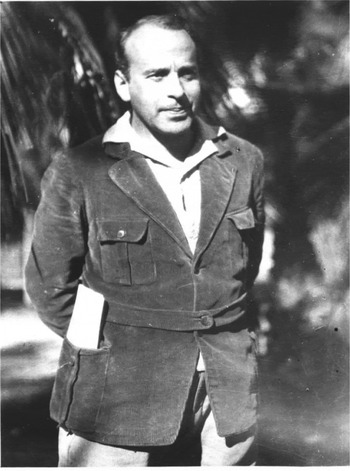
Siegfried Lehmann. Courtesy of Chanan Lehmann.

In a 1918 article, Lehmann applauded youth work and presented opinions in the spirit of German youth movement ideology.Footnote 71 In the article, published in Jerubaal—Eine Zeitschrift Der Jüdischen Jugend (Journal of Jewish youth, edited by Siegfried Bernfeld), Lehmann wrote that only youth have the potential to lead national and social renewal, a potential that would be realized only if they were allowed to develop independently, detached from their parents and from bourgeois society. The ideal solution was the education of young people in residential schools outside the city, where students and teachers would live together. This was an unrealistic solution, since few if any Jewish parents in Germany would agree to send their children to be educated outside the home, and in any case it would have been difficult to apply on a broad scale.
Instead, Lehmann suggested making do with the establishment of clubhouses, “youth home communities” (Jugendheimgemeinde), in and around the city, where youths could spend their free time.Footnote 72 During the school year, the youths would spend their afternoon hours at the youth home in the city, and during summer vacation, they would stay at the village home. At the youth homes, according to the plan, young Jews would study Jewish topics, socialism, philosophy, art, and music. They would garden, hike, and participate in musical and sporting festivities. Next to the village youth home, a small settlement would gradually grow, including an agricultural preparatory farm for those planning to immigrate to Palestine, with facilities for workshops and the like. “The settlement that would function initially only during vacations could later develop along lines similar to Alfred Lemm's project regarding ‘settlement near the city’ [Siedlung neben der Stadt], becoming a sort of residence for nationalist Jews with our tendencies, who for whatever reason are unable to emigrate to Palestine.”Footnote 73 The fact that Lehmann places the words, “settlement near the city” in quotations marks, and directly refers to “Alfred Lemm's project” may indicate that he is referring to Lemm's lost book, which bears the same title.
In the above instances, Siegfried Lehmann presented his plans as a modification of his brother's ideas. Moreover, although Lemm himself had gradually presented “softer” versions of his original vision, the theoretical proposals expressed in Lehmann's articles are even more compromised versions of Lemm's ideas. When his brother suggested operating in eastern Europe (1916), Lehmann proposed operating in Germany itself, and when Lemm suggested establishing settlements near German cities (1918), Lehmann proposed starting with settlements within the city. However, while Lehmann presented sober, practical tendencies in writing, examination of his activities shows that over the years he actually realized Lemm's most radical programs, with activities ranging from Germany to eastern Europe, and from there to Mandatory Palestine.
Lehmann's educational activity reached its climax with the establishment of the Ben Shemen Youth Village in 1927. That year he made Aliyah with fifty of his students from the children's home in Kovno, and they constituted the first group of students at Ben Shemen. If Lehmann had wondered, at the beginning of his educational career, whether Jewish parents would agree to transfer their children to external education, the crises of the twentieth century “solved” his problem. Most of the students at the youth village in its first decades were children whose fate was sealed. The war orphans from Lithuania were initially joined by children from poverty-stricken neighborhoods in Mandate Palestine, then by children who survived the Holocaust in Europe, and finally by Jewish children from Arab countries.Footnote 74
Lehmann sought to create a sense of home for these children, and to prepare them for life in ’Ereẓ Yisra'el. Anita Weiner, who has studied the history of the Ben Shemen Youth Village, described Lehmann's pedagogical mission. “The goal of his education [was] becoming a person with a four-fold connection: to the soil of his homeland, to his people and heritage, to humanity being renewed toward a society of cooperation and equality, and to He who is above man, the people and society.”Footnote 75 These metagoals were broken down into daily activity in the youth village. Lehmann hoped “to turn the displaced, the unattached, into a person with a relationship to the land” by training the pupils from an early age to perform agricultural work in the different sections of the farm on a daily basis.Footnote 76 As part of the aspiration to develop a youth culture, Lehmann encouraged student self-government and supported their involvement in decision-making. Great emphasis was placed on marking Shabbat and Jewish holidays and festivities, since Lehmann believed it important to preserve students' ties to Jewish tradition, and to develop a religious sensibility and respect for the transcendental; he also wanted to encourage them to fashion and shape their own rituals, and stressed the agricultural dimension of the Jewish holidays.Footnote 77
Scholarly literature about Ben Shemen indicates a series of individuals and currents that influenced Lehmann's educational perspective, and through them, the youth village. Buber's influence was expressed by affinity to Jewish sources and tradition, and abstention from affiliation with a particular movement or stream within the Zionist movement. Landauer's influence was expressed through belief in socialism and the integration of elements from anarchist theory into the idea of self-government for the youth.Footnote 78 From the German youth movement, and especially from Wyneken and Berenfeld, Lehmann drew the idea of “youth culture” (Jugendkultur) and rural education. A. D. Gordon's theory of work and the populist ideas of Dostoevsky and Tolstoy have also been cited among the sources of influence.Footnote 79
Interestingly, aside from a single sentence, the various writings detailing the history of Ben Shemen do not recognize Alfred Lemm's influence on his younger brother.Footnote 80 While Lehmann specifically mentioned the connection between his activity and his brother's vision, the ideological similarity between the brothers is more comprehensive. Lemm and Lehmann shared a world view, analyzed the reality of their times in a similar way, and agreed on the appropriate solutions for the problems of the period. Both were influenced by the same cultural climate, especially by the ideas of Buber, Landauer, and Wyneken, both believed in a unique infusion of Judaism, Zionism, and socialism, and they shared the same belief in rural education and in the importance of youth. Yet their ideologies bore more resemblance to one another than to any one of the original doctrines from which they drew.
For example, both analyzed the problems facing modern man, and specifically the modern Jew, similarly. This is clear when one compares Lemm's analysis of the problem in his article “The Jews and Anticulture in the Big City” with Lehmann's analysis in his article “Rural Education,” in which he wrote, “For reasons deeply linked with the problematic condition of man in our age … he is attracted to the city more than to the village. This is affecting the entire world…. Some philosophers of culture consider the creation of a new human type, a city-dweller detached from the ground, who is like a new nomad … entirely factual, lacking tradition, a molecule within a massive current, unconsolidated, unreligious, intelligent, sterile, wholeheartedly fed up with the peasant's life (Spengler).”Footnote 81 The four-fold connection—to the land, to the people, to humanity, and to the transcendent—that Lehmann sought to instill in his pupils, is reminiscent of Lemm's aspirations to reconnect modern western Jews both to an earthly dimension of their Jewish identity (in the form of a land and a people) and to the transcendent. But whereas for Lehmann, the tie to the universal human dimension is translated into the context of ’Ereẓ Yisra'el, including his aspirations for coexistence between Jews and Arabs, Lemm had interpreted this idea in the relevant context of his times—in opposition to the First World War.
Although one could continue to list the ideological similarities between the brothers' world views, the comparison may be summarized by suggesting that Ben Shemen constituted the realization of Lemm's vision in its most original, radical version. Ben Shemen was a new youth society in Palestine, where Jewish youths from around the world were to live together with their educators in a state of mutual inspiration. The youth village was established near the city, as far as possible from the influence of urban bourgeois culture, separate from parents, and aimed to build a new society, a new man, and a “new religion” (of non-Orthodox Judaism).
From German Expressionism to Zionism
The route leading from Berlin to Ben Shemen began in early twentieth-century Germany, with the cultural crisis and the imprint that it made on Lemm's expressionistic prose. Lemm's short stories expressed his displeasure with the norms and values of his period. His search for a better, alternative lifestyle among the avant-garde and reform movements is described in his novel Felician the Fugitive. Disillusionment with the avant-garde movement led Lemm to try to break the oppressive bonds of reality in a different way, and he volunteered to join the German army in the First World War. His military service in eastern Europe broadened his horizons in new, unexpected ways. The encounter with eastern European Jews, along with the antisemitism of his fellow soldiers, awakened his Jewish identity. In a series of articles on the subject, Lemm described what he saw as the ills of German Jewish identity and crystallized his Mittelland vision, which was his solution to these ills. This vision went through several metamorphoses and versions, and the Ben Shemen Youth Village can be regarded as an implementation of one of these versions.
Many of the artists who were identified with the expressionist movement in the fields of literature, poetry, and theater were of Jewish origin.Footnote 82 However, the question whether there was a substantial link between Jews and expressionism is highly debatable; certainly, many of the expressionist artists of Jewish origin did not concern themselves with Jewish matters and problems. Nevertheless, comparing Lemm's path with that of fellow expressionists of Jewish origin, who were, like himself, explicitly interested in Jewish questions, would be valuable.
Hans Otto Horch, for example, has studied discussions of Jewish identity and expressionist modernism that took place in the second and third decades of the twentieth century on the pages of Buber's newspaper, Der Jude. Jewish expressionist writers participating in the discussion presented a range of sometimes contradictory positions on the issue. Max Brod, for instance, attacked Jewish writers for escaping to individualism and seeking personal redemption, instead of working to realize utopic new societies outside the literary sphere.Footnote 83 Brod's opinion was that the only solution to the problems of Jewish identity was the practical implementation of Zionism in Palestine. Rudolph Kaiser, in contrast, presented a pro-Diaspora position, calling on Jews to continue wandering throughout the world, disseminating universal morality and serving as a bridge between East and West.Footnote 84 Alfred Wolfenstein also saw the Jewish Diaspora as a spiritual mission.Footnote 85 Wolfenstein interpreted the messianic character of the expressionist movement as a secularized Jewish religiosity, or substitute religion, which expressed the crisis of the time as well as hope for rebirth.
Quite surprisingly, Lemm's position was closer to that of the non-Zionists, Kaiser and Wolfenstein, than to Brod's Zionist stance. Lemm believed that German Jewish artists made important contributions to European culture, so that Jewish artists' separation from European culture would be detrimental not only to their fellow Jews, but to the larger human sphere. In his articles, Lemm tried to present artists as special individuals, living on a higher spiritual level than the average western Jew. The solution he proposed for the rest of the Jewish community, therefore, would be inappropriate for artists.Footnote 86 According to Lemm's thinking, the artist need not develop Jewish awareness in order for this Jewish essence to be expressed in his work, for example through the varied usage of the German language.Footnote 87
Horch argues that despite their differences, all the Jewish expressionist writers relied on the Jewish messianic tradition, either in its activist version or in its internalized, mystical version.Footnote 88 He believes that this active urge to change the world using art or other means infiltrated through these Jewish artists, and affected the German expressionist movement as a whole.Footnote 89 Whether or not the messianic drive inherent to expressionism is specifically Jewish, as Horch claims, is debatable. But there is no doubt that a messianic aspect to expressionism exists. It is through writers such as Alfred Lemm that this messianic drive infiltrated from the expressionist movement to the Jewish sphere, and in particular to Zionism.
The rebellion against the older generation, the rejection of modern urban culture,Footnote 90 the emphasis on youth culture, the attraction to “the authentic” and the irrational, and ultimately, the activist messianic drive to repair the world, all characterize both the expressionist movement and Zionism. In the case of artists such as Lemm, who before their Jewish awakening were at home in German culture, the ideological development was from expressionism to Zionism. Their ideas of reform drew from the German reform and avant-garde movements, and they sought to apply them in the inner-Jewish sphere.
The entire expressionist movement underwent an upheaval in the wake of the First World War, and as a result, many expressionists moved from social and political criticism via literary means to activism. In this context, Lemm's turn to cultural Zionism in 1915 was not unusual, and reflects expressionism's general search for new social forms, a search that was expressed in various ways. While several expressionist writers turned to Zionism, including Max Brod, Arnold Zweig, and Ludwig Strauss, this was just one of the “solutions” adopted by Jewish intellectuals in reaction to the war.Footnote 91
Lemm's path from expressionism to cultural Zionism depicts Zionism as a possible solution to the European cultural crisis and as a realization of a European utopia outside European territory. Whereas in Europe the German Jew was primarily connected to the German language, the transition from Europe to ’Ereẓ Yisra'el meant a transition from grasping a language to holding land. In this sense as well, the story of the Lehmann brothers reflects that era: while Lemm remained in Germany and his ideas and work (in German) remained “on paper” alone, the ideological horizon he outlined in his writings was implemented in actuality by his brother on the soil of Palestine.
One might wonder what might have happened had Lemm lived longer. Would he have been able to detach himself from German culture to follow in his brother's footsteps, in the way he himself had outlined, taking the path from Germany to eastern Europe and from there to ’Ereẓ Yisra'el? Would he have remained tied to German culture?Footnote 92 As a German Jewish artist, Lemm felt he was confronted with an impossible choice. The twofold tragedy of his situation is expressed in Felician. Felician, his literary alter ego, failed to fit in at the idyllic rural settlement depicted in the novel, possibly because he arrived there at too late a stage in his journey of self-discovery. If we view the rural colony in the novel as representing the social utopias common in Germany in Lemm's day, then Felician's failure may represent the failure of Lemm the Jew to integrate within the German utopia. Another possibility is to view the rural colony as an embryonic version of the Jewish settlement Lemm envisioned for German Jews. This could lead us to interpret Felician's failure as the failure of Lemm the artist to integrate within the Jewish utopia. These two interpretations are not mutually exclusive, and both represent the same tragic, unsolvable element of German Jewish identity that recurs in Lemm's writings.