Introduction
Some studies have suggested that development of embryos depends largely on the quality of the oocytes from which they originate (Lonergan et al., Reference Lonergan, Rizos, Kanka, Nemcova, Mbaye, Kingston, Wade, Duffy and Boland2003; Rodriguez & Farin, Reference Rodriguez and Farin2004). However, there is also evidence that the environment to which the embryos are exposed during culture may affect their quality and viability (Van Soom et al., Reference Van Soom, Yuan, Peelman, de Matos, Dewulf, Laevens and de Kruif2002; Yuan et al., Reference Yuan, Van Soom, Coopman, Mintiens, Boerjan, Van Zeveren, de Kruif and Peelman2003). Different culture systems have been successfully used for in vitro production (IVP) of bovine embryos including serum/co-culture-based systems, serum-free systems, and systems in which serum is introduced after a few days of culture (Farin & Farin, Reference Farin, Crosier and Farin1995; Farin et al., Reference Farin and Farin2001; Hagemann et al., Reference Hagemann, Weilert, Beaumont and Tervit1998; Hasler, Reference Hasler2000; Thompson, Reference Thompson2000). However, the oxygen tension under which embryos are cultured in these systems differ markedly: 20% is normally used as culture atmosphere in co-culture conditions, whilst 5% oxygen is applied in cell-free culture systems, a condition that would be more similar to the oxygen tension found in the oviduct of most mammals (Fischer & Bavister, Reference Fischer and Bavister1993). It has been shown that a high oxygen tension results in an increased production of reactive oxygen species (ROS), which are known to have a damaging effect on cells (Johnson & Nasr-Esfahani, Reference Johnson and Nasr-Esfahani1994). This finding is confirmed by studies in various species that have shown a clear increase in embryo development in vitro when oxygen tension is reduced from 20 to 5% (Yuan et al., Reference Yuan, Van Soom, Coopman, Mintiens, Boerjan, Van Zeveren, de Kruif and Peelman2003; Adam et al., Reference Adam, Takahashi, Katagiri and Nagano2004; Kitagawa et al., Reference Kitagawa, Suzuki, Yoneda and Watanabe2004).
Different culture systems have been developed in order to ensure optimal environmental conditions for embryos, particularly related to the gas atmosphere. Suzuki et al. (Reference Suzuki, Sumantri, Khan, Murakami and Saha1999) reported the production of bovine embryos in vitro with a portable incubator using effervescent granules to obtain an optimum level of CO2 with low oxygen tension (8–10%). However, blastocysts rates from this system were only compared with a CO2 incubator in different atmospheres (3, 6 and 12% CO2) but not with low O2 tension (Suzuki et al., Reference Suzuki, Sumantri, Khan, Murakami and Saha1999). Other studies suggest the possibility to mature oocytes in vitro or to culture early embryos in incubators without CO2, leaving the culture plates in transparent plastic bags filled with the desired gas mixture (Bag System). With this system, similar rates of cleavage and blastocysts were obtained compared with incubators with controlled gas and temperature (Palma et al., Reference Palma, Olivier, Alberio and Brem1998). Likewise, the use of laminated foil bags filled with expired lung air or a mixture of 4% CO2 and submerged in a water bath (Submarine Incubation System), proved an efficient and economic alternative method for in vitro embryo production (Vajta et al., Reference Vajta, Holm, Greve and Callesen1997). Although some of these systems have been successfully implemented in several laboratories, there are no data available regarding a comparative effect on the quality and gene expression profile of embryos generated under these culture systems. The objective of the present study was therefore to evaluate the effect of different culture systems with low oxygen tension on the development, quality and oxidative stress-related genes of bovine embryos produced in vitro.
Materials and methods
Collection of ovaries, selection of oocytes and in vitro maturation
Ovaries were collected from a local slaughterhouse (Frigorifico Temuco). The cumulus–oocyte complexes (COC) were aspirated from the 2–7 mm follicles, using an 18-gauge needle and a vacuum pump set to 60–70 mmHg. Good quality oocytes having a corona of cells of at least four layers and a uniformly granulated cytoplasm, were selected and matured in TCM-199 (Sigma) medium, supplemented with 10% inactivated bovine fetal serum (HyClone) and 6 μg/ml luteinising hormone (LH) (Sioux Biochem), 6 μg/ml follicle stimulating hormone (FSH) (Sioux Biochem) and 1 μg/ml estradiol (Sigma), and then incubated for 22–24 h at 38.5 °C, in 5% CO2 and saturation humidity.
In vitro fertilization (IVF) and embryo culture
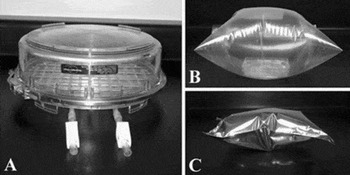
Matured oocytes and sperm were co-incubated for 18–20 h in IVF-TL supplemented with 0.2 mM sodium pyruvate, 6 mg fatty acid-free BSA and 0.025 mg gentamicin sulphate per ml (Parrish et al., Reference Parrish, Susko-Parrish, Leibfried-Rutledge, Critser, Eyestone and First1986). Final IVF- TALP contained PHE (2 mM penicillamine, 1 mM hypotaurine, 0.25 mM epinephrine) 2 μg heparin and 1 × 10⁶ Percoll separated frozen–thawed sperm per ml. Presumptive zygotes were stripped of cumulus cells via vortex and randomly assigned to the different culture systems. In vitro maturation and fertilization were conducted in 400 μl drops (50 COCs and/or eggs per well) at 38.5 °C and 5% CO2 in humidified atmosphere, while embryo culture was carried out in 100 μl drops (~45 embryos per drop) under mineral oil of KSOM–0.4% BSA medium (EmbryoMax®, Chemicom International, USA) at 38.5 °C and 5% CO2, 5% O2 and 90% N2, in a humidified atmosphere. The culture systems assessed were: (1) incubator chamber (Billups-Rothenberg, USA); (2) plastic bag (low-density polyethylene, LDPE); and (3) foil bag (metallized polyester plus low-density polyethylene, MP + LDPE) (Fig. 1). Both bags are regularly used in the food industry to maintain food fresh. Humidification was achieved by filling a 10-cm plastic plate with 5 ml of sterile water that was introduced inside the incubator chamber and by filling with 3 ml of sterile water between the wells of the 4-well culture plate (Nunc) in both plastic and foil bags. The gazing procedure was performed by filling the incubator chamber and the plastic bags with the gas mixture for 2 min and then by closing these systems with a clamp (incubator chamber) and heat sealing (plastic and foil bags). All culture systems were kept inside a water jacketed CO2 incubator (Nuaire) during the entire culture period, except for cleavage assessment.
Culture systems used for production of bovine embryos under low oxygen tension. (A) Incubator chamber (Billups-Rothenberg, USA); (B) plastic bag (model LDPE); and (C) foil bag (model PET.MET + PEBD).

Total number, cell allocation and TUNEL staining
A double-staining procedure was used to assess the total number of cells and their allocation to the trophectoderm (TE) and inner cell mass cells (ICM) in day 7 expanded blastocysts (Fouladi-Nashta et al., Reference Fouladi-Nashta, Alberio, Kafi, Nicholas, Campbell and Webb2005). Briefly, embryos were partially permeabilized with 0.2% Triton for 20 seconds and then immediately washed twice with PBS/BSA and incubated with 10 μg/ml propidium iodide (Sigma) for 5 min at 37 °C to stain the TE cells. Then, to fix and stain all cells, embryos were washed twice in PBS/BSA and incubated for 30 min at ambient temperature in 4% paraformaldehyde containing 10 μg/ml of Hoechst (Sigma). For the TUNEL assay, embryos were additionally permeabilized for 5 min with 0.1% sodium citrate containing 0.1% Triton, washed twice with PBS/BSA and incubated with labelling reagent according to the manufacturer's instructions (In Situ Cell Death Detection Kit, Fluorescein, Roche). Finally, embryos were mounted onto a glass slide on drops of 10 μl of anti-fade and examined under an epifluorescence microscope (Nikon Eclipse TS100) coupled with UV-2E/C DAPI and/or EGFP filters. Positive control for TUNEL was carried out by treating embryos with 75.4 U DNase I for 15 min at 37 °C before the TUNEL assay, and negative control by incubating embryos with the fluorescence labelling reagent in the absence of the terminal transferase dUTP enzyme.
Quantification of reactive oxygen species (ROS)
Quantification of ROS was carried out according to Moss et al. (Reference Moss, Pontes and Hansen2009). Briefly, the embryos were incubated in their respective treatments for 1 h in KSOM-0.4% BSA containing 10 μM of 5-(and-6)-carboxy-2,7′-dihydrofluorescein diacetate (H2DFFDA, Invitrogen). The embryos were washed four times with PBS containing 1 mg/ml of PVP and 0.9% NaCl (PBS-PVP) and immediately deposited individually in drops of 50 μl of PBS–PVP and examined with an epifluorescence microscope (NIKON eclipse TS100, Mercury Lamp Illuminator) with FITC filter. Images were acquired with automatic camera tamer-1 software (ACT-1, NIKON), using the same settings to capture all images. Average fluorescence intensity (with respect to the total area) was measured using the National Institute of Health ImageJ software programme (available at www.rsb.nih.gov/ij/), using the circle-drawing tool and selecting manually the total area adjacent to the inner side of the zona pellucida. The experiments were replicated twice using 10 embryos each time point per treatment (60 embryos total analysed). Positive control was carried out by incubating embryos before the assay with carboxy-(H2DFFDA) with 2% of H2O2 and the negative control by incubating only in KSOM–0.4% BSA.
RNA extraction, reverse transcription and gene expression analysis
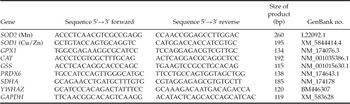
RNA was extracted from a pool of five expanded blastocysts (three replicates per treatment) using the PicoPure™ Kit (Arcturus) according to the manufacturer's instructions. RNA was kept frozen at –80 °C in the kit's extraction buffer until all samples were collected for analysis. The reverse transcription assay was carried out by using the RevertAid™ H Minus First Strand Kit (Fermentas, Life Sciences). Quantitative real-time PCR (qRT-PCR) was carried out to analyze a panel of six oxidative stress-related genes: (i) superoxide dismutases 1 and 2 (SOD1, SOD2); (ii) glutathione peroxidase 1 (GPX1); (iii) glutathione synthetase (GSS); (iv) catalase (CAT); and (v) peroxiredoxin-6 (PRDX6), using ‘Brilliant® II SYBR® Green QPCR Master Mix’ (Stratagene) in a thermocycler MX3000P (Stratagene). Primer sequences are shown in Table 1. The comparative Ct method was used for quantification of mRNA expression levels using the amplification efficiency of each gene as a correction factor (Livak & Schmittgen, Reference Livak and Schmittgen2001). As reference genes, we used SDHA, YWHAZ and GAPDH genes (Goossens et al., Reference Goossens, Van Poucke, Van Soom, Vandesompele, Van Zeveren and Peelman2005), after being previously analysed with the geNorm Visual Basic Application Program for Microsoft Excel, as described by Vandesompele et al. (Reference Vandesompele, De Preter, Pattyn, Poppe, Van Roy, De Paepe and Speleman2002), confirming their stability under our laboratory conditions (data not shown). To measure the differences in expression between the different culture systems, we used the pair-wise fixed reallocation randomization test in the Relative Expression Software Tool (REST; V2.0.7, Copyright 2008, Corbett Research Pty. Limited) (Pfaffl et al., Reference Pfaffl, Horgan and Dempfle2002). The hypothesis of no difference between groups was the null one (HO) and the differences were considered statistically significant when the probability of the alternative hypothesis [P(H1)] was <0.05.
Primers used in quantitative Real time PCR (qRT-PCR)

Statistical analysis
Data analysis was carried out by descriptive statistics based on average and standard error calculated for each of the variables using Stat graphics Plus 5.1 Software. One-way ANOVA was used to test for statistically significant differences (p < 0.05) among groups. In cases where statistically significant differences were observed, the least significant difference test (LSD) was invoked to determine where those differences existed.
Results
Development and quality of embryos cultured under low oxygen tension
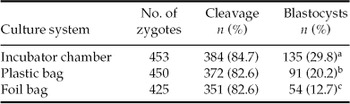
The results of 10 replicates with a total of 1328 oocytes cultured in the incubator chamber, plastic bag and foil bag, showed no differences in the cleavage rate at 72 h of culture in any of the treatments assessed (84.7, 82.6 and 82.6% for incubator chamber, plastic bag and foil bag, respectively) (Table 2). However, significant differences were observed in the rate of blastocysts on day 7 (p < 0.01). A larger proportion of embryos reached the blastocyst stage when they were cultured in the incubator chamber (29.8%) as compared with embryos cultured in the plastic bag (20.2%) and foil bag (12.7%) (Table 2). Although no differences were observed in the total number of cells of expanded blastocysts cultured in the different systems (148.8 ± 11.0, 155.4 ± 717.6 and 130.3 ± 8.0 for the incubator chamber, plastic bag and foil bag, respectively) or in the TE cells (103.7 ± 10.9, 126.2 ± 17.7 and 95.7 ± 10.5 for the incubator chamber, plastic bag and foil bag, respectively), the ICM cells and the ICM:total cell ratio, were significantly affected by the culture system, particularly in the plastic bag (Table 3). Embryos cultured in the incubator chamber showed a higher number of ICM cells (45.1 ± 3.0) and a higher ICM:total cell ratio (31.4 ± 2.7), than embryos cultured in the plastic bags (29.2 ± 6.4 and 19.5 ± 4.2, respectively) and foil bags (34.5 ± 5.2 and 27.7 ± 4.6, respectively) (Table 3).
Effect of culture systems with low oxygen tension on in vitro development of bovine embryos

Cleavage and blastocyst rates (10 replicates) were registered at 72 and 168 h, respectively. a,b,cData followed by different letters in the same column are significantly different (p < 0.01).
Effect of culture systems with low oxygen tension on the total number of cells, inner cell mass (ICM), trophectoderm (TE) and apoptosis

Cell counts were registered at 168 h in expanded blastocysts (nine blastocysts for each treatment).
a,bData followed by the different letters in the same column are significantly different (p < 0.01).
Quantification of apoptotic nuclei
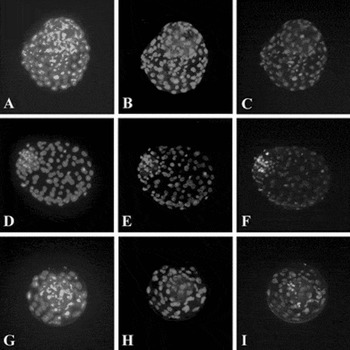
TUNEL assay carried out in blastocysts generated by the different culture systems showed a significant increase (p < 0.01) in the number of apoptotic nuclei in embryos cultured in the gassed bags (plastic and foil bags, respectively) with a proportion (%) of apoptotic: total cells of 3.3 ± 0.5, 6.5 ± 0.7 and 8.8 ± 1.1 for the incubator chamber, plastic bag and foil bag, respectively (Table 3 and Fig. 2). Furthermore, a higher proportion of apoptotic nuclei were observed in both compartments of the embryo in the gassed bags as compared with the incubator chamber (Table 3).
Differential staining and TUNEL labelling of bovine embryos produced in vitro in different culture systems with low oxygen tension. Day 7 expanded blastocysts stained with Hoechst for total cells (A, D, G), propidium iodide for TE cells (B, E, H) and TUNEL assay for apoptosis (C, F, I). Incubator chamber (A–C), plastic bag (D–F) and foil bag (G–I). Magnification ×200.

Effect of embryo culture system on ROS production
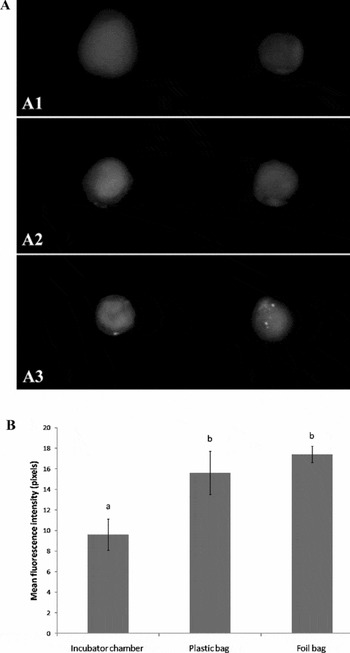
The ROS level measured by the average intensity of fluorescence (Fig. 3A) in day 7 blastocysts generated in the incubator chamber was significantly lower (p < 0.05) 9.6 ± 1.3, than the ROS level observed in embryos generated in the plastic bag (15.6 ± 1.8) and/or the foil bag (17.4 ± 0.7). No difference in the ROS level was observed (P > 0.05) between embryos generated in the plastic and foil bags, respectively (Fig. 3B).
Reactive oxygen species (ROS) in day 7 blastocysts. (A) Microphotographs of two blastocysts representative of each culture system assessed, stained with H2DFFDA. (A1) Incubator chamber, (A2) plastic bag and (A3) foil bag. (B) Effect of culture systems on ROS production measured by the average fluorescence intensity in blastocysts cultured in the Incubator chamber, Plastic bag and Foil bag, respectively. a,bData followed by different letters on the bars are significantly different (p < 0.05).

Gene expression analysis
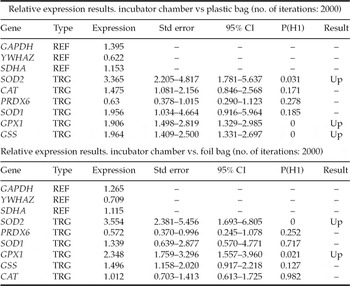
Gene expression analysis of ROS related genes in day 7 blastocysts, showed a higher expression of SOD2 (p < 0.05), GPX1 (P < 0.01) and GSS (P < 0.01) genes, in embryos cultured in the plastic bag, as compared with embryos cultured in the incubator chamber, while no differences were observed in the expression of CAT, PRDX6 and SOD1 genes (Table 4). In the case of the foil bag, a higher expression of SOD2 (p < 0.01) and GPX1 (p < 0.01) genes was observed as compared with embryos cultured in the incubator chamber, while no differences were found in the expression of the CAT, PRDX6, GSS and SOD1 genes (Table 4).
Analysis of gene expression in day 7 blastocysts using the REST program with the geometric mean of three reference genes (GAPDH, YWHAZ and SDHA)

Discussion
The majority of laboratories working with embryo technologies, such as IVF or somatic cell nuclear transfer that require culture conditions with low oxygen tension (5% O2, 5% CO2 and 90% N2), has implemented alternative physical systems to the more expensive conventional CO2 and/or Multigas CO2/O2/N2 incubators. These alternative systems have the advantage to prevent the alterations to the environment of embryos due to the constant opening of the incubators, which may generate cumulative negative effects on the embryos, reducing their developmental potential and viability (Vajta et al., Reference Vajta, Holm, Greve and Callesen1997). Furthermore, the replacement of serum/co-culture-based systems by cell-free culture systems made also necessary to implement culture conditions with low oxygen tension, ok it had been previously demonstrated that when embryos were cultured in the absence of somatic cells, the high oxygen tension generated harmful effects on the development of embryos (Fukui et al., Reference Fukui, McGowan, James, Pugh and Tervit1991).
For the culture conditions with low oxygen tension, a number of devices have been developed that fulfill these requirements, including impermeable bags that are filled with the desire gas mixture (Vajta et al., Reference Vajta, Holm, Greve and Callesen1997 Palma et al., Reference Palma, Olivier, Alberio and Brem1998;). However, in the present study our results showed that not all of these systems are suitable for generating high quality bovine embryos. In fact, we observed significant differences in the rate of blastocysts, the incubator chamber being more efficient than the gassed bags evaluated here (plastic and foil bags, respectively). Although the quality of embryos generated in these culture systems, measured by the total number of cells, was within the normal range for blastocysts generated in vitro (Koo et al., Reference Koo, Kang, Choi, Park, Kim, Oh, Son, Park, Lee and Han2002), the ratio of ICM:total cells was lower in blastocysts cultured in gassed bags, while the incubator chamber showed a ratio closer to the values observed in blastocysts generated in vitro or in vivo (Koo et al., Reference Koo, Kang, Choi, Park, Kim, Oh, Son, Park, Lee and Han2002).
The ICM cells contribute to all embryonic tissues and to some extent to the extraembryonic membranes, while TE cells contribute mainly to the formation of the external layer of the placenta (Gardner, Reference Gardner1989). Thus, both cell lines are of vital importance for the survival of the embryo and further development of the foetus (Hardy et al., Reference Hardy, Handyside and Winston1989). Furthermore, it has been shown that the proportion of ICM cells in blastocysts is crucial for implantation (Iwasaki & Nakahara, Reference Iwasaki and Nakahara1990), and increased cell death in these cells will compromise subsequent development, since critical threshold numbers of ICM cells are required for normal post-implantation development (Tam, Reference Tam1988). Our results suggest that these gassed bags generate an aberrant distribution of cells in these compartments of the embryo, which could be due to an abnormal compaction and allocation of the cells to each cell line, a loss of ICM cells due to an increased of apoptosis or an increased proliferation of TE cells. In fact, the level of apoptosis observed in embryos cultured in the gassed bags were significantly higher than those of the incubator chamber and higher than the levels observed in other studies using culture conditions with low oxygen tension (Van Soom et al., Reference Van Soom, Yuan, Peelman, de Matos, Dewulf, Laevens and de Kruif2002 Yuan et al., Reference Yuan, Van Soom, Coopman, Mintiens, Boerjan, Van Zeveren, de Kruif and Peelman2003;). Furthermore, a higher proportion of apoptotic nuclei were observed in the ICM and TE compartments of the embryos, which may explain the lower ICM: total cell ratio observed in the gassed bags as compared with the incubator chamber. These data are also in agreement with previous reports that show a predominant occurrence of apoptosis in the ICM of mouse and bovine embryos (Byrne et al., Reference Byrne, Southgate, Brison and Leese1999; Hardy, Reference Hardy1999; Yuan et al., Reference Yuan, Van Soom, Coopman, Mintiens, Boerjan, Van Zeveren, de Kruif and Peelman2003; Fouladi-Nashta et al., Reference Fouladi-Nashta, Alberio, Kafi, Nicholas, Campbell and Webb2005).
Consequently with these results, embryos generated in the gassed bags had significantly higher quantities of ROS (p < 0.05) than embryos generated in the incubator chamber, which might confirm this deleterious effect of ROS on the DNA integrity of cells (Johnson & Nasr-Esfahani, Reference Johnson and Nasr-Esfahani1994; Guerin et al., Reference Guerin, Mouatassim and Menezo2001; Orsi & Leese, Reference Orsi and Leese2001), although a potential toxicity effect of the plastic and foil bags that could have also generated an oxidative stress reaction cannot be ruled out at this time. A higher oxygen tension was previously observed to increase the level of ROS in cells and it was hypothesized to be a possible implication in the retarded growth of embryos (Johnson & Nasr-Esfahani, Reference Johnson and Nasr-Esfahani1994; Tarin, Reference Tarin1996). Oxidative stress can also be responsible for induction of apoptosis in embryos (Salas-Vidal et al., Reference Salas-Vidal, Lomeli, Castro-Obregon, Cuervo, Escalante-Alcalde and Covarrubias1998; Van Soom et al., Reference Van Soom, Yuan, Peelman, de Matos, Dewulf, Laevens and de Kruif2002; Yuan et al., Reference Yuan, Van Soom, Coopman, Mintiens, Boerjan, Van Zeveren, de Kruif and Peelman2003), which is consistent with the results observed here.
As stated earlier, oxidative stress in culture is one of the main reasons why mammalian embryos do not develop well in a 20% oxygen environment affecting key cellular functions including the control of gene expression of several genes (Correa et al., Reference Correa, Rumpf, Mundim, Franco and Dode2008; Mundim et al., Reference Mundim, Ramos, Sartori, Dode, Melo, Gomes, Rumpf and Franco2009). Therefore, in this study we sought to analyse the gene expression profile of six of the main genes associated with oxidative stress. Our results confirmed a significant increase in the expression of SOD2 (P < 0.05), GPX1 (p < 0.01) and GSS (p < 0.01) genes in embryos cultured in gassed bags, relative to embryos cultured in the incubator chamber, while no differences were observed for CAT, PRDX6 and SOD1 genes. SOD2 is an antioxidant enzyme located in the mitochondria and is involved in the protection of embryos against oxidative stress through the transformation of toxic superoxides, a byproduct of the mitochondrial electron transport chain, into hydrogen peroxide (H2O2), which is eliminated by CAT or GPX1 (Guerin et al., Reference Guerin, Mouatassim and Menezo2001). However, unlike CAT that acts only on H2O2, GPX1 enzyme has a wider spectrum of action suggesting a more important role in the protection of cells against ROS (Remacle et al., Reference Remacle, Lambert, Raes, Pigeolet, Michiels and Toussaint1992; El Mouatassim et al., Reference El Mouatassim, Guerin and Menezo1999). These results are in agreement with a recent study that describes a higher SOD2 and GPX1 expression level in embryos cultured in high oxygen tension, while CAT levels were unaffected (Correa et al., Reference Correa, Rumpf, Mundim, Franco and Dode2008). Using this option, the higher production of ROS observed in gassed bag culture systems, is probably due to an increase in the initial oxygen tension that results in a higher expression of GSS, SOD2 and GPX1, triggered to compensate for hyperoxia conditions, conditions that are known to increase the activity of oxidase enzymes that generate O2− in the cells (Guerin et al., Reference Guerin, Mouatassim and Menezo2001). This finding is also confirmed by previous studies that demonstrate that an increase in the oxygen tension increased the production of ROS in mouse and bovine embryos (Goto et al., Reference Goto, Noda, Mori and Nakano1993; Nagao et al., Reference Nagao, Saeki, Hoshi and Kainuma1994), which was correlated to a higher transcription level of oxidative stress-related genes (Wrenzycki et al., Reference Wrenzycki, Herrmann, Keskintepe, Martins, Sirisathien, Brackett and Niemann2001; Rinaudo et al., Reference Rinaudo, Giritharan, Talbi, Dobson and Schultz2006; Correa et al., Reference Correa, Rumpf, Mundim, Franco and Dode2008).
Despite the fact that the gassed bags evaluated are specifically manufactured for the food industry, the results observed here indicate that these bags were not completely impermeable to the gas mixture, allowing to balance their composition with the atmospheric oxygen. Unfortunately, we did not have the technical equipment to measure the oxygen concentration inside the chamber/bags during the incubation period, which could have helped to confirm this hypothesis, but it is clear from these results that this effect was apparently prevented in the incubator chamber, due to its physical characteristics that ensure the desired oxygen tension in the interior. In conclusion, the culture system using an incubator chamber with low oxygen tension was a better alternative for the culture of bovine embryos generated in vitro, as it generated a greater number of embryos and of better quality than gassed bag culture systems evaluated here.
Acknowledgements
The authors wish to thank Dr Gaston Muñoz and Javier Rio for the initial set-up of the PCR conditions for gene expression analysis and Horacio Floody for technical assistance. The provision of ovaries by our local Slaughterhouse (Frigorifico Temuco) and funding support from FONDECYT 1080216 CONICYT, Chile are gratefully acknowledged.