INTRODUCTION
Individual identification in a population is an essential tool for ecological studies. For instance, it allows us to estimate population size (Koenig et al., Reference Koenig, Coleman and Kingon2011), movement patterns (Carlson et al., Reference Carlson, Gulak, Simpfendorfer, Grubbs, Romine and Burgess2013) and behavioural aspects (Cantor et al., Reference Cantor, Wedekin, Guimarães, Daura-Jorge, Rossi-Santos and Simões-Lopes2013). To mark individuals, an effective and most often used method is the application of artificial tags, either external or internal. However, tags may trigger problems associated with physical or behavioural disruptions of normal processes (Murray & Fuller, Reference Murray, Fuller, Boitani and Fuller2000). As an alternative or supplement to conventional methods, photo-identification (photo-ID) using morphological features, natural markings, and/or scars present a non-invasive way to collect similar data (Speed et al., Reference Speed, Meekan and Bradshaw2007). Despite some inconveniences linked to its technical implementation (see Marshall & Pierce, Reference Marshall and Pierce2012) photo-ID is an alternative method that shows a recent fast increase on sharks and rays surveys (e.g. Castro & Rosa, Reference Castro and Rosa2005; Meekan et al., Reference Meekan, Bradshaw, Press, Mclean, Richards, Quasnichka and Taylor2006; Van Tienhoven et al., Reference Van Tienhoven, Den Hartog, Reijins and Peddemors2007; Luiz et al., Reference Luiz, Balboni, Kodja, Andrade and Marum2008; Holmberg et al., Reference Holmberg, Norman and Arzoumanian2009).
Among bony fish, the goliath grouper, Epinephelus itajara (Litchtenstein, 1822) is a candidate for the use of the photo-ID approach, because the species is typically unwary of divers (Carvalho-Filho, Reference Carvalho-Filho1999) and easily recorded by underwater photographers. The goliath grouper is a large (> 2 m total length (TL), > 400 kg) and long-lived reef fish (> 37 years), reaching gonadal maturity at 5–8 years and 115–135 cm TL (Bullock et al., Reference Bullock, Murphy, Godcharles and Mitchell1992). Previous studies have shown movement patterns for the goliath grouper, with recaptures in spawning aggregations over years through conventional mark–recapture methods, such as external tags and acoustic telemetry (Eklund & Schull, Reference Eklund, Schull, Sibert and Nielsen2001; Pina-Amargós & González-Sansón, Reference Pina-Amargós and González-Sansón2009). However, there are no methods describing the use of photo-ID on the species surveys.
In Brazil, the goliath grouper is rare, but often sighted in areas where SCUBA dive tourism is common, such as marine protected areas and shipwrecks (Giglio et al., in press). Here, we describe the use of scars to photo-identify the goliath grouper and discuss the potentials and weakness of this methodology for long time investigations on species movement patterns and site fidelity.
MATERIALS AND METHODS
A data bank of photographs and videos of recreational diver collaborators was obtained through posts on web-based forms of the participative survey of the Meros do Brasil project (www.merosdobrasil.org) (Giglio et al., in press). This bank allowed our search for scars and other characteristics that provided the identification of single individuals. After scar-identifying a goliath grouper, we searched re-sightings in: (a) the same dive site; (b) nearby sites and (c) in the region.
Additional data were collected through images and videos posted on social networks, dive centres sites and YouTube (e.g. Kousha et al., Reference Kousha, Thelwall and Abdoli2012). Analyses of videos were conducted using the sequential-take method (Lodi et al., Reference Lodi, Mayerhofer and Monteiro-Neto2009).
RESULTS
A total of 192 photographs and 63 videos were analysed. The majority of images and videos (62%) represent dive sites at Fernando de Noronha National Marine Park (FNNMP north-east Brazil, 3°51′S 32°28′W), one of the main recreational dive destinations in Brazil. Although it is not possible to verify the exact number of individuals in the images, our estimates lead to a total of 60 different goliath groupers in which three were photo-identified through scars and often re-sighted between February 2007 and March 2012 at three sites along the Brazilian coast.
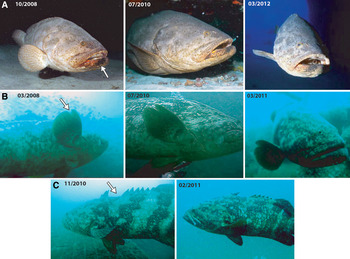
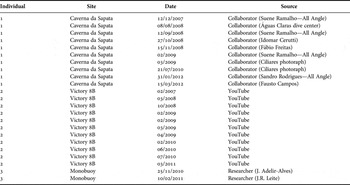
The first was photo-identified at Caverna da Sapata rocky reef (17 m depth) at FNNMP. We photo-identified this individual and obtained a total of 11 recaptures in an interval of 50 months, from December 2007 to March 2012 (Table 1). The individual (≈120 cm TL) had a scar on the right side of its mandible (Figure 1A). Local dive staff reported the occurrence of this goliath grouper in the same site for at least seven years. The second goliath grouper was registered at the Victory 8B shipwreck (south-east Brazil, 20°40′S 40°21′W), inhabited by two individuals. We recorded eleven recaptures within 49 months, from February 2007 to March 2011 (Table 1) also with re-sightings every year. This goliath grouper (≈170 cm TL) was associated with the wreck at the depth of 25 m. Such photo-ID was possible through a cut in the right pectoral fin (Figure 1B). The third individual was photo-identified twice at a monobuoy (a floating platform anchored offshore where tankers moor to unload oil) in South Brazil (26°13′S 48°24′W) within an interval of four months, from November 2010 to February 2011. This site is known as an aggregation site (Giglio et al., in press) with a maximum of 45 individuals observed. This individual (≈150 cm TL) was observed during survey trips to the monobuoy, at a depth of 23 m and had a fault in the dorsal fin spines (Figure 1C).
Dates (month/year) of Goliath groupers photo-identified at: (A) Fernando de Noronha National Marine Park; (B) 'Victory 8B' shipwreck; and (C) monobuoy. Credits: (A) left: I. Cerutti; centre: Ciliares photograph and video; right: Fausto Campos; (B) posted by—left: I. Costa; centre: Revan Berger; right: Eduardo Nogueira; (C) left: J. Adelir-Alves; right: J.R. Leite.

Sightings in Brazil of the goliath grouper, Epinephelus itajara between December 2007 and March 2012.

DISCUSSION
The use of scars proved to be an efficient method to photo-identify goliath groupers. Studies have used successfully the photo-ID method with sharks and rays through analyses of natural spots patterns and blotches characteristics for the species (e.g. Meekan et al., Reference Meekan, Bradshaw, Press, Mclean, Richards, Quasnichka and Taylor2006; Van Tienhoven et al., Reference Van Tienhoven, Den Hartog, Reijins and Peddemors2007; Luiz et al., Reference Luiz, Balboni, Kodja, Andrade and Marum2008). These studies based on colour patterns photo-ID are reliable because focal animals have at least two distinct colours on specific areas of their bodies (Buray et al., Reference Buray, Mourier, Planes and Clua2009).
Photo-ID of the goliath grouper using natural marks is a challenging approach, due to fast changes in coloration (Lara et al., Reference Lara, Schull, Jones and Allman2009) allied to their complex pattern of natural marks and spots. The best way to photo-identify the species is through the small dark spot pattern over their head. The spot-recognition software I3S 2.0 (Van Tienhoven et al., Reference Van Tienhoven, Den Hartog, Reijins and Peddemors2007) is a powerful tool, but demands good quality pictures of the goliath grouper head, which is relatively difficult to obtain in a large quantity, required for a complete photo-ID survey.
On the other hand, scars can be observed even in poor quality photographs and videos, such as some of the YouTube videos used in this study. Scars have also been largely used to identify elasmobranchs where distinctive natural markings are absent (Marshall & Pierce, Reference Marshall and Pierce2012). However, the main weakness in the use of scars to goliath groupers is that the sampling universe is reduced to a few individuals, who have them. For instance, in our estimated universe of 60 individuals, only three were photo-identified by scars. Additionally, scars may become less visible and even disappear over time, such as those observed in the maxilla of FNNMP's goliath grouper (Figure 1A). Nevertheless, some may persist, such as the absence of a dorsal fin spine or cut on the pectoral fin (Figure 1B, c). Although some fish can present great ability to regenerate their tissue, such as the white shark (Domeier & Nasby-Lucas, Reference Domeier and Nasby-Lucas2006) and lemon shark (Buray et al., Reference Buray, Mourier, Planes and Clua2009), so far, no information is available about tissue healing time for groupers.
We verified that scars on the goliath grouper can fulfil its role as an identification tool for a long time, on specimens that had a significant tissue loss. However, our results provided only initial evidences, once we photo-identified only two individuals in a relatively short time (four years), considering this is a long lived species (>40 years). The long-term viability of these markings for individual recognition needs to be better investigated.
Two goliath groupers were recaptured in the same place they inhabited for more than four years. This is the largest report of site fidelity for the species. Site fidelity may be important in enabling the fish to effectively use their acquired knowledge about local refuges and foraging areas (see Lembo et al., Reference Lembo, Fleming, Okland, Carbonara and Spedicato1999). Strong site fidelity has already been noted for adult goliath groupers during spawning aggregations. Adult individuals were re-sighted during three years at the same location (Eklund & Schull, Reference Eklund, Schull, Sibert and Nielsen2001). However, site fidelity is expected to last much longer for this species. Wirtz (Reference Wirtz2007) verified that the island grouper Mycteroperca fusca, returned to the same site over a time span of 25 years.
In conclusion, the use of scars can be an alternative method to investigate movement patterns of the goliath grouper, but restricted to a small number of individuals with scars. Additionally, volunteers can be involved, contributing in data collection, thus decreasing costs and providing significant increase in sampling effort to a large area. Recent surveys with sharks have been successful in involving volunteer divers to collect images (see Holmberg et al., Reference Holmberg, Norman and Arzoumanian2009; Barker & Williamson, Reference Barker and Williamson2010). Considering the popularization of underwater cameras, the use of the photo-ID method is a promising approach for investigations about the movement patterns of goliath groupers.
ACKNOWLEDGEMENTS
We thank divers who have collaborated with this study; Petrobras and Fundação Grupo o Boticário de Proteção à Natureza for financial support; and Jonas Leite and two anonymous referees for suggestions on the manuscript.