Introduction
In spite of the greater utilization of Cucurbita moschata and C. maxima for human consumption and the clear preference for these two species by urban consumers, C. pepo is still commonly cultivated in Portugal, mostly by small farmers and in back yards, for both animal feeding and human consumption. Most of the cultivated genotypes in traditional farming are local landraces frequently named according to the region where they are cultivated.
C. pepo, as other species of the Cucurbitaceae family, is extremely variable in fruit morphology and exhibits an enormous diversity of skin colour, colour pattern, size and shape. This species is usually identified empirically by farmers and consumers through the lower ratio of the volume of mesocarp to the total volume of the fruit or, conversely, through the greater ratio of the seed cavity. However, the vast diversity of C. pepo and other cucurbit species, such as C. maxima and C. moschata, leads to frequent species misclassification and situations of homonymy and synonymy.
In the last few years, the genetic variability and genetic relationships in Cucurbita species, particularly in C. pepo (Ferriol et al., Reference Ferriol, Picó and Nuez2003; Gong et al., Reference Gong, Paris, Nee, Stift, Pachner, Vollmann and Lelley2012), C. moschata (Gwanama et al., Reference Gwanama, Labuschagne and Botha2000; Wu et al., Reference Wu, Chang, Wu, Zhan and Xie2011) and C. maxima (Ferriol et al., Reference Ferriol, Pico and Nuez2004), and other species of the Cucurbitaceae family (Sikdar et al., Reference Sikdar, Bhattacharya, Mukherjee, Banerjee, Ghosh, Ghosh and Roy2010) have been assessed using DNA marker techniques.
The Portuguese central collection of C. pepo germplasm managed by the Banco Português de Germoplasma Vegetal (BPGV) comprises more than 293 accessions of this species, and the present study was conducted to assess the genetic diversity in a representative sample of 130 accessions collected throughout the country for the identification of a genetically diverse core group of accessions for field phenotypic analysis. The use of randomly amplified DNA markers [random amplified polymorphic DNA (RAPD), inter-simple sequence repeat (ISSR) and amplified fragment length polymorphism (AFLP)] allowed the misclassification of multiple accessions to be identified and corrected assigning the respective accessions to the right species: C. moschata.
Materials and methods
Plant material and DNA extraction
A total of 130 accessions of the Portuguese seed collection of C. pepo managed by BPGV, including ten seed accessions collected and maintained at the Direcção Regional de Agricultura e Pescas do Algarve (DRAALG), were analysed in this study.
Fifteen seeds per accession were sown in peat-filled large alveolar trays. One month after sowing, the first or the second leaf of ten plants per accession was collected and washed and leaf discs were excised using an Eppendorf tube and the respective cap. One disc was excised from each leaf, and the ten discs corresponding to each accession, collected in the same microfuge tube, were ground to a fine powder in a sterilized mortar with pestle under liquid nitrogen. The plant macerate, in quantity enough to bring the total volume up to 1 ml, was added to a microfuge tube containing 750 μl of an extraction buffer: 200 mM Tris–HCl, pH 8, 200 mM NaCl, 25 mM EDTA, 1% sodium dodecyl sulphate and 10 mM DTT. After 5 min at room temperature, 250 μl of 1 M KCl were added and the contents were mixed by some gentle inversions of the tubes. After centrifugation (13,000 rpm at 4°C for 5 min), the supernatant was treated with RNase A followed by phenol–chloroform extraction and subsequent ethanol precipitation of the isolated DNA.
DNA marker analyses
RAPD, AFLP and ISSR analyses were carried out as described by Farinhó et al. (Reference Farinhó, Coelho, Carlier, Svetleva, Monteiro and Leitão2004).
Results and discussion
Two RAPD primers, OPI17 and OPV18, of the ten assayed in preliminary tests amplified a higher number of well-defined markers and were selected for further analysis among all the samples. Previously tested with DNA samples of two individuals, three AFLP primer (EcoRI/MseI) combinations, AGC/CTC, ACC/CTA, and AGC/CAC, were found to generate multiple clear and easy-to-score markers and were retained for further analysis among all the accessions.
A total of 43 AFLP markers and 12 RAPD markers were scored among all the studied accessions and assembled into a common binary matrix. After calculation of the genetic similarities (DICE coefficients) and construction of a genetic similarity matrix, a dendrogram depicting the genetic relationships among all the samples was constructed using the Unweighted Pair Group Method with Arithmetic Mean algorithm.
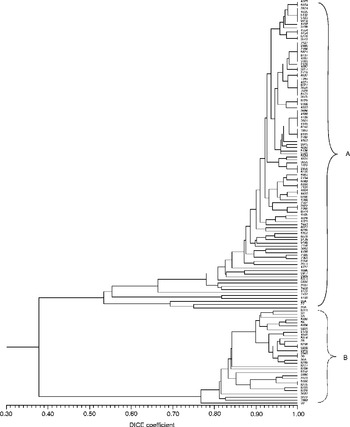
Even a very superficial analysis will reveal the division of the dendrogram (Fig. 1) into two well-separated main clusters. Although only very rare accessions have a genetic similarity value (DICE coefficient) < 0.75 within each cluster, the two clusters diverge at a genetic similarity value of about 0.37.
Dendrogram depicting the genetic relationships among the putative accessions of Cucurbita pepo. The distribution of the accessions into two distinct major clusters diverging at a very low level of genetically similarity (DICE coefficient = 0.37) was caused by the wrong classification and introduction into the collection of multiple accessions of C. moschata that gathered in cluster B.

The analyses that we had carried out previously among multiple plant species in our laboratory using randomly amplified markers (RAPD, ISSR and AFLP) and computing the genetic relatedness based uniquely on all the reproducible and clearly amplified markers, and not the polymorphic ones only, indicate that the minimal value of the DICE coefficient of genetic similarity expected within one and the same species is around 0.8 (Monte-Corvo et al., Reference Monte-Corvo, Cabrita, Oliveira and Leitão2000; Cabrita et al., Reference Cabrita, Aksoy, Hepaksoy and Leitão2001; Goulão et al., Reference Goulão, Cabrita, Oliveira and Leitão2001; Carlier et al., Reference Carlier, Leitão and Fonseca2008).
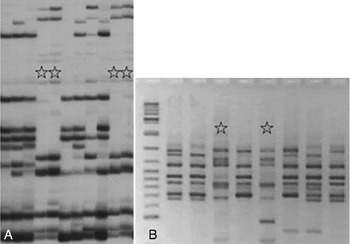
The fact that the putative accessions of C. pepo gathered in two clusters apart diverging at a very low level of genetic similarity and apparently providing evidence for very limited genetic flux was absolutely unexpected. Nevertheless, the dendrogram confirmed the surprisingly different patterns previously identified in agarose gels (RAPD) and in AFLP autoradiographs (Fig. 2).
(A) Amplified fragment length polymorphism and (B) random amplified polymorphic DNA amplification patterns of the putative Cucurbita pepo accessions. Note the clearly distinct molecular patterns of C. pepo (not labelled) and C. moschata (open stars).

The first working hypothesis that emerged as the cause of such unexpected results was a significant part of the collection to be wrongly classified and most probably belonging to a different species.
To clarify this question, three RAPD primers (OPAB03, OPAAA01 and OPAA04) and two ISSR primers ((AG)8T and (AG)8C) were used to analyse 24 accessions selected from the two major clusters (A and B) shown in Fig. 1, eight accessions of C. maxima and a standard accession of C. moschata. The cluster analysis based on 50 DNA markers resulted in the assembly of the ten accessions selected from cluster B (Fig. 1) in the standard accession of C. moschata, while 14 accessions of C. pepo from cluster A (Fig.1) and the eight accessions of C. maxima assembled in two clusters apart. The closer genetic similarity of the accessions belonging to the smaller cluster B to C. moschata was later confirmed against cv. Butternut (NK Lawn & Garden company) and two accessions of C. moschata kindly provided by the University of Georgia (Griffin, USA; data not shown).
A similar division of C. pepo samples into two major clusters differentiated at a very low level of genetic similarity (0.35), although with one of the clusters subdivided into two minor clusters, was also observed by Gong et al. (Reference Gong, Paris, Nee, Stift, Pachner, Vollmann and Lelley2012). However, such a differentiation reflected the presence of the recognized three C. pepo subspecies: pepo, texana and fraternal, and the use of microsatellite (SSR) markers, which, due their hypervariability, tend to inflate the genetic distances.
The present study is a good example of the importance of using DNA markers in the assessment of genetic diversity and genetic relationships and identification of species and varietal misclassification (Table S1, available online) in the establishment and management of plant germplasm collections.
Supplementary Material
To view supplementary material for this article, please visit http://dx.doi.org/10.1017/S147926211400046X