INTRODUCTION
Research on childhood outcomes of extreme prematurity has focused primarily on the nature and predictors of developmental impairment. Findings indicate that extremely preterm/ extremely low birth weight (EPT/ELBW) children (gestational age [GA] <28 weeks or birth weight <1000 g) score more poorly on measures of cognitive abilities and have more learning and behavior problems compared to term-born normal birth weight (NBW) controls (GA ≥37 weeks, birth weight >2500 g) (Johnson, Wolke, Hennessy, & Marlow, Reference Johnson, Wolke, Hennessy and Marlow2011). These deficits are evident in early childhood and persist over time (Baron, Erickson, Ahronovich, Baker, & Litman, Reference Baron, Erickson, Ahronovich, Baker and Litman2011; Taylor, Minich, Klein, & Hack, Reference Taylor, Minich, Klein and Hack2004). Although adverse outcomes are also evident in very preterm/very low birth weight (VPT/VLBW) children (GA <32 weeks or birth weight <1500 g), impairments are more severe and pervasive for children with more extreme prematurity and neonatal complications such as bronchopulmonary dysplasia or brain abnormality on cranial ultrasonography (Aarnousde-Moens, Weisglas-Kuperus, Van Goudoever, & Oosterlaan, Reference Aarnousde-Moens, Weisglas-Kuperus, van Goudoever and Oosterlaan2009; Aylward, Reference Aylward2005; Brydges et al., Reference Brydges, Landes, Reid, Campbell, French and Anderson2018). Greater social disadvantage is also associated with worse outcomes (Joseph, O’Shea, Allred, Heeren, & Kuban, Reference Joseph, O’Shea, Allred, Heeren and Kuban2017; Taylor et al., Reference Taylor, Minich, Klein and Hack2004).
However, outcomes of preterm birth vary substantially (Hopp & Baron, Reference Hopp and Baron2017), and the children who attain age-expected levels of achievement and behavioral adjustment are appropriately characterized as “resilient” (Luthar, Cicchetti, & Becker, Reference Luthar, Cicchetti and Becker2000; Masten, Reference Masten2001, Reference Masten2014). Taylor, Klein, Minich, and Hack (Reference Taylor, Klein, Minich and Hack2000) found that 37% of a cohort of <750 g birth weight children of middle school age were free of cognitive, learning, and behavioral deficits, compared to 82% of NBW controls. Gargus et al. (Reference Gargus, Vohr, Tyson, High, Higgins, Wrage and Poole2009) observed that 24% of children with 901–1000 g birth weight scored in the average range on developmental testing and had normal neurological examinations at 18–22 months corrected age. In a population-based study using Florida public school records, 65% of children with GA 22–23 weeks were considered to be academically ready for kindergarten compared to 85% of full-term children (Garfield et al., Reference Garfield, Karbownik, Murthy, Falciglia, Guryan, Figlio and Roth2017). However, these studies are among the few to focus on resilient EPT/ELBW children and did not examine positive outcomes in relation to multiple child and family characteristics.
In contrast to research on adverse outcomes, studies of resilience investigate factors that promote the development of adaptive competencies in high-risk children (Masten, Reference Masten2001, Reference Masten2014). High-risk groups are defined as those at social disadvantage or with biological vulnerabilities such as preterm birth. Adaptive competencies are conceptualized as age-appropriate functioning in developmentally salient domains, including academic achievement and social-behavioral adjustment. Potential promotive or protective factors are child traits or environmental characteristics that contribute to these competences, such as higher child cognitive and self-regulatory skills, greater socioeconomic advantage, and more supportive and stimulating home environments. A key difference between promotive-protective and vulnerability-risk factors is their potential to have different mechanisms of effect, the former viewed as growth promoting or compensatory and the latter as disruptive or maladaptive (Luthar et al., Reference Luthar, Cicchetti and Becker2000; Rutter, Reference Rutter1987).
In the “person-centered” approach to the study of resilience, high-risk children with adaptive competencies are compared to high-risk children who lack adaptive competence to identify factors related to positive adaptation. Resilient children are also compared to competent low-risk peers to determine if the former children have weaknesses in some areas despite their adaptive competencies or, alternatively, if they have special strengths or resources that help offset their heightened risk for developmental problems (Masten et al., Reference Masten, Hubbard, Gest, Tellegen, Garmezy and Ramirez1999). A second “variable-centered” approach examines the effects of both risk status (high vs. low) and protective factors on adaptive competence. In this approach, methods such as regression analysis are used to determine if protective factors such as favorable child or environmental characteristics offset risks and if high-risk children benefit more from these characteristics or are more vulnerable to their absence than those at low risk.
This study identified adaptive competencies in a sample of EPT/ELBW kindergarten children and NBW controls. Primary goals were to: (1) compare the EPT/ELBW and NBW groups on rates of adaptive competence; (2) use person-centered methods to compare the resilient, or “adaptive,” subset of EPT/ELBW children to both EPT/ELBW children who failed to meet criteria for adaptive competence (i.e., the “maladaptive” subset) and to adaptive NBW controls on child and family characteristics; and (3) apply a variable-centered approach to investigate the conjoint effects of group and environmental factors on adaptive competence. To identify earlier medical and developmental correlates of resilience in the EPT/ELBW children, the adaptive and maladaptive subsets of this group were also compared on neonatal characteristics and rates of neurodevelopmental impairment earlier in childhood.
We hypothesized that some children in the EPT/ELBW group, although proportionally fewer than in the NBW group, would meet criteria for adaptive competence in kindergarten. Using the person-centered approach and based on past research on resilient children (Masten, Reference Masten2014; Nelson et al., Reference Nelson, Choi, Clark, James, Fang, Wiebe and Espy2015), we further hypothesized that adaptive EPT/ELBW children, when compared with the maladaptive children in this group, would have higher cognitive abilities, more positive parent and teacher ratings of behavior and learning on assessments not used to define adaptive competence, and more advantaged family environments. We also examined the possibility that adaptive competence in the EPT/ELBW group would be associated with less extreme prematurity and lower rates of neonatal complications. In view of the vulnerability of EPT/ELBW children to cognitive weaknesses, we further anticipated that the adaptive subset of this group would obtain lower test scores than the adaptive subset of NBW controls. Demonstration of such differences would support the possibility that the adaptive EPT/ELBW children were able to compensate for cognitive weaknesses in attaining adaptive competence.
The variable-centered approach was applied to examine the combined effects of group (EPT/ELBW vs. NBW) and the family environment on adaptive competence in kindergarten. Findings from these analyses were expected to confirm independent associations of group and measures of the family environment with adaptive competence, with higher rates of competence for the NBW group than for the EPT/ELBW group and for children from more advantaged family environments. Associations of more positive family environments with adaptive competence were anticipated for both groups, but it was unclear if these associations would be stronger or weaker for preterm children compared to NBW controls. Some studies report that these associations are more pronounced for preterm than for NBW children (Greenley, Taylor, Drotar, & Minich, Reference Greenley, Taylor, Drotar and Minich2007; Gross, Mettelman, Dye, & Slagle, Reference Gross, Mettelman, Dye and Slagle2001; Jaekel, Pluess, Belsky, & Wolke, Reference Jaekel, Pluess, Belsky and Wolke2015; Landry, Smith, & Swank, Reference Landry, Smith and Swank2006; Wolke, Jaekel, Hall, & Baumann, Reference Wolke, Jaekel, Hall and Baumann2013), while others suggest weaker associations for preterm children (Joseph et al., Reference Joseph, O’Shea, Allred, Heeren and Kuban2017; Taylor, Klein, Drotar, Schluchter, & Hack, Reference Taylor, Klein, Drotar, Schluchter and Hack2006; Treyvaud et al., Reference Treyvaud, Inder, Lee, Northam, Doyle and Anderson2012).
A final exploratory goal was to investigate the stability of adaptive competence across the first 3 school years. Longitudinal follow-up of the present sample and other preterm cohorts documents persisting deficits in academic achievement and behavior (Johnson et al., Reference Johnson, Wolke, Hennessy and Marlow2011; Taylor et al., Reference Taylor, Klein, Espy, Schluchter, Minich, Stilp and Hack2018). Research with community samples also suggests that children regarded as resilient earlier in childhood continue to do better academically and behaviorally over time than those with less adaptive competence at younger ages (Masten, Reference Masten2014). We thus anticipated that the adaptive competence would remain relatively stable across the early school years.
METHOD
Sample
The sample included 146 of 148 EPT/ELBW children from a 2001–2003 birth cohort treated at a single hospital and recruited during their first year in kindergarten from a total population of 198 surviving infants without congenital malformations or infections (Taylor et al., Reference Taylor, Klein, Espy, Schluchter, Minich, Stilp and Hack2018). There were no differences between the children recruited and non-participants in sex, race, or neonatal characteristics (Scott et al., Reference Scott, Taylor, Fristad, Klein, Espy, Minich and Hack2012). The two children from the larger project not included in this study were missing data on the measures used to assess adaptive competence.
A group of 111 NBW controls was also recruited by individual matching of EPT/ELBW children who attended regular kindergarten classrooms with NBW peers from the same or similar classrooms on the basis of age, sex, and race. Matches were not recruited for the 15 EPT/ELBW children who were in full-time special education programs. Matches for another 22 children were not made due to home schooling of the EPT/ELBW child, schools that refused participation or were an excessive distance from the research center, or difficulties in finding appropriate matches.
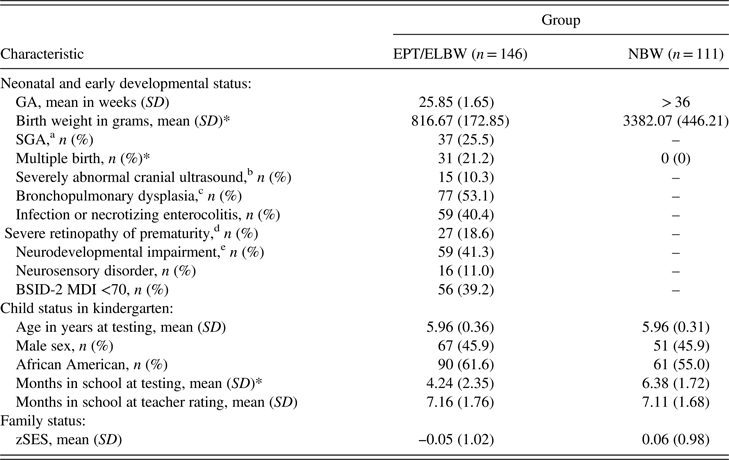
Group characteristics are listed in Table 1. The groups did not differ in age at assessment, sex, race, or socioeconomic status (SES) as defined by the mean of sample z scores for maternal education, caregiver occupation, and census-based median income (socioeconomic status as defined by mean of sample Z-scores for maternal education, caregiver occupation, and census-based family income [zSES]; Orchinik et al., Reference Orchinik, Taylor, Espy, Minich, Klein, Sheffield and Hack2011). Because NBW controls were not recruited until after assessment of the EPT/ELBW children to whom they were matched, the NBW group was assessed significantly later on average in the school year. However, time in school overlapped considerably between the two groups as recruitment of EPT/ELBW children was staggered from October to May and NBW controls were enrolled as soon as could be arranged following assessment of EPT/ELBW children.
Sample characteristics

BSID-2 MDI=Bayley Scales of Infant Development, 2nd Ed. (Bayley, Reference Bayley1993) Mental Development Index.
*p<.05.
a SGA defined by birth weight <2 SDs below expectation for GA based on data from Yudkin, Aboualfa, Eyre, Redman, and Wilkinson (Reference Yudkin, Aboualfa, Eyre, Redman and Wilkinson1987). High rate due to inclusion of children with birth weight <1000 g but GA ≥28 weeks.
b Defined as clinician identified Grade III/IV intraventricular hemorrhage, periventricular leukomalacia, or ventricular dilatation at discharge.
c Defined as supplemental oxygen at 36 weeks corrected age.
d Defined as Stage 4 or 5 retinopathy or treatment with cryotherapy or laser therapy.
e Defined as neurosensory disorder (cerebral palsy or vision or hearing impairment) or BSID-2 MDI <70 at 20 months corrected age.
Of the children assessed in kindergarten (year 1), 241 (94%) were reassessed in year 2 and 229 (89%) in year 3. Comparisons of children who were assessed in all 3 years did not differ significantly from those who dropped out in group membership, sex, or zSES, although higher proportions of completers were white and met criteria for adaptive competence in kindergarten. EPT/ELBW children who remained in the study did not differ significantly from those who dropped out in the neonatal characteristics listed in Table 1.
Procedures
Children were assessed in half-day sessions by examiners not informed of their birth status while their parents completed interviews and ratings of child behavior and the home environment. With caregiver permission, teachers of the 109 EPT/ELBW children in regular kindergarten classrooms and 107 NBW controls completed ratings of child behavior and learning progress. The second and third assessments were conducted at approximately 1-year intervals after the initial visit. The project was IRB-approved and completed in accordance with the Helsinki Declaration.
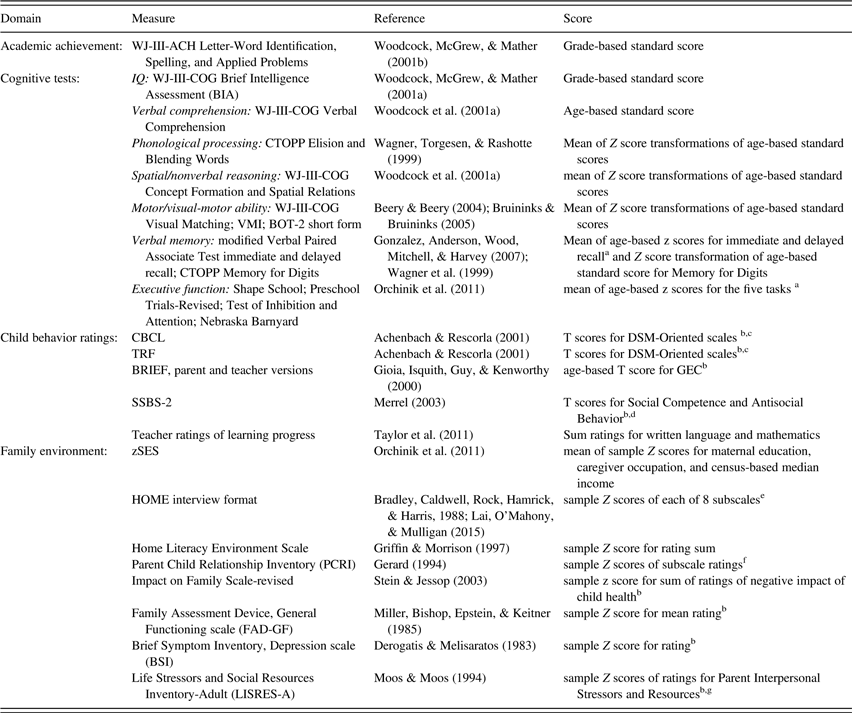
Study measures are listed in Table 2. Achievement tests measured letter and word recognition, spelling to dictation, and mathematics concepts and problem solving. Cognitive tests included measures of IQ and composite scores for six skill domains: verbal comprehension, phonologic processing, spatial/nonverbal reasoning, motor/visual-motor ability, verbal memory, and executive function. Grouping of cognitive tests into these domains was based on test content and justified by internal reliabilities in the moderate-to-high range (Cronbach’s alphas, .66-.83) and associations of the domain scores with academic achievement (Taylor et al., Reference Taylor, Klein, Espy, Schluchter, Minich, Stilp and Hack2018).
Assessments of child outcomes and the family environment
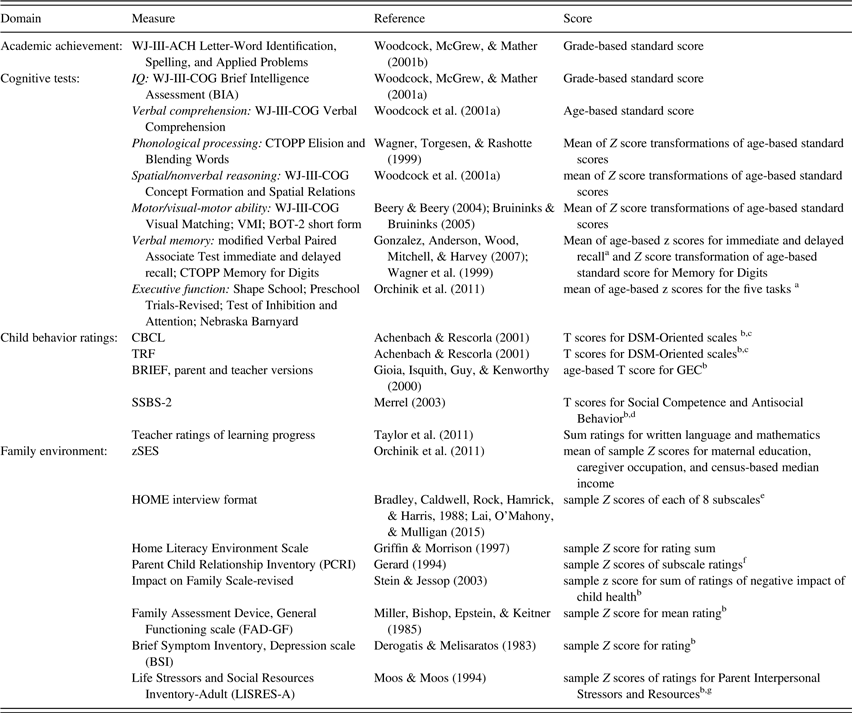
WJ-III-ACH=Woodcock Johnson III Tests of Achievement; WJ-III-COG=Woodcock Johnson Tests of Cognitive Abilities; CTOPP=Comprehensive Test of Phonological Processing; VMI=Developmental Test of Visual Motor Integration; BOT-2=Bruininks-Oseretsky Test of Motor Proficiency, 2nd Ed.
a Z scores represent deviations in Z score units of obtained scores from expected scores, with expected scores based on regression equation relating age and sex to scores for NBW controls.
b Higher scores reflect more problematic behaviors, family dysfunction, or parent stress; for all other measures higher scores reflect higher levels of child competence or more positive family characteristics.
c DSM-Oriented scales are Affective Problems, Anxiety Problems, Somatic Problems, ADHD Problems, Oppositional Defiant Problems, and Conduct Problems.
d Social Competence subscales: Peer Relations, Self-Management/Compliance, and Academic Behavior; Antisocial Behavior subscales: Hostile, Antisocial/Aggressive, and Defiant/Disruptive.
e Subscales are Responsivity, Encouragement of Maturity, Emotional Climate, Learning Materials, Enrichment, Family Companionship, Family Integration, and Physical Environment.
f Subcales: Parental Support, Satisfaction with Parenting, Involvement, Communication, Limit Setting, Autonomy, and Role Orientation.
g Parent Interpersonal Stressors subscales: Health, Work, Spouse, Extended Family, and Friends; Resources subcales: Work, Spouse, Extended Family, and Friends.
Behavior assessments comprised parent and teacher ratings of problems in behavior and executive function and teacher ratings of behavior, social competence, and learning progress relative to curricular objectives for written language and mathematics (Taylor et al., Reference Taylor, Klein, Anselmo, Minich, Espy and Hack2011). The tests of children’s abilities and behavior ratings have good reliability and validity, with previous findings documenting significantly lower test scores and higher behavior problem ratings in kindergarten for the EPT/ELBW group compared to NBW controls (Orchinik et al., Reference Orchinik, Taylor, Espy, Minich, Klein, Sheffield and Hack2011; Scott et al., Reference Scott, Taylor, Fristad, Klein, Espy, Minich and Hack2012; Taylor et al., Reference Taylor, Klein, Anselmo, Minich, Espy and Hack2011).
Adaptive competence was defined as: (a) grade-based standard scores ≥85 on the Letter-Word Identification, Spelling, and Applied Problems tests of the Woodcock Johnson Tests of Achievement, 3rd Edition (Woodcock, McGrew, & Mather, Reference Woodcock, McGrew and Mather2001a); and (b) parent ratings below the borderline clinical range (<93rd percentile) on all DSM-Oriented scales of the Child Behavior Checklist (CBCL, Achenbach & Rescorla, Reference Achenbach and Rescorla2001). Kindergarten children who met these criteria were classified as “adaptive” and those who did not as “maladaptive,” with these same criteria applied in classifying adaptive competence in years 2 and 3. Past research documents the validity of low achievement scores in identifying children with learning problems (Litt, Taylor, Klein, & Hack, Reference Litt, Taylor, Klein and Hack2005), as well as the reliability of the DSM-Oriented scales and the validity of a cut-off at the 93rd percentile in discriminating children with and without corresponding DSM diagnoses (Ebesutani et al., Reference Ebesutani, Bernstein, Nakamura, Chorpita, Higa-McMillan and Weisz2010; Nakamura, Ebesutani, Bernstein, & Chorpita, Reference Nakamura, Ebesutani, Bernstein and Chorpita2009).
The rationale for classifying adaptive competence in this manner was to provide a broad and relatively strict screen for problems likely to exclude children with significant learning or behavior problems. The majority of children classified as maladaptive (57%) failed to meet criteria for competence on ≥2 measures. Impairments were most often identified on Applied Problems (56% of children classified as maladaptive) and Spelling (52%), and less often identified on Letter-Word Identification (17%) and the CBCL DSM-Oriented scales ADHD Problems (26%), Conduct Problems (22%), Anxiety Problems (16%), Somatic Problems (16%), Oppositional Defiant Problems (15%), and Affective Problems (13%).
The family environment was evaluated using distal and proximal assessments of social advantage. Past reports document associations of higher distal social advantage, as measured by zSES, with higher test scores and fewer behavior problems (Orchinik et al.., Reference Orchinik, Taylor, Espy, Minich, Klein, Sheffield and Hack2011; Scott et al., Reference Scott, Taylor, Fristad, Klein, Espy, Minich and Hack2012; Taylor et al., Reference Taylor, Klein, Anselmo, Minich, Espy and Hack2011, Reference Taylor, Klein, Espy, Schluchter, Minich, Stilp and Hack2018). Multi-component measures of SES have been used in previous research (Burchinal, Roberts, Zeisel, Hennon, & Hooper, Reference Burchinal, Roberts, Zeisel, Hennon and Hooper2006; Clark & Woodward, Reference Clark and Woodward2015; Farah, Reference Farah2017) and were justified in this study by independent associations of the three components of zSES with one or more measures of kindergarten outcome in the NBW group (data not shown).
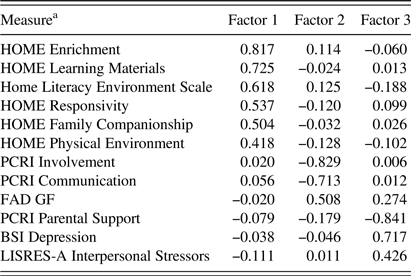
Proximal measures of the family environment were selected to assess a broad range of family influences and because of their associations with academic achievement, behavior, illness severity, and other family characteristics (Gerard, Reference Gerard1994; Griffin & Morrison, Reference Griffin and Morrison1997; Hargrove & O’Dell, Reference Hargrove and O’Dell1999; Lai, O’Mahony, & Mulligan, Reference Lai, O’Mahony and Mulligan2015; Williams, Piamjariyakul, Williams, Bruggeman, & Cabanela, Reference Williams, Piamjariyakul, Williams, Bruggeman and Cabanela2006). All measures were completed using parent questionnaires or interviews. The Home Observation for Measurement of the Environment (HOME; Bradley, Caldwell, Rock, Hamrick, & Harris, Reference Bradley, Caldwell, Rock, Hamrick and Harris1988) was administered in an interview format similar to that used in previous studies validating this method (Jacobson & Jacobson, Reference Jacobson and Jacobson1996; Lai et al., Reference Lai, O’Mahony and Mulligan2015; Linares et al., Reference Linares, Singer, Kirchner, Short, Min, Hussey and Minnes2006). A principal axis factor analysis conducted to reduce the measures to a smaller set of family constructs yielded a 3-factor solution (see Table 3). Factor scores were defined as the mean of the sample Z-scores for measures with single factor loadings ≥.4 and without cross-loadings ≥.3, with higher scores reflecting: (1) higher stimulation for learning, (2) higher parent-child relationship quality, and (3) lower parent burden and distress. Similar factors are described in previous research on family influences (Masten et al., Reference Masten, Garmezy, Tellegen, Pellegrini, Larkin and Larsen1988; Nelson et al., Reference Nelson, Choi, Clark, James, Fang, Wiebe and Espy2015).
Pattern matrix from factor analysis of measures of the family environment

Note. The three-factor solution was obtained using principal axis factor analysis with oblimin rotation and explained 59% of the variance in the measures. Factors were interpreted as measures of: (1) home environment for learning, (2) parent-child relationship quality, and (3) parent burden/distress. The factors were computed by averaging the sample z scores for each of the measures that loaded ≥.4 on a single factor, with higher scores on each factor computed to reflect more positive environments. Factor inter-correlations ranged from .37 to .42 (all ps ≤ .001).
PCRI=Parent-Child Relationship Inventory; FAD GF=Family Assessment Device General Functioning scale; BSI=Brief Symptom Inventory; LISRES-A=Life Events and Social Resources Scale, Adult version.
a To ensure that scores were on a common metric for analysis, raw scores for each measure were converted to sample Z scores.
Data Analysis
Analyses used general estimating equations (GEE; Diggle, Liang, & Zeger, Reference Diggle, Liang and Zeger1994) to examine rates of adaptive competence in the two groups and child/family correlates. The primary factors in the latter analyses were group, adaptive competence (adaptive vs. maladaptive), and the group x adaptive competence interaction. Family membership was included as a cluster variable in this and other analyses to account for sibling correlations. Time in school was not significantly associated with adaptive competence and, thus, not considered in the analyses. GEE was also used to conduct pre-planned contrasts of the adaptive EPT/ELBW children to the maladaptive subset of this group and to adaptive NBW controls on the child and family measures.
Variable-centered analyses used GEE to examine the conjoint effects of group and each of the family variables on adaptive competence, with the group × family factor interaction included to explore group differences in family effects. Analyses first examined the family factors in separate models and then tested models that included combinations of those factors. The stability of adaptive competence in the two groups across years was examined using mixed model analysis. Predictors in these analyses were group, year, and the group × year interaction. Missing data were minimal.
Significance was defined as p<.05 without adjustment for multiple comparisons given the lack of preliminary information on the correlates of adaptive competence in EPT/ELBW children and an interest in using all available data. However, estimates of the magnitude of effects included 95% confidence intervals [CIs] and effect sizes (Cohen’s d) for group differences and odds ratios (ORs) and CIs for predictors of adaptive competence. The lower boundaries for small, medium, and large effect sizes for group differences were .2, .5, and .8, respectively (Cohen, Reference Cohen1992).
RESULTS
Group Differences in Rates of Adaptive Competence
Group comparisons revealed that fewer EPT/ELBW children (65; 45%) compared to NBW controls (81; 73%) met criteria for adaptive competence, OR [CI]=0.26 [0.15, 0.45], p<.001.
Correlates of Adaptive Competence
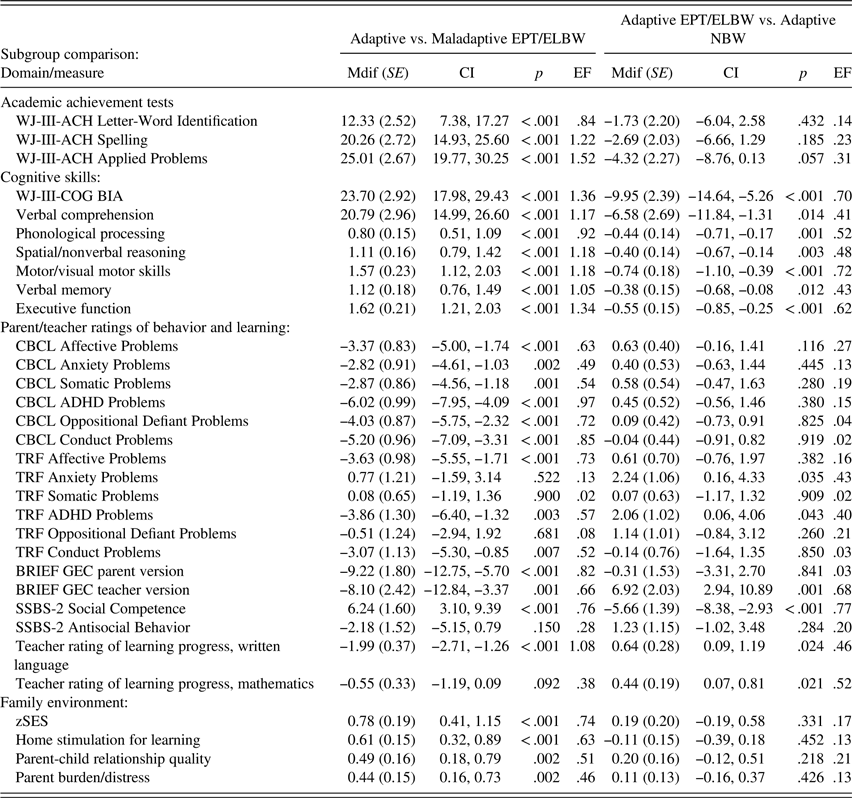
Table 4 summarizes results of person-centered comparisons of adaptive EPT/ELBW children to maladaptive EPT/ELBW children and adaptive NBW controls on child and family characteristics (see Supplementary Table 1 for descriptive data on these characteristics for all four subsets of children). Compared to maladaptive EPT/ELBW children, the adaptive subset of this group obtained: (a) higher scores on all cognitive and achievement tests; (b) lower ratings on the CBCL DSM-Oriented scales used to classify adaptive competence and on the Teacher’s Report Form (TRF, Achenbach & Rescorla, Reference Achenbach and Rescorla2001) DSM-Oriented scales for Affective, ADHD, and Conduct problems and the parent and teacher versions of the Behavior Rating Inventory of Executive Function-General Executive Composite (BRIEF-GEC, Gioia, Isquith, Guy, & Kenworthy, Reference Gioia, Isquith, Guy and Kenworthy2000); and (c) higher teacher ratings of social competence on the School Social Behavior Scale, 2nd Ed. (SSBS-2, Merrel, 2003) and teacher ratings of learning progress in written language.
Comparisons of adaptive and maladaptive subsets of EPT/ELBW children and NBW controls on measures of child and family characteristics

Note. Measurement units listed in Table 1. Home stimulation for learning, parent-child relationship quality, and parent burden/distress are means of the sample Z scores for the family measures with loadings ≥.4 on factors 1-3, respectively (see Table 3). Due to non-normal distributions, scores on the CBCL and TRF were also analyzed using nonparametric Kruskal-Wallis test, with results similar to those reported above.
Mdif (SE)=mean difference (standard error); EF=effect size (Cohen’s d); WJ-III-ACH=Woodcock Johnson Tests of Achievement, 3rd Ed.; WJ-III-COG=Woodcock Johnson Tests of Cognitive Ability, 3rd Ed.
The adaptive EPT/ELBW children also had higher zSES, higher home stimulation for learning, higher parent-child relationship quality, and lower parent burden and distress. Effect sizes were large for all cognitive measures, moderate-to-large for the BRIEF and most teacher ratings, and moderate for family measures. Adaptive competence was not significantly related to the neonatal characteristics listed in Table 1 but was associated with lower rates of early childhood neurodevelopmental impairment, OR [CI]=0.19 [0.06, 0.64], p=.008. Despite this association, 12 (20%) of those with early impairment met criteria for adaptive competence in kindergarten.
The adaptive subsets of the two groups did not differ significantly on the achievement tests and behavior ratings used to classify adaptive competence or on measures of the family environment. However, compared to adaptive NBW controls, adaptive EPT/ELBW children had significantly lower cognitive test scores, higher teacher ratings on the BRIEF-GEC and TRF DSM-Oriented Anxiety and ADHD problems scales, and lower teacher ratings of social competence on the SSBS-2 and learning progress in written language and mathematics. Effect sizes for these measures were small-to-moderate. In additional exploratory comparisons (data not shown), differences between adaptive versus maladaptive NBW children were similar to those found in comparing these two subsets of the EPT/ELBW group.
Conjoint Effects of Group and the Family Environment in Predicting Adaptive Competence
Variable-centered analyses revealed that adaptive competence was associated with higher zSES, OR [CI]=2.10 [1.43, 3.10], higher home stimulation for learning, OR [CI]=2.03 [1.49, 2.77], higher parent-child relationship quality, OR [CI]=1.54 [1.17, 2.03], and lower parent burden/distress, OR [CI]=1.77 [1.35, 2.32], all ps<.003. Analyses failed to document interactions of group with any of the latter factors. Associations of each of the proximal family factors with adaptive competence were independent of group and zSES, all ps<.05.
Adaptive Competence Across School Years 1–3
Group comparisons of adaptive competence across school years indicated a group main effect, F(1,236)=30.94, p<.001, d=.62. Effects for year and group × year were not significant. Rates of adaptive competence in the EPT/ELBW versus NBW groups, respectively, were 47% versus 78% in year 2 and 55% versus 77% in year 3. Although some children changed classifications over time, 49 (82%) of the adaptive subset of EPT/ELBW kindergarten children continued to meet criteria for adaptive competence in year 2 and 53 (90%) in year 3. Similarly, 70 (89%) of the adaptive subset of NBW kindergarten children continued to meet these criteria in year 2 and 69 (90%) in year 3.
DISCUSSION
Adaptive Competence in EPT/ELBW Children
The substantial minority (45%) of the EPT/ELBW group without impairments on achievement testing or on parent ratings of behavior confirms other findings suggesting age-appropriate functional outcomes, or “resilience,” in some EPT/ELBW children (Garfield et al., Reference Garfield, Karbownik, Murthy, Falciglia, Guryan, Figlio and Roth2017; Hopp & Baron, Reference Hopp and Baron2017; Taylor et al., Reference Taylor, Klein, Minich and Hack2000). Adaptive competence in the EPT/ELBW group was associated with higher scores on tests of global and specific cognitive abilities, more advantaged family environments, and the absence of neurodevelopmental impairment earlier in childhood.
Associations of adaptive competence in EPT/ELBW children with higher cognitive abilities and more advantaged family environments mirror findings from research on resilience in children at high social risk (Burchinal et al., Reference Burchinal, Roberts, Zeisel, Hennon and Hooper2006; Jaffe, Reference Jaffe2007; Masten, Reference Masten2014). The findings are also consistent with past research on resilience in preterm children. Gargus et al. (Reference Gargus, Vohr, Tyson, High, Higgins, Wrage and Poole2009) observed that ELBW children who were “unimpaired” in early childhood were at greater social advantage than those with impairments. Poehlmann-Tynan et al. (Reference Poehlmann-Tynan, Gerstein, Burnson, Weymouth, Bolt, Maleck and Schwichtenberg2015) followed a lower risk sample of preterm/low birth weight children (GA <37 weeks or <2500 g) from the neonatal period to early school age. Latent profile analysis was conducted on parent ratings of the children at 6 years of age to identify different profiles of outcome on measures of learning, behavior, social competence, and sleep. Findings suggested a latent class of “resilient” children, comprising 31% of the sample, with age-appropriate ratings on all measures. As younger children, the resilient subset had been exposed to less negative parenting and performed better on a delayed gratification task than children with more problematic parent ratings.
Other studies of preterm EPT/ELBW children identified positive outcomes in individual cases or subsets of their samples or examined associations of preterm birth with continuous measures of academic or behavioral competence (Bradley et al., Reference Bradley, Whiteside, Mundfrom, Casey, Kelleher and Pope1994; Garfield et al., Reference Garfield, Karbownik, Murthy, Falciglia, Guryan, Figlio and Roth2017; Hopp & Baron, Reference Hopp and Baron2017; Jaekel et al., Reference Jaekel, Pluess, Belsky and Wolke2015; Taylor et al., Reference Taylor, Klein, Minich and Hack2000; Treyvaud et al., Reference Treyvaud, Inder, Lee, Northam, Doyle and Anderson2012; Wolke et al., Reference Wolke, Jaekel, Hall and Baumann2013). However, the latter studies either did not include NBW controls or failed to investigate child and family characteristics that distinguished preterm children who were functionally competent from those who were not.
Despite evidence for resilience in many EPT/ELBW children, the lower rate of adaptive competence in this group relative to NBW controls replicates a substantial body of research demonstrating adverse effects of extreme prematurity on achievement and behavior (Johnson et al., Reference Johnson, Wolke, Hennessy and Marlow2011; Scott et al., Reference Scott, Taylor, Fristad, Klein, Espy, Minich and Hack2012; Taylor et al., Reference Taylor, Klein, Anselmo, Minich, Espy and Hack2011). Associations of lower cognitive abilities and less advantaged family environments with impairments in achievement and behavior are also in keeping with previous literature (Taylor et al., Reference Taylor, Klein, Espy, Schluchter, Minich, Stilp and Hack2018). The findings add to knowledge on outcomes of extreme prematurity by documenting the potential for some EPT/ELBW children to attain normative levels of adaptive functioning and by revealing factors associated with these positive outcomes.
Although positive and negative outcomes of high-risk conditions are often opposite sides of the same continuum, positive outcomes cannot be attributed merely to the absence of adversity but also to protective-promotive factors that facilitate age-typical performance in functionally salient aspects of development (Luthar et al., Reference Luthar, Cicchetti and Becker2000; Masten, Reference Masten2011; Rutter, Reference Rutter1987). Identification of factors associated with adaptive competence suggests targets for intervention to optimize development in all at-risk children rather than merely treat negative outcomes.
Adaptive Competence in EPT/ELBW Children Versus NBW Controls
Adaptive EPT/ELBW children were similar in many respects to adaptive NBW controls. These subgroups did not differ significantly on the achievement tests or parent ratings used to classify adaptive competence, several other parent and teacher ratings of behavior, or measures of the family environment. These findings are consistent with research on children at high social risk (Masten et al., Reference Masten, Hubbard, Gest, Tellegen, Garmezy and Ramirez1999) and document competencies in the adaptive EPT/ELBW children that extended beyond those used to classify adaptive competence.
Other findings suggested limitations to these positive outcomes. Compared to adaptive NBW controls, adaptive EPT/ELBW children obtained lower scores on cognitive testing, higher teacher ratings of executive dysfunction, anxiety, and ADHD, and lower teacher ratings of social competence and learning progress. Parents may have been less aware of behavior and learning difficulties evident at school and adaptive competence thus less robust for the adaptive EPT/ELBW children. As adaptive EPT/ELBW children were selected on the basis of scores that departed further from group means than was the case for adaptive NBW children, scores on other measures would be more likely to distinguish the two groups as a result of regression to the mean. Nevertheless, many EPT/ELBW children demonstrated age-appropriate achievement and were not rated by their parents as having clinically significant behavior problems.
Factors Associated With Adaptive Competence
Results of variable-centered analyses confirming independent associations of adaptive competence with preterm birth and the family environment accord with past research on the effects of these factors on children’s cognitive, achievement, and behavioral outcomes (Clark, Woodward, Horwood, & Moor, Reference Clark, Woodward, Horwood and Moor2008; Jaekel et al., Reference Jaekel, Pluess, Belsky and Wolke2015; Johnson, Reference Johnson2007; Orchinik et al., Reference Orchinik, Taylor, Espy, Minich, Klein, Sheffield and Hack2011; Taylor, Klein, Schatschneider, & Hack, Reference Taylor, Klein, Schatschneider and Hack1998; Taylor et al., Reference Taylor, Klein, Minich and Hack2000; Vanderbilt-Adriance & Shaw, Reference Vanderbilt-Adriance and Shaw2008). Independent effects of distal and proximal measures of the family environment on development also parallel results of previous studies of children at social risk and preterm cohorts (Nelson et al., Reference Nelson, Choi, Clark, James, Fang, Wiebe and Espy2015; Treyvaud et al., Reference Treyvaud, Inder, Lee, Northam, Doyle and Anderson2012; Wolke et al., Reference Wolke, Jaekel, Hall and Baumann2013).
Measures of the family environment were moderately intercorrelated and past research suggests that proximal family factors may partially mediate the effects of distal social risk on children’s development (Burchinal et al., Reference Burchinal, Roberts, Zeisel, Hennon and Hooper2006; Treyvaud et al., Reference Treyvaud, Inder, Lee, Northam, Doyle and Anderson2012). Although more complex models of environmental effects were not examined in this study, associations of zSES with adaptive competence that were independent of the effects of proximal family factors raises the possibility that zSES reflected a wider set of influences on learning and behavior, such as family instability, negative life events, the quality of children’s schooling, neighborhood poverty, and access to health and community resources (Andreias et al., Reference Andreias, Borawski, Schluchter, Taylor, Klein and Hack2010; Bradley & Corwyn, Reference Bradley and Corwyn2002; Masten & Coatsworth, Reference Masten and Coatsworth1998; Masten et al., Reference Masten, Hubbard, Gest, Tellegen, Garmezy and Ramirez1999).
Results failed to reveal significant group differences in associations between adaptive competence and the family environment. Consistent with these findings, Clark and Woodward (Reference Clark and Woodward2015) did not find differences between preterm and NBW children in associations of early childhood measures of parenting with later performance on tests of executive function. Treyvaud et al. (Reference Treyvaud, Inder, Lee, Northam, Doyle and Anderson2012) also failed to find moderating effects of birth status (preterm vs. NBW) on associations of the home environment with most measures of early childhood behavior. The one exception to these findings was their report of an association of a higher quality home environment with better behavioral self-regulation for NBW children that was not evident for preterm children with white matter abnormalities on neuroimaging. While the latter finding is consistent with research suggesting that preterm birth may constrain children’s opportunity to take advantage of environmental supports (Joseph et al., Reference Joseph, O’Shea, Allred, Heeren and Kuban2017; Taylor et al., Reference Taylor, Minich, Klein and Hack2004, Reference Taylor, Klein, Drotar, Schluchter and Hack2006), other studies provide evidence either for protective effects of positive environments on preterm children (Gross et al., Reference Gross, Mettelman, Dye and Slagle2001; Taylor et al., Reference Taylor, Klein, Schatschneider and Hack1998) or for a special vulnerability of these children to disadvantaged family environments (Jaekel et al., Reference Jaekel, Pluess, Belsky and Wolke2015; Treyvaud et al., Reference Treyvaud, Inder, Lee, Northam, Doyle and Anderson2012). The extent to which environmental factors have different associations with outcomes in preterm compared to NBW children may depend on the characteristics of the preterm children under investigation and the nature of the outcome measure (Masten et al., Reference Masten, Garmezy, Tellegen, Pellegrini, Larkin and Larsen1988; Taylor et al., Reference Taylor, Minich, Klein and Hack2004).
Persistence of Adaptive Competence
Adaptive competence was evident in EPT/ELBW children during their first year in school and rates of adaptive competence remained at similar levels across the next 2 school years. The results suggest that adaptive competence in both groups was already established by school entry without marked changes across years, despite grade-related increases in learning demands. Previous longitudinal research on resilience in children at high social risk also suggests stability of adaptive competence with advancing age, while acknowledging that changes in competency can vary as children face new developmental challenges or opportunities (Luthar et al., Reference Luthar, Cicchetti and Becker2000; Masten, Reference Masten2011; Masten & Coatsworth, Reference Masten and Coatsworth1998; Rutter, Reference Rutter2013).
Potential Mechanisms
Several possible explanations can be offered for the capacity of many EPT/ELBW children to meet broad expectations for age on achievement tests and parent behavior ratings. One possibility is that their relatively advantaged family environments provided them with additional opportunities to learn and facilitated more engagement in learning readiness tasks and more positive behavioral adaptations (Bradley et al., Reference Bradley, Whiteside, Mundfrom, Casey, Kelleher and Pope1994; Clark & Woodward, Reference Clark and Woodward2015; Masten, Reference Masten2014; Treyvaud et al., Reference Treyvaud, Inder, Lee, Northam, Doyle and Anderson2012). In light of research linking environmental advantage and early parent training to increased brain growth in young children, their more positive family environments may also have facilitated either more normal early brain development or a greater degree of neural reorganization or compensation (Farah, Reference Farah2017; Hair, Hanson, Wolfe, & Pollak, Reference Hair, Hanson, Wolfe and Pollack2015; Milgrom et al., Reference Milgrom, Newnham, Anderson, Doyle, Gemmill, Lee and Inder2010; Noble et al., Reference Noble, Houston, Brito, Bartsch, Kan, Kuperman and Sowell2015; Ursachec & Noble, Reference Ursache and Noble2016).
A second possibility is that the adaptive subset of EPT/ELBW children sustained less severe perinatal brain abnormalities than those in the maladaptive subset. While differences in the degree abnormality in neonatal brain development may have contributed to the different outcomes of the two subsets of EPT/ELBW children, the more positive outcomes of the adaptive subset is unlikely to reflect a total absence of neural abnormality at birth (Inder, Wells, Mogridge, Spencer, & Volpe, Reference Inder, Wells, Mogridge, Spencer and Volpe2003; Woodward, Anderson, Austin, Howard, & Inder, 2006). Barnett et al. (Reference Barnett, Tusor, Ball, Chew, Falconer, Aljabar and Counsell2018) document multiple types of brain abnormalities in preterm children and provide evidence for their combined effect on outcome. The case for absent or limited initial neurological involvement as the sole determinant of resilience is further weakened by the lack of association of neonatal risk factors with adaptive competence and the fact that 20% of the adaptive EPT/ELBW children had early childhood neurodevelopmental impairment.
Other possibilities are that some children were genetically less susceptible to early brain insult, had higher innate potential, neural “reserve,” or capacity for neural compensation than others (Luu, Vohr, Allan, Schneider, & Ment, Reference Luu, Vohr, Allan, Schneider and Ment2011; Stern, Reference Stern2009; Stiles, Reilly, Paul, & Moses, Reference Stiles, Reilly, Paul and Moses2005), or that gene-environment correlations contributed to both parenting characteristics and children’s developmental outcomes (Cicchetti, Reference Cicchetti2013; Rutter & Silberg, Reference Rutter and Silberg2002). Mechanisms underlying resilience may also involve multiple influences on development, as when positive parenting fosters higher levels of executive function, which in turn facilitates children’s academic growth and behavioral adjustment (Masten, Reference Masten2011).
The higher cognitive skills of the adaptive subset of EPT/ELBW children relative to the maladaptive subset likely contributed to their adaptive competence. Any explanations of resilience in EPT/ELBW children will thus need to account for this more generalized pattern of sparing and not for adaptive competence alone. A viable account of resilience will also need to explain how the adaptive subset of EPT/ELBW children were capable of broadly age-typical achievement and parent ratings of behavioral adjustment, despite having both lower cognitive skills and teacher ratings of more learning and behavior problems relative to adaptive NBW controls.
The limited set of academic skills assessed by the tests and the greater demands on children’s learning and behavior at school may help to account for these disparities. Alternatively, environmental enrichment and its effects on neural systems underlying learning and behavior may have helped the adaptive EPT/ELBW children compensate for their weaknesses (Bryck & Fisher, Reference Bryck and Fisher2012; Jaffe, Reference Jaffe2007; Jolles & Crone, Reference Jolles and Crone2012; Luu et al., Reference Luu, Vohr, Allan, Schneider and Ment2011; Ursache & Noble, Reference Ursache and Noble2016).
Study Limitations
A limitation of this study is that adaptive competence was defined using pre-selected standard score cutoffs on achievement tests and parent ratings of child behavior. Although results likely would have differed had competence been defined using other criteria, the cutoffs used were based on scores that fell within grade or age expectations on standardized measures and considered functioning across a range of academic skills and behaviors. Differences between the adaptive and maladaptive subsets of both groups on measures of functioning not used to define competence also support the validity of our criteria.
Another measurement limitation is that the study did not consider a wider range of factors potentially related to adaptive competence, such as children’s motivational status and self-efficacy, their history of engagement in special education and developmental programs, and community resources (Bradley & Corwyn, Reference Bradley and Corwyn2002; Luthar et al., Reference Luthar, Cicchetti and Becker2000; Rutter, Reference Rutter2013). Additionally, teacher ratings were obtained only for children attending regular classrooms. As many of the EPT/ELBW children without teacher ratings were in full-time special education placements for learning or behavior problems, differences between adaptive and maladaptive children on these measures would likely have been greater had teacher ratings also been obtained for these children.
Finally, analyses did not correct for multiple comparisons and the sample was recruited from a 2001–2003 birth cohort from a single site. Further replications are needed to examine correlates of resilience, and caution is advised in generalizing findings to the broader population of more recent EPT/ELBW cohorts.
Despite these limitations, the study included a sample of kindergarten EPT/ELBW children and NBW controls from the same or similar classrooms, extensive assessments provided an opportunity to investigate multiple factors associated with adaptive competence, and rates of developmental morbidities in extremely preterm children remain high, despite recent improvements in survival (Rogers & Hintz, Reference Rogers and Hintz2016).
Implications and Future Directions
Documentation of adaptive competence in a substantial minority of kindergarten EPT/ELBW children reinforces their potential for resilience and suggests that resilience is evident by the age of school entry. The results indicate that adaptive competence is related to higher cognitive abilities; fewer problems in self-regulatory behaviors as measured by the BRIEF; higher social, behavioral, and academic functioning at school; and more advantaged family environments. These findings confirm the potential benefits of early childhood interventions to enhance learning and behavioral outcomes in high-risk children (Clark & Woodward, Reference Clark and Woodward2015; Masten, Reference Masten2011; Nelson et al., Reference Nelson, Choi, Clark, James, Fang, Wiebe and Espy2015).
Associations of adaptive competence with each of the three proximal family factors also support the possibility of promoting better outcomes for at-risk children through interventions that provide learning opportunities for the child, encourage positive parent-child engagement and communication and more supportive and less conflictual family relationships, and reduce parent distress (Bradley et al., Reference Bradley, Whiteside, Mundfrom, Casey, Kelleher and Pope1994; Burchinal et al., Reference Burchinal, Roberts, Zeisel, Hennon and Hooper2006). The weaknesses that EPT/ELBW children have in cognition and psychosocial functioning may need to be considered in designing family interventions (Taylor, Klein, & Hack, Reference Taylor, Klein and Hack2001), but the current findings suggest that these interventions are as applicable to preterm children as to their NBW peers.
Further research is needed to examine different forms of resilience EPT/ELBW children (academic achievement, social-emotional adjustment, daily living skills) and enhance understanding of the “adaptive systems” that help them attain developmentally appropriate levels of competence despite risks for more adverse outcomes (Masten, Reference Masten2001). Study of neural and genetic differences between adaptive and maladaptive EPT/ELBW children may provide additional insights into mechanisms underlying resilience (Farah, Reference Farah2017; Masten, Reference Masten2011; Treyvaud et al., Reference Treyvaud, Inder, Lee, Northam, Doyle and Anderson2012). As a process that evolves with age and is subject to new challenges, it will also be important to examine resilience longitudinally in relation to changing experiences and to identify precursors of school-age outcomes and ways to foster early development (Luthar et al., Reference Luthar, Cicchetti and Becker2000; Masten, Reference Masten2011; Poehlmann-Tynan et al., Reference Poehlmann-Tynan, Gerstein, Burnson, Weymouth, Bolt, Maleck and Schwichtenberg2015).
ACKNOWLEDGMENTS
Funded by grant HD050309 from the National Institutes of Health. We acknowledge the assistance of Anne Birnbaum, Elizabeth Roth, Daniel Maier, Michelle R. Jacobs, Beth Hagesfeld, Ketrin Lengu, Alice Costiuc, and Andrea Barkoukis Gefteas in participant recruitment, assessment, and data coding. We also acknowledge the contributions of our colleague, Maureen Hack, M.B., Ch.B. (deceased), in study design and implementation. The authors have no conflicts to declare.
Supplementary Material
Supplementary material can be found online. Please visit journals.cambridge.org/jid_INS. https://doi.org/10.1017/S1355617719000080