“Look here, Brecht: time and time again during seven years here in America I have seen that people from over there have thrown themselves head over heels into one or other project that has then done them more harm than good.”Footnote 1 Kurt Weill's warning (13 March 1942) to his former collaborator may have been made from a position of strength: The composer was reveling in the runaway success of his Lady in the Dark (1941). However, Weill knew well enough how hard it was for émigré artists from “over there,” Europe, to establish themselves in the United States. He had come to New York in September 1935 to prepare the production of The Eternal Road, but once he decided to stay, he engaged in a mixed bag of projects, with several left unfinished (Davy Crockett, Ulysses africanus) or just stuck on a wish list (e.g., a musical for the Theatre Guild based on Ferenc Molnár's Liliom, later realized as Rodgers and Hammerstein's Carousel).Footnote 2 Even the theatrical works that early on helped make his name at least in some New York circles were not unmitigated successes: The Eternal Road (which eventually opened on 7 January 1937) was an unwieldy curiosity, and Johnny Johnson (19 November 1936) had its music drastically reduced by the Group Theatre, the leftist company meant to bring Weill's radical credentials to new life on this side of the Atlantic. The label so conveniently but problematically applied to Weill in contemporary newspaper reports, “German exile,” was proving more a hindrance than a help in his new home.
Johnny Johnson had a text by the North Carolina playwright Paul Green. It closed on Broadway on 16 January 1937 after sixty-eight performances, a respectable number but without the financial success to stay on the boards. We shall see that it was then taken up with some enthusiasm by the Federal Theatre Project, which opened productions in Boston and Los Angeles in the spring. The Los Angeles FTP then sought to involve Weill in a further project in collaboration with another German émigré, Max Reinhardt (a prime mover behind The Eternal Road): an adaptation of Hugo von Hofmannsthal's Das Salzburger groβe Welttheater (1922). Hallie Flanagan, national director of the FTP, also commissioned from Weill and Green a new theatrical work (eventually titled The Common Glory) to celebrate the sesquicentenary of the U.S. Constitution. Green saw this “legend of American life”—the play's subtitle—as a means of furthering the epic-like genre of “symphonic drama,” following the ideas of the Russian director Alexei Granowski; for Weill, it was one of several attempts to find a workable form of music theater to suit U.S. audiences. After all, so the New York press was told, “Kurt Weill is not here on a visit, as he was in Paris and London; he is here to stay, since he is convinced that the important popular experiments he began in Germany can achieve completion in this country more readily than anywhere in the world.”Footnote 3
Weill and Green worked extensively on The Common Glory during the second half of 1937, but it was eventually abandoned because of Green's procrastination, the incompatible visions of the playwright and composer, and the FTP's eventual frustration over the whole enterprise. However, even though this was yet another Weill project that never reached fruition, it exposes a number of significant issues, ranging from Weill's attempts to establish himself in the United States by focusing on “American” subject matter, through the extent to which the commission was part of the FTP's efforts to rescue its reputation after the fiasco caused by locking Marc Blitzstein's controversial The Cradle Will Rock out of its theater in June 1937, to the broader purposes and problems of historical representation across the arts in the mid-1930s.
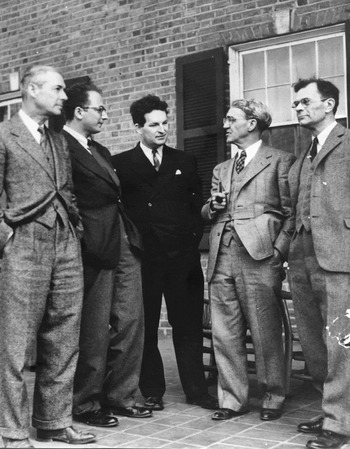
(left to right) DuBose Heyward, Clifford Odets, Paul Green, Frederick “Proff” Koch, and Barrett Clark at the 21st Annual Theatre Festival, Carolina Playmakers, University of North Carolina at Chapel Hill, 1940. (Reproduced by kind permission of the Paul Green Foundation.)

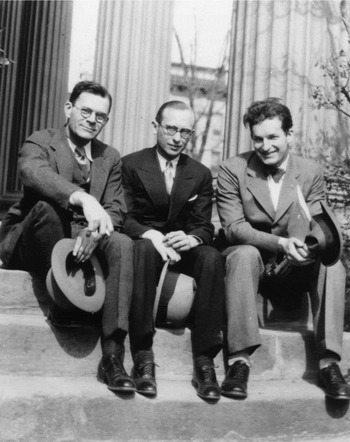
(left to right) Barrett Clark, Lynn Riggs, and Paul Green on the steps of Playmakers Theatre, University of North Carolina at Chapel Hill, 13 February 1931. (Reproduced by kind permission of the Paul Green Foundation.)

Weill, Green, Reinhardt, and the Federal Theatre Project
Paul Green taught at the University of North Carolina at Chapel Hill and had some reputation as a Southern playwright: He was a classmate of Thomas Wolfe and friends with DuBose Heyward and Lynn Riggs (respectively, of Porgy and Green Grow the Lilacs fame) and associated with leftist theatrical figures such as Clifford Odets.
Green's 1927 Pulitzer Prize for the play In Abraham's Bosom led to a Guggenheim Fellowship that allowed him to spend a year in Berlin in 1928–29, when he saw Die Dreigroschenoper,Footnote 4 but he seems to have known nothing else about Weill until an introduction was engineered in New York in early 1936 by Harold Clurman and Cheryl Crawford of the Group Theatre (which had opened with Green's The House of Connelly in 1931). Crawford then encouraged them to work together on Johnny Johnson. Its antiwar subject was topical enough for 1936 as Mussolini's invasion of Ethiopia and events in Spain made it clear that war in Europe was on the horizon. The play's satirical treatment also suited the Group Theatre's left-leaning tendencies. The action starts in 1917 as the United States enters World War I, and its hero, a lowly tombstone cutter, is represented as a kind of Everyman, unsophisticated but pure of heart and with a wealth of homely common sense that exasperates his superiors. In act 1, Johnny Johnson, at first reluctant to join in the patriotic fervor, is prompted to enlist by Woodrow Wilson's support for “a war to end war.” In act 2, he fights at the front in France but realizes war's madness, then uses laughing gas to trick the generals into calling a truce; he is eventually captured and brought back to the United States. Act 3 first shows him in an insane asylum, diagnosed with “peace monomania,” then brings the action to 1936: Johnny is now an itinerant peddler moving through streets filled with voices calling for a new war. He is left singing a brave but futile song in hope of a better world.Footnote 5
Green could not quite decide how to label Johnny Johnson: The opening-night program called it “a legend,” although reviewers quickly started to use the terms “a play with music” and the even more loaded “a musical play.” Certainly Weill's score is substantial (taking up some seventy minutes in a play running just under three hours): Its thirty-nine numbers (some appear more than once) comprise choral scenes, songs, and instrumental interludes. One number is sung by the Statue of Liberty as Johnny's ship passes on its way to Europe, and another by three guns looming over the trenches. The music is an intriguing mixture of European and would-be American idioms (the latter including a “cowboy” song and a reference to Southern hymnody). Weill is also quite inventive in terms of playing out action over underscoring in the laughing-gas and battle scenes, the latter represented as a series of static “flashes” while two priests intone in English and German the prayer “In Time of War and Tumults.” Despite a number of effective moments, however, it seems that Green was somewhat at sea when working with the composer, and never quite sure of just what the role of music in the theater might be. The Group Theatre, too, lost confidence in the songs in Johnny Johnson, subjecting them to massive cuts as the premiere approached. The advance publicity claimed the play to be “the first effort in America of a basic fusion of drama and music in the legitimate theatre”; for most critics, it was a brave experiment gone wrong.
Hallie Flanagan, the energetic director of the Federal Theatre Project, took a different view. The FTP had been formed in 1935 under the aegis of Franklin D. Roosevelt's Works Progress Administration (later, Work Projects Administration), and it was quickly surpassing its role simply to provide training and work for the unemployed within the theatrical professions. It carved out a role for itself as a purveyor of theater for the “people,” ranging from high-art drama, through Gilbert and Sullivan operettas and vaudeville, to marionette productions, children's projects, circus, and niche markets such as Yiddish and African American plays. Performances sponsored by the FTP were low priced to increase accessibility and were often in untypical venues; they also exploited the unconventional in other ways, in part so as not to compete with the commercial theater (such competition was forbidden by the terms of the WPA), but also because of the organization's undoubted progressive political tendencies that subsequently (from 1938) got it into great difficulties with the House Committee on Un-American Activities.Footnote 6
Flanagan had expressed interest in an FTP production of Johnny Johnson as early as October 1936.Footnote 7 She was even more enthusiastic after she saw the piece in mid-December, writing to her husband on the 17th that “to me this is the most potent of all the plays against war because it is funny and sad and infuriating and inevitable.”Footnote 8 The theme was her agenda of the moment: On 1 December, she had issued a directive to her regional directors that in spring 1937 all units should mount an antiwar production, and the FTP soon drew up a list of approved plays for the purpose.Footnote 9 This type of centralized action was typical of the FTP: The best-known example is John C. Moffitt and Sinclair Lewis's It Can't Happen Here, a political satire on the United States under a fascist dictator, which the FTP opened simultaneously in eighteen cities on 27 October 1936. The timing of It Can't Happen Here was deliberately provocative in the context of the November 1936 presidential election. As for Flanagan's antiwar initiative, it meshed perfectly with re-elected President Roosevelt's widely reported opening address at the Inter-American Conference for the Maintenance of Peace in Buenos Aires on 1 December, the same day as the FTP directive.Footnote 10 In his speech Roosevelt sat on the fence in terms of the looming clouds of war in Europe: He made a powerful argument for peace but also refused to tie the hands of the United States and its regional allies in the face of potential aggression. There is a similar ambivalence in Johnny Johnson: Its protagonist is willing to fight for an ideal, but not at the whim of the venal military-industrial complex. Two FTP stagings ensued: one in Boston (25 May to 19 June 1937; twenty to twenty-three performances depending on which document one reads) and the other in Los Angeles (28 May to 4 July; thirty-three or thirty-four performances); a third in Chicago (with an African American cast) was planned but never realized. The Los Angeles production had some direct help from Weill, it restored almost all of the cuts made by the Group Theatre, and it was a significant success, attracting a total audience of some 22,000. It also contributed to a renaissance of the Los Angeles FTP, which had recently fallen victim to political and other intrigues.Footnote 11
The FTP had a vested interest in enhancing the role of music in the theater, in part because of its aim to promote new dramatic forms with social relevance: William Sully's musical revue Machine Age (music and lyrics by Bert Reed and Darl MacBoyle), which the FTP opened in Brooklyn on 30 April 1937, satirized the application of modern industrial techniques to the musical-comedy business with songs such as “Knocking Down the Bosses,” while another FTP initiative, Marc Blitzstein's The Cradle Will Rock, adopted a still more obvious line of political attack. Another advantage of music, however, was to boost the number of performers in any given production and therefore increase the FTP's employment-relief efforts: hence its use in major cities of theater orchestras to provide overtures, entr'actes, and other incidental music.Footnote 12 Likewise, what made Johnny Johnson difficult to sustain on Broadway—its sixty-nine speaking roles—was no longer an impediment. Whereas the Group Theatre had thirty-six actors on stage, the Los Angeles production involved a cast of sixty, plus forty-six extras. The FTP tended to think big, as befit its purposes.
The enthusiasm for Johnny Johnson in Los Angeles prompted the FTP's assistant director in charge of the Western Region, J. Howard Miller, to hatch other plans for Weill. On 29 April 1937, Miller wrote to Flanagan that Max Reinhardt was currently on the West Coast, had expressed great enthusiasm for the recent FTP production there of The Merchant of Venice, and was proposing a revised version of a work that had been his signature piece at the Salzburg Festival since 1922, Hugo von Hofmannsthal's Das Salzburger groβe Welttheater:
I am thrilled about Reinhardt doing a production for us. He called us regarding it and we did not approach him. I have the translation of the prologue of the play, von Hofmannsthal's The Great World Theatre, and it looks very interesting. The play itself deals with the French Revolution, and Reinhardt plans to change the conflict, which I understand revolves about the Catholic church, to one between the various political forces in the world today. . . . I believe that Kurt Weil[l] will do the music for the production. We will probably use anywhere from 250 to 350 pieces [sic], including a chorus of about 50 voices and an orchestra of about 50 instruments.
Miller brimmed with excitement over a collaboration with Reinhardt: “He feels that the Federal Theatre Project is the only organization of the theatre in America which can achieve an artistic production of this type, and he hopes that it will promote an artistic consciousness in California which will establish it as a theatre center and as an art center second to no other place in America.”Footnote 13 Clearly, Miller also thought that Reinhardt had a significant degree of cultural capital that would work to the FTP's benefit. The same seems to have applied to Weill.Footnote 14
Reinhardt had been brought to West Coast prominence by his Oscar-winning film of Shakespeare's A Midsummer Night's Dream (1935) with Dick Powell, Olivia de Havilland, James Cagney, and Mickey Rooney. It derived from a stage production in the Hollywood Bowl the previous summer (1934), and Reinhardt's 1937 plans for Das Salzburger groβe Welttheater appear to piggyback on another Bowl production, the spectacular staging of Hofmannsthal's Jedermann: Das Spiel vom Sterben des reichen Mannes in September 1936.Footnote 15 Reinhardt had made Jedermann another standard feature of the Salzburg Festival from 1920 on, although the new Los Angeles production was directed by Johannes Poulsen from the Danish Royal Theatre, with the music by Einar Nilson (who conducted) written for Reinhardt's 1912 production of the play in Berlin.Footnote 16 The Hofmannsthal plays also seem to have fostered some interest in the Los Angeles FTP in pageant-style productions: Miller's letter to Flanagan of 29 April 1937 further noted his plans to create a new theatrical space in Los Angeles to be called the “Theatre of the Southwest,” with five stages to allow for the production of “pageantry” on historical themes.Footnote 17 As for Reinhardt, he had already (January 1936) discussed with Paul Green the idea of turning Jedermann into “an American Negro morality play.” That idea was revived at a dinner party in New York on 11 January 1937—after a performance of The Eternal Road—although Green thought it “a dull piece” albeit with “here and there some touches of human warmth.” When Reinhardt then cabled him from Hollywood requesting an outline “of a sort of American ‘Everyman’” to present to Warner Brothers, Green was unenthusiastic.Footnote 18 So he remained when Weill sought to interest him in the Great World Theatre project in a telegram sent on 15 April 1937. “After all,” Green wrote in his diary (19 April), “I have no interest in being a small clown in the Reinhardt show. If it was a play of my own he wished to do, I'd hope for something worth my struggling for. Reinhardt must be in a precarious way. But when all is said and done he is still an important man in the theatre.”
The Great World Theatre soon disappeared from view, whether because of the lack of a suitable playwright or, more likely, because of financial uncertainties facing the FTP in late spring 1937 in the run-up to the new fiscal year (starting on 1 July). These budgetary issues also had a severe impact, we shall see, on other FTP initiatives, including The Cradle Will Rock, at least if one believes the official FTP side of that story.
Green, Granowski, and the “Symphonic Drama”
Green had intended to introduce himself to Max Reinhardt during his Guggenheim year in Europe (1928–29), but he lost his nerve at the last minute.Footnote 19 Another European encounter bore greater fruit, however. Green was mightily impressed by his conversations in Berlin with the Russian director Alexei Granowski after seeing his celebrated version of I. L. Peretz's A Night in the Old Marketplace done on tour by the Moscow State Yiddish Theatre: Green described it as “a sort of grotesque, tragic carnival, with hardly any dialogue or spoken words, nearly all pantomime, dance, and musicalized action.”Footnote 20 In talking with Granowski, Green attempted a comparison with Wagner's “music dramas,” although Granowski steered the discussion in a different direction:
But they were operas. Music swallowed up the words, submerged them, changed their real and actual meaning. I use music—and the same for dance, pantomime, costume, properties, and setting—to interpret the words, to give them a richer meaning. I have been working on this type of drama now for ten years, and every day convinces me that I have just begun to glimpse the possibilities. . . .With music and stylization of the proper sort, one can obtain short cuts in scenery, properties, and in moving the story forward. It is easier to get right down to business, go right to the heart of your dramatic matter, to reach the inner meaning and symbolism even of the story you have to tell, to make it immediately available to the audience—with music.
Green also put other words in Granowski's mouth:
If I should ever be forced to leave Russia . . . America is the place I'd want to go to begin my theatre over again. Your nation has everything to make a great theatre movement possible. You are the richest of all countries in dramatic material. You are a country of conflicts. And I don't mean those that result in physical violence necessarily. I mean spiritual conflicts, conflicts of ideas, of individual feelings, of points of view, of mass groupings, of types, of individuals, and of organizations. And always energy, energy. Your country is boundless in that. And think of your many nationalities with their own inheritances of speech and custom. Surely at this hour yours is the most creative nation on the globe.
Further, Green has Granowski claiming, “I can't understand why America hasn't developed music drama,” and asking “Why hasn't America ever created a great Negro theatre? More than once in recent days and under the present regime in my homeland of Russia, I have seriously considered migrating to America to try to build a Negro musical drama there. Think of the singing, the religious rituals and practices, the superstitions, the vivid folk speech, folklore, and tall tales, the dramatic conditions surrounding that submerged yet marvelously gifted people.”Footnote 21
Green was spurred into action: In his post-Berlin phase, he made serious attempts to incorporate music in his African American plays, with Tread the Green Grass (1928–32) and Shroud My Body Down (1935)—both with music by UNC colleague Lamar Stringfield—and Roll, Sweet Chariot (1928–34).Footnote 22 None achieved critical success: Only Roll, Sweet Chariot played on Broadway, for one week in early October 1934, with music by Dolphe Martin for an “orchestral choir” (of voices) accompanied by clarinet, tuba, and timpani. However, Green knew that he was on some kind of track, even if he was not clear where it might lead: In a diary entry for 14 January 1936 he noted that he was “thinking on Stokowski, Martha Graham, Trudi Schoop, Granowski, and meeting planned by Mrs. Isaacs— Something I am after whether stage or screen—preferably for me stage—union of dance, pantomime, song, the word, and acting. Tread [the] Green Grass, Roll, Sweet Chariot, Shroud My Body Down only suggestions of what I want.”Footnote 23 These works also posed a generic conundrum, as Green wrote later about Roll, Sweet Chariot:
“Music drama” didn't seem the right term for the play. For there was more than music. “Ballad opera” it could not be, nor “opera.” “Festival drama” was too loose and “misnoming,” “Lyric drama” lacked entirety. Finally, “symphonic drama” seemed right. Yes, a “sounding together” in the true meaning of the Greek word. And so I adopted the form and have used it for a number of other like dramas that I have written since.Footnote 24
The best example of the genre became Green's “symphonic drama” The Lost Colony, which received its premiere in Manteo, North Carolina, on 4 July 1937 and remains an annual summer fixture there.Footnote 25 In April 1936 Green had been commissioned by the Roanoke Historical Association to prepare an outdoor drama celebrating the 350th anniversary of the first British colony established in the New World, on Roanoke Island. A new theater was constructed with support from the WPA, with three separate stages in a semicircular arrangement.
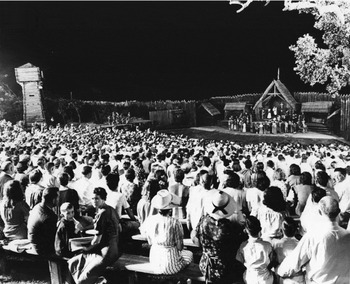
The Lost Colony, Manteo (Roanoke Island), N.C., summer 1937. (Reproduced by kind permission of the Paul Green Foundation.)

Green chose as his subject events from 1584 to 1588 (when the colony was found to have mysteriously disappeared), shifting between a Native American village, the colonists’ fort, and scenes set in England. His characters mix the historical with the fictional—the latter including Old Tom, a former beggar who finds his place among the colonists—with a Minister for the opening prayer and a Historian who serves as narrator. In its opening season, The Lost Colony had a cast of 128, including several actors paid by the FTP, members of UNC's Carolina Playmakers, and a large number of local amateurs, with music provided by the Westminster Choir from New Jersey.Footnote 26
It is not clear what music was used in the summer 1937 version of The Lost Colony, or how great its extent. At one point Weill seems to have offered to write the music for the 1938 production, but the timetable for The Common Glory intervened.Footnote 27 Thus the settings published in “The Lost Colony” Songbook (New York: Carl Fischer, 1938) are by Green's prior collaborator, Lamar Stringfield, with some additional four-part harmonizations of traditional airs by Adeline McCall.Footnote 28 Stringfield composed an overture, Native American dances, and other numbers; he and McCall arranged several Tudor songs, such as “Mad Robin” and “Greensleeves,” for which Green sometimes provided new texts; and the music also includes hymns and chants by the likes of Thomas Tallis and William Byrd. The Songbook contains twenty-eight items (mostly short), all cued to points in the play where music is required as part of the action. They provide local color as well as some manner of historical authenticity, but the script does not embed them in the drama in the way Green and Weill had attempted with Johnny Johnson.
Summer 1937
Green's enthusiasm for Granowski's ideas—and their evident rapprochement with dramatic theories associated with Bertolt Brecht—should in principle have made him sympathetic to working with Weill. But the Reinhardt/Hofmannsthal projects on the one hand, and The Lost Colony on the other, suggest that although the “symphonic drama” remained an ideal, the playwright was not always willing or able to engage fully with its consequences in dramatic or musical terms. His commitment to politicized theater also wavered, in part, it seems, because of changing circumstances in the second half of 1937.
Hallie Flanagan kept abreast of The Lost Colony, and Green and Weill were invited to speak at the FTP Summer Theatre Program, held at Vassar College in Poughkeepsie, New York, for six weeks from late June to early August.Footnote 29 Here on 29 July Green outlined his theories on symphonic drama, presumably along the line of notes in his diary entry for the 23rd:
By symphonic drama is meant that type of dramatic presentation which (necessarily) demands for its creation the intense and full use of all dramatic elements—words, music, dance, light, masks, color, sculpture (shapes), movement—each one impassioned and integrated in the whole—a sounding (in the Greek sense) together. The word is not exactly apt, and yet “synthetic” is worse.
The two primary elements are words (poetry) and music, and so far the insertion of the cinema does not fit.
This sort of drama is not the Wagnerian music-drama. Nor is it Strindberg nor Kaiser.
At Vassar, Green also came into direct contact with another of the FTP's dramatic experiments, the Living Newspaper, given that the participants in the summer program were developing One-Third of a Nation (taking a cue from President Roosevelt's January 1937 inauguration address—“I see one-third of a nation ill-housed, ill-clad, ill-nourished”). Such productions represented the FTP at its most politically active and were also the cause of some of its greatest controversies. The Living Newspapers drew on Russian and German models to develop a flexible format focusing on major political and social issues of the day, incorporating episodic sketches and songs, usually within a highly stylized staging. The first, Ethiopia (on Mussolini's invasion), was silenced even before its opening, but Triple-A Plowed Under (opened 14 March 1936; with music by Lee Wainer), Injunction Granted (24 July 1936; Virgil Thomson), and Power (23 February 1937; Wainer) brought the FTP some prestige at least in left-leaning circles.Footnote 30 These productions also provide an immediate context for the FTP's entrance into more mainstream political theater with works such as It Can't Happen Here and The Cradle Will Rock, as well as its support for other plays with a “frankly partisan appeal to labor audiences” such as John Wexley's Steel (1931) and They Shall Not Die (1934; on the Scottsboro case).Footnote 31
The FTP Summer Program at Vassar followed hard on the furor caused by locking The Cradle Will Rock out of its theater on the night of the proposed premiere (16 June 1937), then officially dropping the show on 6 July. The story is well known, and in general it has not redounded to the credit of Flanagan or the FTP. The official line was that Cradle simply fell victim to uncertainties over continued funding for the FTP for the new fiscal year that led to a WPA-imposed ban on the opening of new productions until that time. The show's supporters, however, claimed the heavy hand of censorship because of its political orientation, with Flanagan cravenly refusing to defend artistic freedom.Footnote 32 Certainly, Blitzstein's exposure of capitalist excess in Steeltown, U.S.A.—with Mister Mister the industrialist, university President Prexie, Reverend Salvation, Editor Daily, and the like opposed to Larry Foreman, Harry Druggist, and the downtrodden prostitute, Moll—was timely in the context of the recent industrial unrest in “Big” and “Little” Steel, and clearly it was intended to be inflammatory. In early 1938, Flanagan claimed that closing Cradle was a “tragic mistake”: “I heard Marc Blitzstein play this score long before anybody knew who Marc Blitzstein was. I immediately felt it was the work of genius and secured it for the Project. We spent seven months and thousands of dollars on it, and sold 25,000 seats in advance. Then in spite of my protests, the whole thing was stopped.”Footnote 33 Whether or not this accounting represents a creative rewriting of history, July 1937 was a difficult time for the FTP, and Flanagan, ever the pragmatist, must have been eager to find some redress.
The FTP did not give up on political theater: One-Third of a Nation was hardly “safe,” and in October 1937 the FTP revived John Howard Lawson's Processional (1925; music by Earl Robinson) dealing with striking West Virginia miners. However, some counterbalance was also needed. In a diary entry for 22 July 1937 (just before he went to Vassar), Green noted the receipt of a “Letter from Hallie Flanagan offering Madison Square Garden or the Hippodrome for a challenge—will talk it over with her next week.” The next day, he wrote back to Flanagan with thanks for her “words of encouragement about the symphonic drama” (presumably relating to The Lost Colony): “What you have to say about the big constitution production sounds exciting, and I should be more than glad to accept your challenge and offer.”Footnote 34 On 5 August, Flanagan wrote to Green expressing her gratitude for his involvement in the FTP Summer Program, noting that its participants “were most enthusiastic about your plans for a great mass drama.”Footnote 35 It became a key FTP project for the second half of the year.
Celebrating the Constitution
This new “mass drama” was in response to the sesquicentenary of the adoption of the U.S. Constitution in Philadelphia on 17 September 1787. Such celebrations had been on the FTP horizon for a while. On 17 December 1936, one Robert K. Ryland (writing from the National Emergency Council, St Louis, Missouri), submitted to the FTP his play The Making of the Constitution, which Flanagan (in her acknowledgment of 30 December) thought “would prove a most interesting script for some of our units to do in commemoration of the 150th anniversary of the Constitution.” Likewise, on 6 March 1937, Tom L. Cotton (of the White Plains, New York, office of the WPA) forwarded to Harry Hopkins (head of the WPA) a letter from Cotton's former classmate at Dartmouth, Arthur Stout, suggesting that the FTP should do a play on the Constitution in response to the attempts by the American Liberty League to block Roosevelt's proposed reorganization of the Supreme Court, which was one of the first crises of his second-term administration.Footnote 36
The FTP had some sympathy for historical plays: It supported H. R. Hays's The Ballad of Davy Crockett (1936), in which Weill was to develop significant musical interest, and E. P. Conkle's Prologue to Glory (1938; on Abraham Lincoln's early years). Such initiatives also fit into a much broader trend for historical reconstruction typical of the United States in the 1930s.Footnote 37 The immediate cause is obvious enough: The economic and social crises of the Great Depression forced an examination of American history, as well as a search for a “usable past” (to use Van Wyck Brooks's term coined in 1915), for the purpose of reassurance or recrimination. At the heart of the matter lay the “American Dream,” a newly invented catchphrase that formed the focus of the apotheotic final chapter of James Truslow Adams's The Epic of America, first published in 1931 and serialized in FTP Sunday radio broadcasts from November 1937 to February 1938.Footnote 38 These questions became still more acute under the terms of the “New Deal,” where conservative concerns that Roosevelt's social-democratic policies were fundamentally “un-American” could be countered, or supported, by historical example, whereas the well-known political and other difficulties faced by his administration could be contextualized and perhaps mitigated. Likewise, enthusiasm (at least in some quarters) for the apparent socioeconomic successes of the Soviet Union, and fears over the rise of fascism elsewhere in Europe, encouraged inquiry into, if not celebration of, what made the United States unique.
Green was strongly attracted to the idea of contributing to the sesquicentenary celebrations. On 1 August 1937, he wrote from Chapel Hill to Flanagan's assistant director, John McGee:
I want to reiterate that I am very much pepped up over the idea of that big production, and I am counting on all of us working ahead in its completion. I talked at length with Kurt Weill, and he shares our enthusiasm. He is the person I want to arrange the musical end of it, and [he] is coming down here this week to go further into the matter with us. His participation will of course not change any financial arrangement you may make; he and I will simply split the royalty as we did in Johnny Johnson. Although his background is not American, I am sure that fact will not count against the Americanness of the play, for he will use the music of America (folk, national) much in the same way as I will use its history. And his wide theatrical experience in Europe will be of invaluable aid to us all.Footnote 39
Weill went down south shortly thereafter—when he and Lotte Lenya also made the trip out to Manteo to see The Lost Colony—and by the middle of the month, Green was able to send Flanagan and McGee a long letter containing an outline of their proposed collaboration:
Kurt Weill and I have been working down here in North Carolina for a week, and we feel that after many visions, plans, intents, and false starts we have at last got hold of a musical-dramatic idea that will be what we want for our production. It will incorporate practically all the elements of the theatre and at the same time will of necessity carry out some statement about the main social questions of our day—such as wages, housing, security, health, education, justice, and individual rights as guaranteed in the constitution. . . . Our aim in the production will be to show the audience the nature of their constitutional guarantees while at the same time we uncover in the very heart of our governmental system the difficulty and hindrances that are created against these guarantees. The story will speak for itself as it unfolds in words, pantomime, music, and dance.Footnote 40
Rumors also started being fed to the press: Brooks Atkinson's review of The Lost Colony in the New York Times on 15 August, commenting on the form of the “symphonic drama,” noted that “there is already talk of a mass play in that form on the subject of the Constitution, to be done next Winter, if possible, with WPA actors and theatre artisans.”
In his mid-August outline, Green includes a list of proposed characters: citizens of a great American city providing a chorus of about fifty, a young idealistic attorney, a great factory owner and benefactor of education, the president of a university, the governor of the state, a powerful minister of a leading church, the daughter of a capitalist, among others. He also announces his intention to focus on the strikes by North Carolina textile workers in Gastonia (1929) and Burlington (1934); the former, at least, had become a Southern cause célèbre of capitalist and judicial oppression. His outline sets the scene in the Hippodrome (“or wherever the play will be given”), opening with “the figure of Columbia blindfolded (some will call it Justice)” at the center-back stage
intoning in a musical amplified voice the preamble of the constitution (or perhaps I will write a paraphrase from the three sources—Declaration of Independence, Articles of Confederation, and Constitution—which can be sung at different points in the play, either for information, or tragic or ironic effect) all to an orchestral accompaniment. . . . The orchestra continues playing, and now a sonorous bell is being run and a voice calling “oh yus, oh yus, come into court,” etc.
The lights come up to reveal a courtroom at the lower forestage, while as witnesses are summoned, episodes are acted out on separate right-front, left-front, and center-back stages. Striking workers are seen and heard chanting “a terrific labor song,” policemen enter “to musical accompaniment,” and the chorus chants the pros and cons of the strikers’ case, ending with “a final dance of protest, the accompaniment louder and louder, the light glows on the figure at the back, and across the scene the intoning amplified voice reaffirming the principles for which this country was created.”Footnote 41
The singing statue of Columbia/Justice gave Green and Weill a working title for their collaboration: Columbia. Whereas this device invokes the Statue of Liberty in Johnny Johnson, however, the broad format proposed by Green is strongly reminiscent of the Living Newspapers: Indeed, the Gastonia strike had already appeared as an episode in Injunction Granted (1936), as well as being the subject of several radical novels published in the early 1930s, including Sherwood Anderson's Beyond Desire. Inevitably, however, the FTP picked up on a much more obvious association. McGee swiftly sent Green (on 17 August) a rather cool response: “I am beginning to tire, and I think that almost all audiences are beginning to tire, of the typical capitalist arrayed against the noble worker. This was the flaw in Cradle Will Rock, and I should dislike to have your play fall into that category.”Footnote 42
Back to the Drawing Board
McGee may have misread Green's intentions, just as Green may have misread the FTP's. For all his social conscience—he was active in the defense of the Burlington strikers—the playwright was no adherent of the hard left, and although he certainly admired the energy of the Group Theatre, he was as nonplussed by its adherence to Marxist theory as to Stanislavsky. Green and Weill's different responses to President Roosevelt's speech on Roanoke Island as he attended a performance of The Lost Colony on 18 August are also revealing. Roosevelt took every opportunity to score political points: “I fear very much that if certain modern Americans, who protest loudly their devotion to American ideals, were suddenly to be given a comprehensive view of the earliest American colonists and their methods of life and government, they would promptly label them socialists. They would forget that in these pioneer settlements were all the germs of the later American Constitution.”Footnote 43 Weill wrote enthusiastically to Green from New York on 19 August that he was “very impressed” by Roosevelt's remarks:
I think, a few things he said could give exactly the idea for our play. You remember that I said in Chapel Hill, I have the feeling that most people who ever came to this country, came for the same reasons which brought me here: fleeing from the hate, the oppression, the restlessness and troubles of the Old World to find freedom and happiness in a New World. It is exactly this idea which the President expressed in his speech.
Weill also felt that Roosevelt's comment on the colonists’ socialism providing the germ for the Constitution offered “the complete ideological outline of our play.” As he told Green:
It is this “comprehensive view” which we have to give—a picture of early America, completely different from the one we are used to read[ing] in schoolbooks and chronicles: the socialist idea in the early America, its fight against the followers of European feudalism and its final triumph in the Constitution.
This fight for the Constitution should be the great middle part of the play, and the fight should be shown in the private life of one single person—either one of the leaders who had a colourful life, or an invented simple man. For this middle part, I think, it would be important if we go and see the Zola-picture next week when you are in town again. From what I hear, it seems that they have found an interesting way of writing the story of an idea. They show Zola as a young idealist who has more and more success until he finally forgets all his ideals. He has not the slightest interest for Dreyfuss [sic]. But suddenly he is taken by the idea and now he has to fight it through to the end. Don't you think that could be the kind of story we need?
At the present moment I could see our play in three parts: an introduction in [the] form of a chorus-symphony, showing in broad “al fresco” painting, with a reporting chorus, the great events which shake the old world, wars, revolutions, persecutions, etc. which bring new masses of people to this country, people who want freedom and a new social order. This should be a very exciting choreographie [sic], leading from the early days up [to] the seventeenth century. Then our main story (the second part) starts, showing the birth of the Constitution as the drama of an idea. The third part continues the symphonic report of the first part, showing the world-events of the nineteenth and twentieth centuries which all bring new people to the shores of this country, more and more, black, white, yellow men, and women, carried by the same idea: to find a new world of freedom and equality. And that should go right up to Hitler and Mussolini.Footnote 44
In contrast, Green had a much harsher view of the presidential address, tersely noting in his diary, “Thought it inappropriate.” Reading between the lines, it would seem that this reaction was due less to Roosevelt's politics (which Green supported, broadly speaking) than to his apparent conviction that art should rise above them. It is unclear whether Green ever communicated to Weill his feelings about Roosevelt's speech: If he had, the composer probably would not have understood all the political nuances at work here, some with a Southern inflection.
Weill's vision in his 19 August letter took things in a quite different direction from Green's mid-August proposal, painting a much broader historical canvas reminiscent of the Reinhardt/Hofmannsthal project recently proposed but then dropped for Los Angeles. The confusion was troublesome given that the FTP was pressing ahead on fixing a schedule, with delivery of the text and music by 1 December 1937 and an intended opening on 22 February 1938 in eleven cities (New York, Chicago, Los Angeles, San Francisco, Boston, Cincinnati, New Orleans, Atlanta, Miami, Denver, Seattle); the date was announced in the New York Times on 12 September 1937. Weill, who had probably met with Green again in New York at the end of August, wrote to him on 4 September that he was concerned about the timetable—and that to meet it he would need all the parts of the play requiring music by 1 November—yet “What worries me most (between us) is the fact, that we, at this moment, really don't know yet what we are going to do, neither the story nor the form of the play.”Footnote 45 Weill also noted his response to having just seen the grand historical musical Virginia (book by Laurence Stallings and Owen Davis; music by Arthur Schwartz; lyrics by Albert Stillman)—based on semifictional events in Williamsburg on the eve of the Revolution—which had opened at the Rockefeller Center Theatre on 2 September:
I am surer than ever that we should not think in terms of a big, gigantic spectacular show, but try to write a good play with an exciting music, which can be produced in a small theatre as well as in a big one. In the Center theatre for instance, although it still is the best of all great theatres, it is simply impossible to get over drama or comedy. All you can do there is spectacle—and that is not interesting enough.
In his review of Virginia in the New York Times on 3 September, Brooks Atkinson felt that the show's spectacle could not overcome the “stuffiness of the book and the languors of the narrative,” although he paid compliment to one of Arthur Schwartz's “most attractive scores” that mixed “modern showmanship with some beguiling period songs”—pastiches (it seems) of “old English and vocal dance music”—plus “three jubilant songs for Negro voices” (performed by Will Vodery's African American choir). Returning to the show in the New York Times on 12 September, Atkinson was even more negative, placing Virginia in the lineage of The Great Waltz and White Horse Inn—implying it was just folksy kitsch—and comparing it unfavorably with the “exalted reverence” of The Lost Colony. He also mused on the dramatic potentials of U.S. history from colonization to the Constitutional Convention:
As a rule, the stage uses American history only to decorate the background of costume romance. But the homely truths of the men and women who came here, largely to escape oppression and corruption, are overflowing with humanity. Now that we look back at it across the years, it is a story greater than the stature of any of the men involved in it. It is worth serious reinterpretation by serious artists working on the stage.
Atkinson had already alluded to the FTP's plans to celebrate the Constitution in his review of The Lost Colony; now, it seems, he was giving them total support.
Weill continued to be anxious over the timetable.Footnote 46 However, John McGee felt confident enough to start drafting on 13 September an FTP press release with further details of the project, presenting yet another view of the intended content: “The play will deal with the early struggles to establish the fundamental principles of American liberty. The scene of the story is centered at the Constitution Convention in Philadelphia. The production calls for the use of large numbers of actors, singers, dancers, and musicians; perhaps numbered several hundred in each of the ten [sic] productions.”Footnote 47 For the purpose of this press release, McGee also asked Green for further comment, to which the playwright responded by telegram:
The play I am writing for simultaneous production on February 22 by the Federal Theatre somewhat resembles from a technical standpoint The Lost Colony which was produced through the summer on Roanoke Island and which for lack of a better term I called a symphonic drama. The subject matter of the new play is drawn from the revolutionary period of American history and depicts the dramatic struggle of the Founding Fathers to hew out and rive forth into living form their theory of democracy and representative government. Obviously many of the famous personages of those past times appear in the play but the idea that they struggled to envisage might be called the protagonist of the piece rather than any one or several of the characters themselves. The climax of the play comes with the creation of the Constitution. There will be several scenes all integrated and woven together with the use of music, chorus, dance, and pantomime. Atkinson in Sunday's Times [12 September] hit the nail on the head. Talk with Kurt Weil[l] about his plans for the music.Footnote 48
It is not clear why McGee thought that the play would be located in Philadelphia, although it certainly makes sense in historical terms. On 28 September, however, Green cabled Weill with yet another plan: “Have been working night and day on the vast material and from the beginning felt that the story lay around the scene of Boston and the character of Sam Adams.” He expected Weill to come down to Chapel Hill and to avail himself of the university library to dig out any “early American music” he might need. Weill wrote back the next day (the 29th) saying that he was happy with the focus on Boston (“by far the most dramatic period of the Revolution, rich of characters and personal stories”); he introduced another FTP official into the equation, George Kondolf, who on 10 September 1937 had been appointed director of the New York City FTP unit and therefore would take over the reins when it came to production; and he noted that he planned to go back down to Chapel Hill on the following Saturday (2 October).
I will stay there long enough to work out with you the definite story outline and construction of the play and to talk over in detail the formal problems, the places for songs, choruses, dances, etc. With intensive working this should not take us more than 8 or 10 days. After that I will leave you alone to write down, as fast as possible, a first draft of the play which would enable Kondolf and Flanagan to go ahead with production plans. I would prefer to do my own part of the work mostly here in New York, because we have just furnished (for lots of money) our new apartment with a very nice studio for me. There are more reasons for me not to stay away from New York too long: I have prepared very good material for musical research in the 58th Street musical library which I am just starting to study. I also want to keep up the contact with Kondolf who will be back from his vacation around October 8th, and finally Fritz Lang is coming here early in October to talk to me about our picture.Footnote 49
It was during this trip that Green and Weill decided on a new title for their play, The Common Glory, drawing on a well-known speech by Samuel Adams.Footnote 50
On his return to New York, Weill met Kondolf on 13 October and reported back to Green that same day that he had talked about “our problems” and had outlined “the three possible solutions” for the play that seem to have emerged from his recent visit to Chapel Hill: a biographical drama of Samuel Adams; the story of a fictional Jonathan Smith, “a kind of Johnny Johnson of 1776, with Sam Adams as an important background figure and with a strong love story”; and “a panorama of the Revolution, a kind of pageant about the ‘American dream.’” Kondolf (prompted by Weill?) thought the first too problematic for a big musical production, and that the last “was too much ‘spectacle.’” However, he liked the idea of Jonathan Smith and thought in the end that some kind of combination of the three ideas was the best way to go. Weill added:
Since I left you I feel that our last decision, to use all the up-to-date devises [sic] of the free “unbound” theatre, was absolutely right, but that in spite of that we need a very strong human story to give real life to our show. We need humor (the Johnny Johnson-kind of humor) and we need a warm, moving personal story. As soon as our audience is really interested in our characters, they will follow us anywhere when we open our stage for the great fantastic scenes. The more real, dramatic, moving our personal story is, the easier will it be to have our chorus, surrounding the stage, singing the “American dream,” taking part in the action, building up, with movement and excitement, our “al fresco” painting of the Revolution and forming a bridge from the ideology of 1776 to the present day.
If we succeed in creating this combination of realism, poetic contemplation, and fantasy, we have a very natural set-up for the function of the music in this play: we have our chorus, representing the voice of the poet and the voice of the historian; we have our orchester [sic] as a bridge between the different styles of the play, helping the realism with marches, dances, etc., underscoring the speeches, in order to lift them to a higher level, taking the place of the word in our pantomimic and choreographic scenes; and we have sweet, melodious songs to give warmth to our personal drama.
By late October, however, Green was back “in story troubles again,” and Weill was talking with McGee about how best to rescue the situation.Footnote 51 These “troubles” presumably derived from the clash between the broad-sweep approach endorsed (twice) by Weill, and Green's ever-narrowing focus for the action of the play. An undated (but probably late-October) “4th Scheme for Constitution Play” further reveals the shift, retaining a fictional “folk-character” but avoiding the larger-scale historical overviews of events before and after the Revolution. Green now had a still less ambitious scope:
To build the story around a folk-character, a common man, say the prototype of Brother Jonathan, the kindly humorous, comic Yankee spirit, from the line of which such characters as Uncle Sam, Rip Van Winkle, the Old Soak, David Harum, Will Rogers, Johnny Johnson, etc. derive. This folk-hero through some bit of monarchical oppression on himself and his small but personal business gets fired into the dream of liberty and the bill of rights and goes into the adventure to bring these benefits to pass for himself and his brethren—the common people. (On one side of him as a sort of interlocutor and father comptroller is Sam Adams and on the other perhaps a down and out dog-life old fellow, a wastrel and beggarless man, out of whose mouth come at the author's need a roll of words commenting upon the condition of the world and man in general.) Our protagonist, our Green Mountain boy as it were, becomes one of the son's [sic] of liberty.Footnote 52
Green's “folk-hero” is then to suffer various vicissitudes in the years immediately following the Revolution until equilibrium is restored by the addition to the Constitution of the Bill of Rights (1791), leading to a final speech by Samuel Adams containing “much of what is said or suggested in the epilogue of J. T. Adams’ Epic of A[merica] and what is on the minds of all of us who are concerned with ‘a nation of liberty and free men.’ And may the people go out of the theatre feeling that they are more the man, the woman, since in their keeping is the dream of a just and righteous government.”
It appears from such remarks that Green did not necessarily view the 1930s as a particularly “just and righteous” decade, which is clear also from his extensive involvement in the Scottsboro case.Footnote 53 However, he seems to have been unable to decide on the best format for a political engagement that the FTP would probably have preferred to avoid on any level for the present occasion. Whether because of the FTP's cool response to his first ideas, of Roosevelt's distasteful (for Green) politicization of The Lost Colony, or simply of the process involved in pinning grand ideas down on the page, The Common Glory changed significantly from Green's first, mid-August outline to the “4th Scheme” prepared in late October. Although he had started out with some kind of cross between a Living Newspaper and The Cradle Will Rock, and Weill had then flirted with the idea of a mammoth Reinhardt-type spectacle, Green now brought The Common Glory back down to earth by hewing to the formula with which he was now most familiar, and one that had brought him his biggest success to date in The Lost Colony. Weill's point of reference, however, became Johnny Johnson, and his understanding of the genre of the “musical play” was not going to mesh with Green's more restricted notion of the “symphonic drama.”
As Green worked on The Lost Colony, he developed a clear view on the importance of period music as a way of generating authentic historicity and granting historical authenticity: Its Songbook comprises folk songs and other materials from the Elizabethan era, with new compositions (by Lamar Stringfield) restricted largely to the Native American dances rendered spuriously authentic by way of pentatonicism and similar exotic gestures. For The Common Glory, Weill made some initial attempt to follow that lead: He looked at Samuel Endicott's Three Melodies of Revolutionary Times (Boston: Homeyer, 1918), Francis Hopkinson's Colonial Love Lyrics (Boston: Schmidt, 1919), and William Arms Fisher's The Music That Washington Knew (Boston: Ditson, 1931).Footnote 54 However, he warned Green on 28 October that he “did not find much which could be used,” and his letter of 13 October (quoted above) had already outlined a much more ambitious musical scope, with clearly defined functions for the chorus, the instrumental music, and the songs. Least amenable to the use of period-based material was Weill's vision for the chorus, representing the poet and the historian and “surrounding the stage, singing the ‘American dream,’ taking part in the action, building up, with movement and excitement, our ‘al fresco’ painting of the Revolution and forming a bridge from the ideology of 1776 to the present day.” The idea appears to have come from another piece of Americana on which Weill was working concurrently with The Common Glory, a reworking of H. R. Hays's 1936 play The Ballad of Davy Crockett (Weill told Green in his 28 October letter that it “turns out very nicely”). This project was linked to the formation by Weill, Charles Alan, Burgess Meredith, and Robert Edmond Jones of a new company to be called the “Ballad Theatre.”Footnote 55 According to Meredith, “Our purpose was to produce plays in which a new musical form would be used. A chorus of singers, like a musical Greek chorus, would sing the story line, and the actors would go into action only when the mood was prescribed by the chorus.”Footnote 56 Green, however, was not going to buy into this agenda, and he and Weill were left at total musical odds.Footnote 57
Two Draft Scripts and Two Musical Fragments
Things were now moving quite quickly. Green sent McGee a first draft of act 1, scenes 1–6 of The Common Glory on 16 November, and another draft extending to scene 9 (where the surviving copy breaks off in midstream) probably around 9 December, with a note promising a synopsis of act 2 to follow shortly.Footnote 58 These two drafts adhere reasonably closely to the broad plan of the “4th Scheme,” insofar as one can tell from what survives. There are slight differences between the drafts in terms of handling particular moments in the plot and in the cues for music, although the broad content is the same (see the outline in the Appendix).
It is an oddly shaped piece. Scene 1, which Green also labels a prologue, retains a vestige of Weill's broad-sweep plan and the composer's sentiments aroused by Roosevelt's Roanoke Island speech. We see the arrival of European settlers on American shores as a chorus in the orchestra pit establishes the theme:
However, scenes 2–9 concern events in Massachusetts from 1773 to 1775, with a digression to England in scene 6, and then to Virginia in scene 8 (for Patrick Henry's famous “Give me liberty or give me death” speech). The surviving portion of the play deals with Samuel Adams, Edward Malcomb, Paul Revere, John Scollay, Daniel Shays, and other well-known rebels, plus the fictional Jonathan Smith: They argue with the British governor, Thomas Hutchinson, and then prepare for the Revolutionary War.Footnote 59 Green concocts a love interest for Jonathan Smith in the guise of Anne Newton, a Boston aristocrat who follows her heart to join the revolutionary cause, although she disappears from the reckoning as Smith joins the Minute Men and rouses them to battle (where the script breaks off). Other invented characters include Old Jeems Wilson (“a wandering beggar and musician” in the cast list, although he is a peddler in the script), who serves as the rather curmudgeonly voice of a Southern Everyman, and a crotchety Grandma Smith. Some scenes are handled well, including the ball at the governor's house (scene 5), where, despite the rather strange invention of a dance for maidens dressed as wood nymphs, the appearance of the rebels is done to dramatic effect. Elsewhere, however, Green indulges in his typical tendency to speechify in ways that threaten to grind things to a halt. Grandma Smith clearly harks back to Aggie Tompkins in Johnny Johnson, and scene 2 is in effect a reworking of the earlier play's second scene, where Aggie is seen at a sewing machine—and has a work song—before expressing her objections to Johnny Johnson marrying her daughter, Minny Belle. Other aspects of the script, however, are more clearly associated with The Lost Colony, such as the opening prologue and the episodic action, and Old Jeems is a direct descendent of Old Tom. The same applies to Green's cues for music, with hymns, dances, and what seem to be popular songs from the Revolutionary period placed largely in verisimilar contexts. Although Green establishes in scenes 1 and 6 a chorus separate from the action, it is by no means used as consistently or imaginatively as Weill envisaged in his 13 October letter.
After Weill received the first draft (of scenes 1–6) on 23 November, he wrote to Green the next day expressing cautious enthusiasm:
It looks very exciting to me and I am convinced more than ever that it can be a very beautiful show if we get the right production. Of course, I realize that this is only a first draft and that it needs cleaning and rewriting. I have the feeling that it could stand more humor and there are also several details I would like to talk about. But the line and the style seem excellent and very much improved.—I started working immediately and wrote the opening prayer this morning and am working on the march of the pioneers now.
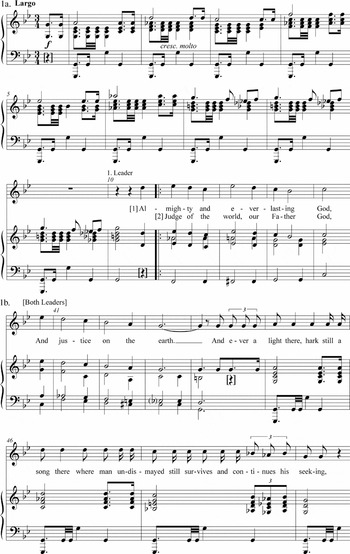
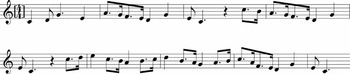
His setting of the first chorus in scene 1 does indeed survive: Its fifty-nine measures contain a somber fanfare-like opening followed by a hymnlike tune set strophically for two leaders (Example 1a). The music then shifts to a more declamatory style for a “chorus” (a single vocal line; Example 1b).
Kurt Weill, “Almighty and everlasting God” (Paul Green, The Common Glory, act 1, scene 1), (a) mm. 1–14, (b) mm. 41–48.

The most obvious reference of the opening is to a number in Johnny Johnson: “In Time of War and Tumults” is chanted by two priests (one from the United States, the other from Germany) as “flashes” of ferocious battle scenes are revealed on stage. This music is Weill in grandiloquent vein, if with a modal tinge no doubt to add a patina of age, while the choral declamation reveals his early thoughts on just how “ballad opera” might work. The same manuscript also contains a jaunty fife-and-drum-style melody for the subsequent march of the pioneers (Example 2): This piece fills an empty stave within the opening chorus but does not relate to it contrapuntally or in any other way.
Weill, march tune for The Common Glory, act 1, scene 1.

Weill's compositional efforts continued, it seems, although nothing more survives. When he acknowledged on 11 December receipt of the longer draft, however, he told Green that “it needs lots of work”: “I am not quite satisfied with the way the music comes into this play. But I think this [sic] are questions which we can only solve when the whole play will be finished and we actually start producing it. I have prepared all the musical material for the chorus parts. The incidental part of the music can only be done in connection with the production.” He remained silent about the other songs cued by Green.
The Project Collapses
The original timetable for The Common Glory to open on 22 February 1938 was no longer feasible: In a memo written by McGee on 6 December, the deadlines shifted to notifying casting and production requirements to directors by 15 December, delivering a rough script by 1 January 1938, then a revised one by the 15th, with the score to be done by 1 February and the orchestrations by the 15th save for the larger orchestras to be used in New York, Los Angeles, and Chicago. The intent was to open on 15 March.Footnote 60 However, both the FTP and Weill soon realized separately, and perhaps together, that things had gone fundamentally awry. Nor were matters helped by the fact that the composer was now en route to Hollywood to work on Fritz Lang's You and Me.
By 14 December, Green fulfilled his promise of sending to the FTP an outline of the rest of the play, as he told Weill in a brief note also suggesting some disgruntlement that the composer had left town. This outline seems to have taken a darker historical turn (as the “4th Scheme” suggests) prior to the signing of the Bill of Rights, with Samuel Adams becoming more a reactionary than a rebel. John McGee felt compelled to write to Flanagan on the 17th that the script was “quite unsatisfactory and will have to be held up indefinitely.”Footnote 61 He tried to be a little more gentle when writing to Green on the 19th, echoing Weill's comments of the 11th:
We have gone over the first act which you sent and I feel that it is impossible to judge the ultimate effect of the play without having the rest of the script. Therefore I am reserving comment until I see the entire thing.
I would like to suggest however that everyone here questions whether or not the “symphonic” fusion of elements is at all realized, and we hope that you will be thinking in terms of greater intergration [sic] of the choral and choreographic elements of the play.Footnote 62
Weill, too, was less than enthusiastic, writing from Santa Monica on the 21st:
Thanks for the letter and the outline of the second part of The Common Glory. After reading the second part I am more than ever convinced that we have an excellent story line for a very exciting play. I also feel that the second part is stronger than the first in its contents and that we will have to work backwards from the second towards the first part, make Adams throughout the play more of a background character and build up Jonathan much more as the common man who should speak much more the language of the man in the street and who should have much more of Johnny Johnson's humor. If we would do this, we could much more dramatise the personal story of Anne and Jonathan which is much too straight now. The best character in the play at the present moment is old Jeems Wilson. The quality which you have found for him, should be the quality of the play. As it is now, the play looses [sic] its balance because old Jeems is the most human and simple character in the play. (You remember how Eternal Road suffered from the fact that the Adversary was the best character of the play.) We would have to talk more about these problems. But [I] also feel very definitely that we have not yet found the right form for this play. As it stands now the chorus is almost unnecessary and the way you use the music is too conventional and does not justify us to talk of a “musical theatre,” much less so than for instance Johnny Johnson. But I also feel very strongly that this is no material for a straight play. I wonder if the whole play would not look much better, if we would stop thinking of a gigantic Federal Theatre production, if we would take out of the play all the pompous stuff and all the historical scenes and make a simple, human, alive play on the line of Johnny Johnson. If the Federal Theatre production would not work out this season, I would like to talk to you about this idea of a complete rewriting of The Common Glory into a real musical play, in connection with a project of a musical theatre in New York which I try to work out together with Charles Alan and Burgess Meredith.
One suspects that by now such criticisms were not helpful; it seems, too, that with Weill now on the West Coast, Green felt he had been left in the lurch. He pressed on, struggling to complete the text during the Christmas period, and he wrote in his diary that he delivered his “poor old piece of script” to the FTP on 28 December (during his visit to New York for the National Theatre Conference, held from the 27th to the 30th). Nevertheless, he knew it was a lost cause, and two days later he admitted to himself the need to start over: “Consider redoing Common Glory entirely, basing the story on Jonathan Smith's effort to bring about ‘a nation of liberty and free men’ after the war. Somewhat echoing the story of Daniel Shays. After Revolutionary War those who had fought hardest and had the highest hopes came back home to be most bitterly disappointed and disillusioned.”Footnote 63 Green suggests that Jonathan should be shown living in poverty with his wife and baby (who dies), then seeking justice along the lines of the Shays Rebellion (1786–87), which costs him his life: “Perhaps open with a modern prologue scene—people gathered with little flags to unveil a monument to a hero. The speaker begins his talk and through his words we dissolve back into the story.” The echo of the opening of Johnny Johnson is clear, but Green now seems to have removed Weill from the reckoning.
More than a year later, Green followed a similar track (but focusing on Daniel Shays and dropping Jonathan Smith) in his play The Critical Year (New York: Samuel French, 1939), subtitled “a one-act sketch of American history and the beginning of the Constitution.” This work deals with the start of the Shays Rebellion and probably derives in some degree from the script (or its outline) that Green wrote for act 2 of The Common Glory: It covers Samuel Adams's shift from rebel to reactionary; it includes some of the same Revolutionary characters from the earlier play (with Old Jeems described as “formerly a peddler but now a wealthy merchant and politician”); it repeats some of the dramatic devices (a meeting of the rebels is disrupted by the arrival of a constable, at which point the rebels pretend to be singing the hymn “As thou with Satan didst contend”); and some of the same music is cued, including the traditional work song “Come, butter, come” (sung here by a Grandma Orne) and Old Jeems singing “In ancient days I heard it said.”Footnote 64
Otherwise The Common Glory disappeared from view save that almost a decade later Green reused the title (but not the content) for another of his outdoor dramas on the model of The Lost Colony, this time for Colonial Williamsburg and dealing more with Virginia's role in Revolutionary history (for which Green revives Patrick Henry's famous speech). Subtitled “A Symphonic Drama of American History,” it opened on 17 July 1947, although Green had been involved in discussions about it since December 1938. In these discussions he initially gives the impression of having learned at least some lessons from the first Common Glory even if he now seems to have felt that he had involved Weill too soon on that project to leave his own creativity unfettered. As Green wrote to Frank Staley (in the office of Kenneth Chorley, president of Colonial Williamsburg) on 28 February 1939, “The music should be an integrated and dramatic part of the play, and I should want the best possible composer for the job.” Lamar Stringfield was an option, but “for the present I personally would prefer to wait on the matter of composer until the play is pretty clear in my mind and I have the musical feel of the production well established.”Footnote 65 In the end, however, Green reverted yet again to the model of The Lost Colony, calling once more on Adeline McCall to arrange the music, with some additional settings by Carl A. Fehr, Wilton Mason (on the music faculty at UNC), John O'Steen, and David Brandt. In his “Author's Note” prefacing the published version of the play (Chapel Hill: University of North Carolina Press, 1948), Green made a now familiar claim: “By symphonic drama I mean that type of drama in which all elements of theatre art are used to sound together—one for all and all for one, a true democracy. The theatre of such a drama is sensitized and charged with a fierce potential of evocation and expressiveness for any moment. . . . And always there is music—music!” If only he had known what to do with it.
Despite the apparent decline in his relationship with Green in the latter part of 1937, Weill remained anxious to keep the original Common Glory alive, not just because of its potential impact on his career in the United States, but also, it seems, because he was gaining some stature within the FTP itself: There is a clear shift around October 1937 in the dynamic of Green and Weill's relations with the FTP's New York City office, with Weill demonstrating increasing familiarity with its main players and taking a stronger lead in conveying their intentions. The composer still had hopes for the project in late January 1938, as he wrote to Green on the 22nd (but “I still think the form has to be different from what it is now”), even though he feared that the FTP would drop it because the organization was under threat. On 12 February he revived the idea of associating it with the Alan/Meredith proposal,Footnote 66 on 14 March he noted that perhaps a movie version was still an option, and on 4 April he felt more confident that the FTP would survive into the following season: “John [McGee] told me that Miss Flanagan liked very much the ideas you told her (in January), how you would rewrite the play, and of course I am very keen to see how the play looks now. If I would know it soon, that we are going to do the show, I could arrange to work on it during the summer.” Clearly Weill was unaware that Green had now made some effort to bypass the composer by proposing The Common Glory to the FTP as just a spoken play.Footnote 67
Weill's subsequent sporadic relationship with Green remained cordial but distant. He found a better collaborator in the playwright Maxwell Anderson for a much more effective piece of (musical-comedy) Americana, Knickerbocker Holiday (1938); he eventually had his first big Broadway success with Lady in the Dark (1941); and he reached his own accommodation with American folk material only in a different context in his music for the World's Fair pageant Railroads on Parade (1939–40) and then in his radio opera, Down in the Valley (1945).Footnote 68 Green, on the other hand, became annoyed with Weill over the long delayed publication of the vocal score of Johnny Johnson (it came out only in 1940), which he felt was sabotaging its performance opportunities, and he produced a spoken version of that play too. Vague plans for Weill and Lenya to visit Chapel Hill in April 1940 and in April–May 1941 fell through.Footnote 69 On 7 January 1942, Green wrote to Weill about the impact of the declaration of war: “But still I hope we can do a play together again about something that lives beyond and through such things—even if we must rise up to whet a bayonet with our left hand” (an apparent reference to Johnny Johnson's cack-handed efforts in the military). They never did.
When Weill first met Green in Chapel Hill in May 1936 to begin work on Johnny Johnson, he thought him “a strange fellow” and was “not sure” whether he would be “able to handle this project.”Footnote 70 The playwright also had a somewhat capricious temperament: Even as he struggled painfully to finish The Common Glory in December 1937, he was writing enthusiastically (on the 16th) to Henry Allen Moe of the Guggenheim Foundation about his willingness to develop an outline by Carleton Sprague Smith (chief of the Music Division of the New York Public Library from 1931 to 1959) for a pageant offering a panoramic view of U.S. history from pre-Colonial times to the present day, intended for the 1939–40 World's Fair.Footnote 71
The stakes were higher for Weill. Despite his avowed optimism at the potential for the United States to help him carry forward his earlier experiments in Europe, he found it difficult to break into musical and other circles on the East and West Coasts: An association with the FTP offered prestige as well as the opportunity to explore alternative music-theatrical forms in a manner relatively immune from commercial exigencies. It also seems likely that in one sense his arrival in the country turned out to be badly timed, on the crest of a left-leaning wave in President Roosevelt's first administration that would soon dissipate after his reelection; when protecting U.S. artists against waves of foreign competition was a matter of serious discussion (not least via Samuel Dickstein's proposed “Alien Actors Bill,” periodically revived from 1933 to 1937 but under particular scrutiny in 1935); and as anything German of whatever political persuasion was to become threatened by the taint of association with well-reported events in Europe. Weill's seemingly exaggerated commitment to relatively “safe” and specifically “American” topics for his first music-theatrical ventures in the United States—Johnny Johnson, The Common Glory, Davy Crockett, Knickerbocker Holiday, and Railroads on Parade—may well reflect the insecurities not just of an émigré seeking assimilation, but also of one trying to keep a step ahead of a country that was fast changing in political and other terms. As he warned Brecht in 1942, he threw himself “head over heels” into one or other of these projects; they did not always do him harm, but not many did much good.
The FTP was facing similar difficulties in adapting to new circumstances. All the Federal Arts Projects supported under the WPA promoted Americana to various degrees, meaning not just “American” artists but also artistic forms and subjects. The broader trend among composers, artists, and authors in the 1930s is also well known. The aim was not just to document and engage with U.S. historical and cultural pasts, but also to show the arts responding to, and shaping, contemporary concerns. Herbert Hoover had already established one agenda at the ceremony laying the foundation stone of the building to house the National Archives on 20 February 1933 (in what was close to the last official act of his presidency):
The building which is rising here will house the name and record of every patriot who bore arms for our country in the Revolutionary War, as well as those of all later wars. Further, there will be aggregated here the most sacred documents of our history, the originals of the Declaration of Independence and of the Constitution of the United States. Here will be preserved all the other records that bind State to State and the hearts of all our people in an indissoluble union.
The romance of our history will have living habitation here in the writings of statesmen, soldiers, and all the others, both men and women, who have builded the great structure of our national life. This temple of our history will appropriately be one of the most beautiful buildings in America, an expression of the American soul. It will be one of the most durable, an expression of the American character.Footnote 72
The restoration of Colonial Williamsburg and even the mammoth Dictionary of American Biography also engaged with the “romance” of U.S. history on the one hand, and its monumentalizing on the other. Yet as the work of Dos Passos and Steinbeck showed, and even the folk-song gathering expeditions of John Avery Lomax under the auspices of the Library of Congress, there were other, more complex sides to the documentary equation. The Common Glory was commissioned in what was perhaps the most difficult year to date of the Roosevelt administration, with its reformist ideals stalled by constitutional crises (over the Supreme Court), vicious labor disputes (including the Memorial Day Massacre in Chicago), and severe economic downturn. None of the plans for the play presented the straightforward triumphalist narrative one might expect of its occasion; rather, they—and their confusions—reflect a much more questioning approach to the interaction of past and present as its creators, like the country at large, sought to define national identities in what were difficult, shifting times.
Appendix
The Common Glory, act 1, scenes 1–9

Source: LOC/FTP, Box 618, S348(1), the later, longer draft of I.1–9, also noting significant variants in the draft of I.1–6 in LOC/FTP, Box 618, S348(2).