Implications
In general, the time length for cows that remain in the beef cattle herd is described as a categorical trait and it depends on the cow's reproductive performance. In addition, only the records of cows that reach a certain age are considered in the statistical analysis, with loss of phenotypic variability of the trait. The cow's age at last calving (ALC) is a continuous trait and it can be used to evaluate the cow's longevity. In survival analysis approach, ALC and all information of cow's reproductive performance, that is, the records from cows that are a long time without calving and those that might calve in the future, can be considered into the statistical model.
Introduction
For beef cattle enterprises to be profitable, cows need to remain in production until their rearing and maintenance costs have been paid (Formigoni et al., Reference Formigoni, Silva, Brumatti, Ferraz and Eler2002; Mwansa et al., Reference Mwansa, Crews, Wilton and Kemp2002). Cows’ longevity, expressed as their continuing presence in the herd, is an economically important trait that is directly related to the yield of the meat production system through its relationship with production efficiency (Van Melis et al., Reference Van Melis, Eler, Oliveira, Rosa, Silva, Ferraz and Pereira2007). Inclusion of this trait in genetic evaluation programs may make it possible to select bulls that have female offspring with a greater likelihood of remaining productive in the herd for a longer period of time or for a time established by the producer.
In the definition of longevity in the herd reported by Buzanskas et al. (Reference Buzanskas, Grossi, Baldi, Barrozo, Silva, Torres Júnior, Munari and Alencar2010), cows aged around 76 months with at least three calvings are considered to be successful and cows of the same age with fewer than three calvings are considered to be failures. A single discard criterion is taken for the whole data set in defining this trait, and only the cows that attain a certain age are considered in the analysis. Consequently, a reduction in phenotypic variability for expression of this variable may occur.
Cows’ age at last calving (ALC) makes it possible to evaluate their continuing presence in the herd. It is easy to measure and already forms part of most farm records. To assess productive longevity, ALC needs to be considered using certain criteria. However, to do this, appropriate methodology for data analysis needs to be used. Survival analyses consider information to be complete or incomplete, which is assessed respectively as uncensored or censored data. Thus, these analyses take into account animals that have left the herd or that continue to be present for future calving.
Many variables contribute toward cows’ longevity in the herd. The earlier the cows start to reproduce, the greater the number of calves born over their reproductive lives is expected to be. As producers’ interest is in profitability, cows’ longevity is directly correlated with the age at first calving (AFC). Moreover, this trait is the one most used for assessing fertility among beef cattle. It can be measured early on and easily, and is recorded for most females put into reproduction (Boligon et al., Reference Boligon, Albuquerque, Mercadante and Lôbo2010).
In the present study, the aim was to characterize ALC in order to study longevity in Nellore cattle, using the Kaplan–Meier estimators and the Cox model.
Material and methods
Data description
The records of 11 791 animals from 22 farms within the Nellore Breed Genetic Improvement Program (‘Nellore Brazil’), which is coordinated by the ‘Associação Nacional de Criadores e Pesquisadores’ – ANCP (‘National Breeders and Researchers Association’), were used. On these farms, the animals are reared on pasture. Weaning takes place at around 6 to 8 months of age. The reproduction management consists of a mating season lasting 90 to 130 days, using artificial insemination or controlled natural breeding.
The trait studied was the cow's age at the last calving (ALC), that is, the age at which the cow's most recent calving occurred, as registered in the data files. The covariables and class effects considered in the study of longevity based on ALC were the AFC, year and season of birth of the cow and the farm. The mean ALC was 61.8 months, with a standard deviation of 5.1 months and minimum and maximum of 21 and 129 months, respectively. ALC was taken to be the response variable and because some animals had not yet definitively reached their last calving, a criterion for censoring these animals was used. This consisted of the difference between the date of the cow's last calving (up to the time of gathering data on each cow) and the date of the latest calving on each farm. If this difference was >36 months, the cow was considered to have failed (uncensored = 1). If not, this cow was censored (= 0), thus indicating that future calving was still possible for this cow. The criterion of 36 months was used because this is sufficient time for a new calving to have occurred, and because beyond this period, the producers’ economic interests become affected. Furthermore, it was seen from the data set that this difference allowed the cow to remain in the herd, and that the intervals between calvings were not >36 months.
The cows’ years of birth ranged from 1998 to 2003. Their season of birth was defined as the rainy season (October to March) or the dry season (April to September). For analysis in nonparametric tests, the cows’ AFCs were classified into three groups: 21 to 30 months, 31 to 40 months and 41 to 49 months of age. The mean number of calvings (NC) was also calculated and was found to be 2.52 calvings per cow.
Statistical analysis
As ALC was used to evaluate the cows’ longevity in the herds, it was important to ascertain its variation as a function of each covariable that was considered individually in the model, and then considering all of them in a single model. The analyses were carried out using, respectively, the Kaplan–Meier estimators and the Cox model.
The Kaplan–Meier estimators show the extent to which each explanatory variable affects the trait that is taken to be the response in the study, with regard to the strata (group) of the variable studied. The major advantages of these estimators are simple calculations and ease of understanding, as no parametric structure is involved (Kaplan and Meier, Reference Kaplan and Meier1958). Furthermore, they indicate the likelihood of longevity in the herd in relation to each covariable considered in the study, taking into account as many time intervals as the number of cows which difference between the date of their last calving and the date of the latest calving on each farm was >36 months. The nonparametric tests used to verify equality in relation to the cows’ longevity in the herd, taking into consideration each covariable in the study, were the multivariate log-rank test (Mantel, Reference Mantel1966) and the multivariate Wilcoxon test, with the generalizations proposed by Gehan (Reference Gehan1965), Peto and Peto (Reference Peto and Peto1972) and Prentice (Reference Prentice1978). These two tests are the ones most used in survival analysis (Lawless, Reference Lawless1982). Data organization, preparation and analysis using the Kaplan–Meier estimators, and also the abovementioned tests, were carried out using the lifetest procedure in the SAS computer software (SAS 9.1, SAS Institute, Cary, NC, USA).
The partial maximum likelihood method (Cox and Hinkley, Reference Cox and Hinkley1974) was used for the Cox model (proportional hazards model). To assess the fit of the Cox model, the Schoenfeld (Reference Schoenfeld1982) graphical technique for standardized residuals was used. The regression coefficients estimated from the model in question could be interpreted as effects that intensified or diminished the hazard function (Struthers and Kalbfleisch, Reference Struthers and Kalbfleisch1986). A more detailed discussion on the interpretations of the estimates can be found in Hosmer and Lemeshow (Reference Hosmer and Lemeshow1999). The expression for the Cox model is given by
 $$ \lambda (t;x;z)\, = \,{{\lambda }_0}(t)\exp \{ {{x}^^{\prime}} \beta \, + \,{{z}^^{\prime}} \alpha \} $$
in which λ(t;x;z) is the risk function for the cow, depending on its ALC; λ 0(t) is the base risk function, β is the fixed-effect vector, α is the random-effect vector and x and z are the incidence vectors of β and α, respectively.
The bulls’ entries were taken to be random effects in the model (frailty term), given that female offspring from the same ancestor presented similar performance in relation to ALC, probably coming from genetic factors. Ducrocq and Casella (Reference Ducrocq and Casella1996) reported that traditionally a gamma distribution has been attached to the frailty term because of its flexibility and mathematical convenience. Therefore, in this study, the gamma distribution was used. No parametric distribution for the baseline hazard was assumed. The mean and the variance for the female offspring per bull were 11.95 and 637.21, respectively. The number of female offspring per bull varied from 1 to 301.
The Wald test was used to assess whether the model tested (in this case, the Cox model) was adequate, and whether the null hypothesis (covariables and class effects are equal to zero) was rejected or not at a significance level of 0.05. The analyses relating to the proportional hazard model, taking the frailty term into consideration, were performed using the survival package (Therneau, Reference Therneau2011) in the R software (version 2.11.1, 31 May 2010, Copyright © 2010, The R Foundation for Statistical Computing). The linear regression was used to study the relation between AFC and NC.
Results
Kaplan–Meier estimators
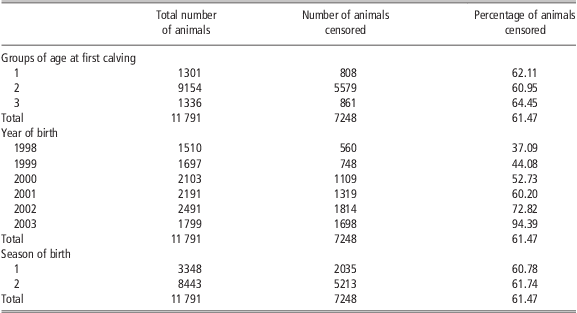
The AFC groups contained different numbers of animals (Table 1). The largest proportion of the animals (77.6%) had their first calving between the ages of 31 and 40 months (group 2). However, the percentages of animals censored in the three groups were similar. The mean AFC found in this study was 35.4 months, with a standard deviation of 5.1 months.
Total number, number and percentage of animals that were censored in the groups of age at first calving, year and season of birth
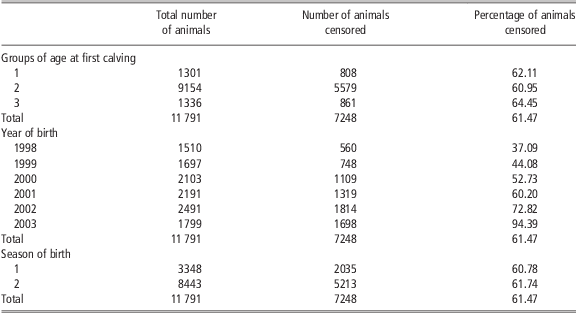
The number of censored animals increased with the cows’ years of birth until 2002, and then decreased in 2003 (Table 1). This occurred because, in accordance with the censoring criterion used, the cows were only considered to have failed after 36 months without calving. Thus, it was seen that the older cows exceeded this limit more often than the younger cows did. In 2003, there was a decrease in the number of censored cows because they were probably between their first and second calvings. Physiologically, cows take longer to conceive again during this stage and therefore, in this study, these cows exceeded the 36-month period stipulated for them to be considered failures.
The season of birth was also studied, because animals born at different times of the year may be influenced by the environment and different feeding conditions, and this may affect their longevity. Although most of the animals were born during the rainy season, the percentages censored in the two seasons of birth were similar. The explanation for the great number of animals born during the rainy season is that most of the farms were operating during a breeding season. This promoted the establishment of a birth season coinciding with greater availability of food and favored formation of homogenous batches of animals and reduction of environmental effects. However, females born in August and September (dry season) have a greater chance of becoming pregnant at the start of the breeding season, and consequently a greater chance of not failing.
The farms with the highest and lowest percentages of censored animals were identified: farms F11 (80.88%) and F15 (24.29%), respectively. With this result, it was seen that on farm F11, most of the animals probably still had reproductive potential. Thus, a large proportion was censored, because these animals did not exceed the 36-month period for them to be considered failures.
The multivariate Log-Rank and Wilcoxon tests led to rejection of the null hypothesis (P < 0.05), indicating that AFC, year and season of birth of the cow and farm groups affected the likelihood that a cow continues to be present in the herd. In addition, the groups for each class effects were compared in pairs and it was ascertained that all of them differed significantly between each other (P < 0.05), according to the Log-Rank and Wilcoxon tests.
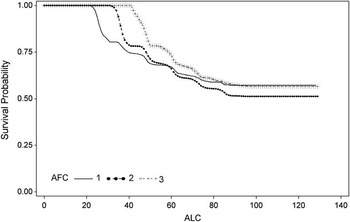
In Figure 1, it can be seen that group 1, relating to AFC of 21 to 30 months of age, presented a lower chance of longevity in the herd than shown by the other groups, until the age of 60 months. The group that presented the highest probability of longevity, throughout the period and together with group 1 from 90 months of age onward, was group 3 (AFC of 41 to 49 months of age). Animals of group 1 had greater chance of longevity at the period of their second calving (ALC from ∼31 to 40 months of age) than animals of groups 2 or 3, for which the second calving occurred in the ALC period from ∼41 to 49 months of age and from ∼51 to 60 months of age, respectively.
Survival probability for the longevity of cows – cow's age at last calving (ALC), according to groups of age at first calving (AFC – 1 = 21 to 30 months; 2 = 31 to 40 months; and 3 = 41 to 49 months).

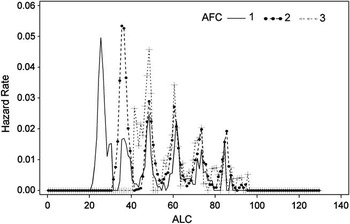
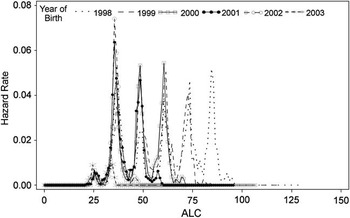
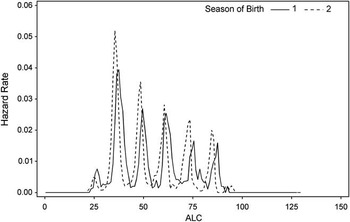
From Figures 2, 3 and 4, the risk that a cow might fail if it continues to be present in the herd until a certain age is reached, taking into consideration the covariable AFC and the class effect year and season of birth of the cow, respectively. Figure 2 shows that between the ages of 20 and 30 months, group 1 of AFC presented the greatest risk of failure. Group 2 presented the greatest risk of failure between 30 and 40 months of age, and group 3 close to 50 months of age. In other words, the greatest risk of failure occurred after the first calving of each group. In the second calving of group 1 (period from 31 to 40 months of age), the risk of failure was lower than for the second calving of groups 2 and 3. The animals that were born in 2002 presented the greatest risk of leaving the herd, with an age at calving of 30 to 35 months (Figure 3).
Hazard Rate for the longevity of cows – cow's age at last calving (ALC), according to groups of age at first calving (AFC – 1 = 21 to 30 months; 2 = 31 to 40 months; and 3 = 41 to 49 months).

Hazard Rate for longevity of cows – cow's age at last calving (ALC), according to years of birth (years of birth ranging from 1998 to 2003).

Hazard Rate for the longevity of cows – cow's age at last calving (ALC), according to season of birth (1 = dry season and 2 = rainy season).

The animals born in the dry season had a lower risk of failure (Figure 4). Those born in the dry season (between April and September) presented a lower probability of leaving the herd than did those born in the rainy season.
Using the Kaplan–Meier estimators, it was possible to determine which farms had females with the highest and lowest probability of longevity (F11 and F15, respectively). These farms were the ones with the greatest and smallest numbers of censored animals, respectively. It could also be seen that the farms with the highest risk of females leaving the herd were F15, F7, F19 and F4. These data are not shown.
Cox model
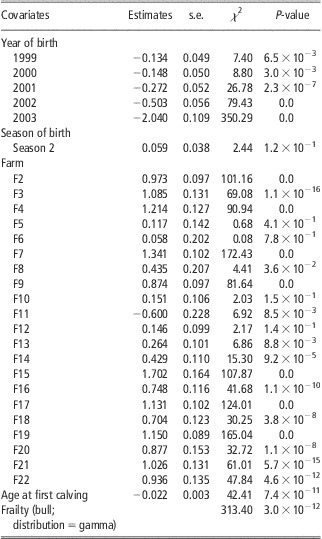
It can be seen in Table 2 that some class effects included in the model were not significant (P > 0.05) in relation to ALC.
Estimates for Cox model regression coefficients in relation to covariables and class effects, standard error, χ 2 statistic and P-value, for cow's age at last calving

Not only did AFC, year of birth and farm individually influence the cows’ probability of longevity (as shown through the Kaplan–Meier estimators), but also these covariables and class effects jointly influenced the trait, according to the Cox model. The P-value for season of birth was 0.12, that is, season of birth did not influence the cows’ longevity together with the other covariables and class effects. The P-value for some of the farms (F5, F6, F10 and F12) was also not significant, unlike F1. Regarding the year of birth of the cow, there was a decrease in risk of failure among the females, in relation to the year 1998 (Table 1). The frailty term, relating to the bulls, was significant (P < 0.05); in other words, the bulls influenced the longevity of their female offspring. The hypothesis that the covariables and class effects would be equal to zero was rejected in the Wald test and the Cox model (P < 0.05).
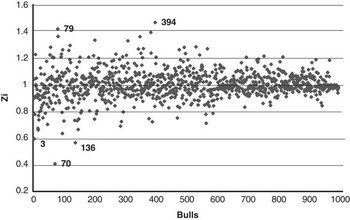
The estimated values zi (frailty term) v. bull identification where the bulls are in birth order (Figure 5), reported the female offspring that presented higher or lower risk of failure. The zi values greater than and less than one indicated bulls with female offspring presenting, respectively, higher and lower than average risk of leaving the herd. The bulls with values >1.4 and <0.6 were identified. These were the ones with descendants presenting greatest (bulls 79 and 394) and least (3, 70 and 136) risk of failure, respectively.
Estimates for frailty parameters (zi), considering the Cox model in relation to bull identity.

Discussion
In view of economic interests, cows’ productive longevity should be considered from the time of their first calving until after their last calving, when they are discarded. Within this period, the greater the number of calves, the greater the producer's profit will be. From the Kaplan–Meier analysis, it was found that animals with their first calving up to the age of 30 months had least longevity up to the age of 60 months. From the Cox model, it was seen that for each additional month of AFC, there was a decrease in the risk of failure of 2% for ALC. Nonetheless, this does not imply that the animals with lower AFC have less profitability. Cows with greater numbers of calvings were more precocious than those with fewer calvings. This was seen through a significant decreasing linear regression, represented by the regression equation of mean AFC by NC: AFC = 37.52−0.74 × NC; R 2 = 0.83 and P < 0.001; where NC = number of calvings. From the data set used in this study, most of the heifers were not exposed to breeding at an early age. Sölkner (Reference Sölkner1989) reported that the production traits are fundamentally important for ensuring that cows continue to get pregnant within the herd, and that there is a negative association between early maturity and longevity in dual-purpose breeds/herds, under intensive rearing conditions. Bertazzo et al. (Reference Bertazzo, Freitas, Gonçalves, Pereira, Eler, Ferraz, Oliveira and Andrade2004) studied the database of the Brazilian Zebu Breeders’ Association (ABCZ) and, on the farms in this database, the great majority of the heifers were not exposed to breeding at an early age. Under such conditions, AFC may be negatively correlated with longevity, given that the younger heifers (born at the end of the birth season) have less probability to become pregnant at the end of the breeding season. However, Van Melis et al. (Reference Van Melis, Eler, Rosa, Ferraz, Figueiredo, Mattos and Oliveira2010) studied data from farms at which heifers were exposed to breeding at an early age (∼14 months of age) and found a positive correlation (0.64) between heifer pregnancy and longevity.
The longest interval between calvings occurs between the first and second calving (Werth et al., Reference Werth, Azzam and Kinder1996). This explains the greater risk of failure during this period, which occurred in all the groups (Figure 2), given the failure criterion of 36 months that was used. Thus, group 1, with AFC between 21 and 30 months, presented the highest risk of failure exactly during this interval, as did group 2 (31 to 40 months) and group 3 (41 to 49 months). In the present study, the mean AFC (35.43 months, with standard deviation of 5.1) was similar to that reported by Grossi et al. (Reference Grossi, Venturini, Paz, Bezerra, Lobo, Oliveira and Munari2009) (35.1 months), for Nellore heifers.
The positive and negative estimates for regression coefficients using the Cox model are interpreted as effects that, respectively, intensify or diminish the risk function (Table 2). Thus, the cows’ years of birth influenced their longevity; given that the lower the coefficient, the lower the risk that the cows would leave the herd. In the two analyses, using the Kaplan–Meier estimators (Figure 3) and the Cox model (Table 2), it was seen that the cows continued to be present in the herd for longer times as the years went by, which may have resulted from a process of direct selection for longevity. On some farms, according to ‘Associação Nacional de Criadores e Pesquisadores’ (data not published), this was already occurring or came as a response correlating this trait with another that was undergoing selection within the herd (indirect selection). Van Melis et al. (Reference Van Melis, Eler, Oliveira, Rosa, Silva, Ferraz and Pereira2007) reported that the mean genetic value for stayability in the herd increased with time.
The Kaplan–Meier estimator indicated that there was a greater risk of failure for females born during the rainy season than those born in the dry season (Figure 4). The greatest proportion of births of cows was also concentrated within this period. According to Vanzin (Reference Vanzin2000), in extensive rearing of beef cattle, births occur naturally and more frequently during the period of July to December, even on farms that do not establish a breeding season. This is because the majority of the females become pregnant between October and March, precisely during the period when the pasture grass is tender and has good nutritive value. During this period too, the daylight hours are longer in the southern hemisphere, which stimulates production of the hormones responsible for the occurrence of estrus. Thus, the reproductive season should be concentrated in the period of best food supply, given that the nutritional requirements for reproduction are high. Consequently, birth occurs during the dry season, in which the incidence of diseases is lower. Furthermore, in practice, females born in August and September (dry season) have a greater chance of forming part of AFC group 1, with regard to the birth season. Thus, the risk of failure is greater for cows born in the rainy season than for those born in the dry season because their number of exposition to breeding can be increased. This result is in line with what was seen for AFC, that is, precocious females are at greater risk of failure. Nonetheless, according to the Cox model, the cows’ calving season was not significant with regard to ALC (Table 2). This may have occurred because the Cox model takes into consideration all the variables together and weighs the estimates according to their degree of influence among all the variables.
The farm is one of the variables used in most studies to make up the contemporary groups. In analyses that include such groups, these present a significant effect on different traits of economic importance, given that the management, health, food, labor and installations may be different. In the present study, this was observed in relation to ALC, using both the Kaplan–Meier estimator and the Cox model. The estimates obtained using the Cox model in relation to this covariable proved the results obtained using the Kaplan–Meier estimator, for example, the lowest value (F11) among the farm estimates. Thus, the risk that these animals would be discarded, that is, exceed 36 months since their last calving, was lowest on this farm. The farm with the highest estimate (F15) thus presented the highest risk of failure.
The Kaplan–Meier estimates were important for describing and differentiating the effects of each covariables and class effects in relation to ALC, given that this was evaluated as a longevity trait. Regression coefficients were estimated using the Cox model, taking all the covariables and class effects together. Thus, it was possible to assess the extent to which each covariable and class effect contributed toward the risk of failure for ALC. Moreover, it was possible to include the effect of the bulls, which was significant in relation to ALC and is of great interest for selection within the field of animal improvement. The criterion of 36 months beyond the last calving, which was used to determine whether the animal would continue to be present in the herd, can be modified according to the herd selection objectives.
Acknowledgments
We acknowledge the financial support provided by FAPESP (Fundação de Amparo à Pesquisa do Estado de São Paulo, São Paulo-SP, Brazil), CAPES (Coordenação de Aperfeiçoamento de Pessoal de Nível Superior, Brasília-DF, Brazil) and CNPq (Conselho Nacional de Desenvolvimento Científico e Tecnológico, Brasília-DF, Brazil). Sabrina Luzia Caetano and Rodrigo Pelicioni Savegnago were granted scholarships from FAPESP. Salvador Boccaletti Ramos received scholarship from CAPES (Coordenação de Aperfeiçoamento de Pessoal de Nível Superior/Programa de Pós-Graduação em Genética e Melhoramento Animal – FCAV/UNESP). We thank ANCP for the use of the data set.