Introduction
Prenatal smoking is one of the greatest avoidable risks to infant health and survival in high income countries (Cnattingius, Reference Cnattingius2004). Pregnancy, therefore, provides a strong additional source of quitting motivation for women who smoke (Curry, McBride, Grothaus, Lando, & Pirie, Reference Curry, McBride, Grothaus, Lando and Pirie2001). Over two-thirds of pregnant smokers report wanting to quit smoking within the next month (Ussher, West, & Hibbs, Reference Ussher, West and Hibbs2004), but less than one-third succeed (Schneider, Huy, Schutz, & Diehl, Reference Schneider, Huy, Schutz and Diehl2010; Owen, McNeill, & Callum, Reference Owen, McNeill and Callum1998). While nicotine dependence may partially explain many women's difficulty in quitting during pregnancy (Lu, Tong, & Oldenburg, Reference Lu, Tong and Oldenburg2001), less is known about psychosocial barriers and how they might inhibit cessation.
While routine antenatal care includes the provision of smoking cessation advice, survey findings indicate that this is not routinely implemented. Pregnant smokers commonly report that midwives only ask about their smoking, rather than offering advice or support, during the initial appointment and rarely discuss it during subsequent visits (Petersen, Nilsson, Everett, & Emmelin, Reference Petersen, Nilsson, Everett and Emmelin2007; Haslam & Draper, Reference Haslam and Draper2001). Surveys of midwives support these findings (Abatemarco, Steinberg, & Delnevo, Reference Abatemarco, Steinberg and Delnevo2007; Cooke, Mattick, & Barclay, Reference Cooke, Mattick and Barclay1996). However, evidence is lacking as to whether and how this might impact on pregnant women's motivation or efforts to quit smoking.
Outside the clinical environment one potential social influence on smoking in pregnancy often reported is awareness of other pregnant women who smoke prenatally but who have ‘healthy babies’ (Arborelius & Nyberg, Reference Arborelius and Nyberg1997). This type of awareness can lead non-pregnant smokers to challenge medical explanations of the causes of ill health, such as the smoker who lives to an advanced age (Davison, Frankel, & Smith, Reference Davison, Frankel and Smith1992). For pregnant smokers, this might enable them to discredit claims of risk (Tod, Reference Tod2003; Haslam & Draper, Reference Haslam and Draper2001). How such beliefs might influence the perception of risk and ultimately motivation to quit among pregnant smokers, however, is not well understood.
Regarding risk perception, surveys indicate that three-quarters of pregnant smokers agree that prenatal smoking is dangerous to the unborn child (Owen & Penn, Reference Owen and Penn1999). Yet when women are asked about specific risks of prenatal smoking, many find them exaggerated and view them with scepticism (Lendahls, Ohman, Liljestrand, & Hakansson, Reference Lendahls, Ohman, Liljestrand and Hakansson2002; Hotham, Atkinson, & Gilbert, Reference Hotham, Atkinson and Gilbert2002; Tod, Reference Tod2003) with some claiming a need for proof of harm (Arborelius & Nyberg, Reference Arborelius and Nyberg1997). Lack of adequate or appropriately tailored risk information may partially explain this discrepancy (Petersen et al., Reference Petersen, Nilsson, Everett and Emmelin2007). However, women's questioning of specific risks might alternatively signify a defence mechanism (Abrahamsson, Springett, Karlsson, & Ottosson, Reference Abrahamsson, Springett, Karlsson and Ottosson2005). Other commonly cited reasons for prenatal smoking, such as relief from environmental stress or having a break or reward (Graham, Reference Graham1976; Tod, Reference Tod2003; Lendahls et al., Reference Lendahls, Ohman, Liljestrand and Hakansson2002), may be, in part, also an activation of this defence mechanism and used as justification for continued smoking. This discrepancy in risk perception, therefore, requires further investigation.
Discrediting or downplaying the risks of smoking is common among non-pregnant smokers (Chapman, Wong, & Smith, Reference Chapman, Wong and Smith1993; Heikkinen, Patja, & Jallinoja, Reference Heikkinen, Patja and Jallinoja2010; Sutton, Reference Sutton1999). Cognitive dissonance theory argues that this is aimed at resolving the psychological discomfort generated from the discrepancy between an underlying belief that smoking is harmful and continued smoking behaviour (Festinger, Reference Festinger1957). The intervening beliefs held that distort or downplay threatening information are referred to as disengagement beliefs (Bandura, Barbaranelli, Caprara, & Pastorelli, Reference Bandura, Barbaranelli, Caprara and Pastorelli1996) and prospectively predict intention to quit, quitting activity and relapse in non-pregnant smokers (Dijkstra, De Vries, Kok, & Rouackers, Reference Dijkstra, De Vries, Kok and Rouackers1999; Dijkstra & Brosschot, Reference Dijkstra and Brosschot2003; Kleinjan, van den Eijnden, Dijkstra, Brug, & Engels, Reference Kleinjan, van den Eijnden, Dijkstra, Brug and Engels2006; Oakes, Chapman, Borland, Balmford, & Trotter, Reference Oakes, Chapman, Borland, Balmford and Trotter2004). Disengagement beliefs may therefore play an important role in inhibiting quitting among pregnant smokers, but this is a current gap in knowledge.
Overall, more research is needed to better understand the social and psychological factors that explain why some pregnant smokers successfully quit while others fail (National Institute for Clinical Excellence, 2010), particularly in the area of risk beliefs. This paper explores the accounts of pregnant smokers and quitters to investigate the role of their smoking beliefs in influencing their cessation behaviour and the relationship of these with psychosocial factors related to pregnancy and antenatal care. As this study was inductive, the analysis preceded and directed the review of the literature described in this introduction.
Methods
Semi-structured interviews were conducted to generate data for this study. Purposive sampling was used to achieve a sample of participants ranging in number of previous pregnancies, age and socioeconomic status. Furthermore, we were keen to recruit a mixture of smokers and quitters. In order to ensure we had captured the most relevant data in relation to the research question, recruitment continued until theoretical saturation was considered to have been reached (Strauss & Corbin, Reference Strauss and Corbin1998).
Participants were recruited via community midwives in two GP practices in Cambridgeshire and Suffolk and through a Cambridgeshire SureStart programme (UK). Midwives were provided with recruitment packs to hand out to any of their pregnant clients who were identified as smokers. During the later stages of recruitment, FN attended community midwife clinics within the practices and a SureStart programme in order to identify further potential participants and ensure sufficient sample variation. Women interested in taking part who returned a Freepost reply slip and who were 16 years of age or over were contacted by phone (by FN) to arrange an interview. All participants completed a written consent form prior to their interview.
Ethical approval was received by the Cambridgeshire 2 Research Ethics Committee (06/Q0108/301).
Data collection and analysis
Interviews were conducted by FN (a non-clinical researcher) between March and July 2007. They were all face-to-face, took between 30 minutes and one hour and the majority took place in participants’ homes. Interviews were audio recorded and transcribed verbatim. One interview was not recorded due to a technical problem and so extensive notes were taken.
Interviews were loosely directed by a topic guide, informed primarily by our research question. This covered respondents’ feelings about smoking and quitting in pregnancy, aspects that made it easier and harder for them to quit and their experiences of discussing the topic with health professionals. Several demographic characteristics were collected at the end of the interview including age, gestation, parity, smoking rates, partner's smoking status and socioeconomic status, measured using the Office for National Statistics Socio-economic Classification (NS-SEC) self-coding method. FN also made field notes to aid reflection on thoughts, interpretations, initial analyses and questions for further exploration (Strauss & Corbin, Reference Strauss and Corbin1998; Mays & Pope, Reference Mays, Pope, Pope and Mays2006).
FN led the analysis. Analysis was informed by grounded theory and the constant comparative approach (Strauss & Corbin, Reference Strauss and Corbin1998). Initially a process of open coding was undertaken to identify and examine concepts based on their properties and dimensions. Concepts were then organised into categories and sub-categories, and subsequently a coding framework was used to code the transcripts. The next stage involved axial coding: through an iterative process of refinement, categories were adapted and integrated and an understanding of the issue of smoking cessation in pregnancy began to emerge. A central category was identified and its relationship with the other categories was reflected upon and refined. ‘Mind maps’ were used to develop the coding framework (Strauss & Corbin, Reference Strauss and Corbin1998), and NVivo version 8 was used to facilitate coding. We waited until we had nearly completed the analysis before seeking input from existing research to help further refine and label the categories, themes and theoretical explanations.
To improve the coherence of the coding framework and validity of the research findings, two colleagues skilled in qualitative data analysis coded 20% of the raw data (Mays & Pope, Reference Mays, Pope, Pope and Mays2006). The coding agreement between the raters was high and any differences were resolved through discussion. During the analysis, particular attention was paid to ‘deviant cases’ as a way of further increasing the credibility of the findings (Silverman, Reference Silverman1989). The main findings relating to interactions between pregnant smokers and antenatal staff were presented to two groups of antenatal health professionals in order to help further develop some of the analytical interpretations.
Results
Participant characteristics
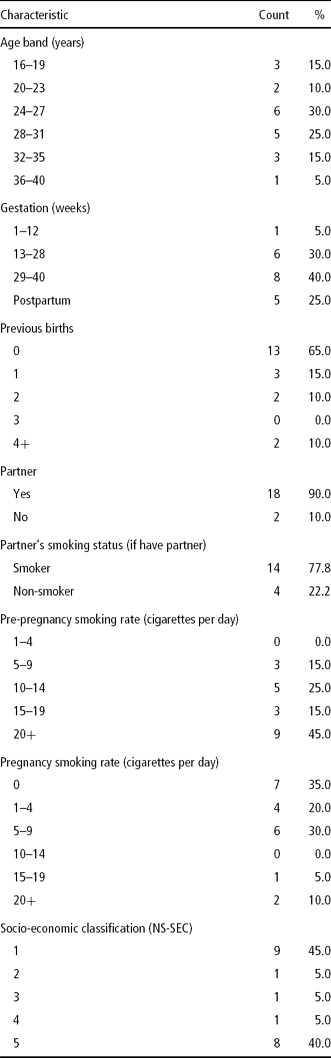
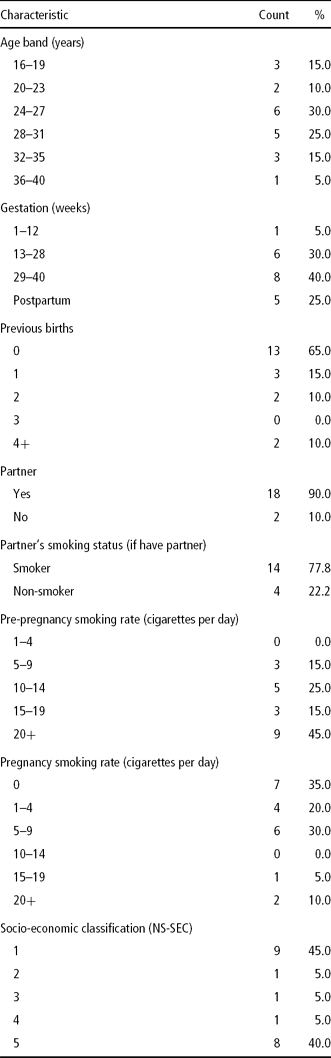
Of those women approached by FN to take part (N = 27), eight were recruited (30%). The exact response rate from midwife recruitment is unknown. In total 20 participants were interviewed, 15 during pregnancy and five postpartum. The participants’ age range was 16–40 years, most had no previous children and there was a range of socioeconomic status (see Table 1). One participant quit smoking prior to her most recent pregnancy (though had smoked during her previous four) and six had quit after finding out they were pregnant (four immediately and two after several weeks) and were abstinent at the interview. The remaining 13 smokers all reported making significant quit attempts, ranging from a few hours to several months long.
Participant demographic and background characteristics
Central category for grounded theory – cognitive dissonance
All participants indicated that they believed smoking during pregnancy was associated with harm. Women referred to prenatal smoking as ‘bad’ and admitted that by smoking they were ‘harming the baby’. A number of women specifically described how holding this belief while continuing to smoke generated a state of psychological discomfort:
And it's like ‘Well why am I smoking when I know I'm harming the baby or could be harming the baby?’ But yet you still smoke. And it is like so hard, because it frustrates you because you wanna quit, because you wanna do the best thing for your baby. But you can't, because you can't get out of it. It is really hard. (1508, smoker)
This state echoes Festinger's concept of cognitive dissonance (Festinger, Reference Festinger1957). In our sample, the dissonant state featured most prominently in participants’ talk about the ways they tried to resolve it:
I've cut [down] now I'm not having that much. It's not that bad. It must be, because I have to justify it to myself all the time, otherwise I'll just sit in a pit of guilt. (1517, smoker)
Psychologically resolving dissonance
The dissonant state appeared to be a motivator to quit smoking – which would be an effective method of resolving dissonance. While all women reported attempting to quit smoking, most relapsed early on which generated renewed dissonance. In addition, women reported dissonance following interaction with others relating to their continued smoking or a reminder of their pregnancy state, such as having an observable pregnancy bump. It was particularly around this point when those continuing to smoke started trying to resolve dissonance in ways other than quitting. The most common method was by endorsing particular beliefs about the circumstances or risks of smoking during pregnancy that supported continued smoking. Such beliefs echo Bandura's ‘disengagement beliefs’ (Bandura et al., Reference Bandura, Barbaranelli, Caprara and Pastorelli1996), and in our sample these were evident in four main ways.
The first type of belief questioned the validity of the risks of prenatal smoking. Some participants described suspecting that what they had been told by health professionals regarding the risks of smoking might not be entirely true, that it was ‘science spooking everyone’ (4519, smoker) and might ‘just be an excuse’ (1508, smoker) to get them to quit for other reasons. This sometimes involved identifying examples that contradicted risk information, such as questioning the position that continued smoking reduces the birth weight of a baby:
I'm six months at the moment, and they are actually putting me four weeks ahead of what I should be because of the size of the baby. So you can't tell me it's a small baby (1507, smoker)
The second type of disengagement belief was one that was used to quickly downplay the threat to oneself when a desire to smoke arose. Participants reported telling themselves that ‘one won't hurt’, despite being aware that it was never ‘just one’. These kinds of beliefs were brought into mind immediately prior to smoking in order to justify having the cigarette:
When I would be sat on my own in the evening or whatever, I'd just think right I'll have a fag, one won't hurt (1501, smoker)
The third type of disengagement belief was to regard the drawbacks of continued smoking as outweighed by the drawbacks of quitting. A common example was specifying that the threat from stress as a result of not smoking was on a par with smoking:
It's harmful for the baby but then if the mum's stressed out that can be just as harmful (1501, smoker)
This was further reinforced by the recalled experience of being told by the doctor that ‘stopping would put more stress on the baby’ (4519, smoker). One participant in particular exhibited a more extreme form of belief manipulation related to this belief type (see Box 1).
One case (1507, smoker) appeared to us to demonstrate how a relatively implausible belief that justifies continued smoking can become more salient in the context of quitting than an ostensibly more plausible belief promoting cessation. This individual experienced a miscarriage during her last pregnancy after she had given up smoking, unlike her previous pregnancies which she had smoked through. On finding out she was pregnant again (current pregnancy at interview), she recalled experiencing concern at quitting, believing that quitting might have played a role in her previous miscarriage:
And psychologically when I fell pregnant with this one I thought if I stop smoking there's a chance it could die.
However, when asked to specifically reflect on this, an alternative explanation was endorsed that excluded quitting as the cause of the miscarriage:
I: Did they say anything about giving up smoking being a factor in that?
R: No. No. No, it wasn't anything to do with that. No, I think it had a heart problem. It was just literally one of those things that couldn't have been predicted.
Despite this, she found herself returning to her original belief that justified her continued smoking when thinking about quitting smoking:
It is going in the back of my head that I shouldn't be smoking. But, as I say, because of what happened last year I can't psychologically do it until I know this baby's here. Then I probably will.
The final type of disengagement belief that emerged concerned scenarios where there was no perceived benefit to quitting. This seemed to occur particularly in later pregnancy. Individuals recalled telling themselves ‘it's too late’ (4523, smoker), ‘I've done [the damage] now’ (1517, smoker) or ‘[the baby is] used to the smoke’ (1609, smoker). This belief reflects how in some cases beliefs are moulded and optimised so they provide the most plausible defence available at that time for continued smoking.
Of note is that many participants were aware that they were altering and endorsing beliefs to justify smoking. They referred to making ‘excuses’ or ‘justifications’, being in ‘denial’ and that ‘I've kind of put that into my head’ (1522, smoker). It was recognised that ‘if you didn't justify it to yourself, then you wouldn't pick up a cigarette’ (1502, smoker).
While resolving dissonance in this way was often a short-term strategy to justify smoking, it did not always succeed. Several participants described how experiencing a salient reminder of their pregnancy status while smoking would make the dissonance return and cue them to take immediate action:
When I feel him kick when I'm having the cigarette and stuff, the cigarette's gone straight out. But then obviously there are times when he doesn't when you're having a cigarette so you smoke that cigarette unless you're aware of it. (4519, smoker)
Two factors emerged from the analysis that appeared to influence participants’ tendency to endorse disengagement beliefs: uncertainty about the mechanism of harm and reassurance from others. How these factors relate to the central category (cognitive dissonance) via the endorsement of disengagement beliefs represents the emergent grounded theory.
Uncertainty about the mechanism of harm
Participants felt they did not know what the risks of smoking during pregnancy were. In particular, many revealed an underlying uncertainty or misconception about how tobacco smoke reached and affected the foetus, irrespective of their motivation to quit or smoking status at interview. This mechanism uncertainty emerged primarily when women talked about the comparative harm of environmental tobacco smoke (ETS) and Nicotine Replacement Therapy (NRT) on their unborn child.
Firstly, many participants placed a high importance on not exposing their baby to ETS after they gave birth, even though most smoked during pregnancy:
I mean if anybody smokes in the car with my baby in there they're, they're dead meat . . .there is no way that I'm going to let anybody smoke round the baby, you know. (4523, smoker)
Participants’ accounts indicated that their strong views about ETS exposure were less to do with it being easier to avoid exposing a newborn to ETS than quitting and more to do with being able to visualise their child breathing in smoke. This appeared to make the risk of harm particularly salient:
You know the thought of your child breathing in all that smoke. . . they say second hand smoke can be even worse than actually smoking yourself. (1504, smoker)
And I was very paranoid if he came back and had been smoking, and you know, talked to her and stuff and I would be like ‘Just don't breathe on her.’ Sorry but don't (1606, quitter)
One participant who had smoked throughout pregnancy quit smoking while breast feeding because she was concerned about exposing her baby to her residual smoke:
But then I didn't have a cigarette for months because I was breastfeeding. . . and I don't know what difference that made psychologically but for some reason I didn't want to be going outside and having a fag and then stinking of smoke and feeding the baby. (1501, smoker)
A second comparison emerged in women's discussion around the use of NRT in pregnancy. While some individuals felt that cigarettes had ‘a lot more harmful stuff’ (1510, smoker) in them than NRT, others felt that taking a high strength form of NRT in pregnancy could be ‘really damaging’ (1502, smoker) and that the nicotine in NRT was a major source of harm:
I would rather a cigarette than wear a patch because you still pumping the stuff into your blood wearing a patch. . .at the end of the day if you are going to smoke cigarettes that's not going to be any more harmful than having a patch (1501, smoker)
This feeling was shared by several quitters, who felt that if they were going to use NRT they ‘might as well still be smoking’ (4518, quitter).
While participants indicated they understood that nicotine reaches an unborn foetus via the bloodstream from both smoking and NRT, most did not describe this as a mechanism for the ingestion of those other constituents of tobacco smoke which are reported to cause harm. This may explain why many seemed to regard the potential harms from smoking and NRT as similar. The two exceptions to this did not present views that reflected a good mechanistic understanding either. They described prenatal smoking as ‘pour[ing] toxic chemicals over your baby’ (1502, smoker) and ‘feed[ing] your child. . .a bottle of bleach’ (4613, quitter).
This limited understanding and/or ability to visualise the mechanism of harm was demonstrated by both smokers and quitters and so is unlikely to be explained as another form of disengagement belief, as quitters would have less reason to justify a behaviour they no longer engaged in. Instead, it appeared to make it easier to resolve dissonance by endorsing disengagement beliefs, particularly those that directly downplayed or questioned the validity of risks. This is exemplified by one individual, who was aware that by knowing more about the effects of prenatal smoking she was likely to experience greater psychological discomfort and that this knowledge would make it harder to resolve the dissonance psychologically:
So I didn't really know what damage I was doing because I didn't want to know, I didn't want to feel bad about. . . If I'd have known, I would probably- I could have thought about it at least. . .And the information would have been in your head whether you liked it or not. (1517, smoker)
Reassurance from others
Many participants talked about being reassured by others – friends, family and health professionals – that their continued smoking in pregnancy was not causing much harm. This appeared to make it easier to psychologically resolve smoking related dissonance.
Most women who continued to smoke, but had cut down, indicated that they had received a positive response from a health professional (usually their midwife) in response to them reporting this reduction. This response was taken by some as guidance as to what was acceptable to minimise smoking related risks:
Everyone's said well that's much better. And so that's much better, I'll just carry on doing that then. So I have done. (1517, smoker)
So it's almost so don't give me an excuse. . .I mean she said, ‘Oh are you a smoker?’ ‘Yeah’. ‘How many are you smoking?’ ‘Five.’ ‘Oh that's not too bad.’ I thought, no tell me that's bad, you know, I need somebody to make me feel really really guilty. (4523, smoker)
One participant, who eventually succeeded in quitting, recalled being told by her midwife that she had done ‘fantastic’ to cut down to five-a-day and not to ‘beat herself up’ about not quitting (4614, quitter). However, she expressed that ‘for me, [it] wasn't good enough’ indicating that while she found the midwife reassuring, she felt she needed to do more than just reduce her smoking.
As well as gaining reassurance from what was said during consultations about cutting down, participants were reassured by what was not said. A number of participants said they had not actually been advised by their health professional to stop smoking and seemed to use this in part to justify not doing so. Participants also reported that the topic of smoking was rarely revisited after their initial consultation. Those who did receive the occasional query did not consider it as re-visiting the issue and this, for some, made it easier for them to downplay the risk of smoking:
I: Do you think if [the midwife] had say been a little bit more stern about [the issue of smoking]. . .do you think that would have changed the relationship?
R: No I don't think it would. I think what I'd have thought is, yeah OK you keep on bringing it up, maybe there is a problem. Whereas I think at the moment it was sort of brushed over lightly and maybe it's not as bad as they're making out. (4523, smoker)
Many participants reported feeling reassured from talking to friends, family and acquaintances who affirmed that despite smoking during pregnancy their children had been healthy. Participants described how hearing this lessened their resolve to quit and reassured them that they could ‘risk it’. For example, one participant felt that hearing this ‘almost end[s] up convincing you that there's no point [in quitting]’ (4519, smoker). One quitter felt that she might have ‘given in’ (2603, quitter) if her partner had continued to tell her about his own mother who had smoked during her pregnancy with him. For some, this subsequently formed into a disengagement belief that directly downplayed the risk:
I met up with some girls and they said, ‘Oh do have a cigarette.’ I said, ‘Oh no I won't today.’ ‘Oh you're not smoking?’, I said ‘Well yeah.’ ‘Oh you might as well have one. I smoked while I was pregnant.’ And der der der. And stop giving me bloody excuses. I mean you know, I'm not normally what I would class as easily led but, ‘Oh go on then, I'll have one.’ (4523, smoker)
If everyone I knew had never smoked whilst they were pregnant or weren't smokers at all and all had healthy babies, then I would probably think maybe I shouldn't risk it, but because I've seen so many people do it then, you use that against the, all the things they tell you that might go wrong. (1501, smoker)
Discussion
By seeking a theoretical explanation of the role of smoking beliefs in affecting motivation and efforts to quit smoking, we gained new insight into how pregnant women commonly use justifications or disengagement beliefs in order to resolve smoking related cognitive dissonance (Festinger, Reference Festinger1957) and allow smoking to continue. The emergent grounded theory describes two psychosocial factors that appeared to affect the ease with which individuals would successfully resolve dissonance through endorsing disengagement beliefs.
Our participants described four different types of disengagement beliefs. While the questioning of risks and downplaying of threat beliefs correspond most closely with the ‘Sceptic’ beliefs in Oakes et al.'s (Reference Oakes, Chapman, Borland, Balmford and Trotter2004) self-exempting belief typology, the other belief types appear to be relatively novel and are primarily pregnancy specific. The use of disengagement beliefs ‘in the moment’, as with one of the types identified, has received little prior attention and suggests a way of psychologically managing low stimulus control, i.e. the inability to deal with stimuli that trigger smoking (Kleinjan et al., Reference Kleinjan, van den Eijnden, Dijkstra, Brug and Engels2006).
While it has already been suggested that lack of knowledge about the negative outcomes of smoking may affect a pregnant smoker's motivation to quit (Petersen et al., Reference Petersen, Nilsson, Everett and Emmelin2007), our data are more specific, suggesting that a limited understanding of the mechanism of harm from prenatal smoking or inability to visualise it may be key factors in affecting the perceived severity of smoking. This uncertainty appears to be common among this group given survey data showing that only around one-half of pregnant smokers agreed that prenatal smoking resulted in poisonous chemicals transferring to the baby's bloodstream and only one-quarter agreed that it made the baby's heart beat faster (Owen & Penn, Reference Owen and Penn1999). In turn, we argue that such uncertainty makes it easier to resolve dissonance through endorsing beliefs that downplay threat. The importance of a coherent model of harm for motivating smokers to quit has been identified previously in relation to cervical cancer (Hall, Weinman, & Marteau, Reference Hall, Weinman and Marteau2004).
Our findings support previous research that pregnant smokers are often told by others that they had a ‘healthy’ child despite smoking during the pregnancy (Arborelius & Nyberg, Reference Arborelius and Nyberg1997). Awareness of such instances in one's immediate social context can work to minimise the perceived risk (Davison et al., Reference Davison, Frankel and Smith1992). Our findings provide additional insight into how such information can affect motivation to quit and its role in resolving cognitive dissonance via disengagement beliefs that reduce the threat of perceived harm.
By responding positively to reports of cutting down and not revisiting smoking, midwives appear to have inadvertently made it easier for some participants to justify continued smoking. While most midwives report advising their clients about smoking (Abatemarco et al., Reference Abatemarco, Steinberg and Delnevo2007; Thyrian et al., Reference Thyrian, Hannover, Roske, Scherbarth, Hapke and John2006), recent surveys indicate they are more likely to advise cutting down than GPs (Glover, Paynter, Bullen, & Kristensen, Reference Glover, Paynter, Bullen and Kristensen2008) and seldom advise pregnant smokers to abstain completely (Ussher, Etter, & West, Reference Ussher, Etter and West2006; Owen & Penn, Reference Owen and Penn1999).
As with all ‘opt in’ qualitative interview studies, there may have been some self-selection bias. Recruiting via midwives may have added further bias as they may have forgotten or felt uncomfortable in asking all smoking clients they saw to take part. To minimise the potential bias, later in the recruitment phase, we selectively sought out individuals in order to maximise the variation of characteristics of the sample.
Participants were interviewed on one occasion only, so we were unable to explore changes in beliefs and behaviours over time and determine whether beliefs preceded or followed behaviours. Our understanding of these relationships would, therefore, be improved by a prospective study.
Implications for practice and future research
Our findings suggest that targeting disengagement beliefs may encourage pregnant smokers to resolve dissonance behaviourally, by putting more effort into attempting to quit smoking. One option would involve persuasive information that challenges the validity of specific disengagement beliefs (Kleinjan et al., Reference Kleinjan, van den Eijnden, Dijkstra, Brug and Engels2006). However, such a challenge could increase dissonance further, adding to the pressure to resolve dissonance psychologically (Festinger, Reference Festinger1957). Alternatively, non-directive counselling that involves supporting individuals to resolve ambivalence about behaviour change on their own, such as motivational interviewing (Miller & Rollnick, Reference Miller and Rollnick1991), may help reduce subsequent disengagement belief endorsement. However, a recent meta-analytic review found no evidence that motivational interviewing increases cessation among pregnant smokers compared to no treatment/self-help (Hettema & Hendricks, Reference Hettema and Hendricks2010). A different approach would involve providing pregnant smokers with a counter-strategy to prevent them endorsing a disengagement belief in a trigger situation. This could be regularly reinforced using media such as mobile phone text messaging (Naughton, Prevost, Gilbert, & Sutton, Reference Naughton, Prevost, Gilbert and Sutton2012) or potentially automatised using an implementation intention (Gollwitzer, Reference Gollwitzer1999). Further research is required to assess the feasibility and potential impact of targeting these beliefs in this population.
Based on our findings, we would recommend that antenatal professionals strongly promote abstinence as the goal at every visit, with any reduction rewarded as a step to achieving that goal. One particular concern with giving false reassurance about reduction is that many smokers do not markedly reduce their exposure to nicotine, toxins, tar and carbon monoxide when they reduce the amount they smoke (Benowitz, Jacob, III, Kozlowski, & Yu, Reference Benowitz, Jacob, Kozlowski and Yu1986), most likely due to compensatory smoking. The extent to which this applies to pregnant smokers, however, is not known. The complete avoidance of rewarding reduction to prevent false reassurance could be counterproductive, however, given its consideration as an important behaviour change technique for promoting abstinence (Michie, Churchill, & West, Reference Michie, Churchill and West2011). Midwives may be concerned that recommending complete abstinence may damage their client relationship (Bull, Reference Bull2007). However, many women, including our participants, report disappointment when midwives do not fully discuss smoking with them (Lendahls et al., Reference Lendahls, Ohman, Liljestrand and Hakansson2002).
Explaining the mechanism of harm from prenatal smoking presents a potentially important target for intervention and would likely affect negative physical outcome expectancies of pregnant smokers. Changes in these outcome expectancies can increase motivation to quit and abstinence among non-pregnant smokers (Bandura, Reference Bandura1977; Dijkstra et al., Reference Dijkstra, De Vries, Kok and Rouackers1999), potentially in part as a result of inhibiting the endorsement of smoking-related disengagement beliefs (Kleinjan et al., Reference Kleinjan, van den Eijnden, Dijkstra, Brug and Engels2006). Interventions to support a coherent model of harm from prenatal smoking could include the provision of visual aids that describe in detail how smoking physically affects the foetus.
Conclusions
Disengagement beliefs, used to relieve cognitive dissonance brought about by continued smoking, are common among pregnant smokers and their regular use is likely to be a contributory factor in hindering their efforts to quit smoking. Our findings uncover the role that lack of understanding of the mechanism of harm and receiving medical and social reassurance of continued smoking can play in affecting the endorsement of disengagement beliefs and ultimately cessation behaviour among pregnant smokers. Given the growing doubt as to the efficacy of standard doses of nicotine replacement therapy in pregnancy (Coleman et al., Reference Coleman, Cooper, Thornton, Grainge, Watts and Britton2012), the importance of improving and refining behavioural support in order to reduce the public health burden of prenatal smoking is critical.
Acknowledgements
The authors would like to thank James Jamison for his assistance in duplicate coding of transcripts.
Financial support
This work was supported by Cancer Research UK (CR-UK) (grant number C1345/A5809).
Conflict of interest
None declared.
Ethical Standards
The authors assert that all procedures contributing to this work comply with the ethical standards of the relevant national and institutional committees on human experimentation and with the Helsinki Declaration of 1975, as revised in 2008.