The aim of this paper is to shed some light on the commissioning of the great Douce Apocalypse (Bodleian, ms Douce 180), owned either by Edward i or by Eleanor of Castile.Footnote 1 Douce is in two parts: an opening but incomplete Anglo-Norman French text of the Apocalypse (now fols 1–12) and an illustrated Latin Apocalypse with commentary (now fols 13–63). The remarkable Latin Apocalypse, left unfinished with its images drawn and inked, but many uncoloured, contains no identifying marks of patronage or ownership, except for some heraldry within the Apocalypse pictures which, taken at face value, suggests royalist links. Its style is manifestly that of the Westminster court and of its high altar Retable, the French antecedents of which are discussed by Michael Michael elsewhere in this journal. The French text opens with an illuminated initial within the S of ‘Seint pol’ (fig 1) showing in its upper part a Mercy Seat Trinity with, kneeling before it, the Lord Edward and Eleanor of Castile, prior to their accession in 1272, and images below of St John the scribe and preacher; an ornamental bar extending to the bottom of the page shows two hunting dogs pursuing a rabbit and a man blowing a horn. The style of the initial is manifestly not that of the Latin pictures, but this tells us little, as a distinction in style between main illustrations and initials may be observed in other English Apocalypse manuscripts of this period, such as that now in the Getty collection.Footnote 2 No other initials in the French part were executed.
Bodleian, ms Douce 180, fol 1: Prince Edward and Princess Eleanor kneel before the Holy Trinity; St John writing. Photograph: © Bodleian Library, Oxford

The heraldry of the two small figures before the Trinity was first noted by S C Cockerell and described by E W B Nicholson, but its significance, dependent in turn on how the relationship between the two parts of the manuscript is construed, has been disputed.Footnote 3 M R James believed that the scribe of the French and Latin parts was probably the same, and this view was lent substance by Peter Klein’s subsequent codicological analysis of the volume, which indicated that, bar some very minor adjustments allowing for the fact that the French part has no pictures, the ruling and script of both must have come from the same scriptorium at around the same time.Footnote 4
Both James and George Henderson were cautious in assuming that the date and patronage of the French part necessarily applied to the Latin part, and James was also dismissive of Nicholson’s idea that the arms of De Clare and De Montfort in the Latin part indicated some connection with the events of the mid-1260s.Footnote 5 In his assessment of the commissioning of the book, James suggested that Edward i and Eleanor of Castile had ‘perhaps’ ordered the Apocalypse, but, before it was complete, also ordered a prefatory French version of the same text with an identifying initial. Henderson rightly objected to this that it is hard to see why, if a French text was needed, Edward and Eleanor had not simply commissioned a French illustrated Apocalypse in the first place.Footnote 6 Klein, however, saw the two parts as one single commission, the French part being completed first, the Latin part second.
Though James and Henderson regarded the initial as dating Douce within the span 1254–72, Klein favoured a date in the 1270s for the Latin part. According to him Douce was commissioned before 1272, and, indeed, probably before 1270, since in August of that year Edward and Eleanor left England on crusade and remained away until 1274. By 1270 both texts were completed and the first initial done. The patrons’ departure then led to a break in work on Douce, the pictures being done outside the period 1254–70, either in the years 1270–4 or after 1274.Footnote 7 In neither part were any other initials executed, including that at the start of the Latin text.
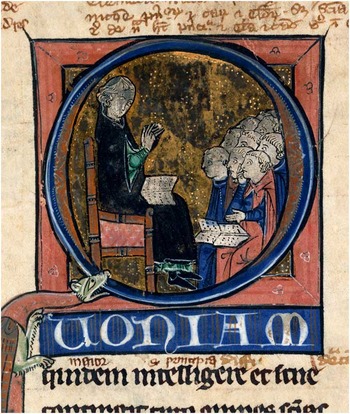
Some light may be shed on this issue, first, by enlarging the repertory of instances of work by the hand or workshop of the opening Trinity initial. James thought the work English; Henderson thought it resembled the Huth Psalter; Morgan thought that a ‘close stylistic parallel’ had yet to be found; and Klein compared it to manuscripts from the so-called Bible of William of Devon group.Footnote 8 In fact very similar work may now be identified in two other manuscripts connected to none of these. The first is a copy of Aristotle’s physical treatises, now BL, Royal ms 12. G. V, ascribed to the third quarter of the thirteenth century and opening at fol 4 with the Physics. The historiated initial Q on fol 4 (fig 2) was published by Charles Burnett in his study of the introduction of Arabic learning into England: it shows a seated scholar with an open book on his lap addressing a group of students with their own books.Footnote 9
BL, ms Royal 12. G. V, fol 4: the opening of Aristotle’s Physics. Photograph: © 2014 The British Library Board. All Rights Reserved

The seated images of the lecturer and of St John, in Douce, bear close comparison. The palette, decorative motifs, garments and facial features are formed identically, as are the chairs. In each case the chair, seen sideways-on, has a sloping armrest with a side panel either in blue or pink spangled with white. The posts of the chair have turned mouldings placed at exactly the same intervals, the main posts ending in each case in identical curled tops. The forearms of the lecturer project from a triangular slit in his gown answering to that of the scholar to the lower right opposite, which resembles the triangular slit in the mantle of Eleanor. The frame of the Q in pink has small white trilobe forms of the sort found below the middle bar of the S initial in Douce. The Aristotle initial has a gold ground punched with a motif of a dot circled by a half-dozen other dots exactly as found on the blue frame of the S initial. The bars and spirals of foliage, though conventionalised, are remarkably similar and the Aristotle has a small ape with a harp at the base, reminding us of the role of university manuscripts in the early generation of border ornament apparent also in the Douce initial. At fol 133 is a second historiated initial P in the same style, less distinguished in quality but possessing the same repertory of small formal motifs as the Douce initial.
BL, Royal ms 12. G. V, which also contains lively border drawings and glosses in various hands, is one of a group of books containing the Aristotelian Corpus vetustius with the so-called ‘Oxford’ gloss, including BL, Harley ms 3487, Royal ms 12. G. II and Royal ms 12. G. III.Footnote 10 According to inscriptions, the latter two books were in the possession of Rochester Cathedral Priory under Prior John (probably John of Renham, 1262–83), Royal ms 12. G. II having an additional cursive inscription (fol 1v) stating that it was written, emended and glossed in the schools at Oxford by Henry of Renham, presumably a kinsman of Prior John.Footnote 11 Unfortunately, though the books have points of similarity with Royal ms 12. G. V, they are in different hands and possess pen decoration only. Accordingly, Royal ms 12. G. V, which contains no demonstrable mark of ownership or date, can at best be dated by comparison with the pre-1272 initial in Douce.Footnote 12 Given its contents, it seems that it was written and illuminated in Oxford.
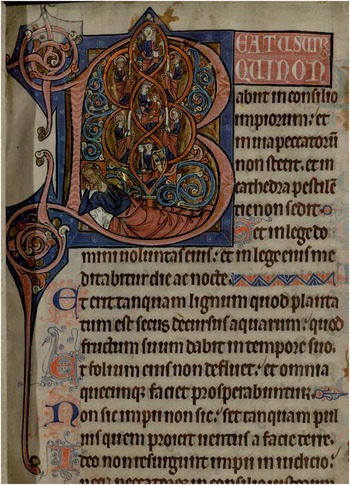
For knowledge of the second manuscript (Cambridge, Trinity College, ms O.4.16) the author is greatly indebted to Dr Adelaide Bennett, who should be fully credited with first noting its relationship to Douce.Footnote 13 Described by Lucy Sandler, FSA,Footnote 14 it is a Psalter, written around the third quarter of the thirteenth century and decorated at the major divisions with generally abstract, fine, full-colour initials. Many more initials were added to the book in the first half of the fourteenth century, as was a late thirteenth-century opening of Passion scenes (fols 113v and 114). The initial to Psalm 1, Beatus Vir, at fol 1 (fig 3) contains a fine Tree of Jesse, and is in a hand very close to the Douce Trinity initial, though it lacks marginalia at the foot of the page. The foliage initials with spiral patterns have long shooting tendrils found also at fol 133 of BL, Royal ms 12. G. V. The palette, drapery and facial types in the Beatus initial and the treatment of its blue frame with white detailing, small circles surrounded by dots and white trilobes, closely match the Douce initial, and the quality of the work is much the same – slightly superior, in fact – to that in ms Royal 12. G. V. The inclusion in the Calendar of St Richard (3 April, fol iiiv) places the Psalter after 1262; St Frideswide occurs in the Litany at fol 164v, pointing again to Oxford. Beyond these features the work cannot be dated further than its general resemblance to work of the 1260s or 1270s, and its subsequent history ended in London.Footnote 15
Cambridge, Trinity College, ms O.4.16, fol 1: Psalm 1. Photograph: © Master and Fellows of Trinity College, Cambridge

It follows that whoever illuminated the Trinity initial in Douce was almost certainly someone from an Oxford workshop, now employed in the household secretariat of Edward i, or, more probably, that of Eleanor of Castile. A date in the third quarter of the century for Douce’s initial is not contradicted. Little is known about Eleanor’s secretariat until near her death in 1290, but use of Oxford book-makers by the royal family is proved by the commission in February 1265 by Eleanor, Countess of Pembroke and Henry iii’s sister, of a breviary for her daughter, written in Oxford.Footnote 16
What may we say about the commissioning process of Douce given the possibility that its French text was initialled in a style of university-linked illuminators? This author believes that what we see in Douce as a total manuscript is evidence for a change in intended ownership, made in the course of the production of the Latin part. The addition of a French text to a set of illustrations commissioned with a Latin one may itself be prima facie evidence for a change of plan, even though a few of the Latin pictures contain small Anglo-Norman captions. As James showed, the Latin text is as uncorrected as the pictures above are incomplete, the aim of the main scribe being to fill two columns regularly and attractively rather than actually make sense.Footnote 17 The scribe’s superficial reasoning would not arise in the service of a textually discriminating patron, and a French text with commentary could also have been manipulated in the same way. Edward i and Eleanor of Castile probably spoke some dialect other than Anglo-Norman, a literary language, but of the two it was Eleanor who kept a chest of vernacular romances and for whom Archbishop Pecham made an Anglo-Norman redaction, the Ierarchie, of the text on angels by the Pseudo-Dionysius, bound up with a copy of the Dominican Somme le Roi (Paris, Bibliothèque Ste-Geneviève, ms 2899).Footnote 18
Douce is not the only book with strong royal connections to reveal strange discontinuities. The copy of the Life of St Edward in Cambridge authored by Matthew Paris, but possibly intended for Eleanor of Castile after her arrival at the English court in 1254–5 (Cambridge, University Library, ms Ee. 3. 59), was never provided with a main initial, and when one was inserted in the fifteenth century it was the wrong one.Footnote 19 The Edward manuscript, one of the very few criteria we have for the production of texts intended for the innermost royal circle, does not support Klein’s argument that initials were done before the illustrations, not least because it is clearly artistically complete as a book. The secondary quality of the initial to the French text in comparison to the superb illustrations of the Apocalypse also challenges the idea that the French text and initial in effect inaugurated the manufacture of the book: why would mainstream Oxford illuminators have been chosen to open the decoration of the greatest royal book of the period?
A more probable explanation for what we see in Douce is that the Latin text and illustrations were begun at some point in the mid-1260s; the full painting of the work was then halted for reasons unknown; and the book was then immediately passed to Edward and Eleanor, who used the same scribe to produce a French version of the text, but had their own illuminators initial it. The colouration of the main illustrations was never finished. The only patron who can for certain be said to have commissioned work in the main style of the book was Henry iii, since a painter close to, or identical with, the Douce illustrator was employed on the ceiling and walls of Henry’s great chamber in the palace at Westminster from some point late in 1263 through to about 1267.Footnote 20 In this period the Westminster Retable, close to Douce and made for the king’s high altar in the Abbey, was also being made. There is no independent evidence that Edward and Eleanor employed artists of this type on other commissions. The pro-royalist, or anti-Montfortian, heraldry on pages 30, 31, 87 and 88 of Douce would be explicable only after 1264–5, but it would presumably be consistent with the views of Henry iii or Eleanor of Provence.Footnote 21 But by 1267 Henry was experiencing serious financial difficulties: in that year he pawned substantial parts of St Edward’s shrine.Footnote 22 His major concern was completing the works at Westminster Abbey before 1269. Under such circumstances, minor commissions, such as illustrated books in hand for Henry but still incomplete, might be passed on to someone who could complete them. Because the same scribe was used for the French part, it is reasonable to infer that this text was added almost immediately and within the same family circle using the same workshop.
It follows that the simplest explanation of the relation of Douce’s two parts is that the Latin part was planned and largely made for Henry or his queen, but then passed on by them for completion to Edward and Eleanor, who duly appropriated the book by using Henry’s scribes and their own illuminator to make the French part, but did no more to the Latin part. All this is consistent with the evidence that the main Latin text and illustrations were begun after c 1264–5, and that the Trinity initial was added by an Oxford-trained illuminator before 1272, and probably before 1270, and so not first, but last. This places all aspects of Douce’s production between c 1265 and c 1270. Why the Trinity was chosen is unknown, but it may be worth noting finally that Eleanor of Castile was buried to the north of the Trinity altar in Westminster Abbey, which might indicate some prior devotion to the Trinity on her part, and indeed her initiative in continuing the book by having the opening initial added to it.Footnote 23
ABBREVIATIONS AND BIBLIOGRAPHY
Abbreviations
- BL
British Library, London
- Bodleian
Bodleian Library, Oxford