Introduction
The taxonomy of Pelonides Kuwert (Coleoptera: Cleridae) species experienced considerable oscillation since the establishment of the genus by Kuwert (Reference Kuwert1894). The genus retained its valid generic status in Wolcott (Reference Wolcott1920, Reference Wolcott1947), Bradley (Reference Bradley1930), Blackwelder (Reference Blackwelder1945), Barr (Reference Barr1950), and Knull (Reference Knull1951). Corporaal (Reference Corporaal1950) synonymised Pelonides under Pyticara Spinola, a classification that was followed by Barr (Reference Barr1962). Later, Barr (Reference Barr1980) resurrected Pelonides under which he listed five species. These species, and one new species described herein, have never been studied collectively. A complete review of the genus Pelonides forms the basis for this paper.
Material and methods
This study is based on the morphology of 1269 adult specimens. I examined the morphological and geographical differences of the species and weighed the differences in the context of the concepts of the biological species. In the descriptions, I have used terminology as presented in Opitz (Reference Opitz2010). Techniques of dissections and illustrations are similar to those described in Opitz (Reference Opitz2007). Line illustrations were produced with a Wild M5 stereoscopic microscope with camera lucida attachment (Leica, Wetzlar, Germany), while scanning electron microscope (SEM) micrographs were taken with a JEOL JSM-5510LV SEM (Hitachi Science Systems, Ltd., Tokyo, Japan). Habitus photographs were taken with a Leica Z 16 APO microscope equipped (Leica) with JVC KY–F75U-CCD camera and controlled by Syncroscopy Auto Montage software (Cambridge, United Kingdom).
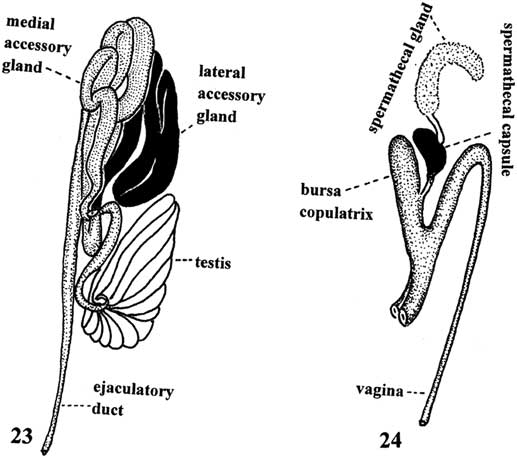
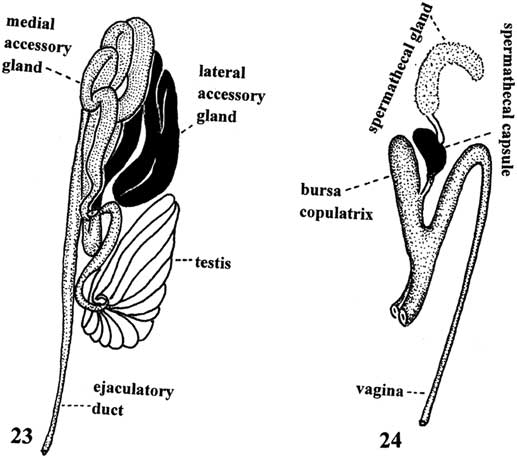
Several specimens of Pelonides quadripunctata were completely disarticulated to reveal the more cryptic morphological characteristics. Also, four specimens of this species were received in Pampel’s fixative (for formula, see Opitz Reference Opitz2010) and dissected to reveal the male and female mesodermal characteristics. The figures of the male and female mesodermal reproductive organs show only one of two testes, one of two ovaries, and in the case of the male, one of two pairs of accessory glands.
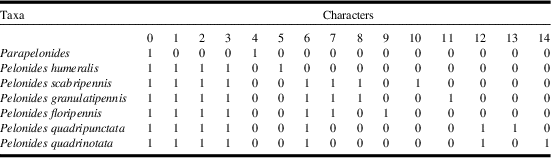
The theoretical basis upon which the species concept is based follows the tenets of Standfuss (Reference Standfuss1896), Dobzhansky (Reference Dobzhansky1937), and Mayr (Reference Mayr1963). It is useful, and historically conventional, to include evolutionary analyses in taxonomic revisions. Such analyses present possibilities of stability in the classificatory process and are in line with the canons of Hennig (Reference Hennig1966). Phylogenetic trees are part of the taxonomic process. It is imperative that the methodologies used to generate such trees are amply explained. Foremost, in proposals of evolutionary relationships, involves evaluation of the evolutionary state of characters. The methods for character-state analysis used herein have been amply discussed elsewhere (Ross Reference Ross1974; Erwin Reference Erwin1975; Ekis Reference Ekis1977; Watrous and Wheeler Reference Watrous and Wheeler1981; Nixon and Carpenter Reference Nixon and Carpenter1993). The outgroup that was used in the character analysis involves the species of Parapelonides Barr and taxa of Enopliinae in general. In short, an inventory of uniquely derived characteristics (the language of Hennig Reference Hennig1966) was organised into a character matrix (Table 1). Then, the matrix was analysed using WINCLADA version 1.00.08 (Nixon Reference Nixon2002) in combination with NONA (Goloboff Reference Goloboff2003). However, I am in agreement with Tuomikosky (Reference Tuomikosky1967) who uses the terms “apotypic” and “plesiotypic” instead of “apomorphic” and “plesiomorphic” on the grounds that “Because phylogenetic work is not confined to the use of morphological characters, more general terms such as plesiotypic and apotypic would perhaps be preferable”.
Character matrix of 14 adult morphological and geographical characters of Pelonides species.

Fourteen adult morphological and one geographical character were used to predict the phylogenetic relationships among Pelonides species. Plesiotypic character states are given the value of “0”, whereas those assessed apotypic were given the value of “1” (Table 1).
Character 0 – Phallus: without spines (0); with spines (1)
Character 1 – Ungues: small (0); large (1)
Character 2 – Eighth antennomere: without collateral branch (0); with collateral branch
Character 3 – Acetiferous punctures: present (0); absent (1)
Character 4 – Phallic plate edges: one edge spinous (0); both edges spinous (1)
Character 5 – Setiferous elytral punctures: not minute (0); minute (1)
Character 6 – Elytral disc: without maculae (0); with maculae (1)
Character 7 – Elytral disc surface: not scabrous (0); scabrous (1)
Character 8 – Pronotal disc: not scabrous (0); scabrous (1)
Character 9 – Dorsum: not floricolorous (0); floricolorous (1)
Character 10 – Distribution: not Baja California, Mexico; (1) Baja California, Mexico
Character 11 – Phallic lobes: long (0); short (1)
Character 12 – Elytral disc maculae: large (0); small (1)
Character 13 – Forebody: not completely black (0); completely black (1)
Character 14 – Tegminal lobes: not acuminate (0); acuminate (1)
Specimens were borrowed from the following collections (with curator in brackets):
AMNH – American Museum of Natural History, New York, New York, United States of America (Lee Herman).
CNIN – Colección Nacional de Insectos, Instituto de Biologia, UNAM, Apartado Postal 70-153, 04510, Cuidad de México, Distrito Federal, Mexico (Silvia Santiago Fragoso).
CASC – California Academy of Sciences, San Francisco, California, United States of America (David H. Kavanaugh)
FMNH – Field Museum of Natural History, Chicago, Illinois, United States of America (James H. Boone).
FSCA – Florida State Collection of Arthropods, Gainesville, Florida, United States of America (Paul E. Skelley).
GSPC – Gareth S. Powell Collection, West Lafeyette, Indiana, United States of America.
JEWC – James E. Wappes Collection, San Antonio, Texas, United States of America.
JJDC – John J. Dorshorst Collection, Des Plains, Illinois, United States of America.
JNRC – Jacques Rifkind Collection, Valley Village, California, United States of America.
MCZC – Museum of Comparative Zoology, Harvard University, Cambridge Massachusetts, United States of America (Philip Perkins).
RHTC – Robert H. Turnbow Collection, Fort Rucker, Alabama, United States of America.
TAMU – Texas A&M University, College Station, Texas, United States of America (Edward G. Riley).
USNM – United States National Museum, Washington, District of Columbia, United States of America (Natalia J. Vandenberg).
WFBM – William F. Barr Museum, University of Idaho, Moscow, Idaho, United States of America (Frank Merickel).
WOPC – Weston Opitz Collection, Salina, Kansas, United States of America.
Natural history
The majority of the information that concerns the natural history of these beetles was gleaned from specimen labels. The mouthpart morphology of these beetles suggests that they are predators. Several specimens were reared from dead woody branches (Champlain Reference Champlain1920), an indication that they may prey on lignicolous insects as do most other Cleridae (Balduf Reference Balduf1935). Most specimens were collected by beating and sweeping vegetation, from southwestern United States of America during the summer months, at altitudes up to 2000 m. Various labels indicate that these beetles may be collected on the flowers of a variety of plant species, however, no evidence of pollen feeding was found in their digestive tract. Therefore, I assume that their flower-visiting behaviour involves predatory activities on anthophilous prey. The following comprises a list of plants on which Pelonides specimens were collected, usually by beating or sweeping foliage and/or on flowers: Allium Linnaeus (Amaryllidaceae), Acacia Miller (Fabaceae), Asclepias Linnaeus (Apocynaceae), Apocynum Linnaeus (Apocynaceae), Betula nigra Linnaeus (Betulaceae), Boerhavia intermedia Jones (Nyctaginaceae), Bursera copallifera (de Candolle) Bullock (Burceraceae), Ceanothus Linnaeus (Rhamnaceae), the desert hackberry Celtis pallida Torrey (Cannabaceae), Celtis reticulata Torrey (Canabaceae), Cercidium macrum Johnson (Fagaceae), Condalia Cavanilles (Rhamnaceae), Mimosa Linnaeus (Fabaceae), Parkinsonia Linnaeus (Fabaceae), Pithecellobium Martius (Fabaceae), Prosopis juliflora (Swartz) de Candolle (Fagaceae), the smooth mesquite Prosopis laevigata (Humboldt and Bonpland ex Willdenow) Johnston (Fagaceae), Quercus virginiana Miller (Fagaceae), Sapindus drummondii (Hooker and Arnott) (Sapindaceae), and shrub of Ziziphus Miller (Rhamnaceae).

Pelonides Kuwert
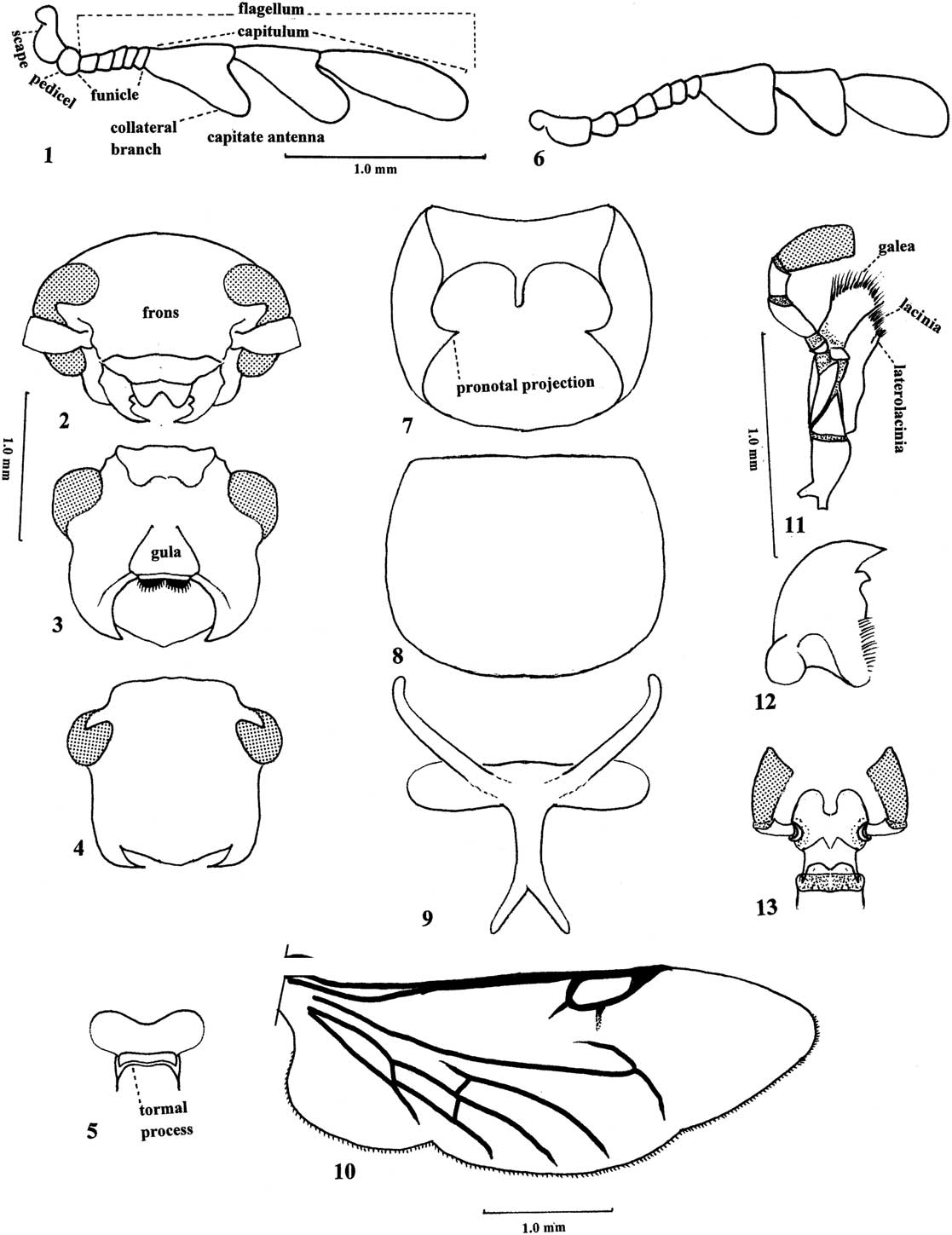
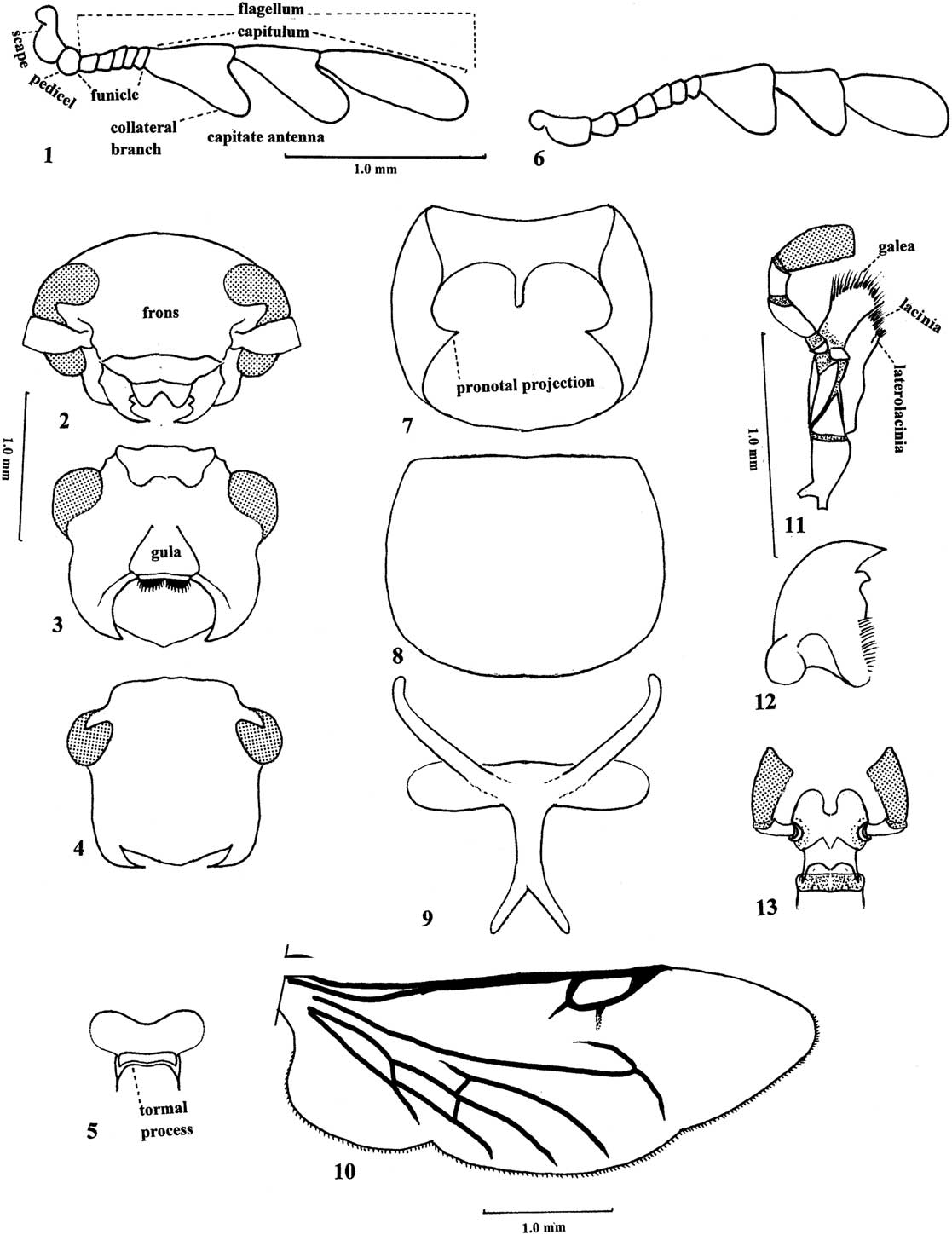
Various structures of Pelonides quadripunctata. 1. Antenna (male). 2–4 Heads (2. frontal view, 3. ventral view, 4. dorsal view). 5. Labrum. 6. Antenna (female). 7–8. Prothorax (7. ventral view, 8. dorsal view). 9. Metendosternite. 10. Metathortacic wing. 11. Maxilla. 12. Mandible. 13. Labium.
Pelonides Kuwert, Reference Kuwert1894: 8. Type species: Enoplium quadripunctatum Say, by monotypy. Wolcott Reference Wolcott1920: 151. Bradley Reference Bradley1930: 107. Blackwelder Reference Blackwelder1945: 389. Wolcott Reference Wolcott1947: 85. Corporaal Reference Corporaal1948: 245; 1950: 274. Knull Reference Knull1951: 304. Barr Reference Barr1962: 126; 1980: 280.
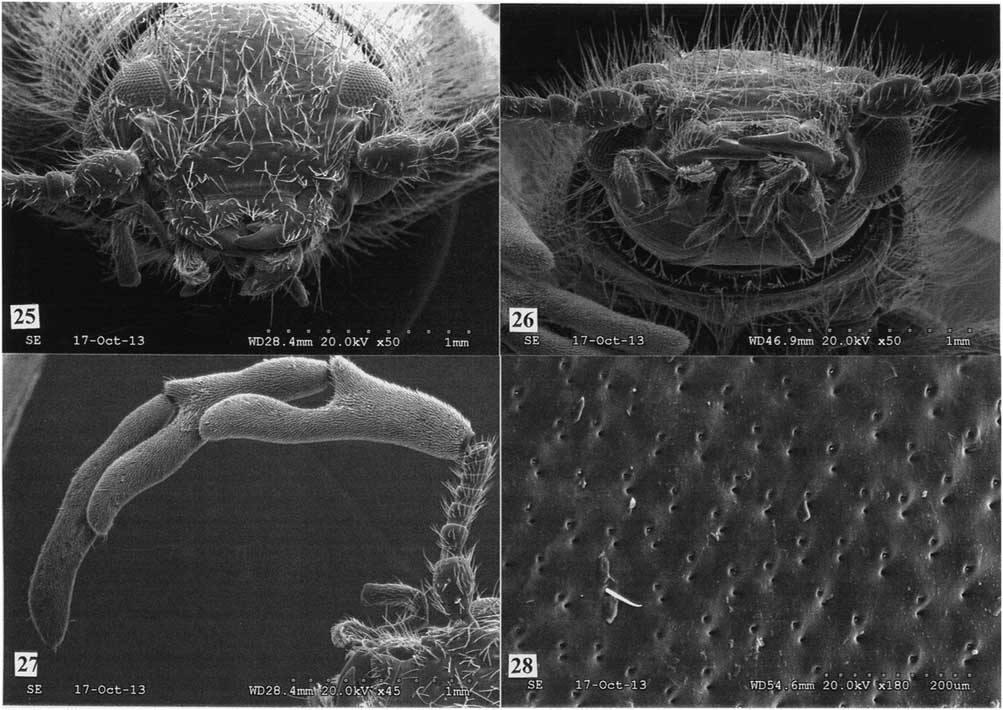
Diagnosis. The collateral branches on antennomeres 8 and 9, particularly prominent in males (Fig. 1), will distinguish the members of this genus from other specimens of New World Enopliinae.
Synapotypic characteristic. Capitular antennomeres 8 and 9 with collateral branches.
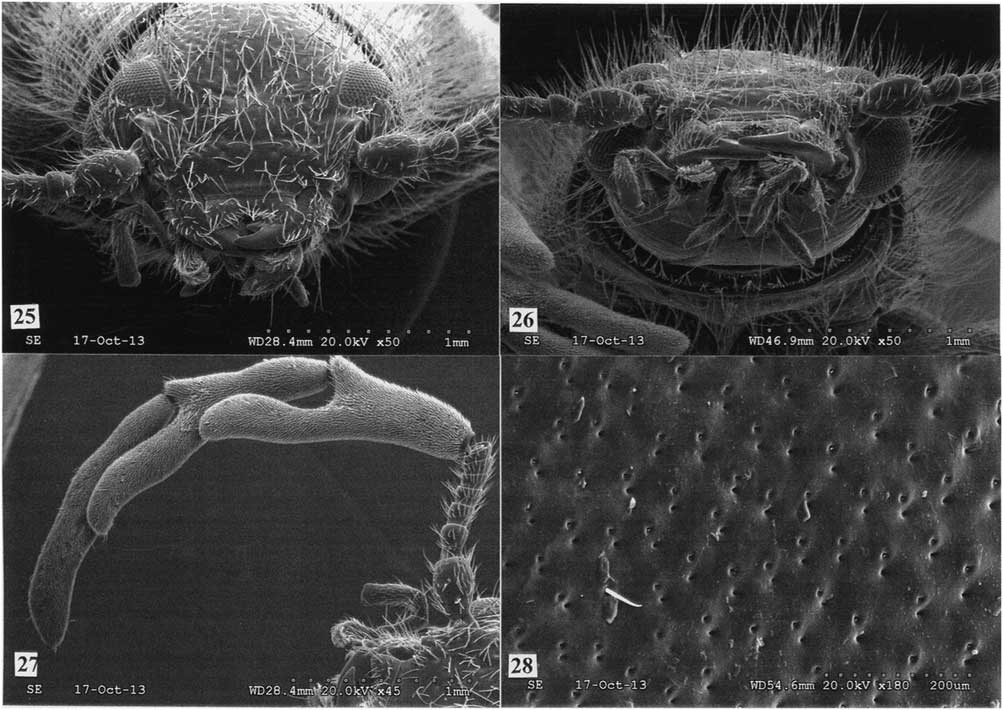
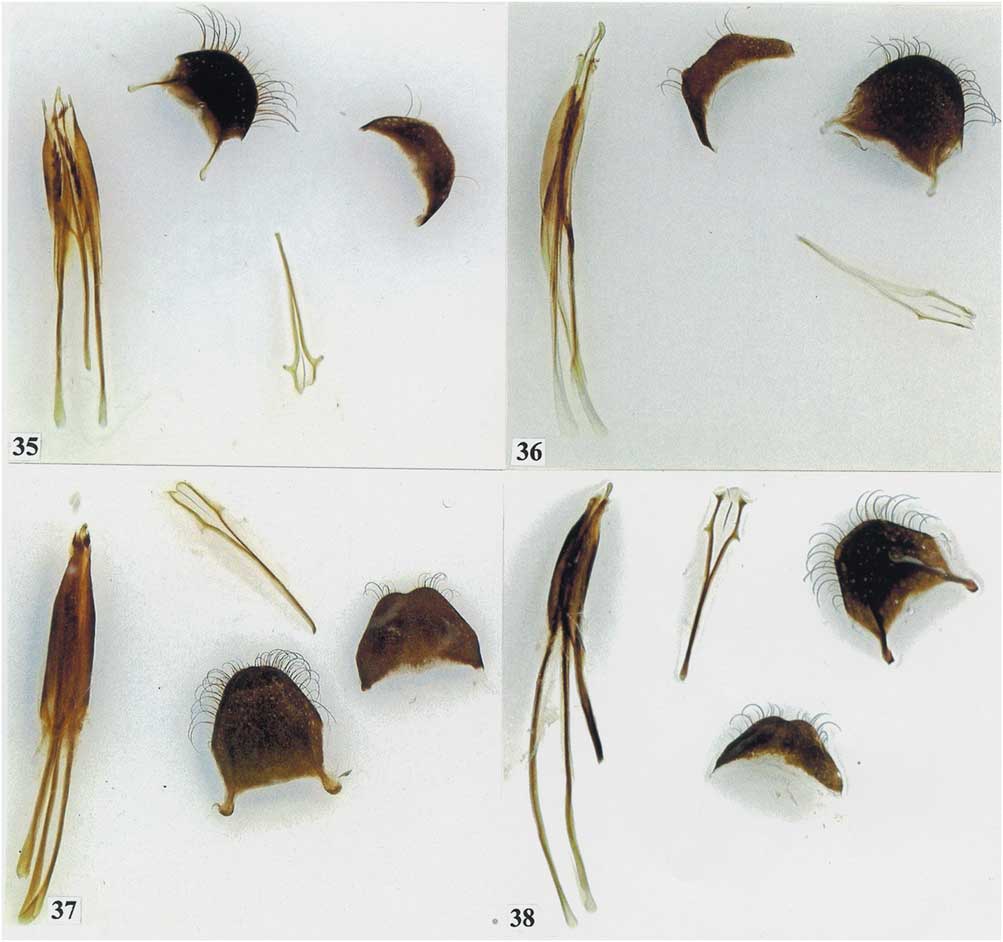
Description. Size: Length 5.0–10.0 mm; width 2.0–4.0 mm. Form (Fig. 30): Oblong suboval (about 2.5× longer than broad), body shallow. Vestiture: Dorsum profusely vested with pale or black pubescence; antenna profusely setose, capitular setae very densely packed and short; elytra with secondary setae, but with no primary setae. Head (Figs. 2–4, 25, 26): Cranium quadrate, frons wider than width of eye, profusely indented with small setiferous punctures. Gula (Fig. 3) large, trapezoidal, sutures converge anteriorly, with two well-developed setose postgular processes (Fig. 3). Labrum (Fig. 5) shallow, incised distally; tormal processes confluent; epipharyngeal plate small. Mandible (Fig. 12) stout; anterior dens acuminate, medial dens well developed, posterior dens poorly developed; penicillus large. Maxilla (Fig. 11) with laterolacinia present, terminal palpomere rectangulate. Labium (Fig. 13) with ligula deeply incised, ligular lobes well developed, terminal palpomere rectangulate. Eyes small, ommatidia very small, ocular notch large. Antenna comprised 10 antennomeres, capitate (Figs. 1, 6, 27); pedicel spheroid, funicular antennomeres narrow, capitulum very long, capitular antennomeres lobed. Thorax: Pronotum (Figs. 7, 8) transverse, disc convex; side margins without lateral tubercle; dorsolateral carina incomplete, anteriorly goes beyond tubercle and confluent with pronotal hem beyond hind angle of pronotum, with partial commissure; prointercoxal process narrow, not expanded distally; pronotal projections very short, acuminate, not approximating prointercoxal process. Elytron profusely sculptured with small setiferous punctures (Fig. 28), asetiferous punctures absent; epipleural fold wide and slightly reflexed; elytral anterior margin not carinate. Metathoracic wing as in Fig. 10, wedge cell closed. Metendosternite (Fig. 9) with furcal lamina, furcal anterior plate triangular. Legs with profemora not swollen, anterior margin of protibia not spinous; tibial spur formula 0-2-2, tarsal pulvillar formula 3-3-3, ungues with small basal swelling. Abdomen: Aedeagus (Figs. 35–40) about as long as length of abdomen; distal region of phallobase finely lobed, latter not fimbriate; tegmen not reduced ventrally, phallobasic struts confluent with phallobasic apodeme, phallobasic rod present, phallic plates narrow; phallus spinous subapically, phallic plates spinous at one margin. Pygidium trapezoidal, 6th visible sternite incised; spicular fork well developed, spicular apodemes fused at middle, intraspicular plate long and linear.
Distribution. This genus is known from the midwestern United States of America to Honduras.
Pelonides floripennis Opitz, new species
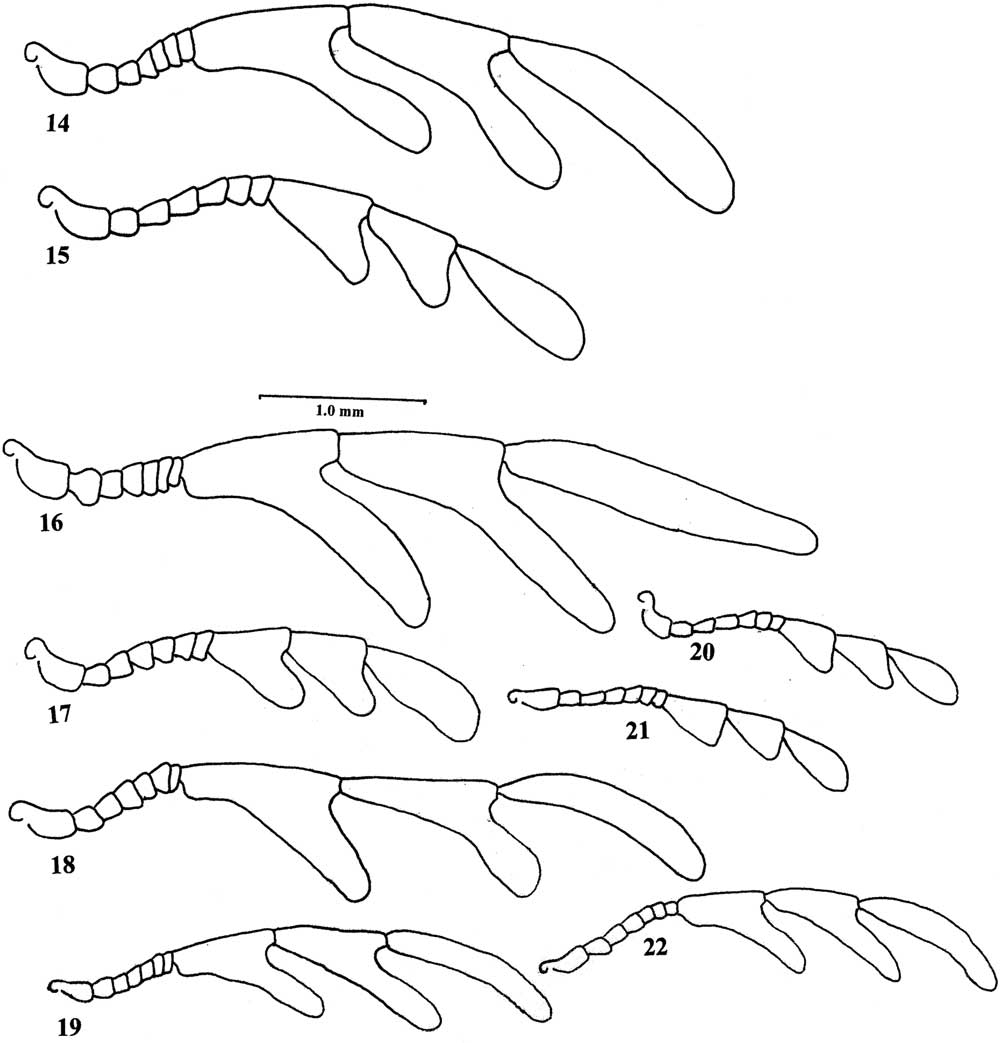
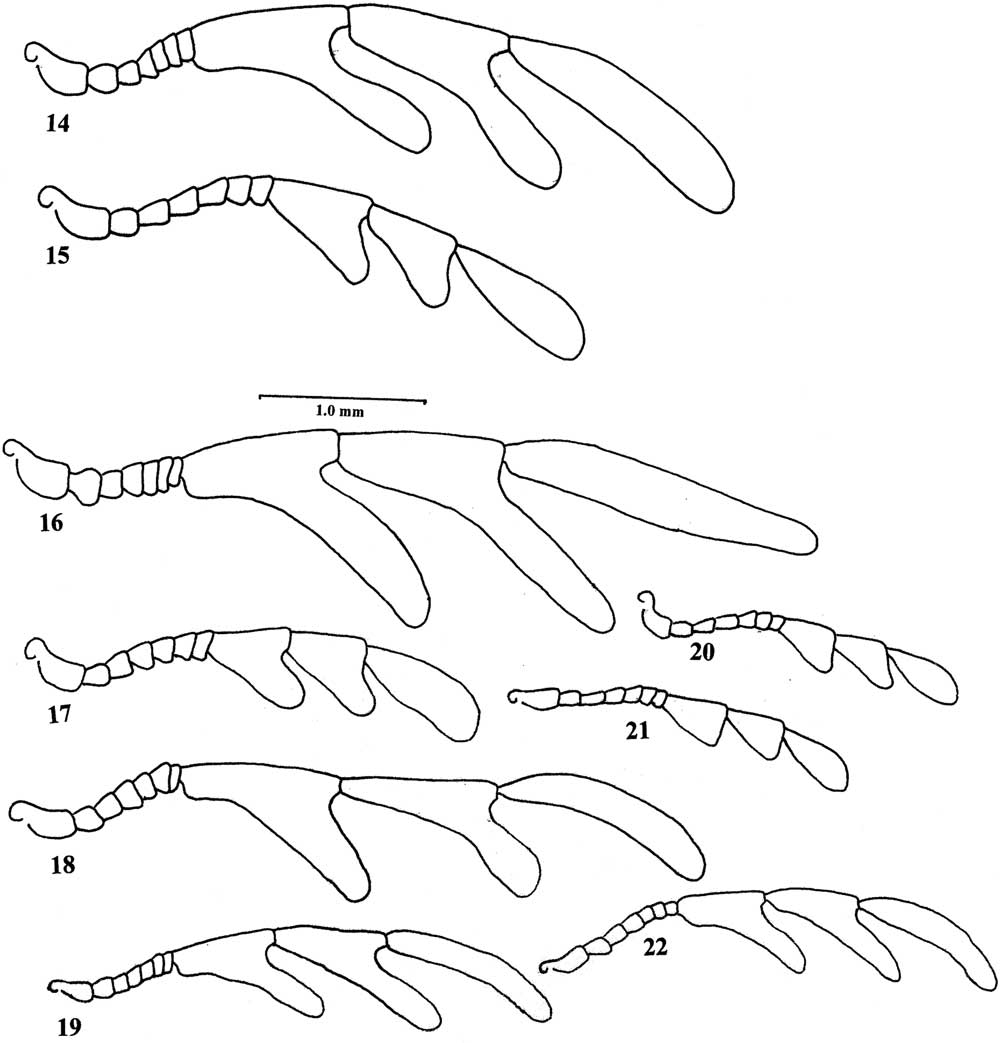
Antennae. 14–15. Pelonides quadrinotata (14. male, 15. female). 16–17. Pelonides humeralis (16. male, 17. female). 18. Pelonides granulatipennis (male). 19. Pelonides floripennis (male). 20. Pelonides scabripennis (female). 21. P. granulatipennis (female). 22. P. scabripennis (male).
Holotype. ♂. MEXICO: Morelos, Tepalcingo, S El Limόn, Parcela de la Cruz, 42.6 N 98 56 24.6 W, Alt 1244 m. A second label: Selva Baja Caducifolia, En flores de B. copallifera, 21-V-2007, Cols. V.H. Toledo and A.M. Corona (CNIN). Paratypes. None.
Diagnosis. The midelytral red fascia, and its confluence with the red humeral fascia, does not extend to the sutural margin. This characteristic will distinguish the members of this species from congeners.
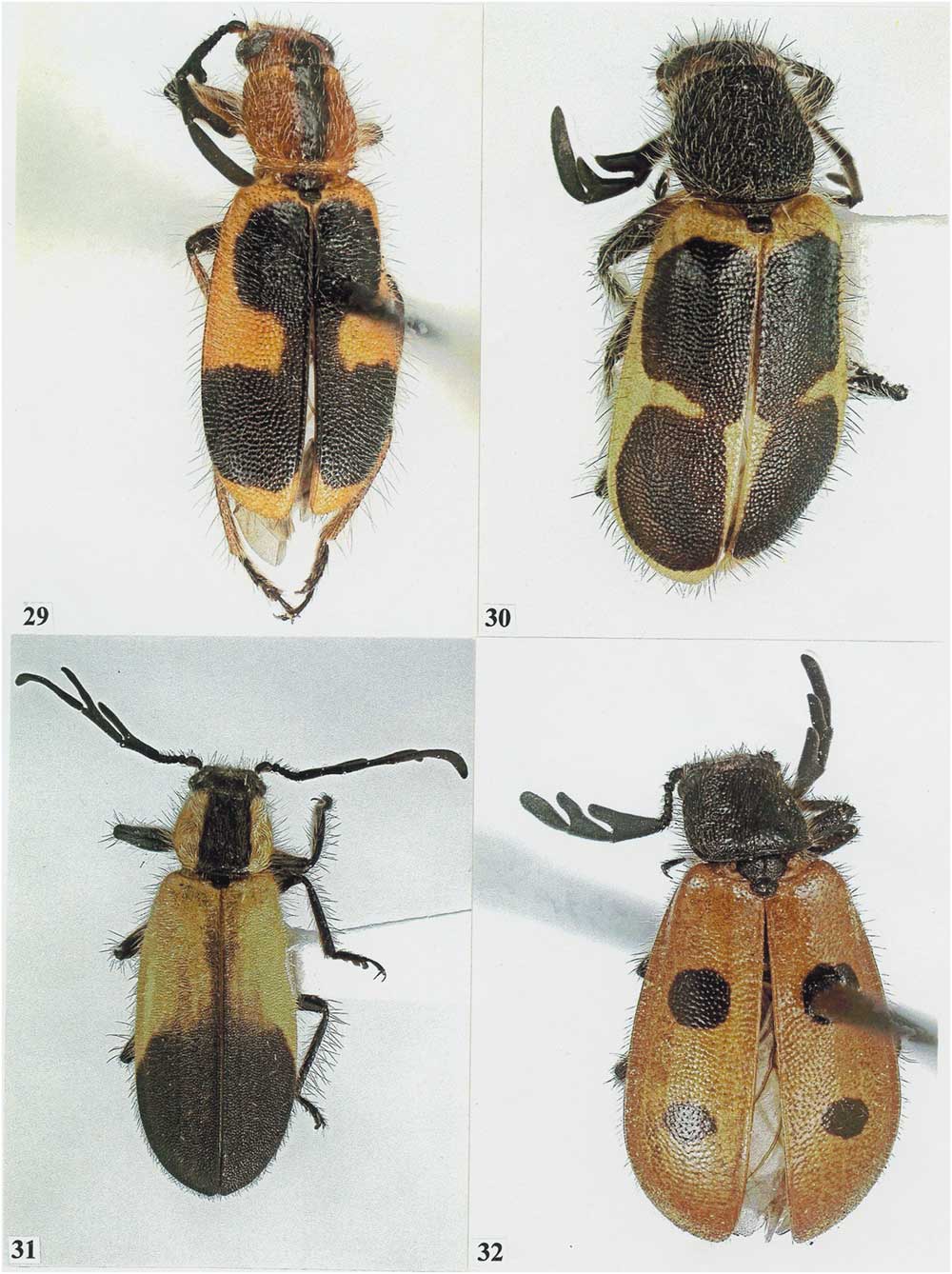
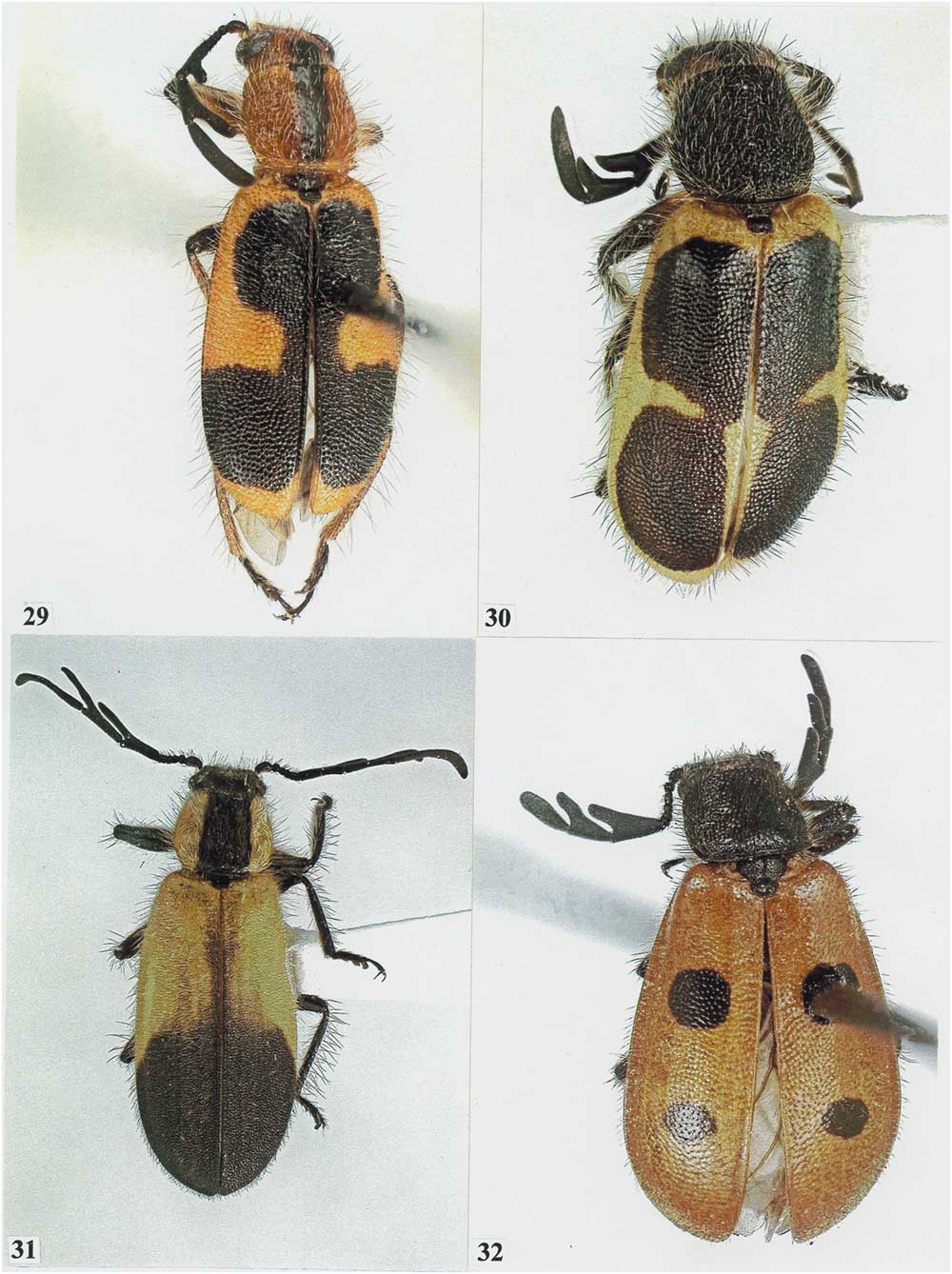
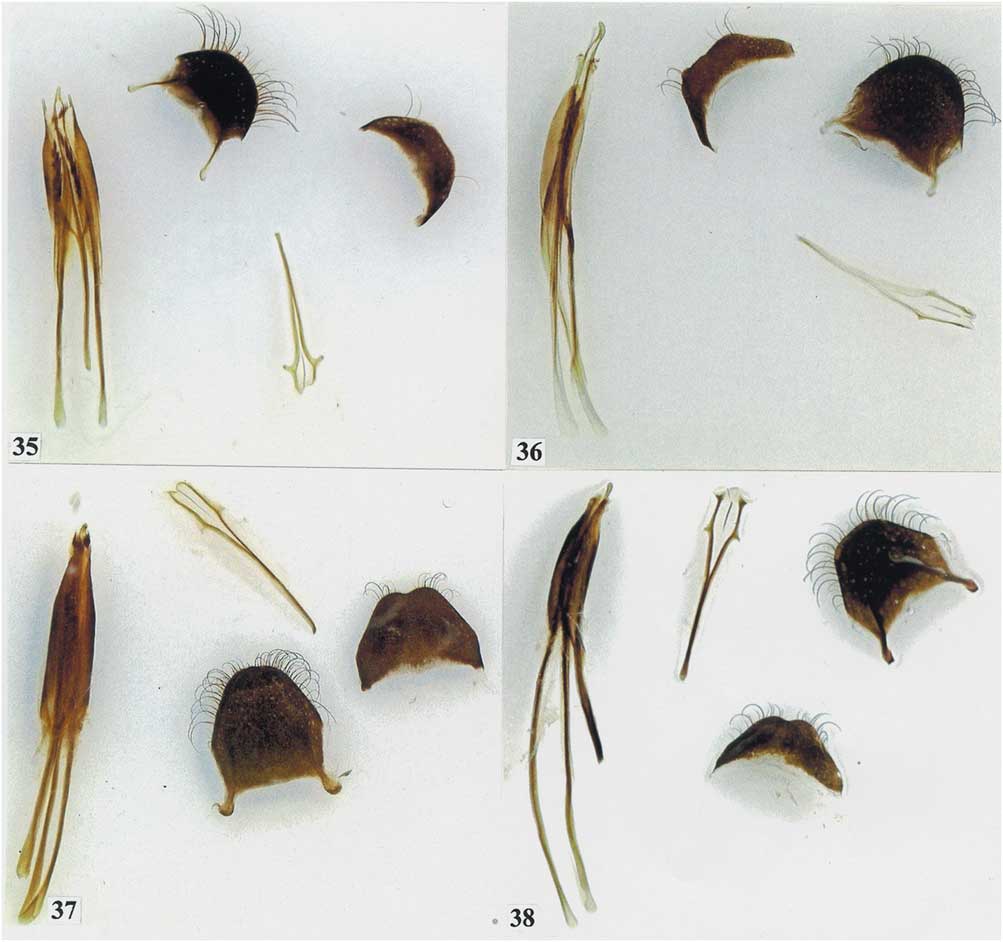
Description. Size: Length 5.0 mm; width 2.0 mm. Form: As in Fig. 29. Integument: Cranium and pronotum mostly reddish yellow, epicranium and pronotal middle with black macula; mesoscutellum black; elytra mostly black, with humeral margin, humerus, anterior half of epipleural margin, and elytral apex reddish yellow; antenna, meso-meta femora, metathorax, and abdomen black; profemur mostly reddish yellow, infuscated on disc and at apex; tibia reddish yellow; tarsi black. Head: Cranium not coarsely punctate, interstitial spaces smooth and shiny; eyes narrower than frons (20:35), small, ommatidia small; capitular antennomeres 8, 9 with long collateral branches (Fig. 19). Thorax: Pronotum slightly transverse (85:80), pronotal sides arcuate. Elytral disc covered profusely with small, setiferous punctures; interstitial spaces smooth and shiny. Epipleural fold gradually narrowed to elytral apex, asetiferous punctures absent, primary setae absent. Abdomen: Pygidium, 6th male visible abdominal sternum, tegmen, phallus, and spicular fork as in Fig. 35.
Natural history. The holotype was collected in May, at 1224 m, on flowers of B. copallifera.
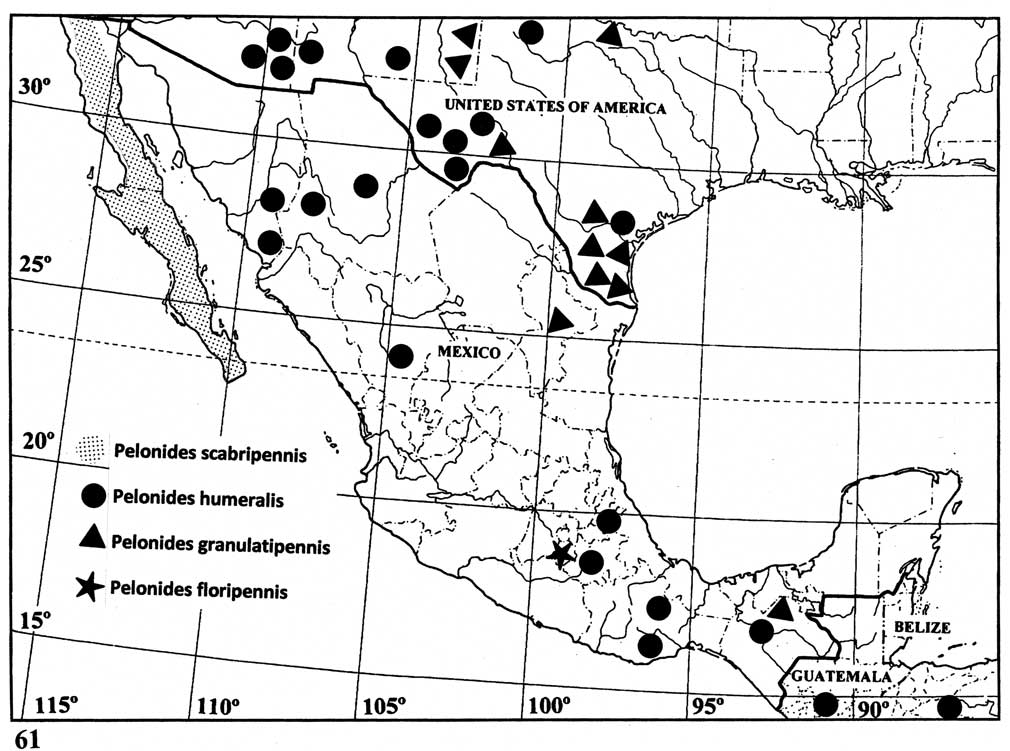
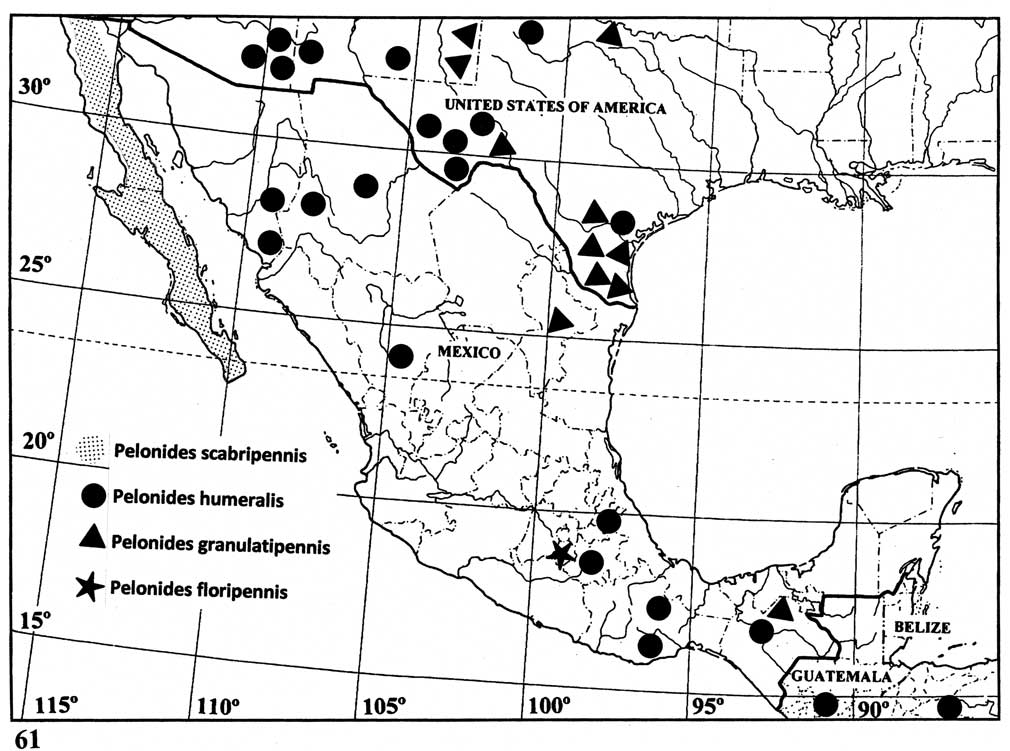
Distribution (Fig. 61). Mexico: Morelos, Tepalcingo, S El Limόn, Parcela de la Cruz.
Etymology. The trivial name is a compound Latin name derived from floris (=flower) and penna (=wing) in reference to the floricolorous condition of the elytral disc.
Pelonides granulatipennis (Schaeffer)
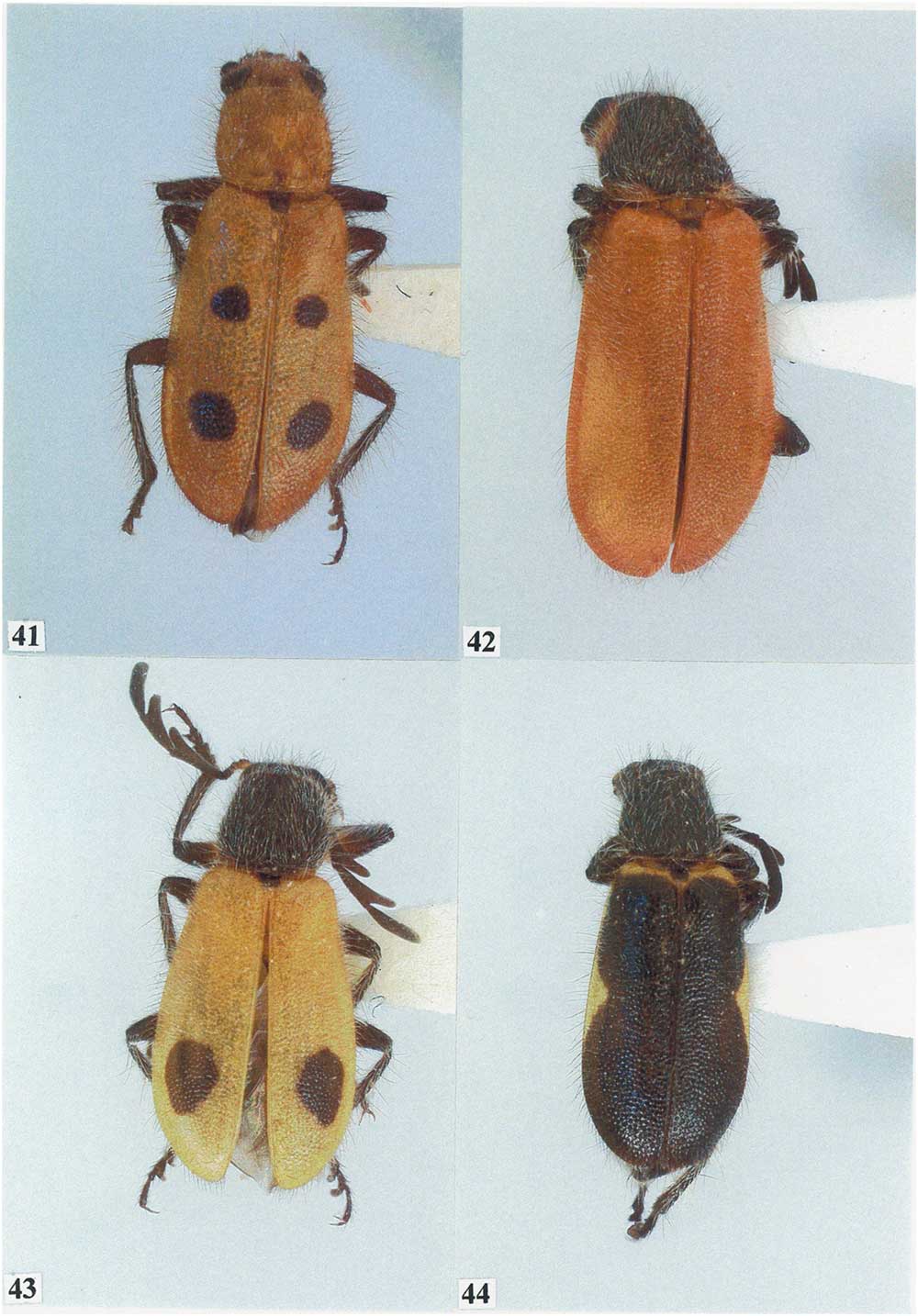
Figs. 18, 21, 30, 36, 41–44, 61.
Enoplium granulatipenne Schaeffer, Reference Schaeffer1904: 220. Lectotype ♂ (USNM). Here designated. Paralectotypes. Five specimens from the same collection site as the lectotype (USNM). Type locality: Brownsville, Texas. Schaeffer Reference Schaeffer1904: 220 (Enoplium). Wolcott Reference Wolcott1920: 151 (Pelonides); Reference Wolcott1947: 85 (Pelonides). Corporaal Reference Corporaal1950: 274 (Pyticara). Barr Reference Barr1980: 280 (Pelonides).
Diagnosis. The very coarse facies of the pronotum will distinguish the member of this species from congeners. Also, when the elytra is spotted, the spots are larger than those found in superficially similar specimens of P. quadripunctata (Say) (compare Figs. 30, 32).
Description. Size: Length 7.0 mm; width 2.7 mm. Form: As in Fig. 30. Integument: Cranium mostly red, epicranium with a black spot; pronotum black; elytra mostly black, with four black maculae; antennae, tibiae, tarsi, metasternum, mesoscutellum, and abdomen black; middle of pronotum with black macula; mesoscutellum black; femora increasingly infuscate from profemur to metafemur. Head: Cranium coarsely punctate, interstitial spaces not smooth and shiny. Eyes narrower than frons (22:40), small; ommatidia small. Capitular antennomeres 8 and 9 with collateral branches (Fig. 18). Thorax: Pronotum slightly transverse (110:100), pronotal sides arcuate. Elytral disc covered profusely with small, setiferous punctures; interstitial spaces somewhat cribrate. Epipleural fold gradually narrowed to elytral apex, asetiferous punctures absent, primary setae absent. Abdomen: Pygidium, 6th male visible abdominal sternum, tegmen, phallus, and spicular fork as in Fig. 36.
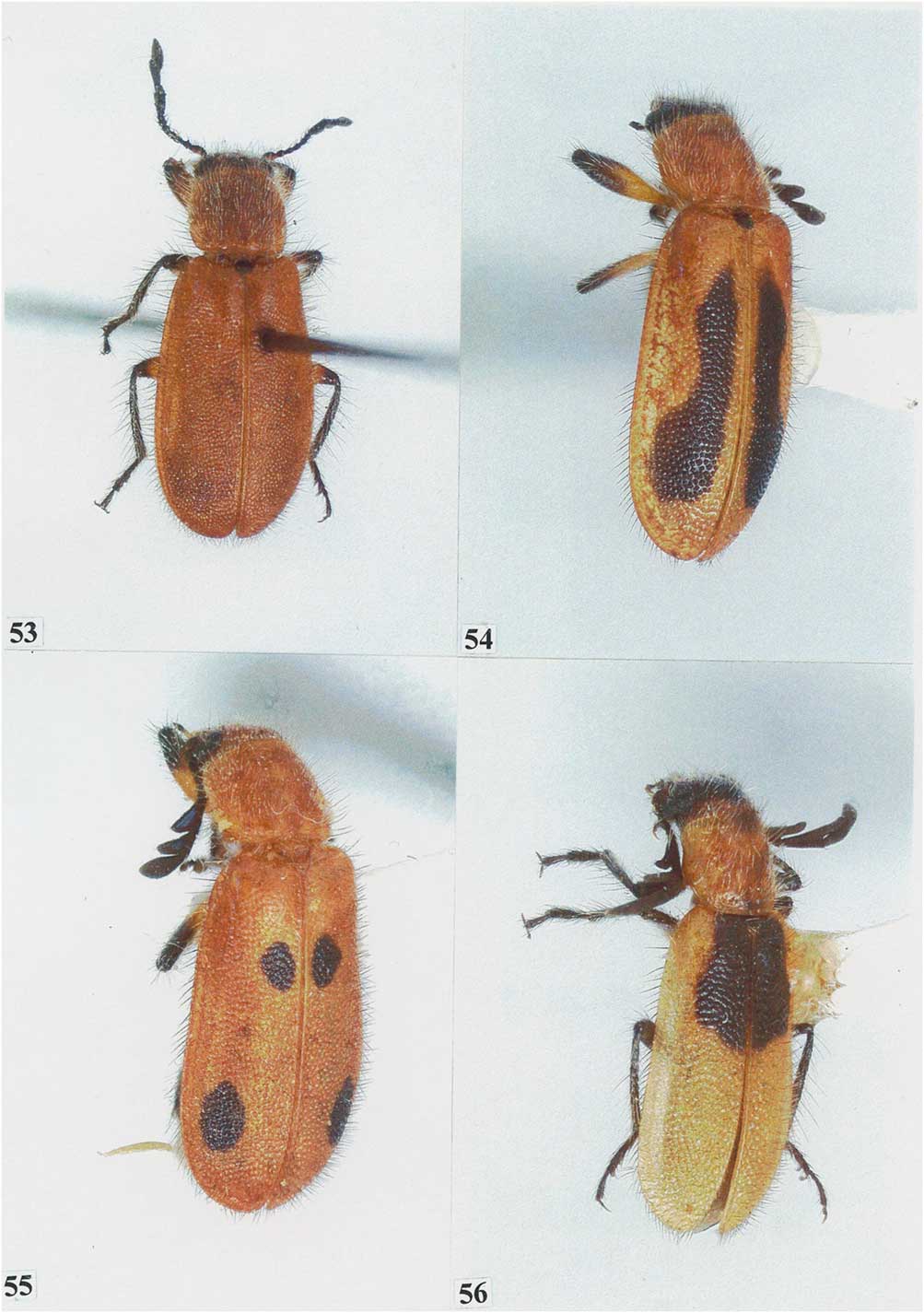
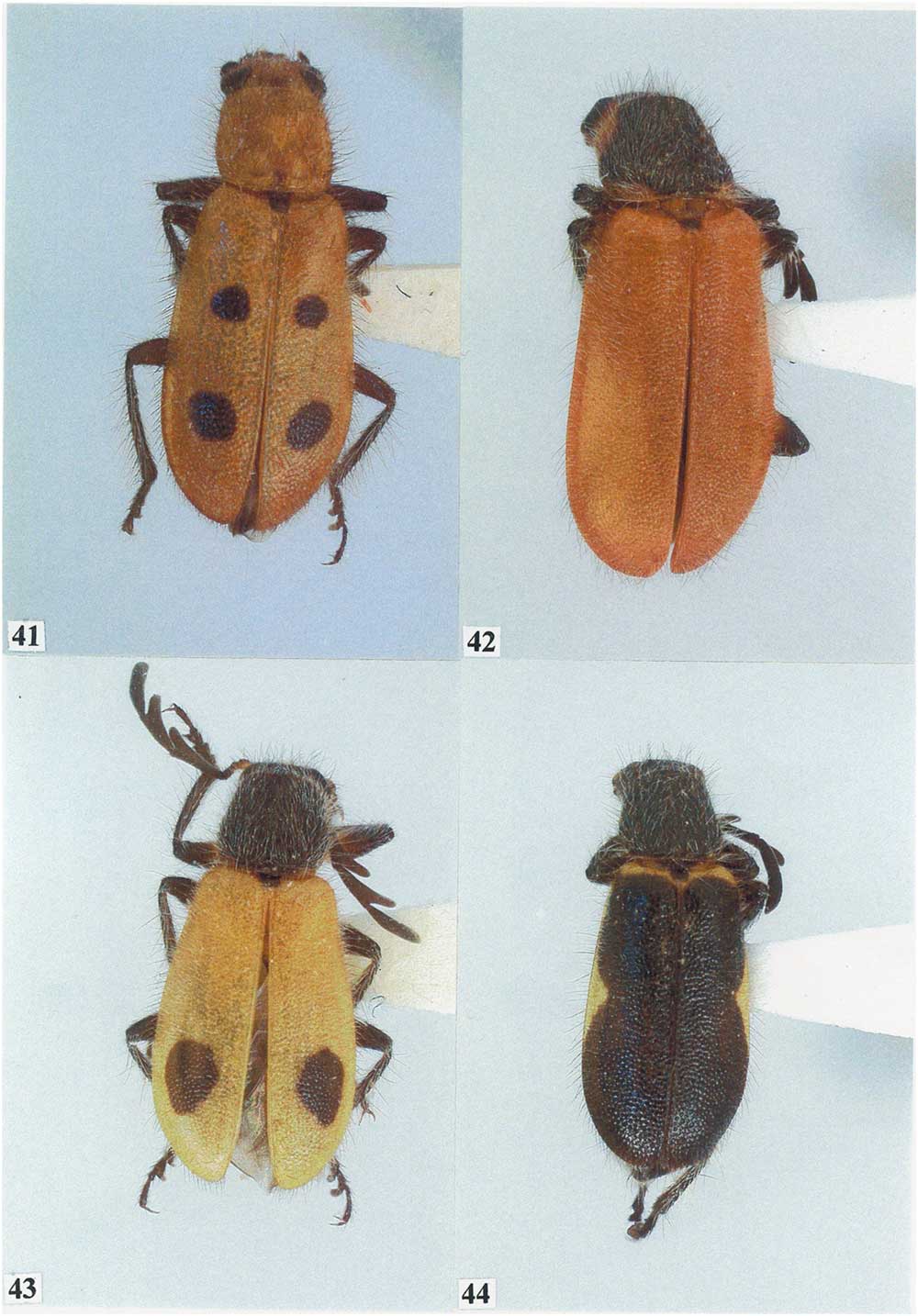
Variation. Size: Length 3.8–7.5 mm; width 1.8–3.0 mm. The antenna is sexually dimorphic (compare Figs. 18, 21). There is considerable variation in integumental colour (Figs. 41–44): the large spots on the elytral disc may coalesce so that the disc is mostly black (Fig. 44), there may be two elytra spots (Fig. 43), or the elytral disc may be entirely devoid of spots (Fig. 42). The abdomen is red or black.
Natural history. Specimens have been collected from the southwestern United States of America from March through August, by sweeping Parkinsonia and beating Prosopis Linnaeus (Fagaceae). Specimens were also collected from Celtis Linnaeus (Canabaceae) vegetation. These beetles were also reared from Pithecellobium and collected using a Malaise trap. George B. Vogt collected specimens by beating flowers and branches of C. macrum and P. juliflora.
Distribution (Fig. 61). Known from southwestern United States of America and northern Mexico.
Material examined. 346 specimens from: United States of America: New Mexico: Eddy County, 41.6 km E Carlsbad 29-V-1977, Malaise trap; 24 km W Caprock, 25-V-1997, W.F. Chamberlain. Texas: Cameron County, 25-III-1952, D.J. and J.N. Knull; Brownsville, V-1912, E.G. Smyth; Eagle Pass, 2-IV-1933, S.E. Jones; Maud, 29-IV-1941, D.J. and J.N. Knull; Hidalgo County, 24-III-1950, D.J. and J.N. Knull; Hidalgo Co, 7-IV-1950, D.J. and J.N. Knull; Hidalgo County, 26-III-1953, D.J. and J.N. Knull; Hidalgo County, 25-III-1954, D.J. and J.N. Knull; Hidalgo County, 26-III-1957, D.J. and J.N. Knull; Hidalgo County 3-IV-1961, D.J. and J.N. Knull; Hidalgo County, 29-III-1963, D.J. and J.N. Knull; Hidalgo Co, 4-IV-1963, D.J. and J.N. Knull; Hidalgo County, 6-IV-1963, D.J. and J.N. Knull; Hidalgo County, 8-IV-1963, D.J. and J.N. Knull; Hidalgo County, 9-IV-1963, D.J. and J.N. Knull; 11.2–16 km N Lin, 7-IV-1985, D. Heffern; Bentsen, Rio Grande Valley State Park, 20-IV-1985, J.B. Woolley; Rio Grande Valley State Park, 24-III-1986, W.F. Chamberlain; Bentsen State Park, 29-III-1989, Parkinsonia, sweeping, E.R. Supoon; 2.9 km E Junction 281 on Highway 186, 6-IV-1991, E. Riley and T. Carlow; Bentsen, Rio Grande Valley State Park, 7-IV-1991, E. Riley and T. Carlow; McManus Unit, 26°N, 98°W, 13-26-III-2009, primary forest, J. King and E. Riley; Bentsen, Rio Grande State Park, 26.1°N, 98.3°W, 7-IV-12-IX-2009, cedar elm, E.G. Riley; Bentsen, Rio Grande State Park, 3-IV-1963, D.J. and J.N. Knull; Bentsen, Rio Grande State Park, 4-IV-1963, D.J. and J.N. Knull; Bentsen, Rio Grande State Park, Relampago, 24-III-1986, Prosopis, W.F. Barr; Bentsen, Rio Grande State Park, 31-III-1946, Prosopis, beating, G.B. Vogt; Bentsen, Rio Grande State Park, 12-IV-1965, D.J. and J.N. Knull; Corpus Christi, 22-III-1954, D.J. and J.N. Knull; Corpus Christi, 28-III-1952, D.J. and J.N. Knull; Santa Anna Refuge, 2-IV-1961, W.F. Chamberlain; Starr County, 30-III-1963, D.J. and J.N. Knull; Starr County, 9-IV-1963, D.J. and J.N. Knull; Starr County, 6-IV-1964, D.J. and J.N. Knull; Starr County, 9-IV-1964, D.J. and J.N. Knull; Starr County, 10-IV-1965, D.J. and J.N. Knull; Starr County, 28-III-1950, D.J. and J.N. Knull; 8 km W Sullivan, 10-IV-1972, Prosopis, G.H. Nelson; 10.4 km SE Rio Grande City, 10-IV-1972, flowering shrub, G.H. Nelson; El Sauz area, 14-IV-1987, D.J. Heffern; Falcon State Park, 6–7-IV-1991, E. Riley and T. Carlow; Falcon Woodlands, below Falcon Dam, 6–7-IV-1991, Riley and Carlow; 12.8 km NW Roma, 9-IV-1994, J.E. Wappes; Falcon Heights, IV-1996, Pithecellobium, reared, D.J. Heffern; 36 km E Falcon Dam, 15-VII-1996, Prosopis, S.G. Wellso; 0–12.8 km E El Sauz, 19-IV-1985, D. Heffern; El Sauz, 28-III-1950, D.J. and J.N. Knull; Falcon Lake State Park, along nature trail, 6-X-1997, Celtis, T.C. MacRae; Falcon Lake State Park, 10-IV-1965, D.J. and J.N. Knull; Falcon Lake State Park, 10-IV-1965, D.J. and J.N. Knull; Falcon Lake State Park, 10-IV-1965, D.J. and J.N. Knull; Falcon Lake State Park, 6-IV-1947, P. juliflora, beating flowers and foliage, G.B. Vogt; 3.2 km W Rio Grande City, 26-III-1986, Acacia, W.F. Barr; Rio Grande City, 6-IV-1947, C. macrum, G.B. Vogt; 6.4 km SW Mathis, 19-IV-1964, H.R. Burke; Mathis, 19-IV-1964,H.R. Burke; Ft. Davis, Limpia Canyon, 5-VIII-1964, H.R. Burke and J. Apperson; Nueces County, Sandia, 27-IV-1969, flowers, L.L. Brown; Brooks County, 4.3 km E Falfurias, 10-IV-1973, Prosopis, beating, W.E. Clark; Duval County, 1.6 km SW San Diego, 10-IV-1973, W.E. Clark; Duval County, La Mariposa Ranch, 5.6 km S Realitos, 27°24'N, 98°32'W, 22–23-IV-2005, E. Riley; Refugio County, 12.8 km S Woodsboro, 23-IV-1973, W.E. Clark: Goliad County, Berclair, 4-IV-1980, N.M. Downie; 4.8 km NE Berclair, 4-IV-1980, J.E. Wappes; W Phillips, 25-VII-1983, Aster, Bates-Porter; 16 km W Uvalde, 8-V-1987, W.F. Chamberlain; Del Rio, 10-V-1987, beating, W.F. Chamberlain; Jim Wells County, La Copita Research Station, 12.8 km W Ben Bolt, 20–21-V-1987, J.C. Schaffner; Jim Wells County, 20-V-1989, J.C. Schaffner; 14.4 km W Ben Bolt, 12-IV-2004, S.G. Wellso; McMullen County, 8 km W Tilden Route 72, 11-V-1978, N.M. Downie; Choke Canyon State Park, 23-III-1990, E.G. Riley; Rio Grande City, 8-IV-1991, W.F. Chamberlain; Premont, 8-IV-1991, W.F. Chamberlain; Falcon State Park, 8-IV-1991, beating, W.F. Chamberlain; McMullen County, 14-IV-1992, beating, W.F. Chamberlain: Live Oak County, 27.2 km SW George West, 2-V-1992, D. Heffern and E.G. Riley; 10–16 km NE George West, 4-IV-1980, N.M. Downie; Karnes County, Ecleto, Metz Ranch, 28-IV-1997, J.W. Wappes; Karnes County, 29-IV-1997, Beierl; Maverick County, Quemado, 30-III-1986, Celtis, beating, W.F. Barr: Frio County, 12.8 km SW Moore, 4-V-1988, Acacia, W.F. Barr; Frio County, 5.6 km SW Moore, 4-V-1988, Acacia, W.F. Barr; Frio County, 5-V-1988, Acacia, W.F. Barr; Kleberg County, Kingsville, 5-IV-1978, Gillapsy et al.: Uvalde Co, 5-V-1941, D.J. and J.N. Knull: Mexico: Nuevo Leon: 12 km S Monterrey, 17-III-1975, Clark and Schaffner; Nuevo Leon: San Ignacio Linares, P. laevigata, C.M. Cantu; La Libertad, Tamaulipas Canyon, 7-III-1986, Kovarik, Jones, and Haack.
Specimens are deposited in AMNH, FMNH, FSCA, JNRC, TAMU, USNM, WFBM, and WOPC.
Notes. The description is not based on a type specimen.
Pelonides humeralis (Horn)
Figs. 16, 17, 31, 37, 50–53, 61.
Enoplium humerale Horn, Reference Horn1868: 135. Holotype ♀ (MCZC). Paratypes. None. Type locality: New Mexico, United States of America. Gemminger and Harold Reference Gemminger and Harold1869: 1756 (Enoplium). Horn Reference Horn1883: 289 (Enoplium). Gorham Reference Gorham1883: 184 (Pyticara). Wolcott Reference Wolcott1910a: 381 (Pyticara); Reference Wolcott1920: 151 (Peloniodes); Reference Wolcott1947: 85 (Pelonides); Reference Wolcott1948: 15 (Pelonides). Blackwelder Reference Blackwelder1945: 389 (Pelonides). Corporaal Reference Corporaal1950: 274 (Pyticara). Barr Reference Barr1980: 280 (Pelonides).
Pelonium militaris Chevrolat, Reference Chevrolat1874: 324 (Pelonium); Reference Chevrolat1876: 48 (Pelonium). Gorham Reference Gorham1883: 184 (Pyticara). Wolcott Reference Wolcott1910: 381 (Pelonium); Reference Wolcott1920: 151 (Pelonides); Reference Wolcott1939: 34 (Pelonides). Reference Wolcott1947: 85 (Pelonides). Corporaal Reference Corporaal1950: 274 (Pyticara). Barr Reference Barr1980: 280 (Pelonides).
Pyticara perroudi Pic, Reference Pic1933: 12. Wolcott Reference Wolcott1939: 34 (Pelonides); Reference Wolcott1947: 85 (Pelonides); Reference Wolcott1948: 15 (Pelonides). Corporaal Reference Corporaal1950: 275 (Pyticara). Barr Reference Barr1980: 280 (Pelonides).
Pelonides similis Knull, Reference Knull1938: 97. New synonymy. Corporaal Reference Corporaal1950: 275. Barr Reference Barr1980: 280.
Diagnosis. The minute punctures on the elytral disc will distinguish the members of this species from congeners.
Description. Size: Length 8.0 mm; width 4.0 mm. Form: As in Fig. 31. Integument: Cranium, antenna, legs, mesoscutellum, and sternum black; pronotum mostly reddish, with broad black, and linear line at centre of disc; elytra mostly reddish, posterior third black. Head: Cranium coarsely punctate, interstitial spaces smooth and shiny. Eyes narrower than frons (25:50), small; ommatidia small. Capitular antennomeres 8 and 9 with collateral branches (Figs. 16, 17). Thorax: Pronotum transverse (115:95), minutely punctate, interstitial spaces narrow, sides arcuate. Elytral disc covered profusely with minute setiferous punctures, interstitial spaces minutely cribrate. Epipleural fold gradually narrowed to elytral apex, asetiferous punctures absent, primary setae absent. Abdomen: Pygidium, 6th male visible abdominal sternum, tegmen, phallus, and spicular fork as in Fig. 37.
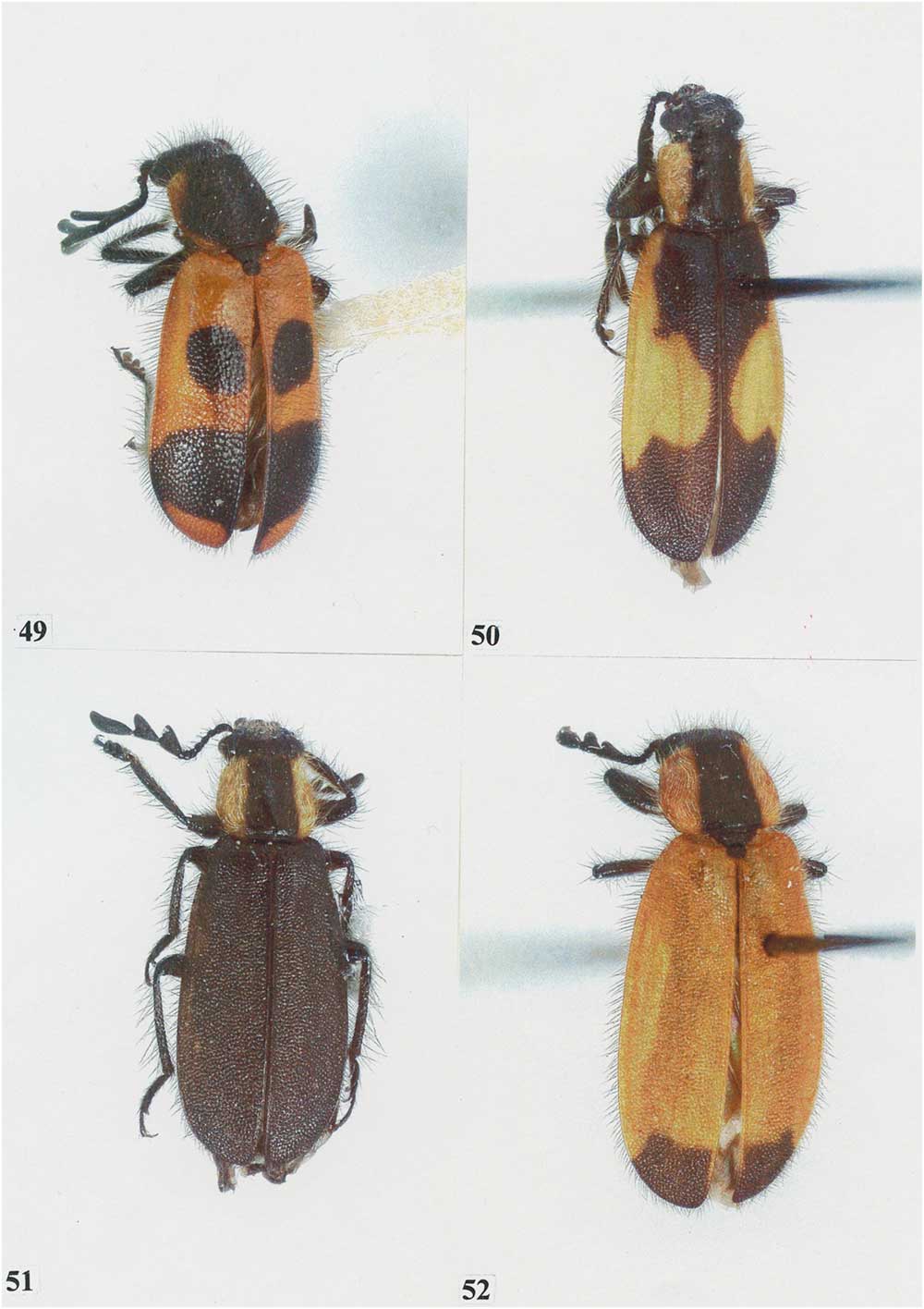
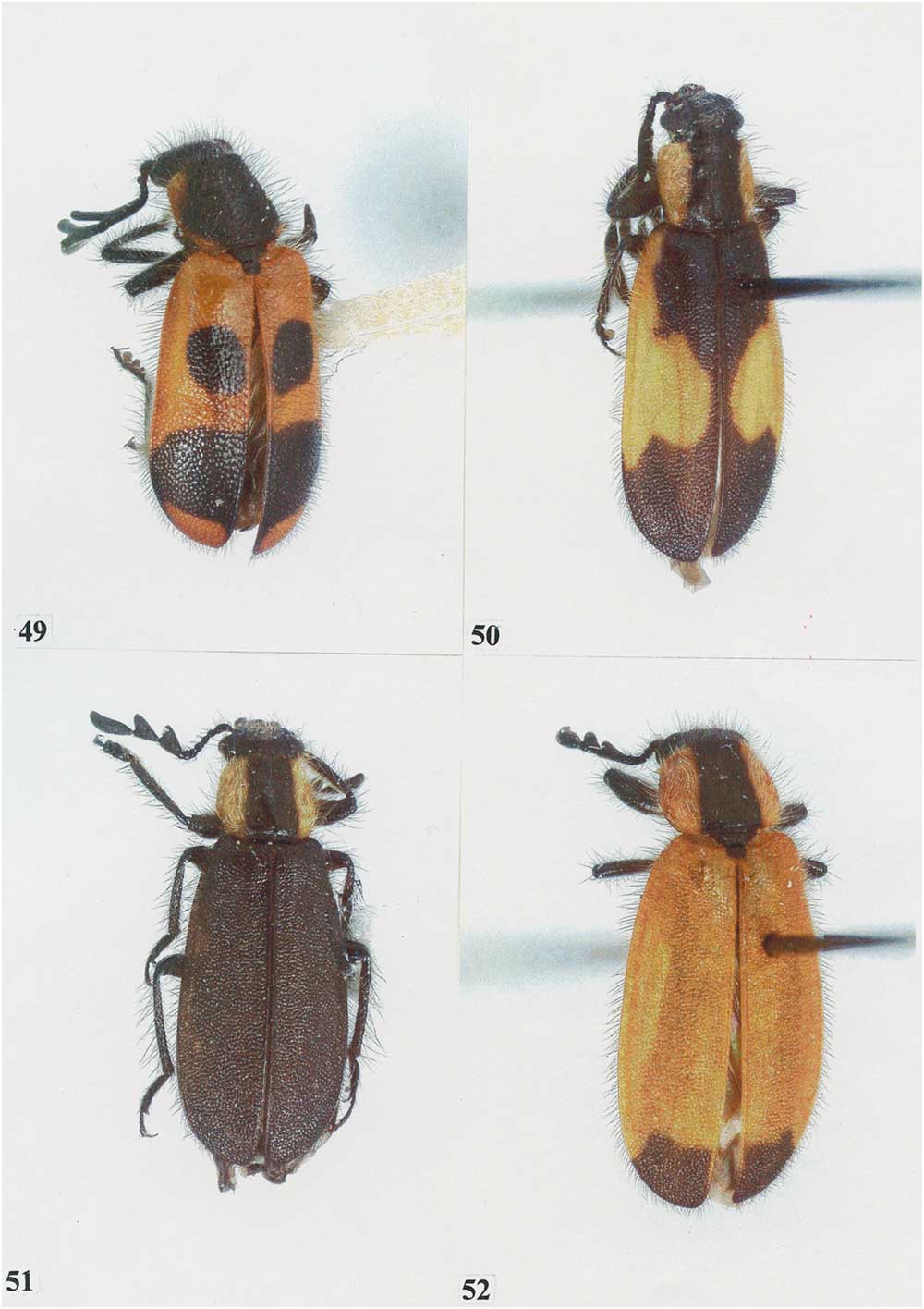
Variation. Size: Length 5.0–9.0 mm; width 2.0–3.8 mm. The antenna is sexually dimorphic compare Figs. 16, 17. Rarely is the cranium partially red, and only in specimens that have the elytra completely red. There is considerable variation in integumental colour. The range of this variation is depicted in Figs. 50–53.
Natural history. Specimens have been collected from the southwestern United States of America from May to August from 1000 to 2000 m. The predominant collecting technique is beating leaves of Condalia, Quercus Linnaeus (Fagaceae), shrub of Ziziphus, mimosa, the desert hackberry C. pallida, and branches of the deciduous tree S. drummondii. Some specimens were collected in an oak/pine/juniper forest.
Distribution (Fig. 61). This species is known from southwestern United States of America south to Honduras.
Material examined. 273 specimens from: United States of America: New Mexico: Catron County, Mogollon Mountains, 4-VII-1969, K. Stephan: Lea County, 28-V-1979, D.R. Delorme and H.L. Carrola: Eddy County, V-1991, R. Morris: Arizona: Coconino County Oak creek Canyon, -VIII-, 1829 m, F.N. Snow; Gila County, 16 km S Globe, Pinal Mountains, 10-VII-1948, M.A. Cazier; Gila County, 27-VII-1947, F.H. Parker; Gila County, 10-VII-1945, on oak, F.H. Parker; Gila County, 10-VII-45, F.H. Parker; 10-VII-45; F.H. Parker; Gila County, 10-VII-1945, on oak, F.H. Parker; Gila County, 10-VII-45, F.H. Parker; Gila County, 10-VII-1948, Quercus, F.H. Parker: Pinal County, Pinal Mountains, 28-VII-1944, F.H. Parker; Grand Canyon National Park, Indian Garden, 12-VII-1948, M. Cazier; Pinal County, Globe, 15-VII-1948, Ziziphus, F.H. Parker; Pinal County, 15-VII-1948, F.H. Parker: Santa Cruz County, Patagonia, 18-VII-1948, C. and P. Vaurie; Santa Cruz County, 3-VI-1962, D.J. and J.N. Knull; Nogales, 29-VII-1955, D.J. and J.N. Knull; Walker Canyon, 17-VI-2001, F.T. Hovore; Pena Blanca Lake, 16-VII-78, C. Bellamy: Pima County, Santa Rita Mountains, Box Canyon, 19-VII-1971, P.H. Sullivan: Gila County, Globe, 26-VII-1948, Ziziphus, F.H. Parker; Cochise County, Montezuma Pass, Huachuca Mountains, 15-VII-2013, 1995 m, G.S. Powell; 16 km NW Bisbee, 21-VII-1971, J.E. Wappes; 9.6 km W Douglas, US 80, 28-VII-1948; Cochise County, Huachuca Mountains, 5354 Ash Canyon Road, 0.8 km W Highway 92, 10-VII-1992, N. McFarland; Huachuca Mountains, 5354 Ash Canyon Road, 0.8 km W Highway 92, 10-VII-1992, N. McFarland; Carr Peak Road, 15-VII-1980, F. Hovore, Cochise County, Carr Canyon Road, 26–27-VII-1979, E. Giesbert; Cochise County, Huachuca Mountains, Miller Canyon, 19-VII-1963, G.H. Nelson; Cochise County, Huachuca Mountains, Copper Canyon W of Montezuma Pass, 21-VII-1963, G.H. Nelson; Copper Canyon, Huachuca Mountains, 25-VII-84, W.F. Barr; Huachuca Mountains, Miller Canyon, 19-VII-1969, G.H. Nelson and D.E. Nelson; Gila County, 16 km S Globe, Pinal Mountains, 31-VII-1949, F.H. Parker; S Graham Mountains, 1563 m, 20-VII-1974, K. Stephan; Portal, Chiricahua Mountains, 31-VII-1975, Mimosa, G.H. Nelson; Gila County, 29-VII-1955 D.J. and J.N. Knull; Gila County,19-VII-1952, D.J. and J.N. Knull; Greenlee County, 8–16 km S Hannagan Meadow, 2187–2813 m, 28-VII-1982, J.E. Wappes; Highway US 666, 16 km N Clifton, 29-1982, N.M. Downie: Coconino County, Oak Creek Canyon, 25-VII-36, O. Bryon; Hualapai Mountain, 3-VII-1934, D.J. and J.N. Knull; Oracle Junction, 26-VII-1948, mesquite area, F. Werner. Texas: Hudspeth County, 3.2 km N Dell City, 31-VII-1950, R.F. Smith; Jeff Davis County, 12-VII-1950, D.J. and J.N. Knull; Davis Mountains, 3-VII-1955, D.J. and J.N. Knull; 6.4 km SE of Ft. Davis, Highway 118, 19-VI-1963, G.H. Nelson and D.E. Nelson; W Davis Mountains, 19.3 km W junction highways 166 and 505, 28-VI-1987, C.L. Bellamy; 18.2 km W Ft. Davis, Highway 166 picnic area, 18-VI-2003, on foliage S. drummondii, T.C MacRae; 18.2 km W Ft. Davis, Highway 166 picnic area, 20-VI-2003, on foliage S. drummondii, T.C MacRae; 18.2 km W Ft. Davis, Highway 166 picnic area, 18-VI-2003, on foliage S. drummondii, T.C MacRae; Jeff Davis County, N of Fort Davis, Limpia Canyon, 29-VI-1971, on S. drummondii, G.H. Nelson; Jeff Davis County, 4-VII-1957, D.J. and J.N. Knull; Davis Mountains, 28-VI-1961, D.J. and J.N. Knull; 3.2 km NW Ft. Davis, Highway 118, 17-VI-1965, G.H. Nelson; Davis Mountains State Park, Limpia Canyon Primitive Area, 1–17-VIII-2002, dead branch of C. reticulata, T.C. MacRae; 6.4 km SE Ft. Davis, Highway 118; 19-VI-1963, G.H. and D.E. Nelson; Limpia Canyon, 30-VI-1971, G.H. Nelson; 6.4 km SE Ft. Davis, Highway 118, 19-VI-1963, Quercus, G.H. and D.E. Nelson; N of Ft. Davis, Highway 118, 6-VII-1963, Celtis, G.H. Nelson; Davis Mountains State Park, 25-VI-1999, Condalia, G.H. Nelson; Potter County, Lake Meredith, McBride Canyon, 1-VI-1971, C.W. O’Brien: Cameron County, Sabal Palm Grove, Audubon Reserve, 9-X-1977, N.M. Downie; Victoria County, Victoria, 5-VIII-1918, J.D. Mitchell. Mexico: Sonora: Minas Nuevas, 7-VIII-1952, C. and P. Vaurie; 17.6 km NW Yecora, 262 km Highway 16, 26-VII-2009, beating, 1759 m, oak/pine/juniper, J. Rifkind, C.L. Bellamy, B. Streit: Chihuahua: 3.2 km W Matachic, 2000 m, 7-VII-1947, D. Rockefeller; Santa Barbara District, Santa Barbara, 2344 m, 18-VII-1947, D. Rockefeller; Chihuahua: 27-VII-1953, D.J. and J.N. Knull; Chihuahua: 7-VIII-1959, D.J. and J.N. Knull; Chihuahua: 27-VII-1969, D.J. and J.N. Knull; Maguarichic, 13-VII-1960, S.L. Wood and J.B. Karren. Durango: 16 km W Durango, 2343.75 m, 15-VI-1964, W.C. McGuffin; Durango: 16 km W Durango, 12-VII-1954, J.W. MacSwain. Jalisco: Nayarit state line, 21-VI-1967, A.R. Hardy; Durango: 4.5 km SE Cuautla, 29-VI-1995, 1610 m, R.L. Westcott. Oaxaca: 11.2–12.8 km E Mitia, 1937.5 m, 3–9-VII-1994, E. Geisbert; 14 km ESE El Camaron, 6-VII-2001, 1265 m, R.L. Westcott. Chiapas: 17 km W Tuxtla Gutierrez, 1032 m, 21–25-VI-1987, E. Geisbert. Puebla: 12 km NW Tehuitzingo, Puerto del Gato, 11-VII-1999, 1220 m, R.L. Westcott; vicinity Tecuitlapa, 13-VII-2001, 2425 m, R.L. Westcott. Sinaloa: 25.7 km S Mazatlan, 26-VI-64, D.S. Verity. Guatemala: Zacapa: 12–14 km S San Lorenzo, 3–6-VI-1989, 3.05–6.05 m, J.E. Wappes. Guatemala: 112 km E Guatemala City, 8-V-1947, R.R. Miller. Honduras: El Paraiso: vic Yuscaran, 18-V-1995, J.E. Wappes. Francisco Morazon: 13 km S El Tigra, 19-V-1995, J.E. Wappes; 5 km E Escuela Agricola Panamericana, 2-VI-1993, M.C. Thomas; 23.8 km SSW Telanga, 3-VI-1993, R. Turnbow.
Specimens are deposited in AMNH, FSCA, GSPC, JEWC, JNRC, TAMU, WFBM, and WOPC.
Pelonides quadripunctata (Say)
Figs. 1–13, 23–28, 32, 38, 45, 46, 62.
Mesodermal reproductive organs of Pelonides quadripunctata (23. male, 24. female).
Various structures of Pelonides quadripunctata. 25–26. Head (25. frontal view, 26. ventral view). 27. Antenna. 28. Elytral disc (most setae missing).
Habitus photographs. 29. Pelonides floripennis. 30. Pelonides granulatipennis. 31. Pelonides humeralis. 32. Pelonides quadripunctata.
Enoplium quadripunctatum Say, Reference Say1823: 188. Lectotype ♀ (MCZC). Here designated. Type locality: United States of America. Say Reference Say1828: 90. Klug Reference Klug1842: 367 (Enoplium). Spinola Reference Spinola1844: 347 (Pelonium). LeConte Reference LeConte1849: 31 (Enoplium); Reference LeConte1863: 56 (Enoplium). Desmarest Reference Desmarest1852: 259 (Enoplium). Gemminger and Harold Reference Gemminger and Harold1869: 1756 (Enoplium). Chevrolat Reference Chevrolat1874: 328 (Pelonium). Kuwert Reference Kuwert1894: 8 (Pelonides). Schaeffer Reference Schaeffer1904: 221 (Enoplium). Schenkling Reference Schenkling1906: 317 (Enoplium). Wolcott Reference Wolcott1910a: 382 (Pyticara); 1910b: 860 (Pyticara); 1920: 151 (Pelonides); 1947: 85 (Pelonides). Champlain Reference Champlain1920: 639 (Enoplium). Corporaal Reference Corporaal1950: 275 (Pyticara). Knull Reference Knull1951: 306 (Pelonides). Barr Reference Barr1980: 280 (Pelonides). Opitz Reference Opitz2002: 279 (Pelonides).
Diagnosis. Specimens of this species resemble those of P. quadrinotata (Haldeman). However, in P. quadripunctata (Say) specimens the collateral branches on antennomeres 8 and 9 are less pronounced (compare Figs. 1, 14) and the tegminal lobes are obtuse, not acuminate as they are in P. quadrinotata. Also, the forebody (head and prothorax) is completely black in the members of this species.
Description. Size: Length 5.5 mm; width 2.2 mm. Form: As in Fig. 32. Integument: Cranium, mouthparts, antenna, prothorax, legs, mesoscutellum, and sternum black; elytral disc mostly red, with four black maculae. Head: Cranium finely punctate, interstitial spaces smooth and shiny. Eyes narrower than frons (20:35), small; ommatidia small. Capitular antennomeres 8 and 9 with collateral branches (Fig. 1). Thorax: Pronotum transverse (80:72), coarsely punctate at sides, mostly smooth and shiny at middle; interstitial spaces smooth and shiny, sides arcuate. Elytral disc covered profusely with small setiferous punctures, interstitial large, spaces smooth and shiny. Epipleural fold gradually narrowed to elytral apex, asetiferous punctures absent, primary setae absent. Abdomen: Pygidium, 6th male visible abdominal sternum, tegmen, phallus, and spicular fork as in Fig. 38.
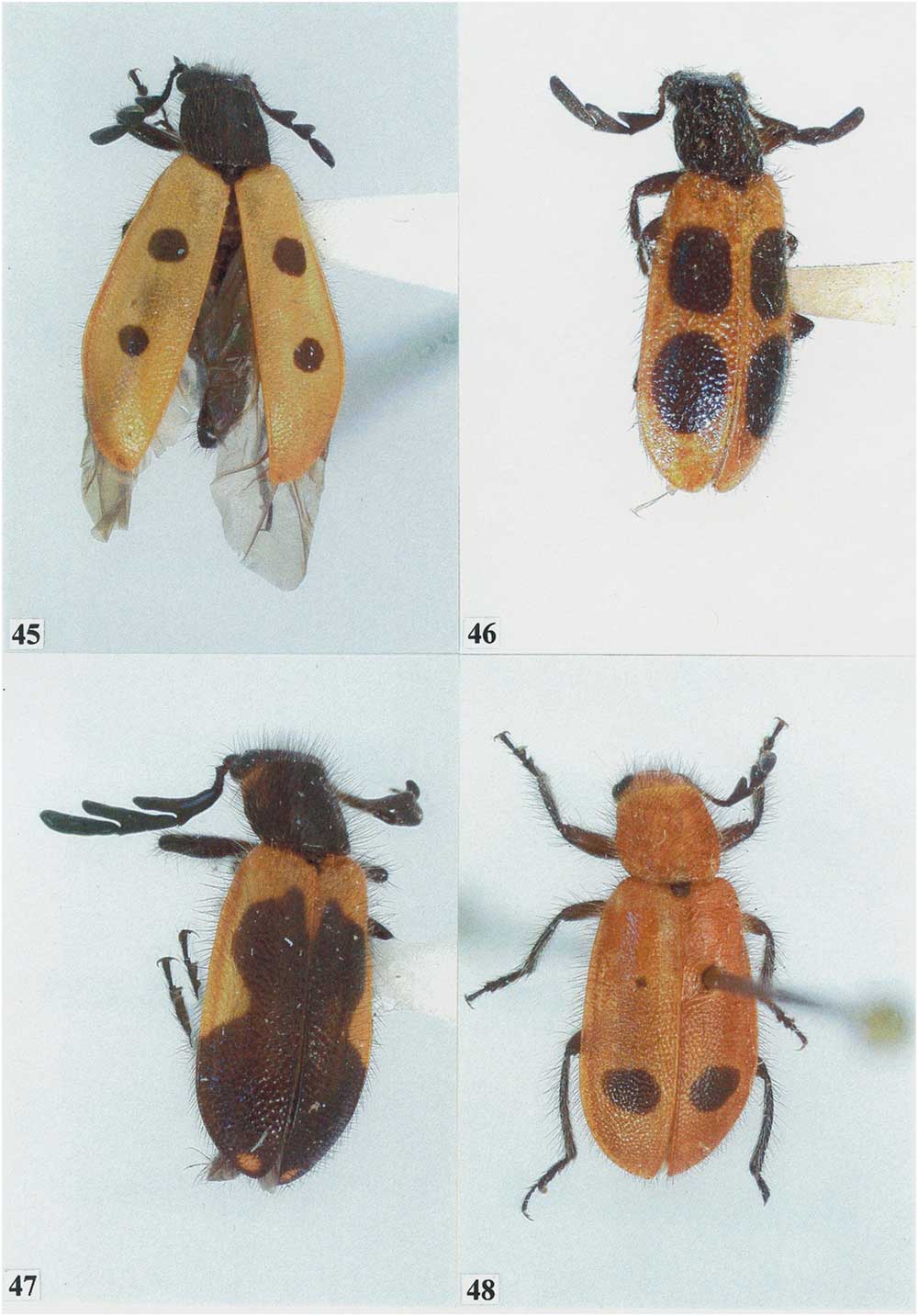
Variation. Size: Length 4.5–8.0 mm; width 1.8–3.5 mm. The antenna is sexually dimorphic (compare Figs. 1, 2), and there is some variation in the size of the elytral disc black spots. In a few specimens the ground colour of the elytral disc is more yellowish than red.
Natural history. Specimens were collected from March through June. Ed Riley collected these beetles by beating shrubs of the parsley hawthorn genus Crataegus Linnaeus (Rosaceae). Some specimens were taken from pear trees. Two specimens were collected on black cherry.
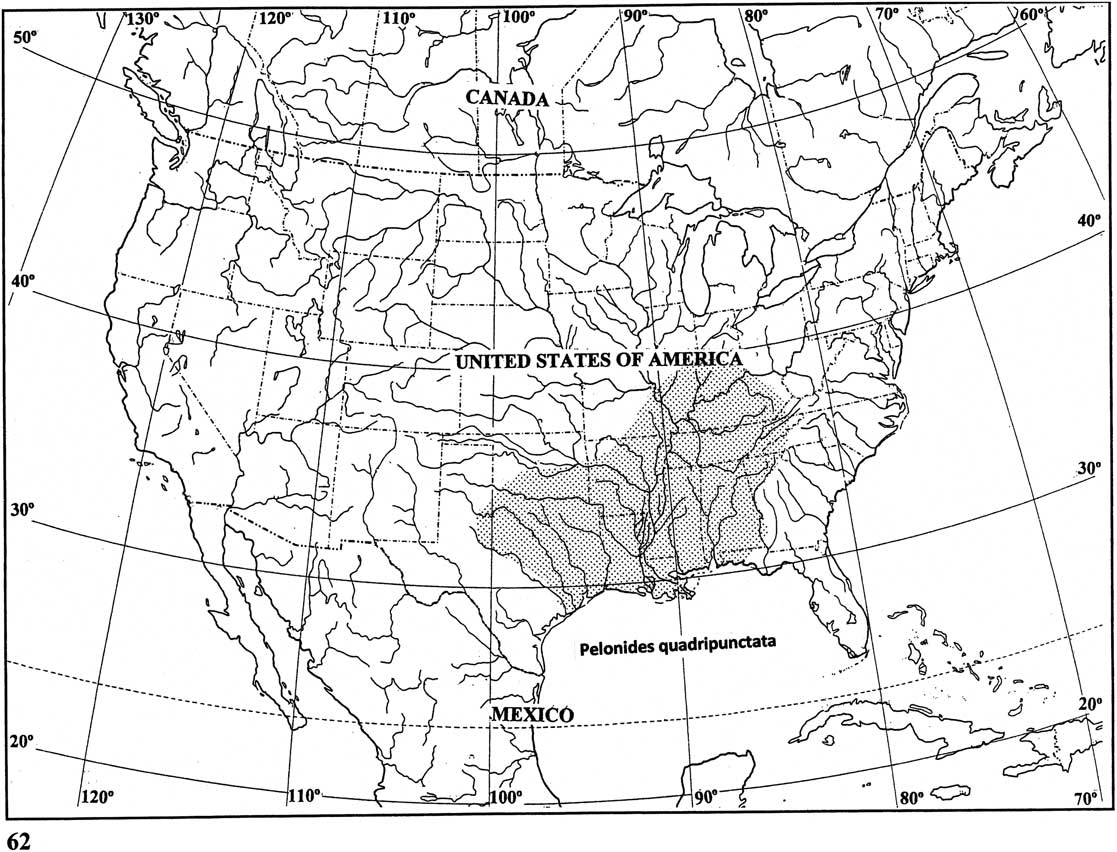
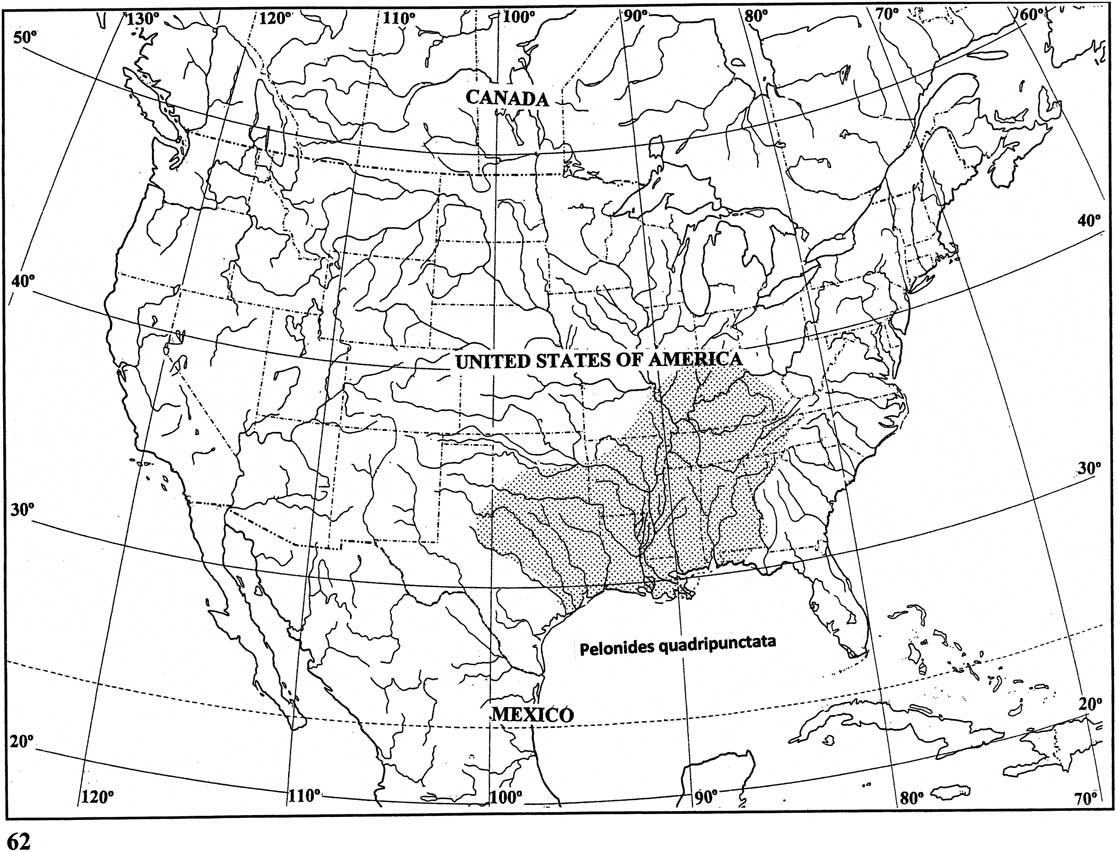
Distribution (Fig. 62). This species is known from Illinois to Texas, United States of America.
Material examined. 270 specimens: United States of America: Ohio: Green County, 16-V-1955, D.J. and J.N. Knull; Green County, 25-V-1953, D.J. and J.N. Knull; Green County, 20-V-1958, D.J. and J.N. Knull; Green County, 7-VI-1971, D.J. and J.N. Knull. Arkansas: Hempstead County, Rick Evans Grandview Prairie, 33°48'42''N 93°46'07''W, Wildlife Management Area, 62 km SW Ozan, 14-IV-2008, J.J. Dorshorst. Illinois: Clark County, Rocky Branch Creek, N Clarksville, 1-V-1990, P.E. Skelley and M. Goodrich. Indiana: Brown County, -VI-1960, N.M. Downie; Anderson County, Clemson College, 14-IV-1934, O.L. Cartwright: Brown County, Bear Wallow, 8-VI-1964, C.E. White; Anderson County, 12-VI-1966, C.E. White; Anderson County, 6-VI-1967, C.E. White: Anderson County, 8-VI-1969, N.M. Downie; Anderson County, 8-VI-1965, N.M. Downie; Anderson County, 12-VI-1966, N.M. Downey; Anderson County, 9-VI-1967, N.M. Downie; Anderson County, 8-VI-1970, N.M. Downie; Anderson County, 13-VI-1971, N. Downie; Anderson County, VI-1973, N.M. Downie; Anderson County, 9-VI-1987, N.M. Downie. Louisiana: Saint Landry Parish, Apelousas, 18-III-1908, R.A. Cushman. Missouri: Carter County, Ozark National Scenic Riverway, Big Spring Campground, 15–22-IV-2001, fallen branch of B. nigra, T.C. MacRae. Kentucky: Simpson County, I-75 rest area, 24-IV-1982, R.M. Brattain. Oklahoma: Oklahoma County, Luther, 26-IV-1993, black cherry, C. Harp; Latimer County, V-1982, K. Stephan; Latimer County, IV-1983, K Stephan; Latimer County, IV-1984, K. Stephan; Latimer County, IV-1986, K. Stephan; Latimer County, IV-1987, K. Stephan; Latimer County, IV-1988, K. Stephan; Latimer County, IV-1989, K. Stephan; Latimer County, IV-1994, K. Stephan: Le Flore County, Page, 13-IV-1965, G.F. Hevel. Mississippi: Oxford, 28-III-1949, Pyrus, H.V. Weems; Alabama: Dale County, Ft. Rucker Military Reserve, 20-IV-1983, R. Turnbow: Jefferson County, Birmingham (Mountain Brook), 27-VI-1982, T. King. Texas: Greene County, 13-30-V-1963, D.J. and J.N. Knull; Greene County, 24 km E Nacogdoches, 7-IV-1968, H.R. Burke: Brazos County, College Station, 12-III-1918; Brazos County, 13-III-1918; Brazos County, 24-III-1920; Brazos County, 20-III-1928, F.F. Bibby; Brazos County, 32-III-1928; Brazos County, 21-IV-1930, R.K. Fletcher; Brazos County, 24-IV-1930, R.K. Fletcher; Brazos County, 4-IV-1932, H.J. Reinhard; Brazos County, 7-IV-1932, H.J. Reinhard; Brazos County, 29-III-1933, H.J. Reinhard; Brazos County, 1-IV-1933, H.J. Reinhard; Koppe Bridge, 12-IV-1968, J.C. Schaffner; Brazos County, College Station, 25-III-1971, Crataegus, R.S. Peigler; Brazos County, College Station, 12-IV-1981, R. Turnbow; Brazos County, 14-IV-1981, R. Turnbow; Brazos County, 20-III-1982; Brazos County, 3-IV-1982, R. Turnbow; Brazos County, 5-IV-1982, R. Turnbow; Brazos County, 8-IV-1982, R. Turnbow; Brazos County, 11-IV-1982, R. Turnbow; Brazos County, 18-III-1990, S.G. Wellso; Brazos County, College Station, Riley Estate, 19-III-2006, E. Riley; Brazos County, 22-III-2007, E. Riley; Brazos County, San Bernard National Wildlife Refuge, Palm Unit, 8 km S Sweeny, 30-III-2007, E.G. Riley; Brazos County,10-V-1935, T. Dobson; Leon County, 16-III-1952, D.J. and J.N. Knull: Tarrant County, Lake Worth National Center, 11-V-1980, C.S. Wolfe; Tarrant County, Lake Worth National Center, 9-V-1982, C.S. Wolfe: Grimes County, 1.6–6.4 km W Plantersville, 11-IV-1982, Crataegus, R. Turnbow; Tarrant County, 17.6 km E Navasota, 21–24-III-1986, J.E. Wappes; Tarrant County, 17.6 km E Navasota, 30-III-1986, J.E. Wappes; Tarrant County, 1.6 km E Plantersville, 9-IV-1988; D.J. Heffern; Tarrant County, 1.6 km NW Stoneham, 4-IV-2003, D.J. Heffern: Montgomery County, Dobbin, 8-IV-1980, N.M. Downey; Montgomery County, 8 km E Plantsville, 28–30-III-1986, J.E. Wappes: Harrison County, 25-V-1950, D.J. and J.N. Knull; Harrison County, 16 km SW Marshall, Highway 43, 28-III-1987, parsley/hawthorn, beating: Harris County, W Houston airport, III-1992, D.J. Heffern; Harris County, 10-III-1993, D.J. Heffern; Bastrop County, Bastrop, 16-IV-1997, S.G. Wellso; Bastrop County, 2.4 km W junction Highway 21 on Highway 290, 15-IV-2007, E.G. and M.L. Riley: Fort Bend County, Brazos Bend State Park, 11-III-2000, E.G. Riley; Fort Bend County, Brazos Bend State Park, Hale Road, 6-IV-2001, D.J. Heffern; Fort Bend County, Brazos Bend State Park, 4-IV-2004, E. Riley and B. Raber; Austin County, 8 km SSW Kenney, 8-IV-2001, J.C. Schaffner; Austin County, 1-VI-1954, D.J. and J.N. Knull; Ellis County, Red Oak, Red Oak Cemetery, 15-IV-2004, J.C. Schaffner: Cameron County, Brownsville, 11-VI-1906; Colorado County, 11-IV-1922, Grace Wiley; Brazoria County, Angleton, VI-1902; Bowie County, Maud, 29-VI-1941, D.J. and J.N. Knull: Victoria County, 4.8 km S Inez, 6-V-1978, J.E. Wappes; Dallas County, Dallas, Hubbard, and Schwartz.
Specimens are deposited in AMNH, FSCA, JJDC, JNRC, RHTC, TAMU, USNM, and WOPC.
Notes: A historical account of the Say collection was published by Mawdsley (Reference Mawdsley1993). It is noteworthy to indicate that Wolcott (Reference Wolcott1910a) was the first to cast some doubt as to the conspecificity between E. quadripunctatum Say and E. quadrinotatum Haldeman. As he states “for the convenience of collectors, however, it is deemed expedient to use the name proposed by Haldeman for the variety (of P. quadripunctatum Say), which has the head a prothorax wholly or in part red”. The distinction between the two nominal species in question eluded Wolcott, “The writer has sought in vain for characters, other than the very feeble and variable one of color, to distinguish these species”. In fact, the completely black colour of the forebody of P. quadripunctata (Say) is a very reliable trait for diagnosing this species. Moreover, the collateral branches of antennomeres 8 and 9 are longer in P. quadrinotata than in quadripunctata, and the apices of the tegminal lobes are acuminate in P. quadrinotata and obtuse in P. quadripunctata.
Pelonides quadrinotata (Haldeman)
Enoplium quadrinotatum Haldeman, Reference Haldeman1853: 362. Holotype ♀ (ANSP). Type locality: Texas. LeConte Reference LeConte1863: 56 (Enoplium). Gemminger and Harold Reference Gemminger and Harold1869: 1756 (Enoplium). Schaeffer Reference Schaeffer1904: 221. Schenkling Reference Schenkling1906: 317 (Enoplium). Wolcott Reference Wolcott1909: 102 (Enoplium); 1910a: 381 (Pyticara); 1920: 151 (Pelonides); 1947: 85 (Pelonides). Corporaal Reference Corporaal1950: 275 (Pyticara). Knull Reference Knull1951: 306 (Pelonides). Barr Reference Barr1980: 280 (Pelonides).
Diagnosis. Specimens of this species resemble those of P. quadripuntata (Say). However, in P. quadrinotata specimens the collateral branches on antennomeres 8 and 9 are more pronounced (compare Figs. 14, 1) and the tegminal lobes are acuminate.
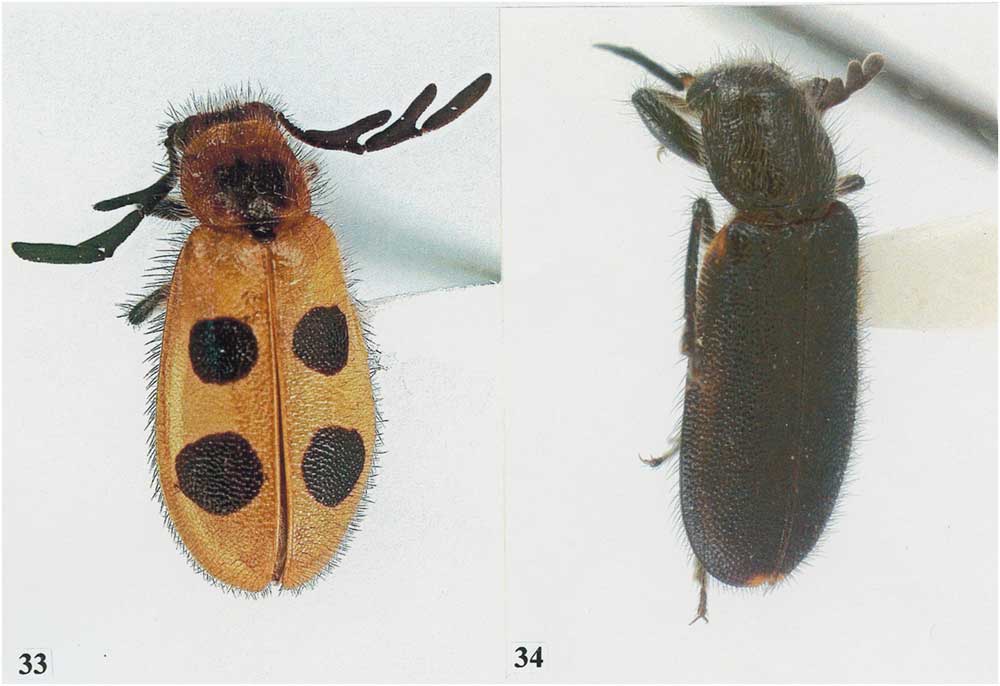
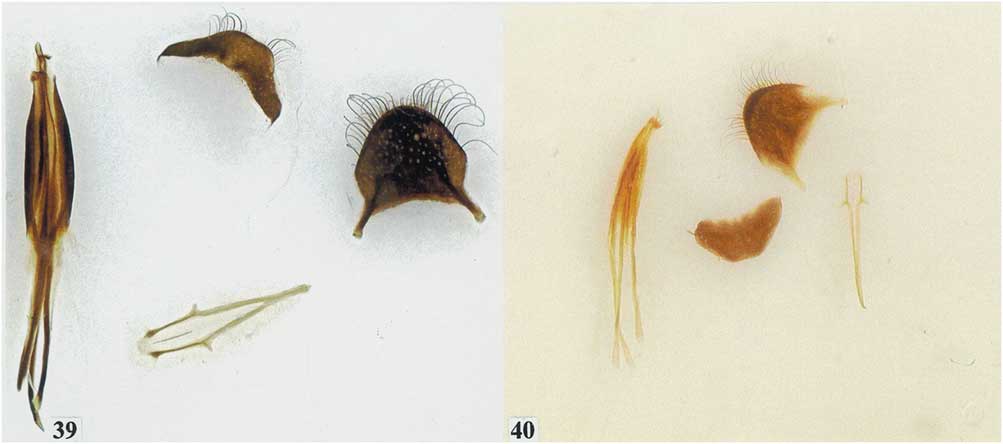
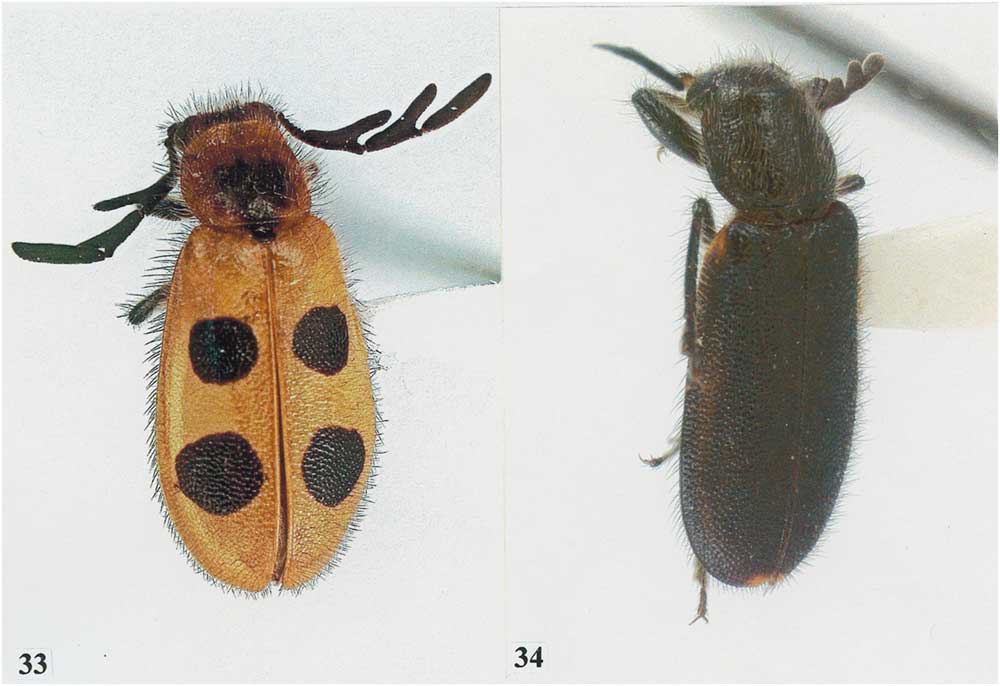
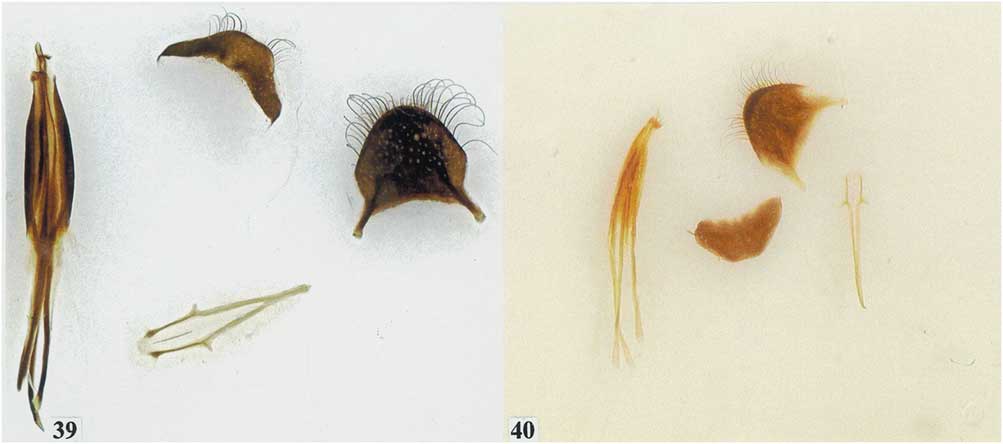
Description. Size: Length 8.0 mm; width 3.0 mm. Form: As in Fig. 33. Integument: Cranium bicolourous, upper frons and epicranium black, yellow-red in remainder; antenna, black; prothorax mostly yellow-red, broadly black at centre of pronotal disc; legs, mesoscutellum, pterothorax, and abdomen black; elytral disc mostly red, with four black maculae. Head: Cranium finely punctate, interstitial spaces smooth and shiny. Eyes narrower than frons (25:43), small; ommatidia small. Capitular antennomeres 8 and 9 with long collateral branches (Figs. 14, 15). Thorax: Pronotum slightly transverse (115:100), coarsely punctate at sides, punctures smaller at pronotal disc; interstitial spaces wide, smooth and shiny at middle, sides arcuate. Elytral disc covered profusely with small setiferous punctures, interstitial spaces smooth and shiny. Epipleural fold gradually narrowed to elytral apex, asetiferous punctures absent, primary setae absent. Abdomen: Pygidium, 6th male visible abdominal sternum, tegmen, phallus, and spicular fork as in Fig. 39.
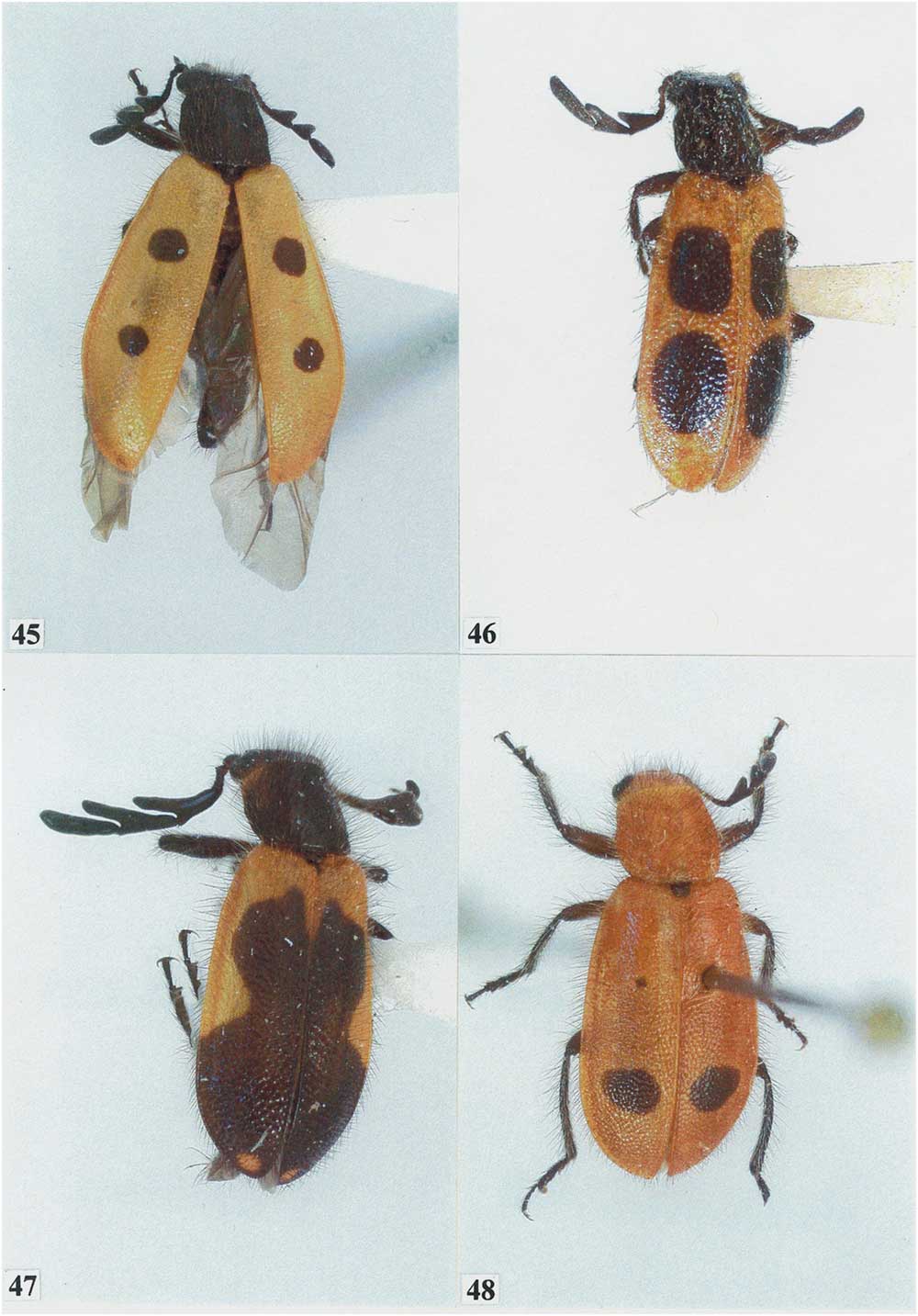
Variation. Size: Length 4.3–8.0 mm; width 1.7–4.0 mm. The antenna is sexually dimorphic (compare Figs. 14, 15). There is variation in the size of the elytral disc black spots to an extent that in some specimens, particularly from Oklahoma, the elytral spots are confluent and occupy most of the elytral disc. The range of variation in elytral colour is depicted in Figs 47–49.
Natural history. Specimens were collected from March through May. Some specimens were collected on the monocot bloom of Allium, others on Asclepias, Ceanothus, and Quercus. Two specimens were collected on Apocynum.
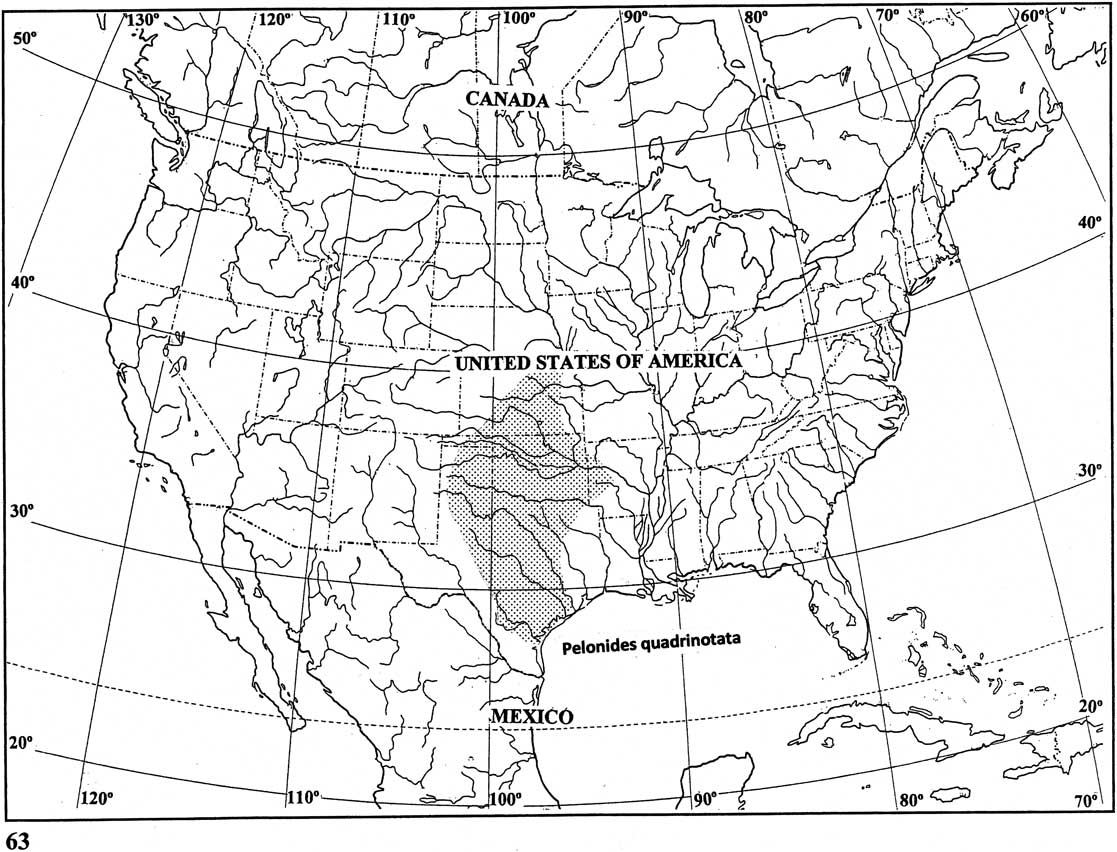
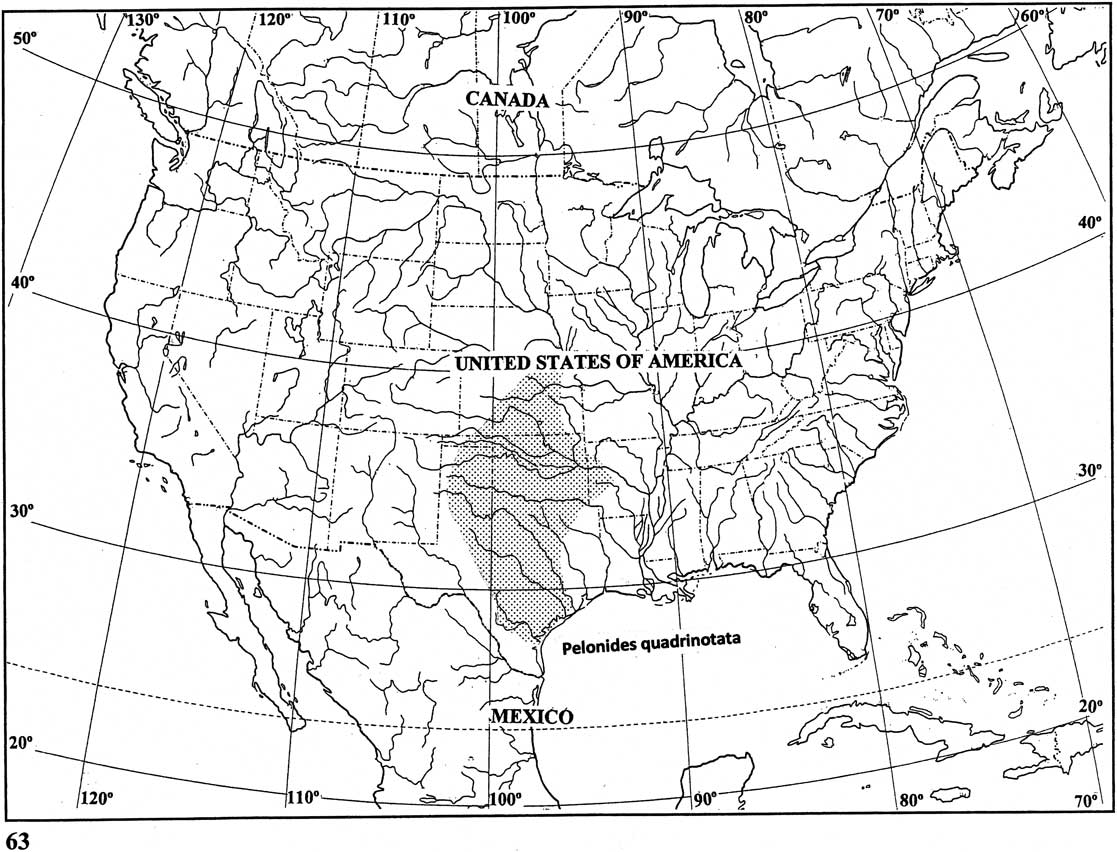
Distribution (Figs. 63). This species is known from Kansas to Texas, United States of America.
Material examined. 312 specimens from: United States of America: Kansas: 9.6 km SW Yates Center, 21-V-1965, on Allium, H. Willis. Oklahoma: Oklahoma County, Luther, 15-V-1992, hickory/oak forest, on Apocynum, C. Harp; Tulsa County, Tulsa, 12-V-1940, E.K. Waering; Creek County, 9.6 km W Mannford, 13-V-1971, on Asclepias, D.C. Arnold; Payne County, 20.8 km E Stillwater, 23-V-1979, D.C. Arnold; Osage County, W Bartlesville, 25-V-1981, P. Burnham; Latimer County, 8 km W Red Oak, IV-1982, K. Stephan; Latimer County, V-1982, K. Stephan; Latimer County, V-1983, K. Stephan; Latimer County, V-1984, K. Stephan; Latimer County, VI-1984, K. Stephan; Latimer County, IV-1985, Ceanothus, K. Stephan; Latimer County, IV-1986, K. Stephan; Latimer County, V-1986, K. Stephan; Latimer County, IV-1987, K. Stephan; Latimer County, IV-1988, K. Stephan; Latimer County, V-1988, K. Stephan; Latimer County, IV-1989, K. Stephan; Latimer County, IV-1991, K. Stephan; Latimer County, IV-1992, K. Stephan; Latimer County, V-1993, K. Stephan; Latimer County, IV-1994, K. Stephan; Latimer County, 8 km W Red Oak, V-1981, K. Stephan; Latimer County, 8 km W Red Oak, IV-1979, K.H. Stephan; Latimer County, IV-1982, K. Stephan; Latimer County, IV-1982, K. Stephan: Le Flore County, 3.2 km NE Cameron, 12-IV-1988, W.F Barr: Pittsburg County, Crowder (lakeside park) 34º06'N, 95º41'W, 2-V-2004, E.G. Riley. Texas: Brooks County, 9 km S Encino, 16-IV-1979, J.E. Wappes: Karnes County, Ecieto, Metz Ranch, 22-IV-1997, J.E. Wappes; Fayette County, Lexington, 10-V-1918, G. Birkmann; Burnett County, no collection date, Hubbard and Schwartz; McMullen County, 14 km W Three Rivers, 11-V-1978; Uvalde County, Concan, IV-1923, W.F. Chamberlain; 4-V-1941, D.J. and J.N. Knull: Bastrop County, Bastrop State Park, 5-V-1968, J.C. Schaffner; Bexar County, Fort Sam Houston, 20-III-1953, M. Wasbauer; Bexar County, Fort Sam Houston, 24-III-1953, M. Wasbauer; Bexar County, Fort Sam Houston, 2-IV-1953, M. Wasbauer; Brazos County, 8 km SW College Station, 11-IV-1981, R. Turnbow; Brazos County, College Station, 17-IV-1932, H.J. Reinherd; Brazos County, 19-IV-1932, H.J. Reinherd; Brazos County, 30-IV-1943, H.J. Reinherd; Brazos County, 2-V-1943, H.J. Reinherd; Brazos County, “Koppe Bridge”, 12-IV-1968, J.C. Schaffner; Brazos County, College Station, 29-IV-1964, J.C. Schaffner; Brazos County, College Station, 30-IV-1964, J.C. Schaffner; Brazos County, College Station, 24-IV-1943, H.J. Reinhard; Brazos County, College Station, 29-IV-1964, J.C. Schaffner; Brazos County, 30-IV-1964, J.C. Shaffner; Brazos County, Bryan, 8-IV-1965, J.C. Shaffner; Gillespie County, 5-IV-1953: Burnet County, 4-V-1953, D.J. and J.N. Knull; Longhorn Cavern State Park, 25-IV-1965, J.C. Shaffner; Lake State Park, 10-V-1970, J.C. Schaffner; Inks Lake State Park, 13-IV-1985, P.W. Kovarik, R.W. Jones, and C.W. Agnew; Gonzales County, Palmetto State Park, 19-IV-1970, V.V. Board; Bosque County, 4.8 km E Iredell, 8-V-1970, J.W. Smith; 4.8 km S Walnut Springs, 2-V-1975, J.C. Shaffner; Bosque County, 3.2 km S Walnut Springs, 4-V-1973, J.C. Schaffner; Dimmit County, Chaparral Wildlife Management Area, 10–14-IX-1977, T. Friedlander; Sandy Creek, 24 km S Lano, 14-IV-1979, W.F. Chamberlain; Tarrant County, Lake Worth National Center, 4-V-1980, C.S. Wolfe; Tarrant County, 10-IV-1981, C.S. Wolfe; Tarrant County, 12-IV-1981, C.S. Wolfe; Tarrant County, Lake Worth National Center, 4-V-1982, C.S. Wolfe; Palo Pinto County, 5.7 km S Palo Pinto, 18-IV-1981, flower, C.S. Wolfe; Palo Pinto County, 25-IV-1981, flower, C.S. Wolfe; Burleson County, Lake Somerville edge, 11-IV-1982, T.P.L.G. Friedlander and J. Lammars; Kimble County, 8 km W Harper, 29-IV-1983, J.C. Schaffner; Junction, 29–30-IV-1983, J.C. Shaffner; Junction, overlook area, 30°28', 99°45', 10-IV-2002, E.G. Riley; Kenedy County, 40 km S Kingsville, 20-IV-1974, J.C. Schaffner; McMullen County, Frio River, 8 km N of State Highway 72, 30-III-1986, S.J. Hanselmann; Travis County, vicinity Long Hollow Creek, 30°27', 97°52', 9-IV-1993, Q. virginiana, Alexander, Quinn, Riley, Wharton et al.; 28.8 km S Lano, 25-IV-1993, W.F. Chamberlain; Brown County, Lake Brownwood State Park, 29-IV-1995, E.G. Riley; Val Verde County, 21.6 km N Comstock, 26-III-1999, E.G. Riley; Brazos County, Bryan, 26-III-2000, J. Crissey; Eastland County, 4-IV-1921, G.O. Wiley; Comal County, 3-IV-1953, D.J. and J.N. Knull; New Braunfels, V-1926, Mittendorf; Gillespie County, 5-IV-1953, D.J. and J.N. Knull; Nueces County, Corpus Christi, 22-III-1954, D.J. and J.N. Knull; Lake Corpus Christi, 3-III-1961, D.J. and J.N. Knull; Jeff Davis County, Davis Mountains, 19-VI-1958, D.J. and J.N. Knull; Lee County, IV-1912, G. Birkman; Liano County 13-IV-1963, D.J. and J.N. Knull.
Specimens are deposited in AMNH, FSCA, TAMU, WFBM, and WOPC.
Notes. The description is not based on a type specimen.
Pelonides scabripennis (LeConte)
Figs. 20, 22, 34, 40, 54–58, 61.
Habitus photographs. 33. Pelonides quadrinotata. 34. Pelonides scabripennis.
Enoplium scabripenne LeConte, Reference LeConte1866: 98. Holotype ♀ (MCZC). Type locality: Cape San Lucas, Baja California. Paratypes. None. Gemminger and Harold Reference Gemminger and Harold1869: 1756 (Enoplium). Wolcott Reference Wolcott1920: 151 (Pelonides); 1947: 85 (Pelonides). Blackwelder Reference Blackwelder1945: 389 (Pelonides). Barr Reference Barr1950: 513 (Pelonides); 1980: 280 (Pelonides).
Diagnosis. This is the only known species of Pelonides that is found in Baja California, Mexico. Also, the elytral surface is particularly scabrous in this species.
Description. Size: Length 6.0 mm; width 2.2 mm. Form: As in Fig. 34. Integument: Cranium, antenna, legs, thorax, mesoscutellum, and sternum black; elytra mostly black, anterior 6th of epipleural margin and elytral apex red. Head: Cranium coarsely punctate, interstitial spaces smooth and shiny. Eyes narrower than frons (20:38), small; ommatidia small. Capitular antennomeres 8 and 9 with short collateral branches (Figs. 20, 22). Thorax: Pronotum transverse (90:83), coarsely punctate, subscabrous, sides arcuate. Elytral disc coarsely vested with setiferous punctures, interstitial spaces minutely cribrate. Epipleural fold gradually narrowed to elytral apex, asetiferous punctures absent, primary setae absent. Abdomen: Pygidium, 6th male visible abdominal sternum, tegmen, phallus, and spicular fork as in Figs. 40.
Male terminalia. 35. Pelonides floripennis. 36. Pelonides granulatipennis. 37. Pelonides humeralis. 38. Pelonides quadripunctata.
Male terminalia. 39. Pelonides quadrinotata. 40. Pelonides scabripennis.
Habitus photographs of Pelonides granulatipennis.
Habitus photographs. 45–46. Pelonides quadripunctata. 47–48. Pelonides quadrinotata.
Habitus photographs. 49. Pelonides quadrinotata. 50–52. Pelonides humeralis.
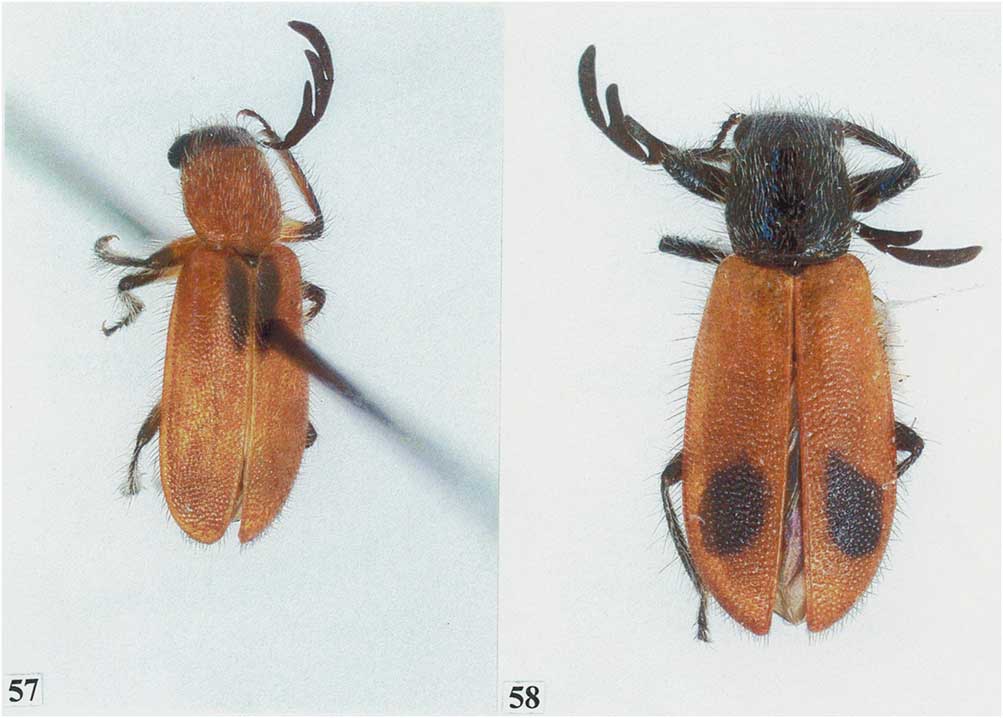
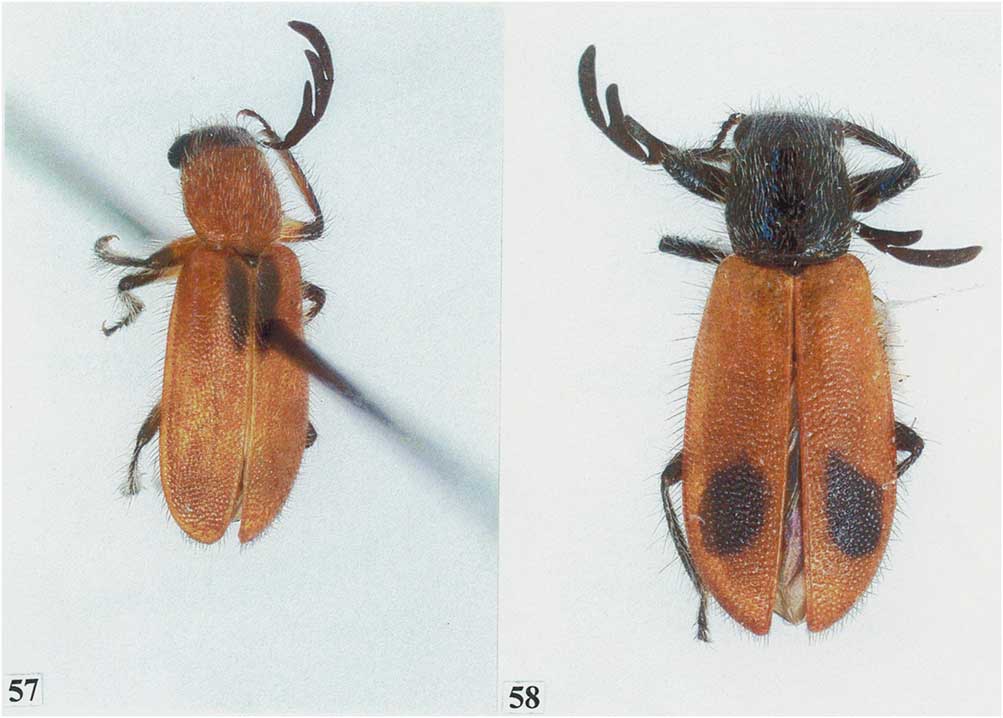
Variation. Size: Length 4.0–6.0 mm; width 1.8–2.2 mm. The antenna is sexually dimorphic (compare Figs. 20, 22). Rarely is body or thorax mostly red. The elytral apex may be black. The elytral colour variations are depicted in Figs. 54–58.
Habitus photographs. 53. Pelonides humeralis. 54–56. Pelonides scabripennis.

Habitus photographs of Pelonides scabripennis.
Natural history. Specimens have been collected from August to November. One specimen was collected on Boerhavia intermedia.
Distribution (Fig. 61). This species is known only from Baja California, Mexico.
Material examined. 67 specimens from: Mexico: Baja California: Baja California Sur, San Antonio, 30-VIII–1-IX-1994, J.E. Wappes; Ram di Naran, 10–28 km W Ruta 1, 28–31-VIII-1994, J.E. Wappes; 4.8 km W La Ribera, 9-IX-1976, on flowers of Boerhavia intermedia, R.L. Westcott; Baja California Sur, 6.9 km W highway 1, on Ramal a El Rosano, 6–7-IX-1988, E.G. Riley; Baja California Sur, 4.8 km W La Ribera, 19-IX-1976, on flowers of Boerhavia intermedia and B. xantii, R.L. Westcott; Baja California Sur, 5 km S La Paz on Highway 1 and 19, 1-X-1995, K. Bryan; Baja California Sur,1 km W El Centenario, 6-IX-1977, Prosopis, W.F. Barr; Baja California Sur, 10 km ESE San Pedro, 2-IX-1977, W.F. Barr; Baja California Sur,18 km SE Todos Santos, 24-IX-1978, W.F. Barr; 51.5 km S Comondu, 6-VIII-1955, J.P. Figg-Hoblyn; Baja California Sur, 18 km SE Todos Santos, 24-IX-1978, D.E. Foster; Baja California Sur, 40.2 km W La Paz, 30-VIII-1959, K.W. Radford and F.G. Werner; Baja California Sur, 1 km SW La Burrera, 27-VIII-1977, 470 m, E. Fisher, R. Westcott; Cabo San Lucas, 30-VIII-1976, E. Giesbert; Baja California Sur, 23 km SE Las Pocitas, 24-VII-1977; Baja California Sur, 8.0 km NW Santa Anita, 2-X-1981, beaten from flowers, foliage Acacia goldmanii, R.L. Penrose; Baja California Sur, 1.6 km N, 12.9 km NW San Jose del Cabo, 14-VIII-1980, W.F. Barr; Baja California Sur, 88 km WNW La Paz, 22-IV-1985, R.L. Westcott; Baja California Sur, 17 km SE La Paz, 3-IX-1977, W.F. Barr; Baja California Sur, 41.8 km W La Paz, 3-VIII-1966, J.A. Chemsak; Baja California Sur, 32.2 km S El Arco, 28-IX-41, Ross and Bohart; Baja California Sur, 3 km S, 1.3 km E San Pedro, 11-VIII-1980, Westcott and Bellamy; 8 km N Santa Anita, 2–3-X-1981, F. Hovore; Baja California Sur, Canon de la Zorra, 11 km W Santiago, 4–5-IX-1977, 285 m, Fisher and Westcott; Baja California Sur, 8 km N Miraflores, 19-VIII-1982, F. Hovore; Baja California Sur, 12.6 km NW San Jose del Cabo, 14-VIII-1980, on Cnidoscolus, C.L. Bellamy; Baja California Sur, 9.7–12.9 km E San Antonio, 16-VIII-1982; Baja California Sur, 3 km S, 1.3 km E San Pedro, 11-VIII-1980, Westcott and Bellamy; Baja California Sur, 14.5 km N, 4.0 km W Santa Anita, 20-VIII-1982, F. Hovore; Baja California Sur, 12.9 km NW San Bartolo, 18-VIII-1982, F. Hovore; Baja California Sur, 23 km SE Las Pocitas, 24-VII-1977; Baja California Sur, 8.0 km NW Santa Anita, 2-X-1981, beaten from flowers, foliage A. goldmanii, R.L. Penrose; Baja California Sur, 6 km N Loreto, 18-VI-1993, Westcott and Equihua; Baja California Sur, 9.7–11.3 km NW San Jose del Cabo, 21–22-IX-1976, 400 m, R.L. Westcott; Baja California Sur, 1 km SW La Burrera, 27-VIII-1977, 470 m, Fisher and Westcott; Baja California Sur, 9.7–11.3 km NW San Jose del Cabo, 21–22-IX-1976, 400 m, R.L. Westcott; Baja California Sur, 9.7–11.3 km NW San Jose del Cabo, 21–22-IX-1976, 400 m, R.L. Westcott; Baja California Sur, 16.1 km NW El Triunfo, 12-VIII-1966, J.T. Doyen; 9.7–11.3 km NW San Jose del Cabo, 21–22-IX-1976, 400 m, R.L. Westcott. Baja California, Ramal al Santa Rosaillita, 3.5 km W Carr, 20-VI-1993, 90 m, R.L. Westcott; Baja California, 24.1 km S San Domingo, 4-X-1941, Ross and Bohart; Baja California, 7.2 km E Santa Catarina, 20–21-IX-1976, R.L. Westcott.
Specimens are deposited in CASC, FSCA, JNRC, TAMU, WFBM, and WOPC.
Notes. The description is not based on a type specimen.
Evolutionary considerations
Two of the six species of Pelonides are exclusively distributed throughout the southwestern United States of America, one extends from the United States of America to northern Mexico, one species is exclusively in Baja California, Mexico, one in central Mexico, and one from the southwestern United States of America down to Honduras. It is perhaps no coincident that the geographically most widespread species, ranging from southwestern United States of America to Honduras, is also the most primitive in the genus. This poses the possibility that the ancestral stock of Pelonides could have diversified on what was once the ancient Mexican/Mayan block (Donnelly Reference Donnelly1988). Moreover, this possibility is supported by the predominantly Mexican distribution of the species of Parapelonides, the putative sister genus of Pelonides. The monophyletic status of Peloniodes is based on three synapotypies: the 8th and 9th antennomeres each have a collateral branch, the ungues are particularly large, and the elytral disc is without asetiferous punctures.
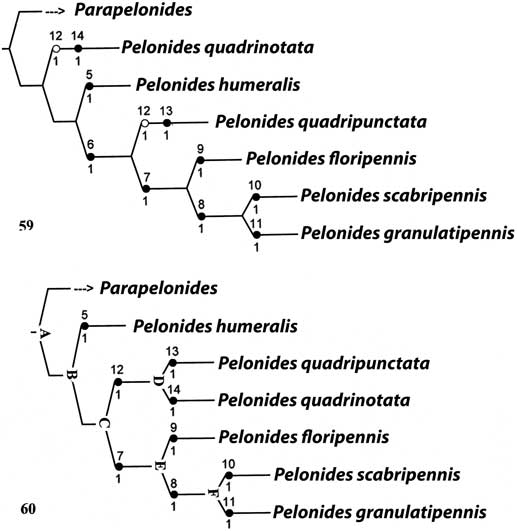
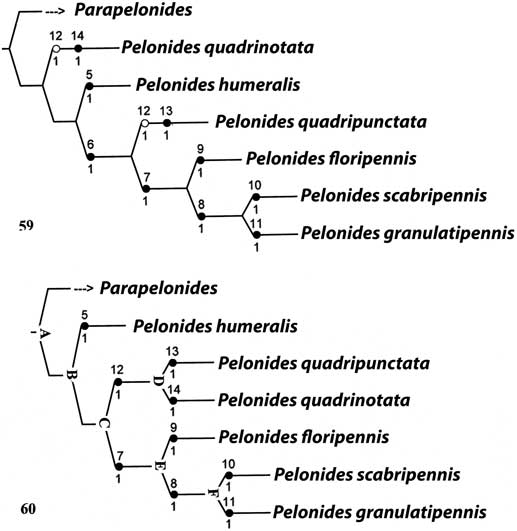
Analysis of the character matrix (Table 1) generated two fully resolved phylogenetic trees (Figs. 59, 60) (length=15, consistency index=93, retention index=83). In my discourse of possible evolutionary relationships, I chose the tree represented by Fig. 60; mostly because the Fig. 60 tree avoids two independent evolutions of the elytral maculae. I speculate that the progenitor of the Parapelonides/Pelonides lineage (ancestor A) evolved spines on the aedeagus. From this ancestor evolved a line in which the aedeagal spines became localised on one side of the phallic plates. In ancestral species B both sides of the phallic plates became spinous. This ancestral stock generated an evolutionary line in which the setiferous punctures became minute. This line eventually produced P. humeralis. The complementary stock led to progenitor C in which the elytral asetiferous punctures were lost, the two basal capitular antennomeres evolved collateral branches, and the ungues became enlarged. Ancestor C generated two lines of evolution that led to progenitor D, which eventually generated two exclusively North American species (P. quadripunctata and P. quadrinotata). The progenitor C line also evolved towards ancestor E, which produced the Mexican P. floripennis and ancestor F. Subsequent evolution produced the sister species P. scabripennis and P. granulatipennis.
Phylogenetic trees of Pelonides species based on 14 morphological and one geographical character.
Geographic distribution of Pelonides floripennis, Pelonides granulatipennis, Pelonides humeralis, and Pelonides scabripennis.
Geographic distribution of Pelonides quadripunctata.
Geographic distribution of Pelonides quadrinotata.
Acknowledgements
I thank Kent Hampton for his assistance with electron micrographs. Special thanks to Andrew Smith for his editorial work, and to my wife Galena for her clerical assistance.