Maskanda is not for Zulus only but for all of us […] Maskanda is our thing as South African people [… and] goes hand in hand with being African.
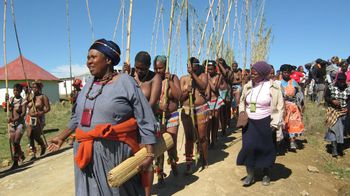
MamadunaU mkhosi wokukhahlela (‘Royal Reed Dance’) is an annual ceremony celebrating virginity among girls and young Bhaca women from the KwaBhaca Great Kingdom.Footnote 1 On the morning of the event, participants take a three-hour walk from the town of Mount Frere to the KwaBhaca royal kraal (the village community of KwaBhaca’s King Madzikane II; see Figure 1). The women and girls, shirtless, dressed in short, beaded skirts and carrying tall reeds, march to the accompaniment of traditional antiphonal singing, the repertory varying from songs commenting on relationships to ones that boast of Bhaca strength. The carrying of the reeds represents the Bhaca’s connection to nature and recognizes the traditional belief that Bhaca ancestors descend from along the African riverbeds (where the tall reeds grow wild). Upon arrival at the royal kraal, these reeds are laid near the king’s residence, further marking the women’s and girls’ agreement to the ritual’s mandate of abstinence. Once their reeds are laid, the participants are provided with brightly coloured strips of cloth, one for each year of participation in the ritual. These are carefully clasped to the beaded skirts, and serve as colourful, visual reminders of the participants’ commitment, which, although celebrated at this annual event, has often lasted their lifetime.
The participants and the elder sisters walking into the royal kraal. Photo courtesy of KwaBhaca Great Kingdom.

The community joins the participants in their walk to the royal kraal, either following behind on foot or inside vehicles that follow slowly. At the front of the participants’ line march the virginity inspectors – the older women of the kingdom who, in addition to verifying the testing of the virginity of each girl or young woman, offer regular counselling sessions throughout the year. At these sessions participants learn the traditional Bhaca dances and songs to be performed at the rituals, and are also taught the myths and legends of the Bhaca ancestors. As one young participant put it, ‘It is where we learn to be proud Bhaca women.’Footnote 2 Halfway to the royal kraal the participants are met by a herd of cows and heifers, from which one heifer will be slaughtered later that day. Herded alongside the community to the royal kraal, the cows and heifers represent the community’s pride and acceptance of the girls’ and young women’s involvement in the ritual.
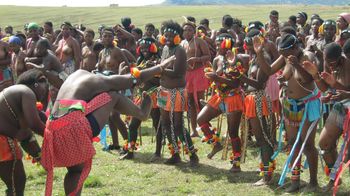
With the arrival of the women and young girls at the royal kraal, the Bhaca dancing begins, with participants swaying in long lines to rhythmic, stomping movements meant to facilitate communication with the ancestors. ‘Ntombazanavala’ (‘Be careful playing with boys’), the lead singer calls out, followed by the unaccompanied response, ‘Ungadai amakhwenkwe ungavuli!’ (‘Hide your private parts!’). Soon after, a DJ seated at the back of the ritual begins playing popular cassettes and CDs of maskanda, the mass-produced recordings of Zulu music that contrast starkly with the live a cappella singing of traditional Bhaca songs. The playing of the recorded music is met with immediate shouts of appreciation from the crowd. Participants immediately change their dancing to include movements visually similar to the Zulu ngoma dance; the high kicks of ngoma are noticeably distinct from the Bhaca stomps (see Figure 2). Audience members, too, assume more participatory roles, some even jumping into the ritual space to dance alongside the participants. Others can be seen dancing on the sidelines, the men (as they later confirm for the authors) competing with one another to achieve the highest ngoma kick.
The high kicks of ngoma are seen as noticeably distinct from the Bhaca stomps. Photo courtesy of KwaBhaca Great Kingdom.

Maskanda, defined and marketed globally as a Zulu-specific musical genre, constitutes an important way of articulating Zulu identity within South Africa. Yet, in KwaBhaca, maskanda has become a tool for celebrating a contemporary Bhaca identity and fighting against HIV and gender-based violence. This article examines Umkhosi wokukhahlela and its reliance on maskanda, and enquires into how and why maskanda was adopted in this ritual, and how that adoption impacts on issues like health and Bhaca identity. The authors emphasize how musical meaning may be attached to particular places, communities and themes (like health), and how that meaning may be borrowed and transformed to provide further opportunities for shaping individual subjectivities and social identities. Central to the discussion is how an epidemic like HIV changes a community, demanding that it create new strategies of empowerment and awareness, requiring that it revise traditions which foster collective identities based on positive and informed concepts of the disease.
This article approaches materials collected during fieldwork conducted in KwaBhaca Great Kingdom, with the authors attending three separate Umkhosi wokukhahlela celebrations held on 23–28 September 2013 (including the pre-celebratory workshops held on 14–18 August of that year); 26–28 September 2014; and 30 September to 2 October 2016. Data was generated through ethnographic concepts and techniques, relying primarily on in-depth interviews and focus groups, conducted in English and isiBhaca (a language closely related to Swati) and involving a wide range of ritual participants, community leaders and audience members. Some 40 interviews were conducted and a dozen focus groups were consulted during the writing of this article.Footnote 3
The thematic findings are analysed using cultural and critical theories, borrowing especially from neo-Gramscian principles. The notion of ‘articulation’ – understood by Antonio Gramsci as a way of reusing existing ideological or political frameworks for different purposes from those intended for them – is introduced as a methodological framework for discussing and analysing Umkhosi wokukhahlela. As Leon De Kock writes, ‘South Africa has been a fertile ground for foundational binary inscription, a place of blatant dualisms, such as the civilised and the savage, settler and indigene, White and Black, oppressed and privileged, rich and poor.’Footnote 4 Such binaries are common in KwaBhaca Great Kingdom, and, as is argued in this article, the Bhaca challenge, control, articulate and negotiate those contradictory binaries through their adoption of maskanda in Umkhosi wokukhahlela. The ritual is transformed as a result, and is capable of cutting across age, gender and HIV status. Articulation provides us with a principle for discussing and analysing Umkhosi wokukhahlela’s transformation in meaning and, in the process, for thinking about local strategies for coping with HIV and gender-based violence. In the words of Gramsci,
If the union of two forces is necessary in order to defeat a third, a recourse to arms and coercion can be nothing more than a methodological hypothesis. The only concrete possibility is compromise. Force can be applied against enemies but not against a part of one’s own side which one wants to assimilate rapidly and whose ‘goodwill’ and ‘enthusiasm’ one needs.Footnote 5
The present authors have presented a number of papers reflecting wider analyses of Umkhosi wokukhahlela. It is examined in one as a health initiative;Footnote 6 in another as an example of modernism;Footnote 7 and here as a Bhaca ritual that employs Zulu music as a vehicle for Bhaca collectivity. Each of these papers involves the collaborative effort of a cultural outsider and an insider who, coming together to frame the questions that guide the research, have worked as a team to gather and interpret these studies. The papers represent an action-based methodology that is designed to encourage local actors to take active roles in gathering evidence and building research agendas, thereby repositioning them as producers rather than subjects of research. As co-authors, King Madzikane II and De Jong collaborated frequently in person and over the telephone to analyse the collected research data and to finalize working theses regarding Umkhosi wokukhahlela. Portions of this research have been shared by both authors with the Bhaca people at public forums held during and directly following the Umkhosi wokukhahlela rituals and at traditional Bhaca royal leadership meetings. This collaborative strategy has helped to build a deepening public understanding and acknowledgement of the social and cultural determinants behind Umkhosi wokukhahlela. In the words of King Madzikane II, ‘Nanette has shown us that by getting the community involved in the research, the community is more ready to take ownership of the results of the research […] Nanette’s research approach gives the community tools for making change and being part of change.’Footnote 8
Maskanda, ‘Zuluness’ and the fragility of definition
Central to the argument in this article is the claim that uses of maskanda are doing particular and remarkable kinds of cultural and social work in Umkhosi wokukhahlela. Maskanda – the Zulu pronunciation of the Afrikaans word musikant (‘musician’) – is a popular South African music style that began as songs of courtship sung by young Zulu men on their walkabouts or by the loved ones who remained behind. When these Zulu men migrated to the cities for work, living with other migrant workers in black male hostels, they ‘transformed the nostalgic songs of love […] into the multipart guitar melodies of migrant longing’.Footnote 9 In the 1930s, recording companies travelled around South Africa in search of music to record and sell to African audiences. Arriving at these black male hostels, they encountered maskanda and quickly sought to record and market the music. To ensure saleability, however, the companies revised maskanda by ‘backing up the individual songsmiths and guitarists with ensemble players […] and later, when urban concerts became established cultural events, with dancers’.Footnote 10 With record-company support, maskanda gained considerable popularity in South Africa, crossing ethnic and cultural lines. Maskanda may have developed out of ‘the “in-between spaces” occupied by [Zulu] labour migrants at the turn of the 20th century’,Footnote 11 but its lyrics of rural life, longing for home and missing loved ones have resonated with non-Zulus as well. The relevance maskanda held for Zulu as well as non-Zulu labourers raises the possibility that the music had the capacity to be rearticulated for new audiences. That maskanda would later be chosen by the Bhaca to be reworked and reinterpreted in Umkhosi wokukhahlela for the purposes of shaping local narratives reconfirms that potential, giving support to Stuart Hall’s claim that, ‘Popular culture is neither, in the “pure” sense, the popular traditions of resistance […] nor is it the forms which are superimposed on and over them. It is the ground on which the transformations are worked.’Footnote 12
Maskanda continued to transform during the mid-twentieth century, emerging as an electronic dance music that could readily be heard on local radio stations as well as in live performance in communal halls. Gaining popularity in both commercial and traditional settings, maskanda had the ability to mix with different music styles and genres, from techno to rap. In these contemporary forms, maskanda managed to maintain a sense of ‘Zuluness’ by upholding features connecting it to a perceived Zulu tradition – these included textual themes, acrobatic dancing, animal-skin costumes and self-praise. Able to attract diverse South African audiences, maskanda emerged as an ideal symbol of the ‘New South Africa’ following apartheid. To quote David Coplan, it embodied ‘an idealised Africanness that denie[d] a colonised consciousness and its expression in ethnic divisions’.Footnote 13
Maskanda’s cultural history has been well documented in several studies.Footnote 14 Less well understood, however, are the sites where maskanda has been disseminated. Briefly, the music reached audiences in the USA and Europe with the boom in music studio recording at the end of apartheid. Marketed under the world music rubric as Afro- or Zulu-pop,Footnote 15 however, it gained but a small global fan base. Reasons for this may lie with maskanda’s close links with Zulu tradition, which – as Coplan surmises – make it ‘opaque to non-Zulu people’.Footnote 16 As a case in point: when the maskanda guitarist Shiyani Ngcobo played a concert at Carnegie Hall in New York City in 2007, reviews were mixed. ‘He hasn’t pre-digested his music for non-Zulu audiences,’ wrote the New York Times. ‘The songs arrived without explanations, but also without abridgement or crossover attempts.’Footnote 17
Another possible contributing factor behind maskanda’s limited international acclaim is the notion of ‘Zuluness’ itself, which historically has struggled against ambiguity and contradiction. ‘Zulu’ as a nation group was first introduced to Europe in the early nineteenth century through stories of Shaka, the king of the Zulus;Footnote 18 the term became equated with ‘anarchy, bloodshed and brutality’.Footnote 19 Some 30 years later, in the middle of the century, a troupe of Zulus was ‘displayed’ at touring shows across Europe. The troupe performed cultural events ‘alleged to be representative of the tenor of their brutish life’.Footnote 20 Advertised as ‘primitives in the raw’, these Zulus flaunted spears, shields, feathers and war paint.Footnote 21 The touring shows not only confirmed white expectations regarding their stereotyped views on ‘Zuluness’, they created a ‘fixed’ idea of Zulus that shaped the ways in which both South Africa and the continent of Africa were perceived: essentialized notions of ‘Zuluness’ became equated with a more generalized ‘Africanness’.Footnote 22
The complexities and contradictions of ‘Zuluness’ come to the fore when discussed within apartheid – a system of exclusion that enforced the separation of black people into different perceived ‘ethnic groups’, forcibly moving them to different regions or townships in South Africa. Enforced ethnic divisions were maintained at least in part by the Bantu Programme Control Board, which, established in 1960 by the apartheid government, oversaw the establishment of separate radio stations for these groups. Each radio station had its own separate cultural programming, which assigned and imposed particular cultural attributes issued by the government. As may be expected, the traditions allocated to the ‘ethnic groups’ were ‘romantically exotic’ and had the effect of ‘turning Blacks against each other by reinforcing and artificially cultivating ethnic and racial differences’.Footnote 23 In other words, constructions of ethnic identity resulted among black people not only from attachments they formed to their assigned ‘ethnic groups’, but also through a process of ‘dis-identification’ with other ethnic groups.Footnote 24 Through an array of binaries that emerged in response – ‘our space’ versus ‘their space’; ‘our culture’ versus ‘their culture’ – these groups further separated themselves from one another: Zulu versus Xhosa versus Pondo versus Bhaca, their definitions of self formed in opposition to the other presumed ‘ethnic groups’.Footnote 25
Although these divisions may have suited the political aspirations of apartheid,Footnote 26 they were considered a hindrance at its close. If South Africa was to be accepted by the Western world as a modernizing nation state, it needed to create a new image to project to the public eye – ‘one scripted along keywords like “democracy”, “reconciliation”, “development”, “unity in diversity”, all wrapped up in the metaphor of the “Rainbow nation”’.Footnote 27 Accordingly, South Africa disseminated images to the West that compressed diversities in tradition and history.Footnote 28 In pursuit of a ‘Rainbow Nation’, there emerged a resimplification of some traditions and a homogenization or even canonization of others. The Zulus, for example, were packaged as the ‘distinct “warrior” nation’, while the Xhosa were deemed ‘proud’ and the Pedi ‘warm-hearted’.Footnote 29 Maskanda, in turn, was promoted as ‘parochial Zulu’.Footnote 30 Just as the Zulus represented a culturally diverse people, however, maskanda too comprised different styles according to the specific Zulu region or community. Yet the music industry reduced those differences to a single, ‘generalised and stereotypical’ notion of Zuluness, which ‘suited commercial marketing categories, and the political aspirations of both the apartheid order and Zulu nationalism’.Footnote 31 These repackaged ideals of maskanda and ‘Zuluness’ were sold not just to Western audiences but also to other South Africans. It was part of a process of nation-building after apartheid, which came with further essentializing of subnational cultures and identities, locally and abroad.Footnote 32
Maskanda was pulled in a variety of directions. For some South Africans, it held connotations of resistance and strength – the result of a post-apartheid repackaging of ‘Zulu’ as the ‘distinct “warrior” nation’. Yet for others, maskanda represented new possibilities for a ‘Rainbow Nation’, the global comparison of ‘Zuluness’ with a more generalized ‘Africanness’ suggesting a similar association with maskanda. In the words of Coplan,
While Africans of other groups are wary of militant Zulu ethnic nationalism and the Zulu reputation for using violence as a favoured means of dispute settlement, the power of Zulu performance culture to evoke an image of a resilient, autonomous Africa is widely accepted and enjoyed by all South Africans, black, brown, and white.Footnote 33
A further exemplification can be found in a 2011 advertisement for a maskanda concert in Durban, South Africa, which bills the music as ‘traditional South African afro-ethnic sounds’.Footnote 34 The global recognition of ‘Zuluness’ as ‘Africanness’ helped to encourage the external reception of maskanda as a prototype for ‘traditional’ Africa, shared in the persuasive example of a maskanda performance at a recent national conference of the organization African Renaissance in Johannesburg. Maskanda ‘fits in neatly’ not only with the ‘Africa in unity’ theme of the conference, but also with the largely African American and non-South African black audiences’ ‘parochial preconception that South African Black people all belong to the Zulu “tribe”’.Footnote 35
According to some sources, the establishment of a Zulu hegemony in South Africa began in the early nineteenth century with Shaka, king of the Zulus.Footnote 36 Shaka sought to unite different black African nations into a single empire, to form a confederation on the foundation of ‘two details of nation-building: culture and warfare’, with his army at the heart of this cultural imperialism.Footnote 37 The Zulu defeat of the British army at the Battle of Isandlwana (22 January 1879) furthered claims of Zulu dominance. Applauded as a story of the Zulus successfully defending their homeland, this Zulu victory (under King Cetshwayo) grew to ‘mythical proportions’ globally, signalling that ‘Black people were not always victims and could assert independence and dignity.’Footnote 38
The Bhaca have a unique, close historical relation to King Shaka and to the Zulus, which renders their use of maskanda politically complex. The Bhaca’s earliest history places them in the northern part of the Pongola river near Libombo Hills (the present-day border between Mpumalanga and Swaziland). Called AbakwaZelemu, they lived peacefully with other nation groups in the region, including the amaWushe, Mpovane, Chiya, amaNqolo, Nguse, Dzana and Begashe. By the 1820s, owing to clashes with the Zulu King Shaka, the AbakwaZelemu’s king, Madzikane I, commanded that they relocate. Other nation groups joined in and, under the leadership of Madzikane I, they started a new, diversified and unified nation group that, now claiming the title of amaBhaca (meaning ‘to move’), settled in the mountainous uplands of the Mount Frere district, a region in Eastern Cape that today is known as KwaBhaca Great Kingdom. ‘Unity is not just a Zulu notion,’ King Madzikane II reconfirms. ‘Unity is our thing.’Footnote 39And when maskanda is played, ‘We can celebrate that unity.’Footnote 40 This decision by the king to rely on maskanda when revising Umkhosi wokukhahlela is symptomatic of articulation through the demonstration of an expressed strategy to overthrow dominant cultural narratives and ‘enter into new articulatory alliances’.Footnote 41 With maskanda, new patterns of meaning and associations are superimposed upon the ritual, further exemplifying the conciliatory and transformative power that maskanda allows; this superimposition is another form of articulation here.
King Madzikane I is celebrated in KwaBhaca Great Kingdom for successfully defeating the Zulu King Shaka’s army. The phrase ‘Umkhosi wakaZulu mina ngowushaya ngesandla esisodwa’ (‘I single-handedly will beat the Zulu army’) has become a popular theme in contemporary Bhaca legends and storytelling. When the Bhaca integrate maskanda into their ritual, it is neither innocent nor accidental. ‘When we hear maskanda played at Umkhosi wokukhahlela, we are reminded of the strength of the Bhaca […] We are remembering that we are the only African nation group to defeat the Zulus.’Footnote 42 The Bhaca’s appropriation of maskanda represents the complex politics of alliance and competition that the Bhaca history holds. The articulating principle behind the social importance of maskanda in Umkhosi wokukhahlela must be viewed in terms of this retelling of history. With their embrace of maskanda, the Bhaca manage to decentre Zulu authority while reminding outsiders of their own strength and resilience. It exemplifies another nuanced way in which the Bhaca use Umkhosi wokukhahlela to rearticulate themselves on their own terms.
Given the complex social and cultural history of the Zulus, King Madzikane II is quick to explain that the Bhaca ‘are not internalizing “Zuluness” with maskanda’ in Umkhosi wokukhahlela. Footnote 43 Rather, they are using it to celebrate their own unique sense of unity and strength. The Bhaca may have joined other South Africans in embracing maskanda, but the ways in which they have acted out and thought about it are articulated from a Bhaca cultural position. A main point here is that the Bhaca are not imitating what other South Africans are doing by supporting maskanda; they are creating their own take on it, using and articulating maskanda on terms most amenable to them.
Maskanda in a Bhaca ritual: inscribing tradition with new meaning
Umkhosi wokukhahlela evolved in the late eighteenth century from local attempts to control premarital sexual behaviour as a way to maintain certain patrilineal lines.Footnote 44 Umkhosi wokukhahlela is not the only reed dance taking place in South Africa. The amaSwazi in Swaziland celebrate Umhlanga at the end of August; and some Zulus (living in KwaZulu-Natal province) observe uMkosi womhlanga, which takes place in September.Footnote 45 Although some stylistic similarities between these reed dances may occur, Umkhosi wokukhahlela remains distinct in terms of its adoption of maskanda and, unlike Umhlanga and uMkosi womhlanga, Umkhosi wokukhahlela is completely independent of tourism.
Umkhosi wokukhahlela fell into disuse at the turn of the twentieth century when large numbers of Bhaca men migrated to urban areas in search of work: with families separated, numerous communal rituals in KwaBhaca – such as Umkhosi wokukhahlela – deteriorated in meaning and were thence abandoned (it may be noted that Umkhosi wokukhahlela is the only public ritual still practised in KwaBhaca). The extraordinary rise in HIV/AIDS across KwaBhaca Great Kingdom, where the HIV infection rate is over 30% (UNAIDS),Footnote 46 along with the government’s perceived inability or unwillingness to combat the pandemic effectively, led KwaBhaca’s King Madzikane II to resurrect Umkhosi wokukhahlela over the last decade. It was, in his words,
an abstinence enforcement mechanism [that] stands on the front lines in the war against HIV/AIDS […] It is about instilling pride amongst young Africans and instilling respect for bodily integrity […] an opportunity [for participants] to demonstrate their cultural value system while also [bringing] together the whole community to reflect on the cultural values.Footnote 47
By reusing an otherwise disregarded ritual to aid with modern difficulties, the Bhaca follow a specific form of articulation, supporting what Gramsci calls the ‘national-popular’: reorganizing (articulating) available cultural elements in order to support the current interests of a community.
HIV and AIDS carry a heavy stigma in KwaBhaca Great Kingdom, and this has led to delays in testing and treatment,Footnote 48 and has reinforced negative self-perceptions.Footnote 49 A Bhaca mother of three who is HIV-positive explains, ‘The world is not kind to someone like me’,Footnote 50 her words resonating with Donald Skinner and Sakhumzi Mfecane’s claim that ‘a major role […] stigma plays in society is to create “difference” and social hierarchy, and then in turn legitimising and perpetuating this social inequality’.Footnote 51 While counselling and support groups have been used successfully in South Africa to relieve experiences of marginalization among those affected by HIV/AIDS,Footnote 52 in KwaBhaca Great Kingdom, a distinctly rural and underpopulated area, such opportunities for counselling and support groups are few. Enter Umkhosi wokukhahlela, which includes a set of public panels as part of its ritual proceedings. At these panels, speakers discuss HIV – how it is transmitted; what the testing procedures are – and they relay to the public their own personal experiences regarding the disease. These speakers are keen to limit local misconceptions about HIV and AIDS and to discourage further stigmatization.Footnote 53 ‘I am HIV-positive,’ one young panel speaker reveals at the 2013 event. ‘Yet having HIV is not a death sentence any more,’ he announces. ‘But not knowing your status can be.’Footnote 54 He applauds the girls’ and women’s choice to abstain, yet also encourages testing. ‘You must know your status. Knowing is important for your health and for your future.’Footnote 55
Other women’s health concerns are also addressed at these ritual panels. These include gender-based violence, which has been on a steady rise in KwaBhaca Great Kingdom. ‘I challenge the men to protect the women of Africa,’ encourages a panel member in 2016.Footnote 56 ‘We men must keep our women safe, and we must be the role models for showing boys that any violence against women is unacceptable.’Footnote 57 A visiting chief in 2013 explains, ‘Today is devoted to the women of the Kingdom. But we must not forget the men and the role that men play in keeping women safe.’Footnote 58
Keeping the girls enrolled in school is yet another goal of the panels. ‘Education provides the keys to success,’ said a speaker in 2016.Footnote 59 ‘Stay in school. Keep learning. Be successful.’ Footnote 60 A woman on the same panel claps her hands as she speaks: ‘We are so proud of you. Stay in school, stay healthy, and continue to show the rest of Africa your strength.’ Footnote 61
Although Umkhosi wokukhahlela culminates at the end of September, the participants meet with the ‘elder sisters’ of their communities throughout the year. Through guidance provided by the elders, the participants develop an appreciation for Bhaca history and culture. Yet they also discuss ways of staying safe, specifically how to protect against HIV and gender-based violence. ‘We meet at our classes every month,’ explains young Ahelisiwe, a 12-year-old participant.Footnote 62 ‘We learn discipline from our teacher, and every day we practise discipline,’ adds Siphephelo, a 16-year-old participant. ‘We talk about HIV at our classes. We learn about it. We discuss it.’Footnote 63 Some of the young participants are born HIV-positive, and, as one such participant explains, ‘At Umkhosi wokukhahlela, I learn to live with HIV. I learn I can live with HIV […] I talk and meet others [who have HIV]. I don’t have to hide my status.’Footnote 64
Regarding abstinence, one of a group of young participants explains, ‘It is not hard to wait, as long as we are together; as long as we can wait with our friends and the other girls at Umkhosi wokukhahlela.’Footnote 65 One girl confides that, ‘We are too young to have sex. We are still girls. We must first learn how to take care of ourselves. The elder sisters help to teach us how to take care of ourselves.’Footnote 66 ‘Umkhosi wokukhahlela has its rewards,’ shares 15-year-old Langalibalele.Footnote 67 ‘Staying in school is my reward. It means I will get a good job and I will have a good life.’Footnote 68 Another girl standing nearby shares, ‘Being healthy is my reward,’ before another chimes in, ‘This is my culture. To [practise my culture] is my reward.’Footnote 69
In speaking with the participants, it becomes clear that Umkhosi wokukhahlela steps in to provide community support and individual instruction. It emerges as a powerful vehicle for providing more knowledge regarding HIV while also limiting negative self-perception of those affected.Footnote 70 It helps build awareness about and establish communication activities on violence against women; and it urges participants to stay in school, motivating them to plan for their futures. As an 18-year-old participant poignantly relays, ‘At Umkhosi wokukhahlela we learn to know ourselves. And we learn to have confidence in who we are.’ Footnote 71
In the effort to give contemporary meaning to Umkhosi wokukhahlela and to ensure wide audience participation, King Madzikane II enlists maskanda recordings to be included in the ritual. Months before the ceremony, he meets with his magistrate to preselect what maskanda songs should be played, and when they should be played. While the king and his magistrate may take advice from area DJs, they also take note of those maskanda recordings most frequently played on the radio or at local parties (the most popular radio station in KwaBhaca Great Kingdom is Alfred Nzo Community Radio, which regularly includes maskanda selections in its music programmes). The maskanda believed most popular with Bhaca audiences are scheduled at key points during the ritual.Footnote 72 In this way, maskanda holds a particular position of authority in Umkhosi wokukhahlela, responsible for mediating meaning, arousing participants into action and sustaining their ritual involvement when necessary.
A wide variety of maskanda genres are included at Umkhosi wokukhahlela. The more contemporary selections, such as ‘Inganekwane’ by Thokozani Langa (from the 2014 album Inganekwane), are popularly heard at the ritual, as well as more established favourites, such as Phuz’khemsi’s ‘Imbizo’ (from the 1992 album of the same title). An increasing number of local Bhaca maskanda musicians have started to emerge as recording artists in Eastern Cape, and their recordings may also find their way to Umkhosi wokukhahlela. A favourite artist is Mful’ongatshi, a Mount Frere native, whose album Inkosi uMadzikane KaZulu (which pays tribute to King Madzikane I) is frequently used at the start of Umkhosi wokukhahlela. ‘Playing this maskanda by Mful’ongatshi helps get the people involved from the very beginning of the ritual,’ explains Chuma, one of the male leaders attending the event. ‘And the text directly connects them to our Bhaca past, our Bhaca history.’Footnote 73 Yet whether the maskanda played at Umkhosi wokukhahlela is acoustic- or electronic-based, whether it is played on guitar or concertina, or whether it is performed by a Bhaca or a Zulu artist, ‘If the maskanda has a good beat, it will be popular in KwaBhaca Great Kingdom!’ confides King Madzikane II. It is the ‘beat’ of the maskanda that will ‘get the people on their feet, dancing! […] If we can get the people involved in Umkhosi wokukhahlela, then we can get the people involved in the values behind Umkhosi wokukhahlela, specifically women’s rights and women’s safety.’Footnote 74
A skilled DJ is expected to take charge of Umkhosi wokukhahlela, playing tracks to inspire participants to more intense levels of interaction, calming them should the action become too heated, stopping altogether when breaks in the ritual are needed. From this perspective, maskanda can be considered to be part of a social language that, learnt from the many local television programmes that feature maskanda music and dance, signals modes of participation – handclapping and dancing, fundamental to the social construction of the ritual. Combining traditional unaccompanied Bhaca songs with the maskanda recordings and mixing Bhaca dancing with ngoma constitute balancing acts that link the past with the present and the local with the national. This mixture of Bhaca tradition and Zulu maskanda recasts and reframes Umkhosi wokukhahlela around current Bhaca needs, aesthetics and mores.
The ritual takes place at the foothills of the Ngidzini Mountains, in the royal palace. Members of the community and invited guests sit underneath a large canopy near the ritual site, awaiting the participants’ arrival. When the participating girls and young women march to the front of the canopy, the audience nods in approval and appreciation, often clapping to the Bhaca singing. Upon hearing the first maskanda, however, they jump to their feet as if on cue, interjecting handclaps and foot-stomps, sometimes urged on by the other audience members, sometimes urged on by the DJ. By the time the third maskanda track is played, some older women from the audience come forward to dance alongside the young women and girls. Bent low, they stomp their feet on the ground, vigorously swaying their bodies to the intricate rhythms of the song. Other women bow in acts of honour, some roll on the ground in appreciation, while still others swirl or squat to the music rhythms. Men, too, may come to the front, yet their participation in comparison is more subdued. They saunter to the maskanda rhythm, methodically placing their beaded walking sticks at the front of participating young women and girls as personal gestures of praise. When the DJ finally stops playing maskanda, the young women and girls promptly take some time to rest, some sitting on the ground, others walking to the main house for refreshments.
As opposed to the unaccompanied singing at Umkhosi wokukhahlela, where songs are sung by the young women and girl participants for the audiences, maskanda invites all to join in: the participants and the audiences, the women and the men, the young and the old – ‘They all come together with maskanda,’ explains King Madzikane II. As he reminds us, ‘It takes everyone in KwaBhaca Great Kingdom to fight against HIV and violence against women. Because maskanda is so popular with the Bhaca people, it becomes an excellent tool in this fight. Using it in Umkhosi wokukhahlela helps get everyone involved in this fight.’Footnote 75 Those attending the ritual often stand near their chairs at the playing of maskanda. Some may clap and even sing along with the recorded tunes. Others may eventually jump into the ritual ring, where they dance alongside the young participants. As such, maskanda enriches the ritual moment, serving not as mere accompaniment but rather assisting as an essential mode through which the underlying meanings of Umkhosi wokukhahlela are shared and circulated. Answering King Madzikane’s call that everyone get ‘involved in this fight’, maskanda transforms individual agency into a shared sense of agency from the start of the ritual.
Maskanda is also used to mark the ritual slaughter of a heifer, an event that occurs just before the ritual oratories of the king and invited guests. Historically, the sacrifice of a heifer was reserved for special occasions where public gratitude to the Bhaca ancestors was needed. Oxen and heifers were integral to KwaBhaca’s agricultural economy, being used to plough the fields, while their dung fired hearths and fertilized farmland. Their sacrifice at Umkhosi wokukhahlela connects participants to KwaBhaca history, tradition and homeland. To have chosen maskanda to accompany a crucial cultural moment like the heifer sacrifice is significant. It signals how far Umkhosi wokukhahlela has changed. While the sacrifice may pay homage to a Bhaca past, maskanda welcomes the future, helping the Bhaca to restructure Umkhosi wokukhahlela further into a tool to combat today’s most pressing challenges.
The heifer offered for sacrifice during the ceremony is escorted into the cattle kraal to the accompaniment of a maskanda track, strategically chosen again as a tool to engage audience members fully in this crucial ritual event. With the arrival of the heifer, everyone stops dancing except for the man leading the slaughter. He waves the special spear reserved for this killing as he leaps and squats to the fast-paced beat of the maskanda. The men from the audience join him inside the cattle kraal, spurring him on with whistles and handclaps – only men are allowed inside this kraal, leaving the women to catch glimpses through gaps between the kraal’s fence posts. As the leader dances closer to the heifer, the men and women react with shouts of praise. The maskanda music stops just before the heifer is slaughtered.
Only men attend the slaughter of the heifer. Yet with maskanda the Bhaca men and women interlock at this ritual moment, moved to joint participation within and outside the kraal through their collective singing, handclapping and dancing. Because maskanda gives voice to a shared involvement, the women are offered an otherwise inaccessible opportunity to join in the shared rituality of Umkhosi wokukhahlela animal sacrifice. There emerges at this moment an intricate interplay of in/out as participants from both sides of the kraal, male and female, unite, furthering the Bhaca commitment to women’s health and safety.
The playing of maskanda also marks the climactic finish of Umkhosi wokukhahlela, when the king and his entourage walk among the young women and girls as a final and formal token of appreciation for their ritual participation. The use of maskanda here is particularly significant: this ritual’s finish is all about strengthening the KwaBhaca community, ensuring its solidarity for the remainder of the year. Maskanda fits neatly into this action. It draws the needed responses from the participants and the audience, thereby serving to safeguard the social and emotional solidarity sought in the practice of Umkhosi wokukhahlela. When the king walks between the participants to the beat of maskanda, repeatedly bowing before them in acts of appreciation, he embodies the KwaBhaca Great Kingdom as a whole, his acknowledgements provided on behalf of the entire community. Maskanda succeeds in creating and strengthening a sense of community at this crucial end of the ritual precisely because it allows for broad cultural effect, engaging audiences in the ritual action through the maskanda expectation of handclapping and ngoma kicks.
King Madzikane II is quick to admit that he makes the most of maskanda’s popularity in order to inject a stronger sense of belonging into Umkhosi wokukhahlela. As James Clifford writes, ‘Any community’s ability to persist, to innovate, to change on its own terms, is relative to its structural power.’Footnote 76 Maskanda can represent a Bhaca search for new ways to articulate identity, a search that necessarily involves the need to devise new and different possibilities through which to envision a new future. King Madzikane II is painfully aware that Eastern Cape is one of South Africa’s poorest provinces; that HIV/AIDS is the leading cause of death there; and that gender-based violence is on the rise. Likewise, he acknowledges that diverse strategies are required to confront the wide-ranging and complex social, cultural, environmental and economic contexts in which HIV and gender-based violence is spreading in KwaBhaca. As the king states,
Maskanda is considered by the Bhaca people to be ‘their thing’. To use the most popular maskanda in our ritual ensures the Bhaca people may feel like Umkhosi wokukhahlela is their ‘thing’ too […] If we are going to win this fight against HIV, we’ve got to try everything that is available […] We’ve got to fight HIV from inside the Bhaca community.Footnote 77
Notably, maskanda ‘speaks of male experience, and is generally regarded as the domain of men’.Footnote 78 Its adoption in a women-dominated ritual may seem initially out of place. However, speaking more fully with King Madzikane II and with members of the Bhaca community, it is quickly revealed that the central issue behind Umkhosi wokukhahlela is the involvement of the community not just to inscribe women into the ritual process, but to bring in the men as well. To Lawrence Grossberg, ‘Articulation links this practice to that effect, this text to that meaning, this meaning to that reality, this experience to those politics. And these links are themselves articulated into larger structures, etc.’Footnote 79 Umkhosi wokukhahlela must be viewed within this complex web of associations, as ‘articulated into different, sometimes competing and sometimes contradictory sets of relations’.Footnote 80 As the Bhaca struggle to reposition themselves within the shifting dynamics of HIV and gender-based violence, the network of relationships embodying Umkhosi wokukhahlela are also reworked and reinterpreted to meet these new needs, the practice of articulation revising the ritual’s context to allow for new goals of health and well-being.
The contemporary Umkhosi wokukhahlela, for example, is no longer just about celebrating the virginity of its young women participants; it is about juxtaposing possible male expectations regarding sex with the woman’s choice to wait; it is about bringing the women and men together on issues of abstinence and gender-based violence – failing to do so would, the king says, ‘guarantee us missing our goal of reducing incidences of HIV/AIDS’.Footnote 81 Thus, it can be argued that the impact of rearticulating the ritual to include the men allows new representations of gender relations to take root in KwaBhaca Great Kingdom. The number of participants involved in Umkhosi wokukhahlela continues to grow, with over 200 young women and girls today voicing collectively their decision to abstain from sex and remain in school, while some 400 men and boys also attend, offering their support.
Articulation affords a clearer awareness of how particular gender positions are created and recreated in KwaBhaca Great Kingdom. It reminds us that ‘we are not forever doomed to ideological operations of subjection formation as fully determined products’, but rather ‘are socially and historically constituted subjects who undergo processes of change, transformation and resignification’.Footnote 82 In response to the new spaces of encounter that this gender crossing allows for in KwaBhaca, the king further explains, ‘The only way this ritual will work is if the entire community comes together. The ritual is about women. It is about celebrating and honouring the woman and her body. Her decision to take care of her body must be supported by everyone in the community.’Footnote 83 Mamaduna, an elderly Bhaca woman who leads virginity inspection among the young participants, puts it this way: ‘It is important that young boys must take part [in Umkhosi wokukhahlela]. For now young boys must be motivated to respect young girls because for now they are still a risk factor to the girls.’Footnote 84 Maskanda’s popularity among Bhaca youths helps to stimulate the young girls’ and boys’ joint participation in Umkhosi wokukhahlela, where together they can make sense of their individual and collective roles in the fight against HIV/AIDS and violence against women, and can consciously contribute to a stronger and safer Bhaca society.
Articulating musical meaning in Umkhosi wokukhahlela
Umkhosi wokukhahlela represents a community that has come together to enact change. Community members draw on the cultural resources at hand, including in this case maskanda and the ritual itself, which are then reworked for the community’s own purposes, needs and interests. The notion of ‘articulation’ works well to describe these developments. Gramsci’s notion of articulationFootnote 85 – key to much work of subaltern studies – is widely used in contemporary postcolonial research. An important figure in dissecting the complex nature of hegemony and counter-hegemony in relation to power structures, Gramsci introduces the concept as a ‘hegemonic principle’ that engages with difference, where two or more available ideological structures are linked together to provide a new position of belonging or meaning. The argument is that by combining these disparate structures new definitions are attached to them.
Numerous scholars have convincingly extended Gramsci’s notion of articulation. Grossberg, for example, emphasizes articulation as ‘the production of identity on top of differences, of unities out of fragments, of structures across practices’.Footnote 86 He stresses the contingency of articulation, that through articulation numerous unities are possible. Hall has highlighted how the elements that come together through articulation ‘need not necessarily be connected’,Footnote 87 yet they are not randomly chosen. Articulation, in the words of Hall, is ‘the form of the connection that can make a unity of two different elements, under certain conditions’.Footnote 88 In other words, articulation gives structure to difference. James Clifford asks us to consider articulation as part of an ongoing cultural process of connections ‘always [to] be made, unmade and remade. Communities can and must reconfigure themselves, drawing selectively on remembered pasts,’ he writes.Footnote 89 Examining articulation as part of a process of creating and revising social links provides us with ‘a nonreductive way to think about cultural transformation and the apparent coming and going of “traditional” forms’, which thereby promises ‘a more realistic way of talking about what has been called cultural “invention”’.Footnote 90 Richard Middleton mobilizes articulation in popular music, using it to examine ways in which musical forms and practices have been appropriated for use by particular classes. ‘The theory of articulation recognises the complexity of cultural fields,’ he writes. ‘It preserves a relative autonomy for cultural and ideological elements […] but also insists that those combinatory patterns that are actually constructed do mediate deep, objective patterns […] and that the mediation takes place in struggle.’ Footnote 91
The extraordinary rise in HIV/AIDS and gender-based violence across KwaBhaca Great Kingdom has led to the need for grass-roots activism. Rather than rely on government and social institutions (which the Bhaca collectively argue have been unsuccessful thus far) to facilitate change, the Bhaca have found it necessary to exert their own strategies: to ‘fight disease and abuse from the inside’.Footnote 92 They have turned to a local cultural practice, Umkhosi wokukhahlela, where privileged claims of Bhaca ownership are already in place. In Gramsci’s words, ‘It is not a question of introducing from scratch a scientific form of thought into everyone’s individual life, but of renovating and making “critical” an already existing activity.’Footnote 93 By using Umkhosi wokukhahlela, part of the Bhaca ‘everyday’, as a platform for change, revised Bhaca perspectives can be immediately and widely articulated.
The ritual is transformed, mobilized and reorganized into a vernacular form of counter-power, performed with the aim of connecting and articulating practices that produce and exercise power from below. Today, Umkhosi wokukhahlela is reinforced as a stage for strengthening a shared, collective Bhaca identity. At the ritual’s year-long education sessions, participants learn from respected elders about Bhaca history and myths; they are reminded of the Bhaca themes of strength and unity through song and storytelling. At the ritual itself, a collective sense of Bhaca belonging is celebrated, with traditional songs and stories about the Bhaca ancestors fostering positive and empowered concepts of belonging. ‘At Umkhosi wokukhahlela, I am reminded what it means to be Bhaca. I am reminded we are a strong people. And this makes me very proud.’Footnote 94
HIV/AIDS and gender-based violence are also openly discussed at the contemporary Umkhosi wokukhahlela. Speakers articulate personal stories and experiences about HIV and gender inequality. They outline how HIV is transmitted, reassuring the public that contracting it is no longer a death sentence. They encourage testing, and emphasize that knowing your status is important not only to your health, but also to your relationships and your future. They also break the silence on gender-based violence, with the king reminding the men of the kingdom that KwaBhaca holds zero tolerance of abuse. In short, the Bhaca rearticulate Umkhosi wokukhahlela to exert community control over the spread and cultural meaning of HIV and gender-based violence, with the words of the speakers providing alternative perspectives to the ideas and meanings being passed around and legitimized on the ground.
Forged with these new meanings and motivations, Umkhosi wokukhahlela is transformed into a form of activism, a framework ‘through which [the Bhaca] represent, interpret, understand and “make sense” of some aspect of social existence’.Footnote 95 Yet the ritual assumes an importance not by integrating ‘isolated and separate concepts, but in the articulation of [these] different elements into a distinctive set or chain of meanings’.Footnote 96 For example, the Bhaca’s articulation of HIV alongside gender-based violence recognizes their broad-minded understanding that violence and the threat of violence can increase women’s and girls’ vulnerability to HIV. Likewise, the opportune choice of Umkhosi wokukhahlela, a ritual based around the sexual customs of Bhaca women, provides an authoritative platform for challenging HIV and gender-based violence.
The choice of maskanda and the way in which it is integrated into the ritual play a further role in the transformation of Umkhosi wokukhahlela into a platform for the Bhaca. Maskanda exists in the tensions between traditional Zulu cultural practices and commercialized South African musical forms, between the local and the global and between modernity and tradition. By enlisting it in Umkhosi wokukhahlela, the Bhaca are powerfully (and conveniently) borrowing maskanda to reproduce and negotiate the aesthetic dimensions of these binaries, producing for themselves that ‘crucial political and cultural position [that is] not firmly anchored on one side or the other but [is] contested and up for grabs’.Footnote 97
Without question, the local–global encounter is very complex in South Africa, a country that, with its long history of colonialism and apartheid, ‘not only sustains invading waves of global forces [but] also sends them back out into the surrounding territories’, thereby creating ‘a cacophony of voices, shaped in unpredictable ways on a terrain forged between globalisation and localism’.Footnote 98 It has been a country based on systems of inclusion and exclusion; it has been about realigning people, traditions and identities in accordance with constructed and imagined ideals of difference,Footnote 99 which not only has legitimized a ‘logic of separateness’,Footnote 100 but has also established what Abebe Zegeye calls ‘imposed ethnicity’.Footnote 101 Its implications have been far-reaching, further changing the ways in which South Africans have come ‘to know themselves, to learn about the “other”, and to become a nation’.Footnote 102
Although maskanda has been linked to a Zulu past, it also has emerged as a symbol of the ‘New South Africa’ as well as ‘an idealised Africanness’.Footnote 103 Because it bridges across divisions of identity in South Africa, maskanda provides the Bhaca with a commanding opportunity to articulate for themselves their relationship to the complexities of global and local. Mamaduna, when asked about maskanda’s inclusion in Umkhosi wokukhahlela, replies: ‘Maskanda is not for Zulus only but for all of us […] Maskanda is our thing as South African people [… and] goes hand in hand with being African.’Footnote 104 This negotiation follows what Middleton calls ‘cross-connotation’, ‘when two or more different elements are made to connote, symbolise or evoke each other’.Footnote 105 When maskanda is integrated into Umkhosi wokukhahlela, what it means to be ‘South African’ and what it means to be ‘African’ are remade, mediated as they are in that ritual moment through complex apartheid and post-apartheid notions of difference. Identity, as a result, extends beyond a singular Bhaca sensibility. It is no longer the exclusive box assigned to it under apartheid; nor is it the static, one-dimensional frame given to South Africans under the banner of the Rainbow Nation.
The use of maskanda also allows for the Bhaca to negotiate the perceived complications of modernity. Modernity has presented itself to them at least partially through the burden of uncertainty, as a period marked by catastrophic illness. For example, HIV and AIDS are seen in KwaBhaca as modern problems imposed from the outside. ‘We had people from Zimbabwe who have AIDS and we got it from those people,’ says a youth leader from Eastern Cape,Footnote 106 his views similar to those shared across KwaBhaca.Footnote 107 ‘The world,’ one Bhaca woman explains, ‘is out of control.’Footnote 108 ‘The modern world is challenging,’ adds another woman. ‘There is HIV, poverty, unemployment. Each day can be a struggle.’Footnote 109 Tradition, in contrast, is seen as familiar, as something positive. ‘One thing we can count on is tradition,’ says Chuma, adding later in the interview, ‘Tradition is our best defence against a world that just makes no sense.’Footnote 110 Umkhosi wokukhahlela represents Bhaca tradition, while maskanda, a contemporary, electronic-based music, embodies the essence of modernity. By including maskanda, the ritual itself ‘becomes modern’, and the modern world ‘becomes something that is easier to understand’.Footnote 111
The popularity of maskanda in KwaBhaca further ensures that the messages within Umkhosi wokukhahlela reach the largest Bhaca audience. To quote Hall, ‘We have to “speak through” the ideologies which are active in our society and which provide us a means of “making sense” of social relations and our place in them.’Footnote 112 Maskanda is easily accessible in KwaBhaca on the radio and is frequently heard at parties and at local clubs. Its inclusion in Umkhosi wokukhahlela helps to transform the ritual into entertainment – ‘a party’, ‘a place to have fun’, ‘a way for people to enjoy themselves traditionally’.Footnote 113 Armed with the popularity of maskanda, then, Umkhosi wokukhahlela is placed in an even stronger position to help defend the social interests of the community.
Conclusions
In this article we have argued that the meanings behind maskanda’s integration into Umkhosi wokukhahlela are neither fixed nor definite. Rather, maskanda emerges as a site of struggle, where the Bhaca can effectively negotiate new forms of cultural belonging and forge new tactics for dealing with the modern-day crises of HIV and gender-based violence. The theory of articulation is useful to this analysis in that it provides an opportunity to unravel some of the complexities behind why the Bhaca adopted maskanda to safeguard their own individual needs, and what this has meant for the community. More specifically, the theory of articulation allows us to view the Bhaca’s adoption of maskanda as strategic and deliberate, heralding new ways for seeing – and understanding – some of the challenges facing rural communities in post-apartheid South Africa.
Maskanda confirms for the Bhaca a sense of unityFootnote 114 and strength.Footnote 115 It serves as a reminder that they withstood Shaka’s stronghold, while still allowing for a party atmosphere. Maskanda helps to make the Umkhosi wokukhahlela ‘modern’, which in turn has helped that modern world to become ‘something that is easier to understand’ for the Bhaca.Footnote 116 As a result, King Madzikane II reminds us, with maskanda Bhaca can ‘assert themselves as Bhaca’. It ‘helps to ground us and remind us who we are and where we come from’.Footnote 117
If colonial and apartheid South Africa symbolizes a particularly radicalized version of the colonial project, the Bhaca with their adoption of maskanda in Umkhosi wokukhahlela represent an example of the postcolonial, complete with all the complexities that that brings with it, including the reclaiming of identity and representation.Footnote 118 Maskanda, for example, provides the Bhaca with a tool through which to respond specifically, collectively and publicly to the complexities of the post-apartheid moment, affording a means of reconstituting themselves against the complex terms and articulations of difference that mark that moment. From reorganizing notions of identity to challenging public discourses on health and well-being, the Bhaca have used maskanda to draft new ways of making sense of their lives and circumstances. Umkhosi wokukhahlela in response has been re-articulated as ‘a crossbred construction, a hybrid of the post-colonial’.Footnote 119
Local Bhaca traditions have been disrupted in South Africa by the effects of an apartheid government, post-apartheid mandates and now HIV. To date, Umkhosi wokukhahlela is the only traditional ritual still publicly practised in KwaBhaca. For this tradition to persist, it has needed to take on and work out features of those disruptions. The significance of the ritual and its importance to the community stems out of that ritual’s ability to support community needs.Footnote 120 For Umkhosi wokukhahlela to assume its importance in KwaBhaca, it was necessary for it to address a contemporary identity that stood both separate from the segregationist stereotypes of apartheid policies and in opposition to the romanticized ‘Rainbowism’ of South Africa, which had largely canonized ‘Zuluness’. Given the devastation HIV has caused in KwaBhaca, it was also important that the ritual serve as a collective response to the disease, to pull the epidemic out from the secret corners where it lurked and to place it in public view, where it could be debated and managed. As has been argued in this article, maskanda has helped to enable Umkhosi wokukhahlela to take on these roles.
Will Umkhosi wokukhahlela always include maskanda? It is a question that King Madzikane II is unsure how to answer. As the needs of the community change, he argues, so too will the ritual be altered in response. Maskanda is employed in the ritual today because the music is so popular with the Bhaca people. In fact, it is the most requested music on the local radio stations in KwaBhaca,Footnote 121 and its adoption in Umkhosi wokukhahlela helps to ensure that bigger audiences attend the ritual. Maskanda is particularly popular with the youths, who are the focus of the ritual; and it is hoped that by including maskanda more youths will get involved in Umkhosi wokukhahlela. Yet maskanda is also adopted because of its association with the Zulus. As Chuma reminds us, ‘When we hear maskanda […] we are remembering that we are the only African nation group to defeat the Zulus.’Footnote 122 Put simply, by integrating maskanda into the traditional ritual, says King Madzikane II, ‘new life is breathed into Umkhosi wokukhahlela’.Footnote 123
‘The strength with which particular potentially contradictory relationships are held together depends not only on the amount of objective “fit” between the components but also on the strength of the articulating principle involved, which is in turn connected with objective social factors,’ Middleton writes.Footnote 124 Although the inclusion of maskanda at the Bhaca ritual may seem initially out of place to a cultural outsider, closer examination reveals that its addition is powerfully beneficial to the community. It helps the Bhaca to rework societal norms and assumptions about HIV, gender-based violence and what it means to be Bhaca. As a local Bhaca woman poignantly explains, ‘It helps us be us.’Footnote 125