Significant acceleration in psychological distress and dysfunction in both survivors and first responders, is a consequent product of every disaster. Reference Everly, McCabe, Semon, Thompson and Links1 Whether it is a great disaster causing severe injuries and disturbances to many people such as hurricanes, or a devastating event that involves individuals or a family like horrendous accidents, house fire, or domestic violence, there is an urge to attend to those affected. Reference Vernberg, Steinberg and Jacobs2 Psychological first aid (PFA) is suggested to be used as the immediate administration aftermath. Reference Uhernik and Husson3
PFA is a method used globally to assist individuals affected by crises, disasters, or catastrophic events. Reference Sijbrandij, Horn and Esliker4 It is an evidence-informed method designed to diminish the distress elicited by adverse occurrences and facilitate the process of adaptive functioning and coping. Reference Ruzek, Brymer, Jacobs, Layne, Vernberg and Watson5,Reference Brymer, Layne and Jacobs6 Unlike psychotherapy that is given by mental health professionals in specific settings where the incidents are discussed in-depth, Reference Everly, McCabe, Semon, Thompson and Links1 PFA can be acquired by anyone who is in a position to provide support in disastrous events, including disaster relief organization workforces, volunteers, health care workers, educators, and others. Having a background in mental health-related areas is not essential for PFA providers 7 ; moreover, it can be applied in the field and does not require a specific setting. Reference Uhernik and Husson3 Learning PFA skills could also benefit helpers in their everyday duties to provide support in the wake of catastrophes. 7
PFA training modules need to enable learners to gain rudimentary knowledge vital for on the spot mental health intervention, and empower providers with technical self-efficacy and self-confidence to have an optimal impact on public health. Reference Everly, McCabe, Semon, Thompson and Links1
The usefulness of PFA as an immediate intervention in disastrous events and for people affected by those occurrences is of consensus. Reference Horn, O’May and Esliker8 Nevertheless, there is still little evidence in literature regarding the optimal duration, method, and protocols used in PFA training worldwide. This paper aimed to investigate the impact of PFA training on the providers through different training methods, various training durations, and participants with dissimilar backgrounds and positions.
Methods
This systematic review was conducted according to the Preferred Reporting Items for Systematic Review and Meta-Analysis Protocols (PRISMA-P) 2015 statement. Reference Moher, Shamseer and Clarke9 We performed a search on MEDLINE (National Library of Medicine Bethesda, MD), EMBASE (Elsevier, Amsterdam, Netherlands), PsycInfo (American Psychological Association, Washington, DC), and Cochrane Library (John Wiley & Sons, Hobken, NJ, USA) by using keywords related to psychological first aid without language or date restriction on August 1, 2020. We hand-searched reference lists of relevant reviews, emailed authors of conference abstracts for further information, and 2 reviewers screened the titles, and abstracts independently. All studies assessing the efficacy of PFA training on care providers were included. Duplicate articles, editorials, commentaries, and reviews were excluded.
In order to assess bias in included studies, we used the Cochrane Risk of Bias tool for randomized controlled trials (RCTs) (Cochrane, London, UK), Reference Higgins, Altman and Gøtzsche10 and the Risk of Bias in Non-Randomized Studies - of Interventions (ROBINS-I) tool (Cochrane, London, UK) for non-randomized studies of interventions. Reference Sterne, Hernán and Reeves11 The purpose of data extraction was to obtain the study design, the country in which the study was conducted, participants’ baseline information, type of training, and outcomes from each study consistently to interpret and analyze the findings. The data extraction was carried out by 2 researchers.
Any disagreements were discussed and resolved by a third reviewer if required. Descriptive, comparative, and correlational summaries were performed using SPSS (IBM Corp., Endicott, NY, USA).
Results
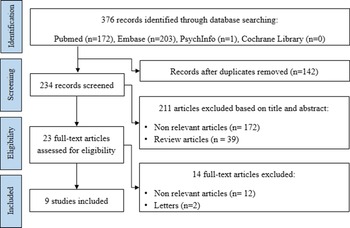
A PRISMA flow diagram outlining the results at each step can be found in Figure 1. Initial papers identified through literature search yielded 376 articles. No additional article was added after hand searching and checking the reference lists of relevant reviews. In total, we excluded 367 articles because they were duplicate, non-relevant, and letters.
PRISMA flow diagram of literature search.

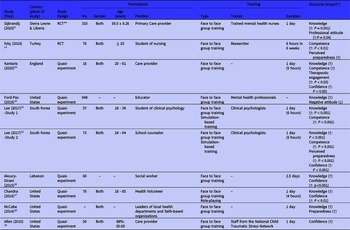
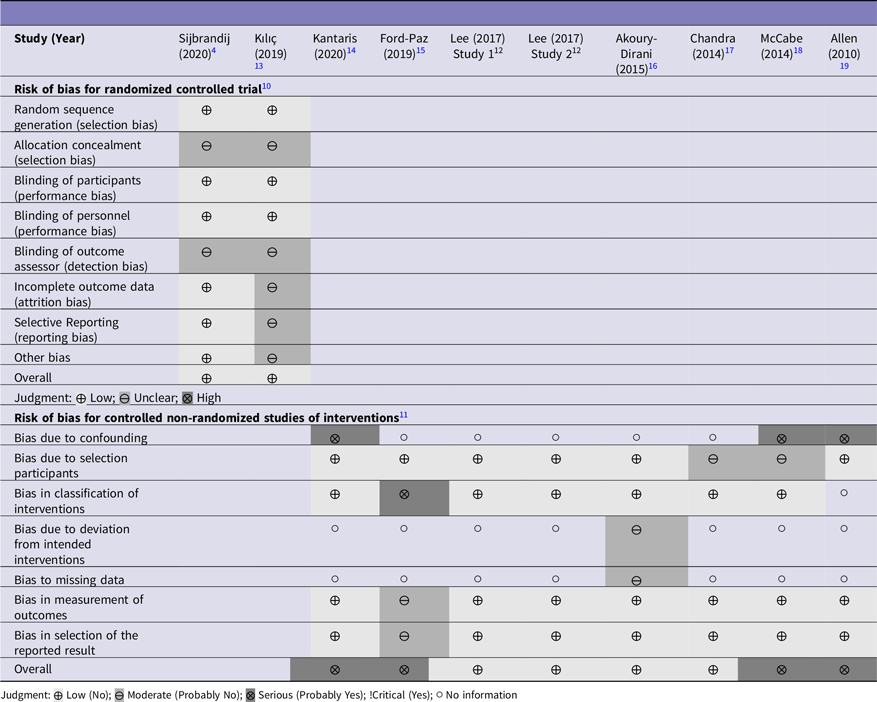
Out of the 9 included articles, 1 consisted of 2 independent studies. Reference Lee, You, Choi, Youn and Shin12 Therefore, we considered both as 2 separate studies. Out of the studies that met inclusion criteria, 2 were RCT, and 8 before-after quasi-experiments (Table 1). All studies were performed after 2009. Table 2 shows the risk of bias assessment of the included RCTs and quasi-experimental studies.
Characteristics of the included studies

*↑: increase; ↓: decrease, **Randomized Control Trial
Risk of bias summary for included studies

The method of training, in all studies, was face-to-face group training. A total of 3 studies used simulation-based training and role-playing too, that led to better outcomes. The training length was 4-6 hours in 80 percent of studies (Table 1). The increase in knowledge was the most common outcome reported in 70 percent of studies, followed by confidence and competence (50% and 40%, respectively). Attitude (20%), preparedness (20%), and therapeutic engagement (10%) were the other outcomes. Most of the studies were done in the United States (n = 4, 40%).
Discussion
This review’s finding indicated that PFA training improved participants’ knowledge, competence, and confidence in providing psychosocial intervention regardless of trainees’ baseline information, the place of study, duration, and method used. It was also reported that acquiring PFA skills increased providers’ confidence in working with both adults and children Reference Allen, Brymer and Steinberg19 ; therefore, it could be considered a practical framework to deliver support during a catastrophe.
Additionally, acquiring fundamental principles of PFA reminded participants of the importance of nonverbal communication and listening skills were pointed out as main components. Reference Chandra, Kim and Pieters17 It is worth mentioning that in 1 study, higher satisfaction with PFA was reported by individuals who had no previous emergency response experience when compared to experienced participants. Reference Allen, Brymer and Steinberg19
According to table 2, most of the studies were quasi-experiments (78%), and more than half of the studies (60%) had acceptable quality; however, to precisely measure the effectiveness of an intervention, controlled trials are preferred. All articles included in this review were written in the past decade, which portrays that the topic is relatively novel and demands more attention and scrutiny.
Horn et al. (2019) discussed that PFA acquisition is not as easy as it is proposed. It is expected that trainees could learn empathic psychosocial support and become equipped with the required skills to deliver it effectively in a short time. However, it is unlikely to be feasible to adapt pre-existing attitudes and lifetime learned responses, which may be aligned with one’s social and cultural norms, to a different pattern of responding in only a day. Reference Horn, O’May and Esliker8 The other controversy about 1-day PFA training is that although it might be sufficient for some people with good communication skills and high empathy levels, most non-professional trainees cannot deliver adequate, supportive, and harmless psychosocial service during the time frame. Reference Horn, O’May and Esliker8 Despite these critiques regarding 1-day PFA workshops’ efficacy, our findings revealed that most training sessions took place in a day. Reference Sijbrandij, Horn and Esliker4,Reference Lee, You, Choi, Youn and Shin12,Reference Kantaris, Radcliffe, Acott, Hughes and Chambers14,Reference Chandra, Kim and Pieters17–Reference Allen, Brymer and Steinberg19
Moreover, studies suggest that for empathy training to be practical, it requires all 4 behavioral training skills, namely instruction, modelling, practice, and feedback, and it should be genuinely experiential, which means role-playing, and receiving feedback on one’s performance are essential for each of the participants in order to strengthen the acquisition and develop new concepts and skills. Reference Teding van Berkhout and Malouff20 Training effectiveness is less when participants are merely being exposed to a demonstration, observing other trainees role-play, or participating in role-playing without receiving individualized feedback, which often is the case as the time is short and the number of participants is large. Reference Teding van Berkhout and Malouff20 There were only 3 programs in which role-playing and simulation-based scenarios were used among the studies we reviewed, and those 3 had better outcomes compared to other training programs.
The other factor reported to be a prominent predictor in changing behavior is post-training supervision. Reference Bertram, Blase and Fixsen21 There is no evidence of post-training supervision in studies conducted to examine the efficacy of PFA training. Although some studies had follow-ups to measure the lasting effect of training on participants for up to 6 months, a decrease in the results over time indicated the necessity of reconducting the training program. Reference Kılıç and Şimşek13
Conclusion
It is important to note that although PFA is the most recommended immediate intervention aftermath and could be acquired by anyone willing to help disaster-affected people, the quality of PFA training is the key to obtaining the desired outcome; non-harmful, empathic, psychosocial support during emergencies. As mentioned by Horn et al. (2019), the misleading assumption that PFA is a low-cost and easy to learn approach often results in short training programs with minimum or no follow-ups. Reference Horn, O’May and Esliker8 The current review also supported this notion that most of the training programs concerning PFA have been short, with few scenario-based interactions and role-playing opportunities, and without post-training supervisions. Hence, to observe the extent of PFA training efficacy on providers, more studies with higher quality training programs are required.
Funding statement
Tehran University of Medical Sciences, Tehran, Iran (No. 99-1-93-41971), supported this study.
Author contributions
MS and EA designed the study. MS developed the search strategy. MM and MKN performed data screening, acquisition, and appraising the quality of studies. MM wrote the manuscript. MS and EA were involved in the critical revision of the manuscript. All authors reviewed and approved the final draft.
Conflict of interest
None.