Introduction
Sialolithiasis is known to be one of the most common diseases of the large salivary glands. One point two per cent of the population suffers from salivary calculi,Reference Teymoortash, Wollstein, Lippert, Peldszus and Werner1 more commonly found in the submandibular gland than in the parotid or sublingual glands.Reference Seifert, Mann, Sialolithiasis, Naumann, Helms, Herberhold and Kastenbauer2 The exact cause of calculus formation is still unknown but differences in lithogenesis are attributed to anatomic factors and to the differences in saliva composition.Reference Teymoortash, Wollstein, Lippert, Peldszus and Werner1, Reference Iro, Zenk, Hornung, Schneider and Ell3, Reference Mimura, Tanaka, Ichinose, Kimijima and Amagasa4 Patients typically present with a postprandial painful swelling at the indicated site, with tendencies to acute inflammation because of saliva stasis.Reference Seifert, Mann, Sialolithiasis, Naumann, Helms, Herberhold and Kastenbauer2, Reference Epker5
First choice for diagnosis after anamnesis and bimanual palpation is ultrasonography (7.5 MHz),Reference Ganzer and Sialolithiasis6 where radiopaque stones can easily be identified by their posterior acoustic shadow or surrounding hypoechogenic halos. Often, a proximal dilatation of the excretory duct can additionally be identified.Reference Bruneton and Mourou7 Other imaging techniques for salivary glands including plain sialography, radiography, scintigraphy, computed tomography or magnetic resonance sialography show no further essential improvement as diagnostic tools.Reference Schratter, Steiner and Imhof8, Reference Lomas, Carroll, Johnson, Antoun, Freer and MR9
Simple forms of sialolithiasis can be treated with sialogogues and massage of the duct in relation to its ostium. If the stone is close to the orifice, dilatation or dissection of the duct can provide a therapeutic cure. Extraction by radiologically guided basket retrievalReference Drage, Brown, Escudier and McGurk10 or laser endoscopic fibre delivery systemsReference Raif, Vardi, Nahlieli and Gannot11 are also discussed in the literature. Otherwise, the surgical removal of the entire gland was the first choice for treatment in former times, including the well-known risks such as injury of the facial, lingual or hypoglossal nerve, Frey's syndrome, scar formation and anaesthetic risks.Reference Berini-Aytes and Gay-Escoda12
In 1986, a new therapeutical method of sialolithiasis was introduced: the extracorporeal shock wave lithotripsy.Reference Marmary13 Pressure waves induce a fragmentation of the calculus which can then be transported to the ostium by saliva easily.Reference Wirth14 This method was first established for the treatment of renal stones in the late 70s,Reference Forssmann, Hepp, Chaussy, Eisenberger and Wanner15 and was then modified for the treatment of gallstones.Reference Sauerbruch, Delius, Paumgartner, Holl, Wess and Weber16, Reference Ell, Kerzel, Heyder, Gunter, Rodl and Flugel17 Its success, with a few modifications, allowed its use in the treatment of salivary stones.Reference Iro, Meier, Nitsche, Wirtz and Ell18, Reference Iro, Nitsche, Schneider and Ell19 The use of extracorporeal shock wave lithotripsy is getting more common because of its effectivity and minimally invasive character, as reported in different publications about its use both in vitro and in vivo.Reference Iro, Zenk, Hornung, Schneider and Ell3, Reference Marmary13, Reference Ell, Kerzel, Heyder, Gunter, Rodl and Flugel17–Reference Yoshimura, Morishita and Sugihara23 The objective of our study was to analyse treatment outcomes in patients who underwent salivary stone lithotripsy with special emphasis on their long-term follow up.
Material and methods
Patients
The present study comprises 167 patients (93 male and 74 female) with a solitary calculus of the salivary gland treated by extracorporeal shock wave lithotripsy in our hospital from 1999 to 2005. Patients' charts as well as ultrasonographic documentations were reviewed retrospectively. For the follow up all patients were asked to fill in a form thus enabling us to analyse the long-term treatment results. The patient's average age was 46 years (10–81 years). Symptoms differed from only intermittent swelling to pain and persistent glandular swelling. The mean duration of symptoms was about two months. Patients with calculi not identifiable by ultrasonography were excluded from extracorporeal shock wave lithotripsy therapy. Other contraindications were acute inflammation of the gland, gingivitis, dentalgia, bleeding disorders or pregnancy. Patients with relative contraindications like cardiovascular risks, cardiac pacemakers, or haemorrhagic diathesis were not excluded and underwent sufficient clinical monitoring according to Streem et al. Reference Streem20
Lithotripter
A Minilith SL 1 lithotripter (Storz Medical, Kreuzlingen, Switzerland) was used for the treatment. Pressure waves were generated from an electromagnetic small diameter source, coupled onto the stone by a parabolic reflector through a water-filled cushion covered with a latex membrane. The shock wave generator was positioned right over the indicated gland until the calculus was located precisely in the focus of the waves. Targeting of the stone was performed by an inline ultrasound transducer, providing continuous monitoring during therapy thus allowing any refocusing in case of patient movement. Ultrasound jelly was applied between the membrane and the skin overlying the affected gland in order to prevent energy loss during transduction of shock waves to the body. The pulses of shock wave energy (10–40 Mpa, grade 1–6) were delivered at a frequency of 120 per minute (2 Hz). Depending on the patient's sensitivity to pain, the pulse intensity was increased up to grade 3. The number of shocks per session was up to 1500.
Treatment administration
Before extracorporeal shock wave lithotripsy was performed, patients underwent at least one ultrasonographic examination with a conventional ultrasound scanner (7.5 MHz) in order to verify the diagnosis and to determine the exact location and size of the stone. In addition to a standard clinical examination, an oral palpation of the duct and the orifice was performed. Stones located close to the ostium or in the distal duct system were treated by duct dilatation or dissection with marsupialisation without extracorporeal shock wave lithotripsy. Acute salivary gland infections were treated with broad-spectrum antibiotics and anti-inflammatory drugs for at least one week before treatment with extracorporeal shock wave lithotripsy. Lithotripsy was only performed after inflammation had completely clinically resolved, or if no other contraindications were present.
During the therapy session, which had a typical duration of about 30 minutes, the patient was lying on his back on an examination couch. Lithotripsy is an out-patient procedure, normally with a rest period of a minimum of one week between the sessions. On average 4.42 sessions were carried out per patient. No premedication (analgesia or anaesthesia) was necessary. Earplugs were used for protection of the auditory system of the patient and the investigator. Additionally, cotton wool was placed in the buccal sulcus and between the teeth of the patient for protection if needed. After each extracorporeal shock wave lithotripsy session the patient was advised to drink sufficient volume of liquids (2–3 l daily) and to use sialogogues (e.g. chewing gum, pieces of lemon, sour candies). Also massage of the affected gland was recommended. The success of the treatment was determined on the basis of regression of the patient's symptoms and the disappearance of calculi on sonographic examination.
Statistics
The differences between the resulting data were analysed by student's t-test and chi-square test considered significant when p < 0.05.
Results
Patients/treatment modalities
A total of 167 patients were treated in our medical centre by extracorporeal shock wave lithotripsy therapy. Seventy-five point four per cent of the calculi were found in the submandibular gland, whereas 23.8 per cent were located in the parotid gland with an average size of 5.94 mm in diameter (minimum 2 mm, maximum 15 mm). A total number of 738 sessions were performed with a mean of 4.42 sessions per patient (range: 1–15 sessions per patient). The number of the applied shock waves ranged from 800–26 500 per patient with a mean of 5498.45. On average, 1221.54 shock waves were administered per session with a mean pulse intensity of grade 2.
Results of the initial treatment
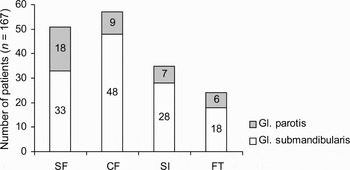
The feedback from the follow-up forms was divided into four categories: patients with total stone disintegration (‘stone-free’), patients with a residual stone but no complaints (‘complaint-free’), patients with a residual stone but improvement of the symptoms (‘symptom improvement’) and patients with no change in their complaints (‘failed treatment’). The results are shown in Figure 1.
Initial results of 167 patients treated with extracorporeal shock wave lithotripsy (average 4.42 sessions) in correlation to stone localisation: SF = stone-free (30.5 per cent); CF = complaint-free (34.1 per cent); SI = symptom improvement (21.0 per cent); FT = failed treatment (14.4 per cent)

A total success was achieved in 51 patients out of 167 (30.5 per cent); 33 patients with submandibular and 18 with parotid calculi. Forty-five per cent of this therapy success was achieved after the first two sessions of extracorporeal shock wave lithotripsy treatment with no detectable stone on ultrasonography afterwards. Ninety-two patients (55.1 per cent) had partially successful treatment, with a disappearance of all symptoms but a sonographically still identifiable stone in 57 patients (48 submandibular and 9 parotid calculi) or improvement of symptoms in 35 patients (28 submandibular and 7 parotid concretions). Failed treatment occurred in 24 patients (14.4 per cent) with 18 submandibular and 6 parotid gland calculi. These patients underwent surgical therapy (14 submandibulectomies or lateral parotidectomies, 10 duct dissections). No direct relation between the success of the therapy and the size of the stone could be detected. The average stone size of the patients with total stone disintegration was 6.3 mm. Partially successful treatment occurred in patients with an average stone diameter of 6.7 mm. Interestingly, the average size of the stones of patients for whom treatment failed was 5.1 mm (3–15 mm).
Adverse effects
During the therapy sessions, patients were complaining about discomfort, coughing and pain proportional to the power of the shock waves. This was handled by repositioning the patient, using cotton wool in the buccal sulcus, drinking a glass of water or reducing the power. After the therapy, local petechial haemorrhages or localised self-limiting swelling of the gland was also common. In five patients the extracorporeal shock wave lithotripsy therapy led to an acute exacerbation of infection in an otherwise chronically infected gland, which was treated with antibiotics and anti-inflammatory drugs. One patient complained about intermittent tinnitus after six sessions that was self-limiting after a few days. He was the only patient who rejected wearing earplugs during therapy. In two other cases the patients reported the loss of an old tooth filling. No other complications or severe side effects were noted during or following treatment. Eighty-nine per cent of the patients did not complain about any uncomfortable side effects.
Follow up
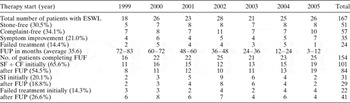
The treatment with extracorporeal shock wave lithotripsy was initially stopped when the stone was no longer detectable by sonography or the patient was free of symptoms. If there was no change in the complaint after the 10th session, the extracorporeal shock wave lithotripsy therapy was also terminated and the patient was advised to undergo surgical therapy. In single cases with special indications, more than 10 sessions were performed. All 167 patients treated between 1999 and 2005 were asked to fill in a questionnaire about their extracorporeal shock wave lithotripsy treatment, concerning the first occurrence of the symptoms, their therapy experiences, and the post-treatment period. One hundred and fifty-four patients (92.2 per cent) sent their questionnaire back for analysis. The mean follow-up period for all patients was 35.6 months (minimum three, maximum 83 months) after the end of therapy. The patients reported that the first symptoms like swelling and pain had occurred for a period of time of two months on average before diagnosis of the disease. Most of the patients (62.2 per cent) reported about tolerable therapy sessions, however, 37.8 per cent complained about really painful extracorporeal shock wave lithotripsy sessions. Table I gives an overview about the total number of patients, the number of patients who filled in the follow-up forms, their therapy start date, follow-up periods and the results.
Results of the extracorporeal shock wave lithotripsy treatment initially and after the follow-up period of seven years

ESWL = extracorporeal shock wave lithotripsy; SF = stone-free; CF = complaint-free; SI = symptom improvement; FUF = follow-up form; FUP = follow-up period
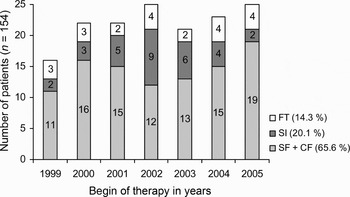
The outcome of the follow-up forms was differentiated into four groups as described above: ‘stone-free’, ‘complaint-free’, ‘symptom improvement’ and ‘failed treatment’. After the initial treatment with extracorporeal shock wave lithotripsy, 101 out of 154 (65.6 per cent) patients were stone- and complaint-free. Eleven of them started their treatment in the year 1999, 16 in 2000, 15 in 2001, 12 in 2002, 13 in 2003, 15 in 2004 and 19 in 2005 (Figure 2). Thirty-one (20.1 per cent) patients reported an improvement of their symptoms, whereas 22 (14.3 per cent) patients had an extracorporeal shock wave lithotripsy treatment failure and underwent surgery, meaning duct dissection or complete extirpation of the salivary gland.
Initial results of the patients treated with extracorporeal shock wave lithotripsy (n = 154), who filled in the questionnaire: SF = stone-free; CF = complaint-free (SF + CF 65.6 per cent); SI = symptom improvement (20.1 per cent); FT = failed treatment (14.3 per cent)

The mean follow-up period for all patients was 35.6 months (minimum three, maximum 83 months) after the end of the therapy. The initial results of these patients are shown in Figure 3. After this period of time 84 (83.2 per cent) of the initially 101 stone- and complaint-free patients were still free of complaints. In detail, eight (72.7 per cent) of the 11 initially stone- and complaint-free patients who started their treatment in the year 1999 were still free of any symptoms (follow-up period 72–83 months). Eleven (68.8 per cent) of the initial 16 patients who started their treatment in 2000 (follow-up period 60–72 months), 12 (80.0 per cent) of the initial 15 patients who started in 2001 (follow up-period 48–60 months), 10 (83.3 per cent) out of 12 who started in 2002 (follow up-period 36–48 months), 11 (84.6 per cent) out of 13 who started in 2003 (follow-up period 24–36 months), 13 (86.7 per cent) of the initially 15 symptom-free patients with the start of their therapy in 2004 (follow-up period 12–24 months) and all 19 patients (100.0 per cent) whose therapy started in 2005 (follow-up period 3–12 months) were still symptom-free at the date of our follow-up (Table I).
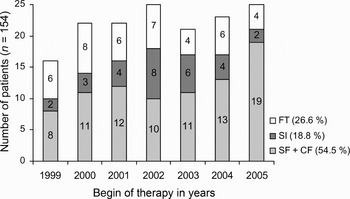
Follow-up results of the patients treated with extracorporeal shock wave lithotripsy (n = 154) after the observation period of 7 years: SF = stone-free; CF = complaint-free (SF + CF 54.5 per cent); SI = symptom improvement (18.8 per cent); FT = failed treatment (26.6 per cent)

Seventeen (16.8 per cent) of the initially stone- and complaint-free patients had a recurrence during the follow-up period, six of them during the first 12 months, nine patients between 12–48 months and two after more than 48 months. These patients were treated by a combination of extracorporeal shock wave lithotripsy and duct dissection, only duct dissection, or, in six cases, by a total extirpation of the gland.
After our follow-up period, 29 (93.5 per cent) out of the initial 31 patients still reported an improvement in their symptoms after extracorporeal shock wave lithotripsy treatment. Two patients showed a recurrence within the first two years which had to be treated surgically.
In total, 41 (26.3 per cent) of the 154 initially treated patients had a treatment failure during the follow-up period, underwent different surgical therapies and had no further complaints.
Discussion
In the late 80s, a new method for the treatment of sialolithiasis was introduced: the extracoporeal shock wave lithotripsy.Reference Marmary13, Reference Iro, Nitsche, Schneider and Ell19 Small modifications to the treatment method of renalReference Forssmann, Hepp, Chaussy, Eisenberger and Wanner15 and gallstonesReference Sauerbruch, Delius, Paumgartner, Holl, Wess and Weber16, Reference Ell, Kerzel, Heyder, Gunter, Rodl and Flugel17 allowed its introduction and establishment in the therapy guidelines for sialolithiasis. This method is based on the fragmentation of the calculus by pressure waves. The fragments can then be transported to the ostium of the gland by normal saliva flow.Reference Wirth14 The objective for this treatment is the total elimination of the concretion, so that the saliva duct obstruction can be dissolved. Chronic obstruction and parallel acute bacterial inflammation normally lead to a severe reduction of the gland functions. Different authors show a functional recovery after stone eradication by scintigraphic examinations.Reference Akker, van and Busemann-Sokole21–Reference Escudier, Brown, Drage and McGurk24 In 1989 Iro et al. performed multiple animal and in vitro experiments using the piezoelectric shock wave generator.Reference Iro, Nitsche, Schneider and Ell19 In 1990, the first clinical report on successful treatment for patients with salivary stones was published.Reference Iro, Schneider, Nitsche, Waitz and Ell25 The use of extracorporeal shock wave lithotripsy is getting more common because of its effectivity and minimally invasive character, as reported in different publications about its use both in vitro and in vivo.Reference Iro, Zenk, Hornung, Schneider and Ell3, Reference Marmary13, Reference Ell, Kerzel, Heyder, Gunter, Rodl and Flugel17–Reference Streem20, Reference Escudier, Brown, Drage and McGurk24–Reference Reimers, Vavrina and Schlegel42 Comparison between these studies is difficult because of the use of two different forms of pressure wave generators (piezoelectric or electromagnetic), different treatment modalities, thus varying the number of sessions or applicated shock waves, lack of differentiation between total or partial success, or size of the concretion.
Diagnostics and stone localisation
All authors agree that ultrasonography is the foremost imaging technique for examination of salivary gland diseases, whether for tumoural, inflammatory or obstructive pathologies. In nearly all cases, ultrasound is sufficient for therapeutic decisions without the exact knowledge of saliva composition or evaluation of the ductal system, which show no further essential improvement as diagnostic tools. In special indications it can be complemented by computed tomography or magnetic resonance imagingReference Bruneton and Mourou7, Reference Lomas, Carroll, Johnson, Antoun, Freer and MR9 or other imaging techniques like sialography, radiography or scintigraphy, which was not necessary in our study.
Intraductal concretions, which were close to the ostium were mostly treated by duct dilatation or dissection. Extracorporeal shock wave lithotripsy was performed only on patients with intraglandular concretions. In the present study, stone localisation was mainly in the submandibular gland (75.4 per cent), whereas the parotid gland was only affected in 24.0 per cent of the cases. Most authors describe similar results concerning concretion occurrence.Reference Zenk, Constantinidis, Kydles, Hornung and Iro26, Reference Aidan, De, LeDuc and Monteil32, Reference Ottaviani, Capaccio, Campi and Ottaviani37, Reference Wehrmann, Kater, Marlinghaus, Peters and Caspary38 Hong et al. reported on a case of sublingual gland sialolithiasis that is very rare.Reference Hong and Yang27 Bilateral occurrence of salivary gland stones was reported in about 2 per cent of patients.Reference Escudier, Brown, Drage and McGurk24 Interestingly, most of the affected glands in our study were situated on the left side of the patient, as also reported by Ottaviani et al. Reference Ottaviani, Cappacio, Rivolta, Cosmacini, Pignataro and Castagnone28 The reason is still unknown. Pedersen et al. Reference Pedersen, Bardow, Beier-Jensen and Nauntofte29 reported on an increased salivary secretion in response to chewing as a result of a masticatory–salivary reflex, which has been found to be unilateral. As the formation of a salivary gland stone is also based on decreased saliva production, this could be an explanation for this phenomenon.
• Extracorporeal shock wave lithotripsy is a relatively new therapeutic method in the treatment of sialolithiasis
• This paper evaluates extracorporeal shock wave lithotripsy in 167 patients with sialolithiasis
• Successful treatment with total stone disintegration was achieved in 51 (31 per cent) patients, whereas 92 (55 per cent) patients had a partially successful outcome, with symptom disappearance but a sonographically still identifiable stone
• Extracorporeal shock wave lithotripsy, as a non-invasive treatment alternative with few side effects, is an efficient technique for the management of sialolithiasis in selected patients
Treatment modalities
In the literature, the number of extracorporeal shock wave lithotripsy therapy sessions differs from maximal three,Reference Iro, Benzel, Zenk, Fodra and Heinritz30–Reference Aidan, De, LeDuc and Monteil32 to fourReference Hessling, Schick, Luckey, Gratz, Qaiyumi and Allhoff33 or fiveReference Gutmann, Ziegler, Leunig, Jacob and Feyh34 sessions. We administered a maximum of 1500 shock waves per session in about 4.4 sessions on average per patient with a typical duration of 30 minutes. Differences in the number of applications occurred due to individual variance depending on compliance of the patient during therapyReference Fokas, Putzr, Dempf and Eckardt35 and on the number of shock waves varying from 1000 up to 5000 per session.Reference Kater, Meyer, Wehrmann, Hurst, Buhne and Schlick36, Reference Escudier, Brown, Drage and McGurk24
Therapy results
The literature also yields different data on therapy results: authors report a partial success rate in 55–100 per centReference Iro, Benzel, Zenk, Fodra and Heinritz30, Reference Iro, Schneider, Fodra, Waitz, Nitsche and Heinritz31, Reference Hessling, Schick, Luckey, Gratz, Qaiyumi and Allhoff33, Reference Ottaviani, Capaccio, Campi and Ottaviani37, Reference Wehrmann, Kater, Marlinghaus, Peters and Caspary38 and a complete success rate in 33–100 per centReference Iro, Schneider, Fodra, Waitz, Nitsche and Heinritz31, Reference Aidan, De, LeDuc and Monteil32, Reference Wehrmann, Kater, Marlinghaus, Peters and Caspary38, Reference Yoshizaki, Maruyama, Motoi, Wasaka and Furukawa39 of their patients and failure in 18–32 per cent.Reference Escudier, Brown, Drage and McGurk24, Reference Hessling, Schick, Luckey, Gratz, Qaiyumi and Allhoff33 In our study, we had a partial success in 55.1 per cent, a total success in 30.5 per cent and a treatment failure in 14.4 per cent of the patients, which fits in with the results of the literature. No significant differences between therapy success and patient gender or smoking habits was identified (p > 0.05).
A direct comparison with the literature seems to be difficult because of different types of lithotriptors with different shock wave generators, missing information about the afflicted gland, stone size, gland function and different opinions about what constitutes a ‘complete’ or ‘partial’ success. In general, the treatment of parotid stones is more effective than that of submandibular stones because of easier targeting (superficial location) or physiological features like serous saliva and the descending path of the parotid duct.Reference Escudier, Brown, Drage and McGurk24, Reference Ottaviani, Cappacio, Rivolta, Cosmacini, Pignataro and Castagnone28 We agree that the number of patients with a complete success rate after the initial treatment is significantly higher in patients with parotid (45 per cent) than with submandibular (26 per cent) stones (p < 0.05).
Some authors discuss the stone size as a predictive factor for a successful stone eliminationReference Escudier, Brown, Drage and McGurk24 showing a positive correlation between the number of administered shock waves and stone size.Reference Gutmann, Ziegler, Leunig, Jacob and Feyh34 In contrast, our study revealed no correlation between the stone size and treatment success as do to other reports.Reference Marmary13, Reference Iro, Meier, Nitsche, Wirtz and Ell18, Reference Fokas, Putzr, Dempf and Eckardt35, Reference Iro, Zenk, Waldfahrer, Benzel, Schneider and Ell40 Gutmann et al. Reference Gutmann, Ziegler, Leunig, Jacob and Feyh34 found a positive correlation of stone composition as analysed by infrared spectroscopy and the number of shock waves needed for therapy. They showed that a normal stone composition consists mostly of 60–95 per cent carbonate apatite and 5–40 per cent protein. Stones with a higher protein portion (>20 per cent) needed less shock waves for a successful treatment.
Adverse events
Lithotripsy as a non-invasive therapy method shows only a few side effects like pain, swelling, haemorrhage and inflammation.Reference Fokas, Putzr, Dempf and Eckardt35, Reference Ottaviani, Capaccio, Campi and Ottaviani37, Reference Iro, Zenk, Waldfahrer, Benzel, Schneider and Ell40, Reference Külkens, Quetz, Lippert, Folz and Werner41 No severe complications like damage to the facial nerve or irreversible hearing disorders have been described. Precautions such as positioning of cotton wool in the buccal sulcus or wearing earplugs during therapy sessions are helpful in order to avoid discomfort. In our study no anaesthesia or sedation was required as proposed by Kater et al. Reference Kater, Meyer, Wehrmann, Hurst, Buhne and Schlick36
Follow-up results
The mean follow-up period for all patients in our study was 35.6 months (minimum three, maximum 83 months). One hundred and fifty-four (92.2 per cent) of the 167 initially treated patients answered our questionnaire. After the follow-up period 84 of these (54.5 per cent) were still stone- and complaint-free, whereas 29 patients (18.8 per cent) reported an improvement of their symptoms, but had no further therapy. This means a total and partial success rate of 73.3 per cent in our patients during the observation period of seven years. Only 41 patients (26.6 per cent) out of 154 had a treatment failure and had to undergo surgery. They had no more complaints during the follow-up period. In detail, 84 (83.2 per cent) of the initially 101 successfully treated patients were still free of symptoms after the follow-up period of seven years; 61.9 per cent of them over an observation time of more than 24 months and 36.9 per cent over more than 48 months (Table I). These results confirm that the eradication of the concretion and hence the removal of the chronic obstruction leads to a functional recovery of the gland as a possible explanation for the low rate of recurrence. The follow up of our patients will be supported by sialendoscopy in future, in order to attain higher levels of total stone disintegration and better long-term results.
In the literature Reimers et al. Reference Reimers, Vavrina and Schlegel42 observed 71 patients over a time period of 24 months, where 48 per cent of the patients with parotid stones and 29 per cent of the patients with submandibular stones were still completely free of stones and any symptoms. Külkens et al. Reference Külkens, Quetz, Lippert, Folz and Werner41 demonstrated a mean follow-up period of 63 months with a complete dissolution of the stone in 67 per cent of 33 patients. Iro et al. Reference Iro, Zenk, Waldfahrer, Benzel, Schneider and Ell40 reported on 76 patients with a mean follow-up period of 48 months, of which 50 per cent were free of stones after extracorporeal shock wave lithotripsy therapy. Zenk et al., Reference Zenk, Bozzato, Winter, Gottwald and Iro43 who analysed a population of 191 patients over 10 years, noted that 35 per cent were still free of stones or symptoms and 15 per cent had improvement in their symptoms and required no further therapy. The remaining 50 per cent had residual stones with recurrent complaints depending on the stone localisation within the gland. Andretta et al. Reference Andretta, Tregnaghi, Prosenikliev and Staffieri44 described a successful therapy in 68 per cent of their patients after 10 years. These results, together with our experience, show that this therapy can be a safe and successful treatment and demonstrates its efficacy in the long term in supporting a functional gland recovery after stone extirpation.Reference Yoshimura, Morishita and Sugihara23 As discussed above, comparison of different studies is difficult because of the use of different pressure wave generators or variation in the treatment modalities varying with shock waves applied, total number of therapy sessions or concretion size. The most limiting factor is the differing view of authors as to what is a ‘successful treatment’ which is often not separated into total or partial success.
Considering the surgical risks of gland extirpation, extracorporeal shock wave lithotripsy is a painless and non-invasive therapy method, with promising long-term success, and is the treatment of choice for salivary gland stones in selected patients considering the concretion size and localisation. The combination of extracorporeal shock wave lithotripsy and either diagnostic or therapeutic sialendoscopy is a promising therapy modality for salivary gland stones of which we expect an improvement in the numbers of completely stone- and complaint-free patients in the future.