I. INTRODUCTION
Titanium alloys are widely used in biomedical applications especially in implantation materials due to their low density, low modulus, high strength, excellent biocompatibility, and enhanced corrosion resistance to chlorides and oxidizing substances. Reference Chen and Thouas1 These properties depend essentially on the chemical composition and phase stabilization. Reference Hao, Li, Sun, Zheng and Yang2 The β-type titanium alloys (the so-called “second generation Ti-alloys”) have the lowest modulus due to the low density of the body-centered cubic (bcc) β-structure. In addition, they are known for their high mechanical strength-to-weight ratio, toughness, and resistance to stress corrosion cracking and to hydrogen embrittlement. Reference Baker, Okamoto and Henry3 Among the β-type Ti-based materials, Ti–Nb system has attracted particular attention due to their low stiffness (reduction of stress shielding effects) and superelastic behaviors caused by the stress-induced martensitic transformation between a cubic β phase and orthorhombic α″ martensite phase. Reference Fu, Yamamoto, Kim, Hosoda and Miyazaki4 Superelastic behavior is observed in the Ti–(25.5–27) at.% Nb alloys. The largest strain recovered superelastically is obtained in the Ti–26 at.% Nb alloy (Ti–40 wt% Nb). Reference Miyazaki, Kim and Hosoda5 Ti–40 wt% Nb also has a good combination of high mechanical strength and low Young’s modulus values. Those aspects are of particular importance in the case of osteoporotic bone and seem to be promising for an application as load bearing replacement or implantation materials. However, a major problem with the replacement or implantation materials is the possibility of pathogenic microorganism infection after the surgery. These pathogenic microorganism infections will become serious if it is not treated properly and leads to revision of surgeries or implant loosening even implantation failure. Although in orthopedic surgery, sterile surgical condition and perioperative antibiotic prophylaxis are used, rates of bacterial infection are 1–4% after replacement surgery and 2–30% after external fixation. Reference Harris and Sledge6 Also the increasing extensive use of antibiotic has led to a considerable drug resistance in the study of antimicrobial functionality. Therefore, to reduce the incidence of implant-associated infections, the biomedical implant materials with good antimicrobial property are of great importance.
Copper (Cu) has been shown to exhibit excellent antimicrobial properties in killing a very broad spectrum of bacteria and fungi and represents lower toxicity and higher cytocompatibility compared to other antimicrobial elements (Ag and Zn) for a long time. Reference Heidenau, Mittelmeier, Detsch, Haenle, Stenzel, Ziegler and Gollwitzer7 Copper, as an essential trace element present in a human body, is essential for biological enzymes and ceruloplasmin in the blood stream. Reference Chen and Thouas1 The deficiency of Cu could result in anemia from preventing the ferroxidase system to regulate iron transport in the blood and facilitate release from storage. Reference Waizy, Seitz, Reifenrath, Weizbauer, Bach, Meyer-Lindenberg, Denkena and Windhagen8,Reference Ding, Wen, Hodgson and Li9 The human body holds a level of 1.1–1.5 μg/mL Cu element in blood serum, and the daily allowance of Cu is 2–3 mg; generally, 1 mg per of dietary Cu can be absorbed in the body. And with emulsification of bile secretions, the excess Cu is excreted, which will cause neurodegenerative diseases (Alzheimer’s disease), whereas silver or zinc tends to stay in the human body and increases the silver serum levels. Reference Abdelmageed and Oehme10 Copper is relatively cheap and has superior electrical and thermal conductivity. Additionally, the addition of copper, as a β-stabilizer element to form eutectoid transformation with a Ti alloy, can stabilize the superelastic properties of alloys against cyclic deformation and reduce the stress–strain diagram hysteresis. Reference Morakabati, Kheirandish, Aboutalebi, Taheri and Abbasi11 Ti–Cu sintered alloys have been proven to be a new antibacterial material which has excellent antibacterial properties as well as good cell biocompatibility in the previous research. Reference Zhang, Zheng, Liu, Bai and Liu12,Reference Zhang, Li, Wang, Liu, Wang and Li13 Due to these unique properties, it can be envisaged that the superelastic Ti–40Nb alloy alloying antimicrobial Cu element seems to have favorable mechanical and antimicrobial properties for biomedical application.
In this study, Cu element was successfully introduced into superelastic Ti–40Nb alloys to improve their antibacterial activity and mechanical properties by the spark plasma sintering (SPS). The as-sintered biocomposites were expected to have excellent mechanical properties, biocompatibility and antimicrobial. So we investigated the effect of Cu contents (0, 2.5, 5, 7.5, and 10 wt%) on the microstructure, mechanical properties, and antimicrobial characterization of the (Ti–40Nb)–Cu (TNC) alloys. The TNC alloys were characterized using an X-ray diffractometer (XRD), scanning electron microscopy (SEM), and energy-dispersive X-ray spectroscopy (EDX). The Cu ion release and antimicrobial tests were used to study the antimicrobial behavior.
II. MATERIALS AND METHODS
A. Materials and synthesis of Ti–Nb–Cu alloy
Titanium (99.9%, wt% purity, 25 μm), niobium (99.95%, wt% purity, 10.5 μm), and copper particles (99.9%, wt% purity, 25 μm) were used in this study. The elemental powders of Ti, Nb, and Cu were mixed together according to nominal compositions of (Ti–40Nb)–xCu, x = 0, 2.5, 5, 7.5, and 10 wt%. Holden et al. made detailed research of Ti–Cu alloys which showed that an alloy containing 10 wt% or more copper had relatively poor mechanical properties. Reference Holden, Watts, Ogden and Jaffee14 The blending was performed in a planetary ball mill (XQM-4, Nanjing Institute of Experimental Apparatus, Nanjing, China) with a stainless steel jar and balls in vacuum at a rotating speed of 300 rpm for 10 h. The weight ratio of stainless steel balls to mixed powders was 3:1. During the mixing and milling process, anhydrous alcohol was used to keep the balance between cold welding and fracturing of powders. The milled powders were then dried in a vacuum drying oven.
The as-milled powders were sintered by SPS (SPS-515S, Syntex Inc, Aichi, Japan) at 1050 °C with a holding time of 5 min in a vacuum chamber of 10 Pa (heating rate was 100 °C/min). During the sintering process, a uniaxial pressure of 40 MPa was applied. The sintered samples were cooled in a chamber with an approximately cooling rate of 50 °C/min. After the sample preparation, the samples for subsequent tests were mechanically polished after sequentially ground with a SiC paper down to 2000 grits, ultrasonically cleaned in acetone, alcohol, and distilled water, then etched with Kroll’s reagent, consisting of 10 mL HF, 5 mL HNO3, and 85 mL H2O for 120 s, and finally dried at room temperature.
B. Structure and morphology characterization
X-ray diffraction (XRD) measurements were carried out to verify the phase constitution after mechanical milling and SPS. X-ray diffraction patterns were obtained utilizing a diffractometer (D8 Advance, Bruker, Karlsruhe, Germany) operated at 40 kV and 30 mA with Cu K radiation and a wavelength of 0.15406 nm at a scan rate of 8°/min with a step size of 0.02° in the diffraction (2-theta) angle.
The surface morphology and determination of chemical compositions of (Ti–40Nb)–xCu biocomposites were observed using a scanning electron microscope (SEM; Quanta 200, FEI Company, Hillsboro, Oregon) with an X-energy spectrometer system (EDAX Genesis 2000, FEI Company).
C. Mechanical and corrosion properties
The mechanical properties of the biocomposites were measured by compression elastic moduli, compressive strength, yield strength, and plastic strain tests. For the mechanical properties tests (compression elastic modulus, compressive strength), the sintered biocomposites were conducted at room temperature according to the ASTM: E9-09 and ASTM E494 standard on the Shimadzu AG-X universal testing machine (Shimadzu Corp., Kyoto, Japan). Three test specimens were conducted for each material and the average values were calculated to be reported. Three samples from each group were conducted and the average values were calculated to be reported. Data were presented as a mean ± standard deviation.
The Vickers indentation hardness of the sintered biocomposite specimens was tested on the polished surfaces at a load of 9.8 N and a dwell time of 10 s. The indentations were repeated 5 times on each composition to minimize the experiment error.
D. Copper ion release test
To examine the ion release, the TNC sample was immersed in a 10 mL Hank’s solution with a surface area-to-volume ratio of 1.5 cm2/mL with reference to ISO Standard 10993-12:2002 and ISO Standard 10993-15:2000 for 1, 7, 14, and 28 days, respectively. The immersion solution used to simulate the physiological medium and to perform the ion release testing was a naturally aerated Hank’s artificial simulated body fluids. The composition of Hank’s artificial simulated body fluids is as follows: NaCl 8 g/L, Na2HPO4 0.0475 g/L, NaHCO3 0.35 g/L, KCl 0.4 g/L, KH2PO4 0.06 g/L, MgCl2–6H2O 0.10 g/L, MgSO4–7H2O 0.10 g/L, CaCl2 0.18 g/L, glucose 1 g/L, and pH 7.4. The solution was maintained at 310 ± 0.5 K (37 ± 0.5 °C) throughout the tests to simulate the physiological environment. The pH of this solution is 7.4, which is very similar to that of physiological fluid. The container was sealed to prevent the evaporation of water. Cu ion concentrations in the Hank’s solution were estimated by an inductively coupled plasma (ICP-MS) spectrometry analysis (Optima 5300DV, Perkin Elmer, Waltham, Massachusetts) with an accuracy of 0.005 mg/L.
E. Antimicrobial test
The antimicrobial activity was evaluated by a spread plate method (ASTM G21-96). E. coli (gram negative bacteria), S. aureus (gram positive bacteria), and C. albicans (fungi) were used in this study. Before the tests, the sintered alloys were placed inside the rear pressure steam sterilizer for 60 min and then sterilized by a UV lamp to avoid microorganism inclusions. Bacterial colonies of TNC alloys were counted and compared with a control blank sample after 24 h incubation at 37 °C in a separate Petri dish. The whole experiment was repeated thrice to reproduce the data. The antibacterial ratio (R) was calculated using the formula
 $$R\left( \% \right) = \left( {B - C{\rm{/}}B} \right) \times 100\quad ,$$
where R is the antibacterial effect (%), B is the mean number of bacteria on the control sample (CFU/sample), and C is the mean number of bacteria on the treated samples (CFU/sample). Reference Ren, Hu, Cheng, Vargas-Reus, Reip and Allaker15
III. RESULTS AND DISCUSSION
A. Phase identification and microstructure
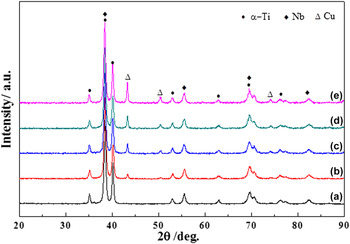
An XRD analysis was performed to determine the phases present in the milled TNC powder and sintered TNC alloys at room temperature. Figure 1 shows the XRD patterns of the milled TNC powder. In the patterns of the milled TNC powder (Fig. 1), diffraction peaks of Ti, Nb, and Cu are clearly shown in the figure without any other intermetallics or impurities, except that the Ti–40Nb does not show the corresponding peaks of Cu. This outcome indicates that no reaction or mechanical alloying happened among titanium, niobium, and copper powders after ball milling. Also the intensity of Cu element peaks (43°, 51° and 74°) increases suggesting an increment in Cu volume fraction.
XRD patterns of as-milled (Ti–40Nb)–xCu powders for different Cu contents: (a) x = 0, (b) x = 2.5, (c) x = 5, (d) x = 7.5, and (e) x = 10.

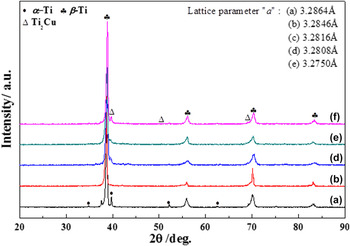
Figure 2 shows the XRD patterns of the sintered TNC alloys. It can be seen from XRD spectra in Fig. 2 that all alloys had a β-phase microstructure. In the Ti–40Nb alloy, it contains a dual-phase microstructure of α (hexagonal close packed) and β (body centered cubic) phases at room temperature, although the concentration of α phase is low. The microstructure of Ti–40Nb fabricated by a traditional sintering method consists of single bcc β-phase (a β-Ti type Nb-rich solid solution). Reference Calin, Helth, Gutierrez, Bönisch, Brackmann and Giebeler16 These nuanced results can be ascribed to the significantly enhanced heating (100 °C/min) and cooling rates (50 °C/min) and the unique SPS mechanism. After addition of Cu elements (β stabilizers), the formation of α phase is suppressed and the alloy exhibits stronger β peaks. At the lower Cu concentration (2.5 wt%), only the β phase was found, and intermetallic compounds either did not exist at all or the minimal amount of intermetallic compounds that possibly existed made it difficult to detect anything by the XRD instrument. When the Cu concentration is up to 5% or more, the spectra showed the presence of peaks of Ti2Cu intermetallic, which were transformed from β-Ti at the eutectoid temperature. There was a tendency for the volume fraction of Ti2Cu intermetallic to increase with the increase in the Cu content of the TNC alloy.
XRD patterns of sintered (Ti–40Nb)–xCu alloys for different Cu contents: (a) x = 0, (b) x = 2.5, (c) x = 5, (d) x = 7.5, and (e) x = 10. Insets show the calculated lattice parameter “α” of cubic β-phase from sintered TNC alloys.

The inset of Fig. 2 summarizes the lattice parameter “α” of cubic β-phase calculated from the XRD spectra of the sintered TNC alloys. The lattice parameters of the sintered alloys were calculated using the Rietveld method. The information presented in the inset of Fig. 2 suggests that the lattice parameter of α changes as a function of the Cu content alloying with the Ti–Nb alloy. The lattice parameter of α decreased about 0.12 pm with 1% increase in the Cu content. Similar results have been reported before for Al addition in Ti–35Nb alloys. Reference Farooq, Khalid, Zaigham and Abidi17 The decrease in “α” values can be attributed to the following two reasons: (i) a smaller atomic radius of substitutional alloying element Cu (0.127 nm) comparing to that of a Ti atom (0.147 nm); (ii) the lattice parameter of cubic β-phase Ti is reduced through substitution of Ti by Cu; (iii) the formation of β solid solution.
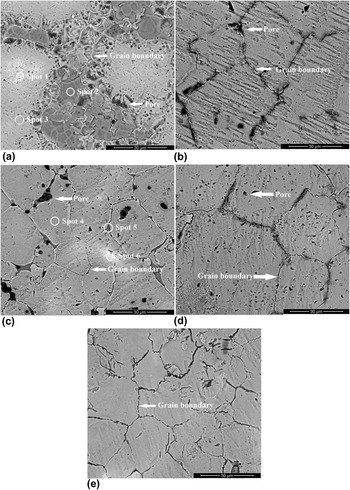
It is well known that the microstructure of metallic alloys has an important role on the mechanical properties and corrosion behavior of composites. Typical SEM-BSE images revealing the microstructures of the sintered TNC alloys varying Cu contents are shown in Fig. 3. Analyzing Fig. 3(a) with the EDS results (Table I), it has been shown that unmelted Ti [spot 2 in Fig. 3(a)] and Nb [spot 1 in Fig. 3(a)] metal particles were found. It can be seen that the microstructures of all the alloys mainly contain β-phases, and the grains have regular polygons and the grain boundaries are flat and straight. The microstructures also revealed that different additions of Cu had effects on the different types of phases formed. As the Cu content increased, no significant white and black areas were found but the gray area increased. Former research had shown that Ti alloyed with copper element is reported to lower melting temperature by causing the liquidus temperature to below the Ti melting point. Reference Baker, Okamoto and Henry3,Reference Lee, Ju and Chern-Lin18,Reference Murray and Baker19 In Figs. 3(a) and 3(b), sintered alloys with Cu element present higher homogeneity. The round pores were observed except the high Cu concentration alloy (10 wt%). The observed small pores are deduced by the addition of Cu element and an increased Cu content. Cu (melting point: 1083 °C) almost forms a liquid phase during the SPS process (sintering temperature: 1050 °C), improving significantly the diffusion of the sintering process, which confirms that the copper element could lower the melting temperature of Ti-alloys. The superelastic behavior of materials depends on the grain size. The Cu addition had effect on the grain size of the Ti–Nb alloys. The grain refinement usually results in the improved superelasticity, because it increases the critical stress for slip. Reference Otsuka and Wayman20,Reference Hayama, Andrade, Cremasco, Contieri, Afonso and Caram21
Micrographs of sintered (Ti–40Nb)–xCu alloys for different Cu contents: (a) x = 0, (b) x = 2.5, (c) x = 5, (d) x = 7.5, and (e) x = 10.

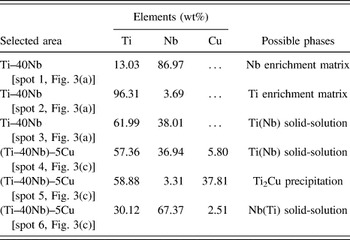
EDS analyses of Ti–40Nb and (Ti–40Nb)–5Cu alloy surface in Fig. 3.

EDS results of the alloy surface marked in Fig. 3 are presented in Table I. In Fig. 3(a), as high as 86.97 wt% Nb and 96.31 wt% Ti were detected in the white region (spot 1) and the black region (spot 2), respectively, corresponding to Nb enrichment region and Ti enrichment region. There were about 37.81 wt% Cu and 58.88 wt% Ti in the gray region [spot 5 in Fig. 3(c)], and the atomic ratio of Ti to Cu was close to 2:1. Combined with the EDS result and XRD pattern, it was deduced that the gray phase (spot 5) was a Ti–Cu intermetallic phase, which has a stoichiometric composition of Ti2Cu. With the consideration of EDS results, Ti2Cu seemed to have precipitated along the phase boundaries of β-Ti. This phenomenon occurred because Ti2Cu transform from as the temperature decreased from the eutectoid temperature. The mechanism of Ti2Cu formation from the β-Ti eutectoid decomposition of Ti–Cu binary alloy has been previously investigated. Reference Lee and Aaronson22
B. Mechanical properties
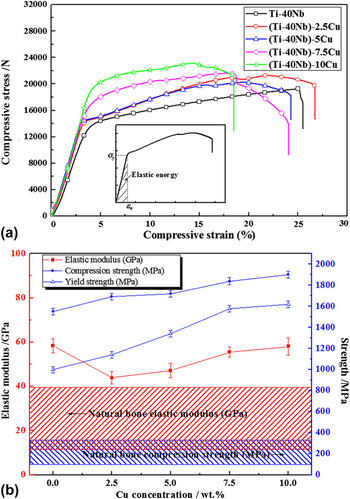
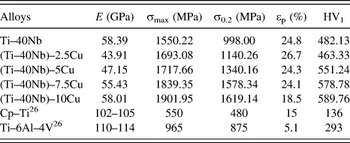
Investigations of the elastic deformation behavior are important for understanding the mechanical response of biomedical materials. Values of compression elastic modulus (E), ultimate compressive strength (σmax), yield strength (σy), and plastic strain (ɛp) measured from stress–strain curves and microhardness tests were conducted to investigate the influence of Cu composition on the mechanical behavior of the TNC alloys. The typical stress–strain curves of (Ti–40Nb)–xCu alloys are presented in Fig. 4(a). The changes of mechanical properties as a function of the copper concentration are illustrated in Fig. 4(b) and their values sum up in Table II.
(a) Typical room-temperature compressive stress–strain curves of the (Ti–40Nb)–xCu alloys: (a) x = 0, (b) x = 2.5, (c) x = 5, (d) x = 7.5, and (e) x = 10; the insets show the magnified elastic region and the elastic energy in a stress–strain plot; (b) elastic modulus, compression strength, and yield strength of (Ti–40Nb)–xCu alloys as a function of the copper content.

Summary of the test data of the (Ti–40Nb)–xCu (x = 0, 2.5, 5, 7.5, and 10%) alloys: elastic modulus E, compressive strength σmax, yield strength σ0.2, plastic strain ɛp, and Vickers hardness HV1.

Figure 4(a) shows representative stress–strain curves of all the sintered alloys obtained by compression tests at room temperature. It can be seen that under compression, the sintered TNC alloys including the Ti–40Nb exhibited considerable plastic deformation ability. Two-stage yielding phenomenon (elastic stage and plastic yield plateau stage) can be observed on the stress–strain curves of all the alloys, which implies that the alloys may have the shape memory effect or superelasticity at room temperature. Reference Zhang, Mao, Li, Li, Yuan and Lin23 From Fig. 4(a), the yield strength (σ0.2), compressive strength (σmax) and plastic strain (ɛp) for the plastic deformations can be obtained, which are shown in Table II.
Table II presents mechanical properties obtained in the compression and hardness tests of TNC samples containing 0, 2.5, 5, 7.5 and 10 wt% Cu. It can be inferred from Table II that elastic modulus, compressive strength, yield strength, plastic strain and microhardness of the alloys are sensitive to Cu concentration.
The binary Ti–40Nb samples exhibited a higher elastic modulus of 58.39 GPa that was in fairly good agreement with that (E = 57 GPa) reported by former researchers. Reference Hon, Wang and Pan24 It was found that alloying Ti–40Nb with copper lowered the elastic modulus. The elastic modulus of (Ti–40Nb)–2.5Cu had a significantly lower value (43.91 GPa) than any of other alloys, which was very close to that of the body natural bone (∼30 GPa). The elastic modulus of the TNC alloys monotonically increased with the concentration of copper. Elastic modulus is sensitive to constituent phases and their concentrations. When increasing the copper content to Ti–Nb substrate, the alloy phases changed from a single β phase to β + intermetallic compounds (Ti2Cu). It is known that the elastic properties of two-phase materials follows the rule of mixtures and vary in a roughly linear manner between those of the two component phases. Reference Graft, Levinson and Rostoker25 The β-Ti phase alloys offer the unique characteristic of low elastic modulus. Also intermetallic compounds generally have higher elastic constants than the constituting elements. Reference Fleischer, Gilmore and Zabala26 The elastic modulus is not only related to the crystal structure, but also to the crystal lattice parameters. Because the higher the bonding force between atoms, the higher the elastic modulus, and the atomic bonding strength is inversely proportional to the volume of the unit cell. Hence, the smaller the volume of the unit cell, the higher the elastic modulus of the material. From the calculated lattice parameter “α” of cubic β-phase from sintered TNC alloys (the inset of Fig. 3), the decreased α caused smaller volume of the unit cell, and then resulted in the higher elastic modulus.
As compression elastic modulus is mainly affected by the chemical composition and microstructure of the alloys, a small amount of Cu in the Ti–40Nb alloys may greatly reduce its value. Generally, the β phase has both greater hardness and smaller modulus of elasticity compared to α or (α + β) structure. However, when the content exceeds a certain value, there are more structures or phases distributing in the β matrix, which may be the reason for the increase of elastic modulus.
Although the presence of Ti2Cu precipitation with lower aspect ratio can have a detrimental effect on the elastic modulus of the (Ti–40Nb)–xCu alloys, the observed increase in the compression strength, yield strength and microhardness of alloys can mainly be attributed to the existence of volume fraction of Ti2Cu precipitation and higher proportion of high strength β phase in its microstructure.
Previous studies showed that the presence of the Ti2Cu intermetallic phase led to increase the mechanical strength. Reference Hayama, Andrade, Cremasco, Contieri, Afonso and Caram21 There was a tendency for the volume fraction of the Ti2Cu precipitates to increase with increased Cu content (Fig. 2). According to Yao et al., Ti2Cu precipitates result in an increase in hardness, attributing to the hinder of the dislocation movement. Reference Yao, Sun, Xiao and Sun27 Consequently, the compressive strength and the yield strength of TNC alloys had a positive correlation with the content of copper element. With the increase of Cu concentration, the compressive strength and the yield strength of alloys increased from 1693.08 MPa to 1901.95 MPa, 1140.26 MPa to 1619.14 MPa, respectively. Additionally, since β-stabilizer elements (i.e., Nb and Cu) have higher solubility in β-Ti phase, due to solid solution strengthening of Nb and Cu, the β phase in the alloys has higher strength than α phase. This phenomenon also can be explained by the presence of Ti2Cu tetragonal phase, which contains fewer slip systems than bcc β-phase, hence higher stress is needed to deform phase than the β phase matrix.
The defects and microdefects in the test samples would undoubtedly affect the alloy’s mechanical behavior. In the SPS process, the rapid densification of powdered metal alloys causes the volumetric shrinkage, which, if not adequately filled with molten metal, may lead to the formation of pores and micropores. Additionally, from Figs. 3(a)–3(e), we could see that the amounts of pore reduced with the addition and the increasing content of Cu.
According to Table II, the addition of alloying element Cu can increase the ductility. The crystal structure of the hcp-α phase is less ductile than the bcc-β phase. The bcc structure has 48 slip systems or potential slip systems, while the hcp structure has 3. Under the action of external stress, the bcc-β phase shows superior ductility. As shown in XRD patterns (Fig. 2), comparing to (Ti–40Nb)–2.5Cu (complete β phase), Ti–40Nb has a small amount of α phase, which makes it less ductile. However, the plastic strain had a negative correlation with the content of copper element. With increasing copper content, the alloys showed a slight tendency for decreasing plastic strain, whose results were similar to that of Ti–Nb–Al memory alloys. Reference Farooq, Khalid, Zaigham and Abidi17 (Ti–40Nb–Cu) alloys seem promising for future long-life implant applications since it shows elastic admissible strain even higher than that of nature human bone itself (0.12–1.36% Reference Ozan, Lin, Li, Ipek and Wen28 ).
Because low microhardness of cp-Ti and some Ti alloys will lead to relatively poor tribological characters, which in turn could induce implant loosening and wear debris generating. So the improvement in microhardness of (Ti–Nb)–Cu is an important aim. Table II also shows the values of microhardness as a function of copper concentration for samples of (Ti–Nb)–Cu alloys. It can be seen that the microhardness of the Ti–40Nb alloy is enhanced to different extents of Cu element. All studied alloys remained with microhardness values above pure-Ti and Ti–6Al–4V due to the solid solution strengthening effect of Ti–Nb phase. For addition of the 2.5 wt% copper element in its composition, (Ti–40Nb)–2.5Cu showed relatively lower hardness, which could be related to the lattice parameter of the β-phase. With the increased of copper content, the alloys presented an increase of hardness values, the additions of Cu result in more enhancement in the microhardness of the alloys reaching a maximum of 589.76 HV1 in the (Ti–40Nb)–10Cu alloy (Table II). Such increases are mainly caused by the solid solution strengthening effect to the β phases and Ti2Cu precipitations (precipitation strengthening effect) retained in the microstructure of the alloys. Thus, based on the Vickers hardness values of the alloys, it is expected that (Ti–Nb)–Cu alloys will exhibit better tribological characters than Ti–40Nb, pure-Ti, and Ti–6Al–4V. Moreover, increasing the Cu content of the alloys contributes to an improved wear resistance. The higher wear resistance can lead to more reduction in the release of wear debris which can prevent loosening of the implant and the subsequent need for revision surgery.
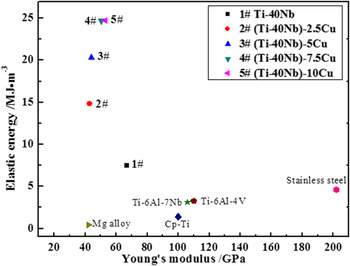
High strength and low elastic modulus are required for implant biomedical materials to bear heavy loading; also these materials usually service under elastic deformation. Reference Zhan, Li and Jiang29 Thus, it is essential to investigate the elastic energy to ensure a safe performance during service. The elastic energy (δe) is defined by the area of the elastic deformation in the stress–strain curve (the inset of Fig. 2). The elastic energy could be calculated by equation, Reference Zhan, Li and Jiang29
 $${\delta _{\rm{e}}} = {1 \over 2}\left( {{\varepsilon _{\rm{e}}}{\sigma _{\rm{y}}}} \right) = {{\sigma _{\rm{y}}^2} \over {2E}}\quad ,$$
where εe is the elastic strain, σy is the elastic strain, and E is the elastic modulus of alloys in the stress–strain curve. Higher elastic energies suggest that the alloys can bear greater elastic deformation. The elastic energy values of TNC alloys were calculated by Eq. (2). Figure 5 shows the calculated elastic energy values of TNC alloys and a series of commercial metallic biomaterials. As shown in Fig. 5, the values of TNC alloys ranged from 14.81 to 24.73 MJ/m3, which are higher than those of the extensively used commercial alloys. And clearly, the elastic energy of the sintered alloys in this study is affected by their Cu content. It is noted that among the (Ti–40Nb)–xCu alloys studied, the elastic energies increased with the increasing content of Cu due to their high yield strength (Table II). It is well known that Cu and Nb are β-phase stabilizer elements. So by adding Cu elements, the primary solidification can make Ti stabilize in the bcc β-phase. Due to the high plasticity and low elastic modulus of the β-phase structure, good combination of mechanical properties for biomedical application is obtained in these alloys.
Elastic energy versus elastic modulus coordinates comparing the (Ti–40Nb)–xCu alloys and some commercial metallic biomaterials. Reference Zhan, Li and Jiang29

Based on the achieved results, it is concluded that to attain a good combinational mechanical properties, i.e., elastic modulus, compression strength, plasticity, elastic energy, and microhardness in (Ti–40Nb)–xCu alloys, the Cu content should be considered properly. Among the five alloys, (Ti–40Nb)–2.5Cu with a single β phase microstructure presents satisfactory mechanical performance such as the lowest elastic modulus (43 GPa) and highest plastic strain (26.7%). Moreover, it presents moderate compressive strength (1693 MPa), yield strength (1140 MPa), Vickers hardness (463.33 HV1), and elastic energy (14.9 MJ/m3) which better than those of commercial pure-Ti (550 MPa, 480 MPa, 136 HV1, and 1.19 MJ/m3) and Ti–6Al–4V (965 MPa, 875 MPa, 293 HV1, and 3.15 MJ/m3) alloys. From the viewpoint of mechanical compatibility, the TNC alloys present a good combination of mechanical properties for hard tissue replacement application.
C. Ion release
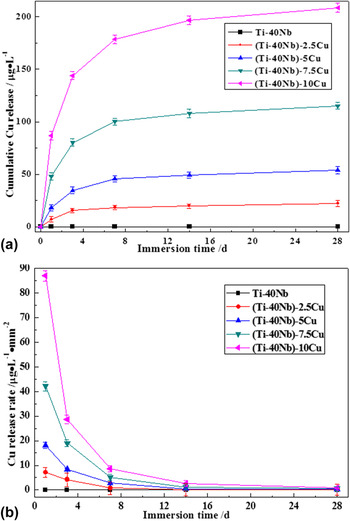
The study of copper ions release into solution could provide a more integrated investigation of antimicrobial activity. Meanwhile, considering the clinical longevity of an implantation, the ion release, especially the Cu ion with which a high concentration could be biologically toxic to the human body and cells, is one of the decisive specialties that must be studied. The ion release of alloys could be influenced by the chemical composition, substrate roughness, and crystallographic structure, etc. The cumulative release and release rate of the Cu ion in Hank’s solution as a function of immersion time are shown in Fig. 6. It is worth noting that sufficient copper release in early stage and long lasting copper release for a relative long time are needed to inhibit and subsequently to kill, especially more resistant bacteria. Reference Stranak, Wulff, Ksirova, Zietz and Drache30 In the first phase, with intensive and fast copper ion release, the greatest number of bacteria could be eliminated; then with long-lasting and moderate copper ion release, the slight surviving bacteria are killed meanwhile the osteoblast cells can recover at the same time. From the results presenting in Fig. 6, the TNC alloys have strong initial intensive and fast copper release (in first 7 days) followed by long-lasting but moderate copper release (at least for a month).
Cumulative release (a) and release rate (b) of Cu ion for the (Ti–40Nb)–xCu with different Cu content in Hank’s solution as a function of immersion time.

The concentration of Cu ions released in solution as the content in alloys increased. In the first 3 days of immersion test, the release rate [Fig. 6(b)] showed a burst release for the alloys with Cu element. With the extension of immersion time, the Cu release rate for all TNC alloys decreases exponentially. The differences in the release rate of Cu ions for different TNC alloys after 14 days of immersion were not great. The Cu ion is released for the reaction between TNC alloys and Hank’s solution on the surface of the TNC alloy. And before the immersion test, the TNC alloys were ground and mechanically polished which will make the surface passive film eliminated. Therefore, the Cu-containing alloys on the surface will react with the immersion solution, which causes the Cu ion released rapidly. With the increasing immersion time in the solution, Ti-based alloys will form an extremely stable passive layer on the surface which can partially inhibit the inner Cu metal ion releasing and result in long-lasting and moderate Cu release. Although the release rates were low, these continuous releases of Cu ions in a small quantity provide the accumulated amount for antimicrobial activity which is still much less than the maximum toxic concentration for the human body and cells. The World Health Organization recommends that an adequate and safe intake of copper requirement is approximate 1.3 mg per day for most of the general population. 31 However, it should be pointed out that the addition of copper in the Ti–Nb alloy would not be intended to replace the normal intake of copper in daily life. The main application of copper addition would be decreasing the pathogenic microorganism and bacterial which could survive after the cleaning procedures of implantation.
D. Antimicrobial property
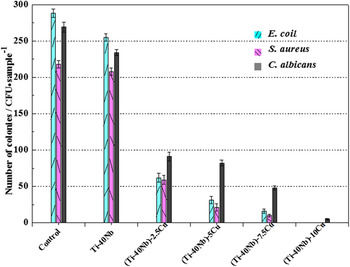
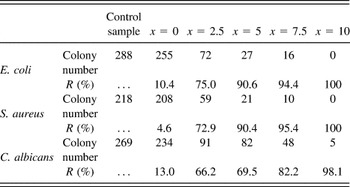
Antimicrobial activity of Ti–Nb–Cu alloys was studied by a spread plate method against E. coli, S. aureus, and C. albicans. Antimicrobial activity and antimicrobial ratio (R) calculated using formula (1) are presented in Fig. 7 and Table III. Table III clearly shows the number of colonies after specified incubation time. No significant decline of number of colonies is noticed with the Ti–40Nb alloy compared with the control which shows that Ti–40Nb alloy does not have evident antimicrobial effect. The antimicrobial activity of TNC alloys against bacteria (E. coli and S. aureus) is found to be pronounced than fungi (C. albicans), see Table III. It was reported by Toshiharu et al. Reference Shirai, Tsuchiya, Shimizu, Ohtani, Zen and Tomita32 that the Ti–Cu alloys remarkably inhibited colony formation of both E. coli and S. aureus. Liu et al. Reference Liu, Li, Liu, Wang, Ren, Yang and Zhang33 reported that Ti–(2 wt%, 5 wt% and 10 wt%) Cu alloys showed an antibacterial rate of 58%, 97%, and 100% against E. coli, respectively. From the experiment results of Table III, the antimicrobial ratio of TNC alloys is at least 66% which could clearly prove that the copper element is one of the antimicrobial effectiveness but the antimicrobial ability was not strong on the (Ti–40Nb)–2.5Cu alloy. When the copper addition increased further to 5 wt% or more, the antimicrobial rate against bacteria was as high as 90%, meaning that TNC alloys had strong antimicrobial efficacy. The study results of Horton et al. suggest that the antimicrobial ratio of the copper element is mainly dependent on the concentration of the dissolved copper ion released to the solution. Reference Horton, Ha, Foster, Bindig and Scully34 The antimicrobial ratio of the (Ti–40Nb)–2.5Cu alloy was 66% after 24 h incubation which is probably caused by the low amount of Cu released (less than 20 μg/L) see Fig. 6.
Antimicrobial activity of (Ti–40Nb)–xCu alloys (x = 0, 2.5, 5, 7.5, and 10 wt%) against E. coli, S. aureus, and C. albicans.

Colony numbers and the antibacterial rates [R (%)] for (Ti–40Nb)–xCu (x = 0, 2.5, 5, 7.5, and 10 wt%) alloys against E. coli, S. aureus, and C. albicans.

The precise mechanism of antimicrobial action of Cu adding biomaterials is not full known. The possible mechanism of action of copper as an antimicrobial agent in copper containing compounds could be due to the interaction of copper ions with the cell membrane of the organism and thereby disrupting the enzyme structure and finally causing microorganism death. Reference Thurman and Gerba35,Reference Samuni, Chevion and Czapski36 According to this mechanism, higher copper ion release will lead to stronger antimicrobial efficacy. This study indicates that the introduction of Cu to Ti–Nb alloy exhibits strong antimicrobial efficacy, proving again that antimicrobial efficacy is really dependent on the Cu concentration. Hence, we could assume that the risk of implant infection, which occurs after implantation on account of the contamination, could be significantly inhibited by copper addition. Although the Cu ion release concentration from TNC alloys was very low, the cytotoxicity of Cu element in alloys is still a concerning problem. In this study, the cytotoxicity of TNC sintered alloys was not assessed. But reports on the cytotoxicity of Cu content in Ti alloys were presented. Yamamoto et al. Reference Yamamoto, Honma and Sumita37 reported that in the cytotoxicity tests of mouse fibroblasts, concentration of Cu (12.7 mg/L) was still tolerated by MC3T3-E1 while the inhibition growth rate of bacteria was observed. Zhang et al. reported that the Cu content up to 25 wt% in the Ti–Cu alloys had no influence on the cell proliferation and differentiation and exhibited very good cell biocompatibility by examining the MG63 cell response by CCK8 assessment. Reference Zhang, Zheng, Liu, Bai and Liu12 Although the maximum addition of the Cu content in the Ti–Nb system was about 10 wt% in this paper, which was much less than the above reported value, the cell toxicity of TNC sintered alloys has to be investigated in the following studies to apply Ti–Nb–Cu system to clinical application.
The addition of Cu element by SPS provides a superelastic Ti–40Nb alloy with a strong antibacterial property without obvious deterioration in mechanical resistance. Especially the 2.5–7.5 wt% addition of copper promotes the alloys’ mechanical properties and ductility. Those results suggest that the development of implant material of TNC alloys might inhibit the infection and thus prolong the service length of the implant.
IV. CONCLUSIONS
In this work, the microstructure, mechanical properties, and antibacterial property of (Ti–40Nb)–xCu alloys synthesized by SPS were studied. This study provided the first evidence of a combination with excellent mechanical properties (ultralow modulus and high strength) of Ti–40Nb and high antimicrobial property of Cu. The studies lead to the following conclusions:
-
(1) Alloys were fabricated with varying Cu additions in Ti–Nb binary alloys. All alloys revealed β phase microstructure and minor Ti2Cu precipitation [except (Ti–40Nb)–2.5Cu]. Lattice parameter of β phase decreased by 0.17 pm with 1 at.% increase in Cu contents. The additions of Cu resulted in refinement of grains size and solid solution strengthening thus influencing the mechanical behavior.
-
(2) These TNC alloys exhibited high compressive strength over 1693.08 MPa, high yield strength of 1140.26–1619.14 MPa, low elastic energy (14.81–24.73 MJ/m3), and elastic modulus (43.91–58.01 GPa), together with large plastic strain over 18.5%.
-
(3) The TNC alloys exhibited antimicrobial activity against E. coli, S. aureus, and C. albicans. The antimicrobial effect of TNC alloys against bacteria (E. coli and S. aureus) is pronounced than fungi (C. albicans). The antimicrobial mechanism was thought to be related to the Cu ion release.
This good combination of mechanical and antimicrobial characteristics indicated that TNC alloys have the potential to be used for biomedical applications with low elastic, excellent mechanical and antibacterial properties.
ACKNOWLEDGMENT
This research is jointly supported by the Natural Science Foundation of China under Grant No. 31660262 and the Innovation Platform Construction Project of Science and Technology of Yunnan province under Grant No. 2013DH012.