


Introduction
The current economic pressures on many healthcare organizations are contributing to major cost-cutting and restructuring (Ham et al. Reference Ham, Dixon and Brooke2012), impacting on the health of employees and the productivity of organizations (Kieselbach et al. Reference Kieselbach, Armgarth, Bagnara, Elo, Jeffreys, Joling, Kuhn, Nielsen, Popma, Rogovsky, Sahler, Thomson, Triomphe and Wiederszal-Bazyl2009). This can result in job and service insecurity, and role uncertainty, which can lead to a loss of trust and a deterioration in the social cohesion of work-based relationships (Elliott et al. Reference Elliott, Harrap, Rothwell, Shepherd and Williams2013). Fewer staff have more work to do, sometimes for less pay and with fewer resources (UNISON, 2014). At the same time, the need for staff to generate income, meet targets and demonstrate the legitimacy and effectiveness of their work is intensifying (PPMA, 2012). In organizations whose business is mental health, this all comes on top of the daily encounters that staff have with severe human distress. Stress-related psychological problems are particularly found among healthcare providers working with patients who have experienced abuse, trauma or those with personality disorders (Shapiro & Burnham, Reference Shapiro, Burnham and Kirkcaldy2011).
There is considerable evidence that stress in healthcare professionals can be linked with decreased job satisfaction (Flanagan & Flanagan, Reference Flanagan and Flanagan2002), depression, anxiety and substance abuse (Tyssen et al. Reference Tyssen, Vaglum, Gronvold and Ekeberg2001; Gilroy et al. Reference Gilroy, Carroll and Murra2002; Wong, Reference Wong2008; Braun et al. Reference Braun, Schonfelt-Lecuona, Freudenmann, Mehta, Hay, Kachele and Beschoner2010), fatigue, emotional dysfunction (Cohen-Katz et al. Reference Cohen-Katz, Wiley, Capuano, Baker, Dietrick and Shapiro2005), reduced self-esteem (Butler & Constantine, Reference Butler and Constantine2005) and burn out (Spickard et al. Reference Spickard, Gabbe and Christensen2002). In North American studies, up to 60% of practising physicians (Shanafelt et al. 2002) and 40% of nurses (Vahey et al. Reference Vahey, Aitken, Sloane, Clarke and Vargs2004) have reported symptoms of burnout.
Stress is not just a personal matter. It may also reduce professional effectiveness, negatively affecting attention and concentration (Mackenzie et al. Reference Mackenzie, Smith, Hasher, Leach and Behl2007), empathy (Thomas et al. Reference Thomas, Dyrbye, Huntington, Lawson, Novotny, Sloan and Shanafelt2007) and the ability to engage in meaningful relationships with patients (Enochs & Etzbach, Reference Enochs and Etzbach2004). Staff burnout has been associated with reduced patient satisfaction and longer patient recovery times (Garman et al. Reference Garman, Corrigan and Morris2002; Shanafelt et al. Reference Shanefelt, Bradley, Wipf and Back2002; Vahey et al. Reference Vahey, Aitken, Sloane, Clarke and Vargs2004; Shapiro et al. Reference Shapiro, Astin, Bishop and Cordova2005).
In view of this picture, it is incumbent on healthcare organizations to help their staff manage stress. Research into mindfulness-based interventions (MBIs) to manage staff stress is limited but suggests that practising mindfulness, which has been defined as the ‘awareness that arises through intentionally attending in an open, kind and discerning way’ (Shapiro & Carlson, Reference Shapiro and Carlson2009, p. 15), can be effective in managing stress. Following MBIs, a variety of healthcare professionals, including trainee counsellors, therapists, physicians and nurses reported significant increases in self-awareness, insights about their professional identity (Bimbaum, Reference Bimbaum2008), overall wellbeing and self-care, and reduced stress, rumination and negative affect (Jain et al. Reference Jain, Shapiro, Swanick, Roesch, Mills and Bell2007; Shapiro et al. Reference Shapiro, Brown and Biegel2007), anxiety, fatigue, depersonalization and burnout (Rosenzweig et al. Reference Rosenzweig, Reibel, Gresson, Brainard and Hojat2003; Galantino et al. Reference Galantino, Baime, Maguire, Szapary and Farrar2005; Shapiro et al. Reference Shapiro, Astin, Bishop and Cordova2005; Schenström et al. Reference Schenström, Rönnberg and Bodlund2006; Krasner et al. Reference Krasner, Epstein, Beckman, Suchman, Chapman, Mooney and Quille2009; Fortney et al. Reference Fortney, Luchterhand, Zakletskaia, Zgierska and Rakel2013). Increased self-acceptance, life satisfaction and self-compassion (Ryback & Russell-Chaplin, Reference Ryback and Russell-Chaplin1998; Cohen-Katz et al. Reference Cohen-Katz, Wiley, Capuano, Baker, Dietrick and Shapiro2005; Shapiro et al. Reference Shapiro, Astin, Bishop and Cordova2005; Schenström et al. Reference Schenström, Rönnberg and Bodlund2006; Gokhan et al. Reference Gokhan, Meehan and Peters2010) were also found in physical and mental healthcare professionals following mindfulness meditation.
Self-compassion is thought to be one of the key mediating factors in MBIs (Kuyken et al. Reference Kuyken, Watkins, Holden, White, Taylor, Byford, Evans, Radford, Teasdale and Dalgleish2010; Van Dam et al. Reference Van Dam, Sheppard, Forsyth and Earleywine2011). The construct of self-compassion correlates with insight, self-awareness, feelings of kindness and sympathy towards others, personal initiative and optimism (Neff et al. Reference Neff, Rude and Kirkpatrick2007). As such, mindfulness interventions have much to offer National Health Service (NHS) Trusts in the UK who are now tasked with bringing about a more compassionate and caring organizational culture (Francis, Reference Francis2013). Uncontrolled studies with psychotherapists and training therapists have pointed to self-reported effects such as increased attentiveness to the therapy process and greater attunement to self and patients as a result of practising mindfulness meditation (Newsome et al. Reference Newsome, Christopher, Dahlen and Christopher2006; Schure et al. Reference Schure, Christopher and Christopher2008). Counsellors and novice therapists also reported an increased ability to conceptualize their patients’ cases, to attend to the therapy process and to be present in the moment during the therapy following their participation in a mindfulness intervention (Schure et al. Reference Schure, Christopher and Christopher2008; McCollum & Gehart, Reference McCollum and Gehart2010). Although the literature is in its infancy and dominated by uncontrolled studies, one randomized controlled study has also suggested that, after 9 weeks, patients of therapists who practised Zen meditation during that period reported favourable levels of self-awareness, symptom reduction, rates of change, and wellbeing compared to the patients of the non-meditating therapists (Grepmair et al. Reference Grepmair, Mitterlehner, Loew, Bachler, Rother and Nickel2007).
Most of the studies on MBIs for healthcare staff have been conducted in the USA using Mindfulness-based Stress Reduction (MBSR). By contrast, the present study was of an adapted Mindfulness-based Cognitive Therapy (MBCT) protocol. Unlike MBSR, MBCT focuses on rumination, negative automatic thoughts, relating to thoughts as thoughts, rather than facts and the use of the 3-minute breathing space, all of which seemed relevant for a staff population dealing with daily challenges in the workplace. However, using an adapted MBCT protocol for staff is innovative, with only one published study previously reporting on this (de Zoysa et al. Reference De Zoysa, Hutton, Ruths, Frearson, Williams and Walsh2013). Moreover, previous studies of MBIs for healthcare staff have typically not explored effects on staff self-compassion and have tended to foreground quantitative rather qualitative approaches to evaluation.
In this study, five adapted MBCT groups were provided for mental healthcare staff within an NHS Trust as part of a drive to improve staff wellbeing. A review of mindfulness interventions with healthcare professionals (Irving et al. Reference Irving, Dobkin and Park2009) recommended that further mindfulness research was needed that looked at both process and outcome, and used both qualitative and quantitative methods to understand more about the processes and mechanisms that lead to psychological health outcomes with MBIs. As our adapted MBCT course is a novel intervention for healthcare staff, this paper reports findings from a feasibility study. Feasibility studies are typically uncontrolled and are interested in whether it is possible to recruit and retain participants in a study and whether the intervention is acceptable to participants [National Institute for Health Research (NIHR), 2013]. These feasibility questions were addressed through collecting quantitative data on recruitment and retention rates and through gathering qualitative feedback on participants’ experiences of the groups. Recruitment and retention rates help to address the question of acceptability as it is assumed the low levels of acceptability would lead to poor recruitment and poor retention. Additional questions concerned effectiveness, with perceived stress as an outcome measure; and mechanisms of change, including a measure of self-compassion. In relation to these questions, hypotheses were that there would be significant pre- to post-MBCT improvements in perceived stress and self-compassion, and that these improvements would be maintained at a 3-month follow-up.
Method
Participants
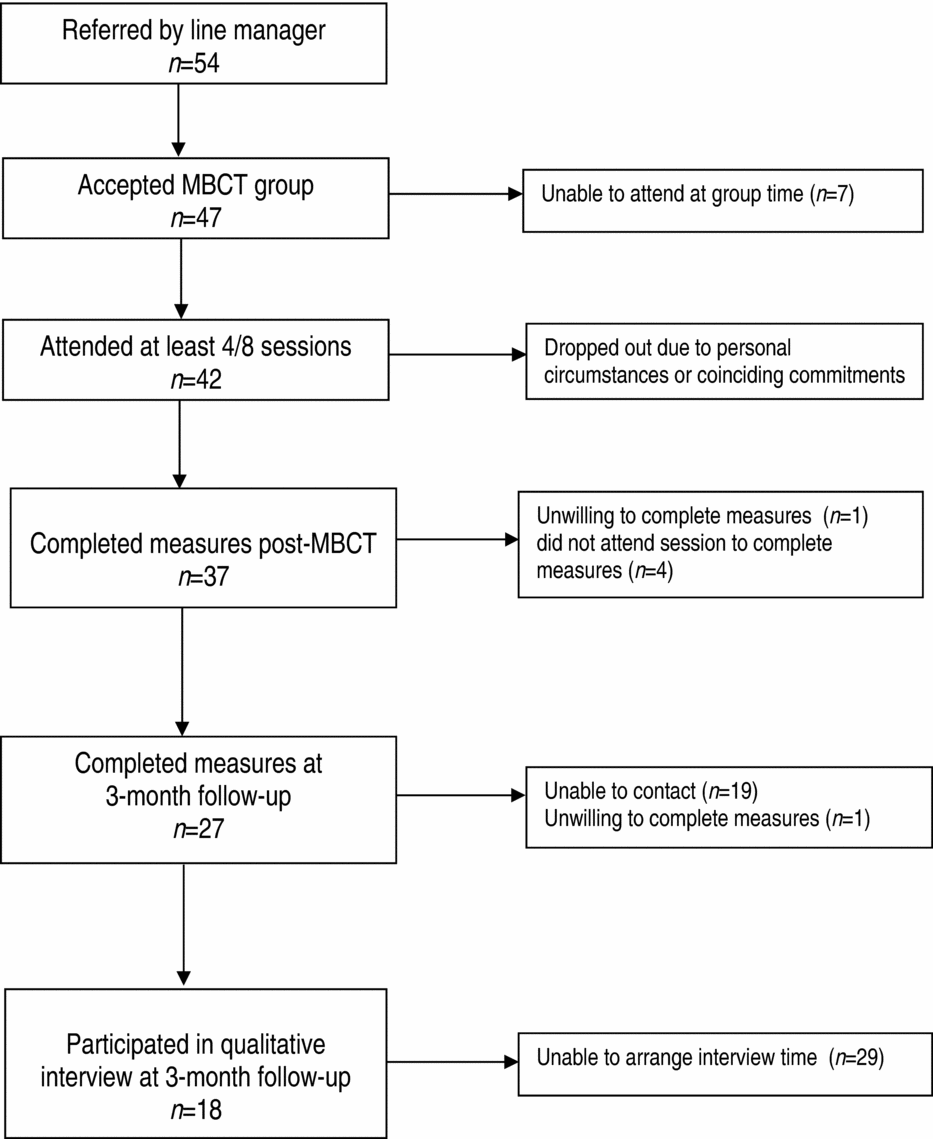
A total of 42 staff working in an NHS mental health service joined one of the five MBCT groups. Participation in the groups was voluntary. Staff were given information about the groups and invited to apply to their managers to join the groups. Managers were given an allocated number of places from their teams and asked to endorse interested staff to attend. Managers were briefed to encourage applications from staff who wanted support, who had an interest in the approach, and who could commit to attend the sessions and do the home practice. Figure 1 shows the flow of participants through the MBCT staff groups.
Diagram showing the flow of participants through the adapted MBCT staff groups.

The mean age of participants was 42 years (s.d. = 11 years) with 81% being female. In terms of job role, 44% were nurses (either specialist, staff or community psychiatric nurses), 12% ward mangers, 12% cognitive behavioural therapists, 8% healthcare assistants, 8% occupational therapists, 8% clinical or counselling psychologists, 4% recovery support workers and 4% trainee psychological wellbeing practitioners. Participants worked in in-patient services (64%), primary-care adult mental health services (22%), or secondary-care community adult mental health services (14%).
Procedure
This was an uncontrolled, feasibility study with one within-group factor (time; three levels: baseline, post-MBCT and 3-month follow-up) and two dependent variables (perceived stress and self-compassion scores).
All five groups were led by one of two highly experienced mindfulness teachers, who also taught MBCT at a UK university and met the UK's Good Practice Guidelines for teaching mindfulness-based courses (UK Network for Mindfulness-based Teacher training Organizations, 2012). They were joined by an auxiliary co-teacher who was a staff trainee on the organization's MBCT training. The trainee co-teachers received weekly supervision from the experienced teacher and the experienced teachers had their own peer supervision arrangements.
The first two authors became involved in the study in their roles as the leads for mindfulness training/governance, and for mindfulness research, in the healthcare organization, and the third author was a research assistant employed by the same organization specifically to conduct the evaluation of this intervention. The fourth and fifth authors were the lead facilitators for the five groups.
The groups followed the 8-week protocol for MBCT (Segal et al. Reference Segal, Williams and Teasdale2002) with an additional orientation session to induct the participants to the culture of the group, to aid group bonding, and ensure the participants were aware of, and signed up to, the level of personal, daily practice commitment involved. None of the main elements of MBCT were omitted, but some appropriate modifications, borrowed from MBSR, were made to the protocol, such as the inclusion of some education around stress physiology in session 5 with less focus specifically on depression, and an emphasis on mindful and difficult communications in sessions 6 and 7.
Staff members who did not attend individual sessions were e-mailed or called to check their wellbeing, and to briefly outline themes and confirm home practice details from the missed session. No extra sessions were offered.
Measures
Issues pertaining to feasibility are presented first (recruitment, retention, and acceptability), followed by the two scales measuring effectiveness.
Recruitment. The number of staff referred to the MBCT groups was recorded along with the number who agreed to take part in a group. Recruitment rates are reported as the percentage of referred staff who agreed to take part in a group.
Retention. Completion in the MBCT literature is typically defined as attending at least 50% of sessions (e.g. Teasdale et al. Reference Teasdale, Segal, Williams, Ridgeway, Soulsby and Lau2000; Ma & Teasdale, Reference Ma and Teasdale2004). The number of MBCT participants who completed at least four of eight sessions was recorded and used to indicate retention to the study.
Acceptability. At the end of each of the five groups, all staff were asked to complete a brief questionnaire asking two questions that were rated on a Likert scale with responses ranging from 1 to 10 (representing ‘not at all’ to ‘extremely’). These questions were: (1) ‘How important has the course been to you?’ and (2) ‘How helpful has the course been to enable you to manage stress at work?’ Qualitative feedback was elicited in two ways. First, the end of therapy questionnaire included open questions about their experience of the course. The questions were: (1) ‘What have you gained from the course?’ (2) ‘What do you think might be different in your work life as a result of the course?’ (3) ‘In what ways might your relationships with colleagues and service users be affected by the course?’ (4) ‘Do you have any suggestions for how we might improve the course in the future?’, and (5) ‘Do you have any other thoughts or feelings about the impact of the course on you personally or professionally?’ Participants were also invited to take part in a 20- to 30-minute face-to-face or telephone semi-structured interview between 1 and 3 months after the end of the groups. This was conducted with a research assistant, who was independent from the MBCT groups. Eighteen staff across the five groups opted to be interviewed (43% of therapy completers). The interview schedule was adapted from the Change Interview (Elliott et al. Reference Elliott, Slatick and Urmann2001), which is a commonly used semi-structured interview about client perspectives on therapeutic change. It consisted of four core questions which were: (1) ‘Are there any differences to your work life that you would like to describe as a result of doing the course?’ (2) ‘What was most helpful about the course?’ (3) ‘What was most challenging about the course? And (4) ‘Was there anything you would have liked in the course that was not there?’ Participants were invited to expand on their answers, where appropriate. Interviews were conducted by telephone with responses transcribed.
Perceived Stress Scale (PSS; Cohen & Williamson, Reference Cohen, Williamson, Spacapan and Oskamp1988). The PSS is a 10-item questionnaire measuring the perception of stress. Each item is scored on a 5-point scale with responses ranging from ‘never’ to ‘very often’. The scale has been shown to have good indices of concurrent validity and internal consistency (Hewitt et al.1992).
Self-Compassion Scale (SCS, Neff, Reference Neff2003). The SCS is a self-report measure which evaluates three main dimensions of self-compassion, self-kindness, a sense of common humanity and mindfulness. There are 26 items with each item rated on a 5-point scale (with responses ranging from ‘almost never’ to ‘almost always’). The SCS has been shown to have robust psychometric properties (Neff et al. Reference Neff, Rude and Kirkpatrick2007).
Data analysis
To address the feasibility questions, the number of people referred and recruited to the study were recorded, along with the number of participants who completed a group (attended 4/8 sessions). Qualitative data was analysed using thematic analysis (Braun & Clarke, Reference Braun and Clarke2006) following their suggested six-step approach. First, interviews were transcribed, read and re-read and initial ideas for themes were suggested by the research assistant. Second, initial codes were generated with the research team through a systematic process of reading the entire dataset and identifying data for each code. Third, codes were collated by the research team into themes with data relevant to each theme identified. Fourth, a thematic map was generated and checked against the codes and against the raw dataset. Fifth, themes were refined for coherence and named appropriately. Finally, a table of themes was produced and analysed in writing for this paper with extracts provided to illustrate each theme. The data was coded and categorized into themes and subthemes by a research assistant who was independent from running of the MBCT groups. Final quotes were then selected from the data to reflect examples of each theme and subtheme.
To analyse the effectiveness of the MBCT groups, intention-to-treat (ITT) analyses were conducted using the ‘last observation carried forward’ (LOCF) method. Repeated-measures ANOVA with post-hoc simple contrasts were conducted on PSS and SCS data using SPSS v. 19 (IBM Corp., 2010). This was a conservative approach and assumes participants who did not provide data following the groups did not improve on the outcome measures.
The Reliable Change Index (RCI; Jacobson & Truax, Reference Jacobson and Truax1991) was used to determine the magnitude of change necessary on each of the outcome measures to be considered greater than would be expected due to measurement error. The percentage of participants showing reliable change from pre-MBCT to post-MBCT and from pre-MBCT to the 3-month follow-up on the PSS and SCS were calculated. Only complete datasets were used to calculate reliable change, rather than using ITT data.
Results
Feasibility of adapted MBCT
Recruitment. Forty-seven of the 54 staff referred to a group accepted the offer of a group (87% of those who were referred). The seven staff that declined the offer of a group all did so because the time of the offered group was not convenient (see Fig. 1).
Retention. Forty-two participants attended at least four of the eight sessions (89% of those who accepted a place). Attending four of eight sessions is typically taken as a marker of ‘completing’ an MBCT course (e.g. Teasdale et al. Reference Teasdale, Segal, Williams, Ridgeway, Soulsby and Lau2000; Ma & Teasdale, Reference Ma and Teasdale2004).
Acceptability. On the two additional ratings questions the mean rating (1–10 scale) for ‘importance of the course’ was 8.61 (s.d. = 1.48) and the mean rating for ‘helpfulness of the course in managing stress at work’ was 7.67 (s.d. = 2.14).
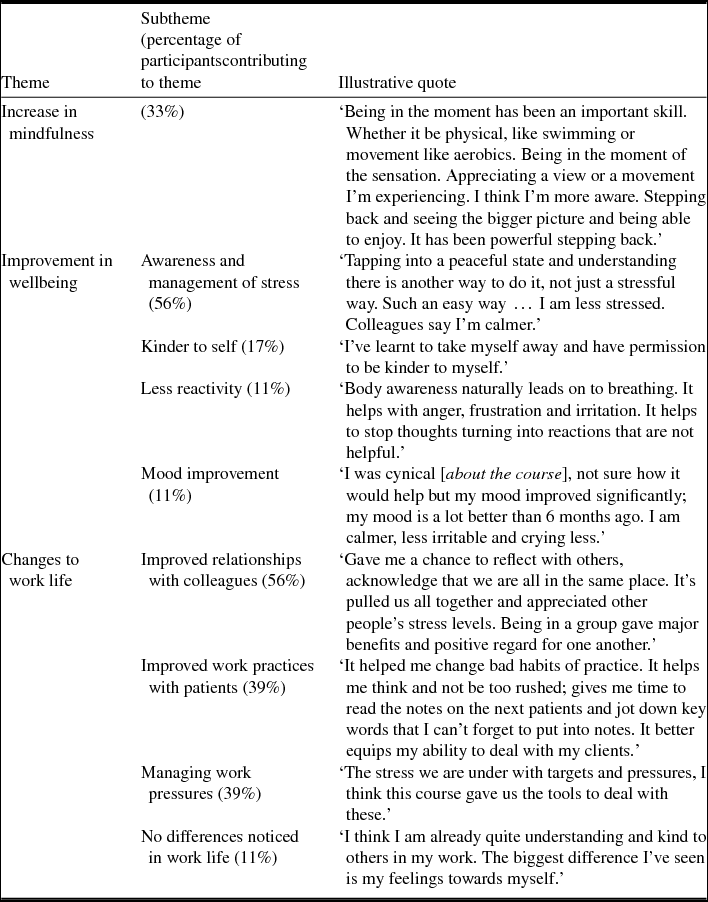
Qualitative data were analysed using thematic analysis (see Table 1). Thirty-seven participants (79% of staff offered a place) contributed to the qualitative analysis through providing written responses to the open-ended questions. Eighteen of these (38% of staff offered a place) also took part in the interview. Three themes emerged from this analysis: (1) increase in mindfulness, (2) improved wellbeing, and (3) changes to work life. ‘Improved wellbeing’ refers to awareness of stress, improved mood and kindness to self. ‘Changes to work life’ include improved relationships with colleagues, working practices and management of work pressures. An increase in perceived mindfulness was a repeating theme among the self-reports of participants.
Themes, subthemes and illustrative quotations from qualitative data provided by staff following their participation in an MBCT group (N = 37)
Effectiveness of adapted MBCT
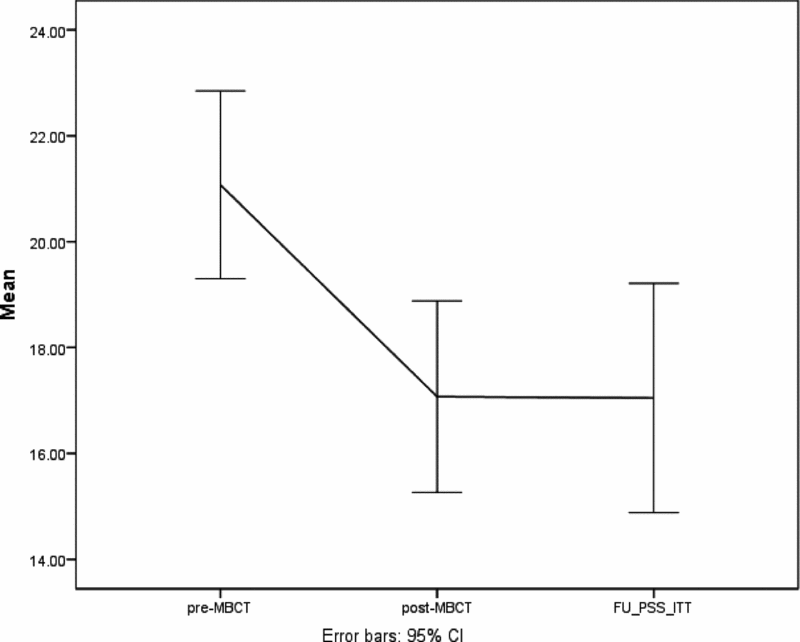
Perceived stress. Figure 2 shows the change in PSS scores over time. PSS scores improved from pre- to post-MBCT group with this improvement being maintained at the 3-month follow-up.
Line graph showing mean Perceived Stress Scale scores and 95% confidence intervals (CI) at pre-MBCT, post-MBCT and at 3-month follow-up (intention-to-treat data).
An ITT repeated-measures ANOVA with time as the within-group variable was conducted on PSS scores. This revealed a significant main effect of time (F 2,39 = 13.17, p < 0.001, η2p = 0.40). Post-hoc simple contrasts showed significant improvements in PSS score from pre-MBCT to post-MBCT with a large effect size (F 1,40 = 26.40, p < 0.001, d = 0.76) and from pre-MBCT to the 3-month follow-up with a large effect size (F 1,40 = 15.73, p < 0.001, d = 0.98).
When studying complete datasets only, 31% of participants showed a reliable improvement in their PSS score from pre- to post-MBCT, with 36% showing a reliable improvement from pre-MBCT to follow-up (3% and 9% showed a reliable deterioration in PSS scores, respectively).
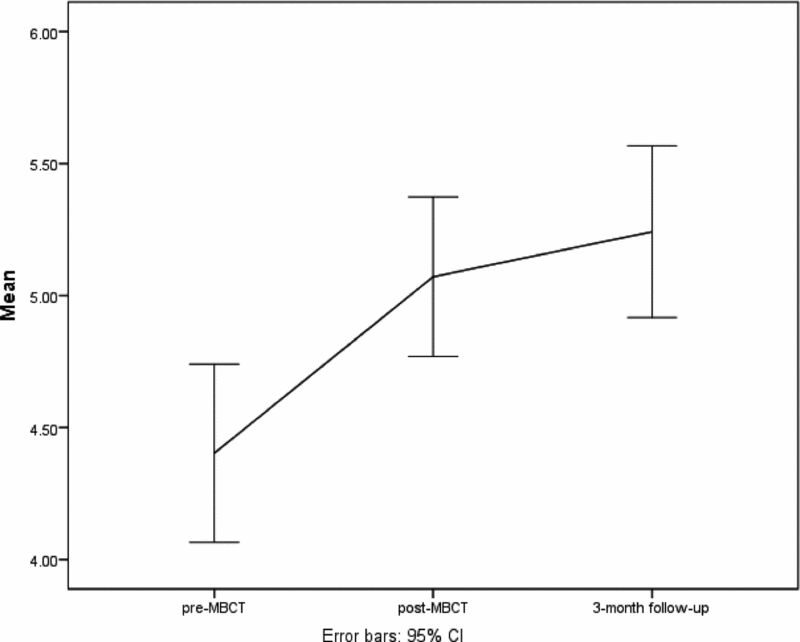
Self-compassion. Figure 3 shows the change in SCS scores over time. SCS scores improved from pre- to post-MBCT group and improved again from post-MBCT to follow-up.
Line graph showing mean Self-Compassion Scale scores and 95% confidence intervals (CI) at pre-MBCT, post-MBCT and at 3-month follow-up (intention-to-treat data).
An ITT repeated-measures ANOVA with time as the within-group variable was conducted on SCS scores. This showed a significant main effect of time (F 2,38 = 9.29, p = 0.001, η2p = 0.33). Post-hoc simple contrasts showed significant improvements in SCS score from pre-MBCT to post-MBCT with a medium-to-large effect size (F 1,39 = 15.24, p < 0.001, d = 0.67) and from pre-MBCT to the 3-month follow-up with a large effect size (F 1,39 = 19.01, p < 0.001, d = 0.81).
When studying complete datasets only, 42% of participants giving complete datasets showed a reliable improvement in their score from pre- to post-MBCT groups with 57% showing reliable improvement from pre-MBCT to the 3-month follow-up (with 3% and 0% showing reliable deterioration, respectively).
Discussion
This was a feasibility study of an adapted MBCT group for healthcare staff. In terms of feasibility and acceptability, 87% of staff referred accepted the offer of a group, and retention was high with 89% of participants attending at least half the MBCT sessions.
The thematic analysis of participants’ descriptions of their experience of undertaking the course allowed for a more enriched and personalized account of how participants experienced the sense of reduced stress and increased self-compassion. It suggested that, among the key changes that staff experienced as a result of the adapted MBCT groups, were greater mindfulness, improved mood and less reactivity as well as improved ways of managing specific work pressures, such as making time to read patients’ notes. Improved relationships with colleagues were also prominent in participants’ reports. Perhaps the MBCT course helped to facilitate improvements in the workplace through increasing a sense of shared experience and compassion between colleagues, as illustrated by the quotation in Table 1.
It is worth noting a few of the most salient characteristics of the remarks made of the courses, which support the case for feasibility and acceptability. They were often linked to the nature of the approach, which was non-stigmatizing, and available to any interested staff member, rather than directed only at ‘stressed staff’. The benefits of the course were noted to be potentially enduring and to promote personal responsibility for change, rather than dependency.
Hypotheses regarding questions of effectiveness and change processes were supported with significant pre- to post-MBCT improvement in perceived stress and self-compassion that was maintained at a 3-month follow-up. In terms of reliable change, about one third of participants showed a reliable improvement in perceived stress during the MBCT groups that was maintained 3 months later. Approximately half of participants showed a reliable improvement in their ratings of self-compassion from before to after the MBCT course with a similar proportion showing reliable improvement in self-compassion from before the MBCT to the 3-month follow-up.
These findings fit with findings from studies using MBSR with healthcare staff. Workplace studies of MBSR have shown improvements in perceived stress (Rosenzweig et al. Reference Rosenzweig, Reibel, Gresson, Brainard and Hojat2003; Galantino et al. Reference Galantino, Baime, Maguire, Szapary and Farrar2005; Shapiro et al. Reference Shapiro, Astin, Bishop and Cordova2005, Reference Shapiro, Brown and Biegel2007; Jain et al. Reference Jain, Shapiro, Swanick, Roesch, Mills and Bell2007), and in self-compassion (Shapiro et al. Reference Shapiro, Astin, Bishop and Cordova2005, Reference Shapiro, Brown and Biegel2007) which are consistent with findings from the current study. The pre-post effect size on the PSS in the current study (d = 0.76) is very similar to the pre-post effect size on stress found in a meta-analysis of MBSR groups for non-clinical populations (d = 0.74) (Chiesa & Serretti, Reference Chiesa and Serretti2009). This shows that our adapted MBCT protocol did not result in inferior effects on stress in comparison to the more widely used MBSR protocol. Moreover, our retention rate of 89% compares favourably to a study retention rate of 86% found in a recent meta-analysis on engagement in randomized controlled trials of MBIs for people experiencing mental health difficulties (Banerjee et al. unpublished data) which suggests that retention rates were not lower than would be expected from the wider literature on MBIs.
These findings offer an interesting case for seeing MBSR and MBCT as less distinct in their application than might traditionally have been thought, and raises the possibility of using adapted MBCT to manage stress in staff. MBCT was originally designed as a relapse prevention intervention for people with a history of recurrent depression (Segal et al. Reference Segal, Williams and Teasdale2002). Findings from this current study, however, suggest that MBCT may be of wider benefit than was first anticipated. Perhaps it is the particular way of relating to experience that MBCT offers that is potentially relevant and helpful, irrespective of diagnosis or population. Further research is now needed to explore the potential of (adapted) MBCT beyond the population it was originally designed for but findings from the current study provide early promise that MBCT might be helpful as an intervention for healthcare staff.
Strengths of the study include the facilitation of the groups by highly experienced MBCT teachers, who were also MBCT trainers which provides assurance about the quality of teaching and the adherence to the model. Many previous studies used student healthcare professionals, in contrast to the present study which used qualified staff. Another strength was the use of qualitative data which helped corroborate the quantitative findings. This was in contrast to most of the studies previously conducted which used quantitative methods only. The qualitative analysis suggested potential processes of change that occurred through the MBCT groups, rather than simply focusing on quantitative outcomes.
The limitations included the absence of a control group, which means that we cannot definitively attribute improvements in perceived stress and self-compassion to the MBCT groups. A quantitative measure of mindfulness was not included in the current study and therefore it was not possible to know if participants increased their levels of mindfulness; however, one theme emerging from the participants’ qualitative data was a reported sense of greater mindfulness. While the subtheme ‘improved work practices with patients’ suggests that the MBCT course had an impact on working practices, a measure of compassion for others was not included. While MBCT has the potential to increase compassion for others, this has not been systematically explored in the published literature to our knowledge. A measure of compassion for others would therefore be important to include in future studies, particularly in light of the Francis Report (Francis, Reference Francis2013) in the UK which highlighted the need to provide an environment for a compassionate NHS workforce. We would also want to see an assessment of levels of home practice included in any future research. Group facilitators administered the quantitative measures and it is good practice for assessments to be conducted by people independent of the therapy groups to reduce the possibility of bias. Another possible source of bias might be the method of opting in for interview, although it is not clear that this bias would be entirely in one direction.
A future study could address these limitations by using a randomized controlled design to compare this adapted MBCT protocol against a control condition, including a measure of mindfulness, and conducting assessments by researchers independent to the therapy groups. Participants could be randomly selected for interview, rather than opt in. A future study could also explore more specifically some of the themes suggested by the qualitative analysis – in particular, the relational dimension and how changes in relationships with colleagues might be important for improving work quality of life and mood. Finally, with the focus on increasing compassion in the NHS future research could explore the potential of this adapted MBCT protocol as a way of enhancing compassion in the organization.
In addition to reporting on findings from the current study we also wish to share our experiences of facilitating the adapted MBCT groups. These experiences were not necessarily reflected in the findings but may be useful for others to draw on who are planning to run similar groups in a similar setting. Although not derived from the findings, our personal reflections lead us to think that the fact that the facilitators came from outside the organization enabled them to bring a different culture to the one that staff participants were entrenched in. In services that are experiencing considerable demands, the response from others within the same culture can be experienced as either collusive (‘isn't it awful?’) or cheer-leading and out of sync (‘look at the improvements we’ve made’). A different culture that is compassionate and relatively free from political agendas can offer a fresh outlook.
There were challenges in setting up the groups. Finding locations that were quiet, pleasant and sufficiently removed from work to allow for a different internal space to emerge, as well as being geographically convenient and free was not always easy. Some of the same stressful elements that the groups were commissioned to help with, such as reconfiguration of service locations and changes in staffing, also became challenging when setting up the groups. Negotiating with managers, who may have been in key posts at the planning stages but not when the groups actually came to start was also challenging. Managers who were dealing with imminent major changes to their services had so much to deal with that thinking about a staff MBCT group simply could not be at the top of their list of priorities. On the other hand, we also encountered very enthusiastic managers who remained in their post throughout the process and were delighted to be offered this resource and willing to put their own time and energy into making sure it was delivered successfully. As those seemed to be the locations where staff continued to meet to meditate after the group had finished, it seems very important to ensure managers are as on board as possible in order to increase the chances of the intervention and its effects enduring within the workplace.
Although not illustrated in the qualitative analysis, one other issue for some staff seemed to be being in a group with their colleagues. While some staff seemed to find that this increased their awareness and compassion for the difficulties their colleagues were going through, others found it exposing. Some staff seemed more interested in attending the group as a potential stepping stone to using MBCT with their own patients than as an intervention for themselves (which might nevertheless indirectly benefit their patients). It is our view that for mindfulness to take effect, the practices have to be engaged with personally, as human beings encountering our own bodies and minds, rather than primarily as professionals scoping out techniques for later use with patients. Even though we emphasized this, and made clear that much more training and experience would be required to run MBCT groups than simply participating in one group, there did seem to be a fine line within a professional context between giving staff permission to come to the groups for themselves and risking shaming, and therefore putting off, professionals who are used to presenting themselves as relatively invulnerable at work. Anyone setting up staff groups within a healthcare context would do well to consider how to approach this issue sensitively at the earliest advertising stages.
Despite some limitations, this study has provided initial evidence that an adapted MBCT group offered to healthcare staff is feasible – recruitment was possible and retention was high. Improvements in perceived stress and self-compassion were found from before to after the adapted MBCT group. Moreover, these improvements appear to have been maintained over the 3-month period following the end of the groups. The qualitative findings added to the quantitative findings by suggesting potential processes of change and by suggesting that the MBCT course had a positive impact in the workplace by improving participants’ interactions with colleagues and patients. These findings were encouraging and would support further research with a more robust design to evaluate the benefits of these adapted MBCT groups for healthcare staff.
Ethical standards
The ethical standards of our professional bodies were adhered to.
Acknowledgements
We acknowledge some of the key people without whom this intervention would never have happened. Brenda Roberts, Duncan Moss, Bridgette O'Neill and Fergal Jones first introduced mindfulness into the organization for staff. Karunavira and Taravajra were the lead facilitators of the groups that were the subject of this study, which were co-facilitated by Caroline Drijver, Clare Coles, Heather Ball, Nicky Boella and Clara Strauss. The initiative was strategically driven and funded by Trust Directors, Sue Morris, Kay MacDonald and Adrian Whittington. The administration was done by Paula Bellers, Chloe Newton and Silvia Rodriguez-Perez.
Declaration of Interest
None.
After reading this paper the reader should understand:
(1) The organizational context in healthcare that makes mindfulness such a relevant intervention for staff.
(2) Some of the likely outcomes from running an MBCT group for staff in an NHS Trust.
(3) Some of the issues facing anyone contemplating setting up a similar intervention within their NHS Trust or comparable organization.



Comments
No Comments have been published for this article.