1. Introduction
Complex life cycles raise a variety of problems for attempts to give general theoretical descriptions of evolutionary processes and also for treatments of “individuality” in biology. A way to initially focus the discussion is as follows. Many people accept general descriptions of evolution by natural selection of roughly the kind associated with Lewontin (Reference Lewontin1970): evolution by natural selection takes place in a population when there is variation, heredity, and differences in reproductive output. Heredity is present when “like makes like.” However, much of the time in biology, like does not make like; it makes unlike (Griesemer Reference Griesemer, Jones and Cartwright2005). This is a reminder that many parts of the framework of evolutionary theory were originally set up with a particular kind of organism in mind—animals, like ourselves and fruit flies, that have well-marked generations and reproduction giving rise to offspring similar to their parents. Those life cycles are contingent evolutionary products, though, and many organisms do things differently.
Here I discuss problems for analyses of reproduction, individuality, and fitness raised by complex life cycles and present a framework for describing them.Footnote 1 Reproduction will be broken down into two more basic phenomena, production and recurrence. I then outline a combinatorial scheme for representing complex life cycles (of certain kinds), with accompanying graphical conventions. The concept of fitness depends on the concept of reproduction, so I then consider how fitness can be understood within the framework. I finish by looking at phenomena that complicate my treatment.
2. Reproduction and Life Cycles
In a vague and intuitive formulation, reproduction occurs when something makes more things of the same kind as itself. This intuitive notion has two parts, the making part and the same kind part. Each can be made more precise. First, reproduction involves a causal relation, which I will call production. Second, there is a role for similarity—the return of the similar—which I will call recurrence. Reproduction is a combination of recurrence and production.
Even in familiar and tractable cases, to talk of reproduction is often to engage in significant coarse-graining. In humans, for example, what the parents produce are gametes, individually, and a zygote, jointly. The mother has the main role in getting that object from foetus to newborn. Then the new individual grows up, develops, and acquires the properties of an adult. Parents only “make” a new individual in a coarse-grained sense, but certainly a theoretically important sense. As we “zoom out” from all the developmental details, we see first the relations represented in a family tree of individual organisms, then the population-level processes of evolution by natural selection, and finally the phyogenetic relationships between species (Hennig Reference Hennig, David and Zangerl1966). An individual lifetime may include extensive change, including metamorphosis, without this interfering with our recognition of that life as a fairly definite, bounded entity. Organisms, in the familiar cases, can be recognized as reproducing continuants—things that persist through change and give rise to more things of the same kind as themselves as they go.
I said that reproduction includes production and recurrence. Some biological objects recur in a way that does not give rise to parent–offspring lineages. Simple examples are enzymes and organs such as hearts. These objects recur, but preexisting individual hearts do not make new hearts, and new enzymes do not have parent enzymes. Your mother has a heart, and so do you, but your mother’s heart plays no causal role in producing your heart that your mother’s eyes or arms do not also play. Other examples of recurring entities that do not form parent–offspring lineages include various symbiotic associations, including some holobionts, animal–microbe associations, in which there is environmental acquisition of the microbial partners rather than transmission from a parent holobiont (Dupré and O’Malley Reference Dupré and O’Malley2009; Pradeu Reference Pradeu2011). Riftia tube worms in the deep sea take in and house colonies of bacteria that form the digestive tract of the adult tube worm. If we consider a particular worm–bacteria association as a whole, its annelid-cell component has two annelid parents, but its bacterial component may come from many preexisting holobionts and from free-living bacterial lineages in the sea. The worm–bacteria associations recur through a coming together of separately reproducing partners.
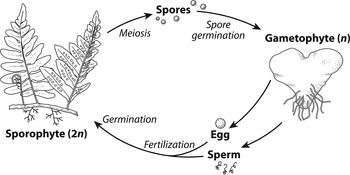
I now turn to complex life cycles. I will initially illustrate these phenomena with the life cycle of a typical fern (Pterophyta). These plants show a marked “alternation of generations” (fig. 1). The fern-shaped sporophyte produces spores that disperse and grow up into gametophytes, smaller plants with their own photosynthetic capacity. The gametophytes produce gametes, which fuse, and the result grows up into a new sporophyte.
Life cycle of a fern (drawn by Eliza Jewett).

Sporophytes make gametophytes and gametophytes make sporophytes, but neither of them makes more of themselves. We might say they do make more of themselves, with the other stage as a way station, but we would apparently have to say that about both stages. There would be an entanglement of two parent–offspring chains, one from sporophyte to sporophyte and the other from gametophyte to gametophyte. In Godfrey-Smith (Reference Godfrey-Smith, Pradeu and Guay2015) I discuss a range of ways of thinking about these cases without much altering the idea of reproduction itself. Perhaps the most important is a reductionist option. Genes reproduce (replicate) through the entire cycle and do so with no alternation (with no “like-makes-unlike” steps). So it might be argued that all the macroscopic multicellular forms, and also the single-celled propagules in the cycle, are devices produced by genes to help their own replication. The case might be handled by adopting the replicator/interactor framework of Dawkins (Reference Dawkins1982) and Hull (Reference Hull1980). In practice, I assume that many biologists would think about many life cycles in something like this way, focusing on the underlying genetic continuities. Cells, rather than genes, might provide a different reductionist option. Here, I’ll present a different approach, based on abstraction rather than reduction, leaving open whether this is best seen as competitor or complement to a reductionist view.Footnote 2 My focus will be on life cycles where a multicellular stage is prominent—I’ll return to this issue briefly at the end.
Reproduction is a combination of production and recurrence; let’s approach complex life cycles through those parts. I understand “production” very broadly; all causal chains, short or long, are cases of production. Some causal chains feature a recurrence of earlier forms; a structure appears once, and something similar appears later. Those are cases of cyclical production. The cycle leading from one instance of a recurring structure to another might be long and indirect, or short and direct. Where there’s one recurring stage in a cycle there tends to be many—gametes and zygotes, for example, in the human life cycle. Recurrence occurs with respect to all of these, and any could be used in the accounting.
I’ll next distinguish some events that may occur between instances of a recurring structure. One is multiplication. At some stages in a case of cyclical production, there may be initiation of a new chain that can lead to another instance of the recurring structure. Then two later instances of the recurring structure will have a (past) coalescent. I’ll call a stage of that sort, one from which many instances of a recurring structure can derive, a multiplicative stage. Gamete production is a multiplicative stage in the human life cycle.
Next, a stage in a case of cyclical production may be a bottleneck stage—a significant narrowing of structure. In all the cases discussed here, the bottlenecks will be single-celled stages, though bottlenecks need not be understood so strictly. Lastly, at some stages there may be sex—fusion of two productive lineages (generating a “future coalescent”; sex is a mirror image of multiplication).
Biological life cycles have other important stages, especially meiosis. I won’t include meiosis explicitly in my framework, as the aim is something that abstracts from specific genetic mechanisms. (I’ll note the role of meiosis when I discuss cases, though.) One reason to focus on my three features here—multiplication, bottlenecks, and sex—is that in the existing literature, all those things have all been seen as marks of reproduction (for multiplication, see Maynard Smith Reference Maynard Smith and Nitecki1988; for bottlenecks, see Bonner Reference Bonner1974; Dawkins Reference Dawkins1982; Godfrey-Smith Reference Godfrey-Smith2009; for sex, see Janzen Reference Janzen1977, and the many writers making use of a ramet/genet distinction). They have all been used to distinguish between reproduction and phenomena such as growth, development, and metamorphosis. Here I’ll use them as elements in a combinatorial treatment of life cycles.
In the human life cycle we see a certain arrangement of those features. If we start with an adult human and follow the chain forward, before recurrence of the adult form there is one multiplicative stage, one bottleneck, and one case of sexual fusion (see fig. 2). In a fern, the same ingredients are present, but not in the same arrangement. If we track the events between two instances of the sporophyte, for example, we find two multiplicative steps, both with bottlenecks, and one case of sexual fusion. This yields a diagnosis of the unintuitive nature of the fern case. In humans, the familiar marks of reproduction all appear next to each other and occur once before recurrence. This makes it easy to mark off the life of an individual human, and easy to view that life as a product of two parents who have their own lives of the same kind (though sexual dimorphism itself introduces some like-makes-unlike phenomena, even in simpler life cycles). In ferns, multiplication and bottlenecks—which are each marks of reproduction—occur twice before recurrence.
Representation of the relations between multiplicative, bottleneck, and sexual steps in cases of cyclical production, shown for the life cycles of a human (a), a fern (b), and a scyphozoan jellyfish (c). Multiplication is represented with diverging arrows, a bottleneck by a small circle, and sexual fusion by converging arrows.

I will add another case for comparison, the life cycle of a scyphozoan, the most familiar kind of jellyfish. Here there is an alternation between polyp and medusa forms. Medusae produce gametes, which fuse to make a zygote, which grows to become a larva, which settles on the sea floor and lives as a polyp. The polyp undergoes strobilation, which looks like a kind of metamorphosis, to produce juvenile medusae. But through strobilation each polyp can produce several medusae. This is a second multiplicative step in the cycle. It is not, however, a second bottleneck, as there was in the fern. So before recurrence in the scyphozoan case there are two multiplicative steps, sex once, and one bottleneck.
Figure 2 shows the three life cycles discussed so far, drawn with a set of conventions that indicate each of the events described. Multiplicative steps are marked with diverging arrows, sexual fusion with converging arrows, and bottlenecks as small circles. Meiosis, which is not represented, occurs at the first multiplicative step in all three cases.
In all three cases there is a chain of production, and one in which forms reliably recur. When bottlenecks, multiplication, and fusion are arranged in one way, they make natural a description in terms of reproducing individuals. When these features are arranged other ways, such a description is more problematic. With this diagnosis in hand, I suggest that there is no point in asking which arrangements of these features are really the ones where there is “reproduction.” What is real is production and recurrence, which take different forms in different living things.
It is sometimes claimed that all (eukaryotic) life cycles are complex, if we look at them in the right way. In plants, a pollen grain is a gametophyte, for example, not a gamete, and the alternation of generations remains. Without disputing the biology, I think that there is some possibility of losing the wood for the trees here. Like-makes-like phenomena (e.g., in bacteria, in humans) are real, though restricted. A process of simplification has also occurred in some groups. A path some lineages seem to have taken, including our own, is an exchange of temporal for spatial complexity; we are spatially complex organisms with simpler life cycles than various of our relatives and likely ancestors. This sort of pattern is one to understand with a framework that recognizes and charts differences between cycles, including differences in complexity.
3. Fitness in Complex Life Cycles
One important role for the idea of reproduction is its relation to fitness, in the sense relevant to Darwinian evolution. How does fitness fit into complex life cycles?
My treatment of fitness is generally deflationary. Talk of fitness is best seen as an attempt to compress a lot of facts about survival and reproduction into a number in a way that meets two goals. First, a measure of fitness should be plausibly related to the biological properties of organisms or other entities such as genes; second, the measure should have a predictive role in some model or formula that describes change. These two goals trade off to some extent; sometimes unnatural-looking properties have a predictive role. (These include higher statistical moments of a distribution of reproductive outputs that an object or type might be associated with; see Abrams Reference Abrams2009). So I am a deflationary pluralist about many questions concerning fitness; there are various reasonable measures, and one can use whatever measure works. I am not a deflationary pluralist about all theoretical concepts in biology, but talk of fitness is subject to a specific trade-off that warrants this view.
Now let’s look at fitness in complex life cycles. In the simple cases, fitness is some measure of reproductive output (actual or expected). I broke reproduction into production and recurrence. Fitness, also, is often seen as having two parts, viability and fecundity. These are directly applicable in different ways to complex life cycles. Viability is definable for every stage; it is the probability of making it to the next stage. Fecundity is definable for every multiplicative stage.
In some cases, fecundity then looks like a measure of the number of gametes produced. That has obvious imperfections, from a predictive point of view. One might say that fecundity is gamete production, even if most of the produced objects have very low viability (a low chance of making it to the next step). Or one might, mindful of the predictive role of fitness talk, say that fecundity at a multiplicative step is initiating productive lineages that reach some relevant next step, such as the next multicellular step.
The two fitness-like properties discussed just above are both related to production. What is the role of recurrence? A fissure seen here in complex life cycles recalls similar fissures that arise even in simpler cases. Lewontin has argued for many years (though, I think, publishing only in Ariew and Lewontin Reference Ariew and Lewontin2004) that in population genetics one must distinguish reproduction by from reproduction of. Consider the case of sickle cell disease, or some other case where one homozygote (aa) is sterile or dies very young. Assume two alleles and three genotypes, AA, Aa, aa. The aa individuals do not reproduce at all. In the productive sense, their fitness is zero. But they are reliably produced, by matings of heterozygotes. They are another case of a recurring object that does not make more of itself.
Even without complex life cycles, there is no “per capita rate of increase” for a genotype in a sexual population; the rate of increase of a type depends not only on its own “head” (capita) but also on who else is in the population, making that type. In a case like aa sterility, there might be zero head of aa in one generation and many of them in the next, due to sex.
Some years ago, Henry Byerly and Rick Michod (Reference Byerly and Michod1991) offered a view of fitness in which recurrence was made primary. Suppose that the aa genotype is sterile but is being continually reintroduced to the population by Aa × Aa matings. Byerly and Michod said that if the frequency of aa is increasing in a population, perhaps because the frequency of Aa is increasing, then aa has a positive fitness. (This is true of what they call r-fitness and also what they call F-fitness.) John Maynard Smith (Reference Nitecki1991) wrote a commentary in which he called this an “error.” If aa is sterile, then “the fitness of aa individuals is zero, whether the frequency of aa in the population is increasing or decreasing.” Maynard Smith took this to be the actual meaning of “fitness” in population genetics and, I think, its appropriate meaning. Maynard Smith’s move compromises the predictive role of fitness, and he saw that as normal: “In order to predict changes in genotype frequency in the population, one must know both the fitnesses of the genotypes, and details of the genetic system” (Reference Nitecki1991, 37). Lewontin, in contrast, sees here a tension in the concept of fitness. The tension is essentially one between production and recurrence. Even in simple life cycles, the relation between the two need not be straightforward. In complex life cycles, they become more disconnected.
Earlier I said that one response to complex life cycles is to reduce the description to the genetic level, where like-makes-like reigns. A related move can be made in evolutionary models of some life cycles, including the ferns and jellyfish above. These cases have sex at one multiplicative step and not at the other. It is possible in such cases to assimilate all the asexually produced material to one big object, with spatially and temporally distributed parts. In the fern case, this object would comprise a sporophyte, all the spores it produces, all the resulting gametophytes, and (perhaps) their gametes. That object engages in sex with other objects of the same sort (perhaps also with itself). Then we have an ordinary diploid population genetics model applied to objects with an unusual kind of “growth and development.” In the fern case, the parts of this object are not merely spatially disconnected but also genetically different from each other. Some parts are haploid and others diploid, and the haploid ones are genetically different from each other. In the jellyfish case, all the parts are diploid except for gametes.
4. Alternative Paths and Subcycles
In several respects I’ve still only addressed easy cases. In the cycles discussed so far, recurrence is reached by the same road every time; there are no alternative or optional paths. In addition, there are no subcycles, no processes in which some stage A gives rise to another A, within a larger cycle. If we zoom in on any of these cases, we will certainly see cell division and gene replication, which are A-makes-A events. Here, though, I’m talking about subcycles with respect to the entities that define the main cycle. If we have a main cycle of the form A→B→C→A, then a related case with a subcycle might look like this: A→B→C→C→A. Or there might be an indirect subcycle: A→B→C→B→A. Either way, there is a small cycle nested inside a larger one.
The two features I mentioned are connected. If a cycle contains a subcycle, either direct or indirect, either there must also be an “optional” move, or some stage must give rise obligately to more than one kind of product. (A converse principle does not hold: it’s possible to have optional paths without subcycles.)
Optional paths and subcycles are common. In some ferns, the gametophytes can make more gametophytes, or sexually produce a sporophyte (Farrar Reference Farrar1990). In jellyfish, Cubozoa (box jellyfish) have a life cycle similar to that of Scyphozoa in some ways, but (in at least some cases) there is a subcycle at the polyp stage. In Morbakka virulenta, for example, a polyp begins with two tentacles, then moves to four-, eight-, and 16-tentacled forms, and then metamorphoses into a medusa. But the eight-tentacle stage also buds off more polyps, at two-tentacle stage, which disperse, settle, and continue the sequence (Toshino et al. Reference Toshino, Miyake, Ohtsuka, Okuizumi, Adachi, Hamatsu, Urata, Nakaguchi and Yamaguchi2013). I will assume for purposes of discussion that this case, unlike the fern, is one where eight-tentacled polyps obligately give rise to more than one product. Figure 3 depicts these cases using the same conventions as figure 2, but indicating an optional path with a dotted line at the beginning of the path. Some algal life cycles feature very complex alternative paths and subcycles (see Herron et al. Reference Herron, Rashidi, Shelton and Driscoll2013).
Life cycles with subcycles of two kinds, drawn with the same conventions used in figure 1. a, In some ferns, gametophytes asexually propagate on occasion, as well as sexually producing sporophytes. b, Life cycle of a cubozoan jellyfish, featuring asexual budding of polyps, as well as polyp metamorphosis to the medusa form.

Do these phenomena motivate revisions to my framework, or do they merely add detail? First, when there is a subcycle, there is often something like ordinary reproduction within a larger cycle: there is an internal like-makes-like step. What relation does this putative reproduction have to questions about fitness and evolution? It varies across cases. Sometimes the subcycle seems secondary as far as evolution of those organisms is concerned. In other cases the opposite is true.
Cubozoa are late-evolving jellyfish, dissimilar to ancestral forms. The subcycle is probably a late addition modified from the strobilation stage (the second multiplicative step) in scyphozoans (Straehler-Pohl and Jarms Reference Straehler-Pohl and Jarms2005). Given the way budding works, most of the reproductive differences that matter to evolution will not be found at this stage. Reproduction within the cycle here might be compared to reproduction by spatial parts of an organism such as cells. Human cells within a body reproduce and pass on traits; small-scale Darwinian evolution is thus inevitable in them, though it generally has limited evolutionary consequences. In cubozoans, differential polyp production may also be of limited evolutionary importance, though one can also envisage a process in which poly-to-polyp reproduction became prevalent and led to large-scale change, perhaps with an abandoning of the medusa form, as some ferns have abandoned the sporophyte.
An entirely different role for a subcycle is seen in the last case I’ll discuss, the cellular slime mold (Dictyostelium). In figure 4 I have drawn this life cycle without applying all the rules seen in figures 2 and 3. Figure 4 is modeled on a more standard representation in Herron et al. (Reference Herron, Rashidi, Shelton and Driscoll2013), but it makes explicit multiplicative steps and fusion events. In this case there is an inner cycle of asexual reproduction by haploid amoebae and two optional paths: one sexual, one multicellular. The multicellular path features the formation of a “slug” by aggregation, and then a fruiting body from which spores are dispersed. The sexual path includes fusion of the haploid cells and then meiosis.
Life cycle of a cellular slime mold, Dictyostelium, modified from Herron et al. (2013) to include some but not all of the conventions used in figures 2 and 3. Multiplicative steps are represented with diverging arrows and fusion with converging arrows. Broken lines indicate alternative paths from the ameoba-to-amoeba subcycle. Bottlenecks are not represented.

Here the multicellular path, not the subcycle, is probably an addition to a preexisting cycle. Asexual reproduction of amoebae appears as a subcycle in any chain running from fruiting body to fruiting body, but the “subcycle” is in no sense secondary, as it was in the cubozoans. The most natural description of this case, in fact, may be one in which reproduction by amoebae is treated as a simple like-makes-like phenomenon, and two additional paths are appended that have other roles, one that is not reproductive at all. If the slug and fruiting body are seen as social entities that arise from the behavior of amoebae, not as multicellular stages in the life cycle, then there is neither fusion nor multiplication in the path on the left-hand side of my figure; all those events are understood in terms of metamorphosis and social behavior. On the sexual side, in many protists sex is disconnected from reproduction (O’Malley Reference O’Malley2016), and this is illustrated to some extent here. Sex is apparently rare in these organisms, punctuating many rounds of asexual multiplication. Sex itself is reductive rather than multiplicative (two entities fuse to one), though it can be combined with a multiplicative step, as in this case.
The framework employed here is designed primarily for cases where multicellularity is prominent; bottlenecks, for example, are not relevant in entirely unicellular life cycles. The slime mold is an intermediate case, with a collective state that forms by aggregation and appears as an optional path in the cycle. Further work on these mixed or intermediate cases—cycles with looser and short-lived collective stages—along with an extension of the framework to entirely unicellular cycles, should provide more insight into the biologically pivotal interactions between production and recurrence.