INTRODUCTION
Despite several studies suggesting that children born very preterm do not show impaired language development (Menyuk, Liebergott & Schultz, Reference Menyuk, Liebergott and Schultz1995; Eilers, Kimbrough Oller, Levine, Basinger, Lynch & Urbano, Reference Eilers, Kimbrough Oller, Levine, Basinger, Lynch and Urbano1993), there is now growing agreement that being born too early may indeed place a child at increased risk of later language delay and/or disorder. Specifically, findings suggest that, to a greater or lesser extent, children born very preterm show delays in both receptive and expressive language development across measures of vocabulary size, utterance length, utterance complexity and phonological short-term memory (Gallagher & Watkin, Reference Gallagher and Watkin1998; Robison & Gonzalez, Reference Robison and Gonzalez1999; Seidman, Allen & Wasserman, Reference Seidman, Allen and Wasserman1986; Briscoe, Gathercole & Marlow, Reference Briscoe, Gathercole and Marlow1998; Censullo, Reference Censullo1994). In terms of developmental timing, some studies support the presence of early language delays, whilst others have suggested that delays emerge later in childhood with impacts well into adolescence (McCarton et al., Reference McCarton, Brookes-Gunn, Wallace, Bauer, Bennett, Bernbaum, Broyles, Casey, McCormick, Scott, Tyson, Tonascia and Meinert1997; Taylor, Klein, Minich & Hack, Reference Taylor, Klein, Minich and Hack2000; Magill-Evans, Harrison, Van der Zalm & Holdgrafer, Reference Magill-Evans, Harrison, Van der Zalm and Holdgrafer2002).
Whilst these existing studies have been helpful in highlighting the effects of very preterm birth on children's language development, the considerable variability in study findings has also created some confusion. There are several reasons why such variability may have occurred. The first relates to the changing nature of this population due to the improved survival of infants born extremely preterm (<28 weeks' gestation) and at the lower limits of viability. As a result, many older studies in this area were based on lower risk samples of children born at later gestational ages. A second reason which may account for the considerable variability in findings across studies is the presence of two additional methodological limitations which have tended to limit the conclusions that can be drawn from existing research. These limitations include the reliance on small and/or selected samples as well as the failure to take into account the effects of confounding child and family factors that might, at least in part, help to explain between-group differences in the language development of preterm and full-term infants.
The present study sought to address these issues by examining the early language development at age 2 ; 0 of children born extremely preterm, very preterm and full term, with a specific focus on the effects of gestational age at birth on children's later language outcomes. A further aim was to examine the extent to which associations between gestational age at birth and language functioning could be explained by the effects of other confounding child and family factors that are correlated with preterm birth and child language development. Important methodological issues that have limited previous research and which we have addressed are reviewed below.
Sampling issues
A number of sampling issues have limited the interpretation of existing research concerned with the effects of very preterm birth on children's language development. One issue has been the tendency for most studies to define their study sample/s according to infant birth weight (e.g. Grunau, Kearney & Whitfield, Reference Grunau, Kearney and Whitfield1990; Klebanov, Brookes-Gunn & McCormick, Reference Klebanov, Brookes-Gunn and McCormick1994; Hershberger, Reference Hershberger1996). This is problematic since birth weight confounds the effects of both gestational age or immaturity and poor physical growth on later outcome. Given this difficulty, it has been suggested that gestational age at birth may offer a more accurate measure of developmental and neurological maturity, and thus early biological risk, than birth weight (Rijken et al., Reference Rijken, Storlhorst, Martens, van Zwieten, Brand, Wit and Veen2003; Alyward, Reference Aylward2005). Findings also suggest that gestational age tends to be a stronger neonatal predictor of subsequent neurodevelopmental outcome than birth weight for children born very preterm (Woodward, Anderson, Austin, Howard & Inder, Reference Woodward, Anderson, Austin, Howard and Inder2006).
Comparisons across studies have also been hindered by differences in sample selection criteria, particularly with respect to birth weight and gestational age. For example, Duncan, Schneider & Robertson (Reference Duncan, Schneider and Robertson1996) assessed only those children born between 24 and 28 weeks on measures of language delay. Briscoe, Gathercole & Marlow (Reference Briscoe, Gathercole and Marlow1998) studied children born between 26 and 32 weeks' gestation with birth weights ranging from 815 to 1,985 grams. In contrast, Menyuk et al. (Reference Menyuk, Liebergott and Schultz1995) studied children born between 27 and 37 weeks' gestation and who had birth weights ranging from 794 to 2,500 grams. Rocissano & Yatchmink (Reference Rocissano and Yatchmink1983) studied children born under 2,500 grams and earlier than 36 weeks' gestation and Ungerer & Sigman (Reference Ungerer and Sigman1983) studied children under 37 weeks and weighing less than 1,500 grams. Given the speed and complexity of foetal development during the third trimester, such variations in sampling criteria may well have contributed to the heterogeneity of study findings. Also, given the absence of studies including sufficient representation of infants born at lower gestational ages as is more common today, relatively little is known about the effects of extremely preterm birth (i.e. <28 weeks' gestation) on children's subsequent language development.
A further sampling issue concerns the effects of sample size, with many studies relying on very small and often selected samples (Briscoe et al., Reference Briscoe, Gathercole and Marlow1998; Frisk & Whyte, Reference Frisk and Whyte1994; Gonzalez & Robison, Reference Gonzalez and Robison2001). For example, Gonzalez & Robison (Reference Gonzalez and Robison2001) acknowledged that their failure to detect significant differences between preterm (n=10) and full-term infants (n=10) on measures of articulation, vocabulary, pragmatic and expressive/receptive language likely reflected their small sample size. In contrast, Briscoe et al. (Reference Briscoe, Gathercole and Marlow1998) found that preschool children born very preterm (n=26) performed less well than their same aged full-term peers (n=26) on measures of expressive language, and receptive and productive vocabulary, with between-group differences averaging about half a standard deviation. These findings correspond to a small to medium effect size (d=0·22–0·67 for these measures), which according to Cohen (Reference Cohen1992) would require a sample of at least 32 children in each group for a significant effect to be detected.
Role of confounding factors
A second methodological issue that has received scant attention concerns the extent to which associations between very preterm birth and language outcomes may reflect either the direct effect of being born very preterm and/or the effects of social and contextual factors correlated with prematurity. Specifically, it is well known that very preterm birth is not randomly distributed in the population, but is associated with a range of maternal and social background factors, including maternal education, maternal age, socioeconomic status and multiple births (Fewell, Casal, Glick, Wheeden & Spiker, Reference Fewell, Casal, Glick, Wheeden and Spiker1996; Hershberger, Reference Hershberger1996; Feldman, Dollaghan, Campbell, Kurs-Lasky, Janosky & Paradise, Reference Feldman, Dollaghan, Campbell, Kurs-Lasky, Janosky and Paradise2000; Badr Zahr, Reference Badr Zahr2001; Landry, Smith & Swank, Reference Landry, Smith and Swank2002; Ment et al., Reference Ment, Vohr, Allan, Katz, Shneider, Westerveld, Duncan and Makuch2003). These findings raise the possibility that associations between very preterm birth and language outcomes may arise, at least in part, from confounding factors that are associated with both increased risks of prematurity and language delay. However, few studies have examined this issue due to small sample numbers. Of those that have, only a limited range of potential confounding factors were generally examined, often with somewhat conflicting results. For example, Hershberger's study (Reference Hershberger1996) evaluated 51 preterm children, born under 2,500 grams, at 3 ; 0 and found a significant correlation between language development and medical and socioeconomic variables. Grunau et al. (Reference Grunau, Kearney and Whitfield1990), on the other hand, found evidence of significant language delays even after adjusting for the effects of confounding social and medical factors, although these were less marked than those found in other studies. In contrast, other studies suggest an impact of such factors on some but not other aspects of language. For example, Magill-Evans & Harrison (Reference Magill-Evans and Harrison1999) found that social factors contributed to preterm infant's receptive but not expressive language development assessed up to age 1 ; 6.
Against this general background, the goal of this study was to examine a series of issues relating to the language outcomes of children born extremely preterm, very preterm and full term, with due attention to these important methodological considerations. The first aim was to examine, in a large regional sample of very preterm (n=90) and comparison term (n=102) infants, associations between gestational age at birth and a range of language outcomes, including vocabulary size and syntactic and morphological complexity. These language outcomes were assessed using the parent report MacArthur Communicative Development Inventory: Words and Sentences (CDI-WS) (Fenson et al., Reference Fenson, Dale, Reznick, Thal, Bates, Hartung, Pethick and Reilly1993), now known as the MacArthur-Bates CDI. The second aim was to examine the extent to which significant associations between gestational age at birth and later language outcomes could be explained by potential confounding child and family characteristics correlated with preterm birth and early language development.
METHODS
Participants
Study participants consisted of two groups of children. These groups were as follows.
Children born very preterm
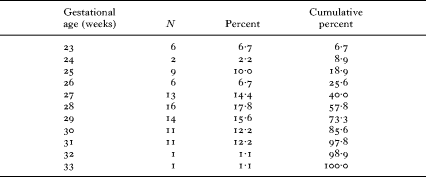
The first group was a regional cohort of 100 very preterm (<33 weeks' gestation and/or <1,500 grams) children who were consecutively admitted to a level III Neonatal Intensive Care Unit (NICU) at Christchurch Women's Hospital (New Zealand) between November 1998 and December 2000. Children with congenital abnormalities and those whose parents did not speak English were excluded. A total of 92% of eligible infants were recruited. These infants had a mean gestational age of 28 weeks (range: 23–33) and a mean birth weight of 1,050 grams (range: 440–1,790 grams). As Table 1 shows, although the largest number of infants were born between 27 and 31 weeks' gestation, there were sufficient numbers born in each of the weeks prior to week 28 (i.e. 40% of the sample were born at fewer than 28 weeks) to allow an examination of the effects of both very preterm (28–32 weeks' gestation) and extremely preterm (<28 weeks' gestation) birth on language outcomes.
Gestational ages of infants in the very preterm group

All infants in the preterm group were studied throughout the perinatal period, at term and within two weeks of their first and second (corrected) birthdays. The retention rate at 2 ; 0 was 93%, with 3 infants lost to follow-up, 3 deaths and 1 international relocation. Data from 8 additional preterm infants were also excluded due to non-completion or late completion of the language measure, resulting in a sample of 90 children with complete data at age 2 ; 0 (corrected for gestational age at birth). For the purposes of this analysis, these children were divided into two groups: those born extremely preterm at less than 28 weeks' gestation (N=36) and those born very preterm between 28 and 33 weeks' gestation (N=54). These gestational cut-off points represent widely used and accepted criteria for defining the extent of immaturity at birth for children born very preterm (Darlow, Horwood, Mogridge & Clemett, Reference Darlow, Horwood, Mogridge and Clemett1997; Horwood, Mogridge & Darlow, Reference Horwood, Mogridge and Darlow1998; Doyle, Reference Doyle2001; Nadeau, Boivin, Tessier, Lefebvre & Robaey, Reference Nadeau, Boivin, Tessier, Lefebvre and Robaey2001; Anderson, Doyle & the Victorian Infant Collaborative Study Group, Reference Anderson2003; Marlow, Reference Marlow2004).
Children born full term
The second group of children consisted of a comparison sample of 105 full-term (38–41 weeks' gestation) children matched to the preterm cohort for gender and date of birth. These term born children were specifically recruited for this study as part of the 2 ; 0 assessment. Children were identified from hospital birth records (n=7,200 total births) by alternately selecting in a forwards and backwards fashion, the next but one child in the hospital delivery records born during the same period as each preterm child. Children with congenital abnormalities and from non-English speaking families were excluded. The recruitment rate for the full-term control group was 62%. Reasons for non-participation at 2 ; 0 included ‘unable to trace’ (47%), ‘moved overseas’ (12·5%), ‘refused’ (12·5%) and ‘agreed but unable to attend the clinic appointment within two weeks of the child's second birthday due to illness or family problems’ (28%). Data from a further 3 control children were also excluded due to non-completion or late completion of the language measure (2 children) and the potential of an autism spectrum diagnosis (1 child).
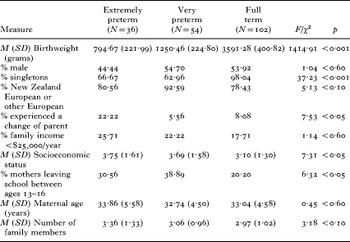
The groups differed with respect to birth weight (M (SD) extremely preterm=794·67 (221·99); very preterm=1250·46 (224·80); full term=3591·28 (400·82); F(1, 189)=1414·91, p<0·001). Measures of gestational age and birth weight were significantly correlated (r=0·74). Six children (6·7%) met criteria for small for gestational age (SGA, birth weight <2 SD). There was no difference in the number of extremely preterm (n=4) and very preterm children born SGA (n=2) (χ2=1·91, p=0·17). Across the preterm and control groups, no significant between-group differences were found for child gender (p<0·60). Four children (11·1%) in the extremely preterm sample had IVH grade 3/4. There were no cases of IVH grade 3/4 in the very preterm sample. In addition, there were 2 cases (5·6%) of severe cerebral palsy in the extremely preterm group and 4 cases (7·4%) in the very preterm group.
Clear between group differences were evident on the cognitive (MDI) and psychomotor (PDI) indices of the Bayley Scales of Infant Development (MDI: M (SD) extremely preterm=82·67 (13·74); very preterm=89·26 (13·20); full term=94·39 (12·62); F(1, 188)=22·52, p<0·001; PDI: M (SD) extremely preterm=92·03 (12·65); very preterm=94·51 (11·25); full term=99·71 (11·19); F(1, 187)=14·19, p<0·001).
Measures
Within two weeks of their second birthday (corrected), all study children underwent an ethics approved developmental assessment. This assessment included the Bayley Scales of Infant Development (BSID-II, Bayley, Reference Bayley1993) and the parent completed the CDI-Words and Sentences form of the MacArthur-Bates Communicative Development Inventory (CDI-WS). Parents were provided with the CDI-WS ahead of their child's developmental assessment and asked to complete it in their own time and bring it to their child's appointment. Information concerning the social background of the families was obtained during a parent interview at the time of each child's assessment. Questionnaires were checked for completion by one of the researchers. All research assessments were completed by trained clinical staff unaware of children's previous medical or family history.
The MacArthur-Bates Communicative Development Inventory
The MacArthur-Bates Communicative Development Inventory (CDI) comes in two forms for two age groups. CDI-Words and Sentences (CDI-WS) is designed for use with children between 1 ; 4 and 2 ; 6. It provides a measure of expressive vocabulary and of productive grammatical complexity, an indication of the morphemes and structures a child is currently using, the uses to which a child can put language and the parents' best memory of their child's longest utterances.
The first section of the CDI-WS (‘Words children use’) contains a vocabulary production checklist, organized into 22 semantic categories. Eleven categories are composed of nouns, with the other categories covering a range of additional vocabulary. The second section (‘Sentences and grammar’) contains 125 items organized into five sections designed to assess morphological and syntactic development. The first three parts of the grammar section address production of irregular and over-regularized word forms. The last two sections include multiword utterances, including parent recall of the three ‘longest’ recently used sentences and items used to assess the child's level of sentence complexity. Because this study began before the publication of the New Zealand version of the CDI (Reese & Read, Reference Reese and Read2000), which incorporates vocabulary differences between American and New Zealand English, the American form was used with modifications for differences in language content. Specifically, parents were provided with a brief list of explanations and alternative words for any word form identified a priori as potentially unfamiliar to New Zealand parents (e.g. nappy for diaper, biscuit for cookie). Given the extensive exposure of New Zealanders to both English and American media, the use of the American CDI is unlikely to have posed a problem for the validity of this instrument.
The scores on the standard measures of the CDI-WS were calculated according to the test manual, and the three longest multiword utterances recorded by the parents were analyzed using the Systematic Analysis of Language Transcripts (SALT) programme (Miller & Chapman, Reference Miller and Chapman1993). In addition to reporting the standard measurements of language function that are prescribed by the CDI, we also examined several aspects of language function that might be hypothesized to be impaired as a result of executive function difficulties in very preterm and extremely preterm infants, such as knowledge of time words and their ability to use words in relation to future and past events. Five questions on the CDI probe parents' observations of their child's word use in terms of the spatial and temporal decontextualisation of language (Fenson et al., Reference Fenson, Dale, Reznick, Thal, Bates, Hartung, Pethick and Reilly1993). These questions involved asking parents to judge whether their children were using language to talk about the past, future, absent objects or people and possession. For example, parents are asked to rate whether or not their child has ever talked about something that may happen in the future, such as saying swing when they are about to go to the park.
Confounding factors
To assess the extent to which associations between gestational age and language outcomes could be explained by confounding factors, several child and social background measures were included in the analysis. Measures of child characteristics included child gender, birth weight and twin birth status. Six measures of family characteristics were also included. First, each child's ethnicity was classified on the basis of parental report as being of European or other (i.e. Maori, Pacific Islander, Asian) descent. Next, in order to measure family stability, at 2 ; 0 the interview respondent was asked whether or not there had been a change in the child's parent figures over the first two years of life. Change of parents included parental separation/divorce, foster placement and parental hospitalizations lasting longer than one month. The next three factors related to the family's socioeconomic status. A family's gross income was coded as more or less than NZ$25,000 per year. Family socioeconomic status was coded according to the Elley & Irving (Reference Elley and Irving2003) scale of socioeconomic status (SES), a six-point rating scale of occupations ranging from (1) professional through to (6) unskilled. This scale was created according to the average income and educational levels of full-time male workers in each occupation in New Zealand. We chose the most skilled level of SES in the household (i.e. either father's or mother's occupational rating) to represent the SES for each family. Maternal education was based on the highest level of educational attainment. Maternal age at birth was recorded in whole years. Finally, family size consisted of the total number of people living in the household, excluding the target child.
Statistical analysis
Study data were analyzed in five stages. In the first stage, the relationship between gestational age and vocabulary size at 2 ; 0 was examined (see Figure 1), as well as associations between gestational age and decontextualized word use (see Table 2). The second stage examined the relationship between gestational age and morphological and syntactic development (see Table 3). Across these analyses, comparisons between the three gestational age groups on each of these language outcomes were assessed using one-way analysis of variance for continuous variables and the Mantel Haenszel chi-squared test for dichotomous variables, including tests for linear and non-linear trend. In the third stage of the analysis, we examined associations between gestational age and a range of child and family social background factors using either one-way analysis of variance or the Mantel Haenszel chi-squared test (see Table 4). In the fourth stage, multivariate linear and logistic regression was used to assess the extent to which reported bivariate associations between gestational age and language outcomes persisted after statistical adjustment for the confounding effects of child and family social background factors (see Table 5). Finally a series of supplementary analyses were undertaken using ANCOVA and logistic regression to examine associations between gestational age and language outcomes when measures of infant birth weight and intra-uterine growth restriction (i.e. being born small for gestational age (SGA)) were included as covariates.
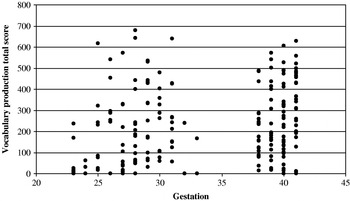
Relationship between gestational age at birth and children's total vocabulary production.

Vocabulary development and word use skills amongst children born extremely preterm, very preterm and full term

* Evidence for a non-linear association (F(1, 189)=6·68, p<0·05).
Syntactic and morphological development of children born extremely preterm, very preterm and full term

Child and family social background characteristics of children born extremely preterm, very preterm and full term

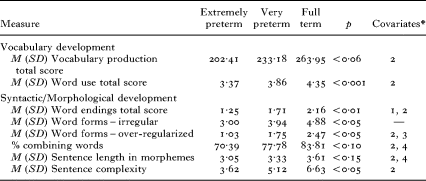
Language outcomes of extremely preterm, very preterm and full-term children after adjustment for the effects of significant child and social background covariates at 2 ; 0

* Significant covariates: 1=ethnicity, 2=change in parents, 3=socioeconomic status, 4=maternal education.
RESULTS
Vocabulary development
Figure 1 shows the distribution of children's total vocabulary production scores at 2 ; 0 in relation to their gestational age at birth. These findings demonstrate that at 2 ; 0 there is considerable inter-individual variability in vocabulary development, with children's total vocabulary scores ranging from 7 to 680. Scores for full-term children ranged from 8 to 627, whilst scores for preterm children ranged from 31 to 680 and scores for extremely preterm children ranged from 7 to 616. These results show that, at 2 ; 0, very preterm children as a group had vocabulary sizes that spanned a similar range as their full-term peers, but that very preterm children tended to be over-represented at the lower end of the vocabulary range.
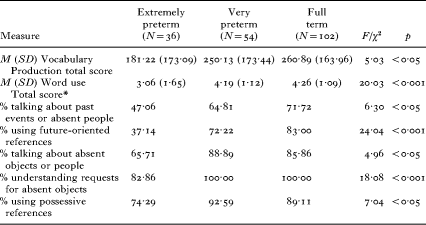
Table 2 shows the mean vocabulary production scores of children born extremely preterm, very preterm and full-term. Results show a clear linear association between children's gestational age at birth and later vocabulary size, with decreasing gestational age being associated with a smaller vocabulary size (p<0·05). There was no evidence of a non-linear trend. While there was a clear decrease in vocabulary size across the three groups, this was most marked for the extremely preterm group who had vocabularies that were, on average, 30% smaller than their very preterm and full-term peers.
Word use
Also shown in Table 2 are the mean total scores on the word use items, derived from the sum of the positive responses in each of these categories for children born extremely preterm, very preterm and full term. Results showed a significant decline in children's scores with decreasing gestational age (p<0·001). However, there was also evidence of a non-linear association (p<0·05) for the word use total score. These results suggest a clear tendency for decontextualized word use to decrease with decreasing gestational age at birth, with delays being most dramatic amongst extremely preterm children relative to very preterm and full-term control children.
To examine the extent to which children varied in the way they used words, we looked at parents' responses to whether or not their child used words to refer to the past, future, absent objects or people and possession separately. As shown in Table 2, there were significant (p<0·05) associations between gestational age and the different forms of decontextualized word use. First, we examined the number of children talking about past events or absent people across the three groups. There was a significant difference across the groups in the number of children who used past-oriented speech (p<0·05). Similarly, the number of children using future-oriented language was significantly lower across the gestational groups (p<0·001). There was also a significant difference in the number of children reported to be able to make references to missing objects and people (p<0·05) and understand requests for absent objects (p<0·001) across the three groups. Finally, there was a significant difference in the number of children reported to use language to express possession (e.g. pointing to an object and naming the person to whom the object belongs) between the three groups (p<0·05). Therefore, gestational age does seem to be an important factor associated with the development of early decontextualized word use. In particular, it would appear that children born extremely preterm may be more severely compromised. This finding was evidenced by lower mean scores and reported percentages in the extremely preterm group as compared to the very preterm and control children. While there was a substantial decrease in the proportion of extremely preterm children who were able to make these orientations in language across all the categories, the number of extremely preterm children that were reportedly able to use future-orientated language was at least 50% lower than the number of very preterm and full-term control children (i.e. 37% vs. 72% in the very preterm group and 83% in the full-term control group).
Morphological and syntactic development
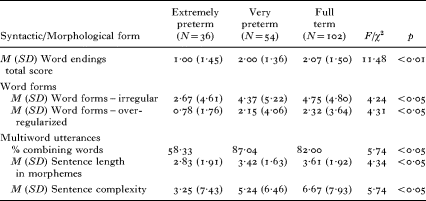
Table 3 compares the morphological and syntactic complexity of children's language across the three gestational groups. First, parents were asked whether their child had begun to use four specific morphological endings: -s for plurals, -s for possessives, -ing for progressives and -ed for the past tense. A chi-square test comparing the number of children reported to use these morphological word endings showed significant differences across the three gestational age groups (p<0·01). Again, the extremely preterm group was noticeably more impaired in the reported use of all of these endings. They were reported as using these endings approximately 50% less than the very preterm and full-term groups.
Other estimates of morphological development come from two sections which ask parents to indicate whether their children use irregular and/or over-regularized nominal and verbal forms. For example, they indicate whether their child uses children, childs or childrens as the plural of child, and whether they use blew, blewed or blowed as the past tense of blow. Parents' responses to both sections suggested a clear and significant delay in the use of both irregular and over-regularized forms across the three groups (p<0·05). There was no evidence for a non-linear trend on either measure.
Finally, syntactic development was assessed by first asking parents if their child had begun to combine words. A chi-square test showed a significant difference in the number of children combining words across the three gestational age groups (p<0·05). Again, the extremely preterm group was the most impaired. The numbers of children reported as combining words were 30% fewer in this group compared to other groups.
Morphological and syntactic development was also assessed by requesting parents to write out three examples of the longest sentences they had heard their child say in the previous two weeks. A test of linear trends using one-way analysis of variance showed that with decreasing gestational age there was a corresponding significant decline in reported sentence length in morphemes (p<0·05). There was no evidence for a non-linear trend. In the final part of the assessment of syntactic and morphological development, parents were asked to indicate which of a pair of multiword utterances (for those children who produced such utterances), distinguished on the basis of their morphological and syntactic complexity, their child is most likely to say. For example, parents were asked to choose between phrases such as there a kitty and there's a kitty. Table 3 shows the mean total score on this section, derived from the total number of times that a parent indicated that their child said the more complex item in a pair of utterances over 37 utterance pairs. A one-way analysis of variance with a test for linear trend revealed a significant decline in the use of the more complex verbal utterances with decreasing gestational age (p<0·05). There was no evidence for a non-linear trend.
Relationships between gestational age and child and social background factors
Whilst the above findings suggest that being born at an earlier gestational age places children at increased risk of later language delays across a range of measures, it is possible that these differences may at least, in part, reflect the effects of the child and family characteristics correlated with prematurity (Hershberger, Reference Hershberger1996). To explore this issue, Table 4 provides a descriptive profile of the child and family characteristics of children in each of the three groups. No significant between-group differences were found for child gender (p<0·60), although there were more multiple births in the two preterm groups than in the control group (p<0·001). In addition, there were significant between-group differences in socioeconomic status (p<0·05), maternal education (p<0·05), family stability (p<0·05) and number of family members (p<0·05). No significant between-group differences were found for maternal age or percentage of individuals falling into the lowest family income categories (<NZ$25,000 per year). There was also a tendency (p<0·10) for more children in the very preterm group than in other groups to be of European New Zealand ethnic origin.
Relationships between gestational age at birth and later language outcomes after adjustment for confounding child and family factors
To examine the extent to which associations between gestational age and later language outcomes could be explained by the confounding effects of child and social background factors, associations between gestational age and each language outcome reported in Tables 2 and 3 were adjusted for the effects of the significant confounding factors shown in Table 4. Birth weight was not included as a covariate due to its high correlation with gestational age (r=0·96) giving rise to multicollinearity problems when both variables were included in each of the multivariate models. The results of these analyses are summarized in Table 5, which shows for each significant language outcome, the adjusted mean language scores and the adjusted word combination rate for each group. The table also lists the covariate factors found to be significant in each model. The adjusted mean scores and percentages shown in Table 5 can be interpreted as the mean score or proportion of each group that would be expected if all children had been exposed to equivalent levels of the covariate factors. The results show that statistical control for confounding child and family background factors reduced associations between gestational age and later language risks by only a small amount. Specifically, of the eight comparisons reported in Table 5, six remained statistically significant and two were still marginally significant (p<0·10).
Further examination of the extent to which study findings might have been influenced by the higher rate of multiple births amongst children in the two preterm groups, achieved by excluding these children from all analyses, revealed a very similar pattern of results. This analysis revealed that the higher rate of multiple births amongst children born very preterm was not a major explanatory factor in accounting for between-group differences in language functioning. Similarly, excluding children born small for gestational age (SGA: birth weight <2 SD: 7% of very and extremely preterm children) also had virtually no effect on study results.
Taken together these analyses suggest that the poorer language outcomes of children born at decreasing gestational ages could not be explained by confounding child and family background factors related to preterm birth. They also strengthen our findings concerning the importance of gestational age for language outcomes.
DISCUSSION
The MacArthur-Bates Communicative Development Inventory (CDI) is one of the most widely used parent report measures of early language development, and has been used with both typically developing and atypical samples (Charman, Drew, Baird & Baird, Reference Charman, Drew, Baird and Baird2003; Fenson, Dale, Reznick, Bates, Thal & Pethick, Reference Fenson, Dale, Reznick, Bates, Thal and Pethick1994; Jackson-Maldonado, Thal, Marchman, Bates & Gutierrez-Clellan, Reference Jackson-Maldonado, Thal, Marchman, Bates and Gutierrez-Clellan1993). Whilst this measure has received some criticism (Feldman et al., Reference Feldman, Dollaghan, Campbell, Kurs-Lasky, Janosky and Paradise2000) and counter-criticisms (Fenson, Bates, Dale, Goodman, Reznick & Thal, Reference Fenson, Bates, Dale, Goodman, Reznick and Thal2000), it is now generally acknowledged as one of the most reliable and valid measures of early language development, correlating well with other structured and observational child language measures (Fenson et al., Reference Fenson, Dale, Reznick, Bates, Thal and Pethick1994). While some over-reporting of early language skills does occur, it has been suggested that this difficulty is mostly apparent at very young ages (i.e. on the infant ‘Words and Gestures’ form) and that scores on the toddler (‘Words and Sentences’) measure are more stable and reliable across the second year of life (Fenson et al., Reference Fenson, Bates, Dale, Goodman, Reznick and Thal2000). The findings of the current study using this measure suggest that children born very preterm are at elevated risk of experiencing early delays in language development, with those children born at lower gestational ages being at increased risk. Furthermore, these associations remained even after taking into account a wide range of other child and family factors correlated with preterm birth that are also known to contribute to early language development.
An examination of the language profiles of extremely preterm, very preterm and full-term comparison children revealed that despite considerable inter-individual variability in the size of children's vocabulary, preterm children were generally more likely to have smaller vocabularies than their full-term counterparts. The earlier they were born, the greater the vocabulary impairment. In addition, the lower the gestational age at birth, the more likely children were not to use language in decontextualized ways, remaining longer with the less mature ‘here-and-now’ character of early language than their full-term peers. Relatedly, preterm children used fewer bound morphemes, fewer irregular and over-regularized forms and were less likely to combine words. When they did, their utterances were shorter than those of their full-term peers. Across these outcomes, decreased gestational age appeared, in general, to be associated with increased risks of later language delay.
These findings are consistent with Seidman et al. (Reference Seidman, Allen and Wasserman1986) who found that two-year-olds born below 36 weeks' gestation had shorter utterances and more limited vocabulary. Our results, however, go further by suggesting a progressive tendency towards shorter utterances and smaller vocabularies the earlier a child is born. Our findings can also be partially compared with the results of Magill-Evans & Harrison (Reference Magill-Evans and Harrison1999) who used the CDI at 1 ; 6 with children born between 30 and 36·5 weeks' gestation and also found a significant difference (p<0·05) between preterm and full-term vocabulary sizes. Our results do not, however, support the conclusions of Menyuk et al. (Reference Menyuk, Liebergott and Schultz1995) that children between 3 and 13 weeks premature are as advanced as, or even ahead of, full-term children in their language development, despite the fact that, like Rocissano & Yatchmink (Reference Rocissano and Yatchmink1983), whose cohort was born at 35 weeks' gestation or younger, we show that a few very preterm children have language that is ahead of their full-term peers. As Censullo (Reference Censullo1994) suggests, while preterm children (<31 weeks' gestation) can be within normal limits in terms of range of scores, they are more likely to be over-represented at the lower end of language outcome scales in comparison to full-term children. This observation reinforces the need to use large cohorts in research on the preterm population, so that the considerable variability within the groups does not lead to false conclusions.
At the same time, other reasons for the delays shown in the current study, besides gestational age, and to a lesser extent family stability and maternal education, also need to be considered. One is the quality of interactions between mothers and their preterm children, which, it has been suggested, may play a role in language delay (Schmidt & Lawson, Reference Schmidt and Lawson2002; Rocissano & Yatchmink, Reference Rocissano and Yatchmink1983; Donahue & Pearl, Reference Donahue and Pearl1995). Finally, it must be acknowledged that the CDI does not measure all aspects of language, and needs to be supplemented with both direct testing and carefully collected observational and diary data for a reasonably full picture to emerge. In particular, specific attention to the differences between comprehension and production capacities are suggested by the literature (Grunau et al., Reference Grunau, Kearney and Whitfield1990; The Scottish Low Birthweight Study, 1992; Crnic, Ragozin, Greenberg, Robinson & Basham, Reference Crnic, Ragozin, Greenberg, Robinson and Basham1983; Cohen, Parmalee, Sigman & Beckwith, Reference Cohen, Parmalee, Sigman and Beckwith1988; Craig, Evans, Meisels & Plunkett, Reference Craig, Evans, Meisels and Plunkett1991; Riitesuo, Reference Riitesuo and Markku1994).
A number of issues remain to be clarified by future research examining the language outcomes of children born very preterm. The first issue is the need for longer term follow-up of cohorts of this kind in order to develop a better understanding of the pattern and nature of language difficulties over the longer term. Of particular interest will be whether very preterm children maintain their relative position in the cohort, whether they ‘catch up’ to the full-term control children or whether they fall further behind. Ungerer & Sigman (Reference Ungerer and Sigman1983) found that by 3 ; 0, differences evident at 2 ; 0 between preterm children (<37 weeks) and full-term children had largely disappeared. It remains to be seen whether our research will provide similar results. If it does, it may help to explain Menyuk et al.'s (Reference Menyuk, Liebergott and Schultz1995) conclusion that preterm infants are not language delayed, since their assessments were carried out at 2 ; 6 and 3 ; 0. On the other hand, Briscoe et al. (Reference Briscoe, Gathercole and Marlow1998) found a significant language delay at 3 ; 0–4 ; 0 in approximately one-third of their very preterm (<32 weeks' gestation) cohort, and a number of other studies suggest that development may be uneven across early childhood for many very preterm infants compared with full-term infants (Ungerer & Sigman, Reference Ungerer and Sigman1983; Briscoe et al., Reference Briscoe, Gathercole and Marlow1998; Robison & Gonzalez, Reference Robison and Gonzalez1999; Gonzalez & Robison, Reference Gonzalez and Robison2001). Duncan et al. (Reference Duncan, Schneider and Robertson1996) studied extremely preterm children five-to seven-year-olds and found them to be weak on sentence complexity, short-term memory and syntax at these ages.
Importantly, work by Fazzi, Orcesi, Telesca, Ometto, Rondini & Lanzi (Reference Fazzi, Orcesi, Telesca, Ometto, Rondini and Lanzi1997) and other studies reviewed by Luciana (Reference Luciana2003), suggests that some children may not display the consequences of their prematurity until later in early childhood. Thus, as suggested by Luciana (Reference Luciana2003), ‘children are more likely to grow into, than to grow out of, deficits following preterm birth’ (p. 1026). Clearly, it will be important to explore this claim in relation to the longer term language development of this and other similar cohorts.