Introduction
To the modern mind information seems to be a highly novel concept since the inception and its association with computers. However, information, as we shall shortly see, has gone through several developments in many different fields. The concept has been elevated to such heights in the contemporary milieu that some authors have construed information as a distinct ontological unit in addition to mass and energy.Footnote 1 One such thinker is William Dembski, a name not unfamiliar in the academic world. Dembski is a well-known Christian proponent of the Intelligent Design (ID) movement and has been, among others, under the heavy scrutiny of scientists for misappropriating science to suit their agendas.Footnote 2 On this point, I would like to mention at the outset that I do not endorse his ID contentions but it is specifically his metaphysics of information that I will be utilising and discussing here. In particular, I will be referring to his monograph entitled Being as Communion: Metaphysics of Information.Footnote 3 It should be noted that Dembski's project in this specific monograph is to provide an alternative metaphysical framework that is more comprehensive and coherent than materialism. His working premise is that materialism is a bottom-up approach and is therefore limited because everything has to be defined by matter, however tentatively we understand it, unlike information which is a top-down approach and does not set the same prescription (as we shall come to see).
Interestingly, how Dembski defines and utilises information to guide and frame his metaphysics seems remarkably similar to al-Ghazālī’s conception of God's will (in conjunction with his omnipotence). Al-Ghazālī is a well-known historical scholar of kalam (Islamic scholasticism) who made a significant impact in Islamic intellectual thought. With gaining academic interest in Islamic philosophy and theology in the past century, al-Ghazālī has gained remarkable traction in the contemporary intellectual climate.Footnote 4 That said, there has hardly been any work done that compare the two thinkers. With this gap in mind, the purpose of this article, then, is to compare their perspectives to determine where (and how) they agree and differ.
That said, this isn't a mere comparison for the sake of a comparison. In addition to being an interreligious discussion, this evaluation is interesting because of recent developments that have taken place in science. Quantum mechanics is a contemporary example whereby traditional notions of locality, determinism and predictability have now been pressed into question; it is no longer the case that they are believed to be unassailable presumptions of the natural world as was heralded by Newtonian physics.Footnote 5 As we will come to see, Dembski and al-Ghazālī both develop interesting metaphysical frameworks within which new developments in science can easily be accommodated.Footnote 6
To fully appreciate both thinkers’ perspectives requires a preliminary review of information theory and kalam. Accordingly, the structure of the article will be as follows. First, I shall review the various ways people have tried to define information. This will then be followed by a review of Dembskian information itself; this two-stage process is needed to appreciate how Dembskian information differs from previously suggested proposals. Second, I shall review the constructive pillars of Ash'arite kalam (the intellectual school which al-Ghazālī belonged and subscribed to),Footnote 7 namely occasionalism and atomism. Since al-Ghazālī was an Ash'arite, albeit an idiosyncratic thinker,Footnote 8 this bodes well when situating al-Ghazālī’s work, which will be reviewed after. Third, after having established their respective worldviews I shall compare and contrast them. This will include a discussion how both frameworks occupy a flexible metaphysics that can deal with issues in light of modern scientific developments.
1. What is Information?
Information theory has gone through several developments since its inception in the mid-twentieth century. Starting with Claude Shannon who identified a mechanism whereby the information exchanged between a sender and a receiver over a medium could be quantified, information theory (or more specifically Shannon information) has been incredibly catalytic in inducing and advancing progress in networking and telecommunication systems.Footnote 9 However, information as a conceptual utility has since then migrated to other subjects such as modern physicsFootnote 10 (referring to quantum information), evolutionFootnote 11, linguisticsFootnote 12 and philosophyFootnote 13 where it has gone through further, distinctive and co-extensive developments. Nonetheless, here I will briefly attempt to define information by looking at the various ways other authours have come to understand the term.
A good place to start with on trying to define information is with the entry on information in the Stanford Encyclopaedia of Philosophy which identifies six different definitions:Footnote 14
1. Fisher information: the amount of information that an observable random variable X carries about an unknown parameter θ upon which the probability of X depends;
2. Shannon information: the entropy, H, of a discrete random variable X is a measure of the amount of uncertainty associated with the value of X;
3. Kolmogorov complexity: the information in a binary string x is the length of the shortest program p that produces x on a reference universal Turing machine U;
4. Quantum Information: The qubit is a generalization of the classical bit and is described by a quantum state in a two-state quantum-mechanical system, which is formally equivalent to a two-dimensional vector space over the complex numbers;
5. Information as a state of an agent;
6. Semantic Information: well-formed, meaningful and truthful data.
The first four are quantitative and the latter two are qualitative. I do not intend to go through all six in depth in establishing a general understanding of information, but a few comments might be helpful to set the context for when discussing Dembskian information. First, the quantitative definitions that have been put forward are largely to do with the measurement of information from a computational perspective. For example, Shannon's information is a measure of how much information can be transferred between the sender and receiver, and thus more of a measure of the process and the medium of transmission without any bearing of what the message itself is conveying. Accordingly, under Shannon's information theory a meaningful sentence and a nonsensical sentence with the exact letters and number of letters (albeit scrambled around) will carry the same information, such as in the following example:
I AM BORED
ER MAIBO D
In each sentence there are ten characters, eight letters and two spaces. However, the first sentence conveys a certain meaning according to the semantic and syntactic rules of the English language while the second one is meaningless. Regardless of this difference, in Shannon Information they are quantitatively the same. The other quantitative kinds of information are of a similar variety but emphasis on different numerical aspects, e.g. Kolmogorov information focuses on ‘compressionability’ of strings.
Second, within qualitative information there is a division between semantic information and shaping information as has been suggested by others.Footnote 15 Semantic information is similar to the sixth definition provided above. I primarily view this as communication that involves language shared by humans which presuppose some logical content, shared symbols or methods of communication, and a cultural background, amongst other things. Shaping information is largely to do with the form given to matter. Whether these are Platonic or Aristotelian needn't concern us. The key thing here is that shaping information is concerned with the form that a matter occupies. Furthermore, shaping information is not necessarily a strictly visual input. It can be broadly understood as any sort of empirical input where properties of a given matter are received by the agent who then occupies a conglomerate picture of the matter being studied. For example, a stone can be visually either blue, grey or brown while also kinaesthetically being either flat, rugged or spiked, or audibly sound dull, scratchy or bristle when hit. The combination of any of these properties constructs the total ‘form’ of the stone.
There is also a further distinction I would like to point out within shaping information, that of semiotic shaping information and non-semiotic shaping information. The distinction between the two rests on certain forms which indicate or point towards intelligence while the latter do not. By intelligence I mean the intuitive stimulus which indicates that something was placed or designed by a sentient being. To make this demarcation a bit clearer, consider the two diagrams shown in Figure 1. The diagram on the left shows a randomly drawn shape which carries no markers of intelligence but rather only sensorial input, e.g. a certain shape and colour. The diagram on the right however shows a specific arrangement of nine pieces of the diagram on the left which we cannot help but intuitively conclude with that it shows marks of intelligence. It carries a certain amount of order in its placement and how the pieces are lined up together, collectively suggesting that these could not have been placed in such a fashion by chance. The former would be non-semiotic shaping information and the latter I would class as semiotic shaping information.Footnote 16
Difference between non-semiotic (left) and semiotic shaping information (right).

Third, the fifth notion of information in the list above is when an agent acquires a certain state, potentially implying that information is an act. This is partly true because to get information there needs to be a dynamic involved of communicable elements between a sender and a receiver. This is the position of physicist von Baeyer who defines information as ‘… imposing, detecting or communicating a form. It connotes change.’Footnote 17 As we shall see in the next section, this kind of information somewhat resonates with Dembskian information.
Fourth, there are some who have taken information to be a physical element. Consider Charle Seife's remarks on the nature of information:
‘Information theory is so powerful because information is physical. Information is not just an abstract concept, and it is not just facts or figures, dates or names. It is a concrete property of matter and energy that is quantifiable and measurable.’Footnote 18 (emphasis my own)
Others however disagree with this conception. For example, Ben-Naim thinks there is a strict demarcation between the two classes of information:
‘Information is an abstract concept and it is not subjected to any (existing) physical law, or any new (non-existing) law of information. In fact, even the well-defined SMI [Shannon's information theory] is not a physical quantity unless one maintains that probabilities are physical quantities … We have information about the location or velocity of an atom, or we may have information about the energy level in which a molecule is, but whether any atom or molecule is information, or even is a carrier of information, is in my opinion untenable.’Footnote 19
This brief overview should highlight that information can be an elusive term. This does not mean we can't create a sensible taxonomy. As seen from this brief review information can fall into three distinctive categories: quantifiable or mathematical information, semantic information and shaping information. I do not think that these categories can always be so clearly demarcated but they are generally distinctive enough to make a meaningful taxonomy. Confusing one for the other or trying to collapse one into the other can potentially lead to some conceptual muddlement. However, as will be seen shortly, Dembski's understanding of information provides a common denominator that could equally apply to all three categories.
1.1 Demsbkian Information
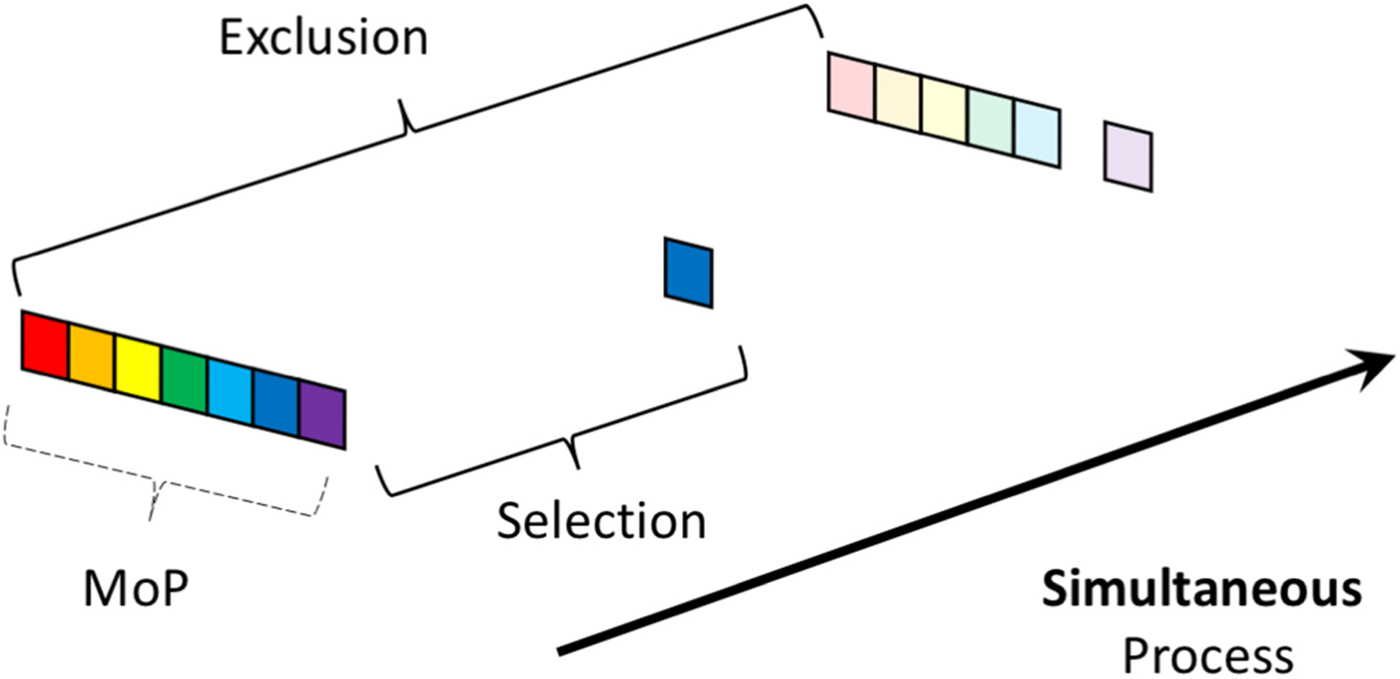
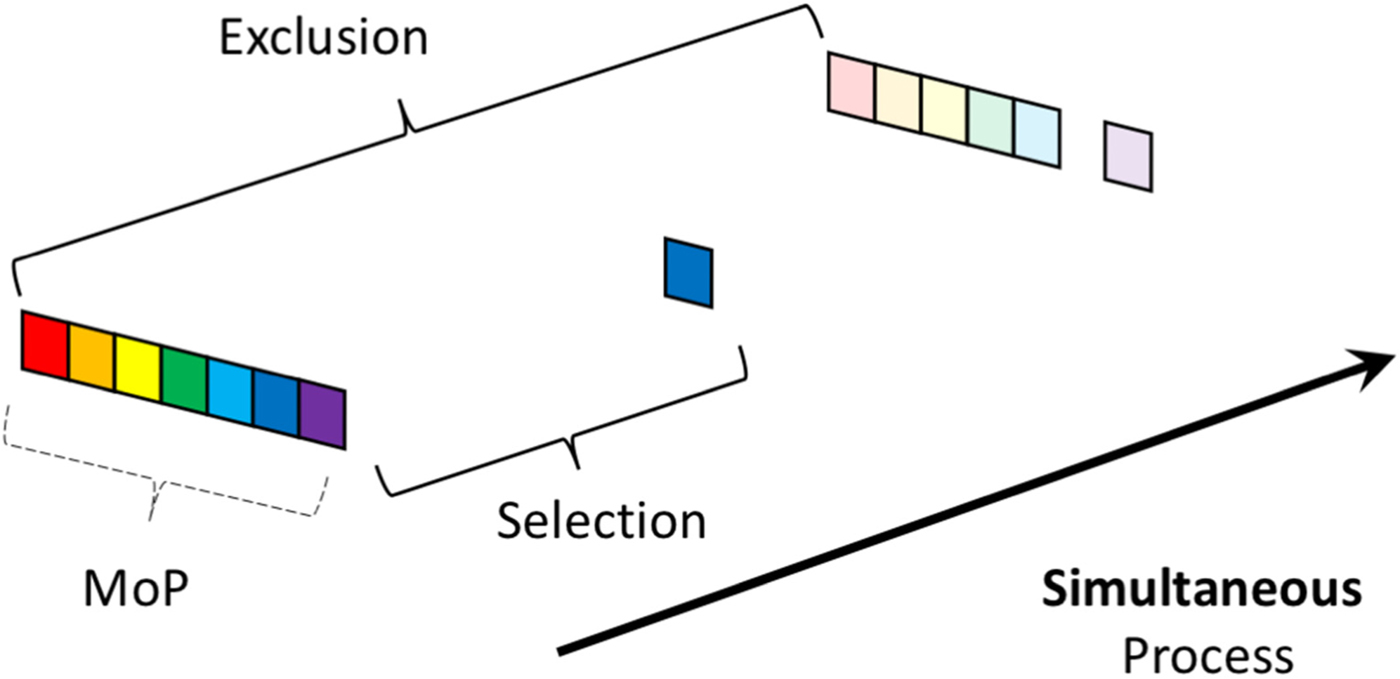
Dembski defines information as an exclusion of possibilities.Footnote 20 He compares propositional statements with tautologies to make this point. For instance, if someone were to say that it could be or could not be raining outside, though it is a statement made on the possibility of the weather, because it is a tautology, it carries within it no actual content and thus is informationless. It conveyed nothing. Compare this to the statement that it is raining outside (and assuming it actually is), then this statement makes a claim with positive content which simultaneously excludes that it is not raining outside. Another example can be used to make this idea more concrete. A die (usually) has six sides and therefore has the possibility set of [1, 2, 3, 4, 5, 6]. If it is rolled and lands on 4, it immediately excludes the other five possibilities. For those more visually inclined this idea of information as an act of exclusion can be seen using the simple example of colours in Figure 2. Imagine that all the colours are present in front of you and you selected blue. In that moment you simultaneously posit one selection and exclude the others, thus leading to information.
Exemplifying Dembski's act of exclusion using colours as an example.
Undoubtedly, Dembski's understanding of information presupposes a possible world narrative or what he refers to as a matrix of possibility (MoP).Footnote 21 Though Dembski is prudential on the altogether entirely different question whether possible worlds exist, he does consider them to ‘serve as useful tools of inquiry into the actual world’ and ‘supply conceptual grids for understanding the actual world.’Footnote 22 As a counter claim it could asked how does one go on to select the MoP? Dembski, clearly foreseeing such a question, notes that the MoP is entirely a tool of inquiry that is not self-imposing: ‘Context determines what possibilities we regard as plausible … and plausibility determines what possibilities we include in our MoP. Shift the context, and our matrix will shift accordingly.’Footnote 23 The MoP is thus completely malleable. Reconsider the rain example from earlier. The MoP and can be treated as a lens that can be made coarser, e.g. it is wet outside (less exclusion), or more refined, e.g. it is raining at three inches per hour (more exclusion).Footnote 24
The MoP can also be expanded to incorporate new possibilities that were not realised before when needed, which is how, for instance, scientific progress is made. For example, for a significant portion of the history of modern science it was thought that world was fundamentally corpuscular, when it could easily have not been. Thus, scientists tried to understand the natural world through a corpuscular narrative. However, after getting indications that matter may (also) be wave-like – as per the double slit experiment – it was realised that the MoP must be revised and should start incorporating wave potentials.Footnote 25 Similarly, in Newtonian physics it was thought that time was absolute but after Einstein's relativity it was realised that time is relative. Newtonian physics is also only considered applicable at low speeds whereas relativistic effects are only pronounced when dealing with velocities close to the speed of light.Footnote 26 Accordingly, and depending on the context, the suitable framework is applied when needed. These examples demonstrate how the MoP is context dependent and is framed by what is being considered (and reconsidered).
It is from this perspective that he argues that grounding reality informationally rather than materially is a better option since it starts from a malleable top-down approach (i.e. variable in its MoP) whereas materialism has a limited bottom-up approach.Footnote 27 A material worldview starts with an isolative and constitutional premise, which is usually on very tentative grounds, and tries to explain everything through that perspective, whereas an informational worldview starts with the many possibilities and ends with the few; information is primarily about diminution.Footnote 28 With this flexibility, an informational approach to understanding reality lets nature be what it really is.
Dembski, however, does not stop here. He goes further and contends that all matter is simply a conglomeration or a loci of information.Footnote 29 Through observation, either direct or inferred, patterns, forms and regular behaviours are simply the formal expressions of matter which are perceivable. No one actually knows what matter is except through the manifestation of these forms and patterns (think of virtual particles which are known only by their inferential patterns in contrast to the traditional understandings of matter):
‘… Matter, as an abstraction from different types of material objects, leaves no characteristic pattern or signature. From the vantage of information, matter is therefore not real. To be sure, different types of matter are, or may be, real: massive particles such as protons and electrons, massless and almost massless particles such as photons and neutrinos, energetic fields, dark matter, dark energy, strings, superstrings, branes, etc. All of these can lay claim to being real. But to do so, each type of matter must display a characteristic signature in concrete circumstances (i.e., in relation to other things known to be real). Moreover, it makes its reality known by signing that signature within a matrix of possibility. Matter as such, however, is not real but merely an abstraction, just as the average American family, which has 2.3 children, is an abstraction. Such abstractions have some connection to reality, but they themselves are not real.’Footnote 30
This point resonates with Philip Clayton who described matter as ‘simply being used as another name for the Unknown.’Footnote 31 Thus, matter is simply a variable for what information that needs to be manifested. So rather than seeing reality as a vertical chain of stratified matter – in other words macroscopic matter resting on microscopic entities – it is instead embodied layers of information. It is from this perspective that Dembski believes that information is ontologically prior and more fundamental than matter rather than information being a by-product of material processes, as is prevalent amongst naturalists and new atheists.Footnote 32
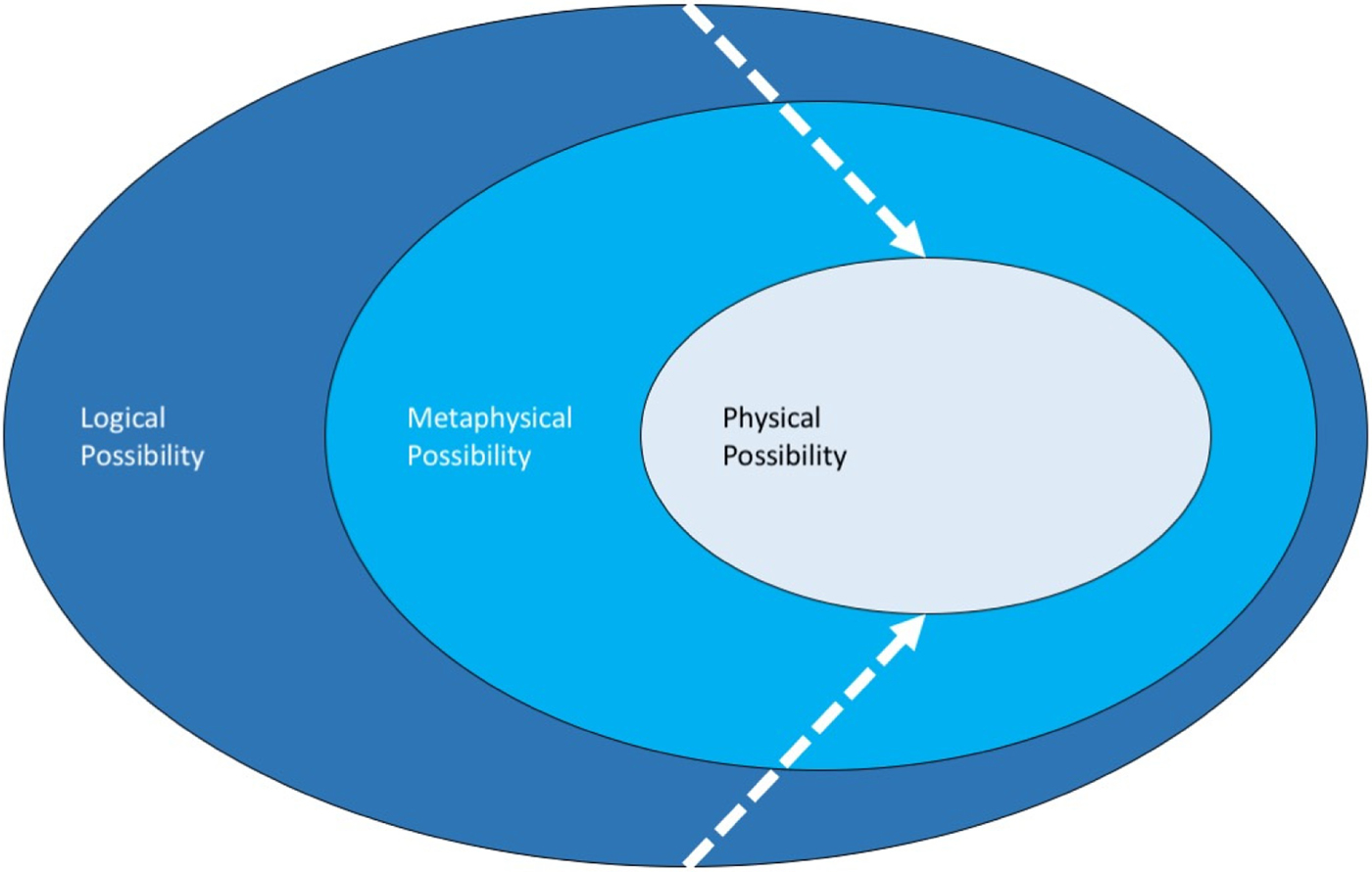
All that has been said thus far may be true with regards to viewing the MoP anthropocentrically. But what about the theocentric perspective? Here Dembski argues that God's eye view is different to the human perspective since God will have the most inclusive MoP.Footnote 33 Unlike humans, God's MoP is not malleable (and it cannot be) because it already contains everything that needs to be known. If God is believed to be omniscient then there is no possibility that can escape God. Thus, His MoP does not need to be made coarser, finer or contextually adaptive. God will have all the logical possibilities at his disposal and it is the exclusion of all those possibilities towards a sub-category of the physical possibilities that He has designated for this universe that would be His act of (primal) exclusion (see Figure 3).Footnote 34 This is unlike the human's MoP which is finite and limited, which is why it has to be contextually constrained and varies from situation to situation. I have summarised this difference in Table 1.
The realm(s) and domains of possibilities. The dashed-white arrows represent the collapse of logical possibilities to physical possibilities.

Comparative summary of the MoP and Acts of Exclusion from God's and a human's perspectives.

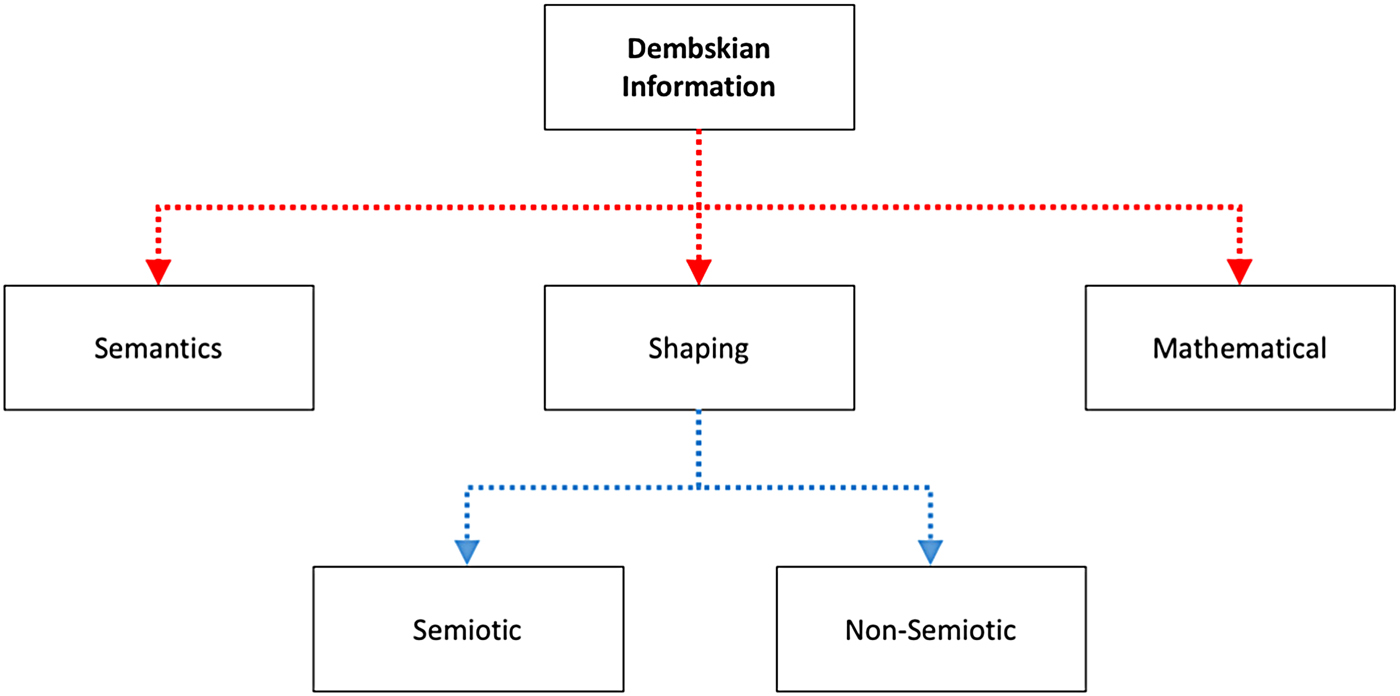
Dembski's account of information is, then, theism-friendly and provides the broadest account of information that undergirds all the other viewpoints of information mentioned earlier as can be seen in Figure 4.Footnote 35 By defining information as an act of exclusion of others it simultaneously negates what could have been and affirms what is, be it quantitatively or qualitatively or a combination of both,Footnote 36 thus reframing the entire ontology of the universe as a relational by-product (i.e. a diminution of possibilities) of a conscious mind. From a theocentric view God's mind has the infinite MoP, the most inclusive matrix, which includes all the possible worlds including the ones that human finitude cannot comprehend. By contrast, anthropocentric MoPs are limited and are developed through experimenting with nature. Nature is, then, like a double sided interface with God collapsing all available possibilities (from His MoP) to the one He wants to actualise,Footnote 37 and therefore creates and sustains, while humans are on the receiving end and use limited MoPs to determine how and which possibilities are actualised in nature at a subsidiary level. Nature therefore has two very different ‘functions’ depending on the perspective.Footnote 38
A suggestive taxonomy of information.

To summarise then, information defined this way, and if nature as we know it is manifested this way, leads to three different ontological implications:
1. The world in its entirety (parts and whole), is relational because the realisation of one possibility is always against a background class of possibilities, e.g. rolling 4 on the dice was one possibility amongst six possibilities;Footnote 39
2. Actualisations are by definition contingent and not necessary because we can always think of other possibilities that could have occurred, e.g. the dice could have rolled as 1 or 2 rather than 4. In other words existence is the actualisation by cancellation;Footnote 40
3. From the previous two it follows that all potential possibilities prior to actualisation must have some ontological reality, and something must be causing that possibility set to collapse to the exclusion of others. For Dembski all possibilities reside in the Mind of God and it He who actualises one above all.
As we shall come to see in the next section, Dembskian information seems to be very similar to what al-Ghazālī defines as the will.
2. Framework of Kalam
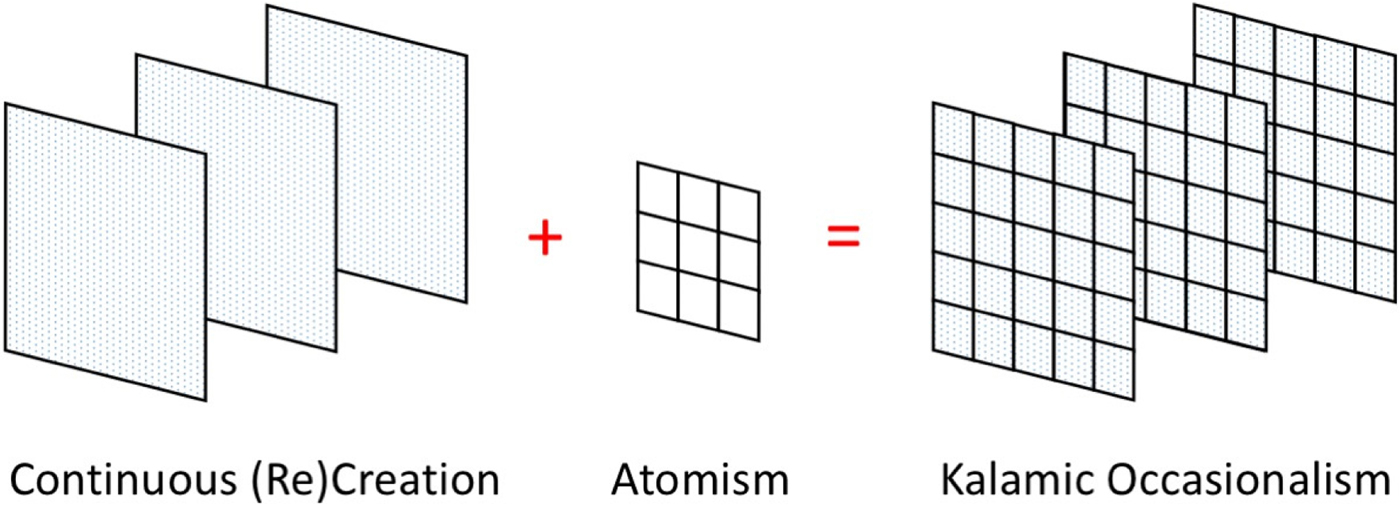
Kalam as a discipline was a creative activity that sought the need to create an intellectual space whereby the tenets of Islam can be maintained and safeguarded. It could be simplistically regarded as Islamic apologetics but that would immediately disqualify a lot of material under kalam which would not fall under that classification. Practitioners of kalam (single: mutakallim, plural: mutakallimūn) were involved in not just defending the articles of faith but also providing an entire metaphysics through which the relationship between God and the natural world could be harmonised, and thus kalam can be more appropriately identified as Islamic scholasticism. The specific worldview of Ash'arite kalam Footnote 41 rested on two different philosophical constructs that were systematically merged together: occasionalismFootnote 42 and atomismFootnote 43 (see Figure 5).
Summary of Kalamic Occasionalism.

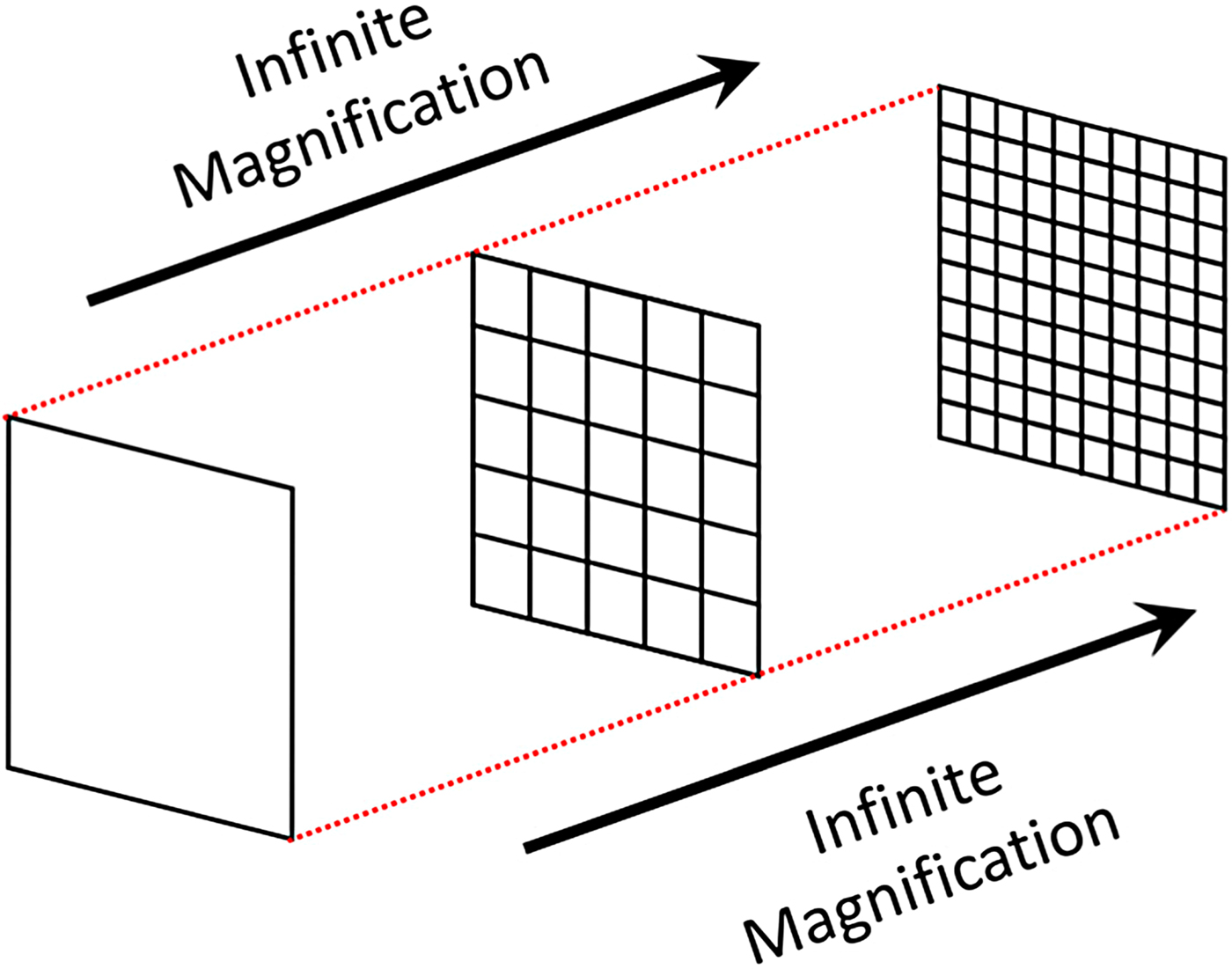
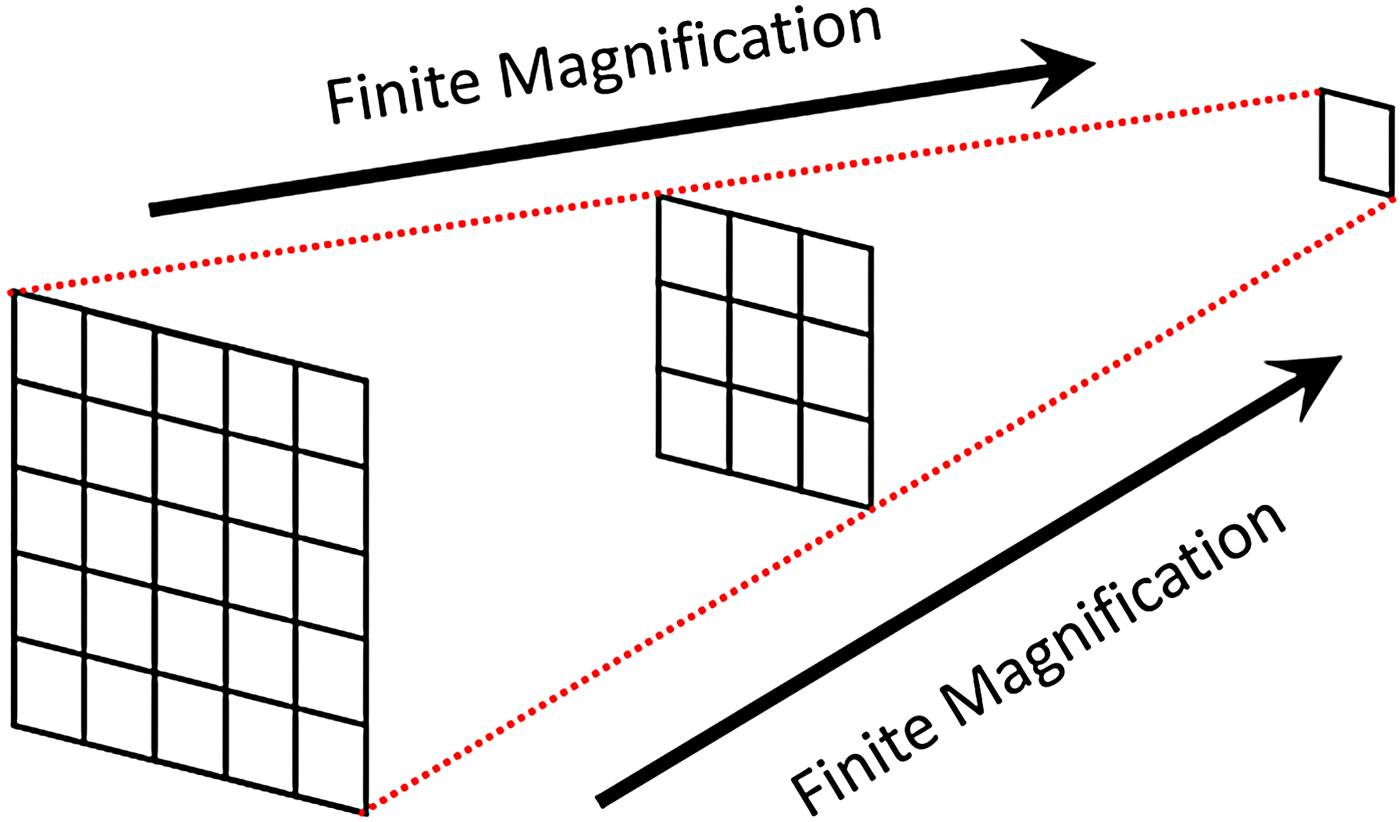
Both were utilised for different reasons. The primary motivation for holding on to occasionalism was to make sure that God's absolute power could not be locked out by any natural laws as a matter of causal necessity as held by rival worldviews,Footnote 44 and to ensure that His involvement would not be expelled from the constant affairs of the world at any moment.Footnote 45 Furthermore, occasionalism was a position that enticed the mutakallimūn because it completely eliminated the idea of any intrinsic power (i.e. power in virtue of its essence) that was thought to belong to nature in the ontological sense,Footnote 46 thus treating nature (including humans themselvesFootnote 47) as the sole manifestation, an interface of some sort, of God's absolute will. Atomism was employed to make sure that creation stayed limited and to avoid absurdities; they rationalised that an eventual end point in how far creation could be divided into its constituents was needed, else the universe could be divided ad infinitum which was illogical (compare Figure 6 and 7).Footnote 48 Shlomo Pines provides an example of such an illogical implication that can be commonly be found in the works of the mutakallimūn: ‘If bodies were infinitely divisible, then a seed of mustard … would necessarily consist of as many parts as a mountain.’Footnote 49
Infinite division of matter.

Finite division of matter.

Though the early mutakallimūn were in broad agreement that the universe was discrete, they differed in how to interpret the nature of the discrete particles of the universe. Generally, there were only one of two positions which Muslim thinkers held. Some believed that the discrete particles of the universe could be divided between substances and accidents, the former acting as the permanent, indivisible scaffold which would act as the conglomeration centre of accidents that would come to define it. Accidents could include properties such as weight, colour, sound, smell and others. The other group would maintain that such a division was not necessary as the discrete entity would not come to concretion unless accidents were manifest, thus suggesting that the substance was a superfluous term.Footnote 50 Hence the discrete unit is simply a collection of accidents.Footnote 51 What was common to both groups was that accidents could not occupy two sequential moments together as according to the occasionalist worldview things were in a continuous state of affairs involving infinitesimally moments of creation and annihilation in recurrence, extrinsically powered by God. Recall, the attraction of this worldview for the early mutakallimūn was that it kept God's power untainted over every single entity by directly forging a link between God and the discrete units, and simultaneously negated any intrinsic power to nature. Thus, God not only was a creator but also kept sustaining the universe unlike the concept of deism.Footnote 52 Relevant for my purposes, what is important to note here is that the mutakallimūn (or most of them) understood all of creation in discrete terms, e.g. matter, energy, time etc.Footnote 53
2.1 Al-Ghazali's Notion of God's Will
Having provided a brief overview of kalam, this leads me to the importance of al-Ghazālī and his stance on God's free will in his iconic Incoherence of the Philosophers (hereon referred to as IP) which seems to have some parallel with Dembskian information. Let us first situate the context in which the book was written. The IP was written as a philosophical exploration of twenty different contentions held by Muslim philosophers, namely Al-Farabi and Avicenna.Footnote 54 These thinkers were heavily inspired and occupied with Aristotelian and Neoplatonic elements, which they tried to enmesh with Islamic principles. Al-Ghazālī goes on to argue and demonstrate how these twenty propositions cannot be held onto by demonstration (burhān) because they buckle when pressed for evidences and/or implications in a dialectical format. To analyse every argument is beyond the scope of this article. Rather I will particularly focus on specific segments where he spends considerable effort in trying to establish and safeguard the will of God against the position of Avicenna who believed that the world was a necessary product due to his adoption of emanationism. In other words, Avicenna believed that the world was a necessary creation and not created by divine choice as stressed by al-Ghazālī. This is a fundamental difference between the two thinkers.
Having cleared this preamble, let us review some passages from the IP to see how al-Ghazālī stresses this difference. In the second proof of the first discussion we get a glimpse of how al-Ghazālī introduces his conception of the will:
‘The world came to existence whence it did, having the description with which it came to exist, and in the place in which it came to exist, through will, will being an attribute whose function is to differentiate a thing from its similar. If this were not its function, then power would be sufficient. But since the relation of power to two contraries is the same and there was an inescapable need for a specifying [agent] that would specify one thing from its similar, it was said: “The Eternal has, beyond power, an attribute that has as its function the specifying of one thing from its similar.” Hence, someone's statement, “Why did the will specifically relate to one of the two similars?” is akin to the statement, “Why does knowledge entail as a requirement the encompassing of the object of knowledge as it is?” For [to the latter] one would reply, “This is because ‘knowledge’ stands as an expression for an attribute that has this as a function.” Similarly, “Will stands as an expression for an attribute whose function—nay, its essence—is to differentiate a thing from its similar.”’Footnote 55
In this paragraph al-Ghazālī defines will as the function which can distinguish between one of several alternatives. If this was not the case, then power would be the sufficient on its own. But power doesn't have the capacity to choose rather it enacts or manifests the selected option. For example, I may have the power to lift a hundred kilograms, but on a particular day I may choose to lift five, ten, fifty or a hundred. The will, then, is different to power. But somewhat not explicitly clear in this paragraph is how knowledge is a prerequisite of will. If one doesn't know the alternatives, one cannot choose one among others. Having cleared this al-Ghazālī then goes on to demonstrate that the world isn't modally necessary as held by Avicenna. Rather, the natural world seems to be an ostentatious display of choices. Consider the following comment where he looks at celestial phenomenon to make this point:
‘Heaven is a sphere rotating around two poles as though both are stationary. [Now,] the heavenly sphere is of similar parts. For it is simple—particularly the highest heaven, the ninth, for it has no stars at all. These two spheres (the ninth and the rest| rotate around two poles, northern and southern. Thus, we say, “There are no two opposite points among the points that, according [to the philosophers], are infinite but could be conceived as being the pole. Why is it, then, that the northern and southern points have been assigned to be the poles and to be stationary? And why does not the ecliptic line [shift], moving with [it] the two points so that the poles would revert to the two opposite points of the ecliptic? If, then, there is wisdom in the extent of the largeness of heaven and its shape, what differentiated the place of the pole from another [place], singling it out to be the pole from the rest of the parts and points, when all the points are similar and all parts of the sphere are equal?”’Footnote 56
Here al-Ghazālī rhetorically asks questions about the arbitrary positions of the poles to demonstrate the contingency of the natural world, unlike the position held by Avicenna. They could have easily been something else. In another instance al-Ghazālī argues the same case in the context of the size of the universe:
‘“Did it lie within God's power to create the highest heaven greater in thickness by onecubit than the one He had created?” If they say, “No”’ this would be [the attribution to Him of] impotence. If they say, “Yes,” then [it follows that God could have created it] greater by two cubits, threecubits, and so on, ascending ad infinitum.’Footnote 57
The purpose of these arguments was to show how God does actually choose what to manifest in creation as per the Wisdom of God and is not necessary but entirely contingent. Does this entail that al-Ghazālī believed that God could manifest anything, even the illogical? No, al-Ghazālī held on to the position that God cannot do the logically impossible:
‘For, in supposing the world larger or smaller than it is by a cubit, the mind is not supposing what is akin to conjoining blackness and whiteness in one and the same place: namely, existence and nonexistence. The impossible consists of conjoining negation and affirmation. All impossibilities reduce to this.’Footnote 58
And in another place he says:
‘The impossible is not within the power [of being enacted]. The impossible consists in affirming a thing conjointly with denying it, affirming the more specific while denying the more general, or affirming two things while negating one [of them]. What does not reduce to this is not impossible, and what is not impossible is within [divine] power.’Footnote 59
Thus, al-Ghazālī’s conception of nature was that it had to be bound by the law of non-contradiction: united contraries are not realisable because they are impossible, but all else is realisable and therefore possible. But we needn't stop here. In a paragraph in his Moderation in Belief, which is considered to be a follow up of IP as a construction of kalam after the deconstructive narrative of the IP, he effectively writes how God ‘chooses’ from an infinite number of possible worlds:
‘It might be asked: “Is there an end to what He knows?” We say “No, for although the existents at the present are infinite, the possible existents in the future are finite. He knows with respect all the possible things that do not exist now whether He will bring them into existence or not. Therefore, what He knows is infinite. In fact, if we want to multiply the aspects of a single object by considering different relations and magnitudes, these aspects would exceed any finite limit; and God knows of these.”’Footnote 60
Of course the ‘choosing’ of God is far removed from any conception of human choices. Since God is eternal, atemporal, and non-spatial, His choice is unlike any human endeavour as of His other attributes (e.g. Seeing and Hearing).Footnote 61 There are many other tangents that one could entertain when looking al-Ghazālī’s conception of modality (and other relevant topics) but this is sufficient my purposes.Footnote 62 Having provided a brief overview of the two thinkers we can now turn to a comparison of the two.
3. Al-Ghazālī’s Notion of God's Will and Dembskian Information
Dembskian information seems to occupy, at first glance, an Aristotelian metaphysics. However, this would be an inaccurate rendering. Aristotle's metaphysics was hylomorphic in that everything in nature was a combination of form (morph) and matter (hyle). But recall Dembski's position from earlier that matter is merely an abstraction, it doesn't actually exist, so it is information ‘all the way down.’ Thus the ontological relegation (or solvation) of matter is a point of departure in Dembskian information with Aristotelian metaphysics. Furthermore, Aristotle believed that forms were an intrinsic component of nature while Dembski seems stuck halfway between Plato and Aristotle. He is half Platonic because all the possibilities are in the transcendent mind of God (and thus extrinsic), and half Aristotelian because the actualisations of these inhere in the natural world (but not due to any intrinsic necessity).Footnote 63 Al-Ghazālī would agree with Dembski's stress on this point and with the contingency of the natural world. But on the other hand he (probably) adopted atomism as his metaphysics of the natural world,Footnote 64 as per his Ash'arite commitments, which is partially at odds with hylomorphism. It is well-known that in Islamic thought there was intense rivalry between hylomorphists (i.e. most philosophers) and atomists (i.e. most mutakallimūn).Footnote 65 The main reason why the mutakallimūn were against hylomorphism was due to atomism being able to deal with the problem of infinity. Recall Pines’ quote earlier where if a mountain and a mustard seed were divided ad infinitum then both would contain the same number of parts, which is illogical. The mutakallimūn also considered examples of other kinds illustrating the falsity of actual infinity, e.g. Zeno's paradox.Footnote 66 Even though Dembski is not a strict hylomorphist himself, by taking information as his ontological anchor with the way he defines it, he doesn't rule out the possibility of infinite extension in (or into) the natural world:
‘Is physical reality in the end just an expression of mathematical reality, with the empty set constituting the rock-bottom informational entity for all of physical reality as we know it? Perhaps, but I question the value of speculating unduly about this information regress. As a Christian theist, who sees God's wisdom and power as unsearchable, I wouldn't be at all surprised if God allows an infinite regress of information and embodiment to mirror his own unsearchableness, at least in the realm of physical matter.’Footnote 67
This shouldn't be surprising seeing that Dembski's worldview occupies no fundamental limit which is why he believes in the possibility of ‘drilling’ deeper into the fabric of the universe indefinitely. In al-Ghazālī’s worldview logic would truncate any such infinite probing (as actual infinity does not exist).Footnote 68
Another difference between two thinkers is the context of impetus for their positions. Dembski develops his worldview as an alternative perspective to materialism. Since science is heralded by atheists as the defining worldview to judge any perspective by, Dembski attempts to show the limits of materialism. To understand a phenomenon one needs a context, observation, data and theory identification (crudely put). Each stage requires the exclusion of possibilities to the realisation of one: ‘A stone falls down. From among an infinite number of possible paths it will choose the one that is prescribed by Newton's law.’Footnote 69 This gives information a stronger ontological status than matter, which itself is nothing more than an abstraction of information signatures. Al-Ghazālī occupied a different historical and contextual setting. His argument was less stimulated by science but more so by a rival theo-philosophical worldview that constricted God's choice, namely Avicenna's adoption of emanationism. Avicenna occupied a metaphysical framework whereby the world and all its subsidiary processes are necessary, i.e. things could not have been otherwise. This motivated al-Ghazālī to develop a worldview in which God would have the freedom to do as He pleases, i.e. His will isn't constrained. It is for this reason that occasionalism and atomism are tightly woven together in his and the Ash'arite's framework.
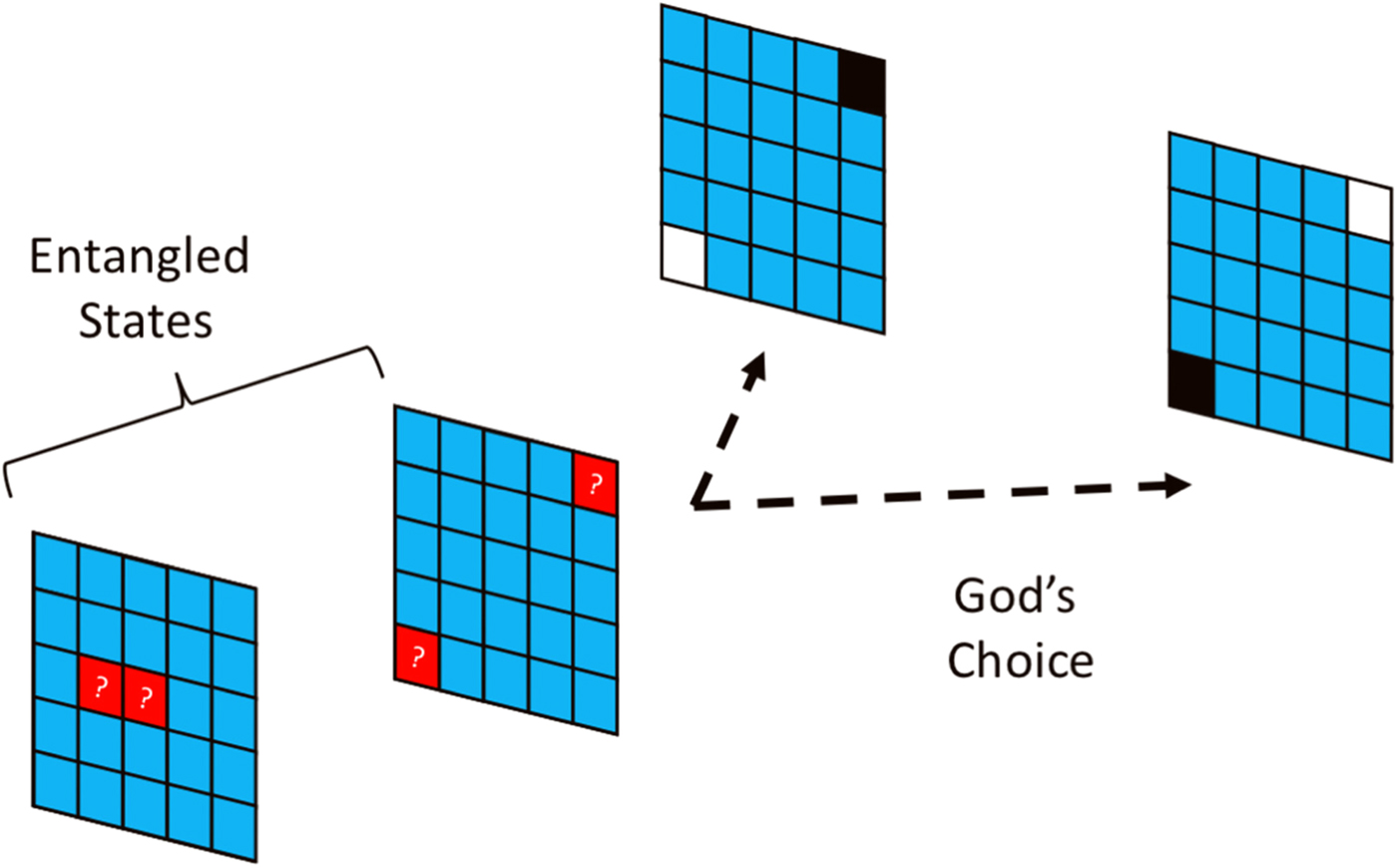
In spite of these differences, and interestingly, both accounts seem to have the available flexibility to embrace developments in modern science. Take the phenomenon of entanglement in quantum mechanics as an example. In an entangled state particles are combined together such that their properties become shared (or state-dependent); if the properties of one atom is measured it immediately alters the property of the other. In other words, one particle can no longer be described independently from the other while entangled (see Figure 8). This has some amazing implications. If these two particles are stretched as far apart as the size of the universe, measuring the properties of one particle will immediately yield the information of the other particle. This would suggest (and not necessarily imply) superluminal communication, something which was thought to be impossible as the speed of light was thought to be the upper speed limit of anything within the universe.Footnote 70 In al-Ghazālī’s conception of contingent causality and Dembski's informationally grounded worldview such counterintuitive scenarios will not be seen as a problem.Footnote 71
A simplified depiction of quantum entanglement. The second frame from the left is supposed to be a crude model of entangled particles at the ‘edge’ or ‘corners’ of the universe. The black and white squares are supposed to represent opposite properties. I should add that every moment is actually considered as the manifestation of God's choice. I only place this in the unveiling of the properties of the entangled particles to demonstrate how neither options are problematic from God's point of view as per both thinkers’ perspectives.

Dembski doesn't specify what model of divine action he adopts but points out how his informational worldview can easily embrace any such counter-intuitive phenomena, including miracles:
‘… the causal structure of the world has no way of barring God from getting novel information into the world to accomplish the divine purposes. God can, if he likes, get information into the world by performing miracles (the one who created the world and its laws is hardly bound by them) … however … God can also get information into the world without performing miracles. In a world of irreducibly chance or random events, as some interpretations of quantum theory allow, God can channel such events toward preordained ends. Yet even in a world whose material arrangement is entirely deterministic, God could so arrange its initial and boundary conditions that it unfolds precisely according to plan. Such a world would exhibit ongoing particular providence, with God moment by moment substantively influencing the world down to the finest details. Thus, regardless of one's view of the causal structure of the world, theism is always a live option and deism (the God who goes on vacation after creation) is never mandated.’Footnote 72
Dembski's first account bears resemblance with al-Ghazālī’s position on divine action and nature's radical contingency:
‘The connection between what is habitually believed to be a cause and what is habitually believed to be an effect is not necessary … for example, the quenching of thirst and drinking, satiety and eating, burning and contact with fire, light and the appearance of the sun, death and decapitation, healing and the drinking of medicine, the purging of the bowels and the using of a purgative, and so on to [include] all [that is] observable among connected things in medicine, astronomy, arts, and crafts. Their connection is due to the prior decree of God, who creates them side by side, not to its being necessary in itself, incapable of separation. On the contrary, it is within [divine] power to create satiety without eating, to create death without decapitation, to continue life after decapitation, and so on to all connected things.’Footnote 73
Accordingly, al-Ghazālī remains entirely open to mysteries and miracles that are beyond current comprehensions:
‘If, then, the principles of dispositions are beyond enumeration, the depth of their nature beyond our ken, there being no way for us to ascertain them, how can we know that it is impossible for a disposition to occur in some bodies that allows their transformation in phase of development in the shortest time so that they become prepared for receiving a form they were never prepared for receiving previously, and that this should not come about as a miracle? The denial of this is only due to our lack of capacity to understand, [our lack of] familiarity with exalted beings, and our unawareness of the secrets of God, praised be He, in creation and nature. Whoever studies [inductively] the wonders of the sciences will not deem remote from the power of God, in any manner whatsoever, what has been related of the miracles of the prophets.’Footnote 74
From these it follows that God can easily keep entangled particles in an indeterminate state (or at least constrained to a suspended sate in the anthropocentric perspective) and then decide to simultaneously assign the respective properties by the act of measurement of either particle, regardless of their spatial distance.Footnote 75 How this works out in a scientific description can be left to the physicists to figure out. What is important to acknowledge is that discoveries like these need not be surprising given the metaphysical flexibility of Dembskian information and the contingency of the causal nexus in al-Ghazālī’s framework as per the will of God.Footnote 76
4. Conclusion
Dembski and al-Ghazālī come from very different starting points to reach somewhat similar stances on the nature of world and its subsidiary processes. Both suggest that the world and all its operations are radically contingent which can be easily couched in a theistic framework. However, this is as far as they share similarities. They differ with respect to the stimuli against which they develop their worldviews. Dembski developed his informational worldview to counter materialism while al-Ghazālī’s position was a response to Avicenna's framework that limited God's freedom. Moreover, Dembski's model permits, potentially, an infinite probing of the universe while al-Ghazālī would reject such a notion due his commitment to atomism (and aversion to contradictory claims). Fascinatingly, both occupy a metaphysical framework which can easily accommodate counter intuitive developments in modern science such as quantum mechanics. This is more so surprising of al-Ghazālī than of Dembski since the latter developed his position in hindsight of contemporary physics. Al-Ghazālī however entertained no such context nine hundred years ago, which is telling of how far he was ahead of his time. On this point Massimo notes: ‘It is tempting to go so far to say that, had they been discovered during his time, al-Ghazālī would have no difficulty in understanding non-Euclidean geometry or black holes, even if they represented anomalies in the cosmological conception of that time's world.’Footnote 77, Footnote 78