Background
Down syndrome is one of the most prevalent genetic conditions in the world. Each year, about 3357 babies in the United States of America are born with Down syndrome at an annual rate of 13 of every 10,000 babies born.Reference Canfield, Honein and Yuskiv 1 Of the children with Down syndrome, 40–50% have congenital heart disease.Reference Rowe and Uchida 2 Many patients with Down syndrome also have associated co-morbidities, which may affect survival after congenital heart disease repair.Reference van Trotsenburg, Heymans, Tijssen, de Vijlder and Vulsma 3 , Reference Baraona, Gurvitz, Landzberg and Opotowsky 4 Although the outcome of children with Down syndrome who undergo single ventricle palliation is poor,Reference Fudge, Li and Jaggers 5 multiple changes in the care of children with single ventricle have occurred over the last decade, leading to improvement in the outcomes of single ventricle palliation. The cumulative effect of Down syndrome in association with other known high-risk factors in a patient who has single ventricle physiology is unknown. Our aim was to study the fate of children with Down syndrome with associated high-risk factors who are undergoing single ventricle palliation in the current era.
Methods
A retrospective review of all patients who underwent single ventricle palliation at Children’s National Health system between March, 2005 and June, 2011 was conducted. Patients with single ventricle anatomy and Down syndrome formed the study population. Operative, echocardiographic, haemodynamic data from cardiac catheterisation, and follow-up data were reviewed to identify key information including cardiac anatomy, types and stages of surgical interventions, hospitalisations, and co-morbidities. Associated high-risk factors – low birth weight, high pulmonary vascular resistance, pulmonary vein stenosis, significant atrioventricular valve regurgitation, and extracardiac anomalies – were recorded.
Aristotle Basic Complexity scoreReference Lacour-Gayet, Clarke and Jacobs 6 , Reference O’Brien, Jacobs and Clarke 7 and Risk Adjustment for Congenital Heart Surgery scoreReference Jenkins, Gauvreau, Newburger, Spray, Moller and Iezzoni 8 were recorded for each procedure. Waiver of informed consent was approved by the Children’s National Health system institutional review board.
Results
A total of 310 patients underwent at least 1 “single ventricle” surgical intervention. Of those, eight patients had Down syndrome. Of these eight patients, six had unbalanced atrioventricular canal defects and two patients, one with aortic atresia and the other with truncus arteriosus, had remote ventricular septal defects not amenable to bi-ventricular repair.
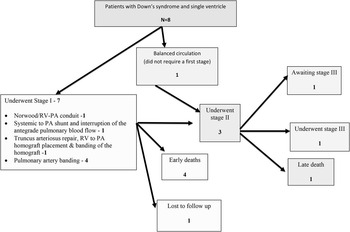
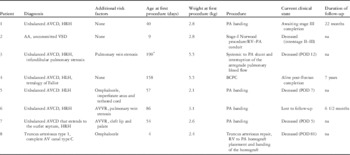
Of the eight patients, seven required stage I palliation, four underwent pulmonary artery banding (Aristotle Basic Complexity score-6, Risk Adjustment for Congenital Heart Surgery score-3), one underwent repair of truncus arteriosus, right ventricle to pulmonary artery homograft placement and banding of the homograft (Aristotle Basic Complexity score-11, Risk Adjustment for Congenital Heart Surgery score-4), one underwent Norwood stage I operation with a right ventricle to pulmonary artery conduit placement (Aristotle Basic Complexity score-14.5, Risk Adjustment for Congenital Heart Surgery score-6), and one underwent a systemic to pulmonary artery shunt with interruption of antegrade pulmonary blood flow (Aristotle Basic Complexity score-6.3, Risk Adjustment for Congenital Heart Surgery score-3). One patient with unbalanced atrioventricular canal and tetralogy of Fallot had a balanced circulation and underwent bidirectional superior cavopulmonary connection (Aristotle Basic Complexity score-7, Risk Adjustment for Congenital Heart Surgery score-2) as a first procedure at 5 months of age (Table 1 and Fig 1).
Distribution of patients. PA=pulmonary artery, RV=Right ventricle.

Patient characteristics.

AA=aortic valve atresia; ASD=atrial septal defect; AVCD=atrio-ventricular canal defect; AV=atrioventricular; AVVR=atrioventricular valve regurgitation; BCPC=bidirectional superior cavopulmonary connection; HLH=hypoplastic left ventricle; HRH=hypoplastic right ventricle; na=not applicable; PA=pulmonary artery; POD=postoperative days; RV=right ventricle; VSD=ventricular septal defect
* This patient’s pre-procedural cardiac catheterization revealed a mean pulmonary artery pressure of 30 mmHg and pulmonary vascular resistance of 7.7 woods units
Of the eight patients who had Down syndrome, five had associated risk factors – low birth weight, high pulmonary vascular resistance, pulmonary vein stenosis, significant atrioventricular valve regurgitation, and extracardiac anomalies. After a median follow-up period of 138 days (8–576 days), only 37.5% (3/8) of Down patients undergoing single ventricle palliation were alive; specifically, 20% (1/5) of the high-risk group and 67% (2/3) of the low-risk group were alive. Clinical, demographic, risk profile, and survival of patients are detailed in Table 1.
The operative mortalityReference Jacobs, Mavroudis and Jacobs 9 rate for all stage I single ventricle palliations in this cohort was 57% (4/7). There was one interstage II–III mortality, and one patient was lost to follow-up 6½ months after the pulmonary artery banding procedure. There were no stage II or stage III mortalities. For comparison purposes, during the same time frame at our centre, the operative mortality for stage I, stage II, and III (Fontan completion) in non-Down syndrome patients were 17.9% (33/184), 4.6% (9/195), and 1.8% (3/171), respectively.
Discussion
The mortality for patients with Down syndrome single ventricle continues to be high, irrespective of the operative complexity, and is extremely poor in patients with associated risk factors.
An unusually high association of high-risk factors such as low birth weight, high pulmonary vascular resistance, pulmonary vein stenosis, significant atrioventricular valve regurgitation and extracardiac anomalies were present in 63% (5/8) of our patients with single ventricle physiology and Down syndrome.Reference Ashburn, McCrindle and Tchervenkov 10 – Reference Hehir, Dominguez and Ballweg 15 The high association in our series could be influenced by multiple factors such as patient selection, local referral patterns, or geographical variation in the spectrum of cardiac disease. Two of the three patients who survived till the most recent follow-up did not have additional risk factors. On the other hand, four of the five patients who died during the follow-up period had associated high-risk factors.
Using the Society of Thoracic Surgeons Congenital Heart Surgery Database, Fudge et alReference Fudge, Li and Jaggers 5 found significantly higher in-hospital mortality rates in patients with Down syndrome compared with patients without Down syndrome after each single ventricle stage procedure. Gupta-Malhotra et alReference Gupta-Malhotra, Larson, Rosengart, Guo and Moller 16 using the Pediatric Cardiac Care Consortium Registry also found higher mortality after the Fontan operation in children with Down syndrome (35%) compared with those without (10%). Wada et al in a report of six patients with Down syndrome who had undergone stage II palliation found half of them not suitable for Fontan completion.Reference Wada, Takahashi, Ando, Park and Sasaki 17 Poor outcomes have also been reported by Campbell et al.Reference Campbell, Adatia, Gow, Webb, Williams and Freedom 18
Although the threshold to adopt a single ventricle palliation pathway in patients with Down syndrome is higher, the outcomes of a discordant management strategy – univentricular versus Biventricular – can also be poor.Reference Hickey, Caldarone and Blackstone 19 Our study shows the cumulative negative prognostic effect of Down syndrome and associated high-risk factors on the outcomes of a single ventricle patient.
Our study has the limitation of being a single-centre, retrospective study with limited patient numbers. The unique underlying anatomy of children with Down syndrome and single ventricle precluded a case control analysis in this report. The majority of our patients with Down syndrome had unbalanced atrioventricular canal, a known risk factor for mortality.Reference Beaton, Pike, Stallings and Donofrio 20 During the same period at our centre, 21% (6/29) of the non-Down syndrome patients with unbalanced atrioventricular canal undergoing single ventricle palliation died after a median follow-up period of 391 (34–837) days. On the other hand, 50% (3/6) of Down syndrome patients with unbalanced atrioventricular canal undergoing single ventricle palliation died (Table 1). From this limited case series, one cannot conclude whether the presence of Down syndrome, irrespective of additional risk factors, is predictive of increased mortality. Further multicentre longer-term studies are needed to validate and quantify the cumulative effects of negative prognostic factors in this complex group of patients.
Despite progressive improvement in the outcomes of single ventricle patients,Reference Anderson, Sleeper and Mahony 21 our study shows that single ventricle patients with Down syndrome overall and especially with associated risk factors continue to have poor survival rates. This overall increased mortality is independent of the surgical complexity of the procedure assessed by the Risk Adjustment for Congenital Heart Surgery score or the Aristotle Basic Complexity scores.
Conclusions
Despite many improvements in the care of single ventricle patients, the fate of those with Down syndrome and associated high-risk factors is extremely poor. Further multicentre longer-term studies are needed to validate and quantify the cumulative effects of negative prognostic factors in this complex group of patients
Acknowledgements
The authors are grateful to Lindsay Attaway, Angela Doty and Christopher Spurney for their editorial assistance.
Financial Support
This research received no specific grant from any funding agency, commercial or not-for-profit sectors.
Conflicts of Interest
None.