Introduction
In ordinary conversation, the literal meaning of words is just one of many cues to a speaker's communicative intent (Bloom, Reference Bloom1997; Clark, Reference Clark1996; Sperber & Wilson, Reference Sperber and Wilson1986). An utterance can often be interpreted in multiple, potentially conflicting ways. When someone says, for example, “It is really cold in here”, the utterance could be taken to mean literally that the temperature in the room is low, or it could be an indirect request to close the window, or it could even be understood ironically as a comment on extreme warmth in a room. To interpret a speaker's utterance accurately, adults have to take into account multiple aspects of the communication, such as the linguistic context and semantics of what were being said, as well as nonlinguistic cues, such as tone of voice and facial expression (e.g., Ackerman, Reference Ackerman1986; Archer & Akert, Reference Archer and Akert1977; Clark & Gerrig, Reference Clark and Gerrig1984; Cutler, Reference Cutler1974; De Groot, Kaplan, Rosenblatt, Dews & Winner, Reference De Groot, Kaplan, Rosenblatt, Dews and Winner1995; Kreuz, Reference Kreuz, Mio and Katz1996; for a review, see Pexman, Reference Pexman, Colston and Katz2005).
Young children too can use simple linguistic and nonlinguistic cues to understand a speaker's communicative intent, especially when the cues are presented individually or when they are congruent with each other (e.g., Baldwin, Reference Baldwin1993; Behne, Carpenter & Tomasello, Reference Behne, Carpenter and Tomasello2005; Diesendruck, Hall & Graham, Reference Diesendruck, Hall and Graham2006; Fernald, Reference Fernald1993; Naigles, Reference Naigles1990). Three- to-four-year-old children are able to use syntactic information to distinguish a speaker's reference to a novel noun, verb or adjective (Diesendruck et al., Reference Diesendruck, Hall and Graham2006; Echols & Marti, Reference Echols, Marti, Hall and Waxman2004). For example, children direct their attention to an object when asked to look at “the blick”, and to an action when “blicking” is requested (Echols, Reference Echols1998). Young infants are able to distinguish messages based on nonlinguistic cues such as tone of voice: five-month-olds react more positively to messages with approval vocalizations (exaggerated rise–fall f0-contours) than those with prohibition vocalizations (lower pitch in short, sharp f0-contours) (Fernald, Reference Fernald1993). To quote another example, 14-month-olds can use an experimenter's pointing and gaze direction to locate a hidden toy when both cues are directed to the same hiding location (Behne et al., Reference Behne, Carpenter and Tomasello2005).
Challenges arise when young children have to attend to multiple communicative cues that conflict with each other, or when these cues have to be construed differently according to context (e.g., Ackerman, Reference Ackerman1982; Freire, Eskritt & Lee, Reference Freire, Eskritt and Lee2002; Hancock, Durham & Purdy, Reference Hancock, Dunham and Purdy2000; Jaswal & Hansen, Reference Jaswal and Hansen2006; Milosky & Ford, Reference Milosky and Ford1997; Moore, Harris & Patriquin, Reference Moore, Harris and Patriquin1993; Morton & Trehub, Reference Morton and Trehub2001; Nurmsoo & Bloom, Reference Nurmsoo and Bloom2008; Povinelli, Reaux, Bierschwale, Allain & Simon, Reference Povinelli, Reaux, Bierschwale, Allain and Simon1997). Hancock et al. (Reference Hancock, Dunham and Purdy2000) suggested that as children become more sophisticated in attending to multiple aspects of communication simultaneously, they shift from basing their responses on single-message elements (e.g., words, face, voice) to integrating different information sources.
Children who regularly experience communicative challenges that demand greater attention and flexibility may develop a greater capacity to integrate multiple cues to infer the communicative intent of a speaker. One such population is children who grow up in a dual-language environment. There is a growing body of evidence that bilingual children may be more sensitive to, and better able to integrate, sources of information about a speaker's communicative intent (e.g., Ben-Zeev, Reference Ben-Zeev1977; Comeau, Genesee & Lapaquette, Reference Comeau, Genesee and Lapaquette2003; Cummins & Mulcahy, Reference Cummins and Mulcahy1978; Genesee, Tucker & Lambert, Reference Genesee, Tucker and Lambert1975; Siegal, Iozzi & Surian, Reference Siegal, Iozzi and Surian2009; Yow & Markman, Reference Yow and Markman2011a, Reference Yow and Markmanb). To take an example from pragmatics, Siegal et al. (Reference Siegal, Iozzi and Surian2009) asked four-to-six-year-old monolingual and bilingual children to identify which of two dolls, that had uttered a response, violated a Gricean conversational maxim (e.g., for the Maxim of Quantity, one of the dolls responded with more information than was needed). Compared to monolingual children, bilingual children showed an enhanced ability to detect these violations of Gricean conversational maxims.
In terms of tone of voice, Morton and Trehub (Reference Morton and Trehub2001) asked children and adults to judge a speaker's emotion while the speaker uttered sentences describing happy and sad situations in either a happy or sad voice. When content and paralanguage matched (e.g., a happy sentence said in a happy voice), both children and adults could accurately identify happy and sad sentences. When the cues conflicted (e.g., a happy sentence said in a sad voice), adults overwhelmingly relied on how speakers sounded, while four-year-olds almost exclusively judged speakers’ emotion from the semantic content. Using similar procedures, Yow and Markman (Reference Yow and Markman2011a) found that four-year-old bilingual children were more tuned-in to the speaker's affective intent and were better able to use the speaker's tone of voice to judge the speaker's emotion, especially when the content of the utterance conflicted with the tone of voice used.
For eye gaze and gesture, in Povinelli et al. (Reference Povinelli, Reaux, Bierschwale, Allain and Simon1997) an experimenter pointed to or looked at a baited box while seated either between two boxes (no conflict) or directly behind an empty box (conflict). They found that two-and-a-half-year-old children were able to use either pointing or gaze direction to locate hidden rewards when there was no conflict between gesture and body position. However, when gesture conflicted with body position, children were able to use the more straightforward gesture, the experimenter's pointing, to locate hidden rewards, but failed when the subtler gesture, gaze direction, was provided. Yow and Markman (Reference Yow and Markman2011b) adapted Povinelli et al.'s (Reference Povinelli, Reaux, Bierschwale, Allain and Simon1997) procedure with two-to-five-year-old monolingual and bilingual children. They found that, compared to monolingual children, young bilingual children made use of the gestures more successfully to locate hidden objects, especially when the subtler gesture – gaze direction – conflicted with the experimenter's body position.
As for integrating multiple sources of information, in Nurmsoo and Bloom (Reference Nurmsoo and Bloom2008), two novel objects were placed in a box so that a child could see both objects while a speaker could only see one. The speaker fixed her gaze on the visible object and said either “There's the [novel-word]! There it is! Can I have the [novel-word]?” or “Where's the [novel-word]? Where is it? Can I have the [novel-word]?”. In this setup, there are multiple sources of information that a child needs to integrate in order to understand what the speaker is looking for, including the speaker's eye gaze, the context of the situation, and the semantics of the utterance. The speaker's eye gaze provides information about which object she is looking at. The context is that she knows there are two objects, but she can see only one and not the other. The semantics of the utterance “there” conveys information about reference to a specific target object, while the semantics of “where” conveys a question about the location of an object. Integrating all the information leads us to expect that the speaker is referring to the mutually visible object when she looks at it and says “there” but that she is referring to the object she cannot see when she asks “where”. Nurmsoo and Bloom (Reference Nurmsoo and Bloom2008) found that while four-year-olds were able to identify the speaker's referent object differentially, two-and-a-half-year-olds found this task challenging. The younger children were more likely to pick the mutually visible object regardless of whether the speaker said “there” or “where”.
In our current study, we made use of this procedure to test whether bilingual children are better able to integrate multiple cues to understand a speaker's communicative intent. We replicated Nurmsoo and Bloom's (Reference Nurmsoo and Bloom2008) Experiment 1 with three-year-old monolingual and bilingual children. We predicted that compared to monolingual children, bilingual children would be better at integrating the multiple cues and thus they would be more likely to successfully pick the hidden object, rather than the mutually visible object, when the speaker said “where”.
Method
Participants
Thirty-two three-year-old English monolingual and bilingual children participated in this study. All the children were recruited from the same university lab school and lived in its neighboring areas. Most families were middle-to-upper class. Sixteen children were monolinguals (8 males; mean age = 3.77 years, range = 3.39–3.96 years). The remaining 16 were bilinguals (8 males; mean age = 3.68 years, range = 3.46–3.98 years).
A language questionnaire was sent to the parents via the school. The questionnaire asked for information about the language first acquired by the child, the language used by the parents and caregivers, and the amount of time the child was exposed to each language (average percentage of exposure per week). Children were determined to be bilingual if they had at least 30% exposure to one of two languages weekly. The 16 bilingual children in the study were reported to have regular exposure to another language besides English, including Spanish (n = 7), Mandarin (n = 2), Korean (n = 2), French (n = 2), German, Italian, and Russian (n = 1 per language) mainly either from parents or a nanny.
Materials and procedure
Children were tested individually in a quiet room in their preschool. We also administered the Peabody Picture Vocabulary Test, Digit-Span task, and Day–Night Stroop task in a separate session.
Experimental design
The materials consisted of an opaque cardboard box (32 cm × 22 cm) and a bag of toys. The box had two open compartments, each with a cutout backing (window). A movable screen covered one of the windows. The box was placed between the child and the experimenter so that the child could see into both compartments but the experimenter could only see into one through the uncovered window. There were two familiar toys (a teddy bear and a toy car) and eight novel objects (uncommon objects or parts of a bigger object). The four pairs of novel objects were used with four novel labels, spoodle, nurmy, flurg, and gorp as per Nurmsoo and Bloom (Reference Nurmsoo and Bloom2008). In the familiarization phase, the two familiar toys were placed in each of the compartments. From the child's perspective, both toys were visible, but from the experimenter's perspective, only the toy in the compartment with the uncovered window was visible. Children were first asked to identify which toy they thought the experimenter could and could not see. The box was then rotated so that the child now had the experimenter's perspective. Children were then asked to identify which toy they now could and could not see. In the experimental phase, there were two “there” trials and two “where” trials, identical except for the test question. On each trial, the child explored a pair of novel objects with two adults (the experimenter and the assistant). The experimenter then turned around while the assistant placed the objects in the box, one in each compartment. When the experimenter turned back around, she fixed her gaze on the object that she could see and asked the test question. On “there” trials, the experimenter said, “Oh! There's the [novel label]! There it is!”. On “where” trials, she said, “Oh! Where's the [novel label]? Where is it?”. In both conditions, the experimenter then looked up at the child, held out her hand, and asked, “Can I have the [novel label]?”. All children participated in two “there” trials and two “where” trials. Children were randomly assigned to one of four pre-determined orders, counterbalanced for “there”/“where” as the first trial, the target object, its location relative to the window and the left/right position of the screen.
Socio-economic status, receptive vocabulary, short-term memory, and inhibitory control skills
Measures of socio-economic status, receptive vocabulary, short-term memory, and inhibitory control skills were included to ensure that monolingual and bilingual children who participated in our study did not differ systematically in these other attributes in ways that might account for any language status differences in performance on our experimental tasks. These variables were selected due to their potential influence on general task performance. Research has shown that socio-economic status is significantly correlated with many aspects of child development, including early vocabulary development (e.g., Hoff, Reference Hoff2003; Hoff & Naigles, Reference Hoff and Naigles2002) and cognitive development (e.g., Andrade, Bastos, Marcondes, Almeida-Filho & Barreto, Reference Andrade, Bastos, Marcondes, Almeida-Filho and Barreto2005; Hackman & Farah, Reference Hackman and Farah2009). Language proficiency (e.g., receptive vocabulary) and cognitive abilities (e.g., short-term memory, inhibitory control skills) may in turn influence children's performance on our task, such as understanding the semantics of an experimenter's utterances, remembering multiple cues (semantics, eye gaze and context), and executing an action despite the presence of potential conflicting information (choosing the hidden object instead of the visible one) respectively.
Socio-economic status (SES)
We followed the procedure reported by Buck, Small, Schisterman, Lyon and Rogers (Reference Buck, Small, Schisterman, Lyon and Rogers2000), Furth, Garg, Neu, Hwang, Flush and Powe (Reference Furth, Garg, Neu, Hwang, Flush and Powe2000), Rathore, Masoudi, Wang, Curtis, Foody, Havranek and Krumholz (Reference Rathore, Masoudi, Wang, Curtis, Foody, Havranek and Krumholz2006), Ward (Reference Ward2008), and Westenberg, Siebelink, Warmenhoven and Treffers (Reference Westenberg, Siebelink, Warmenhoven and Treffers1999), and used the participants’ residential addresses to obtain an estimated value of each family's dwelling from an internet website that provides real estate information such as home prices and home values (www.zillow.com). Using this method, we then calculated the median, mean, and variance property valuation for the monolingual and bilingual children in order to determine whether the two groups of children differed in terms of SES.
Peabody Picture Vocabulary Test IV (Dunn & Dunn, Reference Dunn and Dunn2007)
This is a test of receptive vocabulary where each child was to select one picture from a set of four that depicts the word that was being spoken by the experimenter. The test continued until the child made eight or more errors in any set of 12 items. Raw scores were converted to standard scores using normalized tables based on age.
Digit-Span task (adapted from Wechsler, 1974)
This task was adapted from the Wechsler Intelligence Scale for Children–Revised as a test of short-term memory. A list of pre-determined random numbers ranging from two to nine digits was read out loud. Each child was to repeat all the numbers verbally in the same order. There were two trials for each digit length. The test began with two numbers, increasing until the child made errors on both trials of the same digit length. The child's digit span score was the total number of trials completed correctly.
Day–Night task (adapted from Gerstadt, Hong & Diamond, Reference Gerstadt, Hong and Diamond1994)
This task was adapted from the day–night task used in Gerstadt et al. (Reference Gerstadt, Hong and Diamond1994). It involves instructing children to say the word “day” when they see a card depicting a nighttime sky and to say “night” when shown a picture of the daytime sky. This task requires remembering the two rules and inhibiting a response to the visual cues. There were two training cards and 16 testing cards used in this study. Half of the cards showed a yellow sun on a light blue background and half showed a white crescent moon and stars on a black background. The instructions and presentation of cards were adapted from Siegal, Iozzi and Surian (Reference Siegal, Iozzi and Surian2009). The experimenter first showed each child a card with the moon and said, “We are going to play a funny game. When you see this card I want you to say day. Can you say day?”. The experimenter then showed a card with the sun and said, “Now, when you see this card I want you to say night. Can you say night?”. The child was then shown the first test card with the sun and asked, “Now, what do you say when you see this card?”. The child was shown a card with the moon next and asked, “What do you say when you see this card?”. If the child got either of the first two test trials wrong, these two trials were counted as practice trials. The child would then be told of the rules again and the test trials would start all over again. If the child responded correctly to the first two trials, these were counted as trials 1 and 2 and the child proceeded with the remaining trials. The total number of correct responses was scored on a 2–16 scale.
Results
Preliminary analyses
Measures of SES
In order to determine whether the monolingual and bilingual children came from a similar SES background, statistical analyses were conducted on the ratios of the mean, median, and variance property valuations between monolingual and bilingual children. The ratio of the median property valuation between monolingual and bilingual children was 1:1.03 and Mann–Whitney U-test confirmed that these two groups of children came from the same SES backgrounds, Z = –.83, P > .10. Analyses done on the mean values of the two groups further confirmed that these monolingual and bilingual children were drawn from the same SES population. The ratio of the means was 1:1.51 and t-tests showed no significant differences between these two groups of children based on the estimated property valuations, t(27) = –1.16, p > .10. However, the ratio of the variances was 1:10.81 and the Levene test of equality in variances revealed that the variance of estimated property valuations of the monolingual children were significantly lower than the bilingual children, F(1,27) = 6.30, p < .05. A visual inspection of the data showed that there were two outliers in the bilingual group. After removing the outliers, the ratio of the variances was 1:1.19 and the two group-variances no longer differed significantly from each other, F(1,25) = .01, p > .10. (We ran the full set of statistical analyses with the outliers removed and the statistical significance of all the tests outlined in the later sections remained unchanged. Thus, we decided to retain the two data points in our main results section.)
Measures of vocabulary, memory span, and inhibitory control
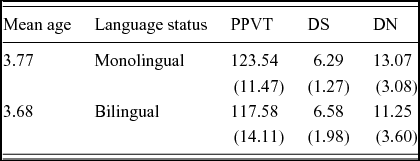
The mean scores and standard deviations for the PPVT, Digit-Span, and Day–Night Stroop tasks are shown in Table 1. Independent-samples t-tests were conducted to compare the children from the two language groups in each of the three tasks. No significant effects were found, all ps > .10. Thus, bilingual and monolingual children did not differ in their receptive vocabulary, short-term memory, or inhibitory control skills.
Mean scores and standard deviations (in parentheses) of children on Peabody Picture Vocabulary Test (PPVT), Digit-Span task (DS), and Day–Night Stroop task (DN).

For the experimental trials, children were given a score of from zero to two that reflects the number of times they successfully selected the mutually visible object. Preliminary analyses revealed no effect of order or gender, so they were combined in subsequent analyses. There were no significant correlations between scores in the experimental trials and SES, PPVT, Digit-Span, and Day–Night Stroop task (all ps > .10).
Thus, the monolingual and bilingual children in our study were drawn from similar SES populations and were comparable in terms of standard measures of vocabulary, short-term memory, and inhibitory control. Furthermore, none of these measures correlated with success on the experimental measures of interest.
Main results
We first compared performance against chance. Monolingual children were significantly above chance in picking the visible object in the “there” trials (t(15) = 5.20, p > .001, η2 = .64) and marginally above chance in picking the visible object in the “where” trials (t(15) = 2.09, p = .054, η2 = .23). For the bilingual children, they were also significantly above chance in picking the visible object in the “there” trials (t(15) = 4.57, p > .001, η2 = .58) but were marginally below chance in picking the visible object in the “where” trials (t(15) = –1.76, p = .096, η2 = .17). Thus, in the “where” trials, while monolingual children were more likely to interpret the speaker's intention to refer to the visible object (just as in the “there” trials), bilingual children were more likely to interpret the speaker's intention to refer to the hidden object.
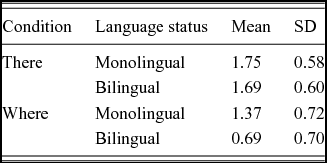
A 2 (condition: there vs. where) × 2 (language status: monolingual vs. bilingual) repeated measures ANOVA was conducted (Table 2). There was a significant main effect of condition, such that children significantly chose the visible object more often in the “there” trials compared to the “where” trials (F(1,30) = 25.56, p < .01, ηp 2 = .46). There was a marginally significant main effect of language status: monolingual children chose the mutually visible object more often compared to the bilingual children (F(1,30) = 4.03, p = .054, ηp 2 = .12). As predicted, these main effects were modulated by an interaction between condition and language status (F(1,30) = 5.28, p < .05, ηp 2 = .15) (see Figure 1). Planned comparison t-tests revealed that while monolingual and bilingual children were equally likely to select the mutually visible object when the experimenter said “there” (t(30) = .30, p > .10, η2 = .003), bilingual children were more likely to select the hidden object than monolingual children when the experimenter said “where” (t(30) = 2.73, p < .05, η2 = .20).
Mean number of times children select the visible object (out of two) and standard deviations.

Average total number of times children picked the visible object (out of 2) (±SE) by condition for monolingual children (n = 16) and bilingual children (n = 16).

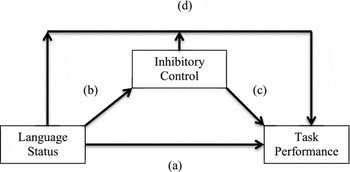
There is a large body of research suggesting that bilingual children have superior inhibitory control skills (e.g., Bialystok, Reference Bialystok2009; Carlson & Meltzoff, Reference Carlson and Meltzoff2008; Martin-Rhee & Bialystok, Reference Martin-Rhee and Bialystok2008; Poulin-Dubois, Blaye, Coutya & Bialystok, Reference Poulin-Dubois, Blaye, Coutya and Bialystok2011). It can be argued that the tasks in our study tap into children's ability to suppress a dominant response (e.g., choosing the visible object) and bilingual children's better performance in our study may be due to their better inhibitory control skills compared to monolingual children. Earlier, we did not find any difference in inhibitory control ability between the language groups. Nevertheless, in order to be more conclusive in ruling out the role of inhibitory control in the performance on our task, we ran a full mediation analysis using a four-step approach based on Baron and Kenny's (Reference Baron and Kenny1986) procedure. Three simple regression analyses and a multiple regression analysis were performed for each condition: (a) Language status predicting task performance, (b) Language status predicting inhibitory control (Day–Night task), (c) Inhibitory control predicting task performance, and (d) Language and inhibitory control predicting task performance (see Figure 2). According to Baron and Kenny (Reference Baron and Kenny1986), the first three effects must be significant in order to establish a mediation effect of inhibitory control, and the fourth step (multiple regression) would establish whether the mediation is partial or complete. For “there” trials, no significant relationships were found (ps > .10). For “where” trials, significant relationships were found between language status and performance of task, where language status was a significant predictor of task performance in condition (a), R2 = .20, F(1,30) = 7.47, p < .05, β(lang) = .45, t(30) = 2.73, p < .05, and condition (d), R2 = .14, F(2,23) = 3.01, p = .069, β(lang) = .44, t(23) = 2.29, p < .05, β(IC) = –.044, t(23) = –.23, p > .10. No other significant relationships were found (ps > .10). Thus, a mediation effect of inhibitory control could not be established. Differences in inhibitory control did not account for the bilingual advantage on our task.
Mediation analysis: (a) Language status predicting task performance, (b) Language status predicting inhibitory control, (c) Inhibitory control predicting task performance, and (d) Language and inhibitory control predicting task performance.

Thus, as predicted, compared to their monolingual peers, bilingual three-year-olds were better at integrating multiple cues, such as eye gaze, context, and semantics when interpreting a speaker's referential intent.
Discussion
Our results provided evidence that children growing up bilingual are more adept than monolingual children at integrating multiple cues when interpreting a speaker's referential intent. We replicated Nurmsoo and Bloom's (Reference Nurmsoo and Bloom2008) Experiment 1 with three-year-old monolingual and bilingual children that required them to integrate a speaker's eye gaze, the context of the situation, and the semantics of the request. Two novel objects were placed in a box so that a speaker could see only one of them while the children could see both (context). The speaker looked at the object she could see (eye gaze) and said either “There's the [novel-word]! Can I have the [novel-word]?” or “Where's the [novel-word]? Can I have the [novel-word]?” (semantics). When the speaker looked at the visible object and said “there”, this integration of all the cues meant that the speaker should be understood as asking for the object she was looking at. But when the speaker looked at the visible object and said “where”, it should be understood that the object she could not see (hidden from the speaker's perspective) is the target object instead. Results indicated that while all children picked the visible object equally often when the speaker said “there”, bilingual children were more likely than monolingual children to pick the other object the speaker could not see when she said “where”, suggesting that three-year-old bilingual children were better at integrating multiple cues (context, eye gaze, and semantics) to understand the speaker's referential intent.
Previous research suggests that bilingual children have superior inhibitory control skills compared to monolingual children (e.g., Bialystok, Reference Bialystok2009; Carlson & Meltzoff, Reference Carlson and Meltzoff2008; Martin-Rhee & Bialystok, Reference Martin-Rhee and Bialystok2008; Poulin-Dubois et al., Reference Poulin-Dubois, Blaye, Coutya and Bialystok2011). So it was important to assess whether the bilingual advantage we found could be accounted for by differences in inhibitory control. It could be argued that the task in our study is tapping into children's ability to suppress a dominant response (e.g., choosing the visible object) and bilingual children's better performance in our study could have been due to their better inhibitory control skills compared to monolingual children. However, we found no evidence for this hypothesis. Monolingual and bilingual children in our study did not differ in their inhibitory control skills as measured by the Day–Night task, indicating that differences in inhibitory control skills did not mediate and could not account for the bilingual advantage in our task. Moreover, children's inhibitory control skills did not contribute to better performance in our task.
In addition, measures of socio-economic status, receptive vocabulary, and short-term memory revealed that monolingual and bilingual children in our study did not differ systematically in these other attributes to an extent that might account for the differences in task performance. As such, bilingual children's better performance in our task is unlikely to be due to being of higher socio-economic status, or having better language ability or better short-term memory than monolingual children.
Past research has shown that young children can interpret simple and straightforward cues to understand a speaker's communicative intent but it is often not until years later that they are able to integrate multiple communicative cues successfully. However, regular exposure to and experience with challenging communicative situations that demand greater attention and flexibility may promote the development of such social-cognitive skills in children (Burleson, Reference Burleson, Whaley and Samter2006). Children may learn, consistently through multiple occasions, that interpretation of cues alone is not sufficient for them to understand the communicative intent of the speaker. These children may then adapt some form of a self-generated monitoring mechanism to manage their potentially more complex everyday communicative demands.
We propose that children growing up in a bilingual environment are one such group who may have benefited from regular exposure to complex communicative situations. All children face the problem of referential indeterminacy when acquiring language, but the unique demands of multilingual communications further compound the problem. First, a novel label could refer to a novel object in one language, a novel part of a known object in that same language, or the same known whole object in a different language. Second, language mixing – the inclusion of one and more language elements in conversation – is prevalent among multi-language adult speakers (e.g., Li, Reference Li1996; Poplack, Reference Poplack and Wei2000). Language mixing is often found in speech to children growing up in a bilingual environment, even in one-language–one-parent families (Genesee, Reference Genesee, Garcia and Frede2010; Goodz, Reference Goodz1989). Young bilingual children, thus, experience yet another challenge in figuring out which language a speaker is using, how they should interpret the speaker's communicative intent and how to respond appropriately. Third, bilingual children also experience the challenge of learning different labels for similar but not exactly the same concepts across languages. Languages often do not have exact translation-equivalent words for a particular concept, or object form. For example, the word “think” in English is a neutral word that is commonly used in false-belief questions. However, the Junín Quechua language lacks the same explicit mental language and uses the verb “say” to refer indirectly to “thought” and “belief” (Vinden, Reference Vinden1996). Chinese, in contrast, has three different mental verbs that mean “think” (xiang3, yi3wei2, and dang1) (Chen & Lin, Reference Chen and Lin1994).
Thus, to cope with the various challenging communicative demands in their environment, young dual-language learners likely intensify their efforts to monitor the communicative situation and attempt to make use of multiple communicative cues available in various contexts to figure out what a speaker means. For example, young bilingual children were found to track language choices of speakers as they spoke and then altered their own language choices accordingly, both with familiar and unfamiliar interlocutors (Comeau et al., Reference Comeau, Genesee and Lapaquette2003; Genesee, Boivin, & Nicoladis, Reference Genesee, Boivin and Nicoladis1996; Genesee, Nicoladis, & Paradis, Reference Genesee, Nicoladis and Paradis1995; Nicoladis & Genesee, Reference Nicoladis, Genesee, Stringfellow, Cahana-Amitay, Hughes and Zukowski1996). Bilingual children also showed enhanced sensitivity in detecting ineffective communicative responses (Siegal et al., Reference Siegal, Iozzi and Surian2009). Olmedo (Reference Olmedo2003) found that even kindergarteners assessed the language proficiency of their bilingual peers, monitored each other's comprehension and production skills, and made use of multiple cues to maximize the understanding and communication of their classmates.
In sum, bilingual children experience communicative challenges to a greater extent than monolingual children. We propose that bilingual children may achieve communicative effectiveness amidst these challenges by frequently monitoring the context, paying attention to the verbal and nonverbal cues available in the situation, and utilizing these cues to better understand the speaker's communicative intent.