From the earliest contemporary commentaries to the most recent scholarly accounts, the exceptional level of violence in Paris during la semaine sanglante, 21–8 May 1871 – ‘one of the bloodiest weeks in the annals of human butchery’Footnote 1 – when the French regular army (the ‘Versaillais’) invaded the city, destroyed the tottering insurrection, and slaughtered thousands of Parisians, has been central to perceptions of the Paris Commune as a whole, and, more broadly, of class and political antagonisms in nineteenth-century France. The London Times at once set the tone: ‘The French are filling up the darkest page in the book of their own or the world's history’, it wrote on 31 May. ‘The Versailles troops seem inclined to outdo the Communists in their lavishness of human blood.’Footnote 2 Some counter-revolutionaries gloated over the carnage. The head of the government, Adolphe Thiers, informed the nation that ‘the ground … is strewn with their corpses. May this terrible sight serve as a lesson’.Footnote 3 Edmond de Goncourt noted in his journal ‘the bleeding has been done thoroughly … by killing the rebellious part of a population, [it] postpones the next revolution’.Footnote 4 Karl Marx, in his almost contemporary Civil war in France, made the slaughter of Communards the core of his peroration: the Commune's ‘martyrs are enshrined in the great heart of the working class. Its exterminators history has already nailed to that eternal pillory from which all the prayers of their priests will not avail to redeem them.’Footnote 5 Military commanders showed no less awareness of the power of martyrdom. General Courtot de Cissey, commander of the 2nd army corps, tried to prevent the body of the radical Tony Moilin, who had been executed by a court martial he had set up at his headquarters at the Luxembourg Palace, from being handed over to his widow for fear that his grave might become a place of pilgrimage. For the same reason, General Douay, commander of the 4th army corps, gave precise orders to bury the body of Charles Delescluze, the Commune's war delegate killed on the barricades, secretly in a common grave so that it could never be recovered.Footnote 6
Not only the fact of the killing, which is undisputed, but the scale of the slaughter has served as the keystone for a range of historical conclusions. Almost all writing since the 1870s, polemical and scholarly, has taken up this theme. For contemporary sympathizers, most notably Prosper-Ollivier Lissagaray, himself a Commune activist, and the radical journalist and politician Camille Pelletan (to both of whom we shall return) it proved that the Communards were victims more than perpetrators of violence, and that the crimes of which they were accused were provoked by, and in any case dwarfed in comparison with, those of the army and government.
Pro-Commune writers quickly converged over the huge number of Communard victims. Lissagaray asserted that at least 17,000 and probably 20,000 or more had been killed. Pelletan argued that the minimum figure was 30,000.Footnote 7 This was soon a familiar theme in left-wing discourse, expressed openly as soon as relatively free speech was permitted in the later 1870s. Louise Michel, herself a prominent Communard, stated in a speech at the funeral of the revolutionary leader Auguste Blanqui in 1881 that 30,000 had been killed or summarily executed.Footnote 8 Some lesser-known Communard sympathizers gave much higher figures, of 50,000 or more killed.
Few subsequent historians have questioned the range of figures given by Communard writers in the 1870s. They became part of a consensus in France consecrated by semi-official Republican historians such as Ernest Lavisse and Charles Seignobos in the early twentieth century. This orthodoxy is repeated in the most recent scholarly works. David A. Shafer cites figures of 17,000 to 30,000 as plausible for the number who ‘perished’.Footnote 9 Jack Hayward, in a history of France's post-revolutionary divisions, refers to the ‘summary mass executions of some 20 to 25,000 Communards’.Footnote 10 In a recent monograph on the Commune, Colette E. Wilson states that ‘some 20,000 (perhaps many more) men, women and children were killed by the “regular” troops'.Footnote 11 Pierre Milza, in a recent major history of the Commune in French, also insists on 20,000.Footnote 12 Robert Gildea estimates that 10,000 people were killed during the street fighting, and another 10,000 executed afterwards.Footnote 13 Michael Rowe adds a chilling detail – that ‘the army used its primitive machine guns against the columns of chained prisoners'.Footnote 14 Peter Starr even suggests that ‘upwards of 25,000’ were killed in ‘the days and weeks that followed the Commune's fall’.Footnote 15 The orthodox account is commonly embroidered by uncritical use of iconography – for example, photographs of rows of corpses in coffins are regularly presented as executed Communards, though they were quite possibly casualties of the Franco-Prussian war.Footnote 16
My own work buttressed the traditional account, by analysing the beliefs and intentions of the killers, and uncovering the mechanisms of the repression. I too was influenced by Lissagaray's dramatic narrative and Pelletan's powerful forensic analysis. My Ph.D. dissertation of 1980 stated that ‘25,000 [deaths] is no wild estimate’,Footnote 17 and in the revised published version that ‘the total number of Parisians killed could … be anything between 10,000 and 30,000, with the most probable figure about halfway between.’Footnote 18 Although I had by 1997 moderated the estimate to ‘at least 12,000’, it still seemed that a unique intensity of violence had occurred in May 1871, with a systematic and ideologically targeted character beyond the norms of nineteenth-century European experience. I made tentative comparisons between this ‘characteristically modern, impersonal and amoral ruthlessness’ and mass violence during the twentieth century.Footnote 19
This revision downwards of my estimates – though 12,000 deaths is still evidently enormous – resulted from gradual doubts about the reliability and plausibility of the traditional account more generally. Parts of Lissagaray's classic narrative were contradicted by direct evidence, or were internally inconsistent. Pelletan's minute examination of the events of May relies on a vast accumulation of purported eye-witness accounts, mostly anonymous. These are rarely possible either to verify or disprove. Several observations raised initial doubts about the accepted estimates of the death toll. First, there were many reports in army documents in the days immediately following la semaine sanglante that soldiers were fraternizing with civilians, even in districts where there had been serious violence. As one general complained, the very day after the fighting ended his men were drinking in working-class districts with ‘people who could very well have fought them from behind the barricades’.Footnote 20 Soldiers regularly disobeyed orders not to go out in Paris unarmed. This behaviour would be strange had they just carried out a wholesale massacre. Second, army reports showed that thousands of insurgents were allowed to negotiate their surrender: 1,500 prisoners were taken in the Rue Haxo (site of a mass lynching of priests and gendarmes by Communards); another 2,000 surrendered nearby at the Père Lachaise cemetery (commonly described as the scene of a desperate last stand); another 800 at the Place Puebla – all in the Commune heartland of eastern Paris where fighting had been most intense, and which was publicly identified with the ‘reddest’ of revolutionary politics.Footnote 21
Most surprising of all was the fate of Communards fighting in the 13th arrondissement, a poor working-class district in the southern part of the city which was the site, according to Lissagaray, of an epic battle in which the army suffered heavy casualties. Captain Garcin, a regular army staff officer in charge of interrogating Communard prisoners, considered them to include ‘dangerous people … most abominable blackguards … people of the lowest class that make up the dregs of the present population of the 13th arrondissement’.Footnote 22 Moreover, local Communards murdered a group of Dominican priests just as the army arrived. All this certainly created circumstances for revenge. An internal military report stated unashamedly that the troops had taken ‘very large numbers of prisoners whom the angry soldiers shot without mercy’.Footnote 23 The question, however, is not whether people were killed by the army – they evidently were – but on what scale, and with what degree of uniformity. In this context occurred an extraordinary incident. During the evening of 25 May, the day the army captured the district, a high-level military dispatch reported to the government and high command that 6,000 prisoners – certainly an exaggeration – had negotiated their surrender at the Place Jeanne d'Arc (a square in the midst of the working-class housing blocks). Orders were given to escort them to Versailles.Footnote 24 However, there was an unexplained delay, and in reply to queries from higher authority, officers reported that they had ‘disappeared, probably into the tunnels’Footnote 25 – that is, the gypsum quarries that honeycomb parts of southern Paris. This seemed a transparent fiction, and, influenced by Pelletan's description of wholesale massacres, I assumed that the prisoners had in fact disappeared into the army's organized killing process of drumhead courts martial and firing squads, and that the escape story had been concocted to conceal an appalling massacre.Footnote 26 Long after having written this, however, I found the statement of the commander of a local national guard battalion, Jules Quesnot,Footnote 27 who had been among that crowd of prisoners at the Place Jeanne d'Arc. He related that some men had been picked out. They were presumably shotFootnote 28 or if lucky taken to Versailles. But the rest, including senior officers such as himself, were merely told to leave their weapons and go home. It must have been this release – contrary to orders – that officers tried to keep from their superiors. Soon afterwards, Quesnot, in civilian clothes, was back with his comrades in a bar near the Place Jeanne d'Arc, discussing the events of the day.Footnote 29 Thus, in the ‘reddest’ of proletarian districts, the site of battles and massacres, some hundreds or even thousands of Communard prisoners had simply been freed. This single incident seemed to me important enough to cast doubt on the more apocalyptic visions of events, especially when combined with the reports of negotiated surrenders from other parts of the city.
I
How many people were actually killed during that traumatic week? The starting point for investigation must be the claim made by Lissagaray and repeated by Pelletan, to which practically all historians of this subject still refer directly or at second or third hand: that the incontrovertible minimum death toll is 17,000, because ‘admitted’ by the army, in the person of General Appert, who was in charge of courts martial in the Paris region.Footnote 30 In Lissagaray's precise words, Appert ‘avoua dix-sept mille fusillés’.Footnote 31 The word fusillé implies execution, not merely death in combat, and it is clear from the context that it was understood in this way.
Appert wrote a report to the national assembly on the operations of the military courts.Footnote 32 Several historians have assumed that Lissagaray was referring to this. In fact he was alluding to a statement by Marshal Patrice de Mac-Mahon, commander-in-chief of the Army of Versailles, before a parliamentary committee of inquiry in August 1871. As this has been so regularly referred to and misinterpreted for more than a century, it is necessary to quote it in the original:Footnote 33
M. Robert de Massy. Pourriez-vous nous dire, Monsieur le Maréchal, quel a été le nombre des hommes fusillés à Paris?
M. le Maréchal. Quand les hommes rendent leurs armes, on ne doit pas les fusiller. Cela était admis. Malheureusement, sur certains points on a oublié les instructions que j'avais données. Je dois dire toutefois qu'on a beaucoup exagéré le nombre des exécutions de ce genre, et, sans pouvoir le préciser, je puis affirmer qu'il a été très-restreint.
M. de Massy. Mais dans le combat?
M. le Maréchal. Il m'est impossible d'en dire le chiffre; je ne le connais pas.
M. Vacherot. Un général m'a affirmé que le chiffre des hommes tués dans le combat ou sur les barricades, ou après le combat, s'élevait à 17,000 hommes.
M. le Maréchal. Je ne sais pas sur quoi il a pu se baser dans son évaluation, qui me paraît exagérée. Tout ce que je puis dire c'est que les insurgés ont perdu beaucoup plus de monde que nous.
M. Vacherot. Ce chiffre peut-être s'applique à tout le siège et au forts d'Issy et de Vanves.
M. le Maréchal. Le chiffre est exagéré.
M. Vacherot. Le général Appert, car c'est de lui que je tiens le renseignement, entendait peut-être parler des morts et des blessés.
M. le Maréchal. Oh! alors c'est différent.
In short, neither Mac-Mahon nor Appert ‘admitted’ to having ‘shot’ 17,000 people – the former explicitly denied it as ‘exaggerated’. He did not deny the possibility of 17,000 as the total of killed and wounded throughout the whole two months of the civil war. But he claimed not to know how many people were killed in the fighting or executed subsequently. He had in fact tried to find out: senior commanders had been asked at the end of May for information about numbers of Communards killed. But they had replied that no details had been kept of armed insurgents summarily executed, and information was at best ‘very incomplete’.Footnote 34
Lissagaray's assertion, the standard source for estimates of the death toll, is clearly based either on a hasty misunderstanding or a deliberate distortion. He also stated, without giving details, that this same figure of 17,000 was the number of burials paid for by the City of Paris. However, a search of the debates of the conseil municipal from 1871 to 1875 and budgets for 1871 did not corroborate this claim: though special grants were made to the cemetery department, they were in part to repair damage caused during the insurrection, or for buildings and land purchase, and it is impossible to deduce the number of burials.Footnote 35
Attempts to arrive at a broad estimation based on demographic data proved equally fruitless. Electoral registers (revised soon after the Commune) quickly show themselves to be highly inaccurate. So do registers of deaths (l’état civil). Registers for inheritance and tax purposes are no use as many of those killed were unidentified. These sources occasionally show individual tragedies – people are occasionally marked as fusillé – but even a cursory examination shows their inaccuracy: for example, certain people known to have been killed are not registered as dead.Footnote 36 Even families in the immediate aftermath of the civil war probably did not know where relatives were – dead, in prison, or in flight – and for years afterwards the authorities were trying in absentia some people who are known to have been killed.
Another source of demographic information is a report published in October 1871 by members of the Paris municipal council on the economic situation in the city. Several historians, including the leading historian of the Commune, Jacques Rougerie, and one of its most recent, Pierre Milza, have taken this as a reliable indication of the order of magnitude of mortality during la semaine sanglante. Their opinion must be considered seriously and in some detail. The report stated that ‘more than 100,000’ workers were missing from Paris compared with the population in 1869.Footnote 37 The authors of the report were not, however, attempting to estimate the mortality of the civil war – they ascribe the missing population as being ‘killed, prisoners, or in flight.’ Indeed, one of the authors, Allain-Targé, told the city council in August 1871 that the population was still ‘falling every day’ because foreign buyers were going elsewhere.Footnote 38 Even if their population estimates are roughly accurate – and they could have been no more than guesses, as there was no census until 1872 – there was and is no way of apportioning the missing between those who, as a result of the civil war, were dead, in prison (40,000 had been arrested), in exile (over 3,000 in Britain alone, with others in Belgium, Switzerland, Italy, Spain, and the USA), in flight, or who had simply left the city to avoid the conflict. Moreover, the civil war was not the only, or even the main, influence on the city's population. Thousands of people had left before or immediately after the German siege (September 1870–January 1871). Moreover, the wartime death rate had been unusually high. There had been outbreaks of smallpox, typhus, and typhoid. Severe cold, overcrowding, shortages of fuel and food, and the need to draw drinking-water from the Seine had caused a major aggravation of respiratory and digestive illnesses. Total excess mortality had been 42,000.Footnote 39 Many French and foreign workers, most obviously the many Germans – estimated at 34,000 – had left either at the outbreak of war or subsequently, as the city economy had ground to a standstill and they had gone to look for work elsewhere, as is pointed out by the authors of the report themselves. For all these reasons, the population of Paris had fallen very steeply before la semaine sanglante. Food consumption during the Commune shows an enormous decline: that of flour fell by half, and of beef by three-quarters. An authoritative scholarly estimate is that one-third of the total population had left by early May – some 600,000 people, a figure corroborated by a contemporary police report.Footnote 40 So the population of the city was evidently much higher at the time the report was written, October 1871, than it had been the previous May: in other words, there were far more people in Paris six months after la semaine sanglante than there had been before it. Nothing, therefore, can be deduced about the numbers killed between 20 and 30 May. When a census was taken in 1872, it showed rises in population in the eastern (working-class) districts, especially in the 11th arrondissement.Footnote 41 These had been the main areas of Commune support and of combat in May 1871, and where the death rate is likely to have been highest. Clearly, fluctuations in the city population, due to several causes, are no help in gauging the May death toll.
The only solid evidence is that of disposal of bodies by the city authorities. Camille Pelletan followed this trail. So did the conservative writer Maxime Du Camp, who set out to refute Communard accounts of mass killings. However, Pelletan and Du Camp, though they agreed on certain figures, as will be seen, came to very different conclusions. Pelletan, as noted earlier, stated that at least 30,000 had been killed. Du Camp put the total at approximately 6,500.Footnote 42 There were two principal differences between their estimates. Pelletan asserted that many more than the records showed had been buried in certain cemeteries. He also alleged that a huge number had been disposed of in open spaces inside the city or in the suburbs.
A number of sources shed light on these problems. Several Paris cemeteries retain registres d'inhumation (ledgers recording daily burials) from 1871. There is also an internal report from June 1871 by the chief engineer of the city highways department on the numbers of bodies collected in the streets.Footnote 43 Using these sources, I published a short article suggesting an approximate death toll of about 10,000.Footnote 44 I hoped this might inspire debate and further research. However, as noted earlier, historians imperturbably continued to stick to the traditional view that 20,000–30,000 people were killed.
I would probably not have returned to the question had it not been for an enquiry from the City of Paris asking whether I thought it advisable to allow a plaque to be placed in Charonne cemetery in eastern Paris stating that some 9,000 Communards had been buried there following la semaine sanglante. This belief is traceable to the 1890s, when public works required the exhumation and reburial of a large number of bodies from the period 1870–1, many of which were assumed to have been victims of la semaine sanglante. If this were true, not only would it explode my estimate of some 10,000 for the whole city, but it would indicate a much higher death toll even than Pelletan's, who had not included Charonne in his grand total of 30,000 plus. This was a motive for further research.
Several new sources came to light.Footnote 45 An internal enquiry had been made in 1872 by the city administration into the number of people buried in all seventeen cemeteries between 20 and 30 May 1871.Footnote 46 There were also detailed lists of the numbers and original locations of bodies exhumed from open spaces within the city, a process which generated considerable correspondence, and which also involved the police, who kept their own lists.Footnote 47 The Assistance Publique compiled statistics of the monthly death rate in Paris hospitals during 1870–1 in comparison with normal months, and also kept records of treatment and deaths in the hospitals during the period of the civil war, with specific reference to wounded Communards.Footnote 48 These sources, in conjunction with the records of the highways department mentioned above, and the registers in the cemeteries, give probably as full and reliable account as can be expected, and I believe permit a sounder basis than anything hitherto available for estimating the approximate number of people killed, and the circumstances of their deaths.
The first necessity is to try to estimate the total of deaths during late May and very early June. Here, there is much agreement among the sources, and even to some extent with the polemical findings published in the 1870s by Pelletan and Du Camp. This is not altogether surprising: Du Camp was shown some of these documents, and Pelletan tells us that he consulted the cemetery registers.Footnote 49 These registers and the reports from the individual cemeteries to the central administration do concur; and they are also very close to the report of the highways department. These documents were for internal use, and there is no reason for them to have been falsified – not least as some were demands for money to cover labour costs.
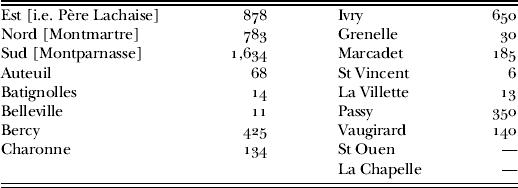
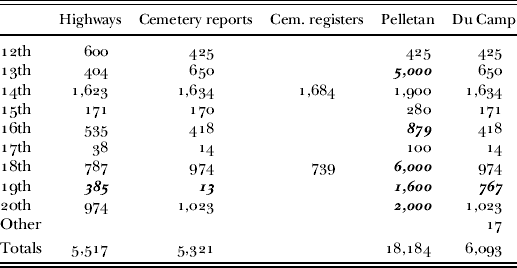
Table 1 appears to give a fairly reliable statement of the approximate number of emergency burials in the Paris cemeteries covering the period of fighting (21–8 May): a total of 5,321. The cemetery registres d'inhumation which appear most complete, those of Montmartre and Montparnasse, record 739 and 1,684 respectively – close to the figures in Table 1, and possibly merely errors of transcription.Footnote 50 The city highways department reported 5,517 bodies brought in.Footnote 51 Pelletan, of course, gives very much higher figures, sometimes round-figure estimates, reflecting the inevitably imprecise nature of much of the information he assembled from a variety of sources, including hearsay.Footnote 52 In order to compare these various figures – some of which are given by arrondissement, not by cemetery – Table 2 recasts them all by arrondissement to see where discrepancies occur. Minor differences can be accounted for by simple error in fraught circumstances, and by the fact that they were not counting exactly the same things, or over exactly the same period. The substantial disagreement across the board for the 19th arrondissement concerns whether or not burials in the Carrières d'Amérique (quarry shafts in an unbuilt area of north-eastern Paris) are included (they are obviously not listed in the cemetery returns), and how many bodies were buried there: up to 1,000.Footnote 53 Otherwise, there is a fair level of agreement between the various sources, except Pelletan. Even then, his really major disagreements come only from his assertions that 5,000 and 6,000 bodies respectively were buried at the cemeteries at Ivry (13th) and Montmartre (18th). It can only be noted that nothing in any of the archival sources lends credence to these claims: the inspector-general's return shows 650 at Ivry and the register at Montmartre 739.Footnote 54
Bodies buried without permits, 20–8 May 1871
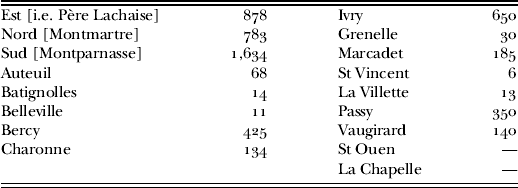
Source: ‘État indiquant le nombre de corps inhumés sans mandat du 20 au 30 mai 1871’, AP 1326W 60.
Burials by arrondissement
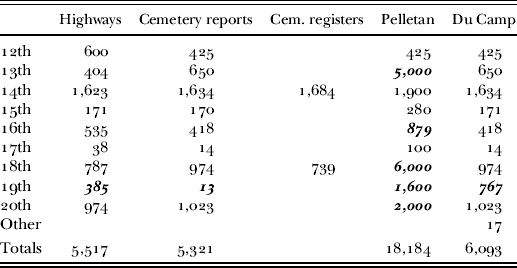
Note: Major discrepancies are shown in bold italics. There were cemeteries only in these nine outer arrondissements and just outside the city walls at Ivry, here included in the 13th arrondissement.
Source: Highways: AP VO (NC) 234; cemetery reports: AP 1326W 60; Pelletan, La semaine, pp. 376–82; Du Camp, Convulsions, ii, pp. 423–5.
Pelletan further asserted that thousands of bodies were buried in open spaces within the city, alleging that many were never found. Immediately after the fighting, the police and the mairie made frantic efforts to find and remove all bodies left lying in the streets or hastily buried. Residents demanded action, and the city administration was under strong pressure. Private individuals and public authorities strongly objected to the presence of bodies in shallow graves under their windows or in their gardens. Public health was the major concern, but there were others, including decorum and public order. One primary school in the 14th arrondissement, for example, had twenty bodies buried in the playground, some of which, it was reported, might have been the fathers of children at the school. Families of Communards were placing flowers at impromptu burial sites.Footnote 55 As quickly as possible, bodies were exhumed and reburied in cemeteries. Only in the Carrières d'Amérique were bodies (estimated by the city administration at 700–800) deliberately left outside a cemetery – a subject of worried correspondence in 1872 when rain caused a landslide, leaving corpses in National Guard uniform exposed to view.Footnote 56 Lissagaray related a macabre and often repeated story that large numbers of executed prisoners, and even still living wounded, were buried in the Square Saint-Jacques, a small central park – later histories claim that there were 1,000 bodies, but the city authorities found only a few dozen.Footnote 57 Detailed records of exhumations were kept, again for internal use. They total 1,328 for the whole city.Footnote 58 This is far lower than stated by Pelletan, who refers to ‘several thousand’.Footnote 59 This total is therefore in addition to the total buried in the cemeteries. Pelletan claimed, without giving details, that bodies were discovered later in the course of building a tram line, but given the efforts clearly made to remove them at the time, and the dense population of Paris, it seems unlikely that there were many. On the other hand, some bodies found in or exhumed from la voie publique had already been reburied in the city cemeteries when their administrators counted and reported their totals; and Du Camp claimed that 754 of these exhumed bodies were among those buried in the Carrières d'Amérique.Footnote 60 Hence, there may be a considerable amount of double counting.
Another fact emerges from the correspondence concerning these exhumations, which also applies to burials in general during la semaine sanglante. Some civilians who died of natural causes (including new-born babies and old people) also had to be buried informally during the fighting, when municipal services were interrupted. Casualties of the Versailles army were similarly buried, sometimes in the same improvised graves as their enemies. Hence, the total of burials for that week also includes non-Communard dead. The normal weekly death rate in Paris was about 1,000. The number of Versaillais soldiers killed during the week of street fighting was probably 400–500.Footnote 61 Consequently, a figure of up to 1,500 might be deducted from the total number of Paris burials to give the net number of Communards. It is impossible to be precise, however, because it cannot be known exactly how many of these non-Communards were buried sans mandat (without a permit), and so placed, in the cemetery records, in the same category as the Communards. Some of them certainly were: in common graves at Montparnasse cemetery ‘were placed bodies of national guards, soldiers and even citizens not involved in the struggle’.Footnote 62 Taking account of all these considerations, the total of Communards buried inside the city walls during and immediately after la semaine sanglante is probably between 5,700 and 7,400.Footnote 63
What of the 9,000 Communards supposedly buried in the Charonne cemetery? Charonne – an ancient churchyard cemetery – had been largely closed in 1860. It had to be reopened during the German siege, when access to the new suburban Ivry cemetery became impossible. As noted, Paris suffered heavy wartime and post-war mortality. Deaths peaked in January and February 1871 and declined slowly thereafter: compared with the equivalent months of 1872, there were 5,000 excess deaths from January to March, from the final days of the war until the start of the Commune.Footnote 64 Consequently, a large number of people were buried at Charonne – 7,900 during the whole of 1871.Footnote 65 Possibly the story of the ‘9,000 Communards’ is a rounding-up of this figure. An annotated plan of the cemetery shows that 3,440 were buried in common graves during the period from January to June 1871. Given the high death rate in January, February, and March, only a proportion of this total can date from la semaine sanglante. The plan indicates that only a small area was used in May–June, the main period of fighting in and around Paris.Footnote 66 Only 134 bodies were reported by the cemetery administration as having been buried between 20 and 30 May.Footnote 67 In short, the 9,000 Communards of Charonne are a legend, reflecting the beliefs about la semaine sanglante that became accepted by later generations.
Both Lissagaray and Pelletan stated that enormous numbers of bodies had been buried or incinerated at various sites outside the city walls. Pelletan estimated that 10,000–14,000 were disposed of in this way.Footnote 68 This is an essential part of his argument, and of the implicit assumptions of later historians who have accepted very high estimates of the number killed.
There are many contemporary references to bodies being incinerated or buried in the suburbs. The republican writer Louis Fiaux, citing a report in the newspaper Le Temps, wrote of ‘masses of smoke, sometimes mixed with flame’ being visible in the southern suburbs, which he assumed to be the burning of bodies.Footnote 69 If bodies were indeed burned – reports seem invariably based on hearsay rather than on direct observation – it is equally possible that they were of men killed during the combat in the suburbs in the days preceding la semaine sanglante and left unburied. For example, bodies found in Fort Montrouge were ordered to be burned.Footnote 70 Or of course smoke and flames could have been due to something else entirely – for example, disposing of the detritus of months of combat.
Why bury or burn bodies in suburban fields? It would have been unpleasant, labour intensive, expensive, and bad publicity – hundreds of cartloads of bodies trundling across the city. Lissagaray, Pelletan, and others argued that it had to be done because the Paris cemeteries were full and could not cope – Lissagaray said they ‘reached their capacity’, and Pelletan alleged that in ‘immense ditches’ bodies were being piled three deep.Footnote 71 But cemetery officials denied in internal reports that bodies were piled into common pits, and insisted that, as regulations required, they were only burying bodies one deep and with space betweenFootnote 72 – a statement proved in one case, as they were able to identify and recover the body of Charles Delescluze years later.Footnote 73 Far from being overwhelmed, the custodian of Passy cemetery complained that he had dug more graves than he had bodies to put into them.Footnote 74
It is difficult to prove a negative. The fringes of Paris were only partially searched, and only a small number of bodies discovered. Summary executions were certainly carried out in the suburbs after the fighting.Footnote 75 But the numbers are unlikely to have been so great as to transform the overall estimates. It seems most unlikely that the huge number of bodies referred to by Pelletan could or would have been disposed of without trace. There is no hint of this in the relevant archives, and as far as I am aware, there has been no subsequent discovery of mass graves on or beyond the scale of Katyn or Srebrenica in the now mostly built-up suburbs.
It is of course possible to believe that almost any number of people were killed in la semaine sanglante, because it is possible to believe that huge numbers of bodies were secretly disposed of and never found. But there is no reason to believe the numbers asserted by Lissagaray, Pelletan, and other contemporaries, even though they have been repeated by generations of historians. None gives verifiable evidence, and the verifiable evidence discovered is against them.Footnote 76 My conclusion is, therefore, that approximately 5,700–7,400 Communards were killed during la semaine sanglante – essentially the number buried inside the city. There must be some unaccounted for bodies inside or outside the walls, but the probable quantity falls within the overall margin of error. This is considerably fewer than my own earlier estimates, and the lower figure is below even that given by Du Camp, widely condemned as tendentiously low – ‘a bad joke’, wrote Pelletan.Footnote 77 It is clear that Du Camp based his figures squarely on administrative returns from the cemeteries; but he did not realize the extent to which these figures included non-Communard dead, both civilian and military.
II
How did these thousands of people die? In general terms we know. Some were killed fighting on the barricades, or died from their wounds. Some were refused quarter and shot down in the streets. This was regarded as ‘the law of war’: rebels captured carrying weapons (les armes à la main) were liable to summary execution. Official documents allude to this as a matter of course, and both Mac-Mahon and Thiers referred to it publicly, if obliquely.Footnote 78 Many prisoners were taken before drumhead courts martial set up across the city, and those considered specially culpable were sentenced to death and executed forthwith: especially targeted were leaders (for example elected National Guard officers), foreigners, army deserters, and volunteers (men belonging to irregular corps francs, and those below or above the age of compulsory National Guard service).Footnote 79 The most notorious places of judgement and execution were the prisons of La Roquette and Mazas, the nearby Père Lachaise cemetery, the Châtelet theatre and nearby Lobau barracks, and the Luxembourg Palace (the seat of the senate) and its gardens.
Two sources – the Montparnasse cemetery register and the Assistance Publique statistics – shed some light on the proportions of deaths due to these various causes. The Montparnasse register was kept in considerable detail for the 1,684 bodies recorded as buried there, giving the date of arrival and the place from which the body came.Footnote 80 Taking my estimate of total deaths as 5,700–7,400, Montparnasse accounts for 23–30 per cent, and it seems reasonable to treat it as a representative sample.
Some of the places from which bodies were brought to Montparnasse are unambiguous: ‘le Luxembourg’ or ‘le Sénat’ refer to the court martial there; these, surely, were people who had been executed. Similarly, those from ‘le caserne Lobau’. When several at a time came from Val de Grâce or Gros Caillou – large military hospitals – I assume they had died from wounds. Those brought in ones and twos from miscellaneous streets were those who had been killed in the fighting or summarily executed – two categories that are impossible to distinguish now, and were difficult to distinguish then. However, the provenance of many corpses is ambiguous. Often several came from local mairies: were these execution sites, or first-aid posts, or places to which people took bodies found in the street? Some bodies came from places where some accounts situate less notorious courts martial. For example, twenty-five bodies were brought from the École Polytechnique, where Pelletan states executions took place. Several came from various barracks: had these all been executed? Some doubtless had: there were reported shootings in a number of barracks, such as the Caserne Dupleix and the École Militaire. From the Panthéon came 125 bodies immediately after the fighting, another twenty-two came later. The first bodies plausibly came from the fierce fighting that all accounts describe round the Panthéon, a natural strongpoint. Were the others executed there later? Or, as the adjacent mairie was also commonly called ‘le Panthéon’, might they just have been assembled there by the highways department or the neighbours? One could multiply such examples.
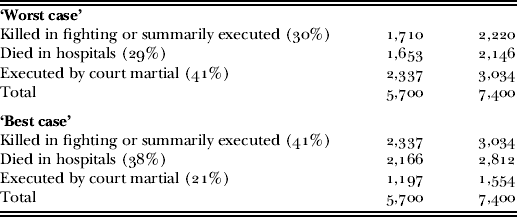
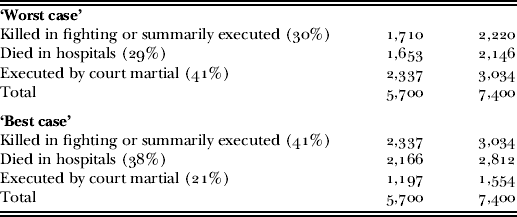
Consequently, I suggest two possibilities: a ‘worst case’ (which assumes that all groups of bodies brought from particular places had been executed in cold blood); and a ‘best case’ (which assumes that in cases of doubt people had been killed in the fighting, and that some places from which several bodies came, but which are not recorded in other sources as execution sites – for example, the church of Saint Germain l'Auxerrois, from where 137 bodies were brought – were temporary hospitals rather than places of execution.) These two hypotheses are then extrapolated from the Montparnasse total of 1,684 to account for 5,700–7,400 deaths throughout the city (see Table 3).
Causes of death
The Assistance Publique archives give some indication as to which of these hypotheses is more plausible by permitting an alternative estimation of deaths in hospital. They give details of admissions, deaths, and releases from twenty-eight civilian hospitals, with a separate category for Communards.Footnote 81 Nearly all surgical cases admitted during late May were due to the fighting.Footnote 82 Given available medical techniques for treating the effects of heavy high-velocity bullets and large iron fragments from black-powder-filled shells, mortality was high even in the best of conditions.Footnote 83 Far worse conditions must have existed amid confusion and street fighting; there are reports, moreover, of ill treatment, neglect, and murder of wounded Communards.Footnote 84 Not surprisingly, the death rate for Communard wounded (30 per cent) was higher than that for the army (21 per cent).
Nearly all those buried at Montparnasse from identifiable hospitals came not from civilian hospitals – why I do not know – but from eight military hospitals: Gros Cailloux, Val de Grâce, Invalides, the temporary hospital at the Palais de l'Industrie, the Ambulance de la Presse, the Ambulance Italienne, the Ambulance de la Bastille, and the Ambulance Saint-Sulpice.Footnote 85 Only the Hôtel Dieu civilian hospital is recorded as sending bodies to Montparnasse. The number at Montparnasse from known military hospitals and dressing stations is 433 (29 per cent of the total buried there) – a proportion not out of line with the 20 per cent recorded at the Montmartre cemetery as coming from Lariboisière hospital and Saint-Martin military hospital.
There follows a somewhat risky assumption: that a broad indication – it can be no moreFootnote 86 – of the number dying from their wounds throughout the city can be obtained by adding together the total of those dying in civilian hospitals during May from firearms injuries, fractures, open wounds (plaies), and infections purulantes – 562Footnote 87 – and an estimate of those dying in military establishments obtained by extrapolating (multiplying by four) from the Montparnasse figures. This extrapolation gives 1,732 deaths in military hospitals for the whole city. Adding the 562 from the civilian hospitals gives a total of 2,294 dying in hospitals. It will be seen that this figure falls within the ‘best case’ range in Table 3. But it may well be an underestimate of the total dying of injuries received in the fighting, as bodies may have arrived from improvised hospitals and dressing stations that cannot be identified, and it also excludes many who died without reaching hospital – people suffering serious head and abdominal wounds rarely survived long enough. Others may not have been taken to hospital for fear of arrest, like Maurice in Zola's La débâcle. A larger number dying of wounds would strengthen the plausibility of the ‘best case’ estimates.
This brings up perhaps the most contentious point: the number executed. The fighting in the city was undoubtedly vicious and bloody – this is the nature of street combat, often at close quarters. The Communards were vastly outnumbered; the army used artillery against them; and its preferred tactic was to surround barricades by occupying adjacent buildings and then fire down at the defenders from the upper windows – all of which would cause heavy casualties. Yet it is not the level of deaths in combat that has seemed to mark out la semaine sanglante from other civil conflicts, but the calculated and merciless nature of the repression after the combat. From the very beginning – in journalistic accounts, agonized poems of protest by Victor Hugo, the jottings of Edmond de Goncourt, the vituperation of Marx – this has been the crux. Later historians – including the present writer – have taken up the theme: the killing was ‘ordered, concentrated and rationalized’ using ‘the structures of a modern society, regulated, bureaucratic, impersonal’.Footnote 88
Yet I am now suggesting a very different conclusion: that the number executed in cold blood, by order of the military authorities, and after some sort of trial, was probably around 1,400. This is still – or ought to be – a shocking figure, and a crime. But it is undeniably very different from the ‘summary mass executions of some 20 to 25,000 Communards’ that historians still refer to, and indeed very different from the numbers that I suggested in earlier work. The question here is about extent and number. If a witness writes about hearing ‘shootings all day’ or seeing wagons full of bodies, does this mean that thousands of people were being executed, or hundreds, or dozens?
About one mass execution, many sources agree: during the night of 29–30 May some 150 Communards were marched from Mazas prison, where a court martial sat, to Père Lachaise cemetery, and were shot at or near what was later famous as the Mur des Fédérés. One of them gave his watch to a soldier to be sent to his wife. Other soldiers were later reported to be selling souvenirs of the dead.Footnote 89 This tragedy quickly became notorious. It was officially reported by the army and police, and featured widely in the press. Alphonse Daudet – no Commune sympathiser – described it in a grim short story ‘La bataille du Père Lachaise’. He too, like Du Camp and Pelletan, had been to the cemetery to talk to the staff: ‘They took them to the far end of the cemetery, and the shooting started … You can imagine how long it took.’Footnote 90 A much reproduced painting, Ernest Pichio's Le triomph de l'ordre (1875), showed a large number of male and female prisoners of all ages being mown down by machine-gun fire and falling into an abyssFootnote 91 – which not a few historians have treated as factual reportage.
The notoriety of this event might suggest that killing on such a scale was not commonplace. But it has been assumed by those who have written on this subject – including the present writer – that a mass execution such as this was but a tiny fragment of the whole. Those executed by the Châtelet court martial, according to Pelletan, may have ‘exceeded 3,000’; another 3,000 for La Roquette; for the Luxembourg, ‘several hundreds’.Footnote 92 But if the total of about 1,400 I am suggesting for those executed is accepted, then one would have to think of the main courts martial – Châtelet, La Roquette, Luxembourg, Mazas – being responsible only for hundreds of victims; and the smaller tribunals – École Militaire, Caserne Dupleix – only for dozens. If this were so, then it might be that the 150 marched from Mazas to Père Lachaise were a large proportion of those condemned there,Footnote 93 and that the 135 bodies brought from the ‘Prévôté’/‘Sénat’/‘Luxembourg’ to Montparnasse cemetery were the total condemned by the 2nd army corps prévôté.Footnote 94
Some historians may find this implausible, as very high figures have always been an inherent part of the story. But a plausibility argument is two edged. The dubiously legal courts martialFootnote 95 mimicked judicial procedure, and kept at least some records. Let us assume for the sake of argument that it took ten minutes on average to bring in a prisoner, elicit details, present some basic evidence (such as circumstances of arrest), carry out a rapid interrogation concerning employment status and activity during the Commune, and pass a sentence.Footnote 96 This was not always straightforward: the prévôt of the 4th army corps complained that prisoners were being brought to him by soldiers who had no idea why they had been arrested, and he was remanding them in custody for further investigation.Footnote 97 The tribunal at the Luxembourg Palace had a chaplain who offered to hear confessions of those condemned. One man was allowed to get married before facing the firing squad. Notoriously, the national assembly deputy Jean-Baptiste Millière was taken to the Panthéon a few minutes' walk away to be shot on its steps. Clearly, some time was involved in these proceedings. But let us nevertheless still assume ten minutes on average per case: if the tribunal sat for eight hours a day, it would in be able to pass forty-eight sentences – but some of these were acquittals or remands to detention at Versailles. The Luxembourg tribunal sat for three to four days, from 25 to 28 May. It is plausible that 135 people – the number recorded as being buried at the nearby Montparnasse cemetery – were sentenced to death during that time. But it seems implausible that it could have had ‘several hundreds’ executed, or that similar tribunals at La Roquette, Mazas, and the Châtelet could have condemned ‘thousands’.Footnote 98
III
This was a terrible atrocity, surely the worst single episode of civil violence in Western Europe during the nineteenth century. But it is undeniably different from the apocalyptic tradition of 20,000–30,000 and more slaughtered, most in cold blood. Rather than being an alien phenomenon outside the normal course of history, leaving historians bereft of explanations,Footnote 99 it is capable of analysis and explanation within nineteenth-century parameters. But ‘which nineteenth century?’ Quentin Deluermoz has asked.Footnote 100 How might our narrative of the nineteenth century be altered?
The apocalyptic tradition marks out May 1871 as some sort of culmination. For Émile Zola, it cauterized the corruption of the empire: ‘the bloodbath … the abominable holocaust … had been necessary … The crucified nation was expiating its sins and would be reborn.’Footnote 101 For François Furet, it was the final paroxysm of the revolutionary cycle – ‘the last great uprising … which shed the most blood [was] the ultimate exorcism of a violence which had been an inseparable part of French public life’ since the 1790s. During la semaine sanglante, ‘the French Revolution bade farewell to history’.Footnote 102
The force of such narratives relies on an extraordinary, even unique, scale of violence. But I am arguing that May 1871 is not the apogee of violence in French history. It was not a quasi-racial extermination, not an indiscriminate massacre of proletarians by peasant soldiers obeying bourgeois masters. Although some on both sides saw it as such, there was not in reality the scale of bloodletting that so impressed Goncourt as ‘killing off the rebellious’. Suggestions that la semaine sanglante must be related to colonial violence or to twentieth-century mass violence seem excessive.
What has to be explained at this turning point in French political history is not only an act of violence (the last of the ‘founding massacres’ that, Alain Corbin has suggested, punctuated changes of regimeFootnote 103), but also the creation of a traumatic and yet inspiring myth of violence going far beyond reality. Historians who argue that the trauma of la semaine sanglante was occluded by various cultural stratagems – painting bright Impressionist pictures of places of massacre, or frantically removing all physical traces of violence – are addressing the wrong problem.Footnote 104 It is the creation of myth, not the suppression of memory, that is the issue.
The idea of la semaine sanglante emerges from an important feature of post-revolutionary political culture: fears and fantasies of both Red and White Terror, each feeding off the other. Since 1789, violence, massacre, and torture had been important presences in French political imagination.Footnote 105 The September Massacres, the Chouan revolt, the White Terror, the killing of Swiss Guards in 1830, the ‘Massacre of the Rue Transnonain’ in 1834, mutual slaughter in June 1848 and December 1851: every crisis and conflict had spawned not merely violence, but fantasies of violence going beyond what actually occurred. The stories of la semaine sanglante gave this tradition a new lease of life, and show the sort of horrors that remained believable. The political situation in 1871 recalled the battles of the 1790s, as reflected in the language used: ‘Chouan’, ‘Committee of Public Safety’, and of course ‘Commune’ itself. For many Republicans, 1871 became a clinching argument in Franco-French polemics: the right had shown itself more ruthless, more savage, more stained with cruelty than even the most extreme revolutionaries: ‘there is nothing comparable in the history of our civil wars’, wrote Lissagaray. ‘The St Batholomew's Day Massacre, June 1848, 2 December [1851], at most would form a single episode of the May massacres.’Footnote 106 Comparison was regularly made between the Terror of 1792–4 (only 12,000 victims over the whole of France, according to PelletanFootnote 107) and la semaine sanglante. This has become a commonplace: Benedict Anderson, in the New Left Review (canonized by Wikepedia), writes that ‘in one horrifying week [the Versaillais] executed roughly 20,000 Communards or suspected sympathisers, a number higher than those killed … during Robespierre's “Terror”.’Footnote 108
It is important to realize where this orthodoxy originated: it appeared very quickly thanks to exile writers, mainly in London.Footnote 109 There is no way they could have had a clear idea of how many people had been killed, and all wrote before a mass of supposed evidence was produced by Pelletan at the end of the decade. Lissagaray claimed in his first writings from exile that 20,000 had been killed,Footnote 110 and Benoît Malon, a member of the Commune who had escaped to London, alleged 25,000 killed, of whom 20,000 summarily executed.Footnote 111 In 1872, this figure was raised to 30,000 by Georges Jeanneret, also to 30,000 by an anonymous Geneva pamphlet L'ordre règne a Paris! Mai et Juin 1871,Footnote 112 and to upwards of 40,000, including 10,000 children, by another member of the Commune in London, Pierre Vésinier.Footnote 113 Thus, consensus on a very high death toll was quickly established among Communard writers: figures of between 20,000 and 30,000 dead were repeated throughout the 1870s. Sceptical views were dismissed, and subsequently forgotten.Footnote 114
Communard authors relied on supposed eye witnesses to provide gruesome examples of violence which the authors themselves had not seen. In Alex Dowdall's words, ‘accumulation of [this] anecdotal evidence [created] a totalised picture of the essential brutality of one's political and social enemy. Authors often moved quickly from the claustrophobic recital of individual acts of brutality to a bird's eye view of the violence being enacted upon the city as a whole.’Footnote 115 These narrative structures make very high estimates of the death toll seem plausible, even compelling. Exaggeration and even wilful distortion were understandable. French democracy seemed threatened by the very men who had crushed the Commune. It was urgent to rouse public sympathy for an amnesty – for which Pelletan's La semaine de Mai explicitly pleaded – to relieve the plight of Communard exiles and some 4,000 transportees in New Caledonia. This sympathy was created by stressing the unprecedented savagery of the repression, which made an amnesty an act of justice. A stress on martyrdom also gave undoubted dignity to the Commune, compensating for its squabbles, timidity, and failures.
If, as has been argued here, the bloodshed of May – the outcome of armed civil conflict on an unusually large scale, following a catastrophic military defeat and a revolution – was not utterly disproportionate to its context (bloodier than, let us say, the Hungarian rising of 1848, but much less so than the Spanish Civil War of 1936), then our perspective on the nineteenth century changes. Obviously, it means that the worst period of violent political conflict was the 1790s, not the 1870s. Nineteenth-century France becomes less of an exception in Western Europe. The period of the Second Empire was not building up to an unprecedented explosion of hatred. Its liberalization in the late 1860s therefore seems more easily interpreted as a transition to the Third Republic. How should we see Haussmann's remodelling of Paris – had it succeeded in making Paris more controllable, or created new dangers, or both? If the Commune did not in reality so bloodily ‘expiate’ the empire or ‘exorcise’ the Revolution, as Zola and Furet thought, does this make the success of the Third Republic in creating a stable democracy easier or more difficult to understand?
In reality, the French in 1871 were less violent than they feared each other to be, and the 1790s had not returned. There was no new Terror – the Communards burned Paris's guillotine – and the novel fear of ‘pétroleuses’ was a fantasy. The ‘White Terror’ too was less than feared. There were no ‘Chouans’. I suggested in an earlier work that the Versailles army killed so many because it was fighting a largely imaginary enemy: ‘they killed and arrested far more people than had ever fought for the Commune’.Footnote 116 But it now seems, on the contrary, that the imaginary nature of their enemy may have limited the killing: most Versaillais seem never to have regarded all Parisians, all workers, or all republicans as the enemy. Their attempts to grapple with an imaginary and hence elusive enemy of sinister criminals, international conspirators and foreign agitators may have prevented an indiscriminate massacre. One senior general was expressing a widespread view when he reported to his commander-in-chief that ‘the mass of national guardsmen do not want to fight; there is just a hard core of fanatics recruited among vagabonds and lazy workers who are ready for anything’.Footnote 117 Several military commanders were even convinced that the repression had not gone far enough. It is remarkable how many members of the ruling Commune council survived: only one was killed and one mortally wounded in the fighting, and three were caught and summarily executed; but forty-eight escaped completely.Footnote 118
It is arguable that the ‘myth’ is more important than the reality, marking French political imagination far into the twentieth century. If so, it is necessary to explain its creation, its ramifications, and its continuing power. This raises an unanswered, and perhaps unanswerable, problem: the relationship between lived experience and ‘memory’ as a constructed understanding of the past. If my argument is correct, then there were fewer bereaved families, and far fewer people who actually knew someone who had been shot by the Versaillais. We can look tentatively at some of the manifestations of political behaviour as a guide to what people actually felt about their recent past, and how it affected them in practice. The political and social life of Paris, in the view of many contemporary observers, returned to normal fairly quickly. By April 1873, the radical Désiré Barodet was able to win a symbolic by-election in Paris, interpreted by conservatives as ‘a revenge of the Commune’; and in the first general elections of the Third Republic, in 1876, radicals won fifteen of the twenty Paris seats.Footnote 119 Many former leaders of the Commune returned to politics in the 1880s, or pursued careers in the municipal or national administration, some holding quite senior positions. Popular songs seem to have ‘forgotten’ the Commune, seen as too dark and divisive a theme.Footnote 120 During the later 1870s, the anniversary of the start of the insurrection, 18 March, was commemorated with dinners, speeches, and dances. Only later, after the amnesty and the return of exiles, did a pilgrimage to the Mur des Fédérés in May take over, with its overwhelming emphasis on bloodshed and martyrdom.Footnote 121 This shows that the Commune left various possible memories. We cannot be sure how people who had lived through it really recalled it, largely because grassroots Paris politics remains strangely unexplored by historians.
The Third Republic was able to live with its ‘founding massacre’ of May 1871. One reason, I have suggested – a tentative suggestion given the sketchy state of research – is that lived experience did not fully support the apocalyptic myth. But the myth itself seems also to have had pacifying effects before the First World War. First, as Pelletan had intended, it facilitated the rehabilitation of former Communards into Republican politics as victims of White Terror. Second, it gave an awful warning against future insurrection, so that even self-proclaimed heirs of the Commune had good reason not to overstep the mark between rhetoric and action: revolutionary politics became ritualized, especially into commemoration of the dead, and this maintained an emotional link with revolution for socialist parties that were in practice becoming constitutional.Footnote 122 Third, it helped to blacken the right – Bonapartist generals, Legitimist peasants, Orleanist politicians – as perpetrators of massacre. All this served to buttress parliamentary Republicanism. Eirenically, the dramatic sculpture placed on the outer wall of the Père Lachaise cemetery in 1909 is dedicated without distinction ‘Aux victims des révolutions’.Footnote 123
It needed very different political circumstances to recharge the semaine sanglante myth in the twentieth century. It was primarily the achievement of the Communists – Russian and German as well as French – who for a time largely took over the historiography and commemoration of the Commune.Footnote 124 From the mid-1930s, and particularly after 1941, they combined class-war ideology and patriotic martyrology, in the French case as both ‘le parti des 75,000 fusillés’ (the number supposedly killed during the Second World War) and as the heir to the 20,000 fusillés of the Commune. This was unanswerable proof that the revolutionary proletariat, Communards and Communists, were the true patriots, and the bourgeois right, Versaillais and Vichyssois, the traitors. Thus, la semaine sanglante became part of an epic history – distinct from the whiggish narrative of parliamentary republicanism – in which the Communards began an international saga of heroic and bloody struggle: 1871, 1917, 1936, and 1941–4. They could figure there not because of their political or ideological achievements, but, as Marx had predicted, due to the supposed scale of their martyrdom.