




1. Introduction
In this paper, I analyse post-tonic syncope in English (Received Pronunciation, RP) in a Loose CV framework, a recent version of Government Phonology (see Lowenstamm Reference Lowenstamm, Durand and Laks1996; Polgárdi Reference Polgárdi1998, Reference Polgárdi, Kenesei and Siptár2002). Post-tonic syncope optionally deletes a schwa between a stressed and an unstressed vowel, as in gén(e)ral. If a stressed vowel follows, as in gén*(e)ràte, or if there is no following vowel, as in hápp*(e)n, then syncope does not apply. Syncope is thus triggered by a sequence of unstressed vowels in English.
Examining the distribution of English short stressed vowels, we find that they cannot stand before a vowel or word-finally. That is, they cannot occur in syllable-final position, except when they are followed by a single consonant and a vowel, as in cíty. Hammond (Reference Hammond1997a), analysing this pattern, required stressed syllables to be heavy in English (Stress-to-Weight), and proposed to close the seemingly open stressed syllable in words like cíty or géneral by a virtual geminate. In this paper, I argue that syncope can be understood as another means of satisfying the Stress-to-Weight requirement, by closing the stressed syllable in a different way, at the same time avoiding a metrical lapse of unstressed vowels.
A curious feature of English post-tonic syncope is that it is sensitive to the quality of the flanking consonants: the consonant following the alternating vowel must be a sonorant which is more sonorous than the consonant preceding the schwa (i.e. no syncope is possible in words like dél*(i)cate or cól*(o)ny). These are the same conditions as those applying to syllabic consonant formation, which can be regarded as a stage preceding syncope, which explains the melodic restrictions.
In this paper, I employ Government Phonological representations, combined with constraint interaction in the framework of Stratal Optimality Theory (Bermúdez-Otero Reference Bermúdez-Otero and Trommer2012). Optionality of both syncope and syllabic consonant formation is captured by the theory of Partially Ordered Grammars (Anttila Reference Anttila and de Lacy2007). In addition to facilitating an account of all the intricacies of syncope in English, this combination has also provided motivation to identify syllabic consonant formation as a stem-level process (pace Borowsky Reference Borowsky, Hargus and Kaisse1993). Finally, this analysis forms a natural basis of an extension to a corpus-based account of the lexical variation exhibited by syncope based on relative usage frequency.
The paper is structured as follows. To provide sufficient background for the following discussion, in Section 2, I present the data on the distribution of short and long stressed vowels, and Hammond's (Reference Hammond1997a) (partial) analysis. Section 3 contains the Loose CV analysis of stressed vowels in English.Footnote 2 Section 4 presents the data on syncope, an initial analysis in terms of proper government, and the problems which this approach faces. In Section 5, I turn to syllabic consonant formation, which enables a solution of those problems. Section 6 integrates the findings in an analysis involving constraint interaction in terms of Stratal Optimality Theory. Section 7 summarises the results.
2. Stress-to-Weight in English
Let us first examine the patterning of stressed vowels in English (Received Pronunciation). (The data presented below are based on Jones Reference Jones1966; Chomsky & Halle Reference Chomsky and Halle1968; Gimson Reference Gimson1980; Wells Reference Wells1982, Reference Wells1990; Kreidler Reference Kreidler1989; Harris Reference Harris1994; Rubach Reference Rubach1996; Hammond Reference Hammond1999; Nádasdy Reference Nádasdy2006; Burzio Reference Burzio2007.) The table in (1) shows the distribution of short and long stressed vowels (the latter including diphthongs) in different syllabic positions. I only consider monomorphemic forms here. The symbol $ stands for syllable boundary and the symbol # stands for word boundary. (The complete system of full vowels, including the tense–lax distinction, can be found in Appendix.)
-
(1) Distribution of stressed vowels in syllable structure

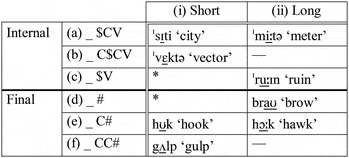
Columns (i) and (ii) show that the distribution of short and long vowels is almost complementary in English. Short vowels do not occur before a vowel, see (1i.c), and word-finally, see (1i.d), that is, they cannot stand at the end of a syllable, except as in (1i.a). Long vowels, in contrast, cannot occur in a closed syllable, as is shown in (1ii.b) and (1ii.f), except in (1ii.e).Footnote 3 These generalisations are summarised in (2).
-
(2) Generalisations
-
(a) Short vowels must be followed by a tautosyllabic consonant (but: (1i.a)).
-
(b) Long vowels cannot be followed by a tautosyllabic consonant (but: (1ii.e)).
-
Note that the restrictions in (1b) and (1f) do not apply to coronal clusters, and clusters involving [s] (indicated by ‘––’, instead of ‘*’), and examples like shoulder [ˈʃəʊldə], easter [ˈiːstə], paint [peɪnt], and ask [ɑːsk] exist (although [s] + non-coronal clusters like the last one only occur after long vowels in accents like RP that lengthened the historically short vowel in this environment). I will not deal with these cases further here (see e.g. Borowsky Reference Borowsky1989, Harris Reference Harris1994, Hall Reference Hall2001 for possible treatments).Footnote 4
The pattern in (1i) can be accounted for by requiring stressed syllables to be heavy in English (Stress-to-Weight), as proposed by Hammond (Reference Hammond1997a). In his analysis, a nonreduced syllable in English must be minimally bimoraic (or bipositional). Long vowels and diphthongs satisfy this requirement underlyingly, while in a closed syllable containing a short vowel, the second mora is provided by the coda consonant (Weight-by-Position). (1i.c, d), like *[ˈrʊɪn] and *[bræ], are then excluded because a short vowel in an open syllable is light, i.e. monomoraic.
To account for examples like [ˈsɪti] in (1i.a), Hammond (Reference Hammond1997a) assumes that the stressed syllable in such cases is in fact closed, albeit by a virtual consonant, namely, a covert geminate, providing the second mora required. Hammond follows Borowsky, Itô & Mester's (Reference Van der Hulst1984) proposal that cases of apparent ambisyllabicity must be treated as gemination (see also Van der Hulst Reference Van der Hulst1984, Reference Van der Hulst, Bennis and Beukema1985 for the same idea). Such geminates are virtual because their phonological length does not correspond to phonetic length, but it is still recoverable from their environment (i.e. they behave as if they were long). As virtual geminates are predictable, they cannot be contrastive.
Apart from the distribution of stressed vowels, independent evidence for virtual geminates in English is provided by expletive infixation, as discussed by Hammond & Dupoux (Reference Hammond, Dupoux, Durand and Laks1996). As shown in (3), the expletives fuckin’ and bloody can be placed between two feet within a word (in certain dialects).
-
(3) Expletive infixation (Hammond & Dupoux 1996: 290)
-
(a) fantastic [ˌfænˈtæstɪk] fan – fuckin’ – tastic
-
(b) Tennessee [ˌtεnəˈsiː] Tenne – fuckin’ – see
-
(c) typhoon [ˌtaɪˈfuːn] ty – fuckin’ – phoon
-
(d) raccoon [ˌræˈkuːn] *
-
The expletive can appear after a consonant, as in (3a), a schwa, as in (3b), or a long vowel, as in (3c), but it cannot occur after a short vowel, as (3d) indicates. If the stressed short vowel is followed by a virtual geminate, then the lack of expletive insertion can be explained by Geminate Integrity because the virtual geminate straddles the foot boundary in examples like (3d). (In addition, Hammond & Dupoux (Reference Hammond, Dupoux, Durand and Laks1996) also cite psycholinguistic evidence for this view on syllabification of intervocalic consonants and consonant sequences.)
The restriction in (1ii.b, f) above, that is, that superheavy rhymes, involving long vowels in closed syllables, are ruled out as well in English (i.e. examples like *[ˈviːktə] and *[guːlp] are ill-formed) is analysed by Borowsky (Reference Borowsky1989). To account for this, she poses an upper limit on rhymes (at Level 1), restricting them to contain maximally two positions (or moras). In addition, she assumes that final consonants are extrasyllabic. Therefore certain types of ‘superheavy rhymes', like those in (1ii.e) and (1i.f), are well-formed in English, but only word-finally (viz. [hɔːk] (VV$C) and [gʌlp] (VC$C)), because now such rhymes are also bipositional (which, of course, will not help examples like *[guːlp], still being tripositional).
If we want to combine the insights of Hammond and Borowsky in a unified analysis, then stressed rhymes in English need to be restricted to exactly two positions (for an analysis of Dutch rhymes along the same lines, see Van der Hulst Reference Van der Hulst1984, Reference Van der Hulst, Bennis and Beukema1985; Kager & Zonneveld Reference Kager and Zonneveld1986). This means that after stress assignment, a word-final consonant must be incorporated into the rhyme when it directly follows a stressed short vowel, as in [hʊk] in (1i.e), to satisfy the bipositional requirement. Final consonants of ‘superheavy rhymes', in contrast, must be extrasyllabic, to be able to state the complementary distribution between short and long stressed vowels, and to explain the pattern in (1i–ii). However, using extrasyllabicity in this way is stipulatory, as is requiring rhymes to contain exactly two positions (and not for example exactly three, exactly four, etc.).
In Polgárdi (Reference Polgárdi, Botma and Noske2012), I analyse this pattern in a recent version of Government Phonology, which provides several advantages.
3. A Loose CV analysis with trochaic proper government
Let me begin with the basic ingredients of the analysis, the underlying assumptions that I adopt. I follow Lowenstamm's (Reference Lowenstamm, Durand and Laks1996) Strict CV approach in the idea that syllable structure consists of strictly alternating C and V positions. As a consequence, the representation of closed syllables, geminate consonants and long vowels involves an empty position, as shown by the hypothetical forms in (4).
-
(4) Strict CV (Lowenstamm Reference Lowenstamm, Durand and Laks1996)
-
(a) Closed syllable (b) Geminate consonant (c) Long vowel
-
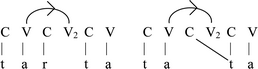

Geminates and long vowels are built up of two CV units. In a geminate the consonantal melody straddles an empty V position, while in a long vowel the vocalic melody straddles an empty C.
Following Rowicka (Reference Rowicka, Rennison and Kühnhammer1999a, Reference Rowickab), I employ trochaic (left-to-right) proper government instead of the more usual right-to-left type,Footnote 5 as defined in (5).
-
(5) Trochaic (left-to-right) proper government (Rowicka Reference Rowicka, Rennison and Kühnhammer1999a, Reference Rowickab)
A nuclear position A properly governs a nuclear position B iff
-
(a) A governs B (adjacent on its projection) from left to right
-
(b) A is not properly governed.
-
Government is a binary, asymmetric relation between skeletal positions. Proper government, indicated by a curved arrow in (4) and in subsequent diagrams, is a special form of government, which works in conjunction with the Empty Category Principle, given in (6).
-
(6) Empty Category Principle (ECP) (Kaye, Lowenstamm & Vergnaud Reference Kaye1990: 219)
A position may be uninterpreted phonetically if it is properly governed.
As a result, an empty V position may remain silent if it is properly governed, as shown by V2 in (4a–b) above. However, if an empty V position is not properly governed, then it must surface as the default vowel (illustrated by the schwa following the long vowel in the example of charlatan [ˈʃɑːlətən] in (11b) below).
Finally, I use a so-called Loose CV skeleton instead of the Strict CV one (as argued for in Polgárdi Reference Polgárdi1998, Reference Polgárdi, Kenesei and Siptár2002). These two approaches are not radically different: word-medially they are the same, they only differ (potentially) at the edges. More precisely, Loose CV dispenses with domain-final empty nuclei that are always inaudible. This means that words do not need to end in a V position: C-final words are allowed (just like V-initial words, when there is no phonetic consonant initially). However, word-medially a strict alternation of C and V positions is still required.
Domain-final empty nuclei present some serious problems, as discussed in Polgárdi (Reference Polgárdi1998). One of the problems is illustrated in (7), where the noun-forming suffix -er is added to the verb listen, resulting in the form listener. In a Strict CV approach, the root ends in the empty V3, while the suffix starts with the empty C4. This empty sequence is then customarily deleted, indicated by angle brackets, referred to as the operation of Reduction by Gussmann & Kaye (Reference Gussmann and Kaye1993).
-
(7) Strict CV: Reduction
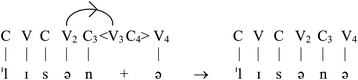
This is, however, problematic because it violates the Projection Principle, given in (8), by also removing the proper governing relation between V2 and V3.
-
(8) Projection Principle (Kaye et al. Reference Kaye, Lowenstamm and Vergnaud1990: 221)
Governing relations are defined at the level of lexical representation and remain constant throughout a phonological derivation.
In a Loose CV approach, as shown in (9), no reduction is necessary, as a consonant-final root and a vowel-initial suffix can simply be concatenated. As a result, no governing relationship has been deleted in this analysis.
-
(9) Loose CV: No reduction

In Polgárdi (Reference Polgárdi, Botma and Noske2012), I propose to analyse the bipositional requirement on stressed rhymes (Stress-to-Weight) by demanding that the stressed position in English properly govern an empty nucleus to its right. A heavy rhyme corresponds to two CV units in the CV approach, bound by trochaic proper government, as shown in (4a–c) above.Footnote 6 As proper government is a binary, non-transitive relation, the requirement automatically ensures that stressed rhymes will be both minimally and maximally bipositional.Footnote 7 Extra motivation for this requirement may be found in the melodic representation of vowels. Since short vowels in English are lax, and lax vowels are melodically represented as headless while tense vowels as headed in Government Phonology (e.g. Cobb Reference Cobb1997), this requirement ensures that all stressed rhymes are headed in some sense. Although lax vowels cannot be headed by themselves, they can satisfy the requirement by heading a proper governing relation with a following empty nucleus. Short vowels in seemingly open rhymes are followed by a virtual geminate to satisfy the requirement, similarly to Hammond's (Reference Hammond1997a) proposal.
Let us now see how the data in (1) can be analysed in this approach. The representation of stressed vowels (underlined) preceding a single intervocalic consonant, i.e. in a word-internal ‘open syllable’, is shown in (10).
-
(10) _ $CV (= (1a))
(a) Short: virtual geminate (b) Long
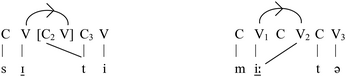
The representation of a long vowel involves two CV units, as seen in (10b). According to Rowicka (Reference Rowicka, Rennison and Kühnhammer1999a, Reference Rowickab), the relationship between the two halves of a long vowel is one of proper government. Since the C position between V1 and V2 is unfilled, this governing relationship is manifested by spreading the melodic content of V1 into V2. The ECP permits properly governed positions to remain uninterpreted, but it does not demand that they do so. Therefore, the realisation of V2 in (10b) does not contradict the ECP. (In those cases where the intervening C position is filled, there is of course no possibility, or need, for spreading, as in vector in (11) below, for example.) In this analysis, the V2 position is properly governed by V1 and not by V3, satisfying in this way the requirement on stressed positions in English to properly govern an empty nucleus to their right.
The stressed short vowel in (10a) is also required to properly govern an empty nucleus to its right, therefore it is followed by an extra CV unit, indicated by square brackets in (10a) and in representations below. I assume, following Bermúdez-Otero (Reference Bermúdez-Otero and Trommer2012), that stress assignment in English is represented by lexical redundancy rules so as to account for its limited productivity and lexical exceptions. Thus, lexical entries are fully prosodified stem-level output structures, also already containing the extra CV unit standing for tonic lengthening in forms like (10a).Footnote 8 As proposed by Larsen (Reference Larsen and Sauzet1998), a totally empty CV unit cannot remain completely silent.Footnote 9 If its V position is not properly governed, then it must be interpreted as the default vowel, according to the ECP. If the V position of the empty CV unit is properly governed, then it is required that at least one of its positions be eventually filled via spreading (Larsen Reference Larsen and Sauzet1998). This more specific requirement thus overrides the ECP.
The extra CV unit in (10a) is properly governed, therefore spreading ensues. In principle, either the neighbouring vowel or the consonant could lengthen, but lengthening the vowel would neutralise the contrast between (10a) and (10b). As consonant length is not contrastive in English, spreading the melody of the following consonant into C2 avoids such neutralisation. However, phonetically there are no long consonants in standard English,Footnote 10 so the resulting geminate is merely virtual. (For earlier use of this device in Strict CV phonology, see for example Lowenstamm Reference Lowenstamm and Kaye1991, Reference Lowenstamm, Durand and Laks1996; Larsen Reference Larsen1994; Ségéral & Scheer Reference Ségéral, Scheer and Dziubalska-Kołaczyk2001; Barillot & Ségéral Reference Barillot and Ségéral2005.) By contrast, virtual gemination of the vowel would not be possible because a virtual long vowel in (10a) would occur in the same context as the phonetically long vowel in (10b), and there would be no way to tell why one can remain phonetically short while the other one cannot. The length of the virtual geminate, on the other hand, is predictable from its environment.
Finally, to preserve the insight that in both (10a) and (10b) the spreading melody is distinctively located only in the head position, C3 and V1, respectively, and it is phonologically unspecified in the dependent position, I employ Harris’ (Reference Harris1994: 167) notion of spreading as interpretation. The line connecting the melody to the dependent position then simply indicates the domain over which that melody should be phonetically interpreted. (Of course, as it happens, in the virtual geminate the melody is not interpreted phonetically in C2. Nevertheless, the domain is phonologically demarcated.) In this analysis, virtual geminates in English are present underlyingly in the same way as long vowels are, and their distribution is captured by the lexical redundancy rules responsible for stress. Thus, (10a–b) show that the superficially similar surface forms in (1i.a) and (1ii.a) in fact have different representations.Footnote 11
The diagrams in (11) show stressed vowels in the word-internal ‘closed syllable’ context.
-
(11) _ C$CV (= (1b))
(a) Short (b) Long
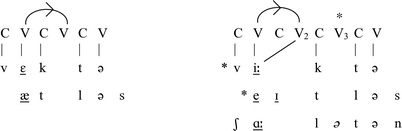
A stressed short vowel can occur here because it can properly govern the empty nucleus to its right, as is shown in (11a). A long vowel, however, cannot occur in this position, see (11b), because the governed V2 position cannot properly govern V3. An ungoverned position such as V3, however, cannot remain silent. It is for this reason that a long vowel cannot be followed by an inaudible nucleus. Of course, if the ungoverned V3 is filled by the default vowel, schwa, as in the example of charlatan [ˈʃɑːlətən], then the preceding long vowel is well-formed.
The contrast in (11) in fact provides an additional argument for a CV representation: the restriction concerning short vs. long vowels shown in (11a–b) applies not only in the case of coda–onset clusters, but also before so-called ‘bogus clusters' (e.g. atlas [ˈætləs], but *[ˈeɪtləs],Footnote 12 again well-formed with a pronounced schwa inside the cluster, as in odalisque [ˈəʊdəlɪsk]), where the consonants cannot form either a coda–onset cluster, or a branching onset in any version of Government Phonology, therefore they must be separated by an empty nucleus (e.g. Kaye et al. Reference Kaye, Lowenstamm and Vergnaud1990).Footnote 13 In a standard Government Phonology analysis, the restriction cannot be formulated in a uniform way: long vowels are ruled out in a closed syllable and preceding an empty nucleus. In the CV approach both contexts involve a following empty nucleus, requiring proper government.
The representations in (12) illustrate the situation of hiatus, that is, the context before a vowel.
-
(12) _ $V (= (1c))
(a) Short: CV unit cannot remain empty (b) Long


A stressed short vowel cannot occur in this position because it needs to properly govern, but the required extra CV unit, indicated by square brackets in (12a), cannot be filled, as there is no consonantal melody on the right to spread there. The vocalic melody of [ɪ] cannot spread either because long vowels are left-headed, and therefore in this case an illicit representation would arise. Since properly governed CV units cannot remain completely empty, such a representation is ill-formed. A long vowel, in contrast, can occur in this position without further provisions, as seen in (12b). The representation of stressed vowels in absolute word-final position in (1d) above (*[bræ] vs. brow [braʊ]) is completely parallel to those in (12a–b), therefore I do not provide them separately.
The examples in (13) illustrate the context before a single word-final consonant.
-
(13) _ C# (= (1e))
(a) Short (b) Long
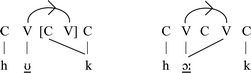
These representations are entirely parallel to the ones given in (10) above, with the exception of the lack of a final vowel. In Strict CV, even this difference would be missing because both forms would end in an empty V position. This, however, would result in ill-formed representations because these empty nuclei would be ungoverned, and therefore could not remain silent, as shown in (11b) above. This could be remedied by reintroducing the parameter of domain-final licensing (which has been made superfluous by switching to trochaic proper government) just for these cases. The problem with this solution is that words like finish would then have two possible analyses, one where the final empty nucleus is governed by the preceding pronounced vowel, and another where it is licensed parametrically. In Loose CV, these problems can be avoided because here words do not need to end in a V position.Footnote 14
Finally, let us examine the context before two word-final consonants in (14).
-
(14) _ CC# (= (1f))
(a) Short (b) Long
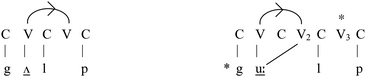
Again, these representations are parallel to those in (11a–b), and a stressed short vowel can occur in this environment, as is shown in (14a), because it can properly govern the empty nucleus inside the final cluster, whereas a long vowel is illicit in this position, see (14b), because the ungoverned V3 cannot remain silent. Note also that it no longer needs to be stipulated that ‘superheavy rhymes' such as (13b) and (14a) can only occur word-finally because the ‘bachelor’ Cs (i.e. Cs without a following V) involved in such rhymes are restricted to the edges.
One further question arises in relation to (14a), namely, whether bogus clusters are also allowed to follow short vowels word-finally, just as they were allowed word-internally in (11a). The answer is that they are not, but this is in fact part of a larger pattern, extending to word-final branching onsets, which are also absent. That is, the generalisation is that rising sonority at the end of the word is interpreted as a syllabic peak in English, i.e. as a pronounced V positionFootnote
15
– as all such words can either be pronounced with a schwa followed by a non-syllabic sonorant (as in settle [ˈsεtəl], muffle [ˈmʌfəl]), or with a syllabic sonorant without a preceding schwa ([ˈsεt
 ], [ˈmʌf
]). Syllabic consonants in English behave like unstressed vowels (as discussed below, in Section 5). This is also shown by the fact that they can be preceded by a long vowel in this position (as in beetle [ˈbiːtəl]/[ˈbiːt
]), which is not true of word-internal bogus clusters. The requirement that the V position inside a word-final rising sonority cluster must be pronounced overrides potential proper government of an empty nucleus in this position, shown in (15a–b) for the two possibilities.
-
(15) Word-final rising sonority clusters: Pronounced V position
(a) settle [ˈsεtəl] (b) settle [ˈsεt
]
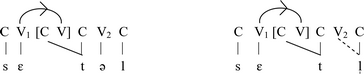
Schwa, as in (15a), is the default vowel. A syllabic consonant, as in (15b), will be analysed below as branching on a preceding V position in English (following Szigetvári Reference Szigetvári1999 and Scheer Reference Scheer2004), accounting for its alternation with schwa in (15a–b). As a syllabic consonant acts like any other unstressed vowel, virtual geminates are necessary in (15a–b) to satisfy the requirement of proper government. Finally, coda–onset sequences as in (14a) behave differently because in them sonority is falling.
In summary, stressed short and long vowels are in complementary distribution in English. At this point, let me summarise the advantages of the present analysis over previous approaches. As opposed to the bipositional rhyme analysis (following Hammond Reference Hammond1997a and Borowsky Reference Borowsky1989), where stressed ‘rhymes' were required to contain exactly two positions, in the present analysis the restriction is no longer arbitrary: a stressed position must properly govern an empty nucleus to be a head in some sense. Defining properties of proper government include that it is binary and non-transitive (arrived at on the basis of independent evidence, e.g. vowel ~ zero alternation in various languages). Therefore, in this analysis, variation is restricted to two possibilities: either a language requires stressed vowels to properly govern or there is no such requirement. In a bipositional rhyme approach, in contrast, there is no reason why rhymes should be restricted to exactly two positions, instead of any other imaginable number. As no other numbers seem to be supported empirically, such an analysis overgenerates.Footnote 16 In addition, a CV analysis can unify the representations of coda–onset clusters and bogus clusters, both of which can provide a following context for short vowels. Another advantage is that there is no need (or even possibility) for extrasyllabicity, and all final consonants are treated in a uniform manner, that is, as a ‘bachelor’ C. In the extrasyllabic account, only final consonants of ‘superheavy rhymes’ are analysed as extrasyllabic, whereas consonants following short stressed vowels belong to the rhyme. Therefore, a final ‘bachelor’ C is not equivalent to extrasyllabicity, neither is it invented for the sake of ‘superheavy rhymes’.
Furthermore, an analysis employing virtual geminates is supported by accents like Welsh English, where the distribution of short and long stressed vowels in syllable structure is identical to that shown in (1) (although differences in melodic identity can be found), but where virtual geminates in fact become audible. Different sources do not agree exactly about the context of lengthening. Thomas (Reference Thomas and Trudgill1984: 185) only mentions that ‘single consonants in medial position following a short stressed vowel are phonetically long’, as in (16a).
-
(16) Welsh English
(a) _ $CV (= (1a.i)) (b) _ C# (= (1e.i))

However, Connolly (Reference Connolly1981) also reports lengthening in the word-final context, as in (16b). In his description, lengthening also applies after [iː, uː] and the diphthongs, when these are fully shortened before a fortis consonant, and to certain, not precisely specified, types of clusters (the latter of which I cannot account for here).
4. Post-tonic syncope
With this background, we can now turn to the phenomenon of syncope. Data on syncope in this paper partly come from Guile (Reference Guile1972), Zwicky (Reference Zwicky, Stockwell and Macaulay1972), Algeo (Reference Algeo1974), Hooper (Reference Hooper and Fisiak1978), Harris (Reference Harris1994, Reference Harris, van Oostendorp, Ewen, Hume and Rice2011) and Szigetvári (Reference Szigetvári2002, Reference Szigetvári2007). In addition, I have used the electronic database at http://seas3.elte.hu/epd, based on Hornby, Cowie & Windsor Lewis (Reference Hornby, Cowie and Lewis1974), and the database of Lindsey & Szigetvári (Reference Lindsey and Szigetvári2013) at http://seas3.elte.hu/cube, where frequency counts are also supplied, to search for additional examples. I have checked all examples cited here in Wells’ (Reference Wells1990) Longman Pronunciation Dictionary.
Post-tonic syncope in English optionally deletes a schwa between a stressed and an unstressed vowel. Here I will not discuss pre-tonic cases of syncope, occurring in examples like potato [p(ə)ˈteɪtəʊ] or support [s(ə)ˈpɔːt], because they involve a separate process, applying only in fast, casual speech. The type of syncope examined here, although optional, applies in non-fast, non-casual speech.
In the pairs of examples in (17), the first item can exhibit syncope, while the second one cannot.
-
(17) Syncope (optional)
C1 ə C2 → C1C2 / stressed V __ unstressed V
-
(a) __ C unstressed V séparateA [ˈsεprət] séparàteV *[ˈsεpreɪt]
jávelin [ˈdʒævlɪn] fáculty *[ˈfæklti]
háppening [ˈhæpnɪŋ] háppen# *[ˈhæpn]
-
(b) C2 = sonorant définite [ˈdεfnət] délicate *[ˈdεlkət]
-
(c) C1 < C2 mémory [ˈmεmri] cólony *[ˈkɒlni]
Post-tonic syncope is only possible in English if the schwa is followed by a single consonant and an unstressed vowel, as in sép(a) rate A , jáv(e) lin, or hápp(e) ning in (17a).Footnote 17 If the vowel after the following consonant is stressed (sép*(a) ràte V ), or if the schwa is followed by a cluster (fác*(u) lty), or by a word-final consonant (hápp*(e) n #), then syncope is not allowed. In addition, syncope is sensitive to the quality of the flanking consonants. The consonant following the alternating vowel can only be a liquid or a nasal, as in déf(i) nite, and it cannot be an obstruent, as in dél*(i) cate, in (17b). Furthermore, the consonant following the schwa must be more sonorous than the consonant preceding it,Footnote 18 therefore syncope is possible in mém (o) ry, but it is ruled out in cól *(o) ny, in (17c).
Finally, apart from being optional, another important characteristic of this process is that it is also lexically variable: that is, in the same prosodic and melodic context, a schwa may alternate with zero in one word (e.g. sím (i) lar [ˈsɪmələ]/[ˈsɪmlə]), but not in another (e.g. anómalous [əˈnɒmələs]/*[əˈnɒmləs]), while in yet a further example the form without the schwa may be lexicalised (e.g. fám (i) ly [ˈfæmli]) (and there is dialectal and inter-speaker variation in which word behaves in which way). The main factor that this difference is based on involves relative usage frequency of lexical items. Fidelholtz (Reference Fidelholtz1975) was the first to note that more frequent words are more prone to reduction processes. He examined vowel reduction in initial closed syllables in English. Hooper (Reference Hooper and Christie1976) observed the same generalisation for post-tonic syncope. The process of t/d-deletion shows the same pattern, as discussed by Coetzee (Reference Coetzee2009) and Coetzee & Pater (Reference Coetzee, Pater, Goldsmith, Riggle and Yu2011) (who also mention several further examples from other languages).
The generalisations in (17) are based on intuitions of the authors cited, which are confirmed to varying degrees by corpus studies (on American English). Dalby's (Reference Dalby1986) study, analysing television broadcast speech, and slow and fast reading, shows a difference between pre- and post-tonic syncope: deletion rate in post-stress word-medial position is much higher than in other positions of the word in broadcast speech, and especially in slow reading, whereas deletion rate in pre-stress position increases radically in fast reading. On the other hand, the sonority restrictions presented in (17) are not confirmed by Dalby's results. Patterson, LoCasto & Connine (Reference Patterson, LoCasto and Connine2003) find an even greater difference in deletion rate between the post-stress and pre-stress environments than Dalby, analysing conversations between strangers over the phone, and between friends in face-to-face interaction. However, they fail to confirm the influence of speech rate on the frequency of deletion. In addition, they identify two groups of words within the post-stress type which show a marked difference in deletion rate. One factor inhibiting deletion is identified as a following stressed syllable. Patterson et al. (Reference Patterson, LoCasto and Connine2003) do not investigate the melodic identity of consonants flanking the syncope site, but almost all the examples they examine conform to the restrictions discussed in (17). Davidson (Reference Davidson2006), investigating normal and fast reading, argues for analysing pre-tonic syncope in English as a result of gestural overlap, instead of deletion, on the basis of evidence showing phonetic traces of presence of a vowel on the neighbouring consonants. In addition, the influence of speech rate on pre-tonic syncope has been confirmed for some speakers, but not for others in this study. Finally, Balogné Bérces (Reference Balogné Bérces, Balogné Bérces, Földváry and Mészárosné Kóris2011) discusses lexicalisation of syncope and finds that all such cases involve post-tonic syncope, observing the sonority restrictions in (17).Footnote 19 As can be seen, these studies sometimes show contradictory results, but as each generalisation in (17) is supported by at least some of them, in my opinion it is justified to attempt an analysis of that pattern.
Post-tonic syncope is thus triggered by a sequence of unstressed vowels, and it does not apply if there is only a single unstressed vowel, either in a word-final syllable (hápp*(e) n #) or followed by a stressed vowel, where the degree of stress is immaterial (the final stress in sép*(a) ràte V has been analysed both as secondary and as tertiary in the literature, but syncope is also blocked preceding a primary stress, as in fàt*(a) lístic). Therefore, the driving force behind syncope is the presence of a metrical lapse, and I propose that the decision about which unstressed vowel should delete is determined by the requirement of proper government introduced in Section 3 above. That is, we can explain why it is normally the post-tonic vowel which deletes (and not the following one), as this provides another means of satisfying the governing duty of stressed vowels, as shown in (18).Footnote 20 In the following representations, V positions inside virtual geminates are not numbered, to ease comparison between syncopated and unsyncopated forms.
-
(18) Two ways of satisfying the requirement of proper government
(a) Virtual geminate: metrical lapse (= (10a)) (b) Syncope (= (11a))
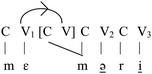
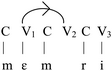
The representation in (18a) satisfies the requirement by the presence of the virtual geminate, while at the same time containing a sequence of two unstressed vowels, V2 and V3, that is, a metrical lapse. In (18b), as a result of syncope, the metrical lapse is avoided, and there is no need for the virtual geminate either.Footnote 21 If a stressed vowel follows the schwa, there is no metrical lapse to trigger syncope, and therefore it does not occur.
In the Government Phonological literature, syncope is generally accounted for by iambic, right-to-left, proper government, like the one between V2 and V3 in (19a) (e.g. Harris Reference Harris1994, Szigetvári Reference Scheer1999).
-
(19) Iambic proper government
(a) Within a stress domain (b) Across stress domains

Then, however, it is unclear why only an unstressed vowel can properly govern, and what the role of the preceding stressed vowel is. As for the first question, Szigetvári (Reference Scheer1999: 79) proposes the Antipenetration Constraint, which prohibits government from penetrating a stress domain. In (19a) V2 and V3 are in the same stress domain (shown by the parentheses on the CV tier). But in (19b) V3, being stressed, starts a new stress domain and is therefore not allowed to govern V2, and syncope is ruled out. However, this analysis cannot work because there are many examples like chàrismátic or magnólia in English, with a bogus cluster preceding a stressed vowel, where the empty nucleus enclosed by the underlined consonants must be governed to be able to remain silent. Trochaic proper government solves these problems, by integrating syncope into the patterning of stressed vowels in English. (For the exact formulation of how syncope is triggered by a metrical lapse, see Section 6 below.)
As we have seen in (18), syncope occurs before a single consonant and an unstressed vowel. The representations in (20) show the two other contexts illustrated in (17a) where syncope does not occur.
-
(20) Right-hand context
(a) __ CC fac*(u)lty (= (11b)) (b) — C# happ*(e)n (= (14a))
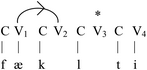

The structure in (20a) is similar to the one in (11b) above: if the V2 position is governed, it cannot properly govern V3, which, in turn, cannot remain silent, and the representation is ill-formed. This is why syncope does not apply preceding a consonant cluster. The structure in (20b) is parallel to the one in (14a), and yet it is ruled out as a result of syncope. The reason is twofold: on the one hand, the situation is similar to the one where a stressed vowel follows: if the schwa precedes a word-final consonant, there is no metrical lapse to trigger syncope. On the other hand, in word-final rising sonority clusters, the V2 position must be pronounced in English, as has been discussed with respect to (14a) above, i.e. it cannot be properly governed.
There is another interesting property of syncope in English, which is unexpected in a CV account involving either type of proper government, namely, the schwa can also be deleted after a consonant cluster or a long vowel, or combinations thereof, as shown in (21).
-
(21) Left-hand context
-
(a) CC cómp(a)ny
víct(o)ry
ádm(i)ral
-
(b) VV ív(o)ry
árs(e)nal
-
(c) VVCC dáng(e)rous
-
The clusters preceding the syncope site are mostly coda–onset clusters, as the first two examples in (21a), and sometimes bogus clusters, as the third example, but there are no examples with a complex onset in this position. This gap can be explained by the representation of complex onsets, involving an infrasegmental governing domain, which has to be licensed by a following pronounced V position according to Scheer (Reference Scheer1999).
The question is how syncope is possible in words like (21). The problem is illustrated in (22).
-
(22) Lack of a proper governor
-
(a) Cluster (b) Long vowel
-
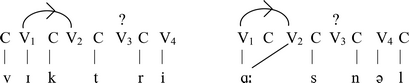
In both representations, it is unclear what triggers syncope, as V2 is itself properly governed and therefore cannot serve as a proper governor for V3. For iambic proper government, the representations are equally problematic because in that case it is V2 that lacks a proper governor.
Another problem faced by an analysis in terms of proper government of either direction concerns the melodic restrictions on the consonants flanking the syncope site, shown in (17b–c). As proper government operates on the nuclear projection, it should be blind to the quality of the surrounding consonants. In fact, this is one of the reasons why proper government has been such a successful tool in accounting for vowel ~ zero alternation: it captures the cross-linguistic sonority-blindness of the process. Vowel ~ zero alternations analysed in terms of proper government include e.g. Tangale (Nikiema Reference Nikiema, Hutchison and Manfredi1989), Moroccan Arabic (Kaye Reference Kaye1990), French (Charette Reference Charette1991), Hungarian (Törkenczy Reference Törkenczy, Kenesei and Pléh1992), Polish (Gussmann & Kaye Reference Gussmann and Kaye1993) and Czech (Scheer Reference Scheer2004).
The sonority restrictions found in English are also left unexplained by analyses involving deletion of melody as well as position, accompanied by resyllabification. Hooper (Reference Hooper and Fisiak1978), for example, states that syncope in English creates syllable-initial clusters, i.e. branching onsets. However, many of these clusters (like [vl pn fn mr] in (17)) do not occur syllable-initially in English lexically, but are rather analysed as coda–onset clusters in an approach like Hooper's, and as bogus clusters in terms of standard Government Phonology. In addition, some other clusters which are considered syllable-initial by Hooper, i.e. [s] + stop clusters, cannot be produced by syncope (as in góss *(i) ping), together with all other falling sonority clusters (as in dél *(i) cate in (17b)). Thus, possible resulting clusters do not form a straightforward class in this approach either.
5. Syllabic consonant formation
We might gain better understanding of these issues by examining the phenomenon of syllabic consonant formation (SCF) in English (Szigetvári Reference Szigetvári2002), illustrated in (23). Comparing (23) to (17) above, it can be observed that the restrictions on syllabic consonant formation are very similar to, although less stringent than, those on syncope. In both cases, a post-tonic schwa is optionally deleted between two consonants, the second of which is a liquid or a nasal, if the second consonant is more sonorous than the first one (23a).
-
(23) Syllabic consonant formation (post-tonic)
C1 ə C2 → C1
2 (optional), C2 = sonorant-
(a) C1 < C2 cámel [ˈkæm
] cólumn *[ˈkɒl
] -
(b) __ # háppen# [ˈhæp
] -
(c) __ C fáculty [ˈfæk
ti] -
(d) __ unstressed V séparateA [ˈsεp
ət] séparàteV *[ˈsεp
ˌeɪt]flànnelétte [ˌflæn
ˈεt] -
(e) __ syllabic C nátional [ˈnæʃ
] -
(f) C1 = r cáramel [ˈkær
]bárrel [ˈbær
] -
(g) + ex. (21) pátron [ˈpeɪtr
]cárd(i)nal [ˈkɑːdn
]
-

In the case of SCF, the second consonant takes over the syllabic role of the deleted vowel and, indeed, it behaves like a(n unstressed) vowel. It can occur at the end of the word, as in (23b), before another consonant, as in (23c), before an unstressed vowel, as in (23d), or before another syllabic consonant, see (23e).Footnote 22 The case of a following stressed vowel is somewhat less clear, as SCF is ruled out in séparàte V, but it is possible in flànnelétte (23d), according to Wells (Reference Wells1990). As will be shown below, a specific type of morpheme boundary needs to separate the sonorant from the stressed vowel for SCF to take place (i.e. it does not apply pre-tonically within monomorphemic forms). The examples in (23f) show that [r] can contradict the sonority requirement and can be followed by a syllabic consonant which is less sonorous.Footnote 23 Finally, (23g) illustrates that syllabic consonants can also follow long vowels and consonant clusters, and all the examples in (21) could be added here (which can then proceed further to complete syncope). That syllabic consonants behave like vowels is also shown by the fact that complex onsets can be found in this environment, as shown by the example of pátron. In addition, syllabic consonants can follow non-lexical bogus clusters, created by syncope, as in cárd (i) nal.
Comparing the application of syncope and SCF, we can conclude that SCF can be regarded as a stage preceding syncope (Harris Reference Harris1994, Szigetvári Reference Szigetvári2002). That is, for each syncopated form, there is also a form with a syllabic consonant, and as a result there is ternary free variation, as in [ˈʤεnərəl]/[ˈʤεn
 əl]/[ˈʤεnrəl]. The reverse, however, does not hold, i.e. a form with a syllabic consonant may have no corresponding syncopated form, in which case there is free variation only between two forms, as in [ˈplεnəri]/[ˈplεn
i]/*[ˈplεnri].
This chronology explains the strange melodic restrictions on syncope, which are not so strange in the context of SCF. The consonant following the syncope site must be a sonorant because only sonorants can become syllabic in English. This restriction applies to syllabic consonants in many other languages as well (Bell Reference Bell and Greenberg1978). In addition, if SCF in English aims at preserving rising sonority between a consonant and a following vowel, then the second consonant must be more sonorous than the first one, to be able to replace the vowel in this role. I have found no explanation for why [r] can form an exception to this condition. But forms like caramel [ˈkær
 ] and irony [ˈaɪ(ə)r
 i] cannot proceed to syncope (i.e. *[ˈkærm
], *[ˈaɪ(ə)rni]) because a short lax or (broken) tense vowel + [r] + non-syllabic consonant sequence is ill-formed in English.Footnote
24
,
Footnote
25
Therefore, in syncope the sonority requirement is strictly observed, and [r] is no exception to it.
In linear phonology, syllabic consonants were represented as [+consonantal, +syllabic] segments (e.g. Chomsky & Halle Reference Chierchia1968: 354; Bell Reference Bell and Greenberg1978), which has mostly corresponded to a consonantal melody associated to a nuclear position in non-linear phonology (e.g. Clements Reference Clements, Kingston and Beckman1990, Blevins Reference Blevins and Goldsmith1995). This approach, however, is problematic because it involves resyllabification during the creation of the syllabic consonant, and in languages like English, also at the next step, during syncope, when the consonant becomes non-syllabic again. Resyllabification is a powerful device, and it should be avoided if simpler solutions are also available.
Government-based approaches, therefore, represent syllabic consonants by spreading the melody distinctively located in a C position into a neighbouring V position, thereby capturing the fact that syllabic consonants have both consonantal and vocalic properties. In the case of syncope (proper government) in English, spreading does not go through, but the structure again remains intact. In the literature, proposals have been made for both a left-branching (e.g. Szigetvári Reference Szigetvári1999: 117ff.; Toft Reference Toft2002; Scheer Reference Scheer2004) and a right-branching structure (e.g. Rowicka Reference Rowicka1999b: 258ff.; Rennison Reference Rennison, van der Hulst and Ritter1999; Blaho Reference Blaho2004) for syllabic consonants. Here I follow the left-branching view, as shown in (24), since the syllabic consonant takes the place of a preceding schwa and behaves like an unstressed vowel in that position (see (15) above). Some further arguments are provided below.
-
(24) Syllabic consonants: Left-branching (= (10a))
(a) __ C [ˈfæk
ti] (b) __ # [ˈhæp
]
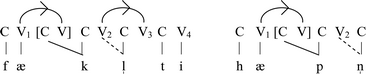
As a syllabic consonant acts like any other pronounced vowel, virtual geminates are necessary in (24a–b) to satisfy the requirement of proper government. Unlike (20), the representations in (24) are well-formed because V3 is properly governed by V2 in (24a) and because V2 is pronounced inside the word-final rising sonority cluster in (24b).
The representations in (25) show that a syllabic consonant forms a metrical lapse with a following schwa in the same way as any other unstressed vowel does, and this lapse is then resolved by syncope in the same way as it was in (18) above.
-
(25) (a) Syllabic consonant (= (10a)) (b) Syncope (= (11a))
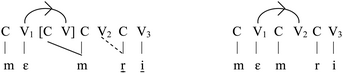
In contrast to (22), the representations in (26) are well-formed because V3 is pronounced, and therefore it does not need a proper governor.
-
(26) No proper governor needed for V3
-
(a) Cluster (b) Long vowel
-

The question now is why these forms can proceed further and syncopate, when this is impossible in a form like (24a). While I cannot answer this question in a satisfying way at the moment, a difference can be observed between the structures in (26) and the one in (24a): in (24a) the potential target of syncope, V2, has a governing duty to fulfil, which is not the case in (26). Whatever makes it possible for V3 to remain silent in (26) is overruled by the governing duty of V2 in (24a). I leave this question open for further research.
Let us briefly return to the question why a right-branching structure is not appropriate for syllabic consonants in English. This structure has been proposed to be universally valid by Blaho (Reference Blaho2004) and Scheer (Reference Scheer, Zybatow, Junghanns, Lenertová and Biskup2009), on the basis of Slavic evidence. Their main arguments, however, are all refuted by English. In Czech and Slovak a syllabic consonant cannot be followed by a pronounced vowel within the same morpheme, whereas in English it can (e.g. memory [ˈmεm
i]), in which case the syllabic consonant would have no place to spread to. Syllabic consonants can be followed by consonant clusters in Czech ([ˈv
hkiː] ‘humid’), and Slovak ([ˈk
ʧma] ‘inn’), producing a sequence of silent empty nuclei, unless the syllabic consonant branches to the right; but English has no such forms (except for a handful of examples with a following branching onset, like concentrate, or if there is an intervening word-level boundary, as in elegant#ly). In contrast, syllabic consonants in English can be freely preceded by consonant clusters, as shown in (23g) and analysed in (26). Vowel ~ zero alternation can occur after a syllabic consonant in Czech ([ˈb
bεʦ ~ ˈb
bʦε] ‘idiot (nom, sg) ~ (gen, sg)’), again producing a following cluster, whereas this normally cannot happen in English (again there are a handful of exceptions, like invent(o)ry, all with the suffix -ory/-ery/-ary, but we have seen in (21) that syncope in English can unexpectedly apply across a cluster also after a stressed vowel). Again, vowel ~ zero alternation can occur before a syllabic consonant in English, see (23g) above. Therefore, it seems to be a parameter, rather than a universal, in which direction a syllabic consonant spreads, and in English ample evidence points in the left direction. Note that in an analysis where syllabic consonants solely occupy the nucleus, this typological difference is mysterious and it cannot be captured, providing further support for a branching representation.
Finally, according to Toft (Reference Toft2002), Southern British English syllabic [
] should be represented by a left-branching structure, whereas syllabic [
] should be connected exclusively to a nucleus, to express the fact that [
] is more restricted in its distribution and that it has longer duration. Then, however, it will be difficult to express their unitary behaviour with respect to syncope, whose representation in the case of [
] will also be substantially complicated. In addition, the distributional differences are not absolute, but gradient, whereas the representational differences proposed by Toft are categorical, which leaves no room for the variation actually observed.
I also disagree with the idea that a branching representation of syllabic consonants necessarily corresponds to extra length phonetically. Blaho (Reference Blaho2004) argues, on the basis of a contrast between short and long syllabic consonants in Slovak, that length is expressed by linking some melody to two positions of the same type (either both Cs, or both Vs). Accordingly, branching involving a C position and a V position does not correspond to phonetic length. Instead, it expresses the fact that syllabic consonants exhibit both consonantal and vocalic characteristics. In addition, Price (Reference Price1980) shows that apart from duration, amplitude and voice onset time also provide phonetic cues to distinguish syllabic from non-syllabic consonants in English.
Furthermore, the branching representation of syllabic consonants is not interpreted as a sequence of a syllabic consonant followed by a non-syllabic one of the same melodic composition either, that is as *[ˈhæp
n] for happen in (24b), for example. As such sequences do not occur at all in English (except across a word-level boundary, as in barren
#
ness), there is no contrast between [
n] and [
]. Therefore, in English a syllabic consonant is simply the interpretation of a branching structure like the one in (24b).
6. Deriving syncope
Now we are ready to formalise the analysis of syncope more precisely. On the basis of the evidence presented in Section 5, I propose that syncope in English needs to be restricted to proper government of (the V position of) a syllabic consonant. SCF is a separate process, which applies first (optionally), and syncope is then optional on the output of SCF. In that way, the sonority restrictions need not be taken into account by proper government: they are already satisfied by its input.
In my view, syncope in English results from a ‘conspiracy’ of different forces: one aiming at avoiding lapses, another requiring stressed positions to properly govern, and a third striving against rising sonority within word-final consonant clusters. Such conspiracies are best expressed by Optimality Theoretic constraint interaction (Prince & Smolensky Reference Prince and Smolensky1993, McCarthy & Prince Reference McCarthy, Prince, Beckman, Urbanczyk and Dickey1995). However, in standard Optimality Theory (OT), evaluation is parallel, ruling out intermediate representations, and ordering between processes. Therefore, here I argue for a Stratal OT analysis of these phenomena (e.g. Kiparsky Reference Kiparsky2000, Bermúdez-Otero Reference Bermúdez-Otero and Trommer2012). This approach recognises three levels: the stem, the word, and the phrase level.
For syllabic consonant formation to be able to precede syncope, the two processes must belong to different levels. And, in fact, it can be shown that SCF applies at the stem level in English, while syncope is a word-level process. If we examine word-level suffixes starting with a sonorant consonant, we find that in those starting with a nasal, -ness and -ment, the initial consonant never becomes syllabic after a schwa, see (27a). Also, it always forms a fake geminate with a preceding identical consonant, indicated by doubling of the symbol in (27b) (where the stem-final consonant might become syllabic if it follows a schwa, the option marked by curly brackets), and a preceding [i] cannot weaken to schwa, see (27c).
-
(27) Syllabic consonant formation: Nasal-initial word-level suffixes
-
(a) ə __ wilderness [ˈwɪldənəs] sacrament [ˈsækrəmənt]
-
(b) Ci __ openness [ˈəʊp{ən/
}nəs] embalmment [ɪmˈbɑːmmənt] -
(c) i __ happiness [ˈhæpinəs] merriment [ˈmεrimənt]
-
Word-level suffixes starting with [l], -less and -ly, are not as clear-cut (and no suffix starts with [r]). After a schwa, -less mostly retains a non-syllabic [l] but with some stems, as in odourless, it undergoes SCF, while -ly can almost always undergo SCF and there are only a few examples like slenderly, with only non-syllabic [l], see (28a).
-
(28) Syllabic consonant formation: [l]-initial word-level suffixes
-
(a) ə __ motherless [ˈmʌðələs] slenderly [ˈslεndəli]
odourless [ˈəʊd{əl/
}əs] tenderly [ˈtεnd{əl/
}i] -
(b) Ci __ soulless[ˈsəʊlləs]solely[ˈsəʊlli]
fully[ˈfʊli]
vowelless[ˈvaʊəlləs]fatally[ˈfeɪt{əl/
}i] -
(c) i __ pitiless [ˈpɪt{ɪl/əl/
}əs] happily [ˈhæp{ɪl/əl/
}i]merciless [ˈmɜːs{ɪ/ə}ləs]
-
With an identical stem-final consonant, the [l] of -less always forms a fake geminate (whether after a stressed or an unstressed vowel), as in (28b). Following a stressed vowel, the [l] of -ly mostly forms a fake geminate, which in some words can optionally degeminate (e.g. dully), and in a few words, like fully, only short [l] occurs. After an unstressed vowel, degemination is obligatory, and SCF is optional. Finally, a stem-final [i] weakens to [ɪ] or [ə] before both suffixes, and the [l] of -less sometimes undergoes SCF, whereas the [l] of -ly can always do so, see (28c). The behaviour of -less and especially of -ly is thus ambiguous: with certain stems they act like a stem-level suffix while with others they show word-level behaviour. Similar problems have been identified with respect to other languages (e.g. Hungarian, Rebrus Reference Rebrus and Kiefer2000), and as far as I know no satisfactory solution has been found. On the basis of the unambiguously word-level behaviour of nasal-initial suffixes, we can conclude that SCF applies at the stem level in English.
Turning now to syncope, those vowel-initial word-level suffixes are relevant here that can be added to stems ending in a schwa + sonorant sequence. From these, -able, -ing, -er, and -ary/-ery/-ory mostly trigger syncope in the preceding syllable, providing evidence for the word-level status of this process (and the last suffix is especially interesting because here the first vowel of the suffix typically also alternates with zero, sometimes giving syncope two options to apply within the same word), see (29a). On the left in (29), examples are shown where syncope is possible, whereas in examples on the right only SCF can apply.
-
(29) Syncope: Vowel-initial word-level suffixes
-
(a) measurable [ˈmεʒrəb
] questionable [ˈkwεsʧ
əb
]blithering [ˈblɪðrɪŋ] wuthering [ˈwʌð
ɪŋ]traveler [ˈtrævlə] wagoner [ˈwæg
ə]missionary [ˈmɪʃn
i] pupilary [ˈpjuːp
i][ˈmɪʃ
ri] -
(b) impressionist [ɪmˈprεʃnɪst] novelist [ˈnɒv
ɪst]devilish [ˈdεvlɪʃ] kittenish [ˈkɪt
ɪʃ]coverage [ˈkʌvrɪʤ] orphanage [ˈɔːf
ɪʤ] -
(c) impressionism [ɪmˈprεʃ
ˌɪz
]localise [ˈləʊk
ˌaɪz]
-
The suffixes -ist, -ish and -age, on the other hand, more often occur with a syllabic consonant than with complete syncope, see (29b). Frequency clearly plays a role in this difference. Finally, -ism and -ise, bearing secondary stress, never allow for syncope, see (29c), and in about half of the cases not even for SCF (e.g. mechanism, monopolise).
Thus, we have seen that SCF applies at the stem level, while syncope applies at the word level in English (contrary to Borowsky's Reference Borowsky, Hargus and Kaisse1993 analysis).Footnote 26 The stem-level status of SCF supports Coetzee & Pater's (Reference Coetzee, Pater, Goldsmith, Riggle and Yu2011) claim that variable and non-categorical processes are not restricted to the late phonology.
Let us start the analysis with syllabic consonant formation, at the stem level. The ranking of the relevant constraints is given in (30a).
-
(30) Syllabic consonant formation: Constraints
-
(a) | C | < | V |, *SylObs » *ə » *SylSon, Faith(ə)
-
(b) | C | < | V |
A segment connected to a C position is less sonorous than the segment connected to the following V position.
-
(c) Faith(ə)
A [ə] in the input corresponds to a [ə] in the output.
-
*SylObs, *SylSon, and *ə are markedness constraints militating against syllabic obstruents, syllabic sonorants, and schwa, respectively. | C | < | V | and Faith(ə) are formulated rather informally, as a detailed discussion of melodic representations in Government Phonology is beyond the scope of this paper.
The input representations to SCF are given in (31a), while the (potential) outputs with a syllabic consonant appear in (31b), for the examples memory, apathy and colony.
-
(31) Syllabic consonant formation: Candidates
-
(a) Schwa (b) Syllabic consonant
-
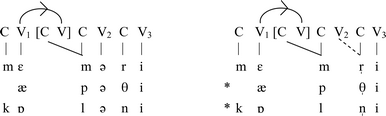
As noted above, in Stratal OT, lexical entries are fully prosodified stem-level output structures (Bermúdez-Otero Reference Bermúdez-Otero and Trommer2012), already containing the results of processes applying in lexical redundancy mode (such as stress, and the extra CV unit constituting the virtual geminate). SCF, a variable process, applies in standard mode, therefore its result is not included in the lexical representation.
The combined tableau in (32) shows how the ranking in (30a) derives SCF in English. In the tableaux, virtual geminates are indicated by doubling of the symbol.
-
(32) Syllabic consonant formation

The candidate with a schwa is identical to the input in each case, shown in (31a). For memory, that candidate (32a) loses by violating *ə. Candidate (32b) with a syllabic consonant wins, demonstrating the ranking: *ə » *SylSon, Faith(ə). That is, it is better to have a syllabic sonorant in an unstressed position than a schwa. In apathy, in (32c–d), in contrast, it is not possible to eliminate the schwa because the following consonant is an obstruent, which cannot become syllabic in English, establishing the ranking: *SylObs » *ə. Finally, in colony, in (32e–f), although the following consonant is a sonorant, it is less sonorous than the preceding one, and again SCF is impossible, providing evidence for the ranking: | C | < | V | » *ə.Footnote 27
Finally, SCF is optional in English, which can be expressed in different ways. Among the models discussed by Anttila (Reference Anttila and de Lacy2007), both Multiple Grammars Theory, with competing total rankings, and the theory of Partially Ordered Grammars, with a total ranking randomly selected at each evaluation, can account for this variation. Here I opt for the theory of Partially Ordered Grammars. The relevant ranking is the one between *ə and *SylSon. When the ranking *SylSon » *ə is selected, the evaluation of apathy and colony remains intact, but memory also surfaces with a schwa instead of a syllabic consonant. As a result, the ranking of these two constraints is unspecified at the stem level in English, accounting for the free variation between the schwa and the syllabic consonant.
Let us now turn to the account of syncope, at the word level. The relevant constraints can be (informally) formulated as in (33).
-
(33) Syncope: Constraints
-
(a) StressPG
A stressed position must properly govern an empty nucleus to its right.
-
(b) *VirtGem
Virtual geminates are prohibited.
-
(c) NoLapse
No sequences of unstressed vowels.
-
(d) Faith(Syl)
A consonant connected to a V position in the input is also connected to that V position in the output.
-
(e) Faith(CV)
A CV unit present in the input is also present in the output.
-
(f) *|C| < |C| #
In word-final consonant clusters, sonority cannot rise.
-
StressPG expresses the requirement introduced in Section 3 above in an OT-style constraint. The constraint *VirtGem indicates the markedness of such configurations. Perhaps it should simply prohibit geminates, as that is what these consonants are phonologically, and their virtuality is just a matter of phonetic interpretation. But for the sake of clearer exposition, I keep the present formulation. NoLapse rules out sequences of unstressed pronounced V positions, whether these are filled by vocalic or consonantal melody (see Hammond Reference Hammond, Archangeli and Langendoen1997b for a similar formulation of the triggering force behind syncope as aiming at improvement in footing). I use Faith(CV) instead of Max because inside a domain Cs and Vs cannot be deleted separately. Also, this constraint only refers to skeletal units, and it is oblivious to melody. *|C| < |C| # only specifies that sonority cannot rise within a word-final consonant cluster, but the solution of realising the intervening V position will be decided by lower-ranked constraints (against epenthesising vocalic melody or spreading consonantal melody).
The representations of the relevant candidates are illustrated in (34), through the example of ráti(o)nal [ˈræʃn
]. The structure in (34a) gives the input [ˈræʃ
], with the syllabic consonants already present, having been created at the stem level, and containing a lapse of unstressed V2 and V3.
-
(34) Syncope: Candidates
-
(a) Lapse (b) Syncope of V2
(c) Syncope of V3 (d) No virtual geminate
-
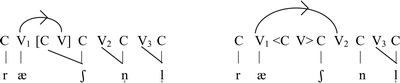

In (34b), syncope of V2 is shown, [ˈræʃn
], whereby the lapse is avoided. To be able to properly govern V2, V1 can no longer govern the V position of the extra CV unit, which is therefore removed from the representation (shown by angle brackets), and the geminate shortens. This is parallel to the mechanism of closed syllable shortening, proposed by Rowicka (Reference Rowicka, Rennison and Kühnhammer1999a). Note that to be able to do this, the Projection Principle needs to be modified slightly: the head of the governing relation in (34b) is the same as in (34a), only its target changes. I propose the revision in (35).
-
(35) Projection Principle (revised)
Governing heads defined at the level of lexical representation remain constant throughout a phonological derivation.
Structure (34c) shows a candidate with syncope of the V3 position, *[ˈræʃ
l]. Lapse is avoided, the virtual geminate is preserved, but a rising sonority cluster is created at the end of the word. Finally, in (34d), a candidate without either syncope or a virtual geminate is provided, *[ˈræʃ
], where, however, the stressed position fails to properly govern an empty nucleus to its right, and therefore the Stress-to-Weight requirement is violated.
The tableau for this example is provided in (36).
-
(36) Syncope

The input contains a sequence of syllabic consonants and a virtual geminate. If it is unchanged, as in (36a), a violation of NoLapse occurs, and *VirtGem is also violated. Candidate (36b), exhibiting syncope of the first syllabic consonant, V2, satisfies both of these constraints, violating the two faithfulness constraints, which must thus both be ranked below NoLapse. Candidate (36c), where it is the second syllabic consonant which is left ‘desyllabified’, violates *VirtGem instead of Faith(CV) (whose (lack of) ranking I will return to below), but it loses because of its word-final rising sonority cluster. The rankings of Faith(Syl) above *VirtGem, and of *| C | < | C | # above NoLapse can only be demonstrated on the basis of later examples. Finally, (36d) shows that the violation of *VirtGem can only be avoided without syncope by disobeying StressPG, which is fatal because this constraint is top-ranked as it can never be violated in English.
Syncope, similarly to SCF, is optional in English. This can be expressed by leaving the ranking between NoLapse and Faith(Syl) unspecified. The ranking in (36) is then one of the options taken at each actual evaluation. The other option is shown in (37), with the output [ˈræʃ
] in this case.
-
(37) Lack of syncope

Changing this ranking does not affect the fate of candidates (c) and (d), but candidate (a) is now more harmonic than candidate (b), and by virtue of that it wins. Comparing candidates (a) and (d), this tableau also demonstrates the ranking of StressPG above *VirtGem, resulting in the existence of virtual geminates, also at the word level.Footnote 28 From now on I will only illustrate the ranking causing syncope,
NoLapse » Faith(Syl), with the understanding that this is just one of the possibilities, and the opposite ranking is also available for all of the examples below, resulting in a non-syncopating form.
Let us now examine the behaviour of forms like míssi(o)n(a)ry, where in a row of three unstressed syllables the first two contain a syllabic consonant, out of which the second is more sonorous than the first one. In such forms either syllabic consonant (but not both) can undergo syncope [ˈmɪʃn
i]/[ˈmɪʃ
ri].
-
(38) Two options for syncope

Comparing (38b), where the first syllabic consonant desyllabifies, with (38c), where the second one does, we find that they tie on NoLapse and Faith(Syl), and the only difference between them is that (38b) incurs a violation of Faith(CV), while (38c) incurs a violation of *VirtGem.Footnote 29 As both forms are possible outputs, this provides evidence for leaving the ranking between the latter two constraints unspecified. At each actual evaluation the ranking will be established in favour of one of the constraints, accounting for the free variation found in such examples. As the choice is based on the presence or absence of virtual geminates, this variation provides independent support for the analysis of stressed vowels proposed in this paper.
So far NoLapse has been treated as a categorical constraint. The example in (38) above shows that this cannot work because the actual outputs still contain a lapse, and syncope in these cases would not improve the situation in this respect. However, syncope does occur, and therefore we must conclude that NoLapse is a gradient constraint, violated once when there is a sequence of two unstressed vowels, and every further unstressed vowel adds an extra violation. This is how the candidate in (38a) is ruled out. Note also that it is not possible to avoid the lapse completely by desyllabifying both syllabic consonants because properties of proper government and the Empty Category Principle rule out creation of sequences of empty nuclei, and such candidates are therefore not even provided by Gen.
Observe also that all the examples allowing for such double options for syncope contain the suffix -ory/-ary/-ery. This is so because all the other word-level suffixes that typically allow for syncope, -able, -ing and -er, attach to verbs, and there are no verbs ending in a sequence of syllabic consonants in English (antepenultimate stress being atypical for verbs in general). The only other forms containing the relevant sequences are derived by the suffix -ly, as in tradíti(o)nally [trəˈdɪʃn
i], but these examples never desyllabify the second syllabic consonant. In fact, the behaviour of -ly is rather peculiar: apart from the suffix combinations -ic-(a)l-ly, where syncope is always possible, and -f(u)l-ly, where syncope can occur in about half of the cases, in almost all other examples syncope is not permitted before -ly, even when a stressed syllable directly precedes (e.g. háppily [ˈhæp
i]/*[ˈhæpli]). At present I cannot account for the behaviour of this suffix.
Tableau (39) shows the case when a syllabic consonant is followed by a stressed vowel, as in flànnelétte [ˌflæn
ˈεt]. We have seen above that SCF is not always possible before a stressed vowel, but even when it is, such syllabic consonants never proceed further to syncope.
-
(39) Lack of pre-tonic syncope

The reason is that there is no triggering force, as there is no metrical lapse in forms like this. NoLapse being satisfied, a violation of Faith(Syl) proves fatal in this case, see (39b). Therefore syncope does not occur, and the virtual geminate is preserved, see (39a). Hence, this tableau demonstrates the ranking of Faith(Syl) » *VirtGem.
Forms like háppen [ˈhæp
] (represented in (24b) above) exhibit lack of syncope partly for the same reason, as shown in (40).
-
(40) Lack of syncope in a word-final syllable

If there is no triggering lapse, maintaining a syllabic consonant is more important than avoiding a virtual geminate. In fact, there is also another reason: syncope in this case would create a rising sonority cluster at the end of the word, violating the constraint *| C | < | C | #.
Now let us see why syncope is not possible when there is no syllabic consonant in a word. In a form like colony [ˈkɒləni], there is a lapse that cannot be repaired because the sonority relations are such that a syllabic consonant cannot be formed either, see (41).
-
(41) Lack of syncope without SCF
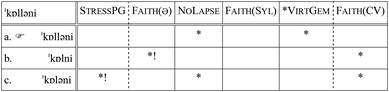
The candidate in (41b), with syncopation of the schwa, fails, which provides evidence for ranking Faith(ə) above NoLapse. Candidate (41a) wins over (41c) because it satisfies StressPG by containing a virtual geminate. This tableau thus also demonstrates the ranking of StressPG » *VirtGem.
But what happens if the first unstressed syllable contains a schwa and the second a syllabic consonant, as in terrible [ˈtεrəb
] in (42)?
-
(42) Lack of syncope without SCF or of a word-final syllabic consonant
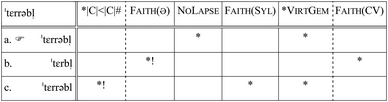
Syncopation of the schwa in (42b) is ruled out in the same way as it was in (41b). Syncopation of the syllabic consonant is not possible either, however, as that would create a word-final rising sonority cluster, as in (42c) (similarly to [ˈræʃ
l] in (36c) and [ˈhæpn] in (40b)), proving the ranking of *| C | < | C | # above NoLapse.
When the syllabic consonant in such a configuration is not word-final but is followed by a vowel, as in monit(o)ring [ˈmɒnətrɪŋ] in (43), syncopation becomes available.
-
(43) Syncope of a non-word-final syllabic consonant

Again, syncopating the schwa violates higher-ranked Faith(ə), see (43b). Here, however, *| C | < | C | # has no say, as the created rising sonority cluster is not final, and therefore the syllabic consonant can desyllabify in (43c) (similarly to [ˈmɪʃ
ri] in (38c) above).
It is the same ranking that accounts for the existence of forms like ínnovat(o)ry [ˈɪnəvətrɪ], where the sonority relations are such that they only permit syncope in the suffix, which, however, is two syllables away from the stressed vowel, see (44).
-
(44) Syncope farther away from the stressed vowel

This tableau is identical to the previous one, except for an extra NoLapse violation for each candidate.
Now that we have seen that syncope is also possible when the syllabic consonant is not immediately post-tonic, the question arises what happens when the vowel following such a syllabic consonant is stressed. The analysis in (43)–(44) predicts that syncope should be possible here because a lapse is present to be avoided. Examples containing this configuration are limited and can be divided into two types on the basis of whether the following stress is primary or secondary. Secondary stress is found in forms with the suffixes -ism and -ise, shown in (45a).
-
(45) Pre-tonic lapse: Preceding secondary stress
-
(a) hooliganism [ˈhuːləg
ˌɪz
] militarism [ˈmɪlətəˌrɪz
]personalise [ˈpɜːs
ˌaɪz] categorise [ˈkætəgəˌraɪz] -
(b) Catalan [ˈkæt
ˌæn] shibboleth [ˈʃɪbəˌlεθ][ˈʃɪb
əθ]
-
As can be seen, syncope is not possible in these cases, and even SCF is restricted. Examples on the left can exhibit SCF, while examples on the right cannot. Examining the two types of examples containing the suffix -ism, the following generalisation arises: SCF is not possible when the suffix is attached to a bound base, as in militarism, whereas with a free base, as in hooliganism, SCF is usually allowed (although there are some exceptions, like secularism). This is in harmony with the fact that SCF is normally ruled out before a stressed vowel in monomorphemic forms, too, as in shíbbolèth in (45b), where SCF is only possible when the final vowel is reduced. There are only a handful of examples like Cátal àn, with a possible syllabic consonant. In forms containing the suffix -ise, the correspondence between bound bases and lack of SCF is less perfect, but it is still present as a tendency.
I propose to account for the difference between the two types with the help of domains. In Stratal OT (Bermúdez-Otero Reference Bermúdez-Otero and Trommer2012, following Kaye Reference Kaye, Durand and Katamba1995), stem-level morphology is represented non-analytically, i.e. it is stored as a single unit together with the stem, whereas word-level morphology is analytic, i.e. it results from concatenation. In addition, compounding structures also exist, where each member constitutes a well-formed domain on its own, by containing a full vowel, which is not required of affixes of the other two types that thus can be subminimal.
When -ism and -ise attach to bound bases, they form a non-analytic structure, and they must be present at the stem level, where SCF is blocked before them, similarly to a position preceding stressed vowels within monomorphemic forms. When they attach to free bases, on the other hand, they are added analytically at the word level, when SCF had already a chance to apply at the stem level. To explain why syncope is still blocked in these cases, I propose that these suffixes form a separate domain from the stem (e.g. [[hóoligan][ìsm]]), similarly to members of compounds. Syncope then cannot apply because that would create a domain-final rising sonority cluster, similarly to (42).Footnote 30 Accordingly, the constraint in (33f) should refer to domain-final clusters instead of word-final ones. This analysis is supported by the fact that these suffixes contain a full vowel, which bears secondary stress. Hence, the stress pattern of such forms is identical to that of true (or initially stressed) compounds in English (like [[cán][òpener]]). The few words like Cátalàn will also need to be analysed with a compounding structure, although in their case this is not supported by morphological evidence and is therefore quite abstract.
Examples of a pre-tonic lapse where the following stress is primary are provided in (46a).
-
(46) Pre-tonic lapse: Preceding primary stress
-
(a) nationalistic [ˌnæʃ
ˈɪstɪk] probabilistic [ˌprɒbəbəˈlɪstɪk]terminological [ˌtɜːmən
ˈɒʤɪk
] mineralogical[ˌmɪn
əˈlɒʤɪk
] -
(b) hullabaloo [ˌhʌləbəˈluː]
-
(c) fatalistic [ˌfeɪt
ˈɪstɪk] impressionistic [ɪmˌprεʃəˈnɪstɪk] -
(d) Catalina [ˌkæt
ˈiːnə] eucalyptus [ˌjuːkəˈlɪptəs]
-
Such examples always involve stress-fixing suffixes like -ic (or self-stressed suffixes like -ette, also found in shorter forms, containing no lapse, like flànelétte, discussed above), which we expect to be non-analytic, i.e. belonging to the stem level. Therefore, no SCF (and therefore no syncope) is predicted for these cases, which is in fact borne out in most of the examples, illustrated on the right in (46a) with free bases (to make the lack of SCF more emphatic). I have only found four examples allowing a syllabic consonant in this configuration, illustrated on the left, one of them containing a bound base (making the occurrence of SCF even less expected here). The example in (46b) shows that monomorphemic items of the same type never permit SCF to apply. When we examine shorter forms, illustrated in (46c), we also find that most examples behave like imprèssionístic, and resist SCF, although there are about seventy words like fàtalístic, with an optional syllabic consonant (again including some with a bound base). Finally, shorter monomorphemic forms again normally disallow SCF, but there are a handful of exceptions like Càtalína, in (46d). None of these examples exhibit syncope.
For the few words in the left-hand column, I again propose a compound structure analysis (e.g. [[nàtional][ístic]]). Such words resemble finally stressed compounds in English, such as [[wèek][énd]]. SCF may apply in them, but syncope may not, because that would create a domain-final rising sonority cluster. Again, for the bound bases and for the monomorphemic examples, this analysis is not independently supported by morphology. Note also that the analysis of flànelétte presented in (39) above now becomes completely parallel to the analysis of háppen in (40) because the second stressed vowel belongs to a separate domain.
The question now is why SCF is blocked pre-tonically in monomorphemic forms. A possible reason is that spreading from a C position to a preceding V position is ruled out if it involves crossing a foot boundary (indicated below by parentheses on the CV tier), as in shibboleth in (47a).
-
(47) Spreading across a foot boundary
-
(a) Syllabic consonant: [ˈʃɪbəˌlεθ] (b) Virtual geminate: [ˌræˈkuːn]
-

However, spreading from a C position to a preceding C position, within a virtual geminate, as in raccoon in (47b), is allowed across such a boundary. A structure like this is thus viable underlyingly, but it cannot be created during the derivation, exemplifying the Emergence of the Unmarked (McCarthy & Prince Reference McCarthy and Prince1994). In fact, the generalisation on pre-tonic lack of SCF is a wider one, which also encompasses word-initial pre-tonic sequences, as in career [kəˈrɪə], where SCF is likewise ruled out. This provides extra support for treating pre-tonic and post-tonic syncope separately, as only post-tonic syncope goes through a stage of syllabic consonant formation, whereas pre-tonic syncope seems to delete the schwa directly. In fact, there is a further reason for a separate treatment of the two types: pre-tonic lapses are never found word-initially in English, therefore, pre-tonic syncope must have a different trigger.
In this analysis, syncope in English falls out of the interplay between three forces: the drive behind syncope is lapse avoidance, but its position is determined by the requirement on stressed positions to properly govern, and by the ban on rising sonority clusters in domain-final position. The OT analysis has also prompted the identification of SCF as a stem-level process. In addition, free variation can be naturally expressed in the theory of Partially Ordered Grammars. The lexical variation based on relative usage frequency could be accounted for by, for example, lexically indexed faithfulness constraints (as proposed by Coetzee Reference Coetzee2009 for t/d-deletion in English), where lexical items are variably affiliated to different lexical classes. The likelihood of association is determined by a probabilistic distribution function, which in turn is controlled by the item's usage frequency. As the OT analysis presented here can form a natural basis of such an extension, this might provide further support for the present approach. Such an extended account, requiring corpus studies, is, however, left for future research.
7. Summary
I have shown that a Loose CV analysis, utilising trochaic proper government, can explain the relationship of stress to the distribution of vowels on the one hand and to syncope on the other. Stressed short vowels occur in ‘closed syllables’ because stressed positions in English must properly govern an empty nucleus. A stressed short vowel in a seemingly open rhyme is therefore followed by a virtual geminate.
Syncope is triggered by a metrical lapse of unstressed vowels, and it can provide another means of satisfying the requirement of proper government, making virtual geminates unnecessary in these cases. It is blocked, however, if it were to create a domain-final rising sonority cluster. As syncope is always preceded by a stage of syllabic consonant formation, the melodic restrictions on the consonants flanking the syncope site are explained. I have provided further evidence for representing syllabic consonants as branching on a neighbouring V position, and have argued for parametric variation between a left-branching and a right-branching structure.
To account for the conspiracy resulting in the intricate pattern of syncope found in English, I have proposed a Stratal OT analysis. This has led me to identify SCF, a variable and gradient process, as belonging to the stem level (contrary to Borowsky's Reference Borowsky, Hargus and Kaisse1993 proposal). The optionality of both SCF and syncope, and the free variation shown by forms where either member of a sequence of syllabic consonants may desyllabify, have been represented by utilising the theory of Partially Ordered Grammars. I have proposed a slight modification to the Projection Principle, by restricting its effect to governing heads.
From the established ranking it follows that syncope is also possible in a not immediately post-tonic position, if there is a following vowel within the word. But in fact syncope is ruled out in this configuration if the following vowel is stressed. In monomorphemic forms, SCF is also disallowed in this position, but preceding a word-level suffix, SCF may apply. To account for these facts, I have proposed that such suffixes form a compounding structure with the stem, and syncope is then blocked by the ban on domain-final rising sonority clusters.
I have left the question of why syncope can apply after a consonant cluster or a long vowel for future research. A corpus study on the lexical variation exhibited by syncope, based on relative usage frequency, also goes beyond the scope of this paper.
APPENDIX
Vowel system of Received Pronunciation

-
(a) Short lax (b) Long lax (c) Long lax pre-R
-
[ɪ] pit [ɔː1] paw [ɔː2] port
[ε] pet [ɑː1]spa [ɑː2]part
[æ] pat ([ɜː1]colonel) [ɜː2]pert
[ɒ] pot
[ʌ] putt
[ʊ] put
-
(d) Tense (e) Tense pre-R
[iː] bee [ɪə] beer
[uː] boo [ʊə] boor
[eɪ] bay [εə] bear
[əʊ] bow [ɔː3] bore
[aɪ] buy [aɪə] tire
[aʊ] bough [aʊə] tower
[ɔɪ] boy [ɔɪə] Moir
-
The above table shows three relevant dimensions: a distinction in terms of length, tenseness–laxness, and whether or not the vowel must be followed by an (underlying) [r]. The tense–lax classification is based on the phonological behaviour of the vowels, as they pattern together for example in Vowel Shift, or in the way they are influenced by a following [r]. Short vowels are always lax, see (a), and they do not need to be followed by [r]. They can be followed by [r], however, if the [r] itself is not separated from a following vowel by a word(-level) boundary, as in carrot [æ] or occurr+ence [ʌ]. Tense vowels are always long, as shown in (d)–(e), realised as monophthongs or diphthongs. In pre-R position, they are obligatorily broken to a centring diphthong or triphthong (or the monophthong [ɔː3]), see (e), where the [r] itself is only realised if it is followed by a vowel. Long lax vowels either result from pre-R broadening, as in (c) (typically accompanied by loss of the triggering [r] – unless the [r] is followed by a vowel across a word(-level) boundary, as in occurr#ing or occur # in [ɜː2], in which case we find both broadening and the presence of [r]), or else they are underlying, as in (b). The example of colonel appears in parentheses because it is the sole example containing underlying [ɜː1]. Subscript numbers are added to distinguish vowels which sound the same in RP but behave differently. In fact, the three [ɔː]s are kept distinct by some speakers of General American, as [pɒː], [pɔrt], and [bor], respectively. Similarly, some of the [ɑː1]s are pronounced as [æ] in General American, as in bath.

 Open access

