INTRODUCTION
The need of cancer treatments in the area of head and neck is increasing nowadays; such procedures are carried out by radiotherapy, chemotherapy, surgery or their combinations. However, the former is the main option due to the high chances of cures or at least benefit in life quality of patients.Reference Salvajoli, Souhami and Faria1 It requires the use of immobilization devices in order to assure the application of routine doses in the same area, reducing damage of healthy tissue and enhancing the dose volume in the target.Reference Khan and Potish2,Reference Dunscombe, Johnson, Aresnault, Mawko, Bissonnette and Seuntjens3 Their preparation is the first step of the application planning when using a linear accelerator (X-rays) to provide a quality treatment.Reference Karzmark and Morton4,Reference Van Dyk5
The immobilization devices are made of polymeric materials which soften after immersion in hot water and are ideal to manually place it in the patient’s anatomy. After cooling, they are fixed to a proper base to retain the patient’s head immobilized, assuring reproducibility of irradiation region.Reference Kang, Lovelock, Yorke, Kriminiski, Lee and Amols6 Considering that such devices are used during 1.5 months for each patient and re-utilized for 6 of them, usually the material suffers some changes in its physical properties and after some use does not immobilize appropriately.
It is known that polymeric materials, as all organic chemicals, are susceptible to attack of environmental agents that cause degradation. Among these agents, ionizing radiation leads to changes in the physical properties of polymers, especially if it is continuously applied in the same area as it usually happens for immobilization devices. Changes in crystallinity and thermal properties have been observed for polymers after degradation.Reference Sánchez, Cabral and Felisberti7,Reference Vinhas, Souto and de Almeida8 The purpose of this work is to identify the polymeric material used in the immobilization devices and to investigate their degradation effects caused after continuous use in patients submitted to radiotherapy treatment in the Radiotherapy Service of Hospital São José (HSJ, Criciúma, SC, Brazil).
EXPERIMENTAL
Treatment of samples. Immobilization devices were provided by the industrial manufacturer, Medintec Latin America Ltda., and treated in accordance with the HSJ protocol for their use up to six patients. The thermal treatment condition was applied immersing samples in a hot water bath at 70°C during 1 minute; each time was considered for one patient’s use and this procedure was repeated six times. The irradiation condition was given to the samples using a Linear accelerator Siemens Primus of 6 MV. Six samples were also treated, the first receiving a total dose of 70 Gy (common dose for a patient) and accumulated doses for the rest. Finally, other six samples were prepared with combined conditions (thermal and irradiation) considering same amount of patients. The irradiation was applied to an area of 15 × 15 cm and the monitoring dose at 5 cm deepness.
Characterization of samples. The samples were characterized by thermal analysis and X-ray diffraction techniques in order to investigate differences in physical properties before and after treatments. Thermogravimetry was employed to evaluate dynamic thermal stability of samples in a TA Instruments 2050 apparatus. Each sample was scanned at the typical range from 30 to 600°C with a 20°C/min ramp rate under nitrogen atmosphere. Inert atmosphere was used in order to only evaluate material’s stability against temperature, without influence of any oxidative mechanism.
Differential Scanning Calorimetry (DSC) was used in order to observe the thermal transitions of the polymer used in the immobilization devices (identification) and to evaluate their changes as indicators of extent of degradation. They were carried out on a DSC TA Instruments 2010 thermal system purged with nitrogen. Samples were enclosed in aluminium capsules and scanned from 20 to 100°C at a rate of 10°C/min.
Wide-angle X-ray diffraction (WAXD) measurements used a Rigaku diffractometer operating in a θ/2θ geometry with CuKα source. The equipment was operated at 40 kV and 40 mA; the beam was filtered with a graphite monochromator. The scan range was fixed between 10 and 60° with increments of 0.05° at ambient temperature.
Thermomechanical analysis (TMA) was used to evaluate the mechanical changes in the samples. A TMA TA Instruments 2920 with a flexure accessory monitored the Young’s modulus (E*) throughout the treatments (indicator of rigidity of material). Measurements were carried out isothermally at 35°C and a force interval of 0.1 to 1 Nw, but only the deflection of the sample at the force of 0.5 Nw was used for calculation of the modulus.
Finally, the sixth or most treated samples were evaluated kinetically for their thermal decomposition energy of activation (Ea) with a TGA Dupont 951. Ea is the necessary energy to initiate the degradation process. The evaluation was carried out following the guide of the American Society for Testing and Materials (ASTM) E-1641-94 at four different heating rates: 2, 5, 10 and 20°C/min, under inert atmosphere.
RESULTS AND DISCUSSION
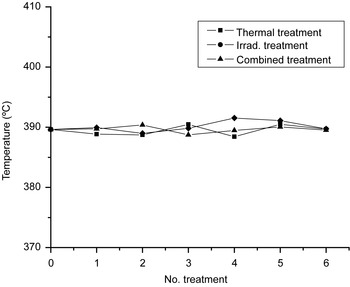
Thermogravimetric analysis showed a weight loss of almost 100% in one step for all samples, which begins in the vicinity of 390°C and ends up at about 460°C. It was observed that there were no significant changes related to the sample treatments (thermal, irradiation and combined), as can be seen in Figure 1. This suggests that the polymeric material used for six different patients, suffering the corresponding irradiation doses and the thermal conditions applied during reusing, does support perfectly in its chemical structure. Neither initiation of reactions nor sensibilisation of the chains for degradation seems to be happening during such treatment conditions.
Effect of number of treatments in the degradation temperature measured by TGA.

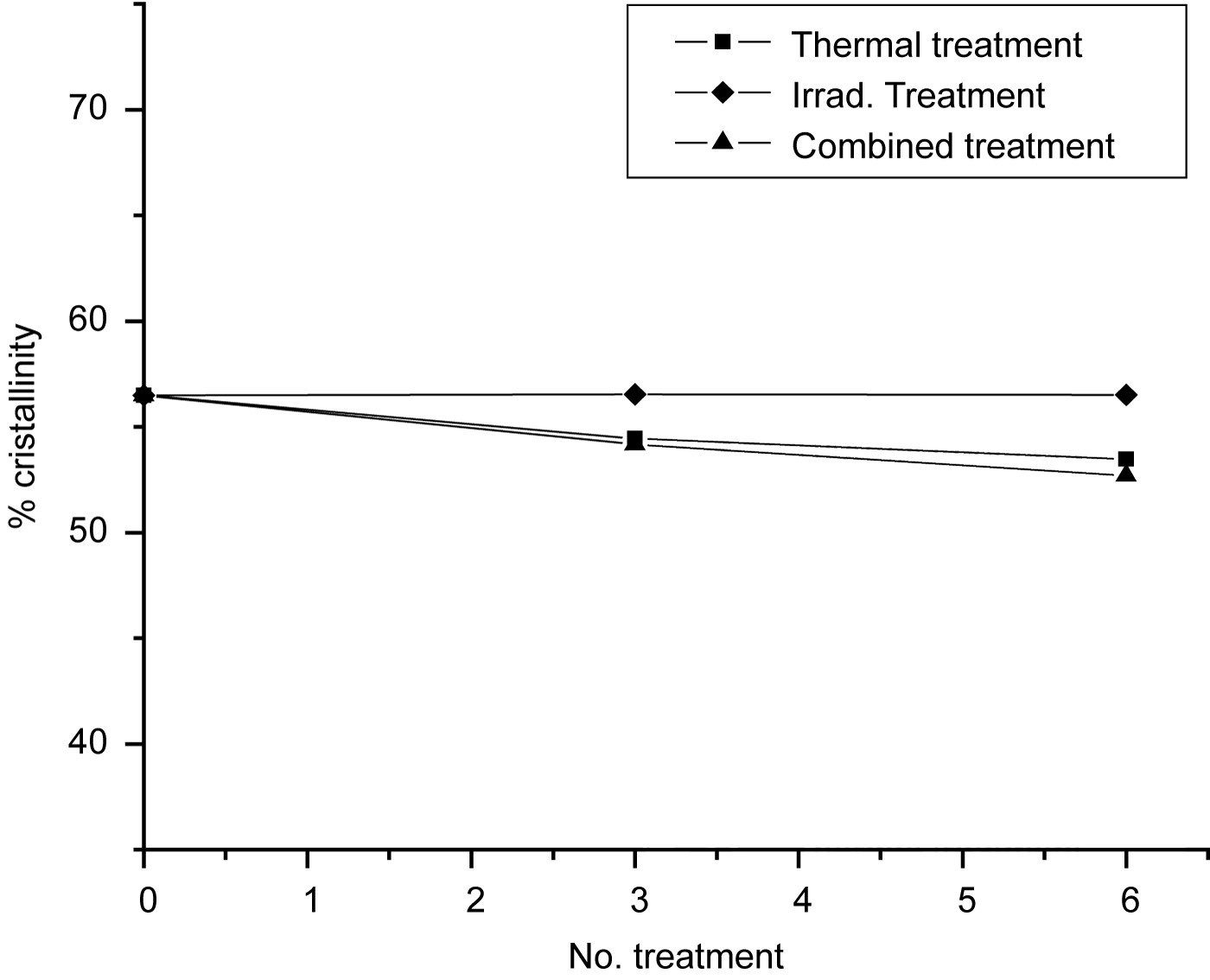
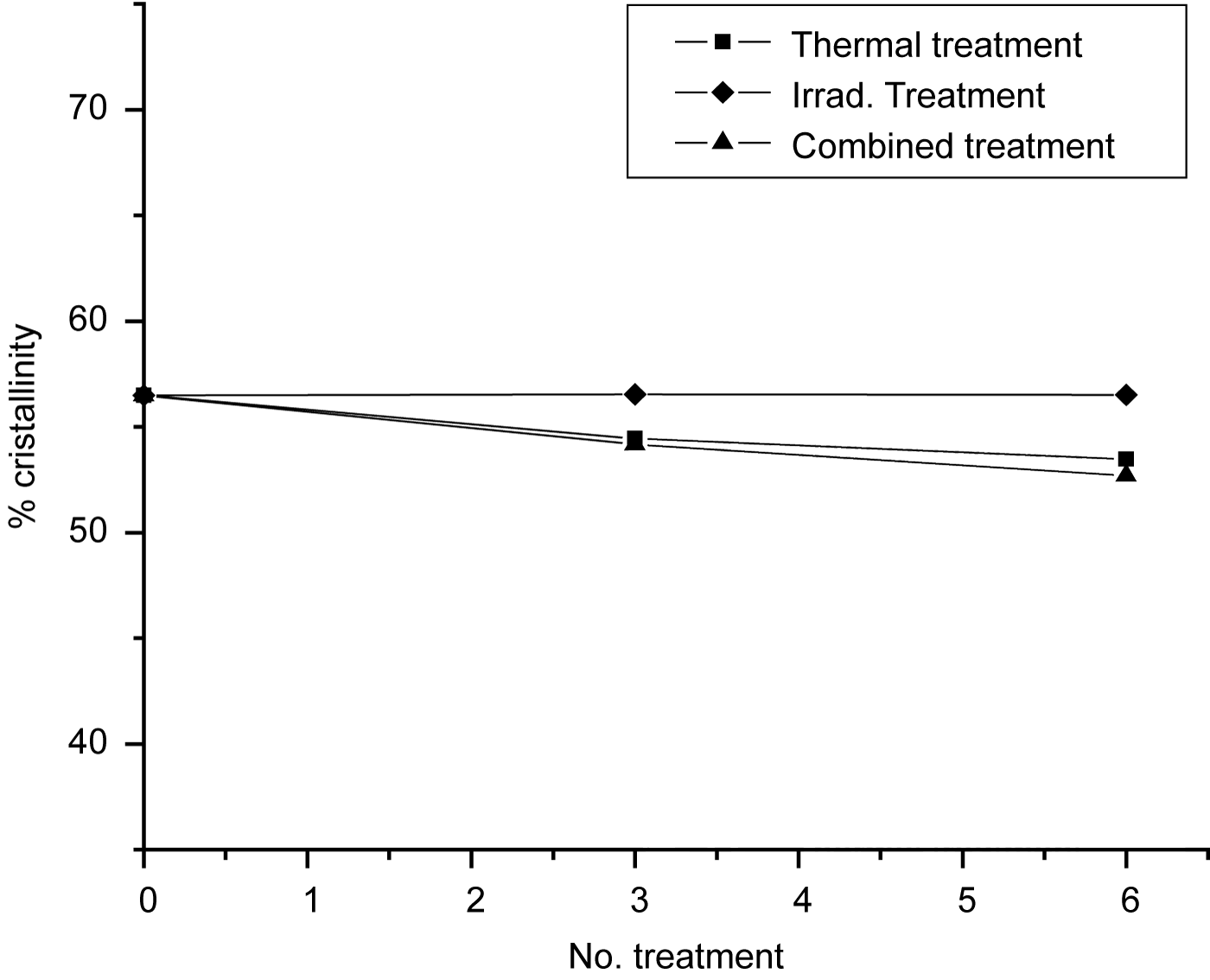
DSC studies indicate a melting temperature for the polymer at 63°C, which corresponds to polycaprolactone (PCL) according to the literature.Reference Plivelic, Cassu, Gonçalves and Torriani9,Reference Osa, Penteado and Calil10 Furthermore, DSC results showed no displacement in the melting endotherms of the polymer after treatments; although, some changes were observed in the enthalpy (heat flow) value related with modifications induced by the treatments. The amount of enthalpy is quantitatively related to the crystallinity of the material and such results versus treatments are shown in Figure 2. It can be seen that irradiation dose did not affect the crystallinity of the polymer. However, the more thermal treatments the lower value of enthalpy was observed indicating that the molecular order was reduced. The conjugated effect of heat and irradiation was basically controlled by the thermal treatment.
Effect of the irradiation treatment in the crystallinity measured by the enthalpy of the fusion transition in DSC.
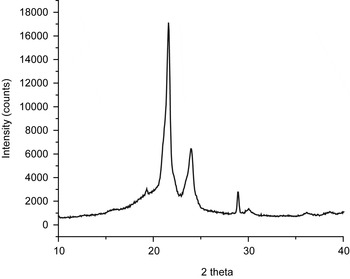
The X-ray diffraction studies did not reveal important differences in the diffractograms of the samples before and after treatments, except a small variation in the sharpness of the signals related to the amount of crystals after the thermal procedure, supporting the results found by DSC. The diffractogram of the non-treated material is shown in Figure 3 and corresponds to a polycaprolactone.Reference Osa, Penteado and Calil10
WAXD diffractogram of the untreated material of immobilization devices.

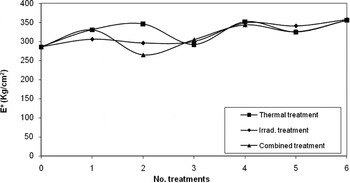
The samples were also studied for their mechanical changes and the analysis of Young’s modulus by TMA show the results observed in Figure 4. A notorious increment of the modulus can be seen throughout the treatment procedures for all samples (>20%), which suggests reticulation of the polymer. The irradiation does produce crosslinking in polymers and the thermal treatment could be enhancing such effect; on the other hand, heating by itself at the temperature applied for molding the immobilization devices in the patient’s face (70°C) is not enough for producing such effect; however, it is highly possible that some oligomers can be extracted from the material during the thermal treatments, ending up with a similar effect of enhancing mechanical properties.
Effect of the irradiation treatment in the Young’s modulus (E*) obtained by flexure in a TMA.

Another attempt to observe degradation of the treated samples was carried out by activation energy calculation (Ea) using the Arrhenius approach. The studies involved kinetic measurements by using different heating rates in a thermogravimetric analyzer. The calculation of Ea was obtained following the appropriate ASTM standard method and the results obtained for 4 different criteria of percentage of weight loss. The ASTM method suggests 5%, but additional calculations were performed for 10, 15 and 20% of weight loss. Table 1 shows the Ea values obtained for the non-treated sample and for samples submitted to the different treatments, considering only the 6th treatment.
Activation energy (Ea) for thermal degradation measured at different percentages of mass loss for the most treated samples (6th treatment)

When 5% of weight loss was considered, an activation energy of 107 kJ/mol was obtained for the non-treated sample and the thermally treated; such value was higher for the irradiated sample (118 kJ/mol) and even higher for the combined treated sample (137 kJ/mol). The previous result means that thermal treatments does not affect the chemical structure, while irradiation and irradiation enhanced with heating produce some changes that make a chemical structure more resistant to degrade; namely, crosslinking.
When a consideration of higher weight loss was taken (10, 15 or 20%) the values of Ea show interesting features: a more sensible material to degrade thermally, a material more resistant to degrade with irradiation (high Ea values) and a combined effect basically dependent on the irradiation treatment. The latter indicates that treatment in hot water (70°C) is dissolving oligomers, reducing crystallinity but enhancing mechanical properties due to the reduced slipping of small chains in the material.
The difficulty to dissolve the samples before any treatment was also noted, suggesting that the material used for immobilization devices was already crosslinked from the manufacturer. Radiation is perhaps increasing crosslinking density, enhancing the mechanical property and the stability without altering the crystallinity. More studies are underway to evaluate such crosslinking density and identify the proper reason of such material for losing moldeability in its application as immobilization devices.
CONCLUSIONS
The DSC and WAXD studies identified the material used for immobilization devices at Hospital São José (HSJ) as being the biodegradable polymer polycaprolactone (PCL), which is a hypoallergenic soft material with a convenient fusion temperature of 63°C for such application. No evidence of degradation was observed by TGA after the thermal (70°C, 6 times during 1 minute each), irradiation (70 kGy six times) or combined treatments; only a slight reduction of crystallinity after heating was demonstrated by DSC and WAXD techniques. It has a certain degree of crosslinking, since the material does not dissolve with common solvents and just adsorbs and expands like a gel.
Mechanical evaluations indicate a steady increment of Young’s modulus (less flexibility) throughout the number of treatments, suggesting changes in crosslinking density for irradiated material, but extraction of oligomers for thermally treated samples in hot water. The results of activation energy of the thermal decomposition (Ea) indicate that thermal treatment does not affect chemical stability of PCL while irradiation is definitively enhancing it.
Finally it can be concluded that thermal treatment at 70°C (according to the protocol in HSJ) reduce the molecular order of the PCL and enhance the mechanical property due to the extraction of small chains. Irradiation does not affect order but increases the crosslinking density, enhancing the mechanical property as well. Professional practice at HSJ has been moved to a recent protocol where immobilization devices are now molded at 65°C, convenient temperature to have moldeability and less influence in physical properties of the material throughout the six re-utilization steps.
Acknowledgements
Deep thanks to Demian Fogaça and Gabriel Hoyer Lopes from ULBRA for their help during WAXD and Thermal analyses.