INTRODUCTION
The genus Ophieulima Warén & Sibuet, Reference Warén and Sibuet1981 includes a few species of parasitizing brittlestars of the genus Ophiactis Lütken, 1856. They have semi-transparent, colourless shells with a conical profile, with quite rounded whorls, the last one being inflated. The teleoconch has two to three whorls, with the males having one less than females. The aperture is large and prosocline with its anterior margin fairly expanded. The outer lip in the lateral view is sinuous near the subsutural area. The columella is solid and slightly twisted. There is no umbilicus. The protoconch is multispiral with about three whorls, being rather cylindrical and brownish. The shell's surface has fine prosocline growth lines and a spiral microsculpture consisting of irregular, discontinuous lines. Information on the morphology and anatomy of the soft parts can be found in the original description (Warén & Sibuet, Reference Warén and Sibuet1981).
Three species are currently known: Ophieulima minima (Dall, Reference Dall1927) from both sides of the Northern Atlantic, Ophieulima fuscoapicata Warén, Reference Warén1981 from the Kermadec Islands (New Zealand) and a third undescribed species from south-eastern Australia (Dall, Reference Dall1927; Warén, Reference Warén1981; Warén, Reference Warén1983; Bouchet & Warén, Reference Bouchet and Warén1986; Hoffman et al., Reference Hoffman, van Heugten and Lavaleye2011).
The genus has not been reported in the Mediterranean Basin so far, with the nearest Ophieulima record having been found off north-west Morocco (Hoffman et al., Reference Hoffman, van Heugten and Lavaleye2011). Rindone & Vizzana (Reference Rindone and Vizzana1989) have reported Ophieulima minima (Dall, Reference Dall1927) as a fossil from the Pleistocene bathyal deposits of Southern Italy.
MATERIAL EXAMINED
-
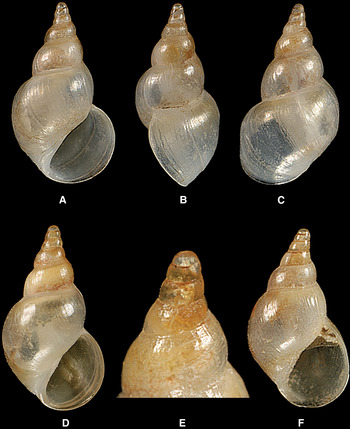
A. One specimen with dried soft parts from Banco di Santa Lucia off Livorno (Italy), 43°45′N 9°30′E, October 2003, 500 m, in a sediment sample trawled by local fishermen, in Sbrana Collection (Figure 1F).
-
B, C. Two specimens with dried soft parts from Secca delle Vedove off Livorno (Italy), May 2007, 550 m, in a sediment sample trawled by local fishermen, in Giusti Collection (Figure 1A–C, E).
-
D. One specimen with dried soft parts off Capo Corso (Corsica, France), July 2011, 500 m, in a sediment sample trawled by local fishermen, in Giusti Collection (Figure 1D).
Ophieulima minima (Dall, 1927): (A–C) specimen B (H = 2.57 mm); (D–E) specimen D (H = 2.35 mm) with particular of the protoconch; (F) specimen C (H = 2.13 mm).

Morphological features
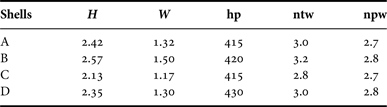
Morphological features for the studied shells are summarized in Table 1.
Morphological features of examined shells. H = maximum height (in mm); hp = height of protoconch (in µm); npw = number of protoconch whorls; ntw = number of teleoconch whorls; W = maximum width (in mm).

SYSTEMATICS
Order CAENOGASTROPODA Cox, 1960
Superfamily EULIMOIDEA Philippi, 1853
Family EULIMIDAE Philippi, 1853
Genus Ophieulima Warén & Sibuet, Reference Warén and Sibuet1981
Ophieulima minima (Dall, Reference Dall1927) [Stilifer]
(Figure 1)
DISCUSSION
The shells are very fresh, containing dried animal remains, so the species can be confirmed as living in the area; regrettably, no specimens were taken alive and properly preserved. All of them are probably females, judging from the number of whorls.
The Mediterranean specimens agree with the features of the species (Warén & Sibuet, Reference Warén and Sibuet1981), although some subtle differences can be noticed: the shell's surface is glossy with only growth lines and four to five incremental scars, and the protoconch is larger, exceeding 400 µm. We were unable to find specimens associated to the host but we can make some considerations: Warén & Sibuet (Reference Warén and Sibuet1981) attributed European specimens to Stilifer minima Dall, Reference Dall1927 (type locality off Georgia, USA) for substantial conchological similarities, even if Ophiactis abyssicola (M. Sars, 1861), the host of north-east Atlantic specimens, is not present in the north-west Atlantic. Since other Ophiactis species live in the north-west Atlantic, it is then presumed that Ophieulima minima is not strictly species-specific. The studied sediment was rich in echinoderm remains, mostly Leptometra phalangium (Müller, 1841), but also Stylocidaris affinis (Philippi, 1845), Gracilechinus acutus (Lamarck, 1816), Astropecten cf. irregularis (Pennant, 1777) and Ophiura ophiura (Linnaeus, 1758). No Ophiactis remains could be identified. Three Ophiactis species occur in the Mediterranean Basin but currently none have been reported from the northern Tyrrhenian Sea (Tortonese, Reference Tortonese1965; Matarrese, Reference Matarrese2010). It can be assumed that future research may reveal their presence or show that Ophieulima minima is able to parasitize other brittlestar genera, but no final conclusion can be made until host-attached specimens are found.
ACKNOWLEDGEMENTS
We are grateful to Anders Warén (SMNH), Alfonso Matarrese (University of Bari), Gianna Innocenti (University of Florence) and Cesare Bogi for their useful advice. We are also indebted to Mauro Brunetti for providing us with a bibliography and to Enzo Campani for their critical reading of the manuscript.