


INTRODUCTION
To what extent is social activism a vehicle for promoting the rights and awareness of historically marginalized groups? In the immediate term, does early activism break down social barriers, intensify opposition, or fail to make much headway on key goals? We ask these questions in the context of early advocacy for LGBT+ rights in a society with relatively intolerant attitudes toward such groups. Specifically, we examine whether public marches and demonstrations on behalf of LGBT+ people increase social awareness, tolerance, and support.
The literature suggests that both mobilization and counter-mobilization pervade contemporary LGBT+ politics. Arguably no transnationally circulating social issue has provoked such rapid favorable change—for example, in terms of policy innovation and public attitudes toward same-sex marriage (Kollman Reference Kollman2013)—and backlash simultaneously in the last two decades (Velasco Reference Velasco2020a). However, the potential effects of mobilization on behalf of LGBT+ and other marginalized societal groups needs greater theoretical clarification and empirical validation. We do not know how movement performances, such as globally popular Gay/LGBT+ Pride Marches (hereafter Prides), affect social tolerance and political participation by ordinary citizens (whether pro-LGBT+ or anti-LGBT+). While comparative studies surrounding sexuality continue to emerge (Ayoub Reference Ayoub2016; O’Dwyer Reference O’Dwyer2018; Page Reference Page2018a; Turnbull-Dugarte Reference Turnbull-Dugarte2020), researchers would benefit from paying greater attention to public opinion and political behavior.
Recent reviews of the contentious politics field lament the “dearth of research” on “cultural outcomes of social movements [as] glaring” (van Dyke and Taylor Reference Van Dyke, Taylor, Snow, Soule, Kriesi and McCammon2018, 483), arguing that scholars have devoted “little systematic effort” to account for the influence of advocacy on the communities where it takes place (Amenta and Polleta Reference Amenta and Polletta2019, 280). This is concerning, given that movements, especially those emphasizing sexuality, gender and race, clearly deploy strategies designed to shift public opinion (Banaszak and Ondercin Reference Banaszak and Ondercin2016), and policy change often depends on this initial effort (Fetner Reference Fetner2016). With limited scholarly investigation in this area, we know little about how movements drive changes in social attitudes and behaviors.
We attempt to address this gap using a compelling case study: the impact of the 2019 Sarajevo Pride on local attitudes in Bosnia and Herzegovina (hereafter Bosnia). As a conservative, postconflict society, Bosnia reflects conditions of heightened ethnic nationalism and religiosity that scholars theorize should correspond to low levels of LGBT+ support and well-mobilized resistance (Ayoub Reference Ayoub2014). It is telling that Bosnia is the last former Yugoslav Republic, and the last country in Europe, to hold a Pride event due in part to opposition from nationalist forces within the dominant ethno-religious groups, representing Muslim Bosniaks, Orthodox Serbs, and Catholic Croats (Swimelar Reference Swimelar2017). As is common in many conservative contexts, organized counter-protests devoted to “traditional values” and opposed to “sinfulness” took place during the September 8, 2019 Pride. Despite backlash, organizers viewed the Sarajevo Pride as an important accomplishment for Bosnia’s LGBT+ community that garnered overwhelming international support. The Sarajevo Pride signaled the emergence of a robust LGBT+ movement in Bosnia in concert with growing international LGBT+ rights activism. By examining public opinion before and after this first Pride in Bosnia, we can systematically study its effects on society.
We begin by theorizing the relationship between Prides and the support for LGBT+ activism that Prides may promote. Our argument rests on the realization that Pride effects are not uniform across society, varying in reach according to a person’s proximity to the event and contact with LGBT+ social networks. The movement’s influence may be limited by the weak transmission of information about the protest and contact outside a Pride’s locality. Beyond the close proximity of Pride events and the networks that support them, many people may hold negative beliefs about LGBT+ people and see Prides as threatening to the social and moral order. In particular, prior research underscores how religiosity and ethnonationalism play an important role in explaining who will have an adverse response to Pride events, perceiving LGBT+ people as a threat to the fixedness of national identity (Ayoub Reference Ayoub2014; Mole Reference Mole2011; Vuletic Reference Vuletic2013). While Pride effects may be amplified by proximity and contact with LGBT+ social networks, diffusion is also likely bounded by religiosity and ethnonationalism.
Building on theory, our empirical analysis consists of four parts. First, we examine changes in attitudes and awareness before and after the Sarajevo Pride using nationwide and panel surveys. Second, we use a survey experiment priming on advocacy for and against the Sarajevo Pride to assess receptiveness to LGBT+ mobilization and counter-mobilization. Third, we conduct a behavioral experiment to assess the Pride’s influence on resource allocation to LGBT+ activist and oppositional groups. Our results show that Prides can raise awareness and support of marginalized groups, but these effects do not extend beyond the locations in which they take place, with little diffusion nationwide. They may also stoke opposition, underscoring the challenges of collective action for group rights when societal norms are highly exclusionary and prejudicial toward the group. Finally, we conduct posttreatment interviews with key Bosnian organizers and activists to clarify treatment effects and mechanisms related to the Pride (cf. Appendix, Interviews). We conclude by reflecting on the prospects and challenges facing LGBT+ activists who wish to use high-visibility events like Prides to raise awareness and support in conservative contexts, as well as the broader implications for social activism in potentially hostile environments.
LGBT+ PRIDE IN THE LITERATURE
Commonly referred to as “Pride”, such demonstrations evoke a repertoire of LGBT+ contention that have their origin in 1970 in New York City, where the original demonstration took place to commemorate the Stonewall Inn riots in June of the previous year. That demonstration ushered in a new generation of LGBT+ activism called Gay Liberation, distinguished from earlier homophile activism (Jackson Reference Jackson, Paternotte and Tremblay2015), and defined by its visibility and the notion that “coming out” and “coming into the streets” would lead to gains in the lived experience of queer people (Weeks Reference Weeks, Paternotte and Tremblay2015).
The Pride innovation spread to multiple countries with thousands of new queer organizations emerging in the decade that followed (D’Emilio Reference D’Emilio1998). Today, Pride or similar events take place in countries around the world and are often organized by LGBT+ organizations as a means to generate visibility and demand rights for the groups they represent. While activists are conscientious about grafting the event to local contexts so that it resonates with local sensibilities (e.g., Prides take on different names, such as “Equality Marches” in Poland), they typically connect back to the original intent of the New York City Pride parade. For example, in Germany, they are called “Christopher Street Days,” in homage to the street where the Stonewall Inn is located. In some contexts, Prides have become celebratory, often criticized for their commercial orientation and diminished political fervor. In other contexts, they are deeply political performances that come with serious risks to participants. For example, at earlier times in the Bosnian case, some activists were hesitant about having a Pride, seeing it as potentially harmful to the movement. While Prides are not always synonymous with the diverse repertoires of LGBT+ activism, comparative politics scholars view them as an important “indicator” and “test of strength” of such activism (O’Dwyer Reference O’Dwyer2018, 15). According to O’Dwyer (Reference O’Dwyer2018),
[Prides are] immensely important to gay rights activism as a social movement. They are the visible manifestation of sexual citizenship, of LGBT persons exercising their civil liberties in the public sphere. They help define the movement both to itself and to broader society: they attract attention to the cause; they generate discussion; and they articulate identities and represent interests. (15)
Prides are often portrayed “front and center” (Bruce Reference Bruce2016; McClendon Reference McClendon2014) as the most visible performances of the mobilization that allows people to live out their sexual and gender identities more than ever before (Weeks Reference Weeks2007). A specific mobilization practice that occurs in a variety of different circumstances, they drive and respond to both mobilization and counter-mobilization; they also mobilize sustained participation. McClendon’s (Reference McClendon2014) field experiment involving a New Jersey Pride shows that feelings of social esteem (derived from associating with LGBT+ people) boosts participation in Prides. However, no study has gauged the responses of societies to the LGBT+ Prides held within them, especially ones that have had less public discourse around LGBT+ communities and high levels of homo- and transphobic attitudes. This is the type of socially conservative context we refer to in this paper. Ideally, such an event would boost social tolerance of LGBT+ communities, consistent with research on the “contact hypothesis,” which posits that direct or indirect interactions with out-groups reduce prejudice (Ayoub and Garretson Reference Ayoub and Garretson2017; Broockman and Kalla Reference Broockman and Kalla2016; Paluck, Green, and Green Reference Paluck, Green and Green2019; Pettigrew and Tropp Reference Pettigrew, Tropp and Oskamp2013).
Prides might also lead to resentment or backlash toward sexual and gender minority groups in socially conservative societies. Progress and backlash narratives in existing research suggest that LGBT+ movements can encourage counter-mobilization (Altman and Symons Reference Altman and Symons2016; Inglehart, Ponarin, and Inglehart Reference Inglehart, Ponarin and Inglehart2017; Weiss and Bosia Reference Weiss and Bosia2013), though we note that such politics can also preempt any such LGBT+ rights mobilization (Weiss and Bosia Reference Weiss and Bosia2013). Weiss and Bosia (Reference Weiss and Bosia2013, 2) term a state’s purposeful “scapegoating of an ‘other’” as “political homophobia” and point to its growing trend in the 21st century. For example, Vuletic (Reference Vuletic2013) illustrates how the conservative Croatian Democratic Union (HDZ) in Croatia has consistently built support around “heteronationalism,” informed by the Catholic Church, as a criterion for belonging to the Croat nation. The prevalence of homophobia and nationalism in society offers conservative political movements opportunities to build social support by rallying against LGBT+ activists (Swimelar Reference Swimelar2020).
At present, we still know too little about the effects that Prides have on attitudes toward LGBT+ people and/or support for their rights. Systematic research about how the Pride performance travels to new locales, given its origin in Western democracies with established movements and protest cultures, is lacking. Furthermore, the social movement explanations surrounding the effects of Pride remain divergent and contested. Some observers see them as a necessary vehicle for rights and recognition (Bruce Reference Bruce2016; Drissel Reference Drissel2017; O’Dwyer Reference O’Dwyer2018; Weeks Reference Weeks, Paternotte and Tremblay2015), and others view them as insensitive to cultural context and capable of provoking increased violence toward local LGBT+ people (Bell and Binnie Reference Bell and Binnie2000; Slootmaeckers Reference Slootmaeckers2017; Woodcock Reference Woodcock2009). This debate echoes in contentious politics research where some scholars distinguish between movement outcomes that are either transformative across broader society (Banaszak and Ondercin Reference Banaszak and Ondercin2016), primarily empowering to engaged activist communities (Whittier Reference Whittier2010), or generally ineffectual for public opinion shifts (McAdam and Su Reference McAdam and Su2002). As such, we see potential commonalities between Prides and other high-risk, high-cost forms of mobilization for social change (McAdam Reference McAdam1986; McAdam, Tarrow, and Tilly Reference McAdam, Tarrow and Tilly2003; Ramakrishan Reference Ramakrishan2005; Tilly and Tarrow Reference Tilly and Tarrow2015). We draw mechanisms from both Pride-optimist/skeptic camps to theorize that the effects of Pride are interactive and operate in different ways across geography and social group. We turn now to our broader theoretical argument.
THEORY: PRIDES, VISIBILITY, AND SOCIAL CHANGE
What are the cultural outcomes of Prides? The debate in the literature is structured largely around the ability of Prides to generate visibility, legitimacy, and ultimately sociolegal recognition and the concern that its provocation and Western tinge can trigger violence and repression. Here, we examine the theoretical underpinnings for both pathways.
Pride ➔ Visibility ➔ Recognition/Legitimacy
A common explanation is that Pride opens the door for the recognition and rights of LGBT+ people. After New York City’s first Pride march in 1970, an event attended by about 5,000 participants, similar organizing in cities around the globe turned out thousands of participants by the end of the 1970s. Organizational capacity also rose from a few dozen groups to well over a thousand by the beginning of the 1980s. According to D’Emilio (Reference D’Emilio1998, 238), “In a relatively short time, gay liberation achieved the goal that had eluded homophile leaders for two decades—the active involvement of large numbers of homosexuals and lesbians in their own emancipation effort.” In Bruce’s (Reference Bruce2016) aptly titled study, Pride Parades: How a Parade Changed the World, she argues that Prides do not seek solely to change government policies and laws but also to shift cultural norms and perceptions of LGBT+ communities through a public display and celebration of queer life. For her, the public visibility of Pride has the power to change attitudes toward LGBT+ communities through the movement tactics of visibility and framing (Bruce Reference Bruce2016).
How influential is the visibility generated by the forceful public presence of Pride? First, it brings queer people in contact with each other through a process of interpersonal visibility (Ayoub Reference Ayoub2016). Seeing like-people can reinforce collective identity building, a pretext for demanding rights, and binds the strategies of the earliest gay activists like Karl Heinrich Ulrichs to more recent ones like Harvey Milk (Reynolds Reference Reynolds2018). Studies show that Pride participants can break heteronormative and sectarian social barriers by cultivating a “subaltern counterpublic” that fills the public space. According to Han (Reference Han2018), Prides provide participants with an expanded idea of their citizenship, which can lead to the demand for universal rights. Thus, Prides represent powerful tools for mobilizing the recognition of political elites, who are then faced with the responsibility of addressing movement claims in the halls of government. Drissel (Reference Drissel2017, 225) explains that even when counter-protests appeared at Belfast Pride, the “collective identities of parade participants are given meaning and relevancy through the ecology of interactions (i.e., multiple interactions with like-minded individuals), which are experienced in intense, concentrated socio-spatial situations.” We expect space to matter in this regard, while taking into account that such direct interaction may dissipate with distance because of the diminishing ability of movements to upend preexisting narratives as a contentious issue travels into the national discourse. In socially conservative societies the issue then mixes with longstanding depictions of LGBT+ identity rooted in threat.
While backlash is prevalent in response to Prides, scholars have argued that the thematization of LGBT+ visibility politics can conjure solidarity for the LGBT+ community across wider hetero- and cisnormative society—when repressive and violent counter-protesters, not queer people, are seen violating public morals (Ayoub Reference Ayoub2014; O’Dwyer Reference O’Dwyer2018). In this sense, backlash, though fully anticipated as an output of Pride, may be followed by greater societal acceptance or more resource support for LGBT+ organizations (O’Dwyer Reference O’Dwyer2018). To clarify, an early Pride, like the one in Sarajevo, may generate the first phase of vigorous counter-mobilization, demonizing LGBT+ people in national debates. We thus might expect responses to Pride to be most reactive at the outset when LGBT+ people are initially politicizing their demands for rights. That said, while progress is not linear, increasing evidence suggests that, when the international context favors LGBT+ rights (as in Europe), LGBT+ activism may outpace its opposition (O’Dwyer Reference O’Dwyer2018).
Part of the backlash thesis rests on the idea that Pride is a part of an international repertoire of LGBT+ activism that legitimizes LGBT+ people. By this, we mean that Pride can legitimate a local context’s movement by drawing international attention to the surrounding status of LGBT+ politics (Thoreson Reference Thoreson2014). In a study of the first Baltic Pride in Lithuania, Mazylis (Reference Mazylis2014) illustrates the active involvement and support of the European Union (EU) and transnational activists, arguing that Pride itself legitimized Lithuania’s membership within the EU. Studies comparing EU states reveal how international attention can mobilize resources for LGBT+ movements in new adopter states (Ayoub Reference Ayoub2016, 93), bolstering a movement’s ability to organize and confront new local challenges (McCarthy and Zald Reference McCarthy and Zald1977). Furthermore, the presence of international media outlets and foreign political elites can add local legitimacy to LGBT+ causes (Ayoub and Garretson Reference Ayoub and Garretson2017). How far and to whom that legitimacy travels remains debated.
Pride ➔ Invisibility / Repression / Illegitimacy
While many studies have demonstrated the utility of Prides, recent research increasingly points to the limits of such optimism, stressing that Pride has serious side effects, including heightened repression of local LGBT+ people. As noted above, Pride often occurs alongside active resistance, as well as heightened public attention around discourses that vilify LGBT+ people as “unnatural,” “criminal,” “sick,” “foreign,” “sinful,” and ultimately a threat to “national identity,” the “traditional family,” and “religious values” (Velasco Reference Velasco2020b). For example, while the three initial Pride parades in Romania were met with violent counter-protests, the Romanian police also “invisibilized” Pride marchers in the name of protection (Woodcock Reference Woodcock2009). This resulted in a “militarized Pride” with little of the public visibility theorized by Bruce (Reference Bruce2016) beyond the event itself, given police cordons and blocked access. We too would expect backlash as LGBT+ rights first enter into domestic discourse; it can bring to light disparate voices and mobilize active resistance, as did early United States’ Prides that mobilized the religious right (Fetner Reference Fetner2008). This may be especially true as information about the Pride travels and loses accuracy. For example, in socially conservative states, the common media portrayal of Pride marchers as “foreign” eschews their indigeneity (Mole Reference Mole2011).
Queer theorists thus argue that Pride can paradoxically make LGBT+ people invisible in some contexts. Prides can be used for other homonationalist ends (Puar Reference Puar2007) that have little to do with the actual lived experiences of LGBT+ people. Slootmaeckers (Reference Slootmaeckers2017) makes such an argument around what he refers to as the Belgrade “Ghost Pride” in Serbia. The concept is useful for illustrating how Pride became a tool of government to demonstrate cooperation with the EU while using a heavy security presence that limited the visibility of LGBT+ people marching (Slootmaeckers Reference Slootmaeckers2017, 530). Serbian national discourse framed the Belgrade Pride as a foreign Western influence antithetical to Serbian identity (Swimelar Reference Swimelar2020). Some conservative opposition groups in Bosnia also equate LGBT+ rights with the EU in a negative way, following disillusionment with the accession process (Page Reference Page2018b). In summary, the state can erase queer people from the social fabric by attaching “foreignness” to them.
Relatedly, state-sponsored Prides may have perverse exclusionary effects. Ideal homosexual subjects, ones that can assimilate in society, are permissible, but those that cannot remain invisible and unacceptable. Ross (Reference Ross2008, 257) states that, in Italy, “there must be a significant shift in opinion and perspective on the part of the mainstream population so that being recognized as ‘normal’ does not require a flattening, invisibilization and normalization of the rich and diverse characteristics of LGBT+ living and loving.” A cross-national study on Pride in six European countries supports some of these notions, in that Prides do not “reflect the diversity within the general population” because participants were on average privileged in political resources (Peterson, Wahlström, and Wennerhag Reference Peterson, Wahlström and Wennerhag2018, 1163). Thus, Prides may ignore the intersectional nature of the cause, and the very essence of the Gay Liberation Movements that initiated Pride (Weeks Reference Weeks, Paternotte and Tremblay2015), by privileging gender, race, and class majorities.
Finally, the effects of Pride may reach diverse societal groups in different ways. As outlined above, people perceive LGBT+ (and women’s) movements as threatening to national identity because they destabilize national narratives and thus may fall on deaf ears or even intensify opposition among people with strong ethnonational commitments. This is amplified by historical characterizations of homosexuality as “linked to conspiracy, recruitment, opposition to the nation, and ultimately a threat to civilization” (Stychin Reference Stychin1998, 9). Both sexuality and gender are threatening because they are fluid concepts, unconfined to borders and challenging to the fixedness of national identity categories (Conrad Reference Conrad2001, 125). Scholars see this threat most pronounced when religious tradition intersects with national identity and the state (Ayoub Reference Ayoub2014; Htun and Weldon Reference Htun and Weldon2018; Swimelar Reference Swimelar2020). These arguments have currency for a case like Bosnia, with several clearly defined ethnonational groups. It is from this point of departure that we wish to explore systematically the disparate effects of the first Sarajevo Pride on social tolerance.
What Explains Pride Participation and Support?
This related and second question motivates our attempt to understand the role of social networks, which may inform the mobilization around Pride events. Social movements literature focuses on the costs and risks of participation and open support, with the expectation that the higher the cost and risk of taking part or identifying with movements, the less likely that people will either join or signal support. For LGBT+ activism in conservative societies, attending or otherwise supporting Pride can score highly on both of these dimensions, given the stigma associated with such public performances. Stigma can translate into costs such as family abandonment, homelessness, and/or lost employment. Direct risk is also high, given the likelihood of meeting counter-protestors, which often leads to marchers being injured by opponents or police.
McAdam’s (Reference McAdam1986) study on Freedom Summer examined the factors that can mitigate the deterrents of high-risk, high-cost activism. Since then, social movement theorists focus on four overarching explanations that explain participation and open support (Snow and Soule Reference Snow and Soule2009). Taking for granted that Sarajevo Pride entails cost and risk to participants, why would ordinary citizens march, given incentives to free ride? And who takes the initative to join counter-protests? First, structural factors like social networks are critical to movement participation. Knowing someone through interpersonal or organizational ties is an essential ingredient for participation. Ramakrishan (Reference Ramakrishan2005) shows the importance of such personal community organizing for boosting political participation among marginalized Asian and Hispanic immigrant communities in the United States. We would anticipate that simply being asked to attend an event for or against LGBT+ rights helps encourage participation.
Second, social-psychological factors like personal and/or collective identity and efficacy are critical for participation. Ayoub and Page (Reference Ayoub and Page2019) found evidence that efficacy, or feeling there is a chance of success, is associated with participation in their study of voting and movement activism. Along the same dimension, a collective identity, or sense of one-ness, held by many marginalized queer people is critical for determining political behavior. Enguix (Reference Enguix2009, 31) argues that the visibility of “sexual difference in urban settings … through presentation and interactions during Pride Week” is essential for collective identity building. As with other dimensions of social tolerance in Europe (Maxwell Reference Maxwell2019), LGBT+ support more often occurs in densely populated, socially diverse urban environments compared with more homogeneous rural settings. Third, demographic background, such as being impressionable and young (exposure and openness to new ideas, being educated, and having more time as a student), as well as having individual-level resources, lowers the cost of the potential risk (like losing employment) and are important for predicting participation. Peterson, Wahlström, and Wennerhag (Reference Peterson, Wahlström and Wennerhag2018) found that Prides overrepresent those who are well educated, middle class, young, politically left, and rich in resources.
Fourth, selective participatory incentives matter: for example, the moral incentives that participants derive from their values can heighten their sense of conviction and obligation to participate. For many LGBT+ activists and their allies, being on the “vanguard of history,” adhering to “human rights” principles, and promoting “EU values” are associated with their participation and support of Pride. The reverse applies to counter-protesters who see themselves as “defending the nation” or “traditional values.” In-group social esteem, in the form of social rewards or shame, can also mobilize individuals to participate in and support contentious politics like Prides (McClendon Reference McClendon2014).
HYPOTHESES ON LGBT+ SUPPORT, MOBILIZATION, AND COUNTER-MOBILIZATION
First, we evaluate the awareness-increasing and support-building prospects of Prides. Following Bruce (Reference Bruce2016) and Enguix (Reference Enguix2009), we argue that Prides work to influence their communities by raising awareness of LGBT+ people and events and by shifting cultural norms through the celebration of queer life. Prides theoretically legitimize LGBT+ people’s presence in public space and should have prosocial effects regarding LGBT+ communities (Drissel Reference Drissel2017). While Pride may have transformative impact within and beyond the movement, these effects may be circumscribed in important ways. We consider whether Prides have effects beyond the communities where they take place. This process could be understood theoretically as a social contagion model, where social networks facilitate the spread of political information (Givan, Roberts, and Soule Reference Givan, Roberts and Soule2010; Huckfeldt and Spraque Reference Huckfeldt and Sprague1987). Weak social and political networks could inhibit the transmission of information beyond the Pride locality. National media may limit coverage of Pride events or cover them negatively. Hence, we expect the strongest Pride effects within the proximity of the Pride itself, which serves as an important scope condition on the impact of Prides. We test the following hypotheses:
H1: (Support for Activism) Prides increase support for LGBT+ activism.
H2: (Proximity) Prides have the greatest effect on individuals in close proximity to the event.
To explain Pride effects, we first consider awareness-raising mechanisms, where awareness of Prides and the salience of actual Pride events could account for increased public support for LGBT+ activism (Woodly Reference Woodly2015). Beyond awareness, we also explore how contact with LGBT+ people could foster awareness and build support for LGBT+ rights. In a recent meta-analysis on the contact hypothesis, Pettigrew and Tropp (Reference Pettigrew and Tropp2008) show that contact works to reduce prejudice by facilitating better information and awareness, reducing fear, and building empathy (Broockman and Kalla Reference Broockman and Kalla2016; Pettigrew and Tropp Reference Pettigrew, Tropp and Oskamp2013; Paluck, Green, and Green Reference Paluck, Green and Green2019). If Prides are interactive, they may enable greater contact with LGBT+ communities. More confining “Ghost Prides” (Slootmaeckers Reference Slootmaeckers2017) in contrast, where police and Pride activists are cordoned off from the greater community owing to high-security concerns, may result in fewer Pride effects through contact mechanisms. In addition, Pride effects may also depend on preexisting support for LGBT+ rights. Specifically, we anticipate that people with greater support for LGBT+ rights should be more receptive to Pride events, which may intensify following the Pride, while low contact, low initial support individuals may react negatively to Prides.
Increased visibility of LGBT+ minorities can also elicit violent reactions and the promotion of heterosexual and cisgendered values, especially in socially conservative contexts (Weiss and Bosia Reference Weiss and Bosia2013). In other words, who the message reaches could circumscribe Pride’s positive effects (Ayoub and Garretson Reference Ayoub and Garretson2017). Visibility does not necessarily lead to tolerance and support directly, and societies often respond negatively to values that they do not generally agree with. Our expectations leave open the theoretical possibility of increased intolerance. To explore the negative effects of Pride events, we focus on the role of ethnonationalism and religiosity, which strongly emphasize fixed heteronormative cultural orders in opposition to LGBT+ identities. If Prides intensify ethnonationalism and religiosity in the populace, they could provoke an oppositional backlash (Ayoub Reference Ayoub2014).
Next, we examine the effects of Prides on social mobilization and counter-mobilization. Following McAdam (Reference McAdam1988) and Snow and Soule (Reference Snow and Soule2009), Pride participation should increase when people feel tied personally to LGBT+ rights movements. We expect that respondents will be more likely to signal support for Prides when implored by LGBT+ rights activists. Moreover, counter-protests should work similarly. Respondents will be more likely to support protests against Prides when propositioned by opposition activists. We test the following hypotheses:
H3a: (Activist Mobilization) Encouragement by pro-LGBT+ activists increases willingness to mobilize in support of Prides.
H3b: (Activist Counter-Mobilization) Encouragement by anti-LGBT+ activists increases willingness to mobilize in opposition to Prides.
Finally, we examine the potential influence of Prides on resource mobilization. Research shows how funding-driven activism plays an important role in social mobilization on behalf of breast cancer and HIV research (Fauci Reference Fauci2008; King Reference King2006). Funding social causes can also signal ideological polarization, as evidenced by corporate funding of the pro-choice, pro-life movements (McCarthy Reference McCarthy, Zald and McCarthy2017). We predict that resource allocation for LGBT+-related causes also may reflect value polarization. Following the logic of previous hypotheses, we anticipate that the Pride might increase individual willingness to support LGBT+ resource mobilization, especially at the local level where the Pride took place and where contact with LGBT+ networks is stronger. The Pride might also increase willingness to fund counter-mobilization efforts as well, especially among people with stronger ethnonational predispositions. We test the following hypothesis:
H4: (Resource Mobilization) Prides increase resource mobilization for LGBT+ activism.
RATIONALE FOR CASE SELECTION
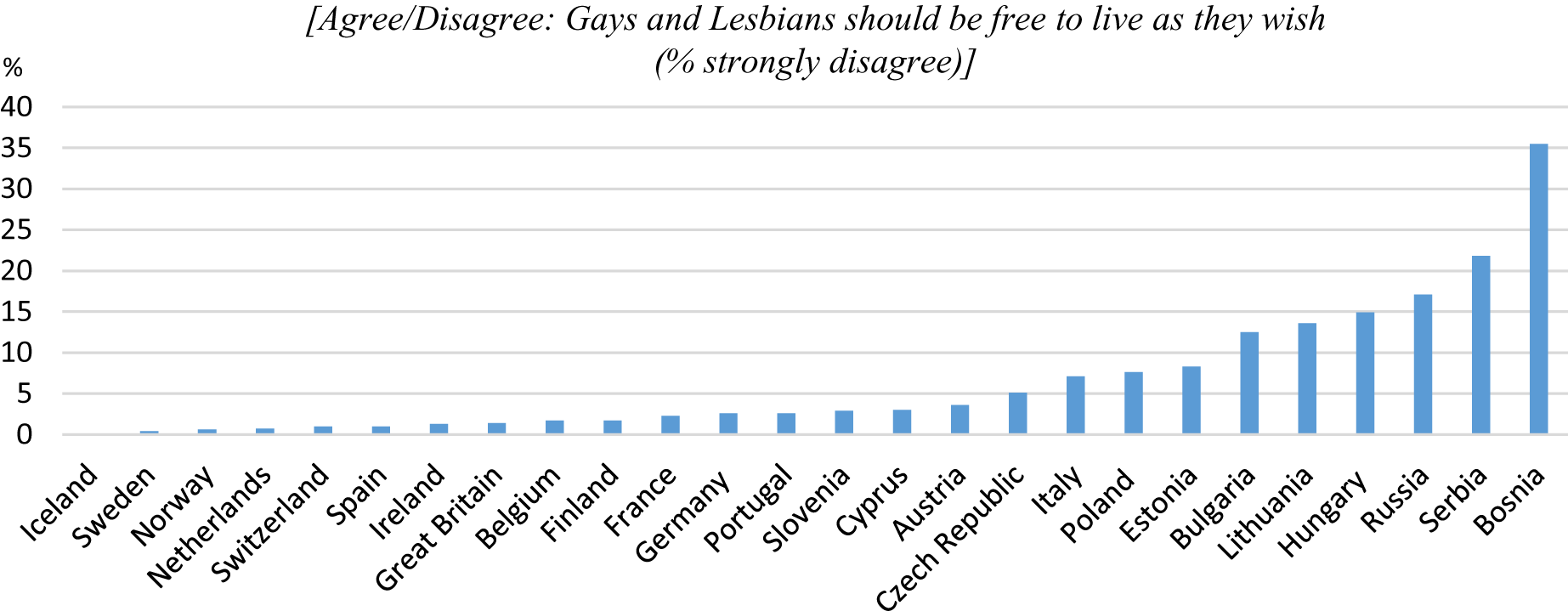
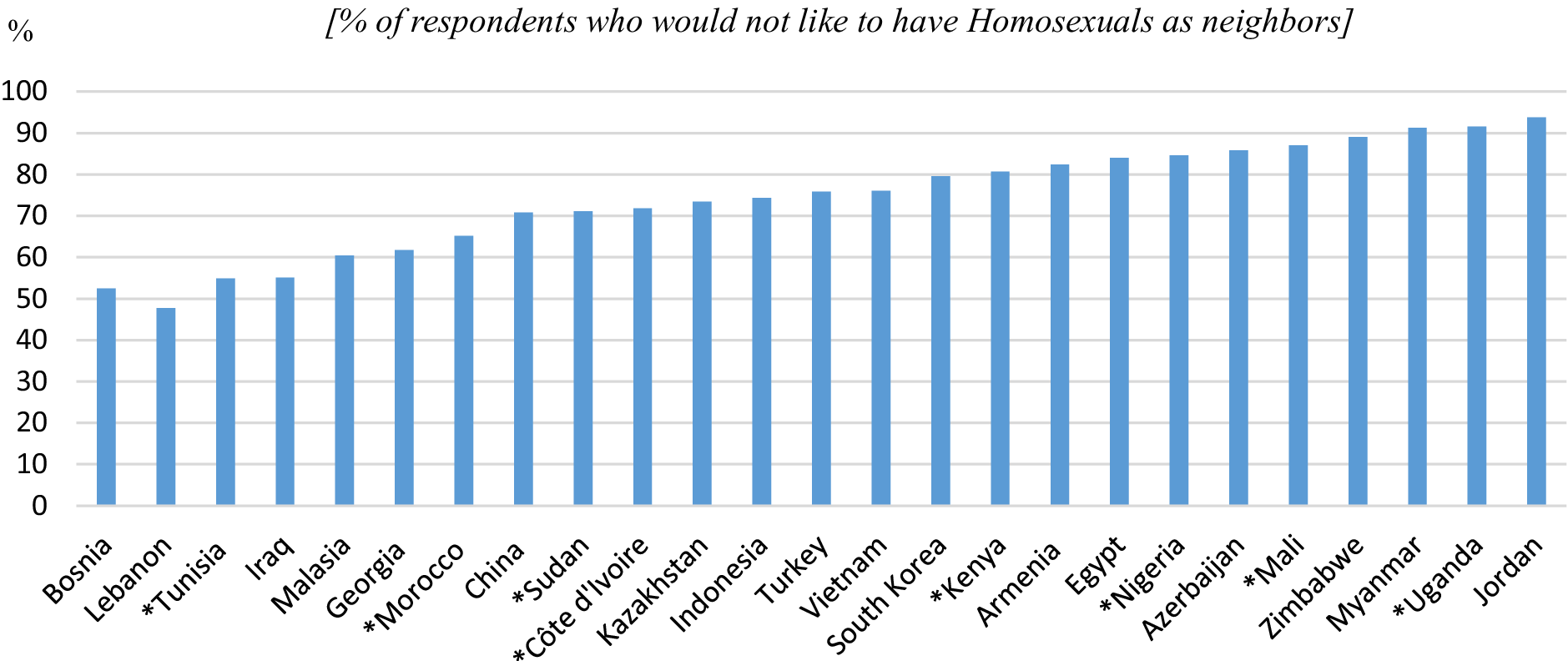
Existing quantitative research on the effects of LGBT+ advocacy has focused on relatively tolerant contexts. Bosnia’s first-ever Pride is a new, intervening event on behalf of LGBT+ rights in a socially conservative society. We define a socially conservative society as one with (a) comparatively high levels of homo-/transphobia and (b) where LGBT+ communities are still new in the domestic discourse.Footnote 1 While Bosnia scores a 37% on ILGA-Europe’s benchmark LGBTI rights index, placing it roughly in the middle of 49 European countries, many of these recent gains were adopted to appeal to the EU, and social change has been slow (ILGA-Europe 2020). In the Bosnian survey data for this study, 77% of respondents reported having zero feelings of closeness toward gay people (on a 0–10-point scale). In comparison to other European societies, Figure 1a indicates that Bosnia ranks high among countries on intolerance toward homosexuality. While an outlier in Europe today, Bosnia reflects other contexts beyond Europe where LGBT+ people routinely face homo- and transphobia within families, the workplace, and in civil society (Figure 1b and online Appendix).
LGBT+ Opposition in a European Context
Note: Source: European Social Survey 2016 and 2018 and this study’s 2019 surveys of Bosnia.

LGBT+ Opposition Beyond Europe
Note: Sources: World Values Surveys 2017–2020; *Afrobarometer 2016–2018.

The potential for counter-mobilization in socially conservative environments necessitates a deeper understanding of reactions to Prides and the communities where they take place. First, many scholars attribute Bosnia’s experience of war and genocide to elite exploitation of underlying ethnonational and religious identity cleavages (Gagnon Reference Gagnon2013; Petersen Reference Petersen2002). Some studies suggest that conflict also amplifies both ethnonationalism and religiosity in ways which could provoke anti-LGBT+ responses (Bauer et al. Reference Bauer, Blattman, Chytilová, Henrich, Miguel and Mitts2016; Henrich et al. Reference Henrich, Bauer, Cassar, Chytilová and Purzycki2019). In particular, ethnonationalism and religiosity often extol heteronormative components to identity, while prohibiting alternative LGBT+ identities (Swimelar Reference Swimelar2020). Thus, Bosnia as a postconflict society is ideal for evaluating whether the Pride leads to rallying effects around the heteronormative, nationalist values that were instrumental to wartime nation-building.
At the same time, while confronting its past, Bosnia is also seeking broader integration into Europe in the future. Swimelar (Reference Swimelar2017) argues that both Bosnia and neighboring Serbia are making progress toward the political empowerment of the LGBT+ community in part attributable to influence by the EU. However, associating LGBT+ rights with EU accession also gives potential fodder to nationalist oppositions. The 2019 Sarajevo Pride is emblematic of the struggle between LGBT+ activists and ethnonationalist oppositions to gain public visibility and shape the political discourse surrounding LGBT+ communities (Swimelar Reference Swimelar2020).
Finally, Bosnia may be unique in Europe in its experience of major civil war at the end of the twentieth century, but civil war and conflict-related violence is not uncommon to the history of many socially conservative societies. As such, Bosnia represents an especially challenging and critical case for examining the positive effects of LGBT+ activism on awareness and support. Elevated nationalism is emblematic of LGBT+ opposition in many societies (Mole Reference Mole2011), so examining Bosnia arguably produces generalizable findings and grounds for future studies in other cases.
The Case of the Sarajevo Pride
With the goal of shedding light on their experience of discrimination, activists organized the first Pride on September 8, 2019, using the motto “Ima izać!/има изаћ!,” roughly translated as “We Want to Come Out!” The motto resonates locally as a play on words for what “you yell to the driver to get off [the bus]” (interview 302). While we adopt what activists called the “de facto” name of Sarajevo Pride, the official name was purposefully selected as BiH (Bosnia and Herzegovina) Pride to emphasize that its message was intended for the whole country. Organizers cooperated with local government to organize 1,000 police officers to protect the Pride route, which passed through the heart of the city, from counter-protesters who came to protest on the basis of “protecting family values.”
The Pride was not the first effort toward raising LGBT+ awareness in Bosnia. In previous years, LGBT+ events generated concern because they led to violence. While quite distinct from Pride, the 2008 Queer Sarajevo Festival resulted in eight people being injured by attacks from counter-protestors. Another incident occurred at the 2014 Merlinka’s Queer Film Festival when a group of masked counter-protesters injured three people. Despite the dangers counter-protesters posed, they also motivated LGBT+ activists to persist (O’Dwyer Reference O’Dwyer2018). Organizer Lejla Huremović told the Pride participants: “If there was no violence I wouldn’t be here today… . This gives us strength and faith that prejudice against us will start to wane and that it will become better for all of us” (Deutsche Welle Reference Welle2019).
According to multiple activists that we interviewed, a wide coalition of LGBT+ community members and activists from across the country supported organizing the 2019 Pride, which drew an estimated 3,000 marchers. The resulting performance was a demonstration: “Some people expected … celebration [like in Berlin], but we were focused on the Pride march as a protest against the violation of human rights and we wanted to show that” (interview 301). Instead of pop music and floats, activists sang anti-fascist songs and called for solidarity with LGBT+ and other marginalized groups. Organizers also combated stereotypes of foreignness by ensuring that the performance centered Bosnians and requested that supportive international guests (from embassies and foreign governments) were not in the front line.
Based on our interviews, those attending the Pride describe a joyful experience of empowered protesters interacting with onlookers, passionately waving and blowing kisses at all who stopped to “look at” the march. The smaller counter-protests organized the day of and day prior did not detract from a feeling of exuberance: “It was so powerful… . being the last of the ‘first prides’ it had a specific meaning for the region. I was almost in tears in walking there. And again now” [tears up] (interview 305). Huremović’s (Reference Huremović2019) speech at Sarajevo Pride conveyed the hope and potential many felt that day:
We are aware that this first march will not change the world and we are aware that there are many LGBTIQ persons who, even after it ends, will not be able to tell the people closest to them who they really are. But we know that this march, this struggle, will give them the strength and hope that change can happen… . This march gives us strength and faith that it will start the process of breaking prejudice against us… . We are here, we exist and we are not a threat to anyone. We are a part of society and we have the right to be equal citizens.
RESEARCH DESIGN
To examine the effects of the Pride on support for LGBT+ activism, we employ nationwide cross-sectional surveys and a local online panel survey before and after the Pride took place. The panel survey offers advantages over cross-sectional data in controlling for omitted variable bias from time-invariant confounders (Hsiao Reference Hsiao2014). Our design also allows us to compare the proximity effects of where the Pride took place with the diffusion effects at the national level. We estimate the effects of the Pride on changes in attitudes in the nationwide and panel samples, as well as their diffusion from the local to the national, using a difference-in-differences estimation model (Angrist and Pischke Reference Angrist and Pischke2014). In this model, the panel survey presents a localized or targeted treatment group for Pride effects, and those in the nationwide survey function as a control group. We pool the data using the following model:
 $$ {Y}_{i t}={\beta}_0+{\beta}_1\left({Treatment}_t\right)+{\beta}_2\left({Sarajevo}_i\right)+{\beta}_3\left({Treatment}_t\ x\ {Sarajevo}_i\right)+{\beta}_4{X}_{i t}+{e}_{i t,} $$
where Yit is the dependent variable (support for LGBT+ activism) for individual i at time t. Treatment is a dummy variable for whether the survey was conducted before or after the Pride. Sarajevo is a dummy variable for whether individual i took part in the local Sarajevo study or the nationwide study; Treatment x Sarajevo is an interaction term capturing the effect of the Pride on Sarajevo respondents, and Xit is a vector of extended controls.
To examine the effects of the Pride on support for LGBT+ activism, we use a survey item that asks respondents: “Do you support or oppose Sarajevo having a Pride march?” with response options ranging from 1 = strongly oppose to 4 = strongly support. We also control for awareness of Prides in general and awareness that a Pride has taken place in Bosnia, which may influence the effect of the Pride on support for LGBT+ activism. We also include other potential correlates of Pride support involving attitudes toward LGBT+ rights, social distance toward LGBT+ people, contact with LGBT+ people, and contact with LGBT+ people who have been victimized by violence over their identity.Footnote 2 Finally, we control for gender, age, education, ethnicity, religiosity, ethnonationalism, urban/rural locations, unemployment, municipal-level fixed effects (to include war-time victimization and displacement), and panel-level fixed effects.
Next, to explore Pride effects on activist-driven and resource-based mobilization, we employ two survey experiments and a behavioral experiment. Following the initial inquiry about support for the Sarajevo Pride, we then engage two survey experiments to elicit subject willingness to attend a Pride in support of LGBT+ rights or to counter-protest. In the survey experiments, we randomize subjects into treatment groups who receive an additional prime from a pro-Pride or anti-Pride activist, respectively. The treatment effects provide an indicator of whether activism can stimulate collective action regarding LGBT+ causes.Footnote 3 We also include a behavioral dimension to the analysis using a dictator experiment (Engel Reference Engel2011) where subjects must decide how to allocate money between organizations that support and oppose Prides to gauge whether resource allocation toward LGBT+ groups increases following the Pride.Footnote 4 Using this design, we now turn to a discussion of data collection.
SAMPLING AND DATA COLLECTION
In order to test our hypotheses, we employed original surveys in Bosnia before and after the Pride, which took place on September 8, 2019. We report all survey questionaire wording in an APSR Dataverse Appendix. We use two nationwide surveys of Bosnia that include representative samples of 1,000 respondents and an online panel survey with 258 participants who were all residents of Sarajevo. All of the surveys were conducted by Ipsos d.o.o., the leading public opinion polling firm in Bosnia. The pre- and post-Pride nationwide surveys were conducted in July and November 2019.Footnote 5 The Sarajevo panel surveys were conducted on the Monday through Friday before the Pride (a Sunday) and the Monday through Friday after the Pride. We also conducted a follow-up survey of 104 members of the original Sarajevo panel in January 2020, giving us two post-Pride measurements to capture time-related diffusion effects. The nationwide surveys involved face-to-face, computer-assisted interviews based on a nationally representative stratified random sample. The panel sample was drawn from an online pool of Bosnian residents, who were then randomly selected from within the pool to participate in the study based on sociodemographic strata to include the location (Sarajevo), gender, and age.
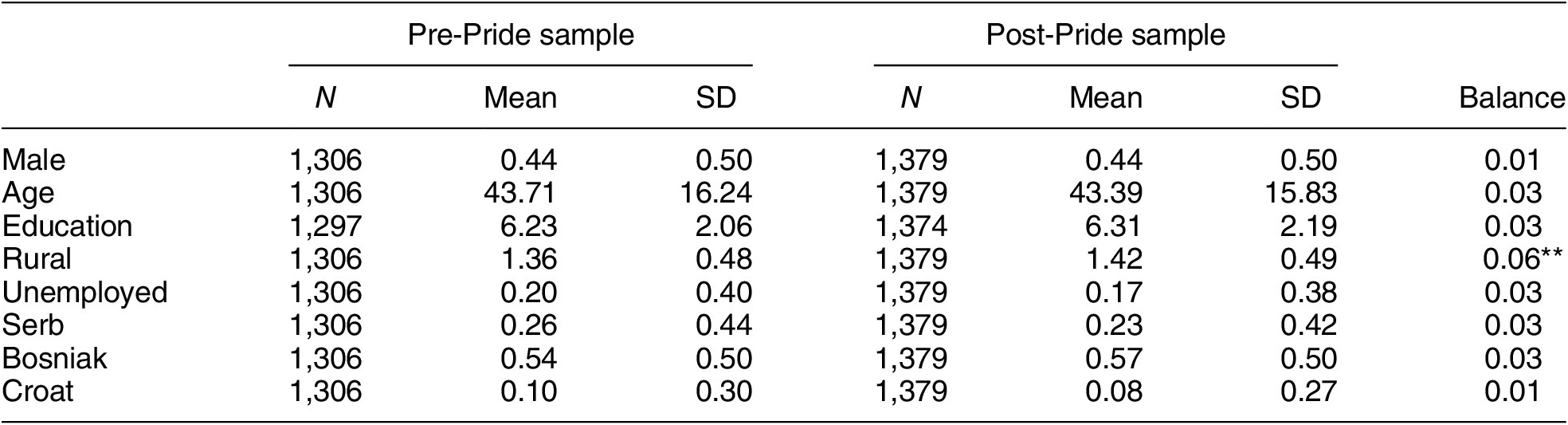
Table 1 provides the results for Kolmogorov–Smirnov balance tests on the resulting pooled samples before and after the Pride. Except for slightly more rural respondents in the post-Pride nationwide sample, the pre and post-Pride samples are well-balanced on the main demographic covariates, making us comfortable with the comparison for treatment effects. We now turn to our main results.
Pre- and Post-Pride Sample Demographics Summary and Balance Tests

Note: **p < 0.05.
RESULTS
Support for LGBT+ Activism
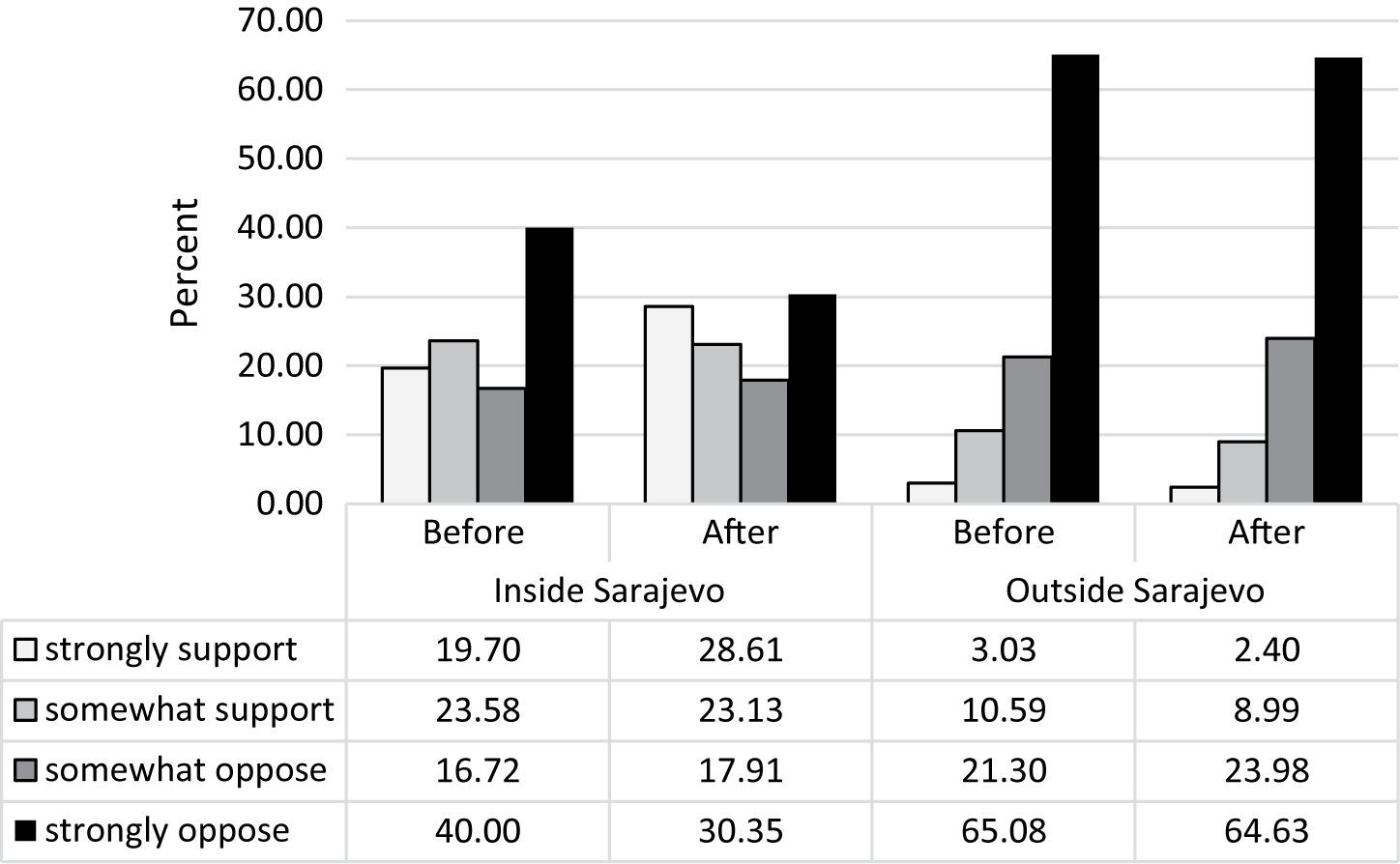
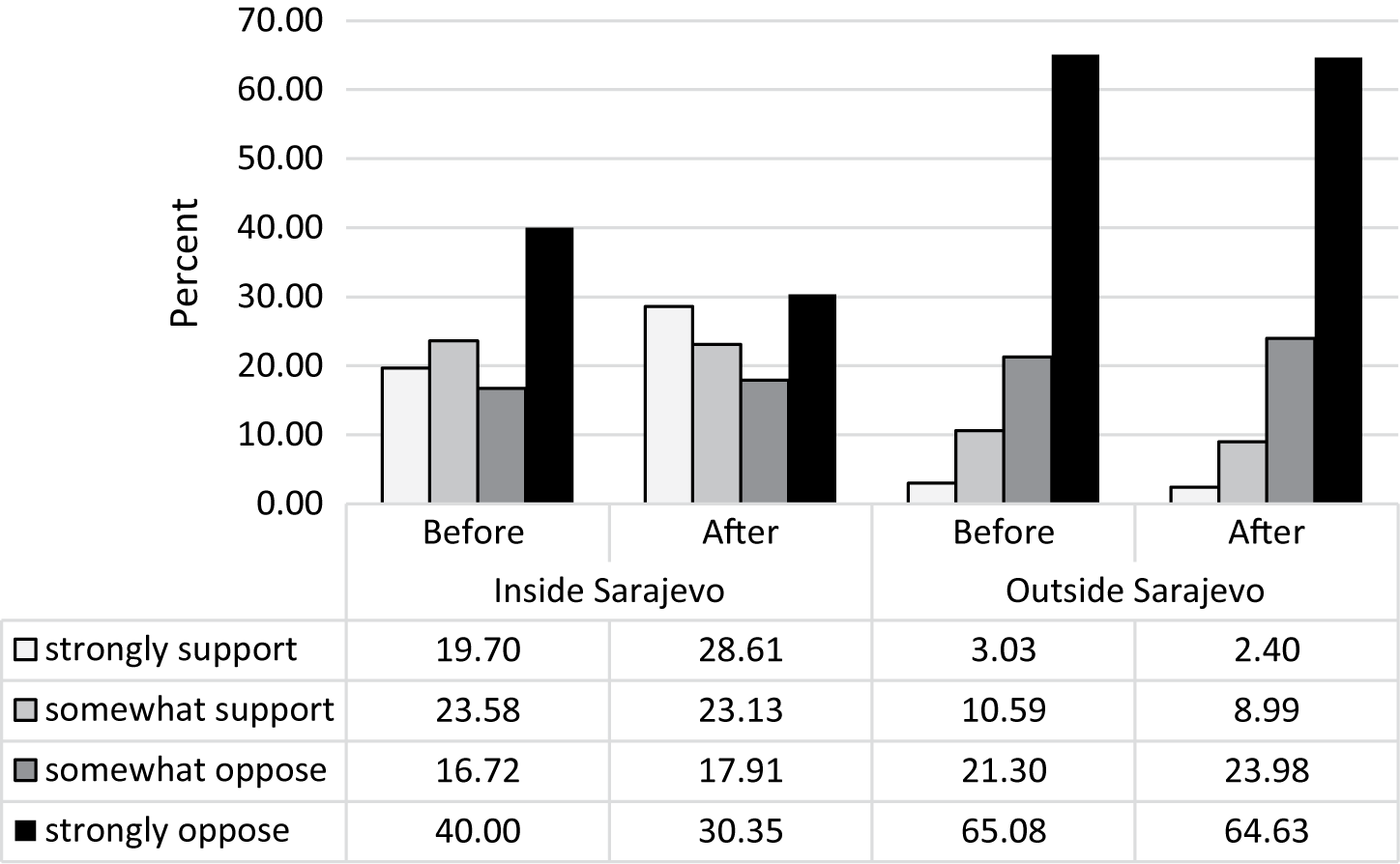
We begin by evaluating public support for LGBT+ activism as expressed through support for holding highly visible Pride events. We use a survey item that asks respondents “Do you support or oppose Sarajevo having a Pride march?” with response options ranging from 1 = strongly oppose to 4 = strongly support. Figure 2 indicates the distribution of responses on Pride Support by location before and after the Pride took place. Before the Pride, it is worth noting the strong opposition outside Sarajevo (65.1% strongly opposed). Even inside Sarajevo, where support and opposition was more divided, the modal response was “strongly oppose” (40.0%). Given considerable opposition to the Pride both within and especially outside Sarajevo, we think the bar is high for finding positive effects of the Pride on activist support. Indeed, Figure 2 shows little to no movement in public opinion outside Sarajevo following the Pride, where opposition remains unchanged (64.6% strongly opposed). However, inside Sarajevo, there is nearly a 10% drop in strong opposition from before to after the Pride, while those strongly supporting the Pride has increased nearly 9%. This suggests that the Pride had a positive effect on reducing opposition and raising support for LGBT+ activism in proximity to where it took place. More symbolically, the shift from majority opposition (56.7% opposed) to majority support (51.7% support) following the Pride indicates how the Pride could have “flipped” public opinion in Sarajevo in the direction of LGBT+ support.Footnote 6
Changes in Pride Support, Before and After Pride, Inside vs. Outside Sarajevo
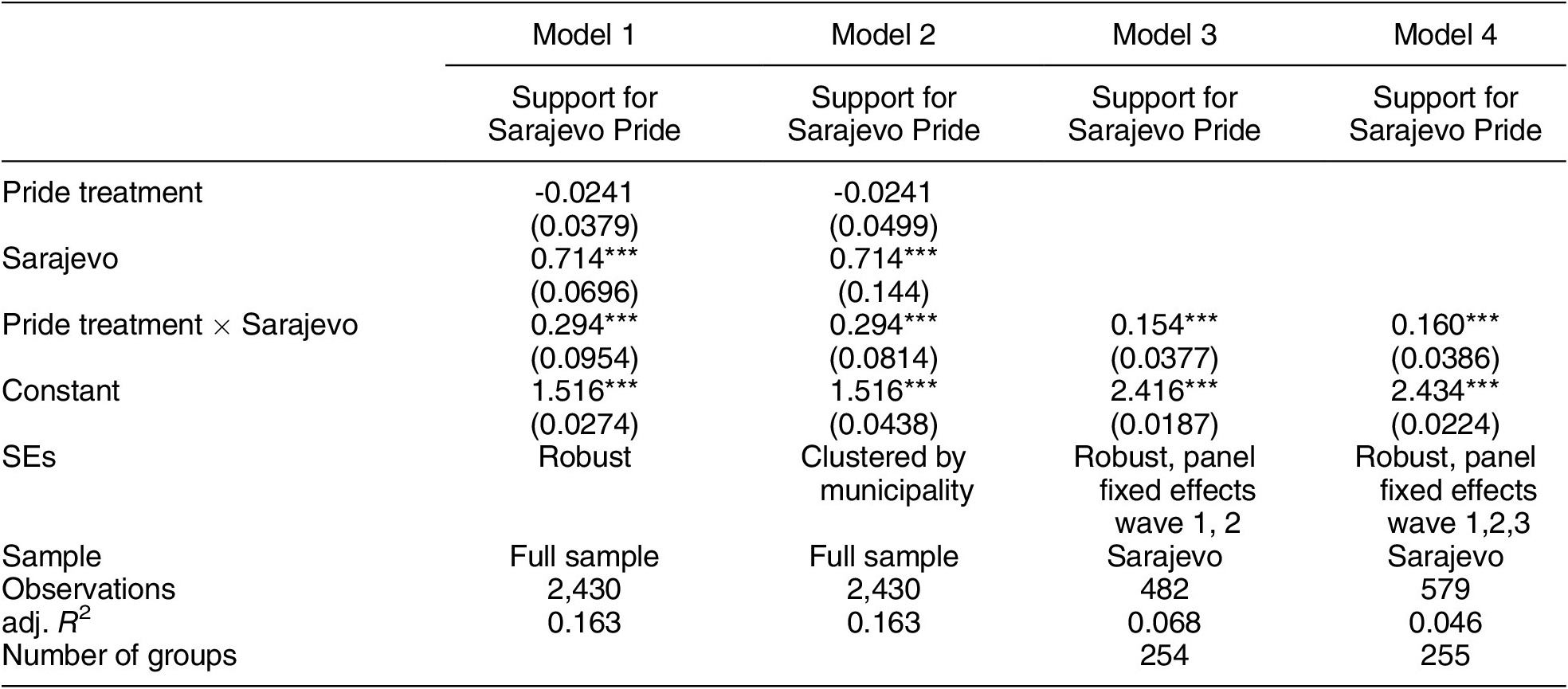
To investigate further, Table 2 estimates the average treatment effect of the Pride on support for LGBT+ activism, using OLS regression. The dependent variable ranges from 1 = strongly oppose to 4 = strongly support a Pride in Sarajevo. In Models 1 and 2, the constant term identifies the baseline support for activism in the nationwide sample before the Pride took place, which is in the strongly oppose range. The Pride Treatment variable indicates the average treatment effect of the Pride on the nationwide sample (outside Sarajevo) and shows that the Sarajevo Pride had no diffusion effects on attitudes toward LGBT+ activism nationwide. The dummy variable, Sarajevo, measures support for LGBT+ rights inside Sarajevo before the Pride took place, and it reveals that Sarajevo residents were more supportive of LGBT+ activism than the nationwide sample even before the Pride.Footnote 7 Finally, the interaction term, Pride Treatment × Sarajevo, estimates the average treatment effect of the Pride on attitudes toward LGBT+ activism in Sarajevo, which is positive and significant. It may also be interpreted as the difference-in-differences between changes in attitudes in Sarajevo compared with those of the nationwide sample. Next, Models 3 and 4 examine Pride effects on Sarajevo with panel fixed effects for the three panel waves. The use of the online panel helps alleviate concerns about time-invariant confounders (e.g., ethnicity, gender, age, education, income, etc.) driving our results in the Sarajevo sample. These models show a strong positive effect of the Pride on raising support for LGBT+ activism inside Sarajevo. Overall, consistent with H1, we find evidence of a Pride effect on increasing LGBT+ activist support, but the effect appears to be limited to those within proximity of the Pride itself, as predicted by H2.
Effect of the Pride on Support for LGBT+ Activism (OLS Regression)
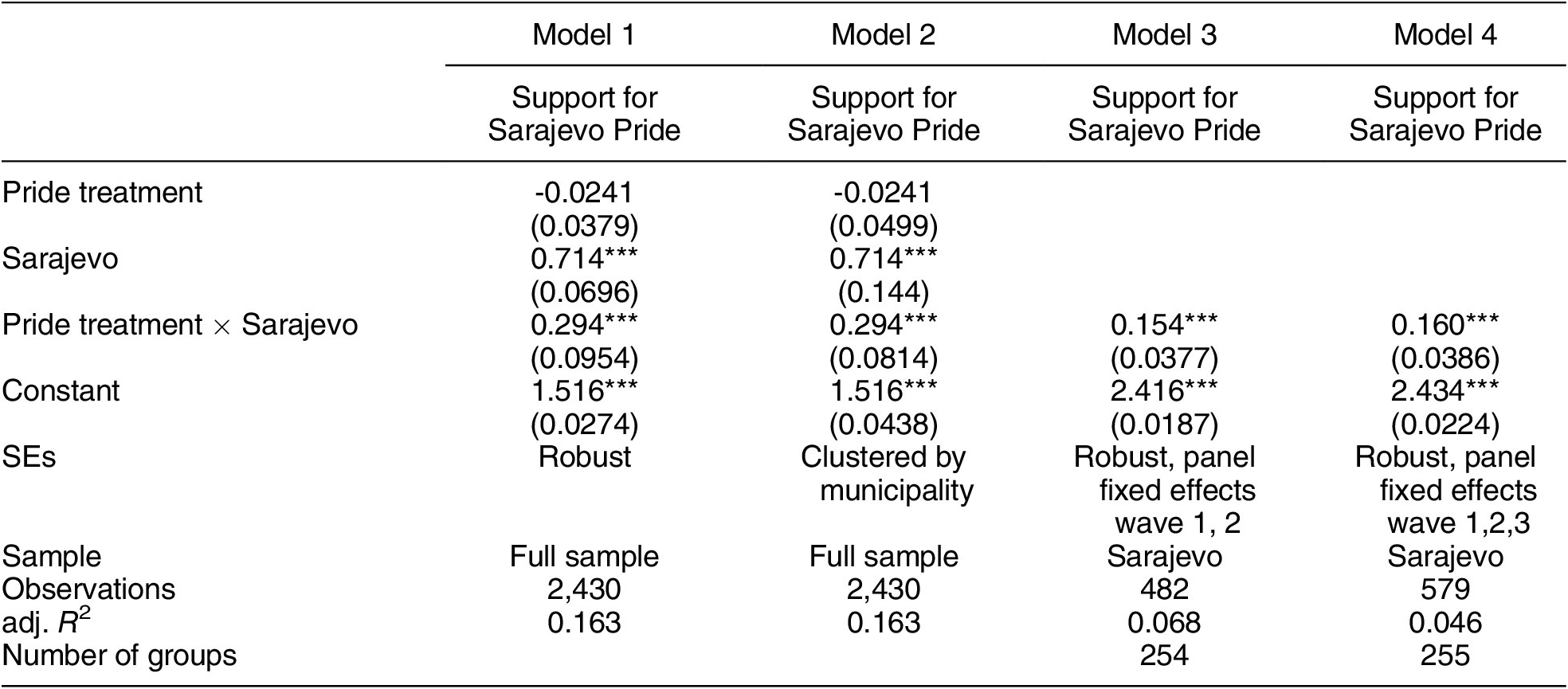
Note: Support for Sarajevo Pride: 1 (strongly oppose Pride)–4 (strongly support Pride). Sarajevo: 0 (Bosnia-wide survey), 1 (Sarajevo survey). Pride Treatment: 0 (pre-Pride data), 1 (post-Pride data). Robust standard errors in parentheses. ***p < 0.01.
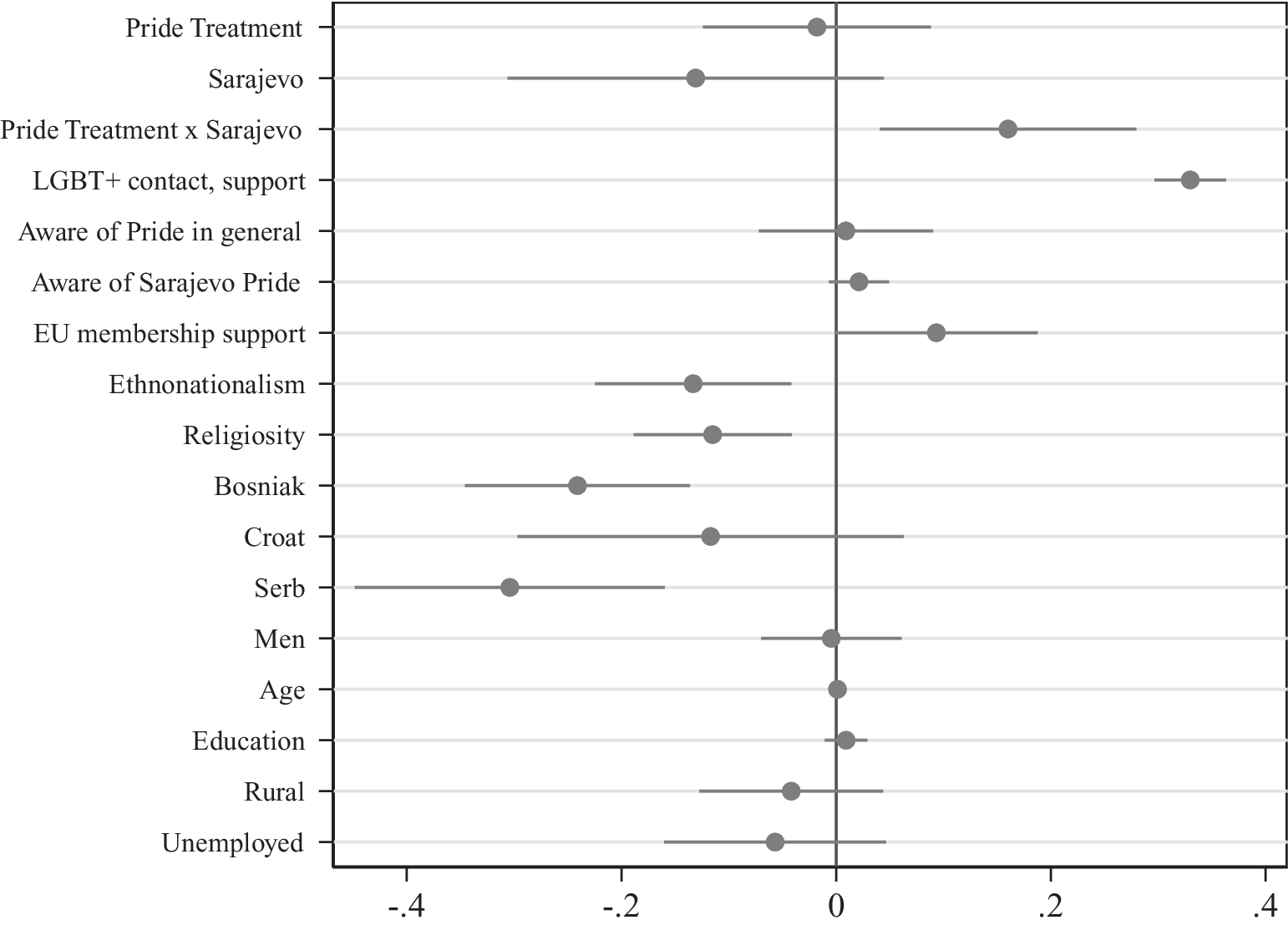
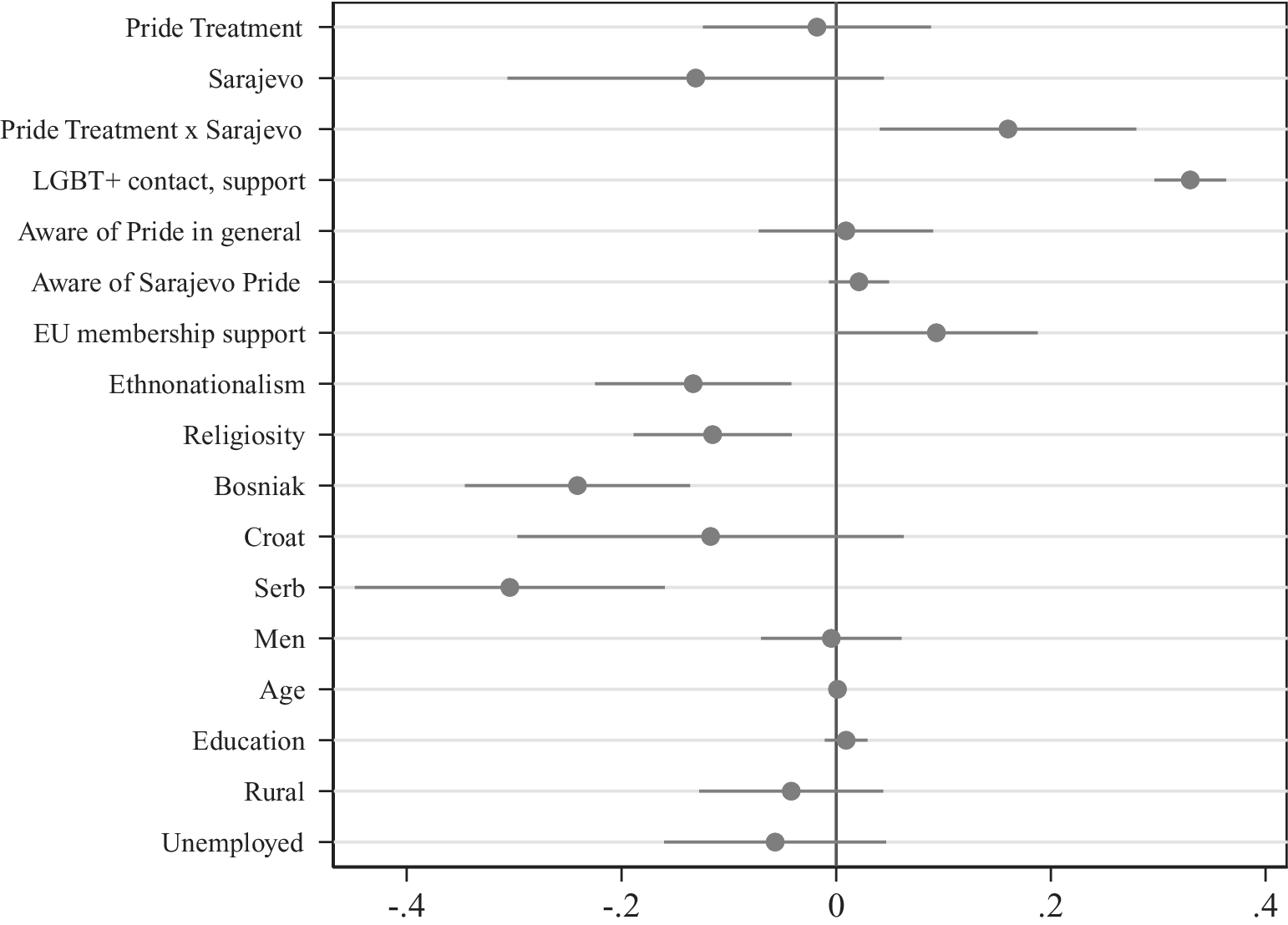
Next, we explore the influence of additional extended controls on our basic treatment effect. In Figure 3 below, we investigate whether covariates in the form of LGBT+ contact and support, EU support, ethnonationalism, religiosity, and demographic controls predict LGBT+ activist support in our Sarajevo and nationwide samples (see APSR Dataverse Appendix for all survey question wording). In comparison with the simple binary models from Table 2, we see that the Pride treatment effect in Sarajevo, reflected in the Pride Treatment × Sarajevo interaction term, is robust to extended controls. Figure 3 shows that LGBT+ contact and support, an index measuring support for LGBT+ rights in general, closeness to LGBT+ people, and contact with LGBT+ people, including those victimized by violence, has an independent effect on LGBT+ support; as does Pride awareness, which also increased locally following the Pride as theorized.Footnote 8 Support for EU integration is also significant as theorized, signaling the influence of external forces beyond Bosnia that affect support for LGBT+ activism and the potential of pro-EU sentiment dampening perceived threats to national sovereignty. People who identify as Bosniaks, Serbs, and to a lesser extent Croats are also less supportive of LGBT+ activism than are those who assume the superordinate identity of Bosnian or “other.” In contrast, there is a persistent negative effect of ethnonationalism and religiosity on support for Prides, in line with our theory. However, the main treatment effect remains positive and significant.Footnote 9 We provide additional robustness checks in an APSR Dataverse Appendix, to include ethno-federal, entity-level controls for the Republika Srpska and municipal-level controls for wartime casualties and displacement, ethnic fractionalization, population density, and ethnic voting, using data from Hadzic, Carlson, and Tavits (Reference Hadzic, Carlson and Tavits2020), which did not influence the basic treatment effects observed in Figure 3.Footnote 10
Pride Effects on Support for LGBT+ Activism, Extended Controls, 95% CIs
Note: N = 2,190, R2 = 0.48, OLS regression coefficients, robust standard errors clustered by municipality.
From Support to Mobilization
The preceding analysis focused primarily on willingness to support LGBT+ activists in their efforts to mobilize. The subsequent analysis takes a step further, examining whether people would be willing to mobilize themselves and their resources in support or opposition to LGBT+ activism.
First, we examine willingness to mobilize for or against LGBT+ activism using two survey experiments, where respondents are randomized into treatment and control groups. The first experiment primes treatment group subjects about their willingness to attend a Pride if asked by a pro-LGBT+ rights advocate. The second experiment primes the treatment group about willingness to attend an opposition protest if asked by an anti-LGBT+ advocate. The control groups receive no priming from pro/anti-LGBT+ advocates and only inquires about willingness to attend a Pride or protest a Pride. Comparing treatment groups with the control groups allows us to assess the effects of advocacy efforts on willingness to mobilize for or against LGBT+ causes.Footnote 11
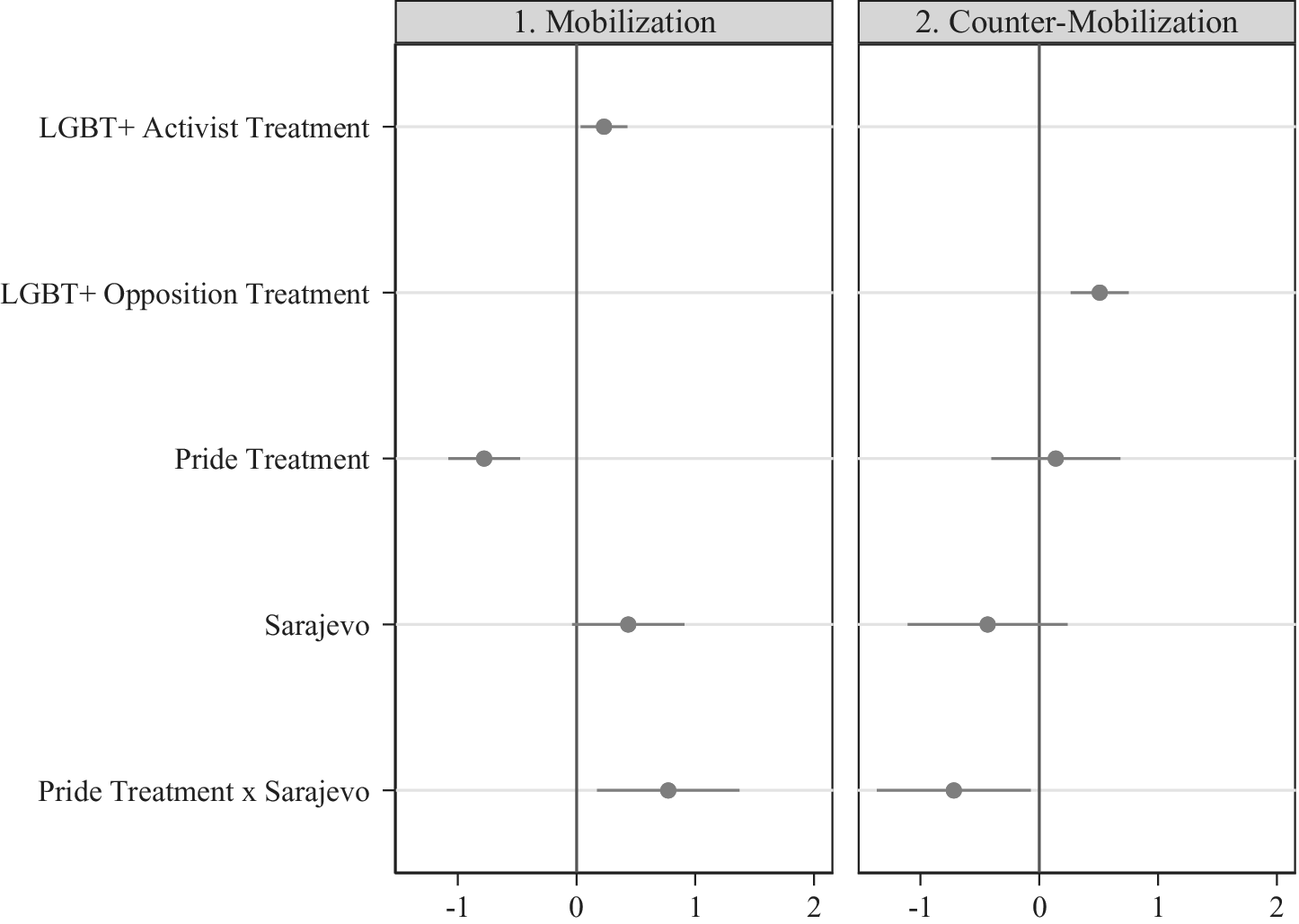
In Figure 4, we report the results of the two survey experiments. The dependent variable ranges from 0 = definitely no to 10 = definitely yes in response to the question of attending a Pride or counter-protest. Model 1 shows the results from the mobilization experiment in support of the Pride. First, consistent with H3a, LGBT+ activist priming increased willingness to attend a Pride (LGBT+ Activist Treatment). Within Sarajevo, the Pride itself also had a positive effect on willingness to mobilize in support of LGBT+ activism (Pride Treatment × Sarajevo). Hence, activist advocacy efforts complement the Pride itself in encouraging mobilization. However, when comparing the nationwide sample before and after the Pride (Pride Treatment), we find that willingness to attend a Pride declines, suggesting that the Pride may have negatively influenced social mobilization propensity beyond Sarajevo. In an APSR Dataverse Appendix, we show that LGBT+ contact and support, which is greater in Sarajevo than elsewhere in Bosnia, amplifies mobilization intent among Sarajevans. Outside Sarajevo, however, we also find that awareness of Prides negatively affected mobilization intent, indicating that awareness itself does not necessarily lead to pro-LGBT+ support. As theorized, awareness encourages support in some but triggers threat and opposition among others. Ethnonationalism also has a negative effect on LGBT+ mobilization in line with our theory.
Mobilization for and Counter-Mobilization against LGBT+ Activism, 95% CIs
Note: Model 1 N = 2,560, Model 2 N = 2,518, OLS regression coefficients, robust standard errors clustered by municipality.

Next, Model 2 reports the results from the counter-mobilization experiment. Here, consistent with H3b, we also observe a strong treatment effect of anti-LGBT+ activist priming on counter-mobilization (LGBT+ Opposition Treatment). Hence, Bosnians in general show willingness to support oppositional protest to Prides. However, the Pride itself did not increase counter-mobilization intent either in Sarajevo (Pride Treatment × Sarajevo) or nationwide (Pride Treatment). Instead, the variable Sarajevo indicates that Sarajevo residents before the Pride are less likely to have supported counter-protesting than Bosnians nationwide. We believe pretreatment support for LGBT+ rights likely reduced the receptiveness of Sarajevo residents to counter-mobilization. In an APSR Dataverse Appendix, we show that support for LGBT+ rights and EU membership are negatively correlated with willingness to counter-protest. In contrast, we find that contact with LGBT+ people encourages both mobilization and counter-mobilization, suggesting that that the nature of the contact matters more than mere contact itself (Pettigrew and Tropp Reference Pettigrew and Tropp2008). Divergent effects of contact might also explain how proximity to Prides could amplify both support and counter-protesting. Finally, Bosniaks and religious people tend to be less willing to mobilize either for or against LGBT+ rights. Hence, while religiosity may signal a lack of support for LGBT+ activism, it produced more antipathy than willful counter-mobilization.
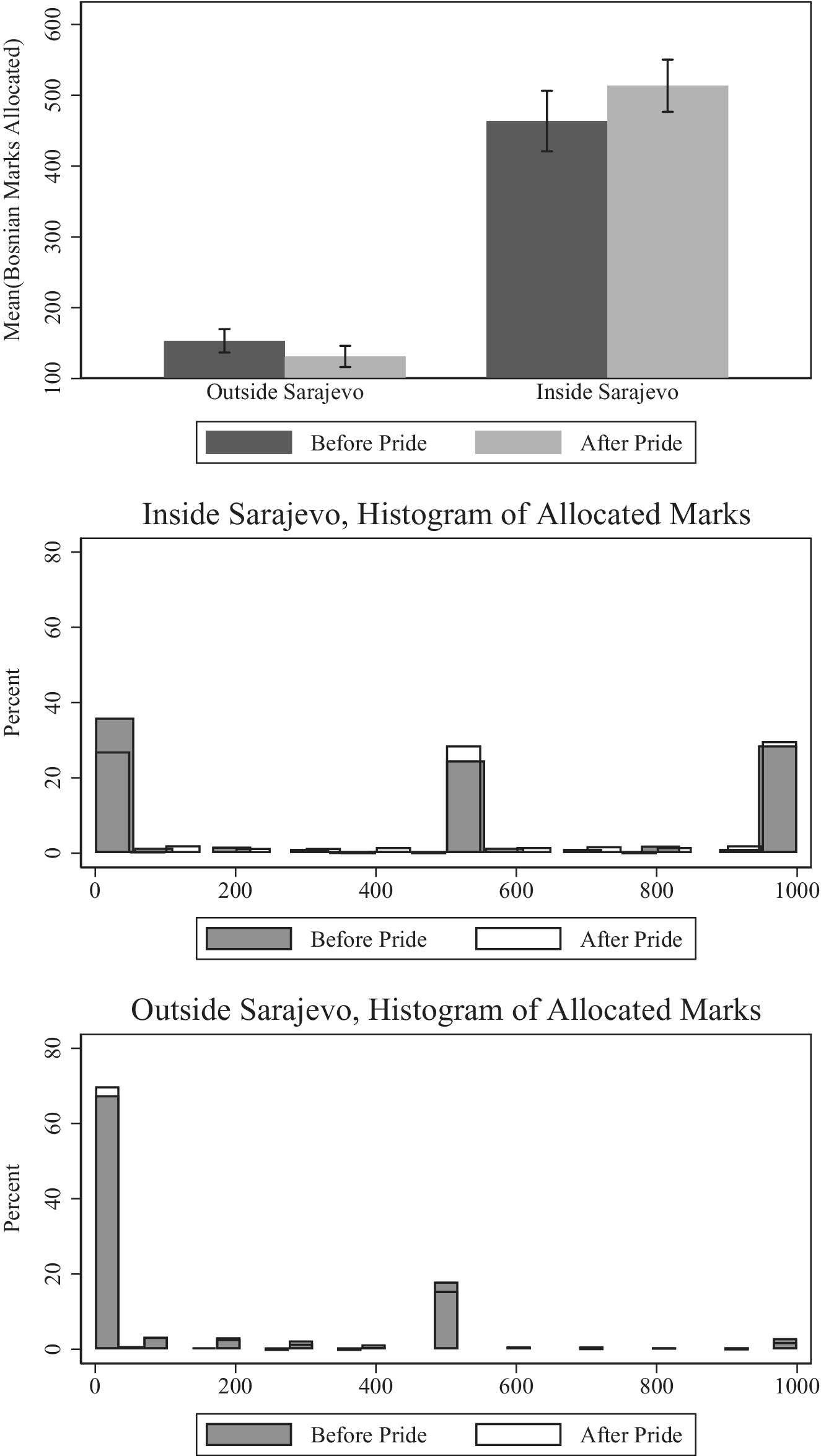
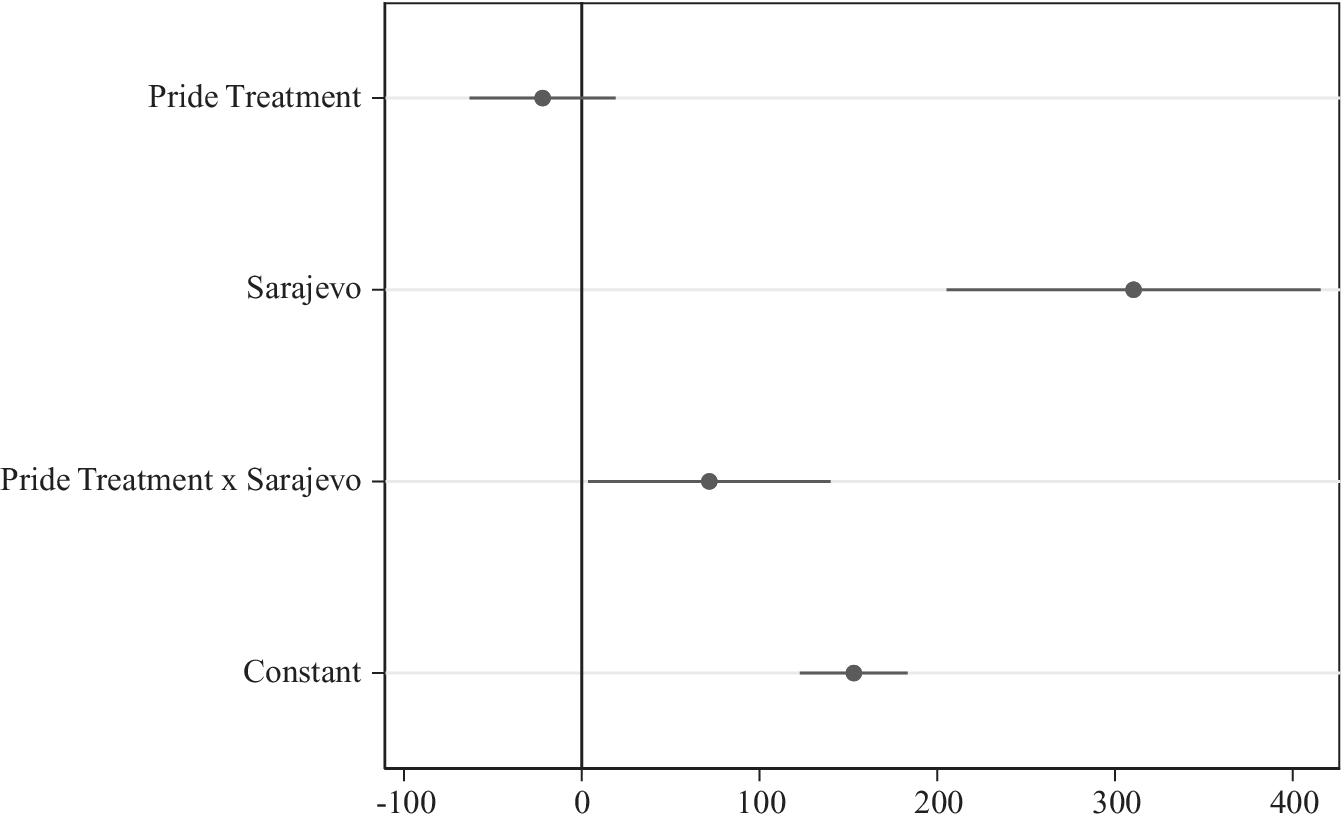
We have established so far that the Sarajevo Pride increased support for LGBT+ activism and willingness to mobilize on behalf of LGBT+ causes. We now examine the effect of the Pride on the mobilization of financial resources in support and opposition to LGBT+ activism, using a dictator game behavioral experiment (Engel Reference Engel2011). In the experiment, subjects decide how to allocate a hypothetical sum of 1,000 Bosnian marks between an organization that supports LGBT+ Pride events and an organization that opposes them. The experiment is a costless way to anticipate how individuals might contribute financial resources to pro- and anti-LGBT+ activist groups, which serves as another proxy for support. Figure 5 provides means and distributions in dictator giving within and outside Sarajevo, and Figure 6 indicates the average treatment effects of the Pride on dictator giving in Sarajevo compared with that of the nationwide sample. The dependent variable represents the amount given from 0–1,000 to a pro-LGBT+ rights organization. The constant term indicates that people in the pre-Pride nationwide sample gave, on average, 153 marks. The Pride Treatment coefficient reflects a slight drop in pro-LGBT+ giving nationwide following the Pride. In contrast, the Sarajevo coefficient indicates that Sarajevo residents, at pretreatment, gave on average 310 more marks than did the nationwide sample to a pro-LGBT+ organization. Following the Pride, the Pride Treatment × Sarajevo interaction term shows allocations increased on average an additional 71 marks. This supports H4 on how Prides can increase resource allocation to LGBT+ causes. In an APSR Dataverse Appendix, we show that the funding effect of the Pride is fully explained by a combination of LGBT+ contact and support, Pride awareness, religiosity, and ethnonationalism. However, in substantive terms, Figures 5 and 6 show how Pride makes a potentially pivotal difference in Sarajevo residents, shifting a majority of funding away from opposition groups to LGBT+ support groups, which can be viewed as both an important symbolic as well as a substantive tipping point.
Dictator Giving to Pro-LGBT+ Advocacy Group, 95% CIs

Mobilization of Resources for LGBT+ Activism, Bosnian Marks Allocated during the Dictator Game, 95% CIs
Note: N = 2,685, Adj. R 2 = 0.22, OLS regression coefficients, robust standard errors clustered by municipality.

In summary, we find that the Sarajevo Pride has increased awareness and support for LGBT+ activism in terms of Pride events, the organizations that sponsor them, and the willingness to attend and even underwrite them financially. However, the effect of the Pride is largely proximate to its immediate location, with little diffusion nationwide. While the staging of Prides is likely endogenous to more welcoming and tolerant communities, as was the case in Sarajevo, they still have an influence on shifting public opinion in a more favorable LGBT+ direction.Footnote 12 We also find negative effects of religiosity and ethnonationalism on LGBT+ support, which may intensify in reaction to Pride advocacy. Our survey experiment shows that respondents, especially outside Sarajevo, are willing to counter-mobilize against LGBT+ activists. While Sarajevo respondents are more favorable toward mobilizing in support of LGBT+ rights, it appears that Sarajevo remains an outlier from much of the rest of Bosnia at this time. Nevertheless, activists would likely find these results encouraging in view of the influence of Prides on LGBT+ support, and our results do not preclude the possibility of down-stream Pride effects on broader LGBT+ mobilization over time, as has been the case with many other social movements.
THE ACTIVIST PERSPECTIVE
To validate the proximity mechanisms undergirding Pride effects, we conducted semistructured post-Pride interviews with six leading LGBT+ activists in Bosnia. A description of the interview methods and data are included in an online Appendix. Despite coming from different perspectives, our interviewees perceived the Pride’s effects positively, emphasizing a mechanism of change rooted in contact with LGBT+ communities. Pride compelled ordinary Bosnians to recognize LGBT+ people, and the perception among activists was that Bosnians, especially those without strong negative priors, were positively swayed by the depictions of LGBT+ minorities during the Pride. One activist described how people had the opportunity to “see us” and were confronted with the fact that their stereotypes did not hold, stating that “[Pride] contributed to portraying a positive picture of the LGBT community and to forcing people to discuss LGBT rights” (interview 300).Footnote 13
But activists also qualified Pride effects, alluding to how the effects diminished with distance from Sarajevo, attributable to a lack of contact with LGBT+ activists. As one observed,
[Pride] had an especially positive impact on those that were physically closer to it… . [P]eople in the Sarajevo region were more confronted with it and compelled to form an opinion on it, compared to others. So even though it was called BiH Pride, it was de facto Sarajevo Pride. … [People in] places far away from Sarajevo could go about their regular life without dealing with it” (interview 300).
Despite framing the Pride to reach far and wide, organizers recognized that the event was not processed the same way outside Sarajevo. As one stated, “people felt it more here because they took part and could see what happened” (interview 302). And while the Pride felt “real” in Sarajevo, it was “virtual” for people outside of it, dampening its influence (interview 303).
Hence, activists believe that Prides work through contact and proximity. First, people in Sarajevo saw it from the street or from their windows and balconies (cf. Images 1 and 2 in the Appendix). People came “to their windows to see what was actually happening. And their reactions were really positive” (interview 301). Second, the Pride’s route caused disruption to the city’s accessibility, impeding Sarajevans from going about their daily business without having contact with it. Interviewees viewed the disruption positively, as a form of interaction available only to people living inside Sarajevo: “Everyone was aware of it. Everyone talked about it at the dinner table… . People were confronted with the question: ‘Will my neighbors or family members show up at Pride?’” (interview 300).
Third, citizens could only identify people as LGBT+ in proximity to the event itself. Safety concerns meant Pride participants adjusted their appearance in a chameleon-like fashion. For example, organizers had participants strategically time the donning of rainbow attire that might identify someone as LGBT+: “We asked everyone … not to wear [Pride-looking] T-shirts or rainbow colors [until they were at the route, and then take them off before leaving it]” (interview 301). Activists deemed this necessary for contentious performances in contexts where the fear of violence is pervasive, meaning that communities are re-invisibilized before their journeys home.
Finally, proximity increases visibility in media. National media coverage of Pride did not provide the same degree of indirect exposure to LGBT+ people. “The media was less likely to cover Pride outside of Sarajevo, where some people didn’t know it was happening. In Sarajevo, it was impossible to move without knowing it was happening” (interview 303). While activists noted the limited quantity of media coverage, others also lamented its adverse quality outside Sarajevo: “The media … are still reporting on LGBT+ issues more negatively there, also due to ties to ethnonationalist media … who say we’re destroying traditional values” (interview 300).
In summary, even though the 3,000-person Pride included many people that organizers “had never seen” and “from the all around the country,” interviews help clarify why diffusion effects are limited (interview 300). Unlike a “Ghost Pride,” activists affirm that in Sarajevo, the performance was seen and felt. One interviewee referred to it as, at worst, a “Zoo Pride” where “we had protection but we were visible” (interview 300). Activist interviews underscore how the Pride, as a vibrant performance, required proximity for its visibility to permeate.
CONCLUSIONS
According to Amenta and Polleta (Reference Amenta and Polletta2019), a central challenge for comparative social movements scholarship involves the methodological complexity of isolating the effects of social movement actions and performances on opinion and behavioral change. This is the first study to assess the effects of LGBT+ Pride activism on a socially conservative society using a pre-post treatment panel design. What are the effects of early activism on behalf of historically marginalized groups? The rich debate on this question in the comparative social movement and Pride literatures is there for a reason: the findings are heterogeneous and complex. Analyzing Bosnia’s first attempt at a Pride in Sarajevo, we identify conditions through which pro-movement outcomes described in the literature can occur.
First, we provide evidence that Prides are successful in raising LGBT+ awareness, support, and mobilization potential. Prides can heighten the visibility that validates LGBT+ identity development (Bruce Reference Bruce2016; Enguix Reference Enguix2009; O’Dwyer Reference O’Dwyer2018). In terms of activist goals, these results suggest that Prides can work in hard cases like Bosnia with outcomes that garner greater awareness and support. Our survey experiment also shows that encouragement by activists leads to more interest in Pride participation. Consistent with the social movement literature (McAdam Reference McAdam1986; Ramakrishan Reference Ramakrishan2005), we reveal how contact with LGBT+ social networks may alter the risk calculus of participation, encouraging future activism and generating support for marginalized communities. Sarajevo residents also allocated more funding for pro-LGBT+ activists in the aftermath of Pride, which suggests behavioral implications of holding Prides. Activists we interviewed echoed optimism for the behavioral change associated with Pride:
It is always a struggle to have a first Pride, and then it happens, and people wake up in the morning and find that life has not changed. Purity in society has not been overthrown, the leaders of the church are still the leaders of the church… . That’s why Pride matters. (interview 305)
At the same time, we recognize important scope conditions regarding what Prides can substantively do to shift public opinion initially in a conservative society. When advocacy issues are emergent but highly contentious, diffusion effects are likely circumscribed. Support for LGBT+ activism increased considerably in Sarajevo after the Pride but not across Bosnia, where connections to LGBT+ people were less seen and felt. This is due to Pride faciliting contact with LGBT+ people in its proximity, which could be more effective at allaying negative stereotypes of participants than in other further-removed contexts where movement demands become diluted or invisible. Another condition for the effectiveness of a Pride is the type of locale where the performance takes place. Sarajevo was more favorable toward LGBT+ rights before the Pride, which may reflect the cosmopolitan attitudes in more densely populated and socially diverse urban environments observed in other European contexts (Maxwell Reference Maxwell2019). These compositional effects could also be important in explaining why Pride effects did not diffuse beyond Sarajevo into more conservative rural environments in Bosnia. On the whole, levels of social tolerance remained similar before and after Pride in much of Bosnia, including other urban areas, indicating limits on the degree to which Prides can shift public opinion nationwide. Hence, the positive outcomes of contentious performances may be bounded to the proximity of where Prides take place. And while Prides may yield potential rewards for LGBT+ organizers in raising support and awareness, they also carry risks. For LGBT+ movements, security remains a major issue for Prides and their participants, which places important ethical constraints on when and where Prides are appropriate.
Importantly, our survey experiment shows how opponents of LGBT+ rights could foment public homophobia in response to Prides (Weiss and Bosia Reference Weiss and Bosia2013). Homophobic narratives are especially persuasive to Bosnians with strong ethnonational and religious orientations, which were likely amplified during the war (Dyrstad Reference Dyrstad2012). Social divisions might also prohibit the diffusion of Pride effects between groups, such that Prides become “balkanized” within co-ethnic communities. Hence, the prevalence of nationalism and religiosity offer additional restrictive scope conditions on the transmission of Pride effects beyond activist networks into broader society (Ayoub Reference Ayoub2014; Swimelar Reference Swimelar2020). Furthermore, such restrictions likely apply to any movement advocating for fluid social constructs that disrupt the fixity of national or religious identity narratives, such as women’s (Htun and Weldon Reference Htun and Weldon2018) and immigrant (Zepeda-Millán Reference Zepeda-Millán2017) rights movements. The risk of violent counter-mobilization is one reason why advocacy groups proceed with great caution.
In conclusion, our findings inform how Prides work to build visibility and support for LGBT+ activist communities. While Sarajevo Pride 2019 has some hallmarks of a “Zoo Pride” (police presence and regulated march), it may nonetheless set a precedent that can lead to more open and publicly inclusive events over time. First Prides set the stage for holding them “in other towns [moving forward]” (interview 303). Moreover, while the public visibility of early activism is limited by proximity, the diffusion of interpersonal visibility (increased bonding and social cohesion among LGBT+ communities) may have happened already. As one activist explained to us, “We received a lot of messages from LGBT+ people from smaller communities and towns, saying that Pride gave them hope to carry on. I think that empowerment is most important” (interview 301). Future research can test this expectation, building upon McClendon’s (Reference McClendon2014) as well as our work to better understand the interpersonal awareness-raising and diffusion mechanisms of Prides. Research should also further examine dynamics between LGBT+ activism and counter-mobilization to deepen our understanding of reactionary backlash associated with Prides. At present, this study sets a new benchmark for whether Prides offer a tipping point for cascading LGBT+ activism, spawn reactionary backlashes that entrench homophobia, or open the door to symbolically important—if incremental—societal change.
SUPPLEMENTARY MATERIALS
To view supplementary material for this article, please visit http://dx.doi.org/10.1017/S0003055420001082.
DATA AVAILABILITY STATEMENT
Replication files are available at the American Political Science Review Dataverse: https://doi.org/10.7910/DVN/IROJ12.
ACKNOWLEDGMENTS
We owe a debt of gratitude to the inspiring activists and organizers who shared their time and experience with us in the interviews associated with this study, as well as Ipsos in Bosnia and Herzegovina for their help with data collection. For their astute and constructive comments on earlier drafts, we thank our colleagues Sarah Soule, Dragana Svraka, Safia Swimelar, Sidney Tarrow, Hana Huskić, Jade Wu, the APSR editors and the three anonymous reviewers: their generosity greatly enriched the quality of this article. Errors are our own.
FUNDING STATEMENT
This research was funded by High Point University, the John Young Parke Initiative at Occidental College, and the Provost’s Office at Gettysburg College.
CONFLICT OF INTEREST
The authors declare no ethical issues or conflicts of interest in this research.
ETHICAL STANDARDS
The authors declare the human subjects research in this article was reviewed and approved by High Point University’s IRB (Certificate numbers: 201906-826 and 202008-957). The authors affirm that this article adheres to the APSA’s Principles and Guidance on Human Subject Research.




Comments
No Comments have been published for this article.