Introduction
Background
The annual incidence of out-of-hospital cardiac arrest (OHCA) in the US is estimated to be 110.8 cases per 100,000 people.Reference Mozaffarian and Benjamin1 The American Heart Association (Dallas, Texas USA) promotes the “chain of survival” concept to illustrate the importance of system-based response to OHCA patients. The chain of survival consists of early recognition of cardiac arrest, the activation of the emergency response system, early cardiopulmonary resuscitation (CPR), rapid defibrillation, quality Advanced Life Support (ALS), and appropriate post-resuscitation care for cardiac arrest patients.Reference Hazinski, Nolan and Aickin2 The public-safety answering point (PSAP) dispatcher, also known as an emergency medical dispatcher (EMD), has been referred to as the “anchor link” in the chain of survival.Reference Bobrow, Panczyk and Subido3
Precise identification of OHCA by the PSAP dispatcher is vital to ensuring the appropriate allocation of prehospital resources. The dispatcher’s decision on what resources (ALS versus Basic Life Support [BLS] or dual dispatch versus single dispatch) to leverage against the OHCA patient can have clinically significant effects on patient outcomes.Reference Nordberg, Jonsson and Forsberg4–Reference Husain and Eisenberg7 Additionally, the dispatcher can provide CPR instructions to laypersons. Dispatch-assisted CPR (DA-CPR) has the potential to increase rates of bystander CPR and to improve outcomes.Reference Malta Hansen, Kragholm and Pearson5, Reference Nakahara, Tomio and Ichikawa8–Reference Bohm, Vaillancourt, Charette, Dunford and Castren11 The dispatcher can also facilitate the third link in the chain of survival: early defibrillation.Reference Hazinski, Nolan and Aickin2 A recent large cohort study reconfirmed the association between bystander automated external defibrillator (AED) usage and favorable neurological outcomes.Reference Nakahara, Tomio and Ichikawa8 However, to effectively implement these resources and therapies, the PSAP dispatcher must first recognize the cardiac arrest.
Importance
A systematic review of the literature determined that dispatchers recognize OHCA with an accuracy of approximately 70% (range 38% to 97%).Reference Vaillancourt, Charette, Bohm, Dunford and Castren12 Recent Canadian, French, and Scandinavian multicenter studies published after the systematic review found dispatch accuracy rates between 61% and 86%, respectively.Reference Vaillancourt, Charette and Kasaboski13–Reference Moller, Andrell, Viereck, Todorova, Friberg and Lippert15 A limited number of studies have attempted to link PSAP dispatch accuracy with patient-centered outcomes. Three European studies reported conflicting results about the association of accurate PSAP dispatch and patient-centered outcomes.Reference Hiltunen, Silfvast, Jantti, Kuisma and Kurola16–Reference Viereck, Moller and Ersboll18 To date, there are no published data on the association of patient-centered outcomes and accurate PSAP dispatch in an American population.
Goals of this Investigation
The goal of this study is to determine if PSAP dispatcher recognition of OHCA is associated with neurologically intact survival to hospital discharge.
Materials and Methods
Study Design and Setting
This retrospective cohort study is an analysis of prospectively collected Quality Assurance/Quality Improvement (QA/QI) data. The cohort was derived from the San Antonio Fire Department (SAFD; San Antonio, Texas USA) OHCA QA/QI registry from January 2013 through December 2015. This study was designed to adhere to the Strengthening the Reporting of Observational Studies in Epidemiology (STROBE) statement.Reference von Elm, Altman and Egger19 The University of Texas Health Science Center at San Antonio (UTHSCSA; San Antonio, Texas USA) Institutional Review Board approved the study.
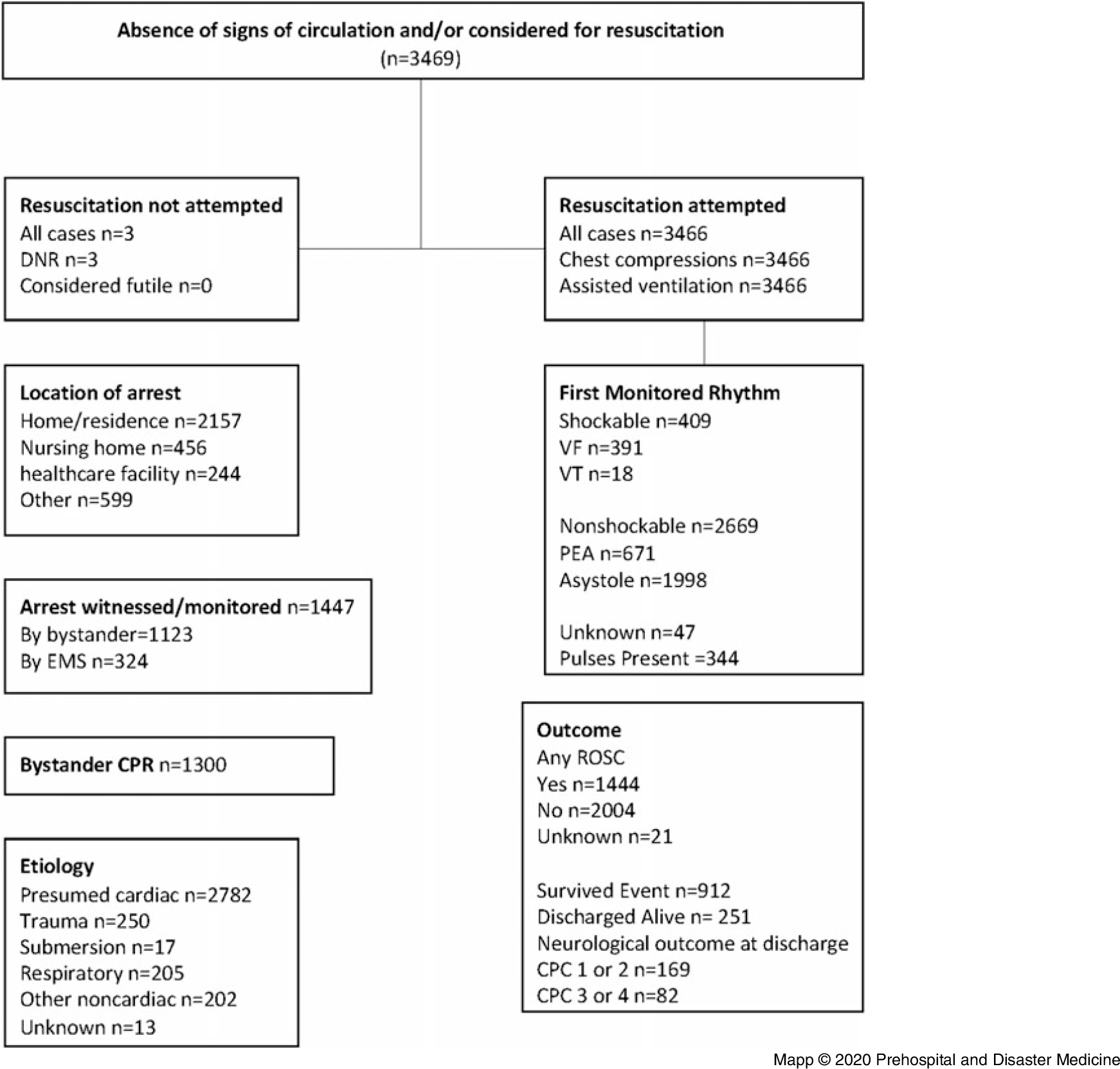
The SAFD is the primary 911 Emergency Medical Service (EMS) provider for a population of 1.4 million people spread over a 460-square-mile area. Figure 1 contains the standard Utstein description of the SAFD EMS system.Reference Jacobs, Nadkarni and Bahr20 The UTHSCSA Department of Emergency Health Sciences Office of the Medical Director (OMD) provides medical direction for the SAFD.
Utstein Reporting Template for Core Data Elements of the San Antonio Fire Department EMS System.

The City of San Antonio PSAP is staffed with salaried 911 dispatchers. The dispatcher asks the caller to identify if they are calling for police, fire, or EMS. These dispatchers transfer fire and EMS calls to the SAFD dispatch section. Uniformed SAFD paramedics with additional EMD training staff this section. If the call is determined to be a cardiac arrest, the SAFD deploys a four-person fire company: two dual-paramedic-staffed mobile intensive care ambulances. The SAFD staffs three-quarters of the fire companies with at least one paramedic qualified firefighter. All fire companies deploy with an AED. Additionally, the paramedic dispatcher provides CPR instructions to the caller. The SAFD uses the Medical Priority Dispatch System version 12.1.
Selection of Participants
The cohort was derived from consecutive SAFD OHCA cases from January 2013 through December 2015. This study excluded all cases with an EMS-witnessed arrest, traumatic arrest, age <18 years old, no dispatch type recorded, or missing outcome data.
Exposure
The exposure was PSAP dispatcher identification of cardiac arrest. A recognized cardiac arrest was defined as: an initial OHCA dispatch, a change in the dispatch to OHCA after the initial call but before SAFD response, or dispatch as a suspected deceased patient. An OHCA case dispatched as anything else was deemed an unrecognized cardiac arrest.
Methods of Measurement
The UTHSCSA OMD utilizes an internal OHCA registry as part of an on-going QA/QI program. This registry captures over 120 discrete variables including: patient demographic information, resuscitative efforts, and patient outcomes. The OMD reviews all SAFD OHCA electronic patient care reports (ePCRs). A dedicated civilian training officer pulls relevant data elements from the ePCR and enters them into the registry. As soon as practicable after the event (typically within 24 hours), an OMD staff member will conduct a structured interview of the resuscitation team leader. The SAFD EMS equipment can be interrogated to collect relevant data, if required. The OMD collects patient outcome data on all patients transported to the hospital for further care. Hospital records, obituary reviews, and the Social Security Death Index are used to determine hospital survival.
One author (JM) prepared the data for statistical analysis. He was blinded to patient outcomes, but not to the study hypothesis.
Outcomes
The primary outcome of this study was neurologically intact survival to hospital discharge. Neurologically intact survival is defined as Cerebral Performance Category (CPC) 1&2. The secondary outcomes were: bystander CPR, AED use (inclusive of bystander and firefighter), and prehospital return of spontaneous circulation (ROSC).
Statistical Analysis
The Fisher’s exact test was used to examine the association between PSAP dispatcher identification of cardiac arrest and neurologically intact survival. Statistical significance was defined as P <.05. An odds ratio was calculated to estimate the magnitude of the effect that PSAP dispatch accuracy had on neurologically intact survival. This study used the Wilson/Brown method to determine the 95% confidence intervals (CIs) of proportions. Microsoft Excel (Microsoft Corp.; Redmond, Washington USA) was used to manage the data. The researchers analyzed the data with GraphPad Prism 7 (GraphPad Software, Inc.; La Jolla, California USA).
This study is retrospective in nature. Therefore, the research team used all years with finalized data in the registry to arrive at the initial cohort. The research team assumed that an increase in neurologically intact survival to hospital discharge by five percentage points would be operationally significant to an EMS system. For the sample size calculation, the research team assumed that 10% of recognized cardiac patients and five percent of unrecognized cardiac patients would have neurologically intact survival to hospital discharge. The expected ratio of recognized cardiac arrests to unrecognized cardiac arrests was 3:1. The power analysis suggested that a minimum of 1,220 cases (recognized 915; unrecognized 305) would be needed to obtain statistical significance (80% power for a significance of .05).
Results
Characteristics of Study Subjects
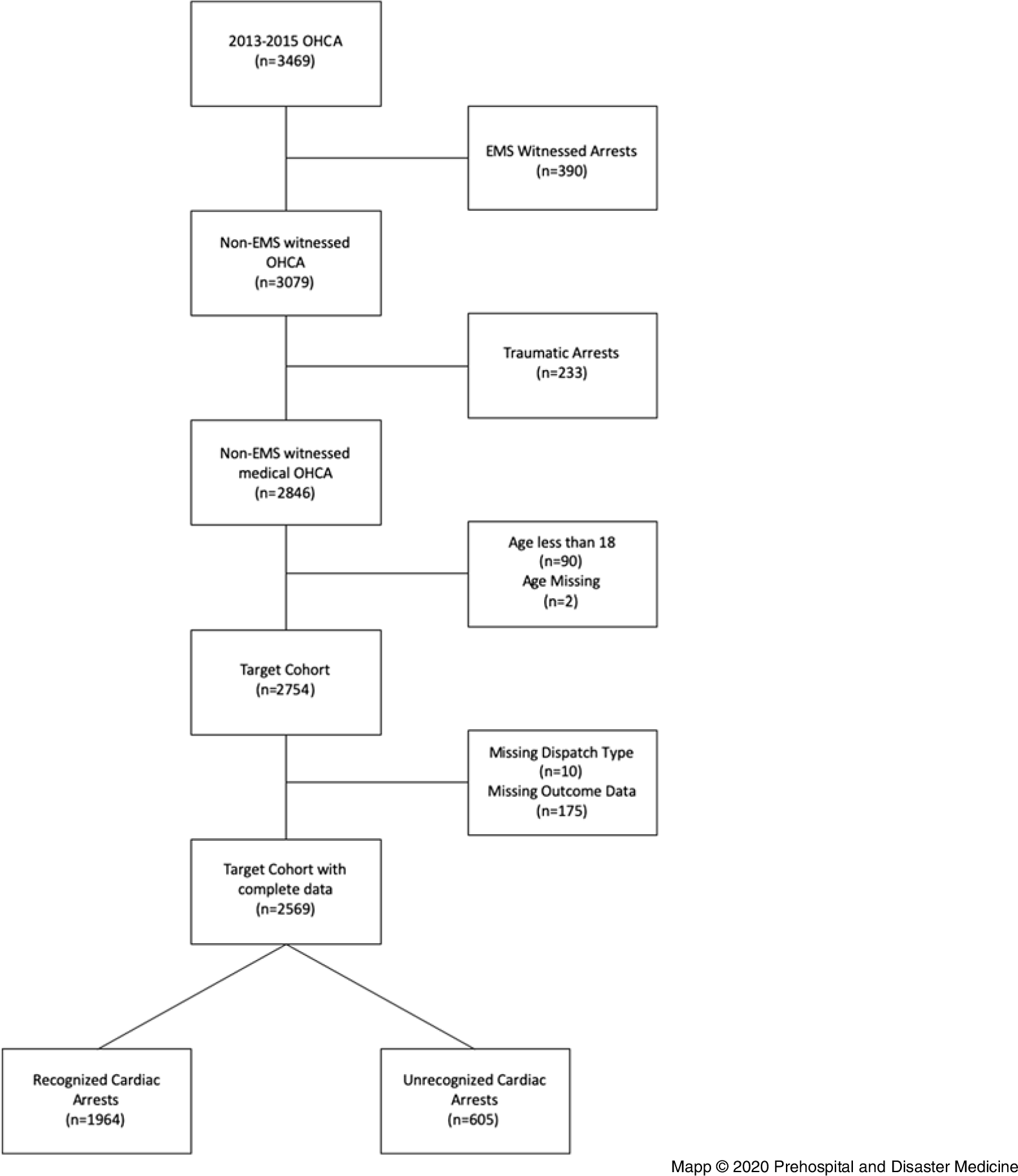
Of 3,469 consecutive OHCA cases, this study excluded 900 cases from the analysis (Figure 2). The PSAP recognized 1,964/2,569 (76.4%; 95% CI, 78.1%–74.8%) of confirmed OHCA cases. The PSAP did not recognize 605/2,569 (23.6%; 95% CI, 25.2%–21.9%) of confirmed OHCA cases.
Exclusion of 900 Cases of 3,469 Consecutive OHCA Cases for Analysis.

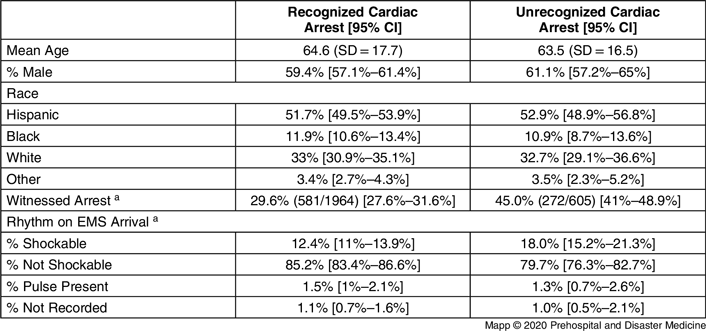
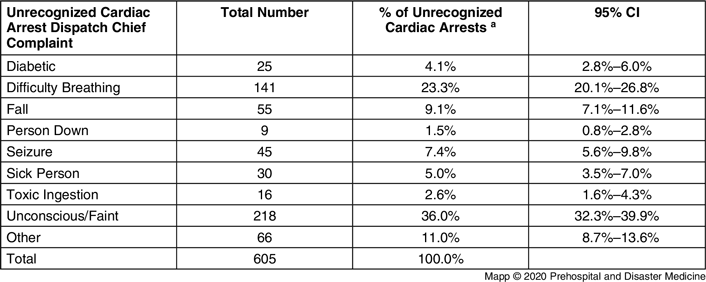
The patient demographics were similar between the two groups. However, the unrecognized cardiac arrest group was more likely to be a witnessed arrest (45.0% versus 29.6%) and more likely to be in a shockable rhythm on EMS arrival (18.0% versus 12.4%; Table 1). Unconscious/faint (36.0%; 95% CI, 39.9%–32.3%) and difficulty breathing (23.3%; 95% CI, 26.8%–20.1%) were the most common unrecognized cardiac arrests. Table 2 provides a full breakdown of the unrecognized cardiac arrests.
Demographic Information for the Two Groups, Accurate and Unrecognized Cardiac Arrest with 95% Confidence Intervals

Abbreviation: EMS, Emergency Medical Services.
a The two groups were similar except for whether the arrest was witnessed and the rhythm on EMS arrival.
Breakdown of Unrecognized Cardiac Arrests Dispatches by Chief Complaint

a Percentages rounded to the nearest tenth.
Main Results
Neurologically intact survival to hospital discharge occurred in 99/1,964 (5.0%) of the recognized cardiac arrest group and 28/605 (4.6%) of the unrecognized cardiac arrest group (P = .75; OR = 1.09; 95% CI, 0.71–1.70). Bystander CPR occurred in 975/1,964 (49.6%) of the recognized cardiac arrest group versus 138/605 (22.8%) of the unrecognized cardiac arrest group (P <.001; OR = 3.34; 95% CI, 2.70–4.11). Use of AED occurred in 861/1,964 (43.8%) of the recognized cardiac arrest group and 161/605 (26.6%) of the unrecognized cardiac arrest group (P <.001; OR = 2.15; 95% CI, 1.76–2.63). Prehospital ROSC occurred in 741/1,964 (37.7%) of the recognized cardiac arrest group versus 308/605 (50.9%) of the unrecognized cardiac arrest group (P <.001; OR = 0.58; 95% CI, 0.49–0.70). Table 3 provides a full breakdown of the results.
Results for the Primary and Secondary Outcomes

Note: Odds ratios and 95% Confidence Intervals for the primary and secondary outcomes of interest are also presented.
Abbreviations: AED, automated external defibrillator; CPC, Cerebral Performance Category; CPR, cardiopulmonary resuscitation; ROSC, return of spontaneous circulation.
a AED use inclusive of bystander and firefighter.
Discussion
Concerning the primary outcome, this study found no difference in neurologically intact survival to hospital discharge between the recognized and unrecognized cardiac arrest groups. This study was adequately powered. The study cohort was collected in a large urban/suburban setting with a well-trained, professional dispatch center and professional paramedic and firefighter response teams. There were no significant differences in demographics between the recognized cardiac arrest and unrecognized cardiac arrest groups.
Recognized cardiac arrests were more likely to have bystander CPR and AED use as expected. However, in the SAFD EMS system, dispatcher recognition only had a moderate effect on bystander CPR (OR = 3.34; 95% CI, 2.70–4.11).Reference Chen, Cohen and Chen21 The effect size needed to be larger to translate to an improvement in neurologically intact survival to hospital discharge. During the study period, the OMD did not have direct oversight of the PSAP dispatchers. However, routine continuous quality improvement surveillance suggests that the PSAP dispatchers provide DA-CPR when cardiac arrest is recognized. Previous publications demonstrate that the rate of bystander CPR in an area is affected by socioeconomic factors.Reference Uber, Sadler, Chassee and Reynolds22–Reference Sasson, Magid and Chan24 As a result of these data and the existing evidence of socioeconomic factors influencing bystander CPR rates, the SAFD EMS system modified its public health communication strategies in an attempt to increase bystander CPR in its metropolitan area.
Surprisingly, the unrecognized cardiac arrests were more likely to achieve prehospital ROSC. The research team suspects that the unrecognized cardiac arrest group had higher rates of ROSC due to a shorter downtime. The researcher’s theory is that a significant percentage of these patients arrested while EMS was en route. The primary piece of evidence is that the unrecognized cardiac arrest group had more patients in a shockable rhythm on EMS arrival. The probability of a patient having a shockable rhythm on EMS arrival declines by eight percent per minute of response time.Reference Renkiewicz, Hubble and Wesley25 An alternative hypothesis is that patients with ventricular fibrillation have more myoclonic movement and agonal breaths than other OHCA patients. These characteristics may confuse the bystander and result in more unrecognized cardiac arrests.Reference Hardeland, Sunde and Ramsdal26 Witnessed arrests being more common in the unrecognized cardiac arrest group supports this theory. These potential confounding variables may have skewed the study’s observations. Given these findings, a multivariable regression model may have been a better tool to evaluate these data. However, the variables typically used to gauge the likelihood of a positive outcome in cardiac arrest (bystander CPR, EMS response time, and early defibrillation) are not independent of the exposure in this retrospective study. Therefore, a regression model would rely on correcting demographic differences between the two groups. This study does not have evidence of substantial demographic differences between the cohorts.
The researchers are aware of only three studies that attempt to link dispatch accuracy with patient-centered outcomes. Hiltunen, et al investigated the link between dispatch accuracy and neurologically intact survival in a patient population with bystander-witnessed arrests and shockable rhythms.Reference Hiltunen, Silfvast, Jantti, Kuisma and Kurola16 Despite evaluating very different patient populations, both of these studies demonstrated that there was no association between dispatch accuracy and neurologically intact survival. Viereck, et al attempted to link dispatcher recognition of cardiac arrest and survival.Reference Viereck, Moller and Ersboll18 In their study, dispatcher recognition of cardiac arrest had a much more robust effect (OR = 7.84; 95% CI, 5.10–12.05) on bystander CPR rates. Despite this difference in effect, they were unable to show an increase in 30-day survival. However, in the sub-set of witnessed cardiac arrest, dispatcher recognition was associated with 30-day survival (OR = 2.80; 95% CI, 1.58–4.96). Berdowski, et al observed an association between recognized cardiac arrest and survival.Reference Berdowski, Beekhuis, Zwinderman, Tijssen and Koster17 In their system, a nonmedical cardiac arrest call received only one ambulance. This number of personnel is insufficient to run a cardiac arrest resuscitation effectively. The SAFD EMS routine medical calls receive an ambulance and a fire engine. Even if the dispatcher does not recognize the cardiac arrest, SAFD EMS routinely dispatch enough personnel to run a code effectively. This difference in EMS systems may explain the discrepancies in these findings.
Future studies on PSAP cardiac arrest dispatch should focus on patient-centered outcomes. There is a growing body of literature comparing criteria-based dispatch systems, medical-priority dispatch systems, and alternative dispatch systems in cardiac arrest care.Reference Dami, Heymann, Pasquier, Fuchs, Carron and Hugli27–Reference Stipulante, Tubes and El Fassi30 Unfortunately, most of this exciting work uses the time to identification as the primary outcome. Time to identification does not directly translate into a clinically significant increase in bystander CPR or decrease in time to the first shock. Furthermore, fixating on time to recognition minimizes the critical public health outreach that may be required to increase bystander-initiated resuscitation in individual EMS systems.
Limitations
This study has limitations. First, this observational study is prone to selection bias. The researchers chose the 2013 to 2015 timeframe because 2013 was the first year with data that could test the hypothesis. The team included up to the year 2015 because it was the last year with finalized data when the project began. Second, some percentage of the OHCA patients will arrest between PSAP dispatch and EMS arrival. Therefore, the unrecognized cardiac arrest group should have an over-representation of patients who arrested recently. This potential skewing of the average cardiac arrest duration can explain some of the contradictory findings in the study. Third, data fidelity was not complete in the existing OHCA registry. Due to the absence of essential data, the research team excluded 6.7% (185/2,754) of the relevant patient population from the final analysis. This OHCA registry receives inputs from over 20 hospitals in the greater San Antonio area. Unfortunately, this limits how often the UTHSCSA OMD can follow up with a hospital if the institution fails to send all relevant hospital data in a particular case. These missing data are a source of information bias. Finally, the research team did not attempt to control for the length of time it took for the PSAP dispatcher to recognize OHCA. These data are not available in the SAFD EMS cardiac arrest registry.
Conclusion
This study found no association between PSAP dispatcher identification of OHCA and neurologically intact survival to hospital discharge. Dispatcher identification of OHCA remains an important, but not singularly decisive, link in the OHCA chain of survival.
Acknowledgements
The authors would like to thank the San Antonio Fire Department, the Office of the Medical Director for the San Antonio Fire Department, and Joan Petty Polk for their significant contributions to this work.
Conflicts of interest/disclaimer
This research was presented as an abstract at the American College of Emergency Physicians Scientific Assembly, October 2017, Las Vegas, Nevada USA.
The views expressed in this article are those of the author(s) and do not necessarily reflect the official policy or position of the Department of the Army, the Department of the Air Force, Department of Defense, or the United States Government. The authors have no conflicts of interest to declare.
Author Contributions
JM, AD, SH, CK, DM, and DW were responsible for the project design. JM was responsible for data abstraction. JM and DW were responsible for data analysis and interpretation. JM and AD drafted the original manuscript. All authors critically reviewed the article. JM takes responsibility for the paper as a whole.