Introduction
In the wild relatives of cultivated crops including potatoes (Flanders et al., Reference Flanders, Hawkes, Radcliffe and Lauer1992), tomatoes (Simmons and Gurr, Reference Simmons and Gurr2005), alfalfa (Ranger and Hower, Reference Ranger and Hower2001) and tobacco (Neal et al., Reference Neal, Buta, Pittarelli, Lusby and Bentz1994), glandular trichomes are valuable components of plant resistance to insects. Compounds sequestered within glandular trichomes are involved in both chemical and physical defence. For example, the contents of glandular trichomes (often terpenoids or flavonoids) may repel or poison herbivores (Frelichowski and Juvik, Reference Frelichowski and Juvik2001). In other cases, rupture of glandular trichomes may impair insect movement via the release of sticky or resinous compounds (Simmons et al., Reference Simmons, Gurr, McGrath, Martin and Nicol2004). As has been observed for other plant defence mechanisms, the quantity or quality of glandular trichomes in species (or varieties) adapted for agriculture is believed to be low compared with that in wild relatives (Flanders et al., Reference Flanders, Hawkes, Radcliffe and Lauer1992; Simmons and Gurr, Reference Simmons and Gurr2005).
In general, attributes of glandular trichomes in sunflower, Helianthus spp., appear to be similar to those in other genera. The capitate glandular trichomes of sunflower are present on the leaves of most species (Spring, Reference Spring1989), but their concentrations in plant reproductive structures (anther appendages of florets) play a putative role in the defence against herbivores. In wild sunflowers, the contents of these glandular trichomes are considered to be effective defence components that act against sunflower moth, Homoeosoma electellum (Hulst), the larvae of which feed on sunflower pollen, florets and maturing achenes; the diterpenes and sesquiterpene lactones present in glandular trichomes cause larval mortality and delayed development (Rogers et al., Reference Rogers, Gershenzon, Ohno, Mabry, Stipanovic and Kreitner1987). Many of the same compounds have broader repellent or toxic effects on insects not believed to have coevolved with sunflower (Gershenzon et al., Reference Gershenzon, Rossiter, Mabry, Rogers, Blust, Hopkins and Hein1985; Chou and Mullin, Reference Chou and Mullin1993b). However, cultivated sunflowers (Helianthus annuus L.) are reportedly deficient in glandular trichomes (Gershenzon, Reference Gershenzon1984; Rossiter et al., Reference Rossiter, Gershenzon and Mabry1986; Rogers et al., Reference Rogers, Gershenzon, Ohno, Mabry, Stipanovic and Kreitner1987), suggesting that this type of host plant resistance does not play a role in the limitation of herbivore damage to sunflower lines grown for food or feed purposes.
At least two lines of evidence suggest that some cultivated sunflowers may have trichome-based resistance to insects similar to that found in wild sunflowers. First, examples of trichome-mediated plant resistance to insects have been reported in other cultivated crops (Heinz and Zalom, Reference Heinz and Zalom1995; Ranger and Hower, Reference Ranger and Hower2001). Second, it has been observed that in efforts to develop sunflower inbreds resistant to insects that feed on sunflower florets and seeds, some public or commercial hybrids often exhibit damage equal to or less than that observed in putative sources of resistance, including interspecific crosses with wild sunflowers (Charlet et al., Reference Charlet, Aiken, Seiler, Chirumamilla, Hulke and Knodel2008, Reference Charlet, Seiler, Miller, Hulke and Knodel2009; J. R. Prasifka, unpublished data); furthermore, the same hybrids appear to lack a separate physical defence mechanism (high pericarp strength) that might help explain the relatively low levels of damage observed (Prasifka et al., Reference Prasifka, Hulke and Seiler2014). To help determine whether glandular trichomes have a role in the conferment of resistance to pests of cultivated sunflowers, this study aimed to (1) determine glandular trichome density for a broad spectrum of cultivated and wild H. annuus germplasm types and (2) use laboratory-based tests to assess whether glandular trichomes in cultivated sunflowers provide some resistance to larvae of one sunflower insect pest.
Materials and methods
Trichome density determination
A total of 68 entries was used to determine the density of glandular trichomes across H. annuus germplasm types. The entries included 15 each from two sunflower heterotic groups (inbred maintainer (HA) and restorer (RHA) lines), wild sunflowers and commercial hybrids. Wild sunflower entries were selected as a stratified random sample using the GRIN database (USDA-ARS, 2013), with five accessions each from Texas, Kansas and North Dakota; these locations represent a latitudinal gradient in the native range of wild H. annuus and its coevolved herbivores in North America. Similarly, commercial hybrids included five entries from each of three companies (with specific sources and lines not being identified for anonymity). Additional entries included three hybrids of USDA lines and five interspecific crosses or numbered accessions (plant introduction) previously identified as those being resistant to seed-feeding caterpillars in sunflower (Wilson and McClurg, Reference Wilson and McClurg1997; Charlet et al., Reference Charlet, Aiken, Seiler, Chirumamilla, Hulke and Knodel2008, Reference Charlet, Seiler, Miller, Hulke and Knodel2009).
Plants were grown in the field from seed (cultivated material) or transplanted (wild entries; after germination in the laboratory using gibberellic acid) in a plot in Fargo, North Dakota, during the summer of 2012. From three plants (replicates) of each entry, five pre-anthesis florets were removed with forceps as soon as the outermost rows of florets reached anthesis. Pre-anthesis florets are needed for accurate counts of capitate glandular trichomes because rubbing of fused anthers during exsertion from the corolla and subsequent activity of insects (especially pollinators) physically destroy or remove many of the trichomes on anther appendages (Griffiths and Erickson, Reference Griffiths, Erickson, Jones and Little1983). After being placed in microcentrifuge tubes, the florets were stored frozen ( − 20°C) until sunflower harvest.
For the quantification of glandular trichomes in each sampled plant, at least three florets (subsamples) were dissected by unfurling the anther tube and slide-mounting in Hoyer's medium. Glandular trichomes were counted at 40–100 × magnification with notes made of the number on each anther appendage and those dislodged during mounting (i.e. suspended unattached in the medium, categorized as ‘loose’). Because all the slides were prepared by the same person, the number of loose trichomes was considered a property of each entry rather than a reflection on the care taken in mounting. Additionally, scanning electron micrographs (45 × magnification) were made using a subset of entries selected after counts had been completed for slide-mounted samples.
To determine whether glandular trichome number is consistent for germplasm grown in different conditions, 14 inbred lines evaluated in 2012 were subsequently grown in Casselton, North Dakota, during the summer of 2013. The number of glandular trichomes per floret for each inbred line was determined using the same methods as in the previous year.
Laboratory assay
Visual (i.e. non-quantitative) examination of glandular trichomes on public maintainer (HA) lines during 2012 allowed the selection of entries that appeared to differ significantly. For low (HA 89) and high (HA 248) representatives, flowering heads were cut and placed in water in the laboratory. This allowed anther tubes to exsert with minimal disturbance to glandular trichomes, allowing a new set of florets to be collected and frozen for several consecutive days. The effects of extracts taken from groups of florets on larval survival and development were subsequently assessed by evaporating terpenoid extracts onto the surface of an artificial diet.
Cells were filled into bioassay trays (BAW128; Bio-Serv, Frenchtown, NJ, USA) using a repeating pipette with 1.0 ml of a wheat-germ diet (modified from Wilson (Reference Wilson1990) by the addition of aureomycin at 400 mg/l finished diet) and allowed to cool uncovered. The contents of glandular trichomes were extracted in dichloromethane, separated from the pollen and florets via centrifugation, and evaporated under nitrogen gas. The extracts were redissolved in methanol to obtain solutions with each 50 μl aliquot being equivalent to one, two or four florets of HA 89 or HA 248. A total of 32 cells were used for each treatment, including additional untreated and solvent-only (methanol) controls. Solvent evaporation was accelerated by the immediate placement of trays under a fume hood. After solvent evaporation was complete, larvae from a H. electellum colony established in July 2011 (initial n>200 adults from Colby and Hays, Kansas) were introduced into the cells. After placing one neonate into each cell, clear adhesive lids were used to contain the larvae. After 9 d, each cell was scored for larval mortality and development (larval mass and head capsule width).
Statistical analyses
All tests were carried out using the SAS (SAS Institute Inc, 2007) statistical software. An analysis of variance (ANOVA) was used to test for an effect of germplasm type (wild H. annuus, HA, RHA and commercial hybrids) on the number of glandular trichomes per floret in 2012, and differences between the groups were determined with t tests. Subsequent ANOVAs were used to test for differences within the germplasm types, with significant F tests being followed by Dunnett's test (using the numerically highest entry within each germplasm type as a control) to select entries with the similarly high numbers of glandular trichomes. Because there were apparently large differences among the entries for the proportion of loose glands (dislodged during slide-mounting) on florets, separate ANOVAs were used to test for differences in the (arcsine square root transformed) proportion of loose glandular trichomes within each of the four primary germplasm types, with significant F tests again being followed by Dunnett's test. To determine whether the estimates of glandular trichome number were consistent in differing years or environments, mean glandular trichome counts from 14 inbred lines evaluated in 2013 were regressed on their counts recorded in the 2012 field season.
A χ2 test on an r× c contingency table was used to assess whether the likelihood of larval mortality was influenced by glandular trichome extracts in the laboratory assay. For larvae scored as alive after 9 d, separate ANOVAs were used to test for an effect of treatment on larval mass and head capsule width; significant F tests followed by t tests were used for pairwise comparisons of (least-squares estimated) treatment means.
Results
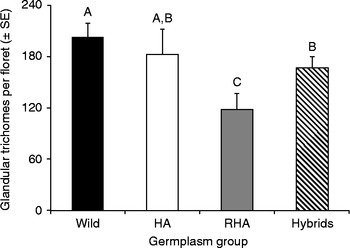
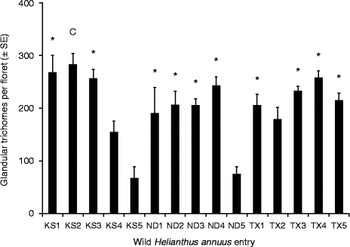
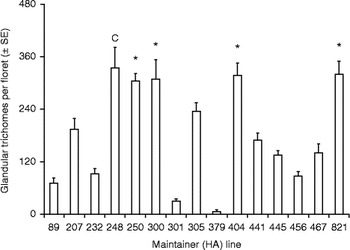
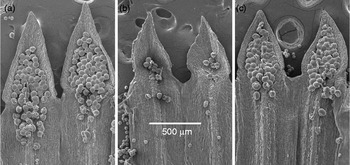
Across all the 68 entries, the mean number of glandular trichomes ranged from 2 to 334 per floret. The ANOVA carried out for the number of glandular trichomes per floret indicated differences between the groups (F= 8.75, df = 3, 176; P< 0.001), with wild sunflowers having a higher number than commercial hybrids and public restorer (RHA) lines; public maintainer (HA) lines were statistically similar to both wild sunflowers and commercial hybrids (Fig. 1). Differences within the groups were also apparent (df = 14, 30) for wild sunflowers (F= 6.91; P< 0.001; Fig. 2), maintainer lines (F= 24.39; P< 0.001; Fig. 3), restorer lines (F= 43.56; P< 0.001) and commercial hybrids (F= 17.62; P< 0.001; see online supplementary Table S1). Scanning electron micrographs revealed the range of glandular trichome abundance that can exist in wild sunflowers and inbred lines (Fig. 4). Among the entries with at least 50 glandular trichomes per floret, 1–45% of the glandular trichomes were dislodged during slide-mounting of the florets. The proportion of loose glandular trichomes appeared to vary among the entries (unless otherwise indicated, df = 14, 30) for wild sunflowers (F= 2.90; P= 0.007), maintainer lines (F= 17.71; P< 0.001), restorer lines (F= 3.44, df = 14, 29; P= 0.002) and commercial hybrids (F= 3.70; P= 0.001) (see online supplementary Table S1). The regression of glandular trichome number for 14 entries evaluated in 2013 onto the data for the same entries recorded in 2012 indicated consistent year-to-year estimates (y= 0.88x+0.93, R 2= 0.98), with glandular trichome counts for individual entries, on average, being about 10% less than that recorded in the previous year.
Mean number of capitate glandular trichomes per floret recorded in the sunflower germplasm types, including public maintainer (HA) and restorer (RHA) inbreds. Significant differences between the least-squares estimated means are indicated by different uppercase letters above the columns.

Mean number of capitate glandular trichomes per floret recorded in the 15 wild sunflower accessions originally collected from Kansas (KS), North Dakota (ND) and Texas (TX). Asterisks (*) above the columns indicate values similar to those recorded in the numerically highest entry (C), as indicated by Dunnett's test. Plant Introduction numbers for entries are given in online supplementary Table S1.

Mean number of capitate glandular trichomes per floret recorded in the 15 sunflower maintainer lines. Asterisks (*) above the columns indicate values similar to those recorded in the numerically highest entry (C), as indicated by Dunnett's test. Difference in the scale of y-axis is relative to that in Fig. 2.

Scanning electron micrographs (45 × magnification) of anther tips on sunflower florets. In the images, upper portions of the anther tubes, which were cut longitudinally and unfurled, are shown. Inbred lines (a) HA 300 and (b) HA 301 illustrate the wide variation in glandular trichome number in public and cultivated germplasm, while (c) PI 435556 (KS3 in Fig. 2) has a relatively high number of glandular trichomes for wild sunflower. Pollen grains are also visible as smaller, detached spheres in each image.

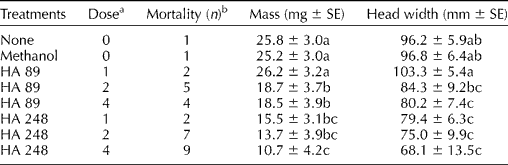
The artificial diet treated with glandular trichome extracts increased the mortality rates (χ2= 17.87, df = 7; P= 0.013) of H. electellum exposed from the neonatal stage to 9 d. In the surviving H. electellum larvae, glandular trichome extracts significantly reduced larval mass at 9 d (F= 5.72, df = 7, 202; P< 0.001), though one floret equivalent of HA 89 (lower glandular trichome line) was similar to the untreated and solvent-only controls; four floret equivalents of HA 248 (higher glandular trichome line) reduced larval mass to a greater extent than all the levels of HA 89. Glandular trichome extracts included in the diet also reduced head capsule width at 9 d (F= 5.22, df = 14, 29; P< 0.001), with differences among the treatments being similar to those observed in larval mass (Table 1).
Survival and development data recorded at 9 d in Homoeosoma electellum neonates exposed to sunflower glandular trichome extracts in a laboratory-based diet overlay

a Expressed in floret equivalents extracted and applied per cell.
b Among 32 larvae per treatment.
Significant differences are indicated by different lowercase letters (P< 0.05).
Discussion
Evaluation of several types of germplasm has revealed that capitate glandular trichomes are often abundant in cultivated sunflowers. Relative to wild H. annuus, inbred maintainer (HA) lines have a similar number of glandular trichomes per floret, while commercial hybrids have only ≈ 20% fewer trichomes; both these specific outcomes contradict previous reports that cultivated sunflowers are deficient in glandular trichomes (Gershenzon, Reference Gershenzon1984; Rossiter et al., Reference Rossiter, Gershenzon and Mabry1986; Rogers et al., Reference Rogers, Gershenzon, Ohno, Mabry, Stipanovic and Kreitner1987). However, because the capitate glandular trichomes of H. annuus germplasm contain several sesquiterpene lactones in differing amounts, a greater number of glandular trichomes may not provide greater resistance to insects. Within germplasm types, wild H. annuus or commercial hybrids exhibit only ≈ 5-fold differences in the mean number of trichomes per floret, while publicly released lines have ranges ≥ 50-fold. These differences are presumably the effects of outcrossing (wild and commercial hybrids) and inbreeding (HA and RHA) within sunflower germplasm types and suggest that purposeful development of inbreds or hybrids with high numbers of glandular trichomes is feasible.
Laboratory data indicate that the contents of glands present on cultivated sunflower florets limit the survival or development of the larvae of H. electellum, a primary pest of sunflower in the USA. The inhibitory effects of glandular trichomes of cultivated sunflowers on H. electellum follow logically from previous work on other sunflower lines. Diterpenes and sesquiterpene lactones from six wild annual and perennial Helianthus spp. have been shown to cause mortality or developmental delays in H. electellum (Rogers et al., Reference Rogers, Gershenzon, Ohno, Mabry, Stipanovic and Kreitner1987), and the primary sesquiterpene lactone of the perennial Helianthus maximiliani Schrad. has been shown to cause H. electellum mortality and avoidance (Rossiter et al., Reference Rossiter, Gershenzon and Mabry1986). It has been suggested that cultivated sunflowers lack sesquiterpene lactones (Mphosi and Foster, Reference Mphosi and Foster2010), but because sesquiterpene lactones have been repeatedly identified in the glandular trichomes of wild and cultivated H. annuus (Spring et al., Reference Spring, Priester, Stransky and Hager1985; Spring, Reference Spring1989; Chou and Mullin, Reference Chou and Mullin1993a, Reference Chou and Mullin1993b; Göpfert et al., Reference Göpfert, Heil, Conrad and Spring2005), it appears that cultivated sunflowers have the same type of terpenoid-based host plant resistance as wild sunflowers.
There are at least three potential limitations to the value of glandular trichomes for host plant resistance to H. electellum. First, the activity of pollinating insects may remove a large proportion of the glandular trichomes present on florets (Griffiths and Erickson, Reference Griffiths, Erickson, Jones and Little1983), as foraging for pollen and nectar results in physical contact with the glands. Though there was variability in the proportion of glands dislodged during slide-mounting, it is unclear whether the inbred lines that produced fewer loose trichomes on slides would also retain more glandular trichomes after pollinator visits (which might preserve resistance to insect pests). Second, H. electellum may avoid glandular trichomes at the distal end of anthers. While neonates would usually need to crawl over glandular trichomes to access pollen within the anther tube, if enough pollen can be scavenged (e.g. fallen between the corolla and anther tube, where H. electellum often oviposit) to develop to second instar, larvae may be strong enough to obtain more pollen by chewing through the corollas of nearby florets (Rossiter et al., Reference Rossiter, Gershenzon and Mabry1986). Finally, later-instar H. electellum may simply overcome glandular trichome defence, because of the ability to tolerate higher levels of sesquiterpene lactones (Rossiter et al., Reference Rossiter, Gershenzon and Mabry1986).
It is possible that the value of sunflower glandular trichomes (and sesquiterpene lactones) may be greater for other herbivores than for H. electellum. Extracts from H. maximiliani lead to feeding avoidance by generalist herbivores including migratory grasshopper, Melanoplus sanguinipes (Fabricius), and southern armyworm, Spodoptera eridania (Stoll) (Gershenzon et al., Reference Gershenzon, Rossiter, Mabry, Rogers, Blust, Hopkins and Hein1985), while extracts from cultivated sunflowers deter feeding by western corn rootworm, Diabrotica virgifera virgifera LeConte (Chou and Mullin, Reference Chou and Mullin1993b). Because the sesquiterpene lactones in sunflower florets are developed several days prior to anthesis (Göpfert et al., Reference Göpfert, Heil, Conrad and Spring2005), this type of chemical defence could be effective against species that feed on unopened florets, such as Melanagromyza minimoides Spencer, which causes significant damage to florets and seeds of late-planted sunflowers in South America (Zerbino, Reference Zerbino1991; Ves Losada and Figueruelo, Reference Ves Losada and Figueruelo2006).
The successful use of glandular trichomes for host plant resistance in sunflower requires additional knowledge and tools. Minimally, the inheritance of glandular trichome number should be understood and genetic markers established to facilitate efficient breeding; in the process, lines that allow for more controlled field testing of the effects of glandular trichomes would be developed. The effects of single or combined sesquiterpene lactones on the development of target pests should be investigated; in particular, there may be compounds present in wild H. annuus germplasm that are deficient in cultivated material. Because the sesquiterpene lactone composition of glandular trichomes on leaves and florets are similar (Rowe et al., Reference Rowe, Ro and Rieseberg2012), it may be possible to rapidly phenotype young plants to select for increased levels of one or more sesquiterpene lactones. Recent research has also revealed the presence of key enzymes of sesquiterpene lactone biosynthesis in capitate glandular trichomes (Göpfert et al., Reference Göpfert, MacNevin, Ro and Spring2009) and documented the distribution of less well-known linear glandular trichomes in cultivated sunflowers (Aschenbrenner et al., Reference Aschenbrenner, Horvath and Spring2013), suggesting additional avenues to improve host plant resistance to sunflower insect pests.
Supplementary material
To view supplementary material for this article, please visit http://dx.doi.org/10.1017/S1479262114000653
Acknowledgements
The author thanks Laura Marek (Iowa State University) and Irvin Larsen (USDA-ARS, North Central Regional Plant Introduction Station) for providing the wild sunflower germplasm and Rick Hellmich (USDA-ARS, Corn Insects and Crop Genetics Research Unit), Gerald Seiler (USDA-ARS, Sunflower and Plant Biology Research Unit) and two anonymous reviewers for assisting in the revision of the manuscript.