1. Introduction
Southern Hunan Province is located at the intersection of the Shi–Hang Zone and the Nanling Belt and is characterized by the occurrence of extensive Mesozoic magmatic rocks and coeval polymetallic deposits. These deposits can be divided into granite-related skarn W–Sn (∼155 Ma) and granodiorite porphyry-related skarn (Cu)–Pb–Zn (∼160 Ma) polymetallic mineralization, with the latter mineralization having formed c. 5 Ma earlier than the former (e.g. Mao et al. Reference Mao, Cheng, Chen and Pirajno2013, Reference Mao, Zheng, Xie, Lehmann and Goldfarb2021; Ding et al. Reference Ding, Ma, Lu and Zhang2015). In general, the W–Sn deposits related to granites also contain minor Pb–Zn mineralization in this area, including the Xintianling and Xitian W–Pb–Zn deposits (e.g. Yao et al. Reference Yao, Chen, Lu and Zhang2013; Zhang, Reference Zhang2014) and the Hehuaping and Xianghualing Sn–Pb–Zn deposits (e.g. Yuan et al. Reference Yuan, Peng and Shen2007; Yao et al. Reference Yao, Chen, Lu, Wang and Zhang2014). Unlike the proximal W–Sn mineralization, which has a close temporal–spatial relationship with granites, the sources of Pb–Zn mineralization within these deposits have not yet been clarified, mainly because of the unknown ages of the distal orebodies. In addition, previous studies have suggested that granitoids related to W–Sn and (Cu)–Pb–Zn mineralization generate reducing and oxidizing conditions, respectively (e.g. Ding et al. Reference Ding, Ma, Lu and Zhang2015, Reference Ding, Wang, Tan, Ma, Lu, Zhang, Liang, Zhu and Wu2021). These uncertainties and variability have meant that the relationship between W–Sn and Pb–Zn mineralization in these particular deposits remains unclear.
The Huangshaping deposit is typical of W–Sn–Pb–Zn deposits in southern Hunan Province, hosting significant W–Mo and Pb–Zn mineralization with 152.9 kt WO3 at a grade of 0.2 %, 43.2 kt Mo at 0.2 %, 761.3 kt Pb at 3.55 %, and 1.5 Mt Zn at 7.13 % (Huang et al. Reference Huang, Li, Wang and Liu2013). The W–Mo and Pb–Zn mineralization in this deposit occur as proximal and distal orebodies, respectively, similar to other deposits in southern Hunan Province. However, previous studies have shown that sulphides of the Pb–Zn mineralization from the Huangshaping deposit are extremely enriched in relatively heavy sulphur compared with other deposits within southern Hunan (e.g. Xi et al. Reference Xi, Dai and Liu2009; Zhu et al. Reference Zhu, Wang, Wang, Cheng and Fu2012; Ding et al. Reference Ding, Ma, Lu, Zhang and Zhang2016 b), suggesting that the sources for the Pb–Zn mineralization in this deposit may be more complicated than other cases. Various investigations into the polymetallic mineralization processes in this deposit have been conducted using different measures and indicators, such as petrological and mineralogical features of ore-bearing granite (e.g. Ding et al. Reference Ding, Ma, Lu, Zhang, Zhang and Gao2016 c, Reference Ding, Ma, Lu, Zhang and Zhang2017), dating of molybdenite and hydrothermal K-feldspar (Ma et al. Reference Ma, Lu, Qu and Fu2007; Yao et al. Reference Yao, Hua, Qu, Qi, Lin and Du2007; Lei et al. Reference Lei, Cen, Chen, Xu, Gong, Li, Mei, Qu and Wang2010; Qi et al. Reference Qi, Zhang, Zhu, Li, Zhen, Gong, Gong and He2012; Li et al. Reference Li, Yonezu, Watanabe and Tindell2017), fluid inclusions and trace-element compositions of skarn minerals (e.g. Huang et al. Reference Huang, Li, Wang and Liu2013; XF Li et al., Reference Li, Huang, Wang and Wang2016; Ding et al. Reference Ding, Ma, Lu and Zhang2018 a, b; Zhu et al. Reference Zhu, Li, Algeo, Jiang and Wang2021), and S–Pb–Sr isotopic compositions of sulphides (e.g. Xi et al. Reference Xi, Dai and Liu2009; Zhu et al. Reference Zhu, Wang, Wang, Cheng and Fu2012; Ding et al. Reference Ding, Ma, Lu, Zhang and Zhang2016 b). However, the relationship between W–Mo and Pb–Zn mineralization is not yet fully understood. The reasons for this include the lack of comprehensive studies of both W–Mo and Pb–Zn mineralization, the distinct mineral assemblages of these two mineralization stages, and the low availability of indicators that can record the physicochemical conditions for both stages at the same time.
Sulphur is an essential element that generally resides in terrestrial reservoirs by local concentration in mineralized systems typically associated with ore deposits as sulphide and sulphate minerals (e.g. LaFlamme et al. Reference LaFlamme, Martin, Jeon, Reddy, Selvaraja, Caruso, Bui, Roberts, Voute, Hagemann, Wacey, Littman, Wing, Fiorentini and Kilburn2016, Reference LaFlamme, Jamieson, Fiorentini and Thébaud2018 a, b). Numerous studies using sulphur isotopes as indicators have been conducted to investigate sulphide mineralization mechanisms under a variety of geological settings (e.g. Shanks, Reference Shanks2001; Hannington et al. Reference Hannington, de Ronde, Petersen, Hedenquist, Thompson, Goldfarb and Richards2005; Seal, Reference Seal2006; Peters et al. Reference Peters, Strauss, Farquhar, Ockert, Eickmann and Jost2010). For the Huangshaping deposit, sulphides can occur in both proximal W–Mo (pyrite, arsenopyrite, molybdenite and chalcopyrite) and distal Pb–Zn (chalcopyrite, pyrrhotite, pyrite, sphalerite and galena) orebodies, generally corresponding to high- and low-temperature stages of mineralization, respectively (e.g. Ding et al. Reference Ding, Ma, Lu, Zhang and Zhang2016 b, Reference Ding, Ma, Lu and Zhang2018 a, b, Reference Ding, Wang, Tan, Ma, Lu, Zhang, Liang, Zhu and Wu2021). Therefore, sulphur isotopic compositions of sulphides from this deposit could be good indicators of the relationship between W–Mo and Pb–Zn mineralization. In addition, chemical zonation and intra- and inter-grain chemical and isotopic variations are common in sulphide mineralized systems, and in situ measurements of sulphur isotopes at high spatial resolution therefore enable information about sulphide growth history, which cannot be gained through bulk analytical measurements, to be obtained from a single sample grain (e.g. Heinrich & Eadington, Reference Heinrich and Eadington1986; Craig et al. Reference Craig, Vokes and Solberg1998). For this study, in situ laser-ablation – multicollector – inductively coupled plasma – mass spectrometry (LA-MC-ICP-MS) sulphur isotopic composition analyses were conducted on sulphide samples from the Huangshaping deposit. This paper reports results of these analyses, infers the mineralization processes that took place in this deposit, and determines the relationship between W–Mo and Pb–Zn mineralization in this deposit.
2. Geological background
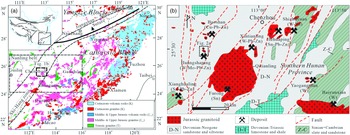
The Cathaysia Block and the Yangtze Block amalgamated along the Jiangshan–Shaoxin Suture at 970 Ma during the Jinning orogenic event (Li & McCulloch, Reference Li and McCulloch1996). The Cathaysia Block records intensive Jurassic–Cretaceous magmatism that formed a belt of igneous rocks that young towards the coast (Fig. 1a; Zhou et al. Reference Zhou, Sun, Shen, Shu and Niu2006).The intrusive and volcanic rocks of this period include a belt of granites with high Sm (>8 ppm) and Nd (>45 ppm) contents, ϵ Nd(t) values greater than −8, and young Nd model ages (T DM < 1.5 Ga; Gilder et al. Reference Gilder, Gill, Coe, Zao, Liu, Wang, Yuan, Liu, Kuang and Wu1996). The granites form a belt that is approximately parallel to two NE–SW-trending Mesozoic grabens located between Hangzhou (Zhejiang Province) and Shiwandashan (Guangxi Province). This belt, termed the Shi–Hang Zone, is closely associated with Cu–Mo–Pb–Zn polymetallic deposits (Fig. 1a; Ding et al. Reference Ding, Ma, Lu and Zhang2015 and references therein). The Nanling Belt, which runs through Guangxi, Hunan, Jiangxi and Guangdong provinces, contains W–Sn–Cu–Pb–Zn polymetallic deposits associated with granitoids (Fig. 1a; Mao et al. Reference Mao, Cheng, Chen and Pirajno2013).
(a) Distribution of Mesozoic intrusive and volcanic rocks in southeastern China (modified from Zhou et al. Reference Zhou, Sun, Shen, Shu and Niu2006). Locations of the Shi–Hang zone and Nanling belt are from Jiang et al. (Reference Jiang, Jiang, Dai, Liao, Zhao and Ling2009), Li et al. (Reference Li, Hu, Hua, Ma, Wu, Qi and Peng2013) and Mao et al. (Reference Mao, Cheng, Chen and Pirajno2013). (b) Distribution of Jurassic igneous rocks and associated polymetallic mineral deposits in southern Hunan Province, including the Huangshaping deposit.

Southern Hunan Province lies within the Cathaysia Block at the intersection of the Shi–Hang Zone and the Nanling Belt, where Neoproterozoic–Palaeozoic continental and neritic marine sediments cover Palaeo- to Mesoproterozoic metamorphic basement (Yu et al. Reference Yu, Wei, Wang, Shu and Sun2006; Zheng et al. Reference Zheng, Griffin, O’Reilly, Zhang, Pearson and Pan2006; Wang et al. Reference Wang, Fan, Sun, Liang, Zhang and Peng2007). Granitic rocks that occur in southern Hunan Province can be divided into granites that formed by the melting of crustal material and granodiorite porphyries that formed from a mixture of crustal- and mantle-derived material; the former are associated with W and Sn polymetallic mineralization, and the latter are related to skarn-type Cu–Mo–Pb–Zn polymetallic deposits (Fig. 1b). All of these deposits are hosted by Devonian and Carboniferous carbonates, and the substantial endowment of southern Hunan Province means that this region has been the focus of considerable geological and mineral research and exploration (e.g. Hua et al. Reference Hua, Zhang, Gu and Chen2007; Li et al. Reference Li, Hu, Hua, Ma, Wu, Qi and Peng2013; Mao et al. Reference Mao, Cheng, Chen and Pirajno2013).
3. Geology of the Huangshaping deposit
3.1. Stratigraphy and structure
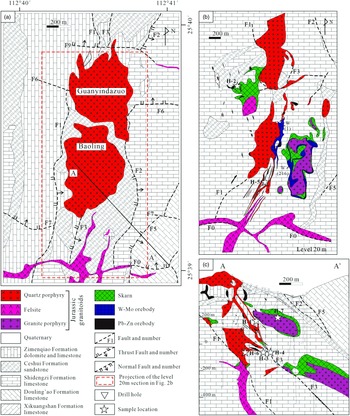
The Huangshaping deposit lies northwest of the Qitianling batholith (Fig. 1b). Sedimentary rocks of the deposit are predominantly neritic marine sediments, including limestones of the Upper Devonian Xikuangshan and lower Carboniferous Douling’ao and Shidengzi formations, Ceshui Formation sandstone, and Zimenqiao Formation dolomite and limestone (Fig. 2a, b). The Shidengzi Formation limestone is the main host of W–Mo–Pb–Zn mineralization (Fig. 2c; Tong, Reference Tong1986). The dominant structure is the N–S-trending Guanyindazuo–Baoling inverted anticline, with a core of Shidengzi Formation rocks and limbs comprising the Ceshui and Zimenqiao formations (Fig. 2b–c). Three N–S-trending thrust faults (F1, F2 and F3) occur within the anticlinal axis and limbs (Fig. 2a). These faults, particularly F3, control the location of most of the Pb–Zn reserves (Fig. 2b–c). Several E–W- and WNW–ENE-trending normal faults (F0, F6, F7 and F9) occur within the deposit (Fig. 2a–b). The intersection of these faults and the anticline forms a cross-hatch-shaped structure that controls both the outcrop pattern of granitoids and the locations of W–Mo–Pb–Zn mineralization.
(a) Geological map of the Huangshaping deposit. (b) Simplified geological maps of the Huangshaping deposit at the 20 m level. (c) Geological cross-section through the Huangshaping deposit. Stars in (b) and (c) represent sampling locations of the sulphides analysed in this study. Abbreviations H-1 to H-7 correspond to 11HSP-26, -50, -82, -99, -135, 1212HSP14 and 11702-12, respectively.

3.2. Granitoids
3.2.1. Quartz porphyry, felsite, and granite porphyry
The Huangshaping deposit is associated with hypabyssal granitoids, which are divided into quartz porphyry, felsite, and granite porphyry on the basis of mineralogy, geochemistry and texture. The mineral assemblage of the quartz porphyry is limited to quartz and minor K-feldspar phenocrysts. Felsite has an aphyric texture generally devoid of phenocrysts and comprises monzogranite and syenogranite (Ding et al. Reference Ding, Ma, Lu, Zhang, Zhang and Gao2016 c). Granite porphyry is composed of K-feldspar, plagioclase, quartz, and minor biotite phenocrysts. Igneous rocks exposed in the deposit include quartz porphyry and weathered felsite, whereas granite porphyry occurs below the southeastern part of the deposit (Fig. 2b–c). The contacts between quartz porphyry and felsite are faults, but whether faulting caused intercalations of granite porphyry and other granitoids is uncertain (Fig. 2b–c). All three types of granitoid contain similar accessory minerals, including primary zircon and apatite, as well as secondary sulphides and fluorite. Wolframite, columbite and molybdenite also occur in the granite porphyry, suggesting a close relationship between granite porphyry and W–Mo mineralization in this deposit (Ding et al. Reference Ding, Ma, Lu, Zhang and Zhang2017).
Previous studies have determined that the intrusions are silicic, with SiO2 contents of >70 wt %. Their aluminium saturation index values of 0.7–1.6 indicate that the granitoids are metaluminous or peraluminous, and their K2O contents of 3.7–7.0 wt % classify them as high-K calc-alkaline to shoshonitic igneous rocks (Yao et al. Reference Yao, Hua and Lin2005; Li et al. Reference Li, Watanabe and Yonezu2014; Ding et al. Reference Ding, Ma, Lu, Zhang, Zhang and Gao2016 c). Geochronological data indicate two periods of igneous activity, with quartz porphyry forming at 160.5 ± 1.3 Ma, and felsite and granite porphyry at 156.6 ± 1.4 and 155.3 ± 1.6 Ma, respectively (Ding et al. Reference Ding, Ma, Lu, Zhang, Zhang and Gao2016 c and references therein). Further support for distinct episodes of igneous activity is provided by Sr–Nd–Hf–Pb isotopic compositions, which show that the felsite and granite porphyry are co-magmatic and formed as a result of partial melting of metamorphic basement within the upper crust (Li et al. Reference Li, Watanabe and Yonezu2014; Ding et al. Reference Ding, Ma, Lu, Zhang, Zhang and Gao2016 c). In contrast, quartz porphyry associated with the Huangshaping deposit was formed by melting of metamorphic basement rocks within the lower crust, with input of coeval basaltic magma (Li et al. Reference Li, Watanabe and Yonezu2014; Ding et al. Reference Ding, Ma, Lu, Zhang, Zhang and Gao2016 c).
3.2.2. Granodioritic enclaves in quartz porphyry
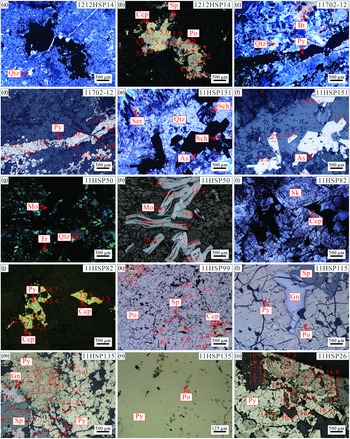
Granodioritic enclaves occur in the quartz porphyry in the Huangshaping deposit, forming ellipsoidal or lens-shaped bodies with diameters of 5–40 cm. Some enclaves are strongly altered, have porphyritic textures with feldspar and quartz phenocrysts, and contain primary euhedral zircon and apatite as common accessory minerals (Ding et al. Reference Ding, Ma, Lu, Zhang, Zhang and Gao2016 c). Zircons from the granodioritic enclaves yield a weighted mean U–Pb age of 160.2 ± 1.6 Ma, which is within error of the age of the host quartz porphyry (160.5 ± 1.3 Ma), indicating that the enclaves crystallized at the same time as the host quartz porphyry (Ding et al. Reference Ding, Ma, Lu, Zhang, Zhang and Gao2016 c). Two-stage Hf model ages, TDMC(Hf), of zircons from the enclaves are in the range 1.91–1.59 Ga, much older than those of quartz porphyry (1.61–1.32 Ga) and granite porphyry (1.72–1.42 Ga; Ding et al. Reference Ding, Ma, Lu, Zhang, Zhang and Gao2016 c), but consistent with those of Pb–Zn-bearing granodiorite porphyries in the area, such as in the Tongshanling (1.83–1.65 Ga; Jiang et al. Reference Jiang, Jiang, Dai, Liao, Zhao and Ling2009) and Baoshan (2.08–1.77 Ga; Xie et al. Reference Xie, Lu, Ma, Zhang, Gao and Yao2013) deposits. Calculated rare earth element patterns of the granodioritic enclaves, based on their apatite contents, are similar to those of granodiorite porphyries in the area (e.g. the Tongshanling and Baoshan deposits) but distinct from those of granitoids in the Huangshaping deposit (Ding et al. Reference Ding, Ma, Lu, Zhang, Zhang and Gao2016 c). The granodioritic enclaves thus represent an end-member magma that was added to the quartz porphyry magma chamber and was derived from melting of lower crust compositionally similar to that forming the Pb–Zn-bearing granodiorite porphyries in southern Hunan Province. It is particularly relevant that these granodioritic enclaves host abundant sulphides, including chalcopyrite, pyrrhotite and sphalerite, which coexist in the enclaves and form discrete grains (Fig. 3a–b). These sulphides are distinct from secondary sulphides, which include mainly pyrite and generally occur as veinlets cross-cutting granitoids (Fig. 3c–d; Ding et al. Reference Ding, Ma, Lu, Zhang and Zhang2016 b).
Photomicrographs showing the occurrence of sulphides in granodioritic enclaves, proximal W–Mo, and distal Pb–Zn mineralization. Circles represent the analysed spots, which are labelled with their δ34S values (in ‰). (a–b) Chalcopyrite, pyrrhotite and sphalerite coexisting in granodioritic enclaves as discrete grains ((a) cross-polarized light; (b), reflected light); (c–d) pyrite vein cross-cutting granite porphyry ((c) cross-polarized light; (d) reflected light); (e–f) arsenopyrite and minor scheelite hosted in sericite, and quartz vein cross-cutting granite porphyry ((e) cross-polarized light; (f) reflected light); (g–h) molybdenite replacing tremolite ((g) cross-polarized light; (h) reflected light); (i–j) chalcopyrite with pyrite replacing early skarn minerals ((i) cross-polarized light; (j) reflected light); (k) massive pyrrhotite containing minor chalcopyrite and sphalerite (reflected light); (l) pyrrhotite replaced by pyrite, sphalerite and galena (reflected light); (m) colloform pyrite surrounded by crystallized pyrite, both of which are surrounded by sphalerite, which is replaced by galena (reflected light); (n) pyrrhotite replaced by pyrite with relicts retained (reflected light); (o) oolitic pyrite surrounded by crystallized pyrite (reflected light). Qtz – quartz; Ccp – chalcopyrite; Sp – sphalerite; Po – pyrrhotite; Bt – biotite; Py – pyrite; Ser – sericite; Sch – scheelite; As – arsenopyrite; Mo – molybdenite; Tr – tremolite; Sk – skarn; Gn – galena.

3.3. Alteration and mineralization
3.3.1. W–Mo mineralization
Skarn occurs in a contact zone between granitoids and Shidengzi Formation limestones, with the most complete skarn development being around granite porphyry (Fig. 2b–c). Skarn alteration of limestone is zoned outward from potassic-altered granite porphyry to proximal garnet–diopside and tremolite. The potassic-altered granite porphyry is usually cross-cut by pyrite veins (Fig. 3c–d). Sericitization with abundant arsenopyrite and minor scheelite also occurs in this potassic-altered granite porphyry (Fig. 3e–f). Disseminated abundant scheelite and minor molybdenite are found in the proximal garnet–diopside skarn, which hosts significant W resources, including the No. W216 orebody, which occurs close to the granite porphyry and contains 88 % of known scheelite reserves in the deposit (Fig. 2b). The remaining 12 % of reserves are contained in the No. W1 orebody, which is close to the quartz porphyry intrusion, but are closely associated with the underlying felsite (Fig. 2b; Ding et al. Reference Ding, Ma, Lu, Zhang and Zhang2016 b). The tremolite zone contains actinolite, abundant disseminated molybdenite, and minor scheelite (Fig. 3g–h). Calcite and fluorite are the main gangue minerals, cross-cutting scheelite and molybdenite ores, and these can also host abundant scheelite and molybdenite. Fluid inclusions in garnet and disseminated scheelite and fluorite yield homogenization temperatures (T h) of 528–600 °C, 400–460 °C and 250–303 °C, respectively (Huang et al. Reference Huang, Li, Wang and Liu2013; Li et al. Reference Li, Liu, Ye, Liao, Qian and Wang2016).
Sulphide–quartz mineralization in the Huangshaping deposit is weakly developed and commonly occurs as veinlets cutting skarn, whereas sulphide veinlets containing chalcopyrite, pyrite and molybdenite cut early garnet and scheelite (Fig. 3i–j; Ding et al. Reference Ding, Ma, Lu, Zhang and Zhang2016 b). Fluid inclusions in quartz have T h values of 300–340 °C, lower than those of garnet and scheelite in proximal skarn (Huang et al. Reference Huang, Li, Wang and Liu2013; Li et al. Reference Li, Liu, Ye, Liao, Qian and Wang2016). Distal skarn is represented by a marble zone adjacent to unaltered limestone. The timing of skarn formation and mineralization has been defined by Re–Os isochron ages of 159.4 ± 3.3 to 153.8 ± 4.8 Ma for molybdenite in W–Mo skarn (Ma et al. Reference Ma, Lu, Qu and Fu2007; Yao et al. Reference Yao, Hua, Qu, Qi, Lin and Du2007; Lei et al. Reference Lei, Cen, Chen, Xu, Gong, Li, Mei, Qu and Wang2010; Qi et al. Reference Qi, Zhang, Zhu, Li, Zhen, Gong, Gong and He2012) and 40Ar/39Ar ages of 154.3 ± 0.6 to 152.9 ± 0.5 Ma for hydrothermal K-feldspar (Li et al. Reference Li, Yonezu, Watanabe and Tindell2017). These ages are within analytical error of the 155.2 ± 0.4 Ma age of the granite porphyry (Yuan et al. Reference Yuan, Yuan, Chen and Huo2014; Ding et al. Reference Ding, Ma, Lu, Zhang, Zhang and Gao2016 c), supporting a genetic relationship between the granite porphyry and W–Mo mineralization.
3.3.2. Pb–Zn mineralization
The Pb–Zn mineralization formed during a sulphide–carbonate stage of mineralization, with this stage hosting almost all of the pyrrhotite, pyrite, sphalerite and galena in the Huangshaping deposit (Tong, Reference Tong1986; Xi et al. Reference Xi, Dai and Liu2009; Zhu et al. Reference Zhu, Wang, Wang, Cheng and Fu2012; Ding et al. Reference Ding, Ma, Lu, Zhang and Zhang2016 b, Reference Ding, Wang, Tan, Ma, Lu, Zhang, Liang, Zhu and Wu2021). These sulphides are hosted by distal carbonate sediments and occur as vein-type, stratiform, and lens-shaped zones of mineralization in Shidengzi Formation limestones, Ceshui Formation sandstones and Zimenqiao Formation dolomitic limestones (Fig. 2b–c; Ding et al. Reference Ding, Ma, Lu, Zhang and Zhang2016 b, Reference Ding, Wang, Tan, Ma, Lu, Zhang, Liang, Zhu and Wu2021). The sulphide orebodies are located beneath hanging-wall rocks of Ceshui Formation sandstone and the quartz porphyry intrusion within the upper section of the Huangshaping deposit (Fig. 2b–c; Tong, Reference Tong1986). The Pb–Zn orebodies within the same level of the deposit are isolated (Fig. 2b), but are located along faults that acted as pathways for ore-forming fluids (Fig. 2c). Sulphide ores within the deposit are massive and dominated by sphalerite and galena, with pyrrhotite and pyrite in calcite and fluorite gangue (Fig. 3k–o). The Huangshaping deposit is zoned vertically, with the abundance of pyrrhotite decreasing and that of pyrite increasing upward within the deposit (Xi et al. Reference Xi, Dai and Liu2009; Zhu et al. Reference Zhu, Wang, Wang, Cheng and Fu2012; Ding et al. Reference Ding, Ma, Lu, Zhang and Zhang2016 b).
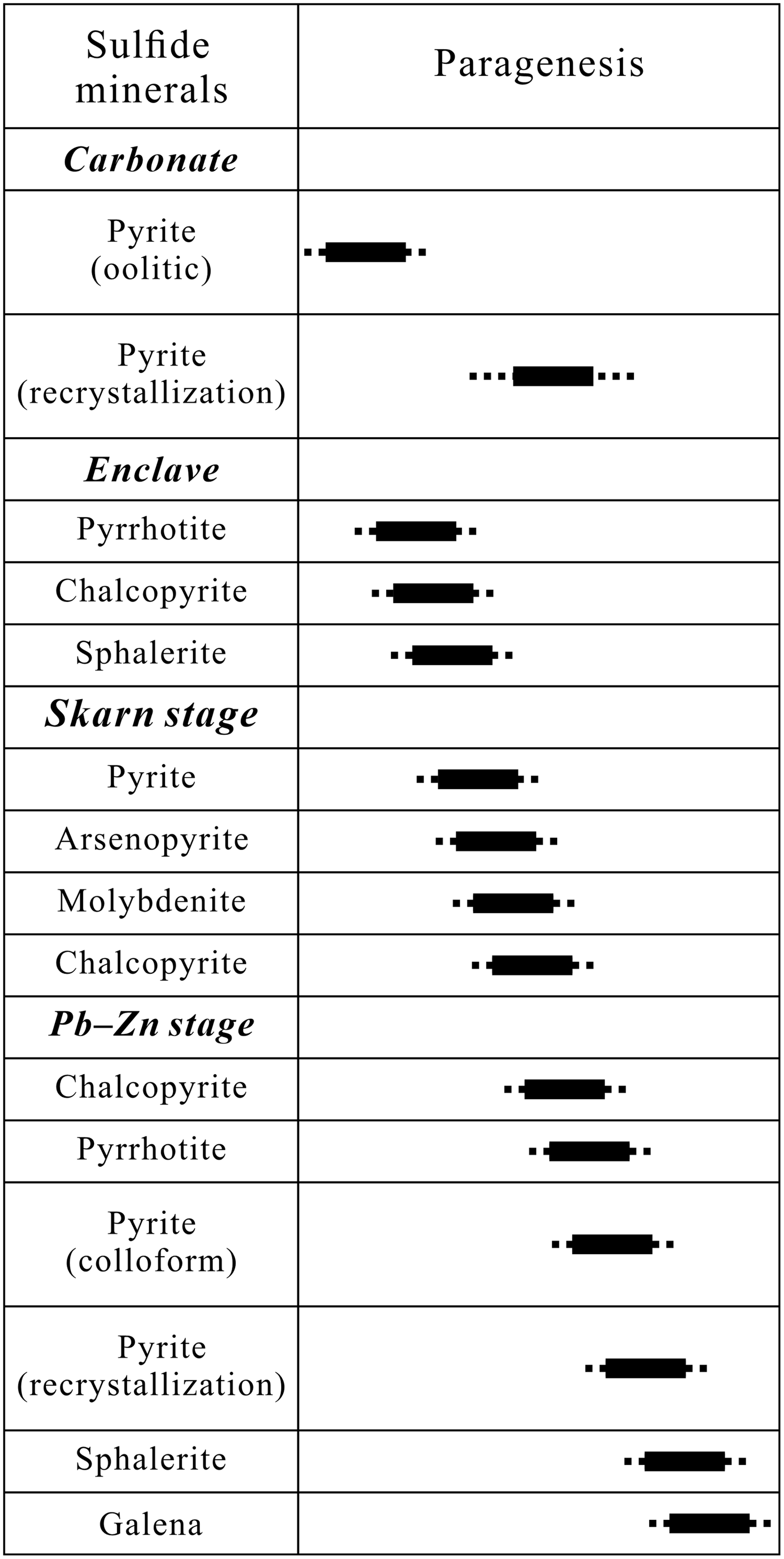
Pyrrhotite is generally massive, with minor coexisting chalcopyrite and sphalerite, indicating that these sulphides precipitated first in the ores and under higher temperatures than the other sulphides in this stage (Fig. 3k). Pyrrhotite was then replaced by pyrite, sphalerite and galena (Fig. 3l–m). In some cases, pyrrhotite is completely replaced by pyrite, retaining pseudomorphic textures or relicts of the original mineral (Fig. 3m–n). Pyrite is more commonly colloform and surrounded by recrystallized pyrite (Fig. 3m). The abundance of colloform pyrite generally increases outward in the sulphide ores from the granitoids to surrounding strata and can easily be distinguished from the recrystallized pyrite on the basis of its turbid appearance and concentric zonation. In addition to that coexisting with pyrrhotite, sphalerite can also replace pyrite in the sulphide ores (Fig. 3l–m), indicating that most sphalerite was precipitated after pyrite, which in turn formed before galena (which generally replaced all the other sulphides; Fig. 3l–m). Oolitic pyrite surrounded by recrystallized pyrite can be observed in the ores from the top of the Huangshaping deposit (Fig. 3o). Calcite and fluorite gangue minerals host fluid inclusions that homogenize at 160–240 °C, with no obvious evidence of boiling (Huang et al. Reference Huang, Li, Wang and Liu2013; Li et al. Reference Li, Liu, Ye, Liao, Qian and Wang2016). The paragenesis of most sulphides of the Huangshaping deposit is summarized in Figure 4.
Paragenetic sequence of the major sulphides found in the Huangshaping deposit.

4. Methods
Thin-sections of samples from the Baoshan deposit and nearby strata were prepared for mineralogical examination with reflected and transmitted light under a petrographic microscope. Sulphur isotopic compositions of sulphide minerals were determined in situ using a 193 nm ArF excimer LA system (RESOlution S-155) connected to an MC-ICP-MS instrument (Nu Plasma II) at the State Key Laboratory for Geological Processes and Mineral Resources, China University of Geosciences, Wuhan, China. Secondary and backscattered electron images were used to select spots for analysis, avoiding defects and contamination from different sulphide minerals. The in situ LA-MC-ICP-MS analytical procedure followed the protocol defined by Zhu et al. (Reference Zhu, Cook, Yang, Ciobanu, Zhao and Jiang2016), and detailed descriptions of this technique have been reported by Mason et al. (Reference Mason, Kosler, de Hoog, Sylvester and Meffan-Main2006), Craddock et al. (Reference Craddock, Rouxel, Ball and Bach2008) and Bühn et al. (Reference Bühn, Santos, Dardenne and de Oliveira2012). In brief, helium carrier gas was used at 0.4 L min−1 and mixed with Ar (0.8 L min−1) and N2 (∼4 mL min−1) (the addition of N2 eliminates polyatomic interferences such as 16O2+; Fu et al. Reference Fu, Hu, Zhang, Yang, Liu, Li, Zong, Gao and Hu2016). The laser beam diameter was 33 μm, with a repetition rate of 10 Hz for single spot analyses, and an energy of 3–4 J cm−2, with the ablation process lasting 40 s. An in-house pyrite standard WS-1, consisting of a natural pyrite crystal from the Wenshan polymetallic skarn deposit (Yunnan Province, South China), was used to calibrate the mass bias for S isotopes. The δ34S composition of WS-1 (1.1 ± 0.2 ‰) was determined by secondary ion mass spectrometry at the Chinese Academy of Geochemistry, Guangzhou, China (Zhu et al. Reference Zhu, Cook, Yang, Ciobanu, Zhao and Jiang2016). Secondary reference material WS-2 pyrite (δ34S = 2.2 ‰) was used to monitor the accuracy of the results of analyses. All sulphur isotopic compositions are given in the usual δ34S notation as per mil difference from the Vienna Canyon Diablo Troilite (V-CDT) reference. The true sulphur isotope ratio of unknown samples was calculated by correcting for instrumental mass bias by linear interpolation between the biases calculated from two neighbouring standard analyses (WS-1; Chen et al. Reference Chen, Yuan, Chen, Bao, Zhu and Liang2019). The internal analytical precision is given as 2 standard errors (2σ), most of which are better than ±0.5 ‰ (2σ). The δ34S compositions of pyrite standards WS-1 and WS-2 obtained in this study range from 0.9 ‰ to 1.3 ‰ and 1.8 ‰ to 2.6 ‰, with averages as 1.0 ± 0.2 ‰ and 2.2 ± 0.2 ‰, respectively (Supplementary Table 1, available online at https://doi.org/10.1017/S0016756822000188), which are consistent with the given values.
5. Results
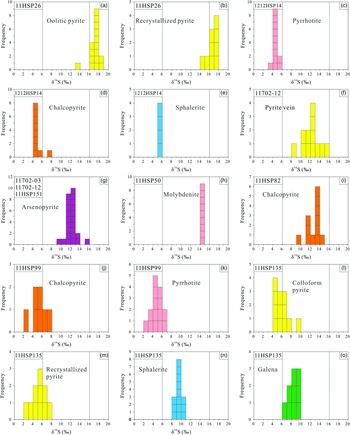
Isotopic compositions for pyrite, arsenopyrite, molybdenite, chalcopyrite, pyrrhotite, sphalerite and galena analysed during this study are summarized in Supplementary Table 1 (available online at https://doi.org/10.1017/S0016756822000188) and displayed in Figures 5 and 6. Representative analysed spots and corresponding δ34S values for the sulphides are presented in Figure 3. All of the analysed results in this study are consistent with the range of published data obtained by bulk analysis of separated sulphide grains (Xi et al. Reference Xi, Dai and Liu2009; Zhu et al. Reference Zhu, Wang, Wang, Cheng and Fu2012; Ding et al. Reference Ding, Ma, Lu, Zhang and Zhang2016 b). Please note that although the sulphur isotopic compositions of different parts of the sulphides have been analysed, no obvious isotopic zonations have been observed (Fig. 3). This means that the sulphide grains from the Huangshaping deposit are generally homogeneous, and the δ34S values obtained in this study can be representative.
Histograms of sulphur isotopic compositions for sulphides from the Huangshaping deposit.

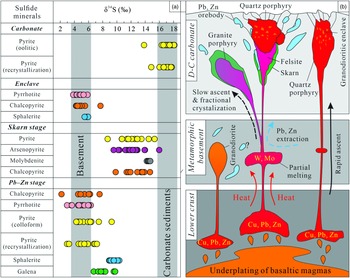
(a) Paragenesis and corresponding sulphur isotopic compositions for sulphides from the Huangshaping deposit. (b) Model of metallogenesis for the Huangshaping W–Mo–Pb–Zn deposit.

For sulphides closely associated with carbonate sediments, oolitic pyrite and the recrystallized pyrite around it have the highest δ34S values within the Huangshaping deposit, ranging from 13.8 ‰ to 18.1 ‰ and 14.9 ‰ to 17.8 ‰, respectively (Supplementary Table 1, available online at https://doi.org/10.1017/S0016756822000188; Fig. 5a–b), and mostly higher than 16 ‰ (Fig. 6a).
For sulphides hosted in granodioritic enclaves, pyrrhotite, chalcopyrite and sphalerite have the lowest δ34S values in this deposit, ranging from 3.8 ‰ to 5.9 ‰, 4.2 ‰ to 7.7 ‰, and 5.4 ‰ to 5.9 ‰, respectively (Supplementary Table 1, available online at https://doi.org/10.1017/S0016756822000188; Fig. 5c–e), and mostly lower than 6 ‰ (Fig. 6a).
For sulphides in the proximal skarn system, pyrite veins cross-cutting granite porphyry, arsenopyrite, molybdenite and chalcopyrite have generally high δ34S values, ranging from 8.7 ‰ to 15.3 ‰, 9.5 ‰ to 16.0 ‰, 14.2 ‰ to 14.7 ‰, and 9.8 ‰ to 14.7 ‰, respectively (Supplementary Table 1, available online at https://doi.org/10.1017/S0016756822000188; Fig. 5f–i). All of the sulphides in the proximal skarn system have δ34S values between those of the sulphides in the carbonate and enclaves, and molybdenite shows the most uniform δ34S values (Fig. 6a).
For sulphides in the distal Pb–Zn orebodies, chalcopyrite, pyrrhotite, colloform pyrite, recrystallized pyrite, sphalerite and galena generally have low δ34S values, ranging from 2.2 ‰ to 7.6 ‰, 3.0 ‰ to 6.3 ‰, 4.3 ‰ to 9.3 ‰, 3.0 ‰ to 7.2 ‰, 8.9 ‰ to 10.3 ‰, and 6.7 ‰ to 9.8 ‰, respectively (Supplementary Table 1, available online at https://doi.org/10.1017/S0016756822000188; Fig. 5j–o). Of these sulphides, chalcopyrite and pyrrhotite have the lowest δ34S values, generally lower than 6 ‰; colloform and recrystallized pyrite have δ34S values of c. 6 ‰; and sphalerite and galena have the highest δ34S values, higher than 6 ‰ but generally lower than those of sulphides from the proximal skarn (Fig. 6a).
6. Discussion
6.1. Sulphur isotopic compositions of possible sulphur source end-members
Sulphides within the Huangshaping deposit are dominated by pyrite, arsenopyrite, molybdenite, chalcopyrite, pyrrhotite, sphalerite and galena. The lack of sulphate within the sulphide ores from this deposit means that the δ34S compositions of the sulphide ores are indicative of the δ34S values of the ore-forming fluids (Ohmoto, Reference Ohmoto1972). Although these sulphides coexist within the Huangshaping deposit, they were not precipitated simultaneously, as indicated by the obvious replacement relationships between them (Fig. 3), suggesting that these sulphides were not in equilibrium with each other during ore formation. This is exemplified by the fact that galena has lower δ34S values compared with pyrite from the same sample in the orebody but yields calculated mineralization temperatures (based on the isotopic equilibrium equation Δ34Spyrite–galena = 1.15 × 10⁶/T2; Smith et al. Reference Smith, Doolan and McFarlane1977) of 452–752 °C, much higher than the temperature of mineralization indicated by fluid inclusion microthermometry (160–240 °C; Ding et al. Reference Ding, Ma, Lu, Zhang and Xie2016 a). This further suggests that the sulphur within these sulphides was distributed by kinetic equilibrium rather than as a result of thermodynamics, indicating that fractionation between the hydrothermal fluids and these sulphide minerals was limited and that the composition of these sulphides may reflect the δ34S values of the ore-forming fluids (Ohmoto, Reference Ohmoto1972; Burnard et al. Reference Burnard, Sweeney, Vaughan, Spiro and Thirlwall1993).
Numerous studies have suggested that the formation of skarn Pb–Zn mineralization is controlled predominantly by igneous rocks, with the implicated ore-forming fluids having highly variable temperatures (100–500 °C) and similar chemical characteristics to those of magmatic fluids rather than to those of basinal-dominated fluids (e.g. Megaw et al. Reference Megaw, Ruiz and Titley1988; Samson et al. Reference Samson, Williams-Jones, Ault, Gagnon and Fryer2008; Kalender, Reference Kalender2011). Sulphide ores also typically have consistent S and Pb isotopic compositions, similar to those of igneous rocks associated with this mineralization (e.g. Ault and Williams-Jones, Reference Ault and Williams-Jones2004; Kalender, Reference Kalender2011; Li et al. Reference Li, Wei, Chen, Tan, Fu and Wu2012; Akiska et al. Reference Akiska, Demirela and Sayili2013; Shu et al. Reference Shu, Lai, Sun, Wang and Meng2013; Wang et al. Reference Wang, Zhang, Wu, Santosh, Zhang, Xu and Zhang2014; Xie et al. Reference Xie, Lu, Yang, Ma, Xu, Zhang, Cai and Ding2015; Ding et al. Reference Ding, Ma, Lu, Zhang and Xie2016 a). However, solid evidence for the genesis of skarn Pb–Zn mineralization is still lacking, with the increasing grade of Pb–Zn ores from the magmatic rocks outward to the host rocks being the main indicator of the relationship between magmatism and mineralization (Megaw et al. Reference Megaw, Ruiz and Titley1988; Meinert et al. Reference Meinert, Dipple, Nicolescu, Hedenquist, Thompson, Goldfarb and Richards2005). In addition, some studies have shown that the isotopic compositions of sulphide ores (e.g. S and Pb) and fluid inclusions (e.g. O and H) can be variable in some cases and have proposed that metamorphosed basement, evaporitic sediments and meteoric water can all probably contribute substantially to Pb–Zn mineralization in skarn systems in different ways (Townley & Godwin, Reference Townley and Godwin2001; Oliver et al. Reference Oliver, McLellan, Hobbs, Cleverley, Ord and Feltrin2006; Palinkaš et al. Reference Palinkaš, Palinkaš, Renge, Spangenberg, Lüders, Molnar and Maliqi2013; Hammerli et al. Reference Hammerli, Spandler, Oliver, Sossi and Dipple2015). Sulphides from the Huangshaping deposit have high and wide-ranging δ34S values, suggesting that multiple end-members might have controlled the sulphur sources of this deposit, as discussed below.
6.1.1. Carbonate sediments strata
Sedimentary rocks of the Huangshaping deposit are predominantly neritic marine carbonate, which hosts both the W–Mo and Pb–Zn mineralization, suggesting that the carbonate is probably one of the end-member sulphur sources of this deposit. Pyrite grains separated from the Devonian–Carboniferous (D-C) carbonate have δ34S values ranging from −22.6 ‰ to −2.5 ‰ (Ding et al. Reference Ding, Ma, Lu, Zhang and Zhang2016 b). This variation could have been caused by microbial activity during the original precipitation of the pyrite or by later diagenetic processes (e.g. Canfield et al. Reference Canfield, Poulton, Knoll, Narbonne, Ross, Goldberg and Strauss2008; Li et al. Reference Li, Love, Lyons, Fike, Sessions and Chu2010). However, evaporite horizons are known to be present within the C1 z sequence in the adjacent area of central Hunan Province (Jin et al. Reference Jin, Long, Zhou, Wo, Xiao, Yang and Yin2006), which is one of the sedimentary sequences (i.e. C1 s, C1 c and C1 z) that host a substantial proportion of the Pb–Zn mineralization within the Huangshaping deposit (Fig. 2c). Reduction of sulphate from the evaporite horizons would have generated sulphur with high δ34S values, and this reaction has previously been considered the dominant factor controlling the enrichment of relatively heavy sulphur in the Pb–Zn mineralization of the Huangshaping deposit (Xi et al. Reference Xi, Dai and Liu2009; Zhu et al. Reference Zhu, Wang, Wang, Cheng and Fu2012; Ding et al. Reference Ding, Ma, Lu, Zhang and Zhang2016 b). This means that the D-C strata in this Huangshaping deposit probably include both carbonate and evaporate layers, which can provide extremely negative and positive sulphur isotopic compositions for the mineralization systems, respectively. However, the pyrite grains are generally disseminated in the carbonate and the amount is quite rare, suggesting the contributions of such pyrite in the hydrothermal fluids are most likely limited. By contrast, although the direct analysis for the sulphur-bearing minerals (e.g. sulphide and sulphate) from the evaporite layers are not available, Jin et al. (Reference Jin, Long, Zhou, Wo, Xiao, Yang and Yin2006) has shown that there exist —three to five layers of evaporite, with a total thickness of c. 14.5 m. Such abundant evaporite with heavy sulphur would contribute significantly to the sulphur in the mineralization systems, and probably has masked the weak sulphur signal of the pyrite grains with light sulphur in the carbonate.
Oolitic pyrite or its debris can be observed in the distal Pb–Zn orebodies at the top of the Huangshaping deposit (e.g. the 165 m level in this study; Fig. 3o). Although it remains unclear whether pyrite with such oolitic texture can form in hydrothermal sulphide deposits, it is commonly accepted that such pyrite can be formed by the following mechanisms: (1) direct precipitation from solution as primary sulphide (e.g. Patnaik et al. Reference Patnaik, Hegde, Paneerselvam, Jain, Verma and Rai2011); (2) replacement of oolites of other compositions (e.g. Pačevski et al. Reference Pačevski, Moriz, Kouzmanov, Marquardt, Živković and Cvetković2012); and (3) precipitation in seafloor hydrothermal systems with significant contribution from microbial activity (e.g. Zhang et al. Reference Zhang, Gao, Ma and Yan2004; Li et al. Reference Li, Liu, Ye, Liao, Qian and Wang2016). No evidence for D-C seafloor hydrothermal activity has been reported from southern Hunan Province, and pyrite oolites in the Huangshaping deposit are generally colloform, suggesting that the oolitic pyrite in this deposit was most likely precipitated simultaneously with the carbonate sediments. Consequently, the high δ34S values (13.8 ‰ to 18.1 ‰) for the oolitic pyrite in this deposit, which are similar to the δ34S values of coeval seawater (∼16 ‰; Holser, Reference Holser1977), are probably the result of the thermodynamic reduction of D-C marine sulphate. This is consistent with the occurrences of evaporite horizons within C1 z in the adjacent area of central Hunan Province (Jin et al. Reference Jin, Long, Zhou, Wo, Xiao, Yang and Yin2006). Although the sulphur isotopic compositions for the carbonate sediments in southern Hunan Province are complex, Ding et al. (Reference Ding, Ma, Lu, Zhang and Zhang2016 b) showed that cubic pyrite hosted in C1 sh limestone has extremely negative δ34S values (−22.6 ‰), but that recrystallized pyrite around oolitic pyrite has high δ34S values (14.9 ‰ to 17.8 ‰). These features suggest that hydrothermal fluids migrating through strata would be strongly influenced by evaporite horizons hosted in D-C carbonate, resulting in heavy-sulphur enrichment of sulphides precipitated from these fluids (Fig. 6a).
6.1.2. Metamorphic or crystalline basement (represented by granodioritic enclaves)
Magmatic enclaves with abundant sulphides have been observed in the quartz porphyry of the Huangshaping deposit and have features similar to those of granodiorite porphyry, as indicated by the geochemical compositions of zircon and apatite within them (Ding et al. Reference Ding, Ma, Lu and Zhang2015, Reference Ding, Ma, Lu, Zhang, Zhang and Gao2016 c). Such enclaves also indicate that in addition to the granodiorite porphyry exposed in adjacent deposits, such as the Boshan, Shuikoushan and Tongshanling (Cu)–Pb–Zn deposits (e.g. Jiang et al. Reference Jiang, Jiang, Dai, Liao, Zhao and Ling2009; Xie et al. Reference Xie, Lu, Ma, Zhang, Gao and Yao2013, Reference Xie, Lu, Yang, Ma, Xu, Zhang, Cai and Ding2015; Zuo et al. Reference Zuo, Lu, Zhao, Xu, Lu, Wang and Chen2014; Huang et al. Reference Huang, Lu, Sizaret, Wang, Ma, Zhang, Zhao and Wu2017), concealed granodiorite (porphyries) may also intrude the basement rocks beneath the Huangshaping deposit (Ding et al. Reference Ding, Wang, Tan, Ma, Lu, Zhang, Liang, Zhu and Wu2021). Previous studies have shown that sulphides from the Huangshaping deposit have Pb isotopic compositions similar to those of the metamorphic basement, suggesting that materials from this basement might have contributed to Pb–Zn mineralization (Xi et al. Reference Xi, Dai and Liu2009; Zhu et al. Reference Zhu, Wang, Wang, Cheng and Fu2012; Ding et al. Reference Ding, Ma, Lu, Zhang and Zhang2016 b), and constitute one of the sulphur sources for the Pb–Zn mineralization in this deposit. In fact, magmatic sulphides can indeed be concentrated within metamorphic or crystalline basement and then subsequently transported by hydrothermal fluids exsolved from the magma, forming giant porphyry – epithermal-sulphide deposits (Halter et al. Reference Halter, Pettke and Heinrich2002, Reference Halter, Heinrich and Pettke2005; Nadeau et al. Reference Nadeau, Williams-Jones and Stix2010; Wilkinson, Reference Wilkinson2013; Mungall et al. Reference Mungall, Brenan, Godel, Barnes and Gaillard2015; Bai et al. Reference Bai, Zhong, Hu and Zhu2020).
The studied sulphides from the granodioritic enclaves, including pyrrhotite, chalcopyrite and sphalerite, are formed of individual grains, suggesting that they were most likely precipitated during magmatic–hydrothermal processes rather than secondary sulphide minerals precipitated after the crystallization of the granodioritic enclaves. In addition, reaction rims are observed between the enclaves and the host quartz porphyry (Ding et al. Reference Ding, Ma, Lu, Zhang, Zhang and Gao2016 c, Reference Ding, Wang, Tan, Ma, Lu, Zhang, Liang, Zhu and Wu2021), meaning that exchange of materials between the quartz porphyry and enclaves was most likely limited, as further evidenced by the uniform geochemical compositions of apatite in the enclaves (Ding et al. Reference Ding, Ma, Lu, Zhang, Zhang and Gao2016 c). These characteristics imply that the intrusion of granodioritic magmas that formed the enclaves most likely triggered the accumulation of sulphides in the basement, in turn meaning that sulphur isotopic compositions of sulphides in the enclaves likely represent those of the basement. Our study obtained δ34S values of 3.8–5.9 ‰, 4.2–7.7 ‰ and 5.4–5.9 ‰ for pyrrhotite, chalcopyrite and sphalerite, respectively (Fig. 5c–e), and no sulphate was observed in the enclaves, meaning that the δ34S values of these sulphides may represent the δ34S values in the metamorphic or crystalline basement. These values are similar to those of pyrite in the granodioritic porphyry (1.5–3.5 ‰) from the Baoshan deposit (Ding et al. Reference Ding, Ma, Lu, Zhang and Xie2016 a). Moreover, these δ34S values are very low and distinct from those of the carbonate sediments, meaning that basement rocks might have been a source of relatively light sulphur in the Huangshaping deposit (Fig. 6a).
6.2. Sulphur sources for W–Mo mineralization
Sulphides in granitoids from the Huangshaping deposit include individual arsenopyrite grains and vein-type pyrite, indicative of secondary pyrites and most likely strongly influenced by hydrothermal fluids derived from the granitoids (Fig. 3c–f). The absence of primary sulphides in the granitoids means that it is difficult to directly determine δ34S values for the sulphur separated from these granitoids. Nevertheless, previous studies have shown that granitoids in general have an average δ34S value of 1.0 ‰ ± 6.1 ‰, with a range of −11 ‰ to +14.5 ‰, reflecting variable assimilation or partial melting of either pyritic sedimentary rocks with low δ34S values or evaporites with high δ34S values (e.g. Ishihara & Sasaki, Reference Ishihara and Sasaki1989; Santosh & Masuda, Reference Santosh and Masuda1991). As mentioned above, proximal W–Mo mineralization has close spatial and temporal relationships with granite porphyry rather than with quartz porphyry and felsite (e.g. Ma et al. Reference Ma, Lu, Qu and Fu2007; Yao et al. Reference Yao, Hua, Qu, Qi, Lin and Du2007; Lei et al. Reference Lei, Cen, Chen, Xu, Gong, Li, Mei, Qu and Wang2010; Qi et al. Reference Qi, Zhang, Zhu, Li, Zhen, Gong, Gong and He2012; Ding et al. Reference Ding, Ma, Lu and Zhang2018 a, b; Zhu et al. Reference Zhu, Li, Algeo, Jiang and Wang2021), suggesting that granite porphyry might be one of the sulphur sources for W−Mo mineralization in the Huangshaping deposit.
Our study obtained δ34S values of 8.7–15.3 ‰, 9.5–16.0 ‰, 14.2–14.7 ‰ and 9.8–14.7 ‰ for pyrite, arsenopyrite, molybdenite, and chalcopyrite from the proximal skarn in the Huangshaping deposit, respectively (Fig. 6a), and no sulphate was observed in the proximal skarn system, meaning that the δ34S values for these sulphides likely represent the δ34S values of ore-forming fluids from which the minerals were precipitated. These values are generally higher than those of sulphides from other skarn deposits in southern Hunan Province, such as Baoshan (e.g. Xie et al. Reference Xie, Lu, Yang, Ma, Xu, Zhang, Cai and Ding2015; Ding et al. Reference Ding, Ma, Lu, Zhang and Xie2016 a), Tongshanling (e.g. Huang et al. Reference Huang, Lu, Sizaret, Wang, Ma, Zhang, Zhao and Wu2017), Shuikoushan (e.g. Zuo, Reference Zuo2015), Hehuaping (e.g. Yao et al. Reference Yao, Chen, Lu, Wang and Zhang2014) and Xianghualing (e.g. Yuan et al. Reference Yuan, Peng and Shen2007) polymetallic W−Sn−Cu−Pb−Zn deposits. The high δ34S values for sulphides in the Huangshaping deposit imply the addition of relatively heavy sulphur to the proximal skarn system, which could have been directly derived from the granitoids or inherited from the carbonate sediments during reactions between hydrothermal fluids and host rocks when the skarn formed. Although the sulphide samples in the proximal skarn were obtained from different levels (Fig. 2b–c), these sulphides have similar ranges of δ34S values (Fig. 6a); such uniform δ34S values suggest that the sulphur in these sulphides was probably dominated by a single source, namely, sulphur derived dominantly from the granite porphyry with limited contamination by sulphur from host rocks.
Sulphides in the proximal skarn from the Huangshaping deposit include pyrite, arsenopyrite, molybdenite and chalcopyrite, all of which were most likely precipitated under high-temperature conditions. Previous studies have shown that arsenopyrite and As-bearing pyrite are likely to control the behavior of As in relatively high-temperature fluids (150–450 °C; e.g. Pokrovski et al. Reference Pokrovski, Kara and Roux2002; Zhang & Zhu, Reference Zhang and Zhu2020). The elements Cu and Mo generally occur in porphyry deposits or proximal skarn systems as opposed to other types of deposit/system, primarily because these two elements are less soluble than Pb and Zn, and the mobilization of Cu and Mo requires additional heat in comparison with Pb and Zn (e.g. Stanton, Reference Stanton1990; Large, Reference Large1992; Meinert et al. Reference Meinert, Dipple, Nicolescu, Hedenquist, Thompson, Goldfarb and Richards2005). These features further indicate that sulphur from the granite porphyry might have been the dominant sulphur source for the sulphides precipitated in the proximal skarn around this intrusion in the Huangshaping deposit. However, the relatively heavy sulphur in the granite porphyry was most likely derived from the host carbonate and was assimilated into the magma(s) and mixed with magmatic sulphur during ascent, similar to other cases of granitoids enriched in relatively heavy sulphur (e.g. Ishihara & Sasaki Reference Ishihara and Sasaki1989). If we consider that the isotopic compositions of sedimentary and initial magmatic sulphur can be represented by those of the sulphides in the carbonate sediments and granodioritic enclaves, respectively, mixing of these two end-member sources can explain the intermediate values of δ34S of sulphides in the granite porphyry and associated proximal skarn (Fig. 6a). Consequently, we consider that the granite porphyry was the sulphur source for the proximal W–Mo mineralization in the Huangshaping deposit.
6.3. Sulphur sources for Pb–Zn mineralization
This study obtained δ34S values of 2.2–7.6 ‰, 3.0–6.3 ‰, 4.3–9.3 ‰, 3.0–7.2 ‰, 8.9–10.3 ‰ and 6.7–9.8 ‰ for the chalcopyrite, pyrrhotite, colloform pyrite, recrystallized pyrite, sphalerite and galena in the distal Pb–Zn mineralization of the Huangshaping deposit, respectively (Fig. 5j–o). Previous studies have shown that the δ34S values of sulphides in distal Pb–Zn mineralization increase with sampling level shallowness (Xi et al. Reference Xi, Dai and Liu2009; Zhu et al. Reference Zhu, Wang, Wang, Cheng and Fu2012; Ding et al. Reference Ding, Ma, Lu, Zhang and Zhang2016 b), a pattern that has been interpreted as representing the mixing of magmatic and sedimentary sulphur sources, with the contribution of the latter increasing as ore-forming fluids evolved. Our investigation also shows that these δ34S values generally increase in order of their paragenesis (Fig. 6a), and although δ34S values can vary between different sulphide minerals even within the same hand specimen, this pattern further suggests the mixing of sulphur sources in the distal Pb–Zn mineralization. These make the Pb–Zn mineralization in the Huangshaping deposit distinct from that of the typical skarn type Pb–Zn deposits, with the sulphur for the latter being mainly derived from the magmatic rocks, as indicated by the generally low and uniform δ34S values for the Pb–Zn ores (e.g. Ault & Williams-Jones, Reference Ault and Williams-Jones2004; Kalender, Reference Kalender2011; Li et al. Reference Li, Wei, Chen, Tan, Fu and Wu2012; Akiska et al. Reference Akiska, Demirela and Sayili2013; Shu et al. Reference Shu, Lai, Sun, Wang and Meng2013; Wang et al. Reference Wang, Zhang, Wu, Santosh, Zhang, Xu and Zhang2014; Xie et al. Reference Xie, Lu, Yang, Ma, Xu, Zhang, Cai and Ding2015; Ding et al. Reference Ding, Ma, Lu, Zhang and Xie2016 a).
Sulphides that were precipitated in the early high-temperature environment of the Huangshaping deposit, including chalcopyrite and pyrrhotite, as well as colloform pyrite and the surrounding recrystallized pyrite, have relatively low and uniform δ34S values that are much lower than those of sulphides from the proximal skarn system (Fig. 6a). The granite porphyry has high δ34S values that were most likely a result of the assimilation of evaporite horizons from host rocks, and the other two granitoids from the Huangshaping deposit might therefore also have high δ34S values, as mixing of sedimentary sulphur with magmatic sulphur could also have occurred in these rocks. Thus, all of the granitoids from the Huangshaping deposit, including granite porphyry, felsite, and quartz porphyry, most likely have high δ34S values similar to those of sulphides in the skarn system. Previous studies have shown that the pyrite from these three types of granitoids has widely varying but generally high δ34S values (0.2–16.5 ‰) by bulk analysis (Ding et al. Reference Ding, Ma, Lu, Zhang and Zhang2016 b). This argument suggests that the granitoids were most likely not the sulphur sources for the distal Pb–Zn mineralization. In contrast, the low δ34S values for the distal Pb–Zn mineralization are similar to those of sulphides from the granodioritic enclaves, indicating that the sulphur in these sulphides was most likely derived from these enclaves or that sulphides from both the enclaves and distal regions were derived from the same source.
No granodiorite porphyry has been observed in the Huangshaping deposit, but the existence of granodioritic enclaves suggests that such rock might have intruded beneath the deposit. The abundance of sulphides in the enclaves indicates that an intrusion of granodiorite porphyry might have accumulated sulphides in the basement beneath the deposit. This intrusion has similar compositions to those of other granodiorite-porphyry-related Pb–Zn mineralizations in southern Hunan Province (Ding et al. Reference Ding, Ma, Lu, Zhang, Zhang and Gao2016 c), and extraction of sulphides from the basement might have imparted sulphur for the distal Pb–Zn mineralization with low δ34S values. Accumulation of sulphides in the basement and their subsequent contributions for the distal Pb–Zn mineralization in the Huangshaping deposit have also been evidenced by the trace-element compositions of sulphides from this deposit (Ding et al. Reference Ding, Wang, Tan, Ma, Lu, Zhang, Liang, Zhu and Wu2021). Alternatively, sulphur from the suspected concealed batholith without contamination of evaporites could also be the source of the relatively light sulphur. However, although the δ34S values of the batholith are not available, previous studies have suggested that all of the granitoids in the Huangshaping deposit formed a reducing environment and would have limited the accumulation and transportation of chalcophile elements (e.g. S, Cu, Pb and Zn) in such rocks (e.g. Li et al. Reference Li, Watanabe and Yonezu2014; Ding et al. Reference Ding, Ma, Lu, Zhang, Zhang and Gao2016 c, Reference Ding, Wang, Tan, Ma, Lu, Zhang, Liang, Zhu and Wu2021). Consequently, we suggest that the low-δ34S sulphur in the distal Pb–Zn mineralization was derived from basement beneath the deposit. The higher δ34S values observed in late-precipitated sphalerite and galena of the distal Pb–Zn mineralization compared with early-precipitated minerals suggest an increased contribution of sedimentary sulphur from the host rocks as the hydrothermal fluids evolved. Therefore, the sulphur in the distal Pb–Zn mineralization most likely represents mixing of the two end-members of basement and carbonate sediments (Fig. 6a), with the contribution of the latter increasing as the ore-forming fluids evolved.
6.4. Proposed model of mineralization for the Huangshaping deposit
Sulphur isotopic compositions of sulphides can be indicators of the sources of sulphur and evolution of the hydrothermal fluids from which these minerals precipitated (e.g. Ault & Williams-Jones, Reference Ault and Williams-Jones2004; Ding et al. Reference Ding, Ma, Lu, Zhang and Zhang2016 b, Reference Ding, Tao, Dias, Liang, Chen, Wu, Ma, Zhang, Wang, Liao, Wang, Yang, Liu, Li, Zhang and Huang2020). In addition to Huangshaping deposit Mo and Pb–Zn mineralization, in which sulphides are the dominant ore-forming minerals, W mineralization in the deposit also has a close relationship with sulphides, including the observed coexistence of wolframite with columbite and molybdenite in quartz veins cross-cutting the granite porphyry (Ding et al. Reference Ding, Ma, Lu, Zhang and Zhang2017), and both scheelite and arsenopyrite coexist in quartz veins within sericite–quartz alteration (Fig. 3e–f). Therefore, the δ34S values of sulphides in the proximal W–Mo mineralization can reflect those of the ore-forming fluids from which the minerals precipitated. These features mean that the sulphur isotopic compositions of the sulphides can be used as indicators of the sources of sulphur and the evolution of ore-forming fluids, and possibly of ore-forming materials, for the W–Mo–Pb–Zn mineralization in the Huangshaping deposit.
Previous petrological studies have suggested that all of the granitoids in the Huangshaping deposit were associated with the melting of lower crust, with the granite porphyry and felsite mixing with abundant magmas resulting from melting of metasedimentary basement (Fig. 6b; Li et al. Reference Li, Watanabe and Yonezu2014; Ding et al. Reference Ding, Ma, Lu, Zhang, Zhang and Gao2016 c). The granite porphyry and felsite were most likely derived from the same magma chamber, although the latter ascended more rapidly without substantial fractional crystallization, similar to the quartz porphyry (Li et al. Reference Li, Watanabe and Yonezu2014; Ding et al. Reference Ding, Ma, Lu, Zhang, Zhang and Gao2016 c). The slower ascent and greater fractional crystallization of the granite porphyry magma allowed more ore-forming metals to be extracted from this magma during its evolution, forming the W–Mo mineralization in the proximal skarn. This interpretation is supported by observations of wolframite and molybdenite in quartz veins cross-cutting granite porphyry (Ding et al. Reference Ding, Ma, Lu, Zhang and Zhang2017). The W- and Mo-bearing fluids further interacted with carbonate strata and formed abundant scheelite and molybdenite in the proximal skarns, which are located predominantly around the granite porphyry. Consequently, the ore-forming fluids and materials (including W, Mo and S) of the skarns were controlled mainly by the granite porphyry. This conclusion is consistent with the high and uniform δ34S values of sulphides from the proximal skarns, with such values also likely reflecting the sulphur isotopic compositions of the granite porphyry.
For (Cu)–Pb–Zn deposits related to granodiorite porphyry in southern Hunan Province, ore-forming materials for the sulphides were derived from magmatic rocks, as indicated by the consistent S and Pb isotopic compositions between these sulphides and rocks (e.g. Lu, Reference Lu2013; Xie et al. Reference Xie, Lu, Yang, Ma, Xu, Zhang, Cai and Ding2015; Ding et al. Reference Ding, Ma, Lu, Zhang and Xie2016 a; Huang, Reference Huang2018). However, the case of the Huangshaping deposit differs, as the sulphides involved in Pb–Zn mineralization in this deposit have lower δ34S values than those of both the granitoids and carbonate sediments and higher values than those of other (Cu)–Pb–Zn deposits in southern Hunan (e.g. Xi et al. Reference Xi, Dai and Liu2009; Zhu et al. Reference Zhu, Wang, Wang, Cheng and Fu2012; Ding et al. Reference Ding, Ma, Lu, Zhang and Zhang2016 b). Nevertheless, these δ34S values cannot be interpreted as contributed by granitoids or mixing with a carbonate-sediment sulphur source. A previous study has shown that the Pb isotopic compositions of sulphides from the Pb–Zn mineralization at Huangshaping are located in the field of metamorphic basement rather than granitoids; therefore, it has been inferred that the ore-forming materials for this mineralization were derived from the basement (Ding et al. Reference Ding, Ma, Lu, Zhang and Zhang2016 b). This finding has been confirmed by a subsequent study of the trace-element compositions of sulphides from this deposit (Ding et al. Reference Ding, Wang, Tan, Ma, Lu, Zhang, Liang, Zhu and Wu2021), which showed that the sulphur in sulphides from the enclaves and distal Pb–Zn mineralization was derived from the same source, with the difference being that the former was precipitated under higher-temperature conditions than the latter.
In addition to the influence of sampling level on δ34S values, the present study has shown that these values can vary even within the same sample. The early-precipitated sulphides that were formed under high-temperature conditions have low δ34S values that are similar to those of sulphides from the basement, suggesting that the compositions of the initial hydrothermal fluids for the distal Pb–Zn mineralization were dominated by deep-seated basement. These fluids were subsequently mixed with those from the carbonate sediments, leading to the increase in δ34S values of sulphur in the late-precipitated sulphides formed under low-temperature conditions. The extraction of ore-forming materials from the basement and subsequent precipitation was therefore the most probable mechanism of formation of the distal Pb–Zn mineralization. Compared with the felsite and quartz porphyry, which intruded host rocks rapidly, the more slowly ascending granite porphyry was more likely to be the dominant heat source driving the hydrothermal circulation of the deposit. Rocks such as this generally have high fluorine content, which can dramatically reduce the solidus temperature of granitic melts, leading to prolonged exsolution of magmatic fluids (Ding et al. Reference Ding, Ma, Lu, Zhang and Zhang2016 b, Reference Ding, Ma, Lu, Zhang and Zhang2017). Based on the above discussion, a comprehensive mineralization model for the W–Mo–Pb–Zn mineralization of the Huangshaping deposit is presented in Figure 6b.
7. Conclusions
(1) The isotopic compositions of possible sulphur end-members of sulphides from the Huangshaping deposit were determined, with carbonate sediments, granitoids and basement showing distinct δ34S values and decreasing in this order.
(2) Granite porphyry dominated the sulphur sources of sulphides (including pyrite, arsenopyrite, molybdenite and chalcopyrite) from the proximal skarn, with both the porphyry and skarn having high δ34S values, which most likely resulted from the assimilation of evaporite from the host rocks into magmas during the intrusion of the granite porphyry.
(3) The δ34S values of sulphides from the distal Pb–Zn orebodies increase in the order of paragenesis, with early-precipitated chalcopyrite and pyrrhotite having low δ34S values similar to those of the basement, suggesting that basement was a sulphur source for the distal Pb–Zn mineralization, with additional input from carbonate sediments during the evolution of hydrothermal fluids.
(4) Sulphur isotope patterns suggest that ore-forming materials for the W–Mo mineralization in the Huangshaping deposit were derived predominantly from the granite porphyry, whereas those for the Pb–Zn mineralization were most likely extracted from the basement. The intrusion of the granite porphyry provided the heat required to drive hydrothermal circulation and mineralization.
Supplementary material
To view supplementary material for this article, please visit https://doi.org/10.1017/S0016756822000188
Acknowledgements
This research was financially supported by the National Natural Science Foundation of China (41830428), Foundation for Young Scientists of Jiangsu Province (BK20180511), Fundamental Research Fund for Central Universities (B210202136), National Science Foundation for Young Scientists of China (41803037 and 41806076), and Open Research Fund Program of the State Key Laboratory for Mineral Deposits Research, Nanjing University (2020-LAMD-K05).
Conflicts of interest
None.