Adolescence is an important developmental period for the emergence of psychopathology and related problem behavior (Cicchetti & Rogosch, Reference Cicchetti and Rogosch2002). In particular, substance use problems and self-harm behavior (broadly defined as behavior that damages one’s own body with or without suicidal intent, and includes non-suicidal self-injury, self-harm with unknown intent to die, suicide attempt, and suicide) are two aspects of psychopathology that often develop across adolescence (Pompili et al., Reference Pompili, Serafini, Innamorati, Biondi, Siracusano, Di Giannantonio, Giupponi, Amore, Lester, Girardi and Möller-Leimkühler2012). In a recent national survey, 47% of 12th graders reported lifetime illegal drug use and 59% reported lifetime alcohol use (Schulenberg et al., Reference Schulenberg, Johnston, O’Malley, Bachman, Miech and Patrick2020). This is particularly concerning considering that early onset substance use is associated with increased psychosocial problems and problematic substance use later in life (Poudel & Gautam, Reference Poudel and Gautam2017; Richmond-Rakerd et al., Reference Richmond-Rakerd, Slutske and Wood2017). In addition, suicide is currently the second leading cause of death among adolescents (Heron, Reference Heron2019) and approximately 9% of high school students reporting having attempting suicide in the past year (Ivey-Stephenson et al., Reference Ivey-Stephenson, Demissie, Crosby, Stone, Gaylor, Wilkins, Lowry and Brown2020). Identifying modifiable factors that decrease risk for adolescent substance use problems and self-harm behaviors is crucial to better inform effective prevention and interventions strategies (Academy of Medical Sciences Working Group, 2007).
Two potential protective factors for substance use and self-harm behavior are (a) sports participation/physical activity and (b) friendship quality. Across adolescence, peer relationships become more important as friends increasingly become a source of social support and influence on developing adaptive and maladaptive behaviors (Sloboda et al., Reference Sloboda, Glantz and Tarter2012). Peer interactions are often enmeshed within physical activities in adolescence, and physical activity is broadly (positively) related to mental health through psychosocial, behavioral, and physiological mechanisms (Biddle et al., Reference Biddle, Ciaccioni, Thomas and Vergeer2019). In fact, past research suggests that physical activity and high-quality friendships in adolescence may specifically be protective against substance use and self-harm behavior (Brellenthin & Lee, Reference Brellenthin and Lee2018; Kwan et al., Reference Kwan, Bobko, Faulkner, Donnelly and Cairney2014; Shadur & Hussong, Reference Shadur and Hussong2014; Ströhle et al., Reference Ströhle, Höfler, Pfister, Müller, Hoyer, Wittchen and Lieb2007; Taliaferro et al., Reference Taliaferro, Rienzo, Pigg, Miller and Dodd2009; Terry-Mcelrath & O'Malley, Reference Terry-Mcelrath and O’Malley2011; Van Meter et al., Reference Van Meter, Paksarian and Merikangas2019; Vancampfort et al., Reference Vancampfort, Hallgren, Firth, Rosenbaum, Schuch, Mugisha, Probst, Van Damme, Carvalho and Stubbs2018).
Sports participation/physical activity and substance use and self-harm behavior
Physical activity has been theorized to be protective against substance use problems through physiological, social, and psychological processes. For example, physical activity is associated with greater regulation of the hypothalamus–pituitary–adrenal axis and, relatedly, stress management, socialization with individuals similarly engaging in health-related behaviors, and reduced symptoms of depression and anxiety (Brellenthin & Lee, Reference Brellenthin and Lee2018). Observational studies in adolescents have produced mixed findings depending on the type of physical activity and substances under investigation. For instance, physical activity in adolescence was associated with reduced risk for cannabis and tobacco use (Terry-Mcelrath & O'Malley, Reference Terry-Mcelrath and O’Malley2011; West et al., Reference West, Bittel, Russell, Evans, Mama and Conroy2020) and illegal drug use in early adulthood (Korhonen et al., Reference Korhonen, Kujala, Rose and Kaprio2009). Whereas some studies report negative associations between adolescent physical activity and alcohol use (Terry-Mcelrath & O'Malley, Reference Terry-Mcelrath and O’Malley2011), a recent systematic review found mainly positive associations in both adolescents and young adults (West et al., Reference West, Bittel, Russell, Evans, Mama and Conroy2020). During adolescence, physical activity involving peer interactions, such as team sports participation, may increase risk for substance use (Kwan et al., Reference Kwan, Bobko, Faulkner, Donnelly and Cairney2014; Terry-Mcelrath & O'Malley, Reference Terry-Mcelrath and O’Malley2011; West et al., Reference West, Bittel, Russell, Evans, Mama and Conroy2020). That is, increased risk may operate through peer socialization mechanisms, as adolescents who excel in sports may be more socially integrated and more likely to encounter substance-using peers (Osgood et al., Reference Osgood, Feinberg, Wallace and Moody2014; Van Ryzin & Dishion, Reference Van Ryzin and Dishion2014).
There are similarly mixed findings when studying associations between physical activity and self-harm behavior in adolescence. The protective effects of physical activity are proposed to occur via increases in physiological health and peer connectedness, leading to reductions in psychopathology (Taliaferro et al., Reference Taliaferro, Rienzo, Miller, Pigg and Dodd2008; Vancampfort et al., Reference Vancampfort, Hallgren, Firth, Rosenbaum, Schuch, Mugisha, Probst, Van Damme, Carvalho and Stubbs2018). However, research supporting this notion is mixed. When examining suicidal ideation – a distinct, yet related construct of self-harm behavior – a meta-analysis found a significant, negative association between physical activity and suicidal ideation in adults but not in adolescents (Vancampfort et al., Reference Vancampfort, Hallgren, Firth, Rosenbaum, Schuch, Mugisha, Probst, Van Damme, Carvalho and Stubbs2018). More recently, large-scale studies have found that adolescents who met or exceeded physical activity guidelines had lower risk of suicidal ideation and suicide attempts among boys but increased risk of suicide attempts in girls (Felez-Nobrega et al., Reference Felez-Nobrega, Haro, Vancampfort and Koyanagi2020; Michael et al., Reference Michael, Lowry, Merlo, Cooper, Hyde and McKeon2020). Conversely, a large study of adolescents from low- and middle-income countries found that low physical activity and high leisure time activity were associated with greater risk for suicidal ideation and suicide planning for both adolescent boys and girls (Uddin et al., Reference Uddin, Burton, Maple, Khan, Tremblay and Khan2020). Among adolescents (both boys and girls) who attempted suicide, one study found that these individuals were more likely to not be involved/infrequently involved in sports and rate sports as unimportant in personal health compared to adolescents who did not attempt suicide (Tomori & Zalar, Reference Tomori and Zalar2000). Relatively few studies have examined associations between physical activity and non-suicidal self-injury (i.e., self-inflicted harm on one’s body without suicidal intent) but have similarly found that some physical activity is associated with less risk for non-suicidal self-injury in adolescents (Boone & Brausch, Reference Boone and Brausch2016). One important caveat is that when adolescents purposefully engage in very frequent or extreme physical activity in order to lose weight or control body image, there is increased risk for self-harm behavior (Vancampfort et al., Reference Vancampfort, Hallgren, Firth, Rosenbaum, Schuch, Mugisha, Probst, Van Damme, Carvalho and Stubbs2018).
Friendship quality in substance use and self-harm behavior
Peer influences are robust predictors of adolescent substance use (Trucco, Reference Trucco2020). Existing observational research suggests that peer relationships have a complex, dynamic influence on adolescent substance use behaviors. Peer rejection and loneliness in childhood and adolescence may increase risk for substance problems in adolescence and early adulthood (Mrug et al., Reference Mrug, Molina, Hoza, Gerdes, Hinshaw, Hechtman and Arnold2012; Stickley et al., Reference Stickley, Koyanagi, Koposov, Schwab-Stone and Ruchkin2014; Zettergren et al., Reference Zettergren, Bergman and Wångby2006), whereas high-quality friendships with non-substance-using peers may reduce risk for adolescent substance use (Shadur & Hussong, Reference Shadur and Hussong2014). Thus, it is plausible that the social support, intimacy, and feelings of belongingness provided by high-quality friendships may protect against problematic substance use (Forster et al., Reference Forster, Grigsby, Bunyan, Unger and Valente2015). Conversely, socially integrated adolescents may also have increased access to substances (Osgood et al., Reference Osgood, Feinberg, Wallace and Moody2014), and close friendships with deviant peers may increase risk for substance use (Meisel & Colder, Reference Meisel and Colder2019; Poulin et al., Reference Poulin, Dishion and Haas1999; Van Ryzin & Dishion, Reference Van Ryzin and Dishion2014; Van Ryzin et al., Reference Van Ryzin, Fosco and Dishion2012).
Research has similarly investigated friendship quality as a protective factor for adolescent self-harm behavior. Existing literature supports the notion that social support (real or perceived) may act as a protective factor against suicidal behavior in adults (Mueller et al., Reference Mueller, Duffy, Stewart, Joiner and Cougle2022). However, the role of friendship quality, especially with close friends, on adolescent self-harm behavior is more uncertain. Research indicates that having fewer close friendships is associated with higher levels of suicidal ideation in adolescents (Adrian et al., Reference Adrian, Zeman, Erdley, Lisa and Sim2011; Prinstein et al., Reference Prinstein, Boergers, Spirito, Little and Grapentine2000). Similarly, college students who engaged in self-harm reported higher levels of dissatisfaction with friendships (Zullig, Reference Zullig2016). When examining positive relationships, high-quality friendship has also been found to be associated with decreased adolescent self-harm behaviors (Ağır, Reference Ağır2019) and positive friendship to be associated with less suicidal ideation (Van Meter et al., Reference Van Meter, Paksarian and Merikangas2019). A recent survey of adolescents in grades 9-12 found that having a close friends may buffer against suicidal ideation and suicide attempt during the COVID-19 pandemic (Jones et al., Reference Jones, Ethier, Hertz, DeGue, Le, Thornton, Lim, Dittus and Geda2022). However, not all studies have found social isolation and poor friendship quality to predict suicidal behavior in youth (Winterrowd & Canetto, Reference Winterrowd and Canetto2013; Winterrowd, Reference Winterrowd2010). These findings indicate that any protective effects of friendship quality on adolescent substance use and self-harm behavior are likely to be nuanced.
Genetic and environmental confounding
Broadly, there is conflicting evidence when examining sports participation/physical activity and friendship quality as predictors of adolescent substance use and self-harm behavior. While some of this variation is likely due to differences in samples and measures, variation in findings may also be due to the extent to which previous studies were able rule out the possibility that the associations between these presumed protective factors and measures of adolescent psychopathology were attributable to confounding factors. Many studies exploring psychosocial factors have generally assumed that there are causal effects that are mediated by social processes (Rutter, Reference Rutter2000). However, researchers must rule out the possibility that genetic and environmental factors may confound the associations between risk/protective factors and developmental outcomes (Rutter et al., Reference Rutter, Pickles, Murray and Eaves2001). Many of the aforementioned studies included some statistical controls for measured covariates, but such approaches are unlikely to account for all confounds (Westfall & Yarkoni, Reference Westfall and Yarkoni2016). Thus, when studying putative protective influences on adolescent substance use and self-harm behavior, the potential presence of unmeasured confounding, including from genetic factors, poses a challenge for inferences. Yet, few studies have examined sports participation, physical activity, and friendship quality with designs that can more rigorously rule out these sources of potential confounding.
Genetically informative studies of related domains suggest the importance of using such designs. For example, a recent co-twin control study (i.e., comparison of differentially exposed twins) found peer deviance in adolescence to predict alcohol dependence in early adulthood (Stephenson et al., Reference Stephenson, Barr, Aliev, Ksinan, Latvala, Vuoksimaa, Viken, Rose, Kaprio, Dick and Salvatore2021). This is supported by a children-of-twins design, used to control for shared familial risk factors, indicating that friend substance use was associated with smoking in offspring who ranged from adolescence to middle adulthood (Scherrer et al., Reference Scherrer, Xian, Pan, Pergadia, Madden, Grant, Sartor, Haber, Jacob and Bucholz2012). However, prior research using a combination of multivariate twin and sibling models found that peer substance use was not associated with adolescent alcohol use when accounting for genetic influences (Hill et al., Reference Hill, Emery, Harden, Mendle and Turkheimer2008). Two studies examining twin pairs discordant on physical activity found physical inactivity in adolescence was associated with greater alcohol, drug, and smoking in young adulthood (Korhonen et al., Reference Korhonen, Kujala, Rose and Kaprio2009; Kujala et al., Reference Kujala, Kaprio and Rose2007).
The lack of genetically informative research on these factors among adolescents extends to self-harm behavior. However, there are relevant meta-analyses that may illuminate the role of confounding. A recent meta-analysis found evidence that randomized control trials (RCTs) designed to increase physical activity (which rule out genetic and other confounding via randomization and assignment to treatment) reduced suicidal ideation in adulthood (Vancampfort et al., Reference Vancampfort, Hallgren, Firth, Rosenbaum, Schuch, Mugisha, Probst, Van Damme, Carvalho and Stubbs2018). Similarly, when examining psychological outcomes related to self-harm behavior, a recent meta-analysis of RCTs indicated that physical activity reduced adolescent depression (Oberste et al., Reference Oberste, Medele, Javelle, Lioba Wunram, Walter, Bloch, Bender, Fricke, Joisten, Walzik and Grossheinrich2020). These RCTs support the causal role of physical activity, yet the association between physical activity and self-harm behaviors remains unclear.
Importantly, these observational studies suggest evidence for some genetic and/or shared environmental confounding in the magnitude of the associations, although the extent of confounding likely differs by predictor and outcome. For example, the association between peer substance use and adolescent alcohol use was attributable to genetic factors when comparing with twin and sibling pairs (Hill et al., Reference Hill, Emery, Harden, Mendle and Turkheimer2008), whereas physical activity was associated with adult smoking even after adjusting for confounding shared within twin pair (Kujala et al., Reference Kujala, Kaprio and Rose2007). Therefore, it remains an empirical question the extent to which genetic and shared environmental confounding underlie the associations between putative protective factors and adolescent substance use and self-harm behavior. There is robust evidence of genetic influences on adolescent substance use (Prom-Wormley et al., Reference Prom-Wormley, Ebejer, Dick and Bowers2017) and suicidal ideation and suicide (Althoff et al., Reference Althoff, Hudziak, Willemsen, Hudziak, Bartels and Boomsma2012; Campos et al., Reference Campos, Verweij, Statham, Madden, Maciejewski, Davis, Hotopf, Heath, Martin and Rentería2020). One pathway through which this predisposition can be associated with adolescent substance use and self-harm behavior is gene–environment correlations (rGE), in which the social environment mediates genetic influences on substance use and self-harm behavior (Elam et al., accepted – in press; Plomin et al., Reference Plomin, DeFries and Loehlin1977; Reiss & Leve, Reference Reiss and Leve2007). Three such processes have been delineated. First, passive rGE occurs when shared parent–child genetic predisposition contributes to similarity in the parenting environment and children’s genetic makeup, which can lead to parent–child similarity in behavior. For example, shared genetic predisposition can contribute to parent factors and adolescent behavior, such as substance use and self-harm behavior. Second, evocative rGE can occur when genetic predisposition evokes a response from others. Finally, active rGE occurs when genetic predisposition contributes to adolescents selecting into an environment, such as when genetic predisposition leads to affiliation with delinquent peers (Teneyck & Barnes, Reference Teneyck and Barnes2015). Theoretically, rGEs are plausible mechanisms that can account for the associations between sports participation/physical activity and friendship quality with adolescent substance use and self-harm behavior.
Thus, it is important to study sports participation/physical activity and friendship quality as protective factors for adolescent substance use and self-harm behavior from a developmental perspective using designs that account for confounding genetic and environmental influences. In particular, the co-twin control design accounts for unmeasured genetic and environmental influences by comparing twins who differ on a given predictor and outcome (D'Onofrio et al., Reference D'Onofrio, Lahey, Turkheimer and Lichtenstein2013; McGue et al., Reference McGue, Osler and Christensen2010). In this design, if there were genetic or environmental confounding shared by twins/siblings, one would expect associations to be attenuated in co-twin comparisons relative to comparisons of unrelated individuals. The remaining association could be attributed to a direct causal effect between exposure/predictor and outcome or to confounding factors not shared between twins. Thus, by accounting for these unmeasured shared confounders, estimates from the design may strengthen causal inferences, which is critical for informing preventive interventions (D'Onofrio et al., Reference D'Onofrio, Lahey, Turkheimer and Lichtenstein2013; McGue et al., Reference McGue, Osler and Christensen2010). It is important to note, however, that if estimates do not partially or completely attenuate in the twin comparison, it does not definitively prove causality, as non-shared confounding factors remain.
Using a co-twin control design in a large, longitudinal, population-based twin sample, our study objectives were to examine associations of sports participation, physical activity, and friendship quality at age 15 with subsequent substance problems (i.e., alcohol problems, illegal drug use, cigarette use, and snuff use) and self-harm behaviors (i.e., suicide attempt and self-harm with unknown intent to die) at age 18. We examined these associations in three models. First, we estimated the longitudinal associations in the entire population. Second, we estimated the population estimates while statistically accounting for childhood psychopathology (i.e., concentration/attention, impulsivity/activity, opposition, conduct, eating, reality/psychosis problems) to help account for measured confounding. Third, we used a co-twin control design to adjust for unmeasured genetic and environmental factors shared by twins, while also accounting for childhood psychopathology to help account for measured confounding. The models, thus, provide a rigorous test of causal effects by using a longitudinal design to examine temporal precedence and ruling out measured and unmeasured factors that could account for the associations between the putative protective factors and risky adolescent behavior.
Method
Sample
We derived data from the Child and Adolescent Twin Study in Sweden (CATSS), which is an ongoing (since 2004) longitudinal study aimed at broadly assessing youth development, including areas of psychological functioning, physical concerns, social environment, and family and school functioning. Each year, all 9-year-old twins living in Sweden were targeted to participate in the study; at the first wave of data collection, the response rate was approximately 80% (Anckarsäter et al., Reference Anckarsäter, Lundström, Kollberg, Kerekes, Palm, Carlström, Långström, Magnusson, Halldner, Bölte, Gillberg, Gumpert, Råstam and Lichtenstein2011). For the first 3 years of the study, twins aged 12 years old also participated in the first assessment in order to increase sample size. Twins and/or their parents were contacted when twins were ages 9 or 12, 15, and 18 years old. For the current study, our target cohort included all twins born between 1994 and 2001 (n = 18,516), given their eligibility to participate in age 15 and 18 data collection (from which the predictors and outcomes were collected). We dropped individuals whose twins were missing from the sample (n = 282) due to the inability to compare within a twin pair in the co-twin control model, for a final analytical sample of 18,234 individuals. Twin zygosity was determined either from a DNA sample analysis of 48 single nucleotide polymorphisms or using a five-question measure about twin similarity validated against DNA samples. We did not restrict our analyses to a particular zygosity and therefore included monozygotic (MZ) (n = 4,923, 27%), same-sex dizygotic (DZ) (n = 6,464, 35.45%), opposite-sex DZ (n = 6,362, 34.89%), and twins of unknown zygosity (n = 485, 2.66%). The Institutional Review Board at Indiana University and the Regional Ethical Review Board in Stockholm, Sweden approved this study.
Predictors
Sports participation/physical activity
At age 15, parents completed a questionnaire indexing the type and frequency of spare time activities in which their child engages. Activities included ball sports (i.e., football, handball, and basketball), ice hockey (i.e., indoor and outdoor), skiing/snowboarding, floorball, athletics, horseback riding, gymnastics/dancing, martial arts (i.e., karate, budo, taekwondo), boxing/kickboxing, wrestling, and strength training. Five response options ranged from “Never” to “Daily.”
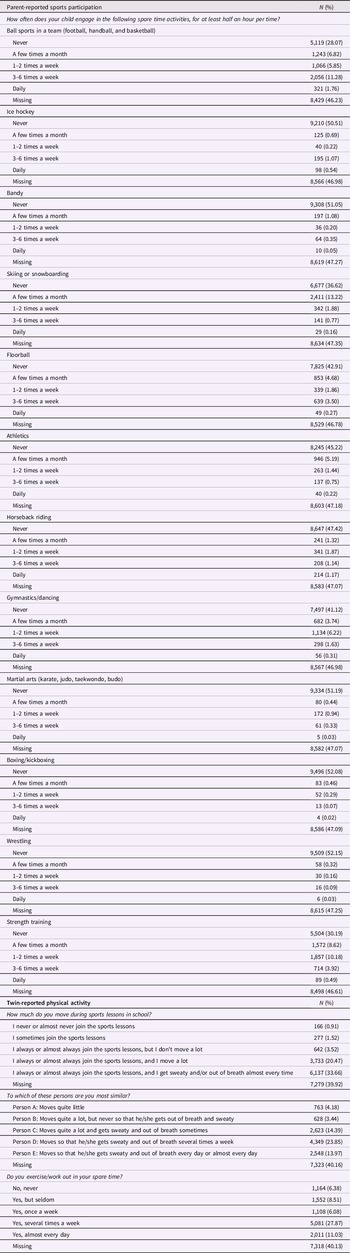
At age 15, twins also completed a questionnaire indexing their level of physical activity. We utilized three items: (1) “How much do you move during sports lessons in school?”, which included five response prompts ranging from “I never or almost never join the sports lessons” to “I always or almost always join the sports lessons, and I get sweaty and/or out of breath almost every time”; (2) “To which of these persons are you most similar?”, which included five response prompts ranging from “Person A: Move quite little” to “Person E: Moves so that he/she gets sweaty and out of breath every day or almost every day”; (3) “Do you exercise/work out in your spare time?”, which included five response prompts ranging from “No, never” to “Yes, almost every day.” Youth who indicated that they did not know/want to answer were coded as missing. Refer to Table A.1 for the distribution of the parent- and twin-reported physical activity items. Cronbach’s alpha for parent-reported sports participation was quite low (0.33), potentially due to the poor relatedness between the different sports participation. For example, an individual involved in dance may be unlikely to also be involved in ball sports. Twin-reported physical activity demonstrated an acceptable alpha (0.74).
Prior literature has assessed the frequency of sports participation/physical activity and further categorized these predictors (Brosnahan et al., Reference Brosnahan, Steffen, Lytle, Patterson and Boostrom2004; Taliaferro et al., Reference Taliaferro, Rienzo, Miller, Pigg and Dodd2008; Taliaferro et al., Reference Taliaferro, Eisenberg Marla, Johnson Karen, Nelson Toben and Neumark-Sztainer2011). However, we decided to maintain these variables as continuous to not further limit statistical power in the co-twin control models. We summed all parent-reported items and standardized (mean = 0, standard deviation = 1) the summed score to generate a parent-reported sports participation. This approach was replicated for the twin-reported physical activity items. Upon item inspection, one parent endorsed daily participation in every sport (parent-reported sum of 48, compared to the next highest value of 19), resulting in a skewness of 1.02 and kurtosis of 5.35. Rather than dropping this individual, we recoded the value of each item contributing to the parent sum score to missing, thereby allowing the individual to contribute to the multiple imputation analysis (see below). After recoding, the skewness and kurtosis of the parent-reported sum of sports participation were 0.75 and 0.76, respectively. The Pearson correlation between parent-reported sports participation and twin-reported physical activity was moderate (r = .53, p < .01).
Friendship quality
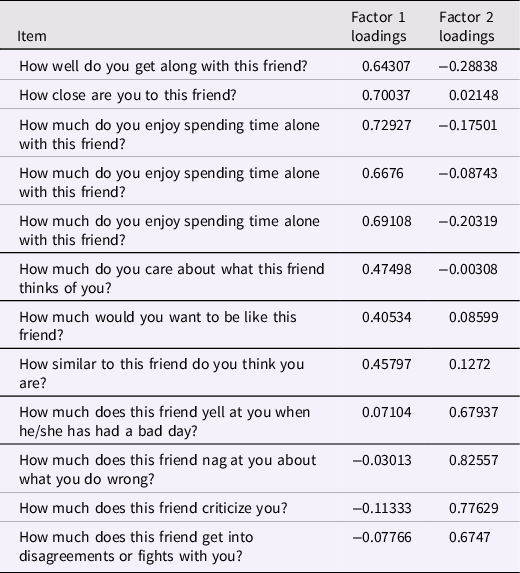
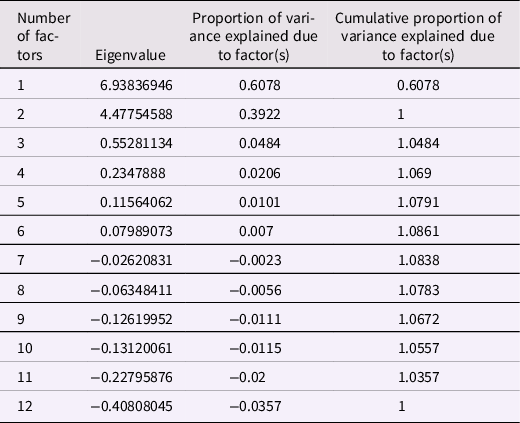
At age 15, twins completed a questionnaire indexing friendship quality, which was adapted from the Parent–Child Relationship Scale (Wamboldt et al., Reference Wamboldt, Wamboldt, Gavin and McTaggart2001). Rather than rate one’s perception of cumulative friendship quality/support, twins were asked to answer the questionnaire with reference to a specific, close friend. Twins could endorse “I don't have a close friend,” which served as a gate question for the remaining questionnaire. If a close friend was endorsed, twins answered twelve questions that were positively (e.g., “How well do you get along with this friend?”) or negatively valenced (e.g., “How much does this friend criticize you?”). Five response options ranged from “Not at all” to “Very much.” We examined the structure of these items through the use of an exploratory factor analysis with orthogonal rotation. Two factors were retained that corresponded to the positively and negatively valenced items; the positively valenced items were summed and standardized (mean = 0, standard deviation = 1; refer to Table A.2 for the factor loadings, Table A.3 for the eigenvalues pertaining to the number of factors). We concentrated exclusively on the positively valenced score given the study’s focus on putative protective factors. If twins did not complete the “I don't have a close friend” item, but completed the remaining questionnaire, we assumed that those twins did have a close friend (and the gate item was coded as 0, n = 2,350). If twins did not have a close friend, their data was coded as missing and their sum score was imputed (see below). Refer to Table A.4 for the frequency distribution of the friendship quality items. Cronbach’s alpha for both positive and negative friendship quality items were acceptable (0.82, 0.83, respectively). The Pearson correlation between summed positive and negative friendship quality was negative and low (r = −.10, p < .01)
Outcomes
Substance use
At age 18, adolescents completed the Alcohol Use Disorders Identification Test (AUDIT) and Drug Use Disorders Identification Test (DUDIT). The AUDIT is a 10-item questionnaire that assesses alcohol consumption and related problems with total scores ranging from 0 to 40, and the DUDIT is an 11-item questionnaire that assesses drug use and associated problems with total scores ranging from 0 to 44. Prior research has demonstrated the reliability and validity of the AUDIT (Daeppen et al., Reference Daeppen, Yersin, Landry, Pécoud and Decrey2000; Källmén, Elgán, et al., Reference Källmén, Elgán, Wennberg and Berman2019) and DUDIT (Hildebrand, Reference Hildebrand2015). For the DUDIT, respondents are prompted to endorse the use of drugs that are either illegal substances or medicaments taken outside of prescription recommendations (e.g., taking greater dosage of prescription medication, a medication to feel “high”, medication taken from a friend or relative, or medication purchased/stolen from another person). Both the AUDIT and DUDIT used a gate-item structure (“How often do you have a drink containing alcohol?” and “How often do you use drugs other than alcohol?”, respectively). Each item is rated on a 0–4 scale, and the items are summed to obtain a total score. If twins endorsed never having consumed alcohol or used drugs, all subsequent items were coded as 0. The AUDIT has a demonstrated cutoff value for risky/problematic alcohol use that differs based on population age and clinical presentations, ranging from 6 to 10 (Coulton et al., Reference Coulton, Alam, Boniface, Deluca, Donoghue, Gilvarry, Kaner, Lynch, Maconochie, McArdle and McGovern2019; Källmén, Berman, et al., Reference Källmén, Berman, Jayaram-Lindström, Hammarberg and Elgán2019). We chose a cutoff of >8 to indicate low-risk (0) and high-risk (1) alcohol use, based on prior research among adolescents (Hagman, Reference Hagman2016). Due to the low endorsement of drug use as indexed by the DUDIT, we dichotomized the DUDIT items as no drug use ever endorsed (0) or any drug use ever endorsed (1).
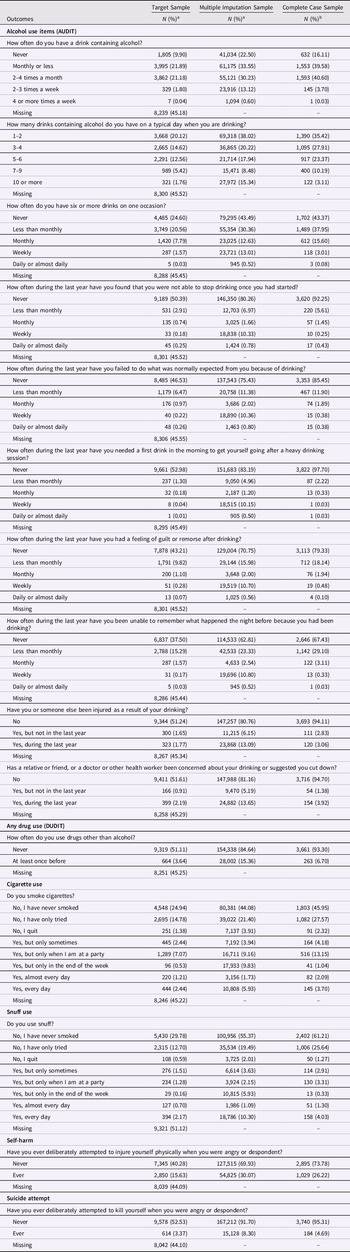
In addition to alcohol and illegal substances, twins completed a questionnaire about their nicotine use, answering two questions: “Do you smoke cigarettes?” and “Do you use snuff?” (i.e., smokeless tobacco). Eight response options ranged from “No, I have never smoked cigarettes/used snuff” to “Yes, every day.” We categorized two variables as: never used (0) or ever used (1) cigarettes; and never used (0) or ever used (1) snuff. If a twin endorsed having “only tried” or having quit using, their response was included as having used, which had high endorsement in the present sample (cigarette: 44%; snuff: 39%). Refer to Table A.5 for the frequency distribution of the substance use items.
In addition to parent- and self-report data, individuals in CATSS have a unique identification number that allows linkage to national registers. The National Patient Register records diagnostic codes from all hospital admissions since 1987 and 80% of specialist outpatient care since 2001 (National Board of Health and Welfare, 2009). We extracted ICD-10 codes to index substance use problems (i.e., substance use disorder and drug/medication overdose; F10-F19 [except F17], T36-T50, T51.0, T96, X40-X45) in order to externally validate the twin-reported AUDIT and DUDIT scores. Alcohol use and any substance use were moderately correlated with ICD-10 substance use problems diagnosis (r polychoric = .39 [adjusted standard error, 0.01]; r tetrachoric = .36 [adjusted SE, 0.01], respectively).
Self-harm behavior
At age 18, adolescents completed the Lifetime History of Aggression questionnaire, which included two questions indexing self-harm behaviors. Specifically, suicide attempt and self-harm behaviors were derived from: “Have you ever deliberately attempted to kill yourself when you were angry or despondent?” and “Have you ever deliberately attempted to injure yourself physically when you were angry or despondent?” Given that intent to die at the time of the self-harm act could not be determined in the former question, we refer to it using the term self-harm throughout. We dichotomized each item into absent (0) or ever present (1) from the six response options ranging from “Never” to “More times than I can count.” We then created an item that indicated any presence of suicide attempt or self-harm (1) or no presence of suicide attempt or self-harm (0), consistent with prior research (O'Reilly et al. Reference O’Reilly, Pettersson, Donahue, Quinn, Klonsky, Lundström, Larsson, Lichtenstein and D’Onofrio2021; O'Reilly et al., Reference O’Reilly, Pettersson, Quinn, Klonsky, Lundström, Larsson, Lichtenstein and D’Onofrio2020). We refer to this combined outcome as suicide attempt/self-harm.
Similar to substance use, we extracted ICD-10 codes from the National Patient Register indexing intentional self-harm (X60-X84, Y870) and self-harm of undetermined intent (Y10-Y34, Y872), which are commonly used in epidemiologic research to index suicide attempts, as well as to capture suicide attempts that are misclassified as events of unknown intent, respectively (Anderson et al., Reference Anderson, Miniño, Hoyert and Rosenberg2001; Bohnert et al., Reference Bohnert, McCarthy, Ignacio, Ilgen, Eisenberg and Blow2013; Walkup et al., Reference Walkup, Townsend, Crystal and Olfson2012). Endorsing prior self-harm or suicide attempt was moderately correlated with ICD-10 intentional self-harm or self-harm of undetermined intent codes (r tetrachoric = .29 [adjusted SE, 0.01]). These associations support the validity of the self-reported measures used in our analyses described below.
Covariates
Psychopathology among youth is associated with substance use and is implicated in the majority of suicide attempts and suicides (King et al., Reference King, Iacono and McGue2004; Klonsky et al., Reference Klonsky, May and Saffer2016; Nock et al., Reference Nock, Green, Hwang, McLaughlin, Sampson, Zaslavsky and Kessler2013). We, therefore, aimed to adjust for potential confounding due to psychopathology broadly presenting in childhood.
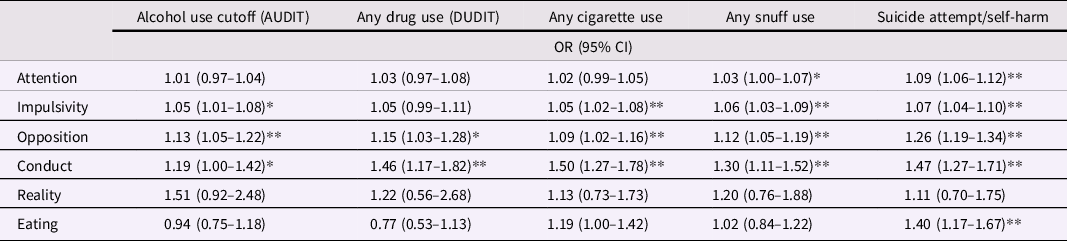
At age 9 or age 12, parents completed the Autism – Tics, AD/HD other Comorbidities inventory (A-TAC), which is a validated, telephone-based interview assessing youth psychopathology with items corresponding to symptoms of DSM-IV diagnoses (Anckarsäter et al., Reference Anckarsäter, Lundström, Kollberg, Kerekes, Palm, Carlström, Långström, Magnusson, Halldner, Bölte, Gillberg, Gumpert, Råstam and Lichtenstein2011). Each response could be endorsed as “No” (0), “Yes, to some extent” (0.5), and “Yes” (1). Based on Anckarsäter et al. (Reference Anckarsäter, Lundström, Kollberg, Kerekes, Palm, Carlström, Långström, Magnusson, Halldner, Bölte, Gillberg, Gumpert, Råstam and Lichtenstein2011), we summed all items for concentration/attention (range 0–9), impulsivity/activity (0-10), opposition (0–5), conduct (0–5), eating (0–2), and reality/psychosis (0–1), which were each included as covariates. The associations between the childhood psychopathology variables and each outcome are presented in Table A.6.
Missing data
Attrition increased across waves; while 15.17% of those eligible to participate at age 9/12 were missing, missingness increased to 47.42% and 52.79% at age 15 and 18 data collection, respectively. In order to examine the implications of attrition, we predicted substance use and suicide attempt/self-harm from a missing indicator at age 9/12 and a missing indicator age 15. Missing at age 9/12 was associated with alcohol use as indicated by the AUDIT (b, −0.14 [standard error, 0.03], p < .01), although there was no association for missing at age 15 (b, 0.04 [SE, 0.03], p = .15). There was no association between missing at age 9/12 (odds ratio [OR], 0.90 [95% confidence interval [CI], 0.72–1.13]) or age 15 (OR, 0.91 [95% CI, 0.74–1.13]) and endorsement of drug use as indicated by the DUDIT at age 18. For any cigarette use, there was no association with missing at age 9/12 (OR, 0.92 [95% CI, 0.82–1.02]), but there was an association with missing at age 15 (OR, 1.30 [95% CI, 1.17–1.44]). Missing at age 9/12 (OR, 0.86 [95% CI, 0.76–0.97]) and missing at age 15 (OR, 1.31 [95% CI, 1.18–1.46]) were associated with any snuff use at age 18. Finally, missing at age 9/12 data collection was not associated with suicide attempt/self-harm (OR, 0.99 [95% CI, 0.88–1.11]), but missing at age 15 was (OR, 1.17 [95% CI, 1.05–1.31]). Taken together, failing to account for missing participants throughout data collection could introduce bias into our analyses (Larsson, Reference Larsson2021).
Missing data inspection indicated an arbitrary (non-monotone) missing data pattern (i.e., individuals could enter and exit data collection across the three waves with no discernable pattern), which guided our choice of the Fully Conditional Specification (FCS) multiple imputation method (as compared to the Markov chain Monte Carlo method). The FCS method offers enhanced flexibility when conducting multivariate imputation (van Buuren, Reference van Buuren2007), including with a mixture of continuous and categorical variables (Liu & De, Reference Liu and De2015). Simulation and real-world data applications have demonstrated that the FCS method results in a reduction in bias compared to joint modeling approaches (Lee & Carlin, Reference Lee and Carlin2010; van Buuren, Reference van Buuren2007), as well as acceptable performance with longitudinal data (Huque et al., Reference Huque, Carlin, Simpson and Lee2018). We conducted a total of 10 imputations using SAS 9.4. The multiple imputation model failed to converge when including the individual sports participation/physical activity, friendship quality, and DUDIT items. We, therefore, created the summed score for physical activity and friendship quality and the dichotomous variable for drug use prior to imputation as described above. After imputation, we created the AUDIT total score, nicotine use, and suicide attempt/self-harm items as described above. We specified the following models in the multiple imputation step: (a) the parent and twin-reported summed scores of sports participation/physical activity and twin-reported friendship quality were imputed continuously using linear regression, while restricting the minimum value to zero; (b) the 10 AUDIT items and two nicotine questions were imputed using the discriminant function to enhance convergence; and (c) the “I don't have a close friend,” any endorsement of drug use via DUDIT, suicide attempt, and self-harm items were imputed using logistic regression.
Table A.5 presents the distribution of the substance use and suicide attempt/self-harm outcomes across three samples: the target sample (n = 18,234), the target sample after 10 multiple imputations (n = 182,340 observations; n = 18,234 unique individuals), and the complete case sample (n = 3,924). In the target sample, approximately 45% was missing the outcome measures. When comparing the distribution of items between the multiple imputation and complete case samples, fewer individuals endorsed more extreme values in the complete case sample. In the multiple imputation dataset, 15% reported drug use at least once, 31% reported smoking, 23% reported snuff use, 30% reported self-harm, and 8% reported suicide attempt.
Analyses
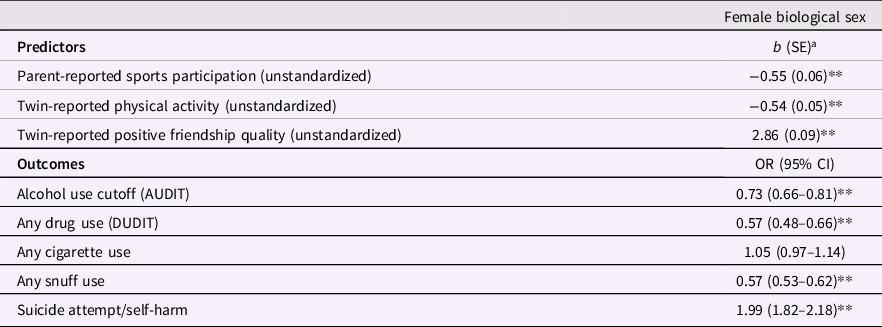
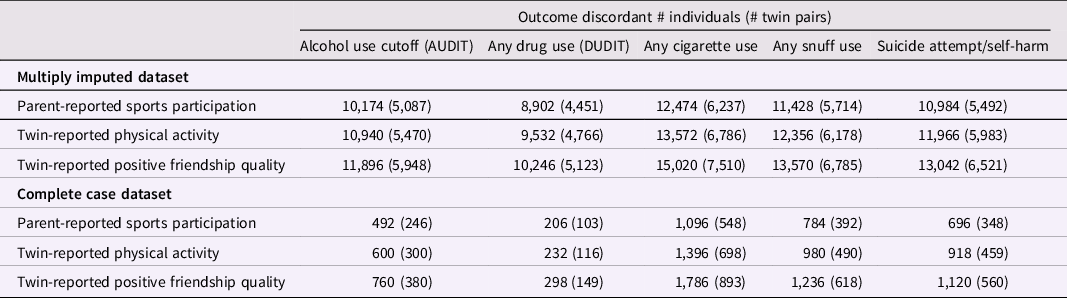
In order to examine the extent to which the associations between protective factors (sports participation, physical activity, and friendship quality) and substance use and suicide attempt/self-harm were consistent with a causal hypothesis, we conducted three sets of analyses using SAS 9.4. First, we used logistic regression to examine associations among all individuals in the CATSS dataset while adjusting for biological sex (i.e., sex assigned at birth). We included biological sex given its association with the predictors and outcomes (see Table A.7). In order to account for the twin-level data, we adjusted standard errors for twin-pair clustering. Second, we included childhood psychopathology covariates to statistically account for parent-reported concentration/attention (range 0–9), impulsivity/activity, opposition, conduct, eating, and reality/psychosis problems. Third, we conducted a co-twin control analysis through fixed-effects regression (Allison, Reference Allison2009). We fit conditional logistic regression models to estimate the within-pair associations, stratifying on the twin pair. The co-twin control design capitalizes on differences within a twin pair. By comparing twins who differ on their exposure to a given protective factor and outcome, we adjust for all unmeasured factors that make twins similar. Twins share 100% or, on average, 50% of their segregating alleles in MZ or DZ pairs, respectively. All environmental factors that make twins similar are also implicitly adjusted for in the analyses. Individuals who differ on both their exposure and outcome are informative to analyses (see Table A.8). To help account for within-pair confounding, we also included biological sex and childhood psychopathology as measured statistical covariates. We used a covariate approach, rather than stratification, due to the lack of clear theoretical rationale and the limited statistical power when stratifying. Note that across all models, the outcomes were modeled as dichotomous.
Sensitivity analyses
We conducted a set of sensitivity analyses to evaluate analytic decisions, as well as examine additional outcomes. First, we conducted a complete case analysis (n = 3,924, 21.5% of total sample) to examine the potential bias introduced by excluding those with missing data and the bias introduced by our multiple imputation choices. Second, literature appears to be somewhat mixed about the potential role of psychopathology in subsequent sports participation/physical activity (Suetani et al., Reference Suetani, Mamun, Williams, Najman, McGrath and Scott2017), suggesting that the status of psychopathology as a confounder is uncertain. Therefore, in order to isolate the role of childhood psychopathology in the co-twin associations, we conducted the co-twin control models while excluding the psychopathology covariates. Third, we examined whether our use of a cutoff score on the AUDIT biased our results, as the AUDIT consists of a total score with at least two underlying latent factors: consumption (items 1–3) and adverse consequences of alcohol consumption (items 4–10) (Reinert & Allen, Reference Reinert and Allen2007). We examined the alcohol total score, alcohol consumption, and alcohol-associated problems corresponding with prior research. For these outcomes, we included the mean and deviations for each predictor (and covariates for the relevant models) in order to estimate fixed effects for these count variables. Fourth, we wanted to examine the potential role of zygosity in confounding the population estimates. Therefore, we additionally included twin zygosity as a covariate in the covariate-adjusted population estimates. Fifth, we conducted the co-twin control models among MZ twins to examine the associations with the most rigorous adjustment for genetic confounding. Sixth, the A-TAC had measures of depression and anxiety for the first 4 years of the cohort (i.e., birthyears 1994–1998). To examine potential confounding due to depression and anxiety, we restricted the sample and conducted the co-twin control models with additional covariate adjustment from depression and anxiety. Seventh, to examine the choice of imputing friendship quality for those who endorsed not having a close friend, we dropped those individuals and examined the co-twin control model. Eighth, we examined suicide attempt and self-harm as separate outcomes, rather than as a combined variable, to determine whether the protective factors have differential relations to different measures of self-harm behavior.
Results
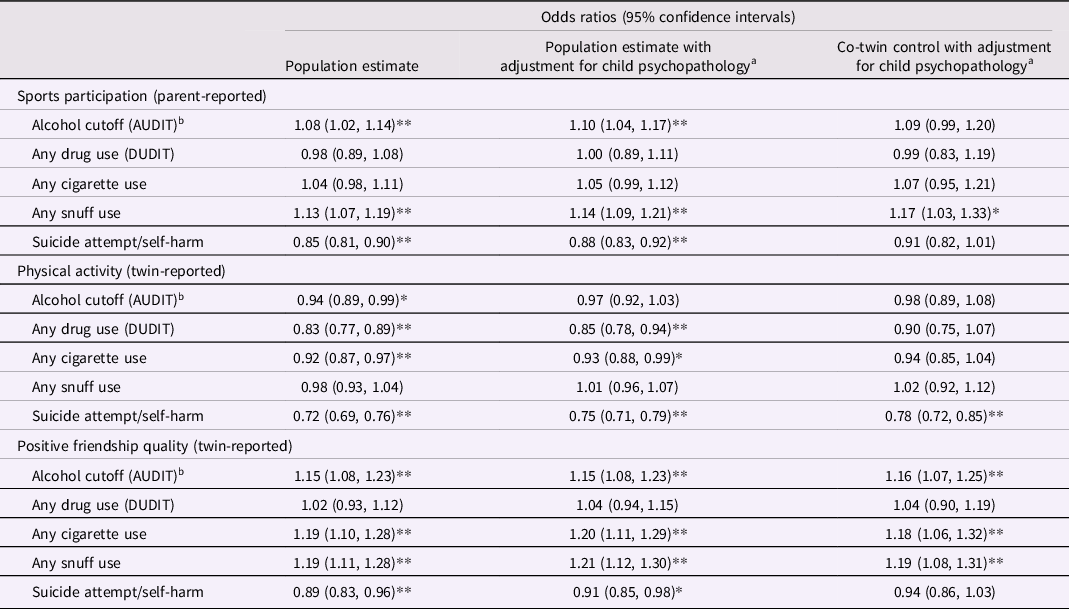
Results of the primary models can be found in Table 1. Parent-reported youth sports participation was associated with an increased risk of high-risk alcohol use (i.e., above the cutoff on the AUDIT) (OR = 1.08, 95% CI = 1.02–1.14) in the population estimate. Accounting for measured traits (OR = 1.10, CI = 1.04–1.17) and accounting for unmeasured genetic and environmental factors (OR = 1.09, CI = 0.99–1.20) in the co-twin control model did not appreciably influence the effect size. The associations between sports participation and drug use and cigarette use were not large or statistically significant across the three models (e.g., OR = 1.07, CI = 0.95–1.21 for any cigarette use in the co-twin control model), but sports participation was associated with risk of snuff use. This elevated association remained even when comparing twins and accounting for measured covariates (OR = 1.17, CI = 1.03–1.33). Conversely, sports participation was associated with decreased odds of suicide attempt/self-harm in the population model (OR = 0.85, CI = 0.81–0.90), with the magnitude of the association remaining in the subsequent models, although the CI included the null (OR = 0.91, CI = 0.82–1.01 in the co-twin control model).
Association between protective factors and substance use and self-harm behavior items across the three models among multiply imputed dataset

Note. All models include adjustment for biological sex. All outcomes are dichotomous. Based 18,234 unique individuals (182,340 observations after 10 imputations). Suicide attempt and self-harm are referred to as self-harm behaviors throughout the text. aAdjusted for A-TAC summed scores for concentration/attention, impulsivity/activity, opposition, conduct, psychosis, and eating symptomology. bThe cutoff score was 8 or higher from the total summed score. *Statistically significant at p < .05. **Statistically significant at p < .01.
In contrast, twin-reported physical activity was generally associated with less substance use. In fact, physical activity was associated with lower high-risk alcohol use (OR = 0.94, CI = 0.89–0.99), drug use (OR = 0.83, CI = 0.77–0.89), and cigarette use (OR = 0.92, CI = 0.87–0.97) in the population models. The magnitude of these associations attenuated somewhat in the subsequent models, with all three including the null in the co-twin control models (e.g., drug use: OR = 0.90, CI = 0.75–1.07). Associations with snuff use remained close to the null across all models (e.g., OR = 1.02, CI = 0.92–1.12 in the co-twin control model). However, physical activity was associated with decreased odds of suicide attempt/self-harm, with little attenuation in the co-twin control model adjusting for childhood psychopathology (OR = 0.78, CI = 0.72–0.85).
Twin-reported positive friendship quality was associated with increased odds of alcohol and tobacco use across the three models. For instance, in the co-twin control model, positive friendship quality was associated with greater odds of high-risk alcohol use (OR = 1.16, CI = 1.07–1.25), cigarette use (OR = 1.18, CI = 1.06–1.32), and snuff use (OR = 1.19, CI = 1.08–1.31). Associations with drug use remained close to the null across all models (e.g., OR = 1.04, OR = 0.90–1.19 in the co-twin control model). In contrast, positive friendship quality was associated with decreased odds of suicide attempt/self-harm in the population model (OR = 0.89, CI = 0.83–0.96), though the association was slightly attenuated in the co-twin control model, with the CIs containing the null (OR = 0.94, CI = 0.86–1.03).
Sensitivity analyses
We conducted eight sets of sensitivity analyses. First, when conducting the co-twin control analyses among a complete case sample (n = 3,924), we found results were attenuated, as only the association between parent-reported sports participation and snuff use remained (Table A.9). Second, when conducting the co-twin control models without psychopathology, associations remained nearly identical to the co-twin control models with psychopathology (Table A.10). Third, when examining three additional alcohol outcomes (AUDIT total, alcohol consumption, and alcohol problems), the results were in line with the main results; positive friendship quality was positively associated with all measures of alcohol outcomes (Table A.11). In addition, parent-reported sports participation was positively associated with alcohol consumption. Fourth, adjustment for zygosity in the population model suggested no change in estimates without adjustment for zygosity (Table A.12). Fifth, examining a subsample of MZ twins only yielded odds rations comparable to those from all twin pairs in the main analyses, However, the CIs widened to include the null for all outcomes except for the association between twin-reported physical activity and suicide attempt/self-harm (OR = 0.77, CI = 0.65–0.93; Table A.13). Sixth, inclusion of childhood depression and anxiety covariates widened CIs, although results were similar to the main analyses (Table A.14). Seventh, results did not change when dropping individuals who did not endorse having a close friend (Table A.15). Eighth, when separating self-harm behavior into self-harm and suicide attempts, findings were similar to the main models in that twin-reported physical activity was associated with both outcomes (Table A.16).
Discussion
We examined sports participation, physical activity, and friendship quality as plausible protective factors for adolescent substance use problems and self-harm behaviors (i.e., suicide attempt or self-harm with unknown intent to die). Given the possible confounding by genetic and environmental factors, as well as the role of childhood psychopathology, we combined a co-twin control design with measured covariates in a longitudinal twin study to more rigorously estimate the independent associations. By comparing results of models examining unrelated individuals to those examining within twin pairs, researchers can strengthen inferences regarding the extent of genetic and shared environmental confounding. If results attenuate in co-twin control models compared to population estimates, there is evidence of confounding. If results do not attenuate, there may be evidence consistent with a causal relationship. Across models, associations did not attenuate, suggesting that childhood psychopathology nor factors shared by twins confounded the associations. While statistical precision decreased in the co-twin control models, our findings suggested that parent-reported sports participation and twin-reported positive friendship quality were associated with increased odds of alcohol problems and tobacco use. However, these factors, as well as twin-reported physical activity, were associated with reduced odds of measures of self-harm behavior. There are two main explanations for associations that remained in the co-twin control model; either the association is due to a causal effect, or the association is attributable to confounding factors not shared by twins (other than the child psychopathology measures included in the regression models).
Findings for sports participation, physical activity, and substance use appeared to depend on the domain. Parent-reported sports participation was associated with increased odds of high-risk alcohol use and tobacco use. For example, a one standard deviation increase in sports participation was associated with 9% increased odds of alcohol use and 17% increased odds of snuff use. Participation in sports likely includes interaction with peers. In the present sample, according to parent-report of sports participation, the greatest percentage of twins participated in ball sports 3–6 times a week, which could be associated with greater subsequent risk for substance use through social contagion, modeling, or increased access to substances (Trucco, Reference Trucco2020). An alternate explanation is that the twin with more the more socially integrated twin engages in both sports and some mild substance use (Shedler & Block, Reference Shedler and Block1990). Previous research has found that popularity during adolescence is associated with subsequent substance use (Allen et al., Reference Allen, Schad, Oudekerk and Chango2014).
In contrast, twin-reported physical activity was minimally associated with reduced odds of substance use in our co-twin models. General physical activity may be protective against drug and cigarette use due to adolescent concerns for physical health and well-being (Brellenthin & Lee, Reference Brellenthin and Lee2018; West et al., Reference West, Bittel, Russell, Evans, Mama and Conroy2020), but our results suggest that any causal effect would be small in magnitude.
Peer processes may also underlie findings for twin-reported friendship quality and substance use. A one standard deviation increase in positive friendship quality was associated with a 16% increased odds of subsequent alcohol problems, 18% increased odds of cigarette use, and 19% increased odds of snuff use. This aligns with literature and theory indicating that during adolescence peers are a primary risk context for exposure and engaging in substance use (Trucco, Reference Trucco2020; Van Ryzin & Dishion, Reference Van Ryzin and Dishion2014).
Conversely, all three of our predictors were associated with fewer self-harm behaviors. For example, sports participation (9% reduction in the odds), physical activity (22% reduction in the odds), and friendship quality (6% reduction in the odds) were associated with self-harm behavior. Notably, the magnitudes of the associations in the co-twin control models were slightly reduced in magnitude compared to the population estimates, with CIs extending to including the null for friendship quality. These decrements in magnitude likely relate to the presence of confounding factors and reduced power to detect effects in the co-twin control model. Similar to the previously mentioned mechanisms, participation in sports may promote peer interactions and the presence of positive friendships may buffer against self-harm behavior via increased social connectedness and reductions in loneliness and depression (Babiss & Gangwisch, Reference Babiss and Gangwisch2009; Taliaferro et al., Reference Taliaferro, Rienzo, Miller, Pigg and Dodd2008). Additionally, greater physical activity and participation in sports can promote physical health and self-esteem reducing self-harm behavior and increasing mental well-being (Babiss & Gangwisch, Reference Babiss and Gangwisch2009).
By accounting for measured and unmeasured confounders, these results provide support for important risk and protective mechanisms that may have causal influences on adolescent substance use and self-harm behavior. This advances previous research on sports participation, physical activity, and friendship quality that were unable to account for these confounding factors. Accounting for unmeasured genetic and environmental factors shared by twins increases confidence that sports participation and friendship quality have potential causal effects on adolescent psychopathology. Those associations that were attenuated, such as between twin-reported physical activity and alcohol and drug use, may be due to underlying confounding genetic and/or environmental factors known to be involved in the developmental emergence of psychopathology. This may indicate the involvement of rGEs; adolescents could choose environments (e.g., participation in sports, delinquent peer groups) based on genetic predisposition (Elam et al., accepted – in press), thereby further increasing risk for substance use.
Strengths and Limitations
This study used a large, population-based dataset from Sweden to examine how three protective factors (sports participation, physical activity, and friendship quality) are associated with substance problems and self-harm behaviors. The data were prospectively collected across adolescence and used multiple raters. We accounted for childhood psychopathology, which is a known predictor of substance use and self-harm behavior, and our use of a co-twin control model accounts for all genetic and environmental confounders that make twins similar. Furthermore, we used multiple imputation to help reduce bias due to loss of follow-up, and we examined several of our analytic and methodological decisions in sensitivity analyses. Finally, we conducted numerous sensitivity analyses, which, broadly, did not demonstrate substantial differences between our main and sensitivity analyses. Of note, it is difficult to compare the multiple imputation and complete case results, as the small sample size utilized in the complete case widened confidence to include the null for all but one estimate.
The strengths should also be considered in light of several limitations. First, our self-report measures may contain bias. Whereas correlations between the self-reported outcome variables and clinical diagnoses from inpatient hospitalizations and specialty medical clinics were moderate, the overlap does support their validity. Second, the interrelatedness of parent-reported sports participation was low (0.33), which may indicate the presence of multiple latent variables. Future research should investigate sports participation constructs, which may vary by gender. Third, we did not have access to measures of suicidal ideation, and our measures of suicide attempts and self-harm were lifetime measures, which may be subject to recall bias (Nock et al., Reference Nock, Borges, Bromet, Cha, Kessler and Lee2012). Fourth, the sample includes adolescents born between 1994 and 1999 who were followed through 2017. Thus, the data may not reflect current levels of substance use and recent trends in physical activity. Fifth, findings are in a Swedish sample of adolescent twins which may limit generalizability to other countries. Sixth, co-twin control designs include a number of assumptions and limitations (D'Onofrio et al., Reference D'Onofrio, Lahey, Turkheimer and Lichtenstein2013; Frisell, Reference Frisell2021). Importantly, the co-twin control design cannot prove causality. The design also has lower statistical power than the population-based regressions because only pairs discordant on both a predictor and the outcome are informative in analyses. Measurement error can make pairs appear discordant (thus biasing down the effect sizes). As we stated above, the design also cannot account for confounding factors that are unique to each twin. Because we were unable to restrict our analyses to MZ twins only (due to statistical power), the estimates from our co-twin control analyses could include some genetic confounding. Due to these limitations, additional studies using other samples and genetically informative designs are necessary to strengthen our understanding of these associations (D'Onofrio et al., Reference D'Onofrio, Sjölander, Lahey, Lichtenstein and Öberg2020).
To our knowledge, this is the first study to examine sports participation, physical activity, and friendship quality as predictors of substance use and self-harm behavior using a co-twin control design. Our findings indicate that sports participation and positive friendship quality were associated with increased odds of substance use, whereas these domains and physical activity were associated with decreased odds of self-harm behavior. Accounting for unmeasured genetic and environmental confounders, as well as multiple measures of childhood psychopathology, increases confidence that these may represent causal effects in order to help researchers target factors unique to twin pairs that account for the associations. If replicated, these findings could indicate that youth at-risk for self-harm behavior would benefit from physical activity. Further, findings indicate that peer influences, via friendship quality and possibly sports participation, may be important targets for the prevention of adolescent and self-harm behaviors.
Funding statement
This project was supported by grant SRG-0-035-16 awarded to Brian D’Onofrio from the American Foundation for Suicide Prevention, by grant DA042828 to Kit K. Elam from the National Institute of Drug Abuse and Office of the Director: Office of Behavioral and Social Sciences Research, by grant R00DA040727 to Patrick D. Quinn from the National Institute on Drug Abuse, and grant F31MH121039-01 to Lauren M. O’Reilly from the National Institute on Mental Health. The content is solely the responsibility of the authors and does not necessarily represent the official views of the NIH or other funders.
Conflicts of interest
Henrik Larsson reports receiving grants from Shire Pharmaceuticals; personal fees from and serving as a speaker for Medice, Shire/Takeda Pharmaceuticals and Evolan Pharma AB; and sponsorship for a conference on attention-deficit/hyperactivity disorder from Shire/Takeda Pharmaceuticals and Evolan Pharma AB, all outside the submitted work.
Appendix A
Frequency distribution of parent-reported sports participation and twin-reported physical activity items

Total unique individuals is 18,234. Percentages rounded and may not total 100%.
Rotated factor loadings of friendship quality items

Note. Factor loadings are derived from the orthogonal rotation.
Eigenvalues of the reduced correlation matix and proportion of variance explained

Note. Factor loadings are derived from the orthogonal rotation.
Frequency distribution of twin-reported friendship quality items

Based on 18,234 unique individuals. Percentages rounded and may not total 100%.
Distribution of substance use and self-harm among the target and complete case sample

Note. Self-harm measured by the Lifetime History of Aggression questionnaire. Female and male refers to biological sex, rather than gender. Note that missing includes both those missing that item, as well as those missing from that particular wave of data collection. aBased on 18,234 unique individuals. bBased on 3,924 unique individuals.
Associations between childhood psychopathology and outcomes

Based on 18,234 unique individuals. *Statistically significant at p < .05. **Statistically significant at p < .01.
Association between biological sex and predictors and outcomes

Based on 18.234 unique individiuals. *Statistically significant at p < .05. **Statistically significant at p < .01.aModeled via linear regression. One unit increase on the explanatory variable corresponds to the respective regression coefficient as measured by number of items endorsed.
Number of individuals and twin pairs predictor and outcome discordant in the multiply imputed and complete case dataset

Association between protective factors and substance use and self-harm items across the three models among complete case dataset

Note. Includes adjustment for biological sex. All outcomes are dichotomous. Based 3,924 unique individuals. *Statistically significant at p < .05. **Statistically significant at p < .01.aAdjusted for A-TAC summed scores for concentration/attention, impulsivity/activity, opposition, conduct, psychosis, and eating symptomology.
Association between protective factors and substance use and self-harm items among the co-twin model without psychopathology adjustment among multiple imputation dataset

Note. Includes adjustment for biological sex. All outcomes are dichotomous. Based 18,234 unique individuals (182,340 observations after 10 imputations). *Statistically significant at p < .05. **Statistically significant at p < .01.aAdjusted for A-TAC summed scores for concentration/attention, impulsivity/activity, opposition, conduct, psychosis, and eating symptomology.
Association between protective factors and various alcohol use definitions across the three models among multiple imputation dataset

Note. Includes adjustment for biological sex. All outcomes are continuous. *Statistically significant at p < .05. **Statistically significant at p < .01.aAlcohol consumption is determined from the items 1-3 on the AUDIT; alcohol problems is determined from items 4-10 on the AUDIT. Based 18,234 unique individuals (182,340 observations after 10 imputations). cAdjusted for A-TAC summed scores for concentration/attention, impulsivity/activity, opposition, conduct, psychosis, and eating symptomology.
Associations between protective factors and outcomes in the population estimate adjusting for childhood psychopathology and zygosity

Note. Includes adjustment for biological sex. Based 18,234 unique individuals (182,340 observations after 10 imputations). *Statistically significant at p < .05. **Statistically significant at p < .01.aAdjusted for A-TAC summed scores for concentration/attention, impulsivity/activity, opposition, conduct, psychosis, and eating symptomology.
Associations between protective factors and outcomes including in MZ twins only

Note. Includes adjustment for biological sex. Based on 4,923 individuals. *Statistically significant at p < .05. **Statistically significant at p < .01. aAdjusted for A-TAC summed scores for concentration/attention, impulsivity/activity, opposition, conduct, psychosis, and eating symptomology.
Associations between protective factors and outcomes including additional adjustment for depression and anxiety

Note. Includes adjustment for biological sex. Based on 11,518 individuals born between 1994–1998. *Statistically significant at p < .05. **Statistically significant at p < .01. aAdjusted for A-TAC summed scores for concentration/attention, impulsivity/activity, opposition, conduct, psychosis, eating, depression, and anxiety symptomology.
Associations between protective factors and outcomes after dropping individuals without a reported close friend

Note. Includes adjustment for biological sex. Based on 16,731 individuals. *Statistically significant at p < .05. **Statistically significant at p < .01.aAdjusted for A-TAC summed scores for concentration/attention, impulsivity/activity, opposition, conduct, psychosis, and eating symptomology.
Association between protective factors and self-harm and suicide attempt across the three models among multiple imputation dataset

Note. Includes adjustment for biological sex. Based 18,234 unique individuals (182,340 observations after 10 imputations).*Statistically significant at p < .05. **Statistically significant at p < .01. aAdjusted for A-TAC summed scores for concentration/attention, impulsivity/activity, opposition, conduct, psychosis, and eating symptomology.