Introduction
Polar Educators International (PEI) is a network of informal and formal educators (hereafter referred to collectively as educators) and polar research scientists, working to provide the crucial link between the scientific community and schools, museums and other public-oriented venues. Since its founding in 2012, PEI has built a membership of over 1,500 members from 30 countries and supports a range of online and face-to-face professional development opportunities.
PEI was created following the International Polar Year (IPY) 2007–2008. Catalyzing thousands around the globe to engage in polar science (Allison et al., Reference Allison, Béland, Alverson, Bell, Carlson, Cutler and Yamanouchi2009; Kaiser, Zicus & Allen, Reference Kaiser, Zicus and Allen2010; Krupnik et al., Reference Krupnik, Allison, Bell, Cutler, Hik, López-Martinez and Summerhayes2011; Salmon et al., Reference Salmon, Carlson, Zicus, Pauls, Baeseman, Sparrow and Raymond2011), the IPY 2007–2008 created a significant opportunity to advance polar education and engagement through its prioritization of public engagement and investment in planning and creating of a wide-range of international events, classroom resources and engagement activities (Allison et al., Reference Allison, Béland, Alverson, Bell, Carlson, Cutler and Yamanouchi2009; Kaiser et al., Reference Kaiser, Zicus and Allen2010; Provencher et al., Reference Provencher, Baeseman, Carlson, Badhe, Bellman, Hik and Zicus2011; Rapley, Bell, & the ICSU IPY 2007–2008 Planning Group, Reference Rapley and Bell2004; Salmon et al., Reference Salmon, Carlson, Zicus, Pauls, Baeseman, Sparrow and Raymond2011). Educators are fundamental to the development of the next generation of scientists and are a crucial link for connecting polar science to society (Illingworth & Roop, Reference Illingworth and Roop2015; Marcum-Dietrich, Marquez, Gill & Medved, Reference Marcum-Dietrich, Marquez, Gill and Medved2011; May, Huffman, Xavier, & Walton, Reference May, Huffman, Xavier and Walton2014). PEI is an organization dedicated to supporting a community of practice aimed at continuing this close integration of polar science into education following the IPY 2007–2008.
Communities of Practice (CoP), as defined by Wenger-Trayner and Wenger-Trayner (Reference Wenger-Trayner and Wegner-Trayner2015) are “…groups of people who share a concern or a passion for something they do and learn how to do it better as they interact regularly” (pp. 1). CoP’s are typically associated with the building of relationships and have active memberships engaged in sharing information, knowledge and best-practices to advance an activity, practice or passion (Wenger-Trayner and Wenger-Trayner, Reference Wenger-Trayner and Wegner-Trayner2015). ‘Practitioners’ in communities of practice “…develop a shared repertoire of resources: experiences, stories, tools, ways of addressing recurring problems…” (Wenger-Trayner and Wenger-Trayner, Reference Wenger-Trayner and Wegner-Trayner2015, pp. 2) and have sustained engagement that leads the development of a shared understanding and collective expertise (Wenger-Trayner and Wenger-Trayner, Reference Wenger-Trayner and Wegner-Trayner2015). In this sense, PEI members are polar science education practitioners.
PEI has worked to build and support a CoP over the last five years, through an intentional emphasis on activities that provide opportunities for both online and face-to-face interactions, following on the noted benefits of balancing the accessibility of online platforms with the support and collaborations that result from face-to-face interactions (e.g. Brooks, Reference Brooks2010). Here we document PEI’s first five years as an organization, outline pilot projects undertaken during this time and explore who has engaged most in this CoP. Through an analysis of member engagement using a ‘level of participation’ framework (Wenger-Trayner & Wenger-Trayner, Reference Wenger-Trayner and Wegner-Trayner2011) for communities of practice, we examine the evolution of this educator-researcher network from 2012–2017 and focus on two key questions: 1) who has PEI reached and served?, and 2) what are barriers to participation? Through this analysis of PEI’s early beginnings, we aim to provide insights into the opportunities and challenges facing PEI to help identify future priorities and to document these experiences to help inform other multidisciplinary CoP’s.
Organizational mission and structure of PEI
Organizational structure
PEI was created through the intentional inclusion of educators in the IPY conferences in Norway (2010) and Canada (2012) with a mission to be “a vibrant network promoting polar education and research to a global community” (Polar Educators International, 2018; pp. 1).
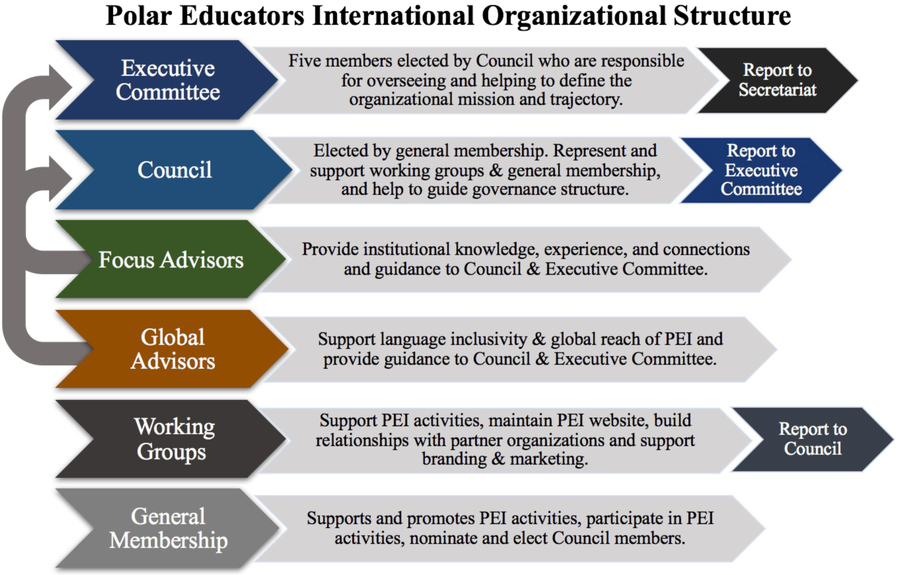
Following the Association of Polar Early Career Scientists (APECS) organizational model (e.g. Provencher et al., Reference Provencher, Baeseman, Carlson, Badhe, Bellman, Hik and Zicus2011), a steering committee was formed to build PEI’s organizational structure (Fig. 1). PEI’s organizational structure includes an elected Executive Committee and Council, Focus and Global Advisors, Working Groups and General Membership (Fig. 1). The organization’s bylaws include plans for an executive director sponsored by a secretariat. However, needing to demonstrate the PEI’s value, an all-volunteer executive committee of four individuals (three educators and one researcher) was elected in 2012 to conduct the duties otherwise designated to a director. This has since expanded to five to six executive committee members, elected annually.
The Polar Educators International organizational chart outlining the key responsibilities and reporting structure of each branch of the organization.

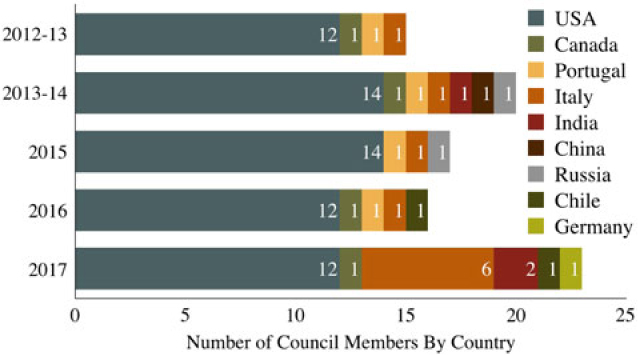
A council of ~20 members, elected annually from the general membership, supports PEI by identifying priorities (Fig. 2). Geographic representation by the PEI council continues to expand (Fig. 2). Working groups, reporting directly to the council and executive committee, manage a range of project tasks (Fig. 1).
Council membership by country from 2012–2017. While total Council membership changed over time based on the number of nominations received, the number of nationalities represented has continued to grow and diversify along with PEI’s membership. The timing of Council elections shifted to January in 2015, accounting for the shift in the date range represented in this graphic.

Membership
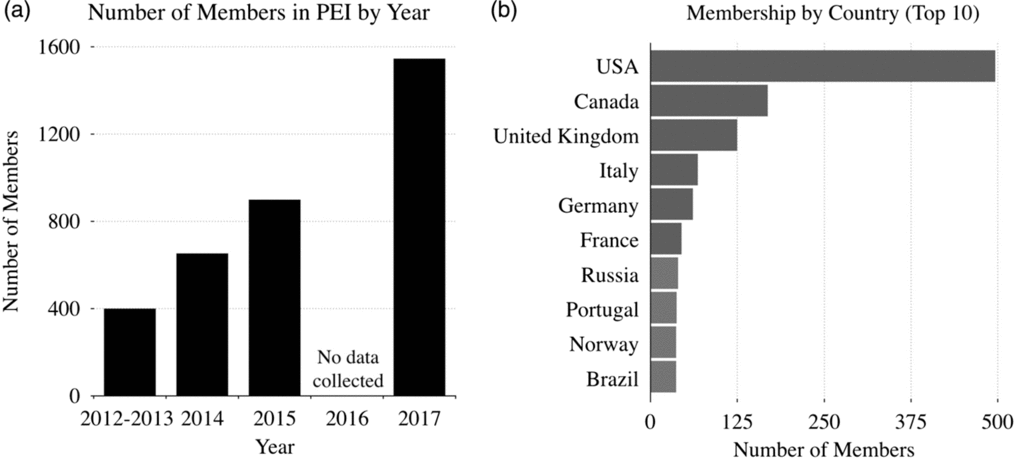
Membership is driven through two platforms—the PEI website (polareducator.org) and a corresponding Facebook group. Most traffic and engagement from PEI’s general membership occurs in the Facebook group. At the end of 2017, there were 1,546 members of in the Facebook group compared to 510 registered users on the website. Facebook membership is likely higher given that the platform makes it easier for members to join and immediately engage by sharing resources, news and research outcomes. Based on analytics from Facebook, PEI membership continues to grow over time (Fig. 3a) and the countries represented span the globe (Fig. 3b). However, the success and sustainability of PEI continues to rely on the investments of a handful of dedicated members (see Levels of Engagement section).
(a) Membership in the Polar Educators International Facebook group over time. In 2016, no review of membership was conducted using Facebook analytics. (b) The top ten countries represented by the membership in the Polar Educators International Facebook group.

Financial and logistical support
In 2012, the Arctic Research Consortium of the United States (ARCUS) provided an initial ‘seed’ grant of $500 USD and agreed to serve as PEI’s secretariat. Primary support for PEI totals less than $500 USD per year, with most support coming in the form of in-kind contributions. Support for the initial PEI website design and hosting was provided by the World Climate Research Programme’s Climate and Cryosphere Project (CliC). CliC also provides PEI with access to its online conferencing system.
Over the last two years, ARCUS, the U.S. National Science Foundation (NSF), the Italian National Research Council (CNR), the German Society of Polar Research (DGP) and International Arctic Science Committee (IASC) have invested other monies and in-kind donations to primarily support participation in PEI international workshops.
Engagement activities
To bolster connectivity between researchers and educators, PEI identified two initial pilot projects—Master Classes and International Workshops. In addition to PEI’s own activities, PEI supports several organizations in broadening the reach of their polar educational activities. For example, PEI supports the Association for Polar Early Career Scientists (APECS) International Polar Weeks (IPW), Our Spaces Foundation for the Good Governance of International Spaces Antarctica Day and contributes regularly to the education section of the SCAR newsletter which reaches over 4,500 scientists and policy-makers (J. Baeseman, personal communication, 11 January 2018).
PEI master classes
The Master Class series is designed to bring researchers and educators together virtually for a two-week-long, online-based dialogue, to provide members with relevant scientific and educational resources. Master Classes focus on two goals: 1) provide educators with access to the best-available science to bring into their classrooms, and 2) provide researchers with tools and expertise for effectively communicating about their work in different educational settings.
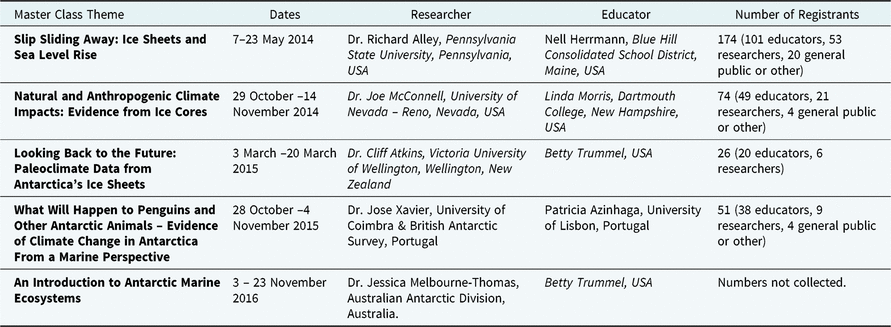
Each Master Class is organized around a central scientific theme (e.g. ice sheets and sea level rise) and is co-presented by a scientist and educator (Table 1). Researchers present the ‘state of the science’ and the educator shares a related activity for incorporating the research into classrooms or informal educational settings. A two-week online discussion follows each webinar, creating an opportunity for all Master Class participants to ask questions, share ideas, and continue to build on the webinar content. Each webinar is archived on PEI’s website and is freely available.
Summary of PEI master classes held between May 2014 and November 2016. No master classes were held in 2017

International workshops
The PEI international workshops provide an opportunity for face-to-face collaboration between researchers and educators. Each workshop includes scientific and educational sessions and interactive workshops. Science sessions highlight current polar research, while education sessions focus on sharing classroom-ready activities. Interactive sessions include hands-on opportunities for assessing knowledge gaps, building collaborations and gaining feedback on the scientific accuracy of classroom activities. PEI has hosted three international workshops between 2013–2017, with participation of scientists and representation from different countries growing over this time (Table 2).
Summary of PEI international workshops

An informal workshop participant survey conducted in 2017 (n=18) indicates that educators benefited primarily from the scientific discussions and the opportunity to connect with other educators interested in teaching polar-related topics. Researchers noted that the workshop provided an opportunity for networking, a new space for sharing their research and a chance to directly improve their own education and outreach initiatives. Both educators and researchers noted that these face-to-face opportunities are important for building collaborations between the core constituencies of PEI and have helped to diversify the PEI network by encouraging more members from different regions to join PEI and participate as Council members (Fig. 2).
Level of participation analysis of PEI’s community of practice
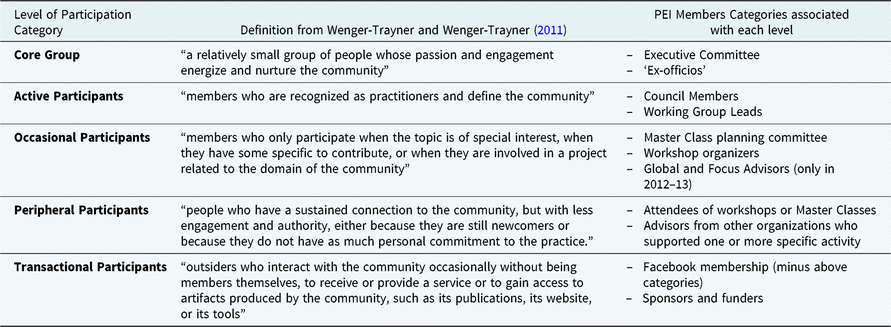
Part of understanding the successes and challenges facing PEI is identifying what value the organization offers as a CoP to its members. Here we explore PEI’s membership in the context of a ‘level of participation’ framework to better understand engagement within the PEI network. CoP levels of participation can be divided into five categories including a core group, and active, occasional, peripheral and transactional participants (Table 3; Wenger-Trayner & Wenger-Trayner, Reference Wenger-Trayner and Wegner-Trayner2011).
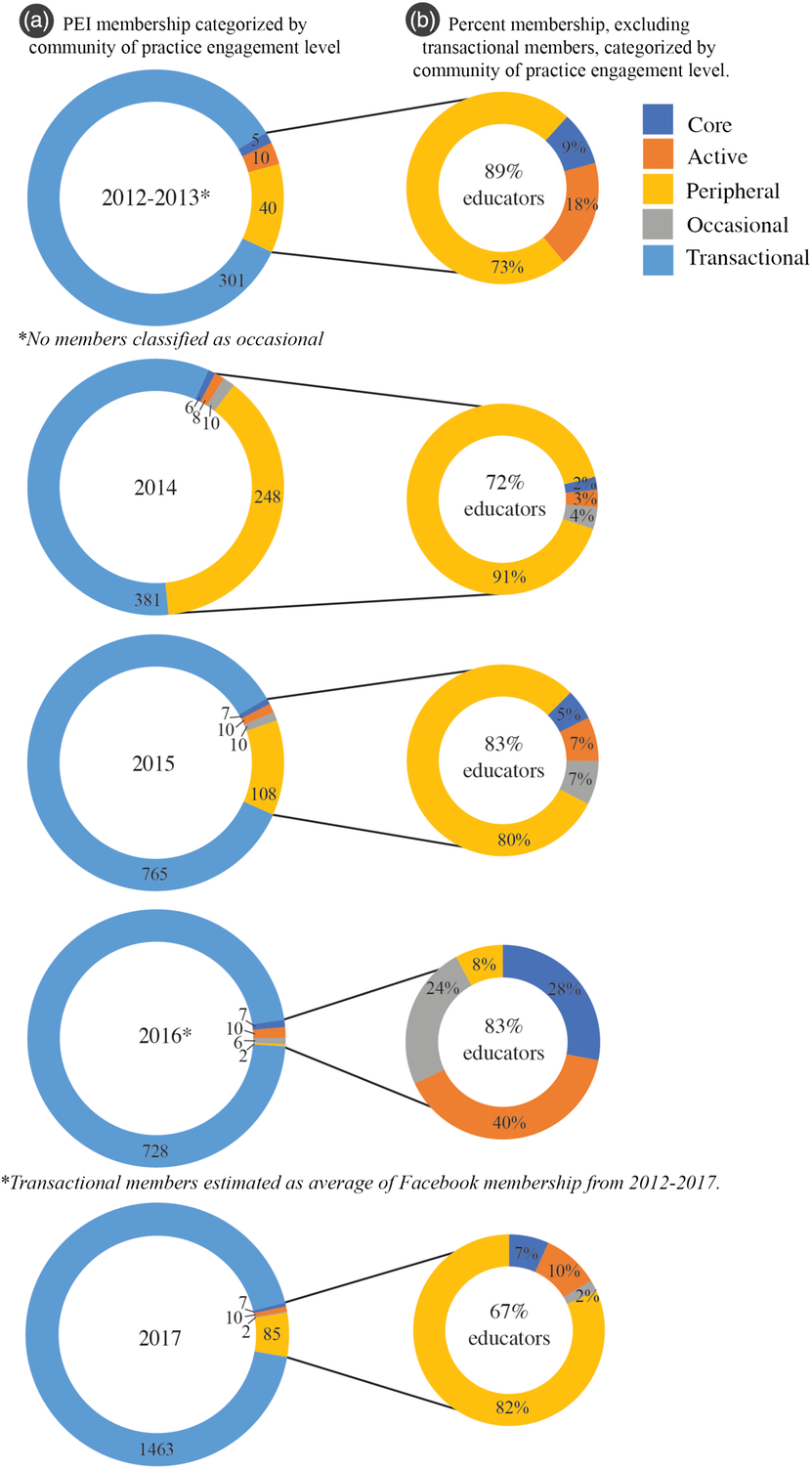
Wenger-Trayner and Wenger-Trayner (Reference Wenger-Trayner and Wegner-Trayner2011) outline levels of participation as one tool for the determining the ‘health’ of a CoP and as a means for identifying areas that need focus, such as where there is a need to diversify the voices within a level, or where a bulk of work may be resting on a small number of individuals. With admittedly limited data, we use levels of participation primarily as a coarse tool for determining where interaction and ‘knowledge flow’ may be hindered by lack of movement across the levels (Fig. 4a, b).
(a) PEI membership totals categorized by level of engagement (see Table 3 for definitions). In 2012–13, there were no members categorized as occasional and in 2016, the number of transactional members was calculated using an average of available Facebook membership data between 2012–2017, as no direct data were available. Active members include the council with totals representing the number of council members that were not also on the Executive Committee (Core Group). (b) Percent of PEI membership, excluding transactional members, categorized by community of practice engagement level. As anticipated, and is common within CoP’s, transactional membership defines a majority of PEI’s community of practice. 2016 is an anomalous year in PEI’s engagement history in regards to peripheral participants as no workshop was held and numbers of Master Class participant were not documented.

Figure 4a and b summarize the evolution of the CoP levels of participation over time. Generally, transactional participants define a majority of PEI’s CoP while the core group and active participants have stayed relatively similar due to the organizational structure (Figure 4a,b). Transactional participation has steadily grown over time, but there appears to be little movement from these more peripheral levels to the central and engaged portion of this CoP, with core and active participants, for the most part, being comprised of the same individuals. This is noted as a potential issue for the health of a CoP (Wenger-Trayner and Wenger-Trayner, Reference Wenger-Trayner and Wegner-Trayner2011).
Peripheral members have been central to the CoP network and are engaged through the key flagship activities, but to date, few of these individuals have found entry points to becoming core group or active or occasional participants with leadership or ownership of projects (Figure 4b). 2016 stands out as an anomalous year in PEI’s engagement history in regards to peripheral participants as no workshop was held and numbers of Master Class participants were not documented; this points to the critical nature of data collection in understanding the characteristics and engagement levels in the CoP (see below). Of note, is the fact that occasional participants, defined here as those who contribute to leading working groups or planning workshops, remain a very small portion of the network (Fig. 4a,b). These participants are those who are likely to become part of the core group and work to define the nature and direction of the organization. The lack of occasional members may be a primary limitation to the movement across levels of participation and may contribute to the limited number of new individuals moving into active participants or to the core group.
Educator, research and external organizational participation
The levels of engagement analysis suggest that PEI has established itself as an important CoP for educators but has had less success creating an established community for researchers within its membership. But what is the relative extent of educator versus researcher involvement in this CoP? Here we coarsely explore, using available workshop participant data and the composition of the Executive Committee, Council and working groups, the relative role of educators versus researchers as core, active, peripheral and occasional participants (Fig. 4b). On average, 79% of the engaged portion of PEI’s CoP are educators.
Educator level of participation
The infusion of financial resources during IPY expanded opportunities for educators to gain direct, hands-on research experience in the polar regions (Allison et al., Reference Allison, Béland, Alverson, Bell, Carlson, Cutler and Yamanouchi2009; Salmon et al., Reference Salmon, Carlson, Zicus, Pauls, Baeseman, Sparrow and Raymond2011). Motivated by these and other experiences, many of PEI’s core group and active participants are educators who continue to donate time to maintain their connectedness to polar research. Further, a bulk of the peripheral and occasional participants are educators (e.g. Table 2), which might be related to the fact that PEI’s activities have more clearly aligned and appealed to the needs of educators. Also, educator-focused organizations like Polar Teachers and Educators Exploring and Collaborating (PolarTREC) continue to be a primary source of new members to PEI.
Researcher level of participation
With an average of 21% of the CoP identifying as researchers, PEI has had difficulty recruiting and engaging research scientists. A majority of PEI’s researcher members are those already engaged in other programs like PolarTREC or who were invested in polar science education, as part of, or prior to IPY 2007–2008. Many of members of the polar research community can be classified transactional or peripheral participants. Engagement with new researchers tends to be one-off, with no sustained engagement or investment in the CoP. Better demonstrating and articulating PEI’s value to researchers and partnering more closely with polar research organizations (see below) may be a future priority that can help to create conduits for researchers to more authentically participate in this CoP as practitioners.
External organization level of participation
PEI partners with IASC, APECS, the U.S Ice Drilling Program Office, and Gaia Antártica and has received financial resources from CliC, ARCUS and the U.S. NSF. PEI also participates as a member of the Scientific Committee on Antarctic Research Capacity Building, Education, and Training Advisory Group and has presented at a 2014 Antarctic Treaty Consultative Meetings in Brazil (Secretariat of the Antarctic Treaty, 2014). However, the level of participation of these organizations is still characterized as transactional as most interactions are characterized best by “receiving or providing a service or to gain access to artifacts produced by the community” (Wenger -Trayner and Wenger-Trayner, Reference Wenger-Trayner and Wegner-Trayner2011, pp. 1; Table 3). While PEI has successfully built the foundation for organizational partnerships, work is still needed to bring these organizations in from solely “interacting to receive or provide a service” (Wenger-Trayner and Wenger-Trayner, Reference Wenger-Trayner and Wegner-Trayner2011) to experiencing PEI as a partner and valuable CoP.
Levels of participation based on current characteristics of PEI membership and the activities that have, to-date, defined the PEI community of practice and relationships therein

Part of identifying the value and impact of an organization is through consistent and intentional data collection about membership and outcomes of activities. PEI needs to consistently collect information about membership and the needs of our community of practice. Experience over the last five years points to the consistent dedication of a few key members with sustained investment by new members being relatively limited. Work is needed to refine who and how PEI is reaching and serving the CoP and how to enhance flow across the various levels of participation through the development of the activities and resources that are most needed by the PEI CoP.
Consistently tracking participation in workshops, Master Classes and engagement on the website and Facebook can help to better understand the ways in which PEI can best serve this CoP. Without consistent benchmarks or standardized reporting, it is hard to understand membership recruitment and retention and characterize participation in PEI-led initiatives.
Conclusions
Overall, the community of practice PEI has supported over the last five years on 100% volunteer effort is remarkable. Engagement continues to grow and there are clear areas where, through focused membership recruitment, leadership development, and improved project design, PEI can increase the flow and exchange of knowledge across this growing CoP. A priority should be identifying ways to create conduits for the transactional participants of PEI, particularly research scientists, to become core members or active participants in this community of practice. Further, coordinating this work, expanding the activities and reach of PEI and evaluating its impact, requires a focus on securing financial support for this CoP.
IPY 2007–2008 created a value system and culture where education was seen as central to its success (Rapley et al., Reference Rapley and Bell2004; Salmon et al., Reference Salmon, Carlson, Zicus, Pauls, Baeseman, Sparrow and Raymond2011). In the absence of this large initiative and the resources it leveraged, a continued barrier to success for organizations like PEI (and the broader field of practitioner-led science communication) is the fact that EOC continues to be under-valued. Little professional recognition and few financial resources are available for those who participate in organizations like PEI; working to change this culture and conduct activities that help to bridge this divide should be an area of collaboration, research and focus for PEI, and the broader polar science and education communities.
PEI should also continue to focus on sustaining and developing robust partnerships with science- and education-oriented organizations (e.g. SCAR, IASC, National Science Teachers Association). Collaborating across the rich community of polar science and education and working to continue the momentum created by IPY 2007–2008, is challenging but vital. As a polar community, science and education need to be central to planning for the future of the polar regions and their role in our global future. PEI has established itself as a valuable part of this conversation and as a growing community of practice. With continued intention and focus, PEI can remain a vital part of expanding this work, diversifying the voices at the table, and increasing the impact and reach of polar science.
Acknowledgements
The authors acknowledge the significant contribution from all members of Polar Educators International who have helped to define our organization’s success. We thank the current and past leadership of PEI for working tirelessly to help launch this organization and extend our gratitude to past and present global advisors, working group leaders, and council members. The authors extend their immense gratitude to Jenny Baeseman, Sarah Bartholow, Julia Dooley and Louise Huffman for their dedication to PEI and their help reviewing earlier versions of this manuscript. We also thank the World Climate Research Programme’s Climate and Cryosphere (CliC) project, and the Arctic Research Consortium (ARCUS) for being early champions of PEI. Thank you to CliC for continued support and access to resources including an online webinar platform and to ARCUS for acting as PEI’s secretariat. Thank you to ARCUS, the U.S. National Science Foundation, the Scientific Committee on Antarctic Research, the Italian National Research Council (CNR) and the German Society of Polar Research (DGP) for investing resources to support PEI’s international workshops.
Financial support
H. Roop was partially supported by the University of Washington Climate Impacts Group’s Science Communication Fund for the writing of this manuscript.
Conflict of interest
The authors declared no known conflicts of interest.