A large species of oyster, Neopycnodonte zibrowii Gofas, Salas & Taviani, Reference Wisshak, López Correa, Gofas, Salas, Taviani, Jakobsen and Freiwald2009, has recently been described from deep water in the Azores and Bay of Biscay (Wisshak et al., Reference Wisshak, López Correa, Gofas, Salas, Taviani, Jakobsen and Freiwald2009). Its occurrence, either living or subfossil, can also be presumed from observations on sea-bottom photographs or videos in scattered locations in the eastern Atlantic (living) and the Mediterranean (as subfossil) (Taviani et al., Reference Taviani, Freiwald, Gofas, López Correa, Remia, Salas and Zibrowius2007). Recently, Hebbeln et al. (Reference Hebbeln, Wienberg, Beuck, Freiwald and Wintersteller2009) have also reported the presence of live specimens in steep cliffs of El Idrissi Bank (Alboran Sea) at 490 m among abundant fossil oysters. The occurrence of this deep-sea oyster spans a depth interval from 300 to 700 m and upsets the popular image of oyster formations being invariably an indication of a shallow sublittoral environment. From the existing reports, it seems that this species thrives on vertical cliffs and underneath bedrock overhangs, being oriented with their umbo upwards. This kind of setting is abundantly provided by the volcanic bedrock which crops out in the type locality and they are encountered in clusters of up to several hundred individuals (figure 2B in Wisshak et al., Reference Wisshak, López Correa, Gofas, Salas, Taviani, Jakobsen and Freiwald2009).
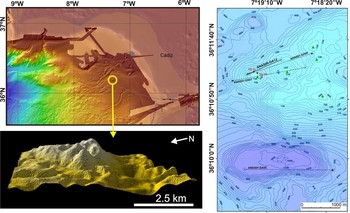
Here we report the occurrence of living Neopycnodonte zibrowii recovered on the slope of the Hespérides Mud Volcano Complex (HMVC). The HMVC (Figure 1) consists of a cluster of five single-cone mud volcanoes that are located in the central part of the Gulf of Cadiz (in the Ibero-Moroccan region), in a range of depths between 680 and 730 m, southward of the Cadiz Channel in the so-called Tasyo Fluid Flow Field (Somoza et al., Reference Somoza, Díaz-del-Río, León, Ivanov, Fernández-Puga, Gardner, Hernández-Molina, Pinheiro, Rodero, Lobato, Maestro, Vázquez, Medialdea and Fernández-Salas2003). The oysters were collected in the HMVC which is affected by the Mediterranean Lower Water that constitutes the more saline and lower core of the Mediterranean Outflow Waters (MOW), running at a depth of 750–1200 m with an estimated mean velocity of 25–70 cm/s (Hanquiez et al., Reference Hanquiez, Mulder, Lecroart, Gonthier, Marchès and Voisset2007). The MOW flows along the channel producing a warming of the deep waters surrounding the HMVC and triggering the destabilization of hydrates and a number of sea floor collapses (pockmarks) with different sizes and morphologies. The complex is composed of a number of morphological meso-structures related to sea-floor fluid expulsion and degassing processes. Two of them are the most dominant: (1) mud volcanoes; and (2) crater-like pockmarks.
(Upper left) location of Hesperides Mud Volcano Complex (HMVC) in the general context of Gulf of Cádiz; (lower left) 3D simulation obtained by means of multibeam bathymetry; (right) detailed bathymetry of the HMVC and surrounding area. Note in the 3D sketch the northern hillside of the twin picks regular cones where the oyster was found.

Five single-cone mud volcanoes can be recognized, forming the complex cluster and covering a surface of 4.5 km2. Bathymetric cross-sections show the particular features of each single-cone with maximum slopes ranging from 24° to 10°. Three morpho-types of cones can be mentioned: (1) twin picks regular cones, placed in the westernmost area of the complex, are characterized by circular and regular contour line, where the oyster was found; (2) twin slightly flat cones, placed in the easternmost corner of the complex presenting smooth surfaces with irregular bathymetric contour lines; and (3) elongated single-cone with strongly irregular and asymmetrical hillsides, located in the southernmost area of the complex.
Mud volcanoes and pockmarks underlie numerous authigenic carbonated chimneys, slabs and pavements (Merinero et al., Reference Merinero, Lunar, Martínez Frías, Somoza and Díaz del Río2008; Wienberg et al., Reference Wienberg, Hebbeln, Fink, Mienis, Dorschel, Vertino, López Correa and Freiwald2009), representing a potential substrate for hard-bottom fauna such as the oysters but also the gorgonian Callogorgia verticillata (Pallas, 1766), the black coral Leiopathes glaberrima (Esper, 1788) or other epifaunal bivalves such as Asperarca nodulosa (Müller, 1776) and Spondylus gussonii Costa, 1829 (Díaz-del-Río et al., Reference Díaz-del-Río, Palomino, Vázquez, Rueda, Fernández-Salas, López-González, Flor, Gallastegui, Flor and Martín2009). Patches of dead scleractinian coral have been reported in the immediate vicinity of the Hespérides cones (Wienberg et al., Reference Wienberg, Hebbeln, Fink, Mienis, Dorschel, Vertino, López Correa and Freiwald2009) with ages obtained from typical deep-water genera such as Lophelia and Madrepora clustering between 12 and 43 thousand years before present.
In the HMVC, four samples were collected using a benthic dredge during cruises ‘Anastasya 2000/09’ (DA-12) and ‘Anastasya 2001/09’ (DA-05, DA-06 and DA-07) carried out on board of RV ‘Cornide de Saavedra’ (Instituto Español de Oceanografía) (Figure 1). Oyster specimens were only found in dredge sample DA-12 (start: 36°11.39N/7° 18.96W; end: 36°11.18N/7° 19.45W, depth 720 m) that run along the northern slope of the HMVC and near the summit line. In that sample, a large amount of brown carbonate crusts and chimneys as well as a polygenic matrix breccia with a strong H2S smell were also collected (Diaz del Río et al., 2003). In samples DA-06 (depth 721 m) and DA-07 (depth 736 m), similar materials were collected but carbonate crusts and chimneys were less abundant in these samples. Contrary to those, the sample DA-05 (depth 1025 m) runs along the pockmark and the material collected only consisted of muddy contourites and no crusts and chimneys were found.
The following oyster specimens were recorded:
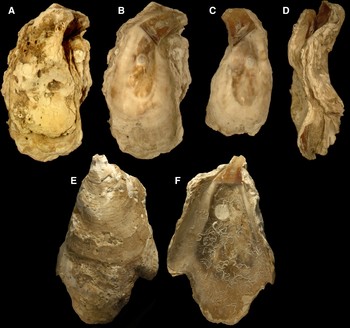
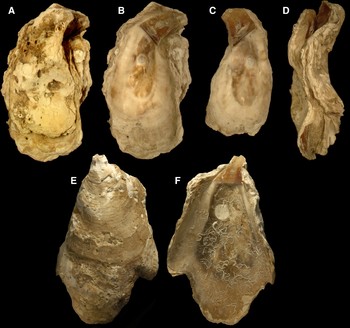
complete specimen live-collected (left valve 16.4 × 8.8 cm, right valve 13.5 × 6.7 cm) (Figure 2 A–D);
left valve 17.5 × 11.2 cm with outer surface showing regular growth lines and no trace of cementation (Figure 2 E, F); another left valve 12.5 × 8.5 cm;
two clusters of 5 and 3 left valves respectively, each valve measuring 8 to 17 cm, cemented to each other without a definite pattern;
two piled left valves of 8 and 5 cm and incomplete from ventral margin; and two very thick fragments (29 and 25 mm thick) probably involving various individuals piled up as described in Wisshak et al. (Reference Wisshak, López Correa, Gofas, Salas, Taviani, Jakobsen and Freiwald2009).
Specimens of Neopycnodonte zibrowii collected in the Hespérides Mud Volcano Complex (Gulf of Cádiz, south-western Iberian Peninsula). (A–D) Live collected specimen, actual size 16.4 cm (A, complete specimen viewed from right valve; B, inside of left valve; C, inside of right valve; D, anterior view of complete specimen); (E–F) loose left valve, actual size 17.5 cm (E, outside, F, inside) with no indication of attachment surface on most of the outer left valve. Note the straight hinge line and the small, round muscle scar situated closer to the hinge than to the ventral margin, which are diagnostic characters of the species.
This is the southernmost record of living specimens of this recently described species for the Atlantic Ocean, together with those mentioned in the preliminary cruise report by Hebbeln et al. (Reference Hebbeln, Wienberg, Beuck, Freiwald and Wintersteller2009) in the Alboran Sea. A noteworthy circumstance of this new record is its situation on a sea bottom which was suitable for the operation of a rock dredge and does not apparently feature abrupt cliffs or rocky overhangs as this was the case in the type locality or in El Idrissi Bank. One of the left (normally attached) valves shows an outer surface where the growth lines appear undisturbed, suggesting that this individual was lying loose on the bottom after probably having been attached as a juvenile. Although we cannot preclude that some specimens would be attached directly to the bedrock, the clusters of left valves indicate that dead specimens were used as attachment surface by newly settled individuals, and those are not regularly piled as described on the Azorean cliffs by Wisshak et al. (Reference Wisshak, López Correa, Gofas, Salas, Taviani, Jakobsen and Freiwald2009).
A relevant feature developed near the HMVC is the pool depression, formed down the slope of the main cone that has been interpreted as a degassing structure and covers a surface of 2.1 km2. Its maximum depth in relation to the surrounding reliefs is 150 m that results in a remarkable pockmark-dwelling benthic species related to methane environment. The absence of oysters in the pockmark sample (DA-05) may be related to a much lower availability of hard substrate (carbonate crusts, slabs and chimneys) when compared to the mud volcanoes. Oysters were not found in samples DA-06 and DA-07 and this may indicate that this species is not very abundant and probably restricted to certain hard-bottom areas within the complex. Moreover, oysters were also not found in similar samples obtained with the same sampling gear in other mud volcanoes from the Gulf of Cádiz (e.g. Cornide, Iberico and Pipoca), indicating that the species is probably restricted to certain volcanoes within this area.
Evidence of activity of gas seepages in this mud volcano complex is shown by water column target plumes (gas bubbles) observed on the EK500 echo-sounder. Cores and dredges collected from the crest of the single cones, yielded large amounts of brown carbonate crusts and chimneys and a polygenic matrix breccia with a strong H2S smell (Fernández-Puga et al., Reference Fernández-Puga, Vázquez, Somoza, Díaz del Río, Medialdea, Mata and León2007). Moreover, the sedimentary framework consists of mud breccia deposits covered by only 5 cm of sandy sediments which are bioturbated and show evidence of oxidation. Pogonophoran tubeworms and pyrite were also collected from the matrix of the breccia, being characteristic of chemosynthetic communities (León et al., Reference León, Somoza, Medialdea, Maestro and Díaz del Río2006). Carbonate crusts and chimneys consist of calcite and minor proportions of dolomite. Sediments recovered from the bottom of the large pockmark located southward of HMVC revealed mud deposits without evidence of gas-rich sediments or carbonate crusts on its surface. The presence of deep-sea oysters in the HMVC is probably not directly related to gas emissions but to a higher availability of hard substrate due to the chimneys and slabs formed as a result of the hydrocarbon seeps and the bacterial activity. This is supported by the absence of hydrocarbon gas emissions in other areas where other populations of deep-sea oysters have been found (Hebbeln et al., Reference Hebbeln, Wienberg, Beuck, Freiwald and Wintersteller2009; Wisshak et al., Reference Wisshak, López Correa, Gofas, Salas, Taviani, Jakobsen and Freiwald2009). This finding broadens considerably not only the geographical range of the species but also indicates that its requirements regarding seabed morphology may not be as narrow as considered in the first place.
ACKNOWLEDGEMENTS
Thanks are due to Gerardo Bruque for GIS data processing and management. We also gratefully acknowledge the cooperation of all those colleagues and friends, as well as the vessel crew who participated in activities developed during the last ten years in the Gulf of Cadiz giving support to this paper. This study was partially supported by the Indemares/Chica Project, EC contract INDEMARES-LIFE (07/NAT/E/000732).