




No CrossRef data available.
Article contents
Extremely rigorous subliminal paradigms demonstrate unconscious influences on simple decisions
Published online by Cambridge University Press: 24 January 2014
Abstract
While showing unconscious influences on complex decisions is indeed difficult, relevant awareness in relatively simpler subliminal paradigms is more easily assessed. Utilizing objective detection (vs. more typical identification or classification) tasks to assess awareness overcomes longstanding residual methodological problems, and prior work using such methods (e.g., Snodgrass & Shevrin 2006) clearly shows unconscious influences on simple decisions.
Information
- Type
- Open Peer Commentary
- Information
- Copyright
- Copyright © Cambridge University Press 2014
References
Debner, J. & Jacoby, L. L. (1994) Unconscious perception: Attention, awareness, and control. Journal of Experimental Psychology: Learning, Memory, and Cognition
20:304–17.Google Scholar
Fisk, G. D. & Haase, S. (2011) The relationship between the objective identification threshold and priming effects does not provide a definitive boundary between conscious and unconscious perceptual processes. Consciousness and Cognition
20:1221–31.Google Scholar
Green, D. M. & Swets, J. A. (1966) Signal detection theory and psychophysics, vol. 1974. Wiley.Google Scholar
Jacoby, L. L. (1991) A process dissociation framework: Separating automatic from intentional uses of memory. Journal of Memory and Language
30:513–41.Google Scholar
Lovibond, P. F. & Shanks, D. R. (2002) The role of awareness in Pavlovian conditioning: Empirical evidence and theoretical implications. Journal of Experimental Psychology: Animal Behavior Processes
28:3–26.Google Scholar
Macmillan, N. (1986) The psychophysics of subliminal perception. Behavioral and Brain Sciences
9:38–39.CrossRefGoogle Scholar
Pratte, M. S. & Rouder, J. N. (2009) A task-difficulty artifact in subliminal priming. Attention, Perception & Psychophysics
71(6):1276–83.Google Scholar
Snodgrass, M., Bernat, E. & Shevrin, H. (2004a) Unconscious perception: A model-based approach to method and evidence. Perception & Psychophysics
66:846–67.Google Scholar
Snodgrass, M., Bernat, E. & Shevrin, H. (2004b) Unconscious perception at the objective detection threshold exists. Perception & Psychophysics
66
888–95.Google Scholar
Snodgrass, M. & Shevrin, H. (2006) Unconscious inhibition and facilitation at the objective detection threshold: Replicable and qualitatively different unconscious perceptual effects. Cognition
101:43–79.Google Scholar
Snodgrass, M., Shevrin, H., & Kopka, M. (1993a) The mediation of intentional judgments by unconscious perceptions: The influences of task strategy, task preference, word meaning, and motivation. Consciousness and Cognition
2:169–93.Google Scholar
Snodgrass, M., Shevrin, H., & Kopka, M. (1993b) Absolute inhibition is incompatible with conscious perception. Consciousness and Cognition
2:204–209.Google Scholar
van Gaal, S., de Lange, F. & Cohen, M. (2012) The role of consciousness in cognitive control and decision making. Frontiers in Human Neuroscience
6:121. doi: 10.3389/fnhum.2012.00121.Google Scholar
Van Selst, M. & Merikle, P. M. (1993) Perception below the objective threshold?
Consciousness and Cognition
2:194–203.Google Scholar
Wong, P., Bernat, E., Snodgrass, M. & Shevrin, H. (2004) Event-related brain correlates of associative learning without awareness. International Journal of Psychophysiology
53:217–31.Google Scholar
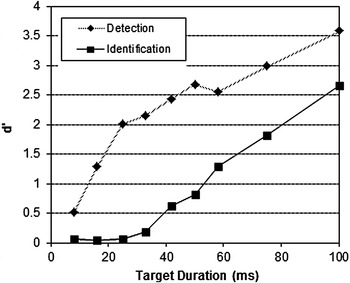
Figure 1. Sensitivity (d') of detection and identification as a function of masked word (target) exposure duration. Reprinted by permission from Fisk and Haase (2011).
Newell and Shanks (N&S) marshal impressive evidence that claims for unconscious influences on decision making are likely premature in the three areas they primarily discuss. Especially in such complex paradigms (e.g., multiple-cue judgment), we agree that it is very difficult to adequately assess relevant awareness, and hence that the jury is (or should be) still out. In contrast, however, subliminal paradigms are simpler, making assessing relevant awareness easier. Of course, such paradigms also face methodological hurdles, and we agree that much subliminal work does not overcome these difficulties. Still, contra N&S, we argue that subliminal paradigms can demonstrate unconscious influences on simple decisions under certain conditions. We first summarize our methodological analysis (cf. Snodgrass et al. Reference Snodgrass, Bernat and Shevrin2004a, pp. 849–53), and then briefly describe some prior work that meets these extremely stringent methodological criteria. We focus on objective threshold paradigms, wherein performance on awareness assessment tasks does not exceed chance (i.e., d′=0). Skeptical interpretations are more plausible in subjective threshold paradigms, wherein performance exceeds chance and/or awareness assessment is often weak (e.g., post-experimental inquiries).
How should relevant awareness be assessed?
All stimulus-related effects (e.g., semantic priming), whether conscious or unconscious, require at least partial stimulus identification. Accordingly, forced-choice prime identification tasks (e.g., “Was it word A or word B that was just presented?”) adequately assess awareness in principle, because any conscious partial identification will raise performance above chance. For example, given “happy” and “terror” as response alternatives, perceiving the letter “t” would favor the latter response. Consequently, demonstrating null identification awareness warrants claims for unconscious effects on other (e.g., priming) tasks.
Perhaps surprisingly, however, widely used categorization tasks (e.g., “Was the just-presented positive or negative?”) may not be adequate because they frequently require more extensive identification. Here, for example, perceiving “t” alone would be useless. Given this, partial identification could conceivably activate related versus unrelated prime words, yet be insufficient to allow conscious categorization. Lovibond and Shanks (Reference Lovibond and Shanks2002, p. 9) made related arguments, but failed to recognize this critical difference between identification versus categorization, instead lumping them together as “recognition” (cf. Wong et al. Reference Wong, Bernat, Snodgrass and Shevrin2004, p. 239).
Unfortunately, however, even given observed chance identification, intrinsic measurement error makes definitively ruling out relevant awareness difficult (cf. the null sensitivity problem), because true identification might exceed chance. While there are various potential solutions, here we suggest a simple yet underutilized alternative: Use true detection tasks (e.g., “Was a word or a blank field just presented?”) instead, arranging conditions such that detection d′ ≈ 0. Signal detection theory (Green & Swets Reference Green and Swets1966) provides strong reasons to believe that such tasks exhaustively assess even partial identification (cf. Macmillan Reference Macmillan1986). Even more important, much evidence (Snodgrass et al. Reference Snodgrass, Bernat and Shevrin2004a, p. 853) shows that objective detection thresholds (ODTs) are well below objective identification thresholds (OITs), and are hence extremely conservative. To illustrate, Fisk and Haase (Reference Fisk and Haase2011) obtained both detection and identification for masked words under various exposure durations. See Fig. 1.
Sensitivity (d') of detection and identification as a function of masked word (target) exposure duration. Reprinted by permission from Fisk and Haase (Reference Fisk and Haase2011).
As Fig 1 shows, given Fisk and Haase's masking conditions, detection d′ ≈ 2 at the OIT (i.e., identification d′ ≈ 0 with 25 ms exposures) and remains well above chance even at below-OIT durations. Critically, then, if the ODT is approximated, we can be very confident that extremely stringent OIT conditions are also satisfied, even given measurement error in detection d′ – thus solving the null sensitivity problem outright regarding ruling out conscious partial identification.
But what about other possible artifacts cited by N&S, such as Pratte and Rouder's (Reference Pratte and Rouder2009) claim that standard prime discrimination tasks underestimate their visibility in the priming phase? While we disagree with their fundamental reasoning, here we simply note that their ostensibly improved awareness assessment procedure only increased identification from 54% to 60%, a d′ increase of about 0.3. Thus, even if they are correct, approximating the ODT would still guarantee that extremely stringent OIT conditions were simultaneously met.
ODT effects are large and reliable
Although most grant that ODT conditions are extremely stringent, they are rarely utilized in recent years, in part because they are difficult to achieve using typical computer monitors. Perhaps more importantly, many investigators believe that all effects will disappear given the extremely brief exposures necessary for ODT conditions. Refuting such intuitions, however, our meta-analysis (Snodgrass et al. Reference Snodgrass, Bernat and Shevrin2004b) shows that ODT effects are both large (Cohen's d = 0.88) and reliable (p ≈ 10−9).
But what about unconscious effects on decision making proper?
In recent years subliminal investigations of cognitive control processes have increased markedly, obtaining positive results with clearly decision-relevant paradigms such as go/no go (cf. van Gaal et al. Reference van Gaal, de Lange and Cohen2012 review). However, because virtually all of these studies used identification or classification tasks to assess awareness, they do not conclusively rule out conscious partial identification.
In a series of ODT studies, however, we (Snodgrass et al. Reference Snodgrass, Shevrin and Kopka1993a; Reference Snodgrass, Shevrin and Kopka1993b; Snodgrass & Shevrin Reference Snodgrass and Shevrin2006) investigated unconscious influences on forced-choice identification itself, which clearly requires simple decision making. For the current purposes, the most striking result was that under certain conditions identification was reliably below chance. This requires that the stimuli were unconsciously identified, yet rejected as a response (i.e., excluded – cf. Jacoby Reference Jacoby1991). Otherwise, only chance performance would result. But could this effect be conscious? No, because (1) ODT conditions rule out conscious partial identification; (2) conscious exclusion requires much stronger stimuli (i.e., exceeding the subjective threshold; Debner & Jacoby Reference Debner and Jacoby1994); and (3) instructions requested correct responses (i.e., inclusion, not exclusion). Further, these effects have been repeatedly replicated, both by skeptical investigators (Van Selst & Merikle Reference Van Selst and Merikle1993) and including critical tests for possible artifacts. Accordingly, these effects reflect unconscious, involuntary exclusion. While still relatively simple, this result is notable indeed, given that response inhibition (i.e., exclusion) is a core decision process long thought to require relevant awareness.
It may be that only relatively simple decisions can be unconsciously influenced. Further subliminal work using more complex paradigms (cf. van Gaal et al. Reference van Gaal, de Lange and Cohen2012) under extremely rigorous ODT conditions, however, are essential before firm conclusions about unconscious influences on complex decision making can be drawn.