Introduction
Strong perceived social support in late adulthood has been associated with lower mortality (Giles et al. Reference Giles, Glonek, Luszcz and Andrews2005), reduced morbidity and better self-rated health (Arthur Reference Arthur2006). It has been suggested that social networks decline over time as people selectively maintain relationships which maximise emotional valence (Carstensen Reference Carstensen, Schaie and Lawton1991), but other research suggests that network size remains relatively constant over the lifespan until very late in life (Antonucci Reference Antonucci, Birren and Schaie2001), when deaths reduce the number of network participants (Lang Reference Lang2001), and relationships of longevity and intimacy are not easily replaced. Although much research supports the view that, in general, women have more extensive and robust social-support networks than men, these can come at a price; for example, the need to continue to provide support to someone in an extensive network (Antonucci, Akiyama and Lansford Reference Antonucci, Akiyama and Lansford1998).
Factors impacting upon older adults' social interactions
Research in Australia and elsewhere has indicated a number of factors related to the ageing process that influence the number of social interactions in late adulthood (Glaser et al. Reference Glaser, Tomassini, Racioppi and Stuchbury2006; Gurung, Taylor and Seeman Reference Gurung, Taylor and Seeman2003; Pachana et al. Reference Pachana, Smith, Watson, McLaughlin and Dobson2008); such as physical impairments that limit mobility and the ability to access network members; sensory problems, such as hearing difficulties and visual impairment, which create barriers to effective communication (Pachana et al. Reference Pachana, Smith, Watson, McLaughlin and Dobson2008); and poor mental health, which causes older people to withdraw from their normal social interactions or leads to increasing isolation as friends withdraw support (Gurung, Taylor and Seeman Reference Gurung, Taylor and Seeman2003). There is also evidence that the experience of widowhood stimulates changes in social interactions in late adulthood and to either losses or gains in support. Previous cross-sectional findings have indicated that disruptions of the marital relationship have deleterious consequences for support at older ages, although few studies have distinguished between deaths and divorces, and these have had mixed findings, with some suggesting that the death of a partner has no effect on perceived support (Glaser et al. Reference Glaser, Tomassini, Racioppi and Stuchbury2006), while others have shown increased instrumental support (Utz et al. Reference Utz, Carr, Nesse and Wortman2002). Many older adults, particularly women, care for a frail or ailing spouse (Lee Reference Lee2001). Many women who take on the care-giver role subsequently reduce their social activities to concentrate their emotional and physical energy on their partner. The distress of bereavement after a period of caring which may last for many years can elicit supportive behaviours from friends and family that increase the size of social networks (Scott et al. Reference Scott, Bergeman, Verney, Longenbaker, Markey and Bisconti2007). Some spouses experience an emotional release when the burden of caring for their loved one is lifted and seek to resume activities and relationships which have been disrupted by the care-giver role (Bernard and Guarnaccia Reference Bernard and Guarnaccia2003; Waldrop Reference Waldrop2007).
Gaps in current understanding
The vast majority of studies of the factors that impact on the size of social networks in late adulthood have not been longitudinal and have relied on cross-sectional data. Moreover, limited research has assessed social-support networks with data gathered from large representative samples of older adults. With age, people become increasingly heterogeneous but a limitation of existing research on social interactions is that individual variations are overlooked (Krause Reference Krause1999). In response, this paper uses both qualitative and quantitative data to understand the trajectory of social networks in late adulthood and to explore the lived experience of older women. The analyses are of data from a cohort of older Australian women who have participated since 1996 in the Australian Longitudinal Study on Women's Health (ALSWH), a survey of the health and wellbeing of three cohorts of women who in 1996 were aged 18–23 years (1973–78 birth cohort), 45–50 years (1946–51 birth cohort) and 70–75 years (1921–26 birth cohort). They were recruited using stratified random sampling from the Australian National Health Insurance database (Medicare), which includes all citizens and permanent residents. Details of the cohorts and recruitment methods have been described elsewhere (Lee et al. Reference Lee, Dobson, Brown, Bryson, Byles, Warner-Smith and Young2005). The large sample is broadly representative of the Australian female population, but there was intentional over-sampling of women from rural and remote areas. Mailed questionnaires were used to collect self-report data on health and related variables every three years.
The longitudinal quantitative analyses reported in this paper explore the links among a number of factors associated with the size of social networks, and the qualitative data are then used as an interpretive resource to explain and contextualise these links. The aims were, firstly, to analyse the longitudinal data to identify the factors that significantly associated with older women's social network size, and secondly, to use these as themes in the explication of the qualitative data. By drawing together both quantitative and qualitative data in a mixed-methods approach, the specific aim was to examine in depth the factors associated with change in the social networks, and to contribute to our understanding of how older women shape, and are shaped by, their social world.
Methods
The participants and the quantitative analysis
The participants were drawn from the 1921–26 birth cohort of ALSWH. The quantitative analyses are based on data from Survey 2, conducted in 1999 when the women were aged 73–78 years; Survey 3 in 2002 (ages 76–81 years) and Survey 4 in 2005 (ages 79–84 years). Survey 1 data were not used because not all the explanatory variables were included. At Survey 2, 9,233 participants completed all the outcome variable items; at Survey 3, 8,294 participants completed all those items; and at Survey 4, 6,833 participants completed all those items. In total, 5,863 women participated in all three surveys (2, 3 and 4); 2,461 participated in only two of the surveys and 1,849 participated in only one.
The outcome variables
Social networks were measured using the network sub-scale of an abbreviated version of the Duke Social Support Index (Koenig et al. Reference Koenig, Weslund, George, Hughes, Blazer and Hybels1993). The sub-scale measures the size and structure of the social network and has four items: number of people in the local area (aside from family) that you can depend on or feel close to; number of times in the past week spent with a person not living in the same residence; number of times in the past week spoken to another person on the telephone; and number of meetings of organisations or groups attended in the past week. Network scores ranged from 0 to 21 with higher scores indicating more social contacts; the distribution of the scores was approximately normal.
The explanatory variables
The factors hypothesised to impact on network scores were: marital status, classified as ‘married/partnered’, ‘divorced’, ‘single’, ‘separated’ and ‘widowed’; country of birth, classified as ‘Australia’, ‘Other English-speaking’, ‘Europe’, ‘Asia’ and ‘Other’; and managing on income: rated as ‘impossible’, ‘difficult always’, ‘difficult sometimes’, ‘not too bad’, and ‘easy’. In each survey, the participants were asked if during the past three years they had experienced: (a) a major decline in the health of their spouse or partner, (b) a major decline in the health of another close family member or close friend, (c) the death of their spouse or partner, and (d) the death of another close friend or family member (not spouse). They were also asked: (a) if they recently moved house, (b) if they had difficulty seeing newspaper print, even with glasses, (c) and if they had difficulty in hearing a conversation, even with a hearing aid. The answers recorded as ‘yes’ or ‘no’. The women were also asked if their health limited them in walking 100 metres, with the possible answers being: ‘yes limited a lot’, ‘yes limited a little’ and ‘no, not limited at all’. To measure psychological health, the five-item mental health (MH) sub-scale of the short-form General Health Survey (SF-36) (Ware et al. Reference Ware, Snow, Kosinski and Gandek1993) was used as a continuous explanatory variable.
Longitudinal regression modelling was used to examine the associations between network size and the explanatory variables. Repeated-measures data were used for network size and the other variables at each survey (except for country of birth which remained unchanged). Random intercepts were fitted to allow for the correlation between observations from the same participants at different surveys. A fixed-effect linear term was used to model the trend in network size over the three surveys, which allowed for change over time. The model was fitted using the Mixed Procedure in SAS version 9.1.
The qualitative analysis
The final page of the questionnaire was headed, ‘Have we missed anything? If you have anything else you would like to tell us, please write on the lines below’. The qualitative data for this paper are drawn from Survey 4, for which 3,611 women provided responses to the open call. The qualitative data were content analysed using the factors identified from the regression analysis, beginning with the identification of keywords and then by carrying out a line-by-line examination of the participants' written comments. Comments relevant to the identified themes were provided by 173 women. Systematic coding was conducted by partitioning the textual data and copying sections under headings that corresponded to the concept. To ensure the rigour and trustworthiness of the data, the coded transcripts were reviewed by two coders and subjected to an iterative process of cross-checking and content analysis.
The findings
Quantitative analyses
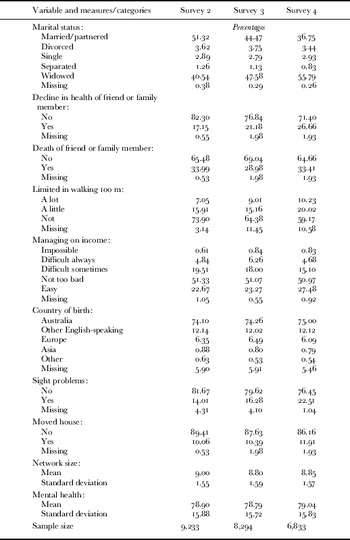
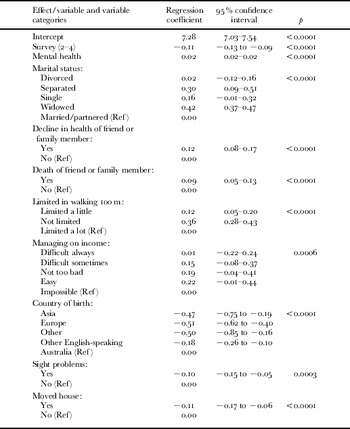
Profiles of the participants in each of the three surveys are shown in Table 1. Network size decreased somewhat over time and there were changes in some of the socio-demographic and health characteristics of the sample. At Survey 2, the majority of the women were married or partnered, but by Survey 4 the majority were widowed. An increasing number of women reported a major decline in the health of a family member or close friend, and problems with mobility and sight increased over time. The regression coefficients from the longitudinal analysis indicated that the size of the women's social networks reduced significantly over time (indicated by the negative coefficient for Survey). Table 2 displays the regression coefficients for all the explanatory variables included in the model. Having better mental health, being widowed or separated, having adequate financial resources, experiencing the death or illness of a family member, and not having mobility problems were associated with larger network size. The reduction in network size over time was associated with not being Australian-born, moving house and having sight problems. Each of these significant explanatory variables will be discussed and combined with the qualitative data in the following sections.
Profiles of the participants in the three survey years

Regression coefficients for factors associated with network size from longitudinal model using all available data

Note: Ref: reference category.
Network size
Although the decline in the size of the women's networks from 1999 to 2005 was statistically significant, overall it was not substantial. Some of the women experienced shrinkage in the size of their social networks, but for others it expanded. Many of the declines resulted from the loss of close ties through death and ill health, which is consistent with previous research findings (e.g. Lang Reference Lang2001). One woman whose network size reduced markedly commented:
In the last two or three years most of my good long-term friends, male and female, have passed away. I now only have three or four and some don't drive or go out much. At 81, these gaps are hard to fill and new friends don't happen along.
In contrast, other women spoke of not pursuing relationships that were not expected to be emotionally meaningful. One, for example, said, ‘I have some, but very little, interactions with people of the area – it is not a matter of anonymity just all being busy and getting on with things’. Carstensen (Reference Carstensen, Schaie and Lawton1991) suggested that with increasing age, social networks are affected by emotional motivation and perceptions of time remaining. Interactions are therefore limited to those social partners who are not ‘costly’ in terms of emotional, physical or psychological input. Older people may actively ‘prune’ their social networks so that they include only those people who can meet their needs and provide an appropriate level of support. In particular, relationships with people that generate disproportionately high emotional demands may be relinquished as the discrepancies between support provided and support received makes these relationships onerous to maintain.
Psychological functioning
The statistical analysis revealed that good mental health associated with larger social networks over time. Individuals with poor psychological functioning may be unable to access their networks effectively, or may in fact be resistant to approaches from network members, particularly, for example, if the individual is withdrawing socially as a result of depression. This is congruent with research that has suggested that those with depression may repel social support from existing networks (Pachana et al. Reference Pachana, Smith, Watson, McLaughlin and Dobson2008). The qualitative data supported these findings, and in particular indicated that an optimistic outlook was the most useful way to manage the ageing process. A number of women commented that although they were not particularly happy at the results wrought by time, they maintained a positive outlook and just got on and ‘made the best of it’. So-called ‘existential variables’, such as optimism, have previously been found to be associated with an individual's ability to overcome difficulties (Reker Reference Reker1997). It is possible that women with more optimistic outlooks are better able to utilise their social-support networks.
Depression or loneliness was cited by some of the women as the reason for their few social contacts, as one participant related: ‘I have no support like many old people. I think loneliness is the biggest problem for old people which is (likely to lead to) depression’. One participant described her mother's experience of social isolation and the impact this can have on the psychological wellbeing of older women: ‘She often suffers depression and “the blues” as her life now seems to be so empty. I do all I can but gradually her friends and family (she has seven siblings) have stopped visiting’. This daughter elaborated on how distressing she found the experience of watching her mother ‘in this unhappy situation’, and alluded to the feeling that increasing age was associated with increasing social irrelevance; that some older women had feelings of no longer being a valued member of the community. As another participant rather bleakly reflected: ‘I am now well aware I've passed my “use by date” … finding the laughs-in-life takes forever and if people my age tell you they're enjoying life, they're putting (on) a face just for you’.
Much of the reported sadness related to the loss of friends and family with the passage of time. Although most of the women were pragmatic about the reality of their finitude, the sadness that they associated with losing loved ones and, for some, of being the last remaining member of their family or social network, clearly affected their psychological wellbeing. One said that she had recently experienced ‘mainly depression, as over last three years I have lost three sisters and their spouses and a male companion of 13 years. I am the last member of our family of seven siblings, I miss them terribly’. Although losses in late adulthood may lead to depression, it is not inevitable. Some women, while acknowledging their grief and sadness, had found that loss brought an increase in social support, as members of their social network rallied to provide emotional and instrumental support.
Loss and bereavement
The quantitative results showed that social network size was larger for women who were widowed or separated, who had experienced a decline in the health or the death of a family member or close friend. Social networks appeared to be larger for the women likely to require help or assistance, especially among the recently widowed. Their new circumstances and needs may attract increased attention and concern, which is congruent with the age and gender-related models of social support which suggest that such women benefit from the responsiveness of their social networks (Pachana et al. Reference Pachana, Smith, Watson, McLaughlin and Dobson2008). The qualitative data illuminated how the declining health and the subsequent death of a family member, in many instances a spouse, was followed by enhanced social support and networks. As most women received social support from family and friends, the time of bereavement provided the opportunity for these to become rich sources of emotional and instrumental support, as was encapsulated in two quotations:
I cared for my darling husband for 59 years; he died on our wedding anniversary. After sitting with him in hospital for ten days, he died in my arms. My son and daughter-in-law and three adult grandchildren … and just people … are so kind. Even young ones say, ‘Would you like a cuddle to cheer up your day?’
The major change in my life since you last surveyed me is the long illness and death of my husband. We had a long time to think and talk about it together, but it is worse than I imagined. I am fortunate to have more personal and social resources than many people of my age, and I get comfort from them as I always have. I don't think I am unhappy but I find his absence more difficult than I have words for. I do believe I am managing on the whole but it is tougher than I was able to imagine.
Many women explained how the death of a beloved partner could be interpreted and experienced as a release. One said: ‘My husband was ill (with cancer) for a very long time and suffered so much so it was a relief to not see him suffer any more’. A protracted illness affects the response of the carer to the eventual death of a spouse or family member. During the illness period, much of the carer's psycho-social resources are consumed by the need to care. Managing this burden may contribute to the adjustment process after recovery or death. If roles are relinquished or change in ways that are incompatible with the carer's needs, however, post-bereavement adjustment may be lengthy and complicated. For example, social and leisure roles are often sacrificed as the care-burden increases, because they are perceived as of less importance (Bernard and Guarnaccia Reference Bernard and Guarnaccia2003). Reduced interaction with social networks may leave the carer vulnerable to isolation, loneliness and reduced wellbeing when the caring role ceases.
Marital separation in later life also associated with larger social networks, with friends rallying around to provide support. One woman explained: ‘I am separated from my husband for a little over a year. … I feel freer and happier about this. My neighbours in the village are very good’. These results are consistent with earlier research which has described marriage as more socially beneficial for men than women (Lyyra and Heikkinen Reference Lyyra and Heikkinen2006). This may be because men report their wives as their chief source of social support, while women receive most support from their children and friends (Pugliesi and Shook Reference Pugliesi and Shook1998). Separated or divorced women are more likely than men to have large social networks and to maintain contact with their children and other family members (Amato Reference Amato2000).
Access to social networks: mobility
The quantitative analysis found that larger social networks were significantly associated with good mobility. Over time, the percentage of women who reported difficulties in walking a distance of 100 metres increased from 23 per cent to a little more than 30 per cent. An important condition of social networks is that the members are accessible. To be able to walk, drive or use public transport is an essential element in maintaining participation in a social network, an aspect that the qualitative data illuminated well. One participant put the matter brusquely: ‘(I) can't walk without a walking stick (and) won't go out on public transport’. Another said, ‘I have slowed up and do not now go walking, especially on my own. Shopping is now left to family members and activities have been restricted’.
Financial resources
The quantitative data indicated that most of the respondents had no difficulty managing on their income and that a lack of financial stress was associated with more extensive social networks. Several women commented that emotional resources were more important than financial means, as this woman's quote clearly illustrated:
It's easy because with a family of eight children I learnt to budget. As the family grew, and the children married and had children I had to learn not to feel guilty about not [being able to] buy [for the] grandchildren, then the great-grandchildren – Christmas and birthday presents. We can only give our love. Our children in turn give us sensible gifts at gift-giving times that help our budget.
Some of the women were assisted by family members and reciprocated by providing care to grandchildren or other family members. As one said, ‘due to limited income, my family support me, and in return it is my privilege to mind my grandchildren and attend their events at school and so on’.
The immigrants in the sample
With age, immigrants are at risk of becoming increasingly isolated as their peer and support groups dwindle through natural attrition. The quantitative results indicated that this was the case for many older women, and those not born in Australia had significantly smaller networks. It is a relatively common occurrence for some older adults with age-related memory problems to find increasing difficulty in speaking a non-native language. As one woman explained, ‘(I am) starting to forget now. Being of Italian descent causes language difficulties’. Even some of the women with no language barrier who had spent the larger part of their life in Australia found themselves isolated through unfortunate circumstances. For one woman, some old friends had been left behind and new friends had been estranged because of family difficulties. She explained:
I may appear harsh about my friends – it is difficult to answer truthfully as I have several very dear and kind life-long friends but they all live in the UK! We emigrated from the UK 39 years ago – but my husband became an alcoholic and we lost all the friends we had made here. After more than 25 years of Australia, I inherited a considerable fortune (to us at least) at the age of 70 – he was 74 – I was finally able to separate and set him up in his own house – close by. However, it was too late to make more firm friendships – there were two special people locally but both have passed away.
Access to social networks: sight
The longitudinal analysis found that fading sensory faculties, such as vision, resulted in significantly smaller social networks. Coping with the external world was problematic for the women with limited visual acuity. In the words of one participant: ‘I am very limited in my activities on account of my eyesight. One eye is more or less blind and the other one is failing badly. As yet I can get about safely but although I can see people I can't tell who they are anymore’. As vision restrictions limited their ability to enjoy social interactions, continuing sight deterioration also interfered with the activities that they could enjoy in their own homes. A number of women described the difficulty of adjusting to the limitations imposed by poor vision on previously-enjoyed activities. One explained that ‘deteriorating vision has loomed as a major disability for me. It is hard to get involved in a book while needing to move the magnifying glass’. Families and friends were often understanding of the frustration that occurred with decreased abilities and were supportive in providing care and alternative sources of interest and enjoyment, as the following quote illustrates: ‘My vision impairment means that I do need help with some shopping and of course transport, which I get from friends’.
Moving house
A relatively frequent occurrence in later adulthood is relocation to a smaller dwelling in a retirement complex or a different area, or to a home closer to family members. The quantitative analysis indicated that moving house was associated with reduced social network size. Although moving to either a retirement facility or closer to family can provide additional instrumental support, leaving behind friends of many years can be emotionally wrenching, and making new friends is not always easy in later years. As one participant put it, ‘(we) recently paid a deposit on a self-care retirement home for husband and myself. We really don't want to leave our home and wonderful neighbours but some of them are in a similar position and may also be moving’. Another explained, ‘I have just moved to a self-care unit in a retirement village, far from former friends and activities. So depression is high on the list, so is lack of friends; it is hard to start again at 82’. Other women, however, embraced the challenge of a move and although many encountered initial difficulties, they were generally overcome. One participant explained, ‘I have moved into a retirement village recently. So I don't have many close friends here as yet, but all are very friendly and I am happy here. Another reflected: ‘We find that hostel living has many challenges, brings you new friends and teaches you to be a little tolerant of other people's problems’.
Conclusions
The quantitative aspects of the longitudinal survey revealed that the size of the women's social networks declined between the ages of 73–78 and 79–84 years. Those who reported larger networks were more likely to enjoy positive psychological functioning, be widowed or separated, to have experienced the death or illness of a family member or friend, to have no mobility restrictions, and to be free of financial constraints. Smaller network size was associated with not being Australian-born, having problems with vision, and moving house. These results are consistent with the cross-sectional analyses that we have previously carried out on the cohort data (Pachana et al. Reference Pachana, Smith, Watson, McLaughlin and Dobson2008). Poor mental health was associated with smaller networks and cited by some respondents as being associated with fewer social interactions. Other respondents commented on the sadness they experienced because of the losses associated with ageing, such as the inability to undertake their previous social roles, and the deaths of family and friends. Most respondents acknowledged, however, the importance of having a positive attitude in the face of these challenges.
Widowhood and bereavement appear to be a time in which women garner greater social support from their networks, although we were unable to determine from our analyses if there is a ‘grieving period’ during which support peaks and then tapers off to pre-bereavement levels, as has been suggested by others (Scott et al. Reference Scott, Bergeman, Verney, Longenbaker, Markey and Bisconti2007). The women's comments reinforced the impact of bereavement and were congruent with the model of an emotional release when the physical and emotional burden of caring for a loved one ceases (Bass and Bowman Reference Bass and Bowman1990). The illness or death of a loved family member or friend also increased social support, although not to the extent engendered by widowhood. It may be that the women's networks responded to a time of emotional need and provided a level of support congruent with the experienced loss. Many women commented on their role as care-givers for their spouse, and their subsequent emotional response to widowhood. For some of the women, mourning the loss of a beloved partner was accompanied by a sense of release. The relief model of bereavement portrays the resolution of distress as caring responsibilities come to an end. This resolution allows the care-giver to re-establish social contacts and use psychological resources to adapt to the loss (Bernard and Guarnaccia Reference Bernard and Guarnaccia2003).
The importance of the ability to access social-network members was underscored by the decrease in network size for women with limited mobility. Restrictions in mobility caused by increasing frailty or ill health may lead to the relinquishment of driving licences and limit an older woman's ability to access public transport. If the spouse had been the primary car driver, his disability or death can result in older women becoming increasingly socially isolated. Although most of the women reported little difficulty in managing on their income, those who experienced financial strain participated in reciprocal arrangements with family members that ameliorated the hardship, while concurrently increasing the women's social interactions. Previous research on the effect of financial stress on the social networks of older people has suggested that it is not financial support per se which is the most important factor, but what such support implies: it provides an indication of commitment to the older person's future need (Krause Reference Krause1997).
Women born outside Australia were likely to have smaller networks than the Australian-born, possibly reflecting the shrinking over time of the cohort of peers from their country of origin. Language differences, which may have been manageable in earlier adulthood, became problematic with the passage of time, because older people tend to remember the language of their birth better than an acquired tongue. Likewise, for many participants, deteriorating vision limited not only their social interactions but also their ability to enjoy activities in their home, potentially impairing psychological wellbeing. Loss of vision has been identified as a consistent predictor of depression in late adulthood even after adjusting for a wide range of health-related variables (Chou Reference Chou2008). Increasing frailty in old age leads many people to accommodate their limitations by moving house. Some such moves, sometimes to different states, towns or cities, resulted in women becoming socially isolated as they left behind relationships built up over many years. Most participants were positive about potential new social partners, however, while acknowledging that long-standing friendships are difficult to replace.
A number of limitations of the reported analyses should be considered. As the data came from a postal survey, we have information from only those women who chose to participate. Moreover, a relatively small number provided responses to the open-ended questions. It may be that the women who responded to this survey differed from non-responders, and that those who provided additional comments differed from those who did not. Another possible limitation is our reliance on the Duke Social Support Index as a measure of social network size – although its method for assessing the size of social networks is consistent with other measures of this type. Future research could usefully expand on the presented analyses by comparing in more detail the groups of women whose social network size reduced, remained stable or enlarged. Longitudinal data could be utilised in these group comparisons to illuminate the causal relationships among the variables that this paper has identified as significantly related to social network size. The qualitative analyses enriched the findings by providing thematic illustrations of the lived experiences of older Australian women. Their comments complemented the quantitative findings and provided details that ‘fleshed out’ the statistical results. Their comments were consistent with the themes identified by the quantitative analyses and with earlier research indicating that social networks in late adulthood are affected by a number of psychological and physical variables.
Acknowledgements
The Australian Longitudinal Study on Women's Health was conceived and developed by groups of inter-disciplinary researchers at the Universities of Newcastle and Queensland, and funded by the Australian Government Department of Health and Ageing. We thank all participants for their valuable contribution to this project.