[I]f the body is to be placed at the center of political theory and struggle, then we need to rethink the terms in which the body is understood. We need to understand its open-ended connections with time and space, its dynamic natural and cultural systems, and its mutating, self-changing relations, within natural and social networks.
Elizabeth GroszFootnote 1
What happens when a female body appears to explode and then hover in a cloud of energy? Her figure re-forms; glistening rivulets of sweat pour down taut skin over muscles. She focuses on the molecular information in every cell of her working body. Her concentration exceeds and expands the physical limits of labour to art labour. Her art labour sustains her and costs her, dearly, in time, effort and security. This artist is part of the particular art labour force of butoh in the contemporary performance world of migrant or in-transit performances and workshops.
Numerous Japanese women artists have made the choice to leave their homeland, Japan, and make a living as artists on the move, across Europe, through the Americas and the Pacific Rim. Yoshioka Yumiko, Kaseki Yuko and Seki MinakoFootnote 2, three butoh artists who have made this choice, live and work outside Japan. Their intense and spectacular art labour arises from multiple tensions of living outside their official citizenship nation and performing and teaching butoh in many urban and rural locations, spanning hemispheres, oceans and continents. They are part of a migrant art labour force, a community of individual artists on the move, in transit, and they form a ‘stranger community’ that is not located. Their stranger community is a flexible and non-threatening space of butoh art labour. These women offer performers, spectators and trainees passage into their stranger community of intense butoh art labour.
Why art labour? I first encountered this term in a programme by Yoshioka Yumiko for her group TEN PEN CHii in Berlin in autumn 2010. I was struck by how ‘art labour’ matched the group's live performance strategies: their intense sweat, pain, focus, energy, emotion and exacting skill level drove every moment of performance. Taking off from that ‘labour’, I will foreground how three Japanese women artists perform their art labour within the constellation of their in-transit contexts between Japan and Berlin, and their evolving practices of butoh and contemporary European performance.
This essay places art labour at the centre of our global labour-movement crisis and asks whether these artists and their art labour might initiate a new consciousness of work – outside nations, nationalisms and citizenship – through their moving bodies, collective creativity and intense commitment. I examine how a specific community of in-transit artists create, perform and constantly negotiate their art labour practices. My specific examples of three Japanese women outside Japan, their art labour histories and practices and their stranger community of butoh-related art labour are not a template for in-transit art labour. Through these examples, I explore the complexity and nuances of contemporary in-transit art labour, and simultaneously reflect the inabilities of social, political and aesthetic systems of most nation states to evolve and adapt to the dynamics of migrant labour. Through their art labour, these artists offer brilliant strategies and methods to do just that. In the following sections, I outline a theoretical frame for in-transit art labour, the artists’ histories and transformations of butoh outside Japan, and a sense of their on-the-move collective.
Yoshioka Yumiko, Seki Minako and Kaseki Yuko are Japanese citizens with permanent residence status in Germany, which means they are part of the labour force of the European Union. For over fifteen years, they have called Berlin their ‘home’. They adapt their performance skills, concepts and methods when they relocate, creating a dynamic reconfiguration of their ‘art labour on the move’, which transits beyond a one-nation/one-culture identity model. Their performance skills simultaneously collide and resonate: their Japanese corporeal past/present; their Berlin residence experiences; and their performance travels in North and South America, Asia and Europe. Their art labour is layered, multiple and in transit, reflecting their precarious and exhilarating states of migration.
Over time, their art labour reveals loss and fallout, however slight or significant, where something changes permanently due to passing through other cultures. Perhaps loss is at the centre of these in-transit performances. Loss may arise from the acceleration of cultural frictions in transit. These examples also demonstrate an exhilarating speed of transformation of corporeal consciousness. These three artists adapt, absorb and censor choreographic material, style and their bodies, but this involves struggle and losses, such as connections to family and place and disconnections to physical cultural memory. The artists’ bodies are their means of transformation, their art labour. These losses and frictions make the works by these in-transit women disturbing, stunning and economically fragile.
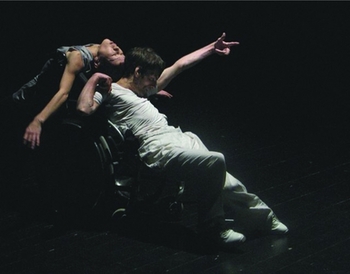
Their art labour examples are from performances created and performed in Berlin between 2009 and 2012. Yoshioka Yumiko's WA-KU, which she created with her group TEN PEN CHii, takes place in a raised boxing ring wading pool. DoroDoro Quarks, dance/poem/performance, by Seki Minako and Kaseki Yuko, is a co-created collection of miniature vignettes, and was first performed in Berlin in 2009, then again in 2010 in Bremen. From Umbra, directed by Kaseki Yuko in collaboration with Theatre Thikwa (an inclusive performance company), I use a section performed by Kaseki, André Nittel and his wheelchair. These examples best demonstrate how in-transit-ness, combined with butoh training, creates an art labour. It is rich with the artists’ interventionist tactics that critique and even ironize their position as (exotic) foreigners and their statuses as permanent-visa labourers. They reveal their high-intensity practices, propelled by their ‘in-transit’ state of being within their acts of art labour.
Theoretical frames of moving art labour
Each of these women chose to live outside Japan in order to create, perform and direct their butoh-related artworks and workshops without the restrictions of the Japanese performing-arts system. They consider Berlin, Germany, their home, but they conduct their art labour, which usually consists of workshops, performances and collaborations, in other parts of Europe, the United States and South America and around the Pacific Rim. These artists articulate complex, layered and unconventional personal narratives and artistic processes in relation to ‘home’, ‘Japan’ and ‘away’. When they return to Japan, they find themselves erased from the current arts scene or cast as outsiders, in a separate category from ‘Japanese artists’.
They are foreign at home and abroad. They are also compelled to keep their butoh artist designation or branding in foreign places because this lends an exotic and radical Japanese-ness to their art labour, which they market to sustain their economic viability. They keep their butoh brand (at a distance) and work against it, creating the push–pull oppositional tension in their work and bodies. This later move correlates with art historian and Asian American studies scholar Margo Machida's understanding of ‘disidentification’, which
enables artists to contest and transcend stereotypic imagery and roles by appropriating and reinhabiting them for their own purposes. Defined as about neither identification nor counter identification, disidentification is a means of working simultaneously within, and in opposition to, the conventions and expectations of a particular artistic form.Footnote 3
These Japanese butoh artists disidentify with butoh's image and use ‘Japan’ and ‘butoh’ as a saturated cultural referent that can be manipulated for their needs. Disidentification complicates any simple outsider/resident status or national/cultural ‘iconic’ representation or imitation. These artists work disidentification to their advantage. In each new place they can reinvent butoh and Japan.
The butoh performances I examine test the boundaries of corporeal adaptation and reinvention and bind them into what I am calling a ‘stranger community’. These artists, who live and create in transit, produce a particular art labour that reflects the circumstances of their in-transit-ness and the complexity of their transnational performance skills and tools. If artists no longer reside in one nation state then their art labour, created while moving through different national, civic and cultural territories, provokes and demands a change in aesthetics, perception and critical response. In-transit art labour productions have become the vortex for churning out new concepts of corporeal identity and place in our unevenly globalized world. These in-transit artists negotiate their art labour wherever they are, giving attention to the details and requirements of each foreign space while struggling with their own creative vision, which is always within the critical tension of their in-transit conditions.
The corporeal politics of in-transit art labour: technique, race and gender
Kaseki, Seki and Yoshioka have devised different systems for living in transit. Theirs is a practice of moving or mobile citizenship that does not fit the present laws or forms of nation states or unions. Their super-skilled art labour has created its own circulation of goods, hierarchies of human rights and systems of civic responsibility within their conditions of mobile citizens. In this section I set out to define what art labour is in the specific circumstances of these transnational performers and their butoh art labour. Kaseki, Seki and Yoshioka never stop working and this non-stop energy is reflected in the choreography and movement qualities of their art labour. Their art labour produces an ongoing tension reflecting the friction in their living and art-making conditions.
An alliance of the aesthetic, social and political defines art labour. In The Work of Dance: Labor, Movement, and Identity in the 1930s, Mark Franko notes, ‘What is certain is that dance conveyed the physical experience of work in aesthetic and critical terms, bringing laboring bodies into visibility as historical agents.’Footnote 4 Borrowing from political theorist Hannah Arendt, he continues,
Work is conventionally thought of as a productive activity, whereas labor is the force that accomplishes it . . . Arendt's useful distinction between labor and work [is that the] ‘word “labor”, understood as a noun, never designates the finished product, the result of laboring . . . whereas the product itself is invariably derived from the word for work.’ Labor, in Arendt's terms, is more like dance than work: it is an action, a process.Footnote 5
This idea of action and process shapes my deployment of the term art labour, which I inflect with twenty-first-century Japanese and German politics and processes of migration, as well as each nation's contemporary corporeal and technological cultures. In Kaseki, Seki and Yoshioka's works, the intensity of movement, compacted in time and space and then reduced and repeated in a minimal gestural vocabulary, echoes earlier choreographic art labour. Language and translation of these key terms, ‘labour’ and ‘work’, are another consideration.
In a post-boom economic context, Kaseki, Seki and Yoshioka's art labour is part of the mobile art labour force of Japanese women who have permanently left Japan to practice their art but remain Japanese citizens. Their performances speak to these tensions. Although each artist is unique in their in-transit circumstances, they move in relation to each other. There is a contingency among them because of their butoh training, their female gender and their Asian and Japanese-ness. In a sense, they have a common ground via their butoh work; their living and participating in Berlin's performance community; their frequent moving around Europe, the Americas and Asia; and their relations to Japan. These butoh women coexist in a collective tension or a ‘stranger’ community of individual artists who demonstrate a different relation to their different nations and cultures. They live as foreign residents (permanent or not) in Berlin, and they are ‘away from’ the place where they are national citizens. Each artist has her own identification with Japan and her own way of shaping that identification in Berlin through her art labour. The artists all deploy some degree of their own concept of stereotypical race-gender-Japanese-ness within their art labour.
Their ‘stranger community’, however tenuous, suggests a new relation to post-colonial studies scholar Homi K. Bhabha's ‘intervention of the Third Space’, which re-enforces the in-transit-ness and the changes and transformations of ‘cultural knowledge’. This stranger community ‘challenges our sense of the historical identity of culture as a homogenizing, unifying force, authenticated by the originary Past, kept alive in the national tradition of the People’.Footnote 6 Although Bhabha claims that it is culture's hybridity that creates the ‘Third Space’, I argue that a culture's movement assures another space. Berliner butoh's stranger community could be part of ‘that Third Space, though unrepresentable in itself, which constitutes the discursive conditions of enunciation that ensure that the meaning and symbols of culture have no primordial unity or fixity; that even the same signs can be appropriated, translated, rehistoricized and read anew’.Footnote 7 One could say that these ‘Berliner butoh’ artists live in a state of being in transit and moving among identities, times and places that are, according to philosopher and dance scholar–artist Erin Manning, dynamic ‘relation-scapes’. Perhaps thinking beyond the individual artist's art labour, we might consider their many different ‘others of our selves’Footnote 8 performing through their transitions, and that when ‘relational movement flows . . . [w]e re-form: We create a collective body. . . . The body-in-deformation is a multiplying sensing body in movement: many potential bodies exist in a singular body. These are the politics of that many-bodied state of transition that is the collectiveFootnote 9 These artists realize that the reputation of butoh outside of Japan has an exotic and orientalized corporeality, which reflects on all of them, despite their differences. They move relationally with each other sharing this ‘many-bodied state of transition,’ which becomes their ‘collective’ that is at once porous and restricted because of their shared territory, audiences, and performer participants.
Butoh works well as in-transit art labour because it is already an antagonistic form in which the forces of individual desires and experiences run up against the multiple and monolithic demands of national authority, citizenship, urban migration and global commodification. The 1960s Japanese male-lead butoh was part of an explosive community of underground art rebels in the milieu of post-war/post-occupation anti-government demonstrations and then the frenzied and unequal economic miracles, which created a messy, scrappy and intense performance environment. The time and the place – Tokyo, late 1960s to early 1970s – were ripe for butoh: artists could stop traffic, scandalize and shut down modern-dance concerts and still gain notoriety and an outstanding reputation for disruptive but sensational performances. In the 1980s and 1990s, when Seki Minako, Kaseki Yuko and Yoshioka Yukiko developed their butoh outside Japan, the stakes were different; their butoh had to twist perceptions and politics and astonish in very different ways, with even more intensity.
Technical labour communities
Kaseki, Seki and Yoshioka testify that butoh is a many-bodied state of transition, a collective body of techniques and body/mind practices. These techniques and practices are intense acts of control, concentration and movement (even if there is no visible movement). They also rely on the act of visual and corporeal intertwining, trained through ‘dispersed multi-focus’ techniques. Butoh is a very powerful and complicated performance form. It has always been against something, resisting something, and provocative in those tensions. In the performance examples, these characteristics of butoh support the progress of each woman artist in making their work, finding their own voice and not returning to Japan.
At this end of butoh genealogy in 2014, Japanese women butoh artists in Europe perform, teach and reformulate what could be called a butoh ‘technique’ that has also transformed in its travelling. Considering this and what performance studies scholar Judith Hamera has written about butoh in Los Angeles, looking at butoh ‘technique’ might be a helpful way to open the conversation of stranger communities of butoh:
Technique is both the animating aesthetic principle and the core ambivalence . . . It demands to be replicated even as it asks to be exceeded. In ballet or in butoh, technique like language reaches out to meet us . . . However pliable and enabling, technique, like the aesthetics it enables, is a pre-existing conversation between bodies, history and desire.Footnote 10
In their workshops, all three teach butoh “techniques,” which ensure that we never stop moving, that the labour of the body continues, that a certain state of beyond-control and exhaustion combines, forcing us out of our comfort zones and prescribed patterns. Hamera notes,
In critical terms, ‘technique’ like aesthetics is a useful synecdoche for the complex webs of relations that link performers to particular subjectivities, histories, practices and to each other . . . [T]echnique is simultaneously, a lexicon, a grammar of/or affiliation, even a rhetoric in motion. It facilitates interpersonal and social relations as it shapes bodies.Footnote 11
Butoh technique, then, could remind us of the complex social, political and historical circumstances and practices of those bodies in their contexts. ‘Technique’ does not deny difference or erase complexity.
The practices of butoh's techniques (different for each artist teacher), the formulations of art labour, become the binding materials of relationships. Hamera explains, ‘In a small place, through the accumulation of small exchanges, technique binds strangers to one another, transforming contingent arrangements, over time into relational infrastructure’.Footnote 12 Thus artists’ methods of doing butoh, their techniques, figure into their art labour, and contribute to the sociality of this stranger community. Hamera emphasizes that ‘technique births new templates for sociality by rendering bodies readable’,Footnote 13 and it organizes how aesthetics, ‘the animating principles of art's social lives’,Footnote 14 come into play and contribute to the binding of performance communities. Here in Berliner butoh, shaped by in-transit experiences and their displacement, these artists perform (and teach) ‘a set of corporeal possibilities, comforts, and constraints linking private self-fashioning and community practice’.Footnote 15 When we turn to examples, the art labour of artists within these diverse butoh techniques illuminates this ‘stranger’ relationship: even as I say ‘community’, the in-transit bodies, combined with the binding of techniques, slip past each other.
The artists’ art labour of wrenching butoh out of Japan and into other cultural spaces with their Japanese female bodies (still in tension with contemporary Japan and its ‘still-to-be-accounted-for’ hierarchical male-gendered art, especially in the butoh system) produces a different and disquieting performance style and corporeality, where concentration and imagination strain, punish and discipline the body. Not unlike the exacting and extreme training of athletes, butoh demands intensive physical work driven by a consciousness of the stakes of the unusual and the out-of-the-ordinary in our current world of standardized and enforced normalcy. In workshops, these artists challenge control and push participants beyond established performance behaviour. They offer exercises that can only be done with absolute focus and all-out energy. All three artists give intense directions and critiques and demand attention to detailed and complex movement and states. A characteristic of their exercises is that they add details and requirements to every task, requiring multiple levels of consciousness and multiple physical skills, all synched in time and space. They demand art labour beyond labour.
Their in-transit status, impacted by their gender and racial appearances, propels the intensity of their art labour in practice. As stated above, butoh practices require intense physical effort, disciplined concentration and rigorous body–mind imagination, which contributes to their physical characteristics. Artists are bone and sinew, with muscles and tendons, wrapped skin-tight to their limbs. Every inch of their bodies is taut. This vigorous, tightened butoh body is a product of their art labour. This labour-intensive physicality is a mark of these works. To a certain degree, they market butoh's self-exotification to counter post-colonial neoliberal oppression. To remain in-transit in the performance market place, they amplify an ‘exotic’ physical presence that produces extraordinary art labour.
Their intensive labouring bodies produce split and fragmented bodies, a dislocated number of selves. These dislocated and multiple bodies are integral to their art labour, making it even more labour-intensive. Aptly, performance theorists Helen Gilbert and Joanne Tompkins read dance as emerging ‘as a locus of struggle in producing and representing individual and cultural identity. As a site of competing ideologies, dance [butoh] also offers the potential liberation from imperialist representation through the construction of an active, moving body that “speaks” its own forms of corporeality’.Footnote 16 In Yoshioka's WA-KU, a trio of boxer butoh women bludgeon Yoshioka with absurdly large boxing gloves in imperfect unison. Then, a doctor/umpire-type in a hospital-white suit strips into a black bra and panties, looking like a top model or stripper. WA-KU is a wet boxing match of morphing women/boxers/pop-starlets. Seki and Kaseki's collaboration, DoroDoro, is a performance of cell-splitting, twinning and doubling doppelganger females cackling, jiving and hiccupping through multiple multilingual corporealities. In Kaseki's Umbra, Theatre Thikwa's multiple bodies are so intertwined that their separation dismembers their bodies. We see their bodies and body parts attach and break off and reattach across machines, wheels, objects and shadows. The pleasure here is this intensity of coming apart, casting off the careful unity of skeleton and musculature or binary of self and other. These artists produce changes in corporeal perception and their material bodies. They become their butoh art labour: their particular moving in time and space is their art labour. These women re-perform their in-transit conditions of living in their art labour.
In-transit genealogies
Yoshioka Yumiko, along with Ikeda Carlotta, was among the first butoh artists to perform in Europe in 1978. Yoshioka was also a member of Ikeda's all-women butoh group, Ariadone, which was founded in Tokyo but toured Europe and continues under Ikeda's direction in France. Seki Minako began her butoh training in Tamura Tetsuro and Furukawa Anzu's company, DanceLoveMachine, in Japan. This company toured to Berlin in 1986. Seki remained in Berlin creating, with Yoshioka and partner artists Joachim Manger and Delta Ra’I, the first German–Japanese dance theatre group, tatoeba – TEATRE DANSE GROTESQUE. They toured Japan, Europe and North America until 1994. In Tokyo, Kaseki was inspired by the dance works of Yamazaki Kota, a student of Kasai Akira, a radical disciple of Tatsumi Hijikata. She researched butoh and began her studies of butoh with Furukawa Anzu in Tokyo. In 1991, she moved to Braunschweig, Germany, where she continued her studies and dancing with Furukawa Anzu, who had migrated to Germany after touring with DanceLoveMachine.
Furukawa had trained in modern dance in Japan, studying with German-influenced Tanztheater and Ausdrucktanz teachers and with early Hijikata dancers, such as Tamura Tetsuro. She became an instructor at the Braunschweig University of the Arts, where many in-transit European and Japanese butoh and dance theatre artists came to study and perform with her. Kaseki performed in Furukawa's new company, Dance Butter Tokio, to 2000. She also toured with Furukawa's company to the US. Yoshioka, Delta Ra’I and several European art partners presently run the international EXit. . .!, intensive butoh workshops at Castle Broellin (near Berlin) during the summer months. Yoshioka, Seki and Kaseki studied and performed with Furukawa Anzu in Europe, which suggests that they share similar training, performance and practice techniques that would re-enforce their collective art labour.
Gendered race and art labour
Yoshioka Yumiko, Seki Minako and Kaseki Yuko deploy both strategic essentialisms and partial, provisional and even fantastic markers of identity and difference in their art labour. Gilbert and Tompkins set out the possibilities for in-transit art labour:
If post-colonial theory has long rejected the idealized undifferentiated body of the other . . . representational practice . . . still faces the problem of how to avoid essentialist constructions of race and gender while recognizing the irreducible specificity of their impact on subject formation. One possible solution is to conceptualize all markers of identity/difference as partial, provisional, and likely to change depending on the context or the signifying system in which they operate at any particular time. This notion avoids a single (biological) origin for race or gender but leaves open the possibility of what Spivak calls ‘strategic essentialism’ . . . the foregrounding of ‘pure’ difference for particular political purposes.Footnote 17
There is nothing set, fixed or originary about the gender or racially inflected acts of these three women. In one section in DoroDoro, Seki kneels on a pillow; for a split second, she is a picture-perfect Japanese woman with her hands folded, smiling, her head tilted shyly. In an instant, she fractures that super ‘oriental’ face, cracks her mouth open, beats her chest, and growls in low, guttural male Japanese speech: ‘Hey you, what's up? Get outta m’face’. In WA-KU, Yoshioka grabs her shirt, pulling it up over her face and containing herself in this wrapped, blind, death-grip. She is boxed and bludgeoned by her own female fight club, and driven relentlessly into a corner of the wading pool boxing ring; she is a stomping, gyrating, frenzied and faceless creature. The two white and one Japanese female boxers are stripped down to their underwear and attack her in a stylized boxer frenzy. Yoshioka, Seki and Kaseki all wring and pull their faces to extremes: they wrinkle and distend immobile female faces and instantly pull their small, soft figures into monstrous or hysterically ridiculous shapes. In motion, in transit, their butoh art labour aims at this destructive, twisted corporeal re-formation.
These sequences distort the stereotypic ‘Japanese woman’ images. Yoshioka exploits the race/movement and gender relationship, signalling her difference and her designed control of that difference: her art labour within her disciplined corporeal craft. Seki gyrates every cell of her skin; every hair vibrates while she clings to a roof beam, like a part-human insect. In Kaseki and André Nittel's Umbra duet, the wheelchair becomes Kaseki's body; wheeled headless with writhing arms, an ‘other’ robotic body jerks into the shadows. Nittel bolts loose into his horizontal writhing dance below that animated wheeled other, until it flies into the shadows and propels Kaseki into a wheeling spiral roll, jamming into Nittel's curling twists of tender, curling sensuality. Each body wrenches the other body out of its ‘self’, displacing aesthetic ease.
In Umbra, Kaseki Yuko leans over backwards, with André Nittell, foreground. Photo by Martin Pfahler.

Race is part of that which is displaced by these performances. Race for all three artists is a fantastic construction, which momentarily flashes and agitates, but it is these flashes that light up the different bodies, flashing ‘race’, ‘disability’ and ‘gender’ in this oddly activist art labour. Race and gender mixes in DoroDoro, WA-KU and Umbra are all slippery and create a dissensus of the white and/or Asian female stereotype, which is part of their particular twenty-first-century art labour. In WA-KU, race shades the roles of boxer/fighters – two white, one Asian – and among the doctors/coaches/umpires are three European white-looking women and one Asian (Japanese) woman, Yoshioka, who controls and then is controlled. Yoshioka's struggle in her scientist/umpire roles, her dancer/boxers’ fight and stripping and her helpless victim/body-without-a-face sequence cries out in-transit unidentified. Even within the set actions of theatrical characters and earlier choreographed routines, Yoshioka, Seki and Kaseki are most often in states of frenetic action and displacement. They seem to have a time limit before something terrible happens: they could explode or freeze suddenly in time like moths against a hot lamp. They are on guard between actions and while moving. Dance theorist Andre Lepecki questions what kind of body could be in this permanent state of emergency,
in the neo-colonial moment of globalization . . . What are this body's capacities for movement . . .? How do this body's movements re-negotiate our understanding of the location of culture? . . . Under which conditions can we house this body without turning it into an excuse and a fetish for racist high anxiety?Footnote 18
In WA-KU, Yoshioka and her medical umpires feed anxiety by checking and rechecking time, monitoring the bodies of the boxers, checking the space, and taking endless notes. She scribbles anxiety. Then a white woman in a black bra, underwear and long boots struts splashing onto the boxing ring wading pool. Performing a thrusting, army march, she holds a white placard with a giant number ‘1’ over her head. She stops in the ring's corners, like an automaton, smiling and jerking the sign. Who is number one? Who are the judges?
Lepecki's call for the pairing of race/movement and emergency/place charges the movement negotiations in these works with these raced and in-transit bodies.Footnote 19 Their art labour is here in these dense choreographies of antagonistic multiple selves. These dancing bodies are not going to lie down to be decoded or recoded. So what are they? Or does their in-transit-ness take them somewhere else, such as across the ‘choreo-political terrain of our neo-colonial contemporaneity’?Footnote 20 Does their art labour force a different paradigm, which may only exist in this moment of moving micro-history?
In-transit-ness and an ethics of art labour
The in-transit-ness of these performers forces a reinvention of their multiple selves, which they keep in flux. Their movement practices, moving between states and cultures and ways of thinking and being in the world, is their exacting articulated art labour. Our twisted times of movement and shifting are embodied in these passing gestures: when Yoshioka blows her whistle over the wet fallen boxer bodies and the marching umpire-in-underwear, freezes and then embraces her; when Seki presses and jerks a pillow over the face of the mad talking and gyrating Kaseki to stop her breathing; when Nittel rolls and grasps Kaseki's weighted body, melting around her. Perhaps this is why the discipline and focus of producing the choreography seems so intense: securing the exact moment and the exact movement, sound and image requires laser-beam intensity, which is thwarted by this chronic instability. This instability makes a lively, edgy performance, but it also indicates this intolerable need and desire for an ‘other’ cultural invention that is not a tradition, nor necessarily a repeated practice that would or could become a tradition. Their art labour opens up, wheels out, splashes and bruises different designs and different messages that seem to miss translation.
This art labour in the twenty-first century combines the effort, drill, discipline, focus and commitment that the artists drive forward into the time and space of performance. Art labour requires the entire person to act: the fleshy, bony and leaky physical stuff and the focus, discipline, energy, drive and visionary consciousness. These acts are extraordinary and nuanced by their conditions of production and the artists exemplify this extraordinary action of art labour. They must excel. They are also the creative agents of the actions, which produce complex and ambiguous meanings in performance. Art labour is this constellation of artists, their circumstances, their practices and theories in performance.
Yoshioka, Seki and Kaseki perform their in-transit status of being Japanese in Europe and in their choice of butoh, a rigorous avant-garde/contemporary physical performance form. Butoh requires extreme physical rigour and employs a radical imagination process, which sets their art labour on a trajectory of dissensus. By radical imagination, I mean that complicated uses of layered imagery and visceral memory are combined with difficult physical techniques, which force a decontrol of learned social behaviour. Hijikata, one of early butoh's creators, sought ‘the remodeling of the human’; this could only be attained through physical and mental extreme exercises that actually produce pain.Footnote 21 The performance examples demonstrate how their art labour works. For a performing artist in Japan, total concentration and physical discipline make the body/self into a tool for producing exacting performance outcomes. At the same time, perhaps provoking even more tension, the three artists’ in-transit lifestyles and their evolution of their own ‘butoh’ style set up another resistance within their art labour.
The force of their commitment to a radical aesthetic form speaks to another set of rules that deeply bind the physical self to social/aesthetic control. Anthropologist Dorinne Kondo explains in her study Crafted Selves: Power, Gender, and Discourses of Identity in a Japanese Workplace that when she attended a retreat/training programme for factory workers, the idea and pedagogy of ‘discipline’ was very complex. At the centre of her experience was how
rigid discipline shaped the outer from of our actions . . . adhering to the proper form is accorded primacy, for it tempers the selfishness of the kokoro . . . [T]he moral weight is placed not on some sense of the ‘self’ as inviolable essence, separate from ‘society’, but on the construction of disciplined selves through relationship with others and through forms we might find coercive.Footnote 22
These concepts are very near to these artists’ performance and workshop strategies. Further, the concepts of Japanese social relations, such as uchi (内, inside or belong to) and soto (外, outside or not belonging), and the importance of the omote (表, surface) of physical appearances and ura (裏, out of sight, behind) concepts are also at work in these contemporary butoh practices. The relationship between discipline and the self in these performances is not about restraining some inner core ‘self’; rather, the careful, repeated practices of exercises and then choreography craft the different ‘selves’ of surface: behind, inside and outside.
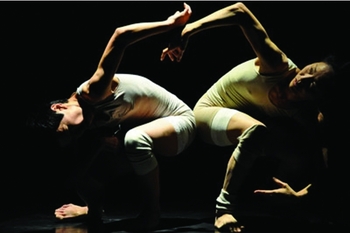
Seki Minako and Kaseki Yuko facing off in DoroDoro. Photo by Roger Rossell, www.milpalabras.eu

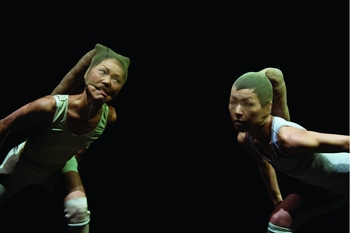
In the second opening of the duet DoroDoro, rock-techno music blasts and white/blue lights flash. We see the two performers, Kaseki and Seki, split apart in a lightning flash-blast to the sides of the stage. They proceed to move towards the audience, dancing steps and gestures in unison in two corridors on each side of the stage. They run and pose, run and jump, run and shake frenetically, caught in these corridors from upstage to downstage. Then they cross, scampering horizontal paths, momentarily meeting centre stage. They gesture, touch their faces, move their lips like a mimetic hit-and-run encounter: ‘Oh hello, sorry, what? Huh, oh yeah, ouch, out of my way, see you, watch it’, a type of movement in gesture conversation that flickers by in seconds. They clap and slap their faces, stretching smiles into wailing, distorted mouths, eyes squeezed shut: the surface of their whole body speaks in congested emotions. Making faces makes the body hide.
Between the jittery scrambling, like pop stars, Seki and Kaseki crumple and fold into comic-strip-like scenes: strange gestural acts with their faces, mouths, eyes, pulling their faces into exaggerated expressions of awe and fear, laughter and anger. They run and jump in and out of spotlights that splinter their faces and limbs. They freeze instantly. They break away, shattering their bodily architectures. Theirs is art labour action: their gesture patterns reach into their Japanese pasts, hands over mouths, a shrinking reticence to be first or in front, karaoke rap, then a silent talk-show rant? They point and squeeze their lips into an extended pucker: cute and grotesque. They seem to reference daily gestures, but reworked with a different imagination. Here their art labour reveals the twists and discomfort of multiple selves in transit. Art labour could also mean that viewers have to work at their seeing during the performance and after in recall and wonder.
Kaseki Yuko and Seki Minako in DoroDoro. Photo by dadaware.

WA-KU in a boxing ring
In Yoshioka's WA-KU (meaning ‘emerge’ or ‘broiling and energized’ in English) is the third in a trilogy of body-image works and one of four performances in a 2010 series celebrating the fifteenth anniversary of TEN PEN CHii art labour productions at Dock 11 in Berlin. TEN PEN CHii is Yoshioka's butoh-based performance ensemble. Although some of the dancers and key production artists remain the same in these works, a shifting ensembles of performers have trained with Yoshioka and other Japanese butoh trainers who move through Berlin on a regular basis. In WA-KU, all of the performers are women; two are Japanese and four are European. WA-KU was third in the trilogy and focused on deriding the contemporary body cultures of beauty, sport and fitness, and mocking ‘competitive bodies’. All of the performers are women and all are white except one Japanese performer. Yoshioka also performs the main doctor/trainer role. The performers perform a twisted and violent training session for boxing and gym-class kickboxing. They display through pumped-up exaggeration the entire beautiful body-up gym culture (present both in Germany and in Japan), especially the ‘testing’ and measurement of the perfect athlete.
The set is a boxing ring set in a raised, shallow wading pool. The bottom of the pool is green and the extended portion of the boxing ring platform is green AstroTurf. Lighting is often from above and is luridly reminiscent of a boxing ring with glaring light bulbs. The audience may sit or stand anywhere around the ring-pool. Everyone gets splashed at some point during the performance when the action gets very violent in the shallow pool. The walls have underwater video loops that are sometimes very large on two walls and sometimes smaller, with video inside projections of underwater sea grass and creatures. One loop looks like wind blowing grass everywhere. The video appears to be shot in black and white with a pale green tinge.
Women play all of the roles: boxers, doctors and scientists. The women have the jobs that the government subsidizes: sport, science research and health sciences. This is a show about women at work, working not only the absurdity of boxing in a wading pool and measuring the progress and safety of hyper-bodies, but also working the freelance dance bodies in Yoshioka's butoh-based art labour productions. In white hospital-like uniforms with big dark rubber boots, the doctor/scientist performers have notepads and measuring equipment for the bodies of the boxers. One doctor, the tallest white woman, who tosses her long ponytail to every beat, strips out of her doctor whites for six sections of the performance. Her black, low-cut underwear is not unlike a bathing suit; she wears big rubber black boots. She breaks up the pool/ring action at intervals when she climbs up into the ring and walks, marches and struts with a large placard with different numbers held high overhead. She walks the periphery of the pool/ring kicking up swathes of water in her staccato march inflected with rumba or eastern belly dance and hip swings when she is stopped at the corners. She smiles and thrusts her number canvas into the air high overhead. The woman is in charge, a supermodel umpire: she is power, authority and judge all at once. She mocks, struts and then leaves. She comes back at the strategic turning points in all of the sequences where violence tends to get a hold on the boxing victor/victims of testing. The super umpire has a theme song that has a mechanical pulse, which is turned up to a deafening pitch whenever she strips to the black bra, pants and boots with her number held defiantly aloft. The woman marches with a number placard, with a model body, the number one militant idol woman gone wild. She marches relentlessly in the boxing ring pool. The effect is surreal, violent, and the entire audience gets wet. Between her super-umpire marches, she changes into the white suit of a doctor/judge.
Three or four ‘doctors’ keep taking the pulses of the three woman boxers and writing information down on their notepads. Yoshioka, the head doctor/judge, eventually becomes the victim of a stripping and drowning fight when the three boxers bully her. In WA-KU, the boxing women are worked near to death, the doctor/trainer is bullied and then saved, and the super-umpire in her black bra breaks down into a wet robotic frenzy – a machinic misfire unplugs her. It ends. Art labour strikes, ambiguously.
Outing labour's dissensus
My contention is that ‘conditions of mobility’, in this case of Japanese women dancers (Yoshioka Yumiko, Seki Minako and Kaseki Yuko), produce a specific art labour that resists/plays both Japanese butoh and European contemporary dance prescriptions. Their in-transit-ness is an embodied resistance against a static condition in Japan and what theorist Bojana Kunst sees happening all over Europe:
It is possible, since dance practice in Europe in the last decade became more and more subjected to the illusion of constant flexibility and collaborative production, to the mobility for its own sake, where artist subjectivities have to become disembodied in order to maintain connection and realize possibilities. . . . Exactly here I see . . . the political aspect of dance: the continuous persistence of contingent materiality of the practice and work (work with the bodies, with others, etc.), enabling different temporal modulations and articulations of life, assemblages which cannot be planned or projected but they arise from dissensus. . . .Footnote 23
Dissensus to the colonial, occupied or immigrant status is what these art labours do in their in-transit migrant (postcolonial) conditions. They perform dissensus. In DoroDoro, when Kaseki and Seki do mimetic dance riffs on colloquial Japanese gestures, they are disrupting these for themselves and then using them as exaggerated ‘Japanese-y’ (or colonized) signs to play with like an animated flip book. They double the exaggeration with their butoh beyond-human twists. They make fun of their inside/outside and mobile identities: what appears to be an un-understandable joke in the multilingual money rap by Kaseki or an argument by Seki in three tones of voice, is cutting-edge irony. They make painful fun with deeply incised meanings from their multiple selves moving multiple bodies. Certainly the post-colonial/post-occupied body that is mobile, the migrant with the permanent visa, the in-transit artist, creates a singular vocabulary of actions: knowable and unknowable moving art labour.
In 2014, Seki, Kaseki and Yoshioka are all producing new works, especially around issues of memory, stranger bodies and dying. Yoshioka, Seki and Kaseki visit their families in Japan, but do not want to move back to Japan. The change in Japan's political leadership and the continuing situation concerning the nuclear disaster in Fukushima deeply affected these artists. Their condition of distance from Japan, in some ways, pressed their stranger community into an uncomfortable intimacy: recognizing their in-transit relation to Japan. Perhaps their new art labour acts will emphasize their diverse mutuality as strangers-to-Japan. Their stranger community moves on.