INTRODUCTION
When employees engage in organizational citizenship behavior (OCB), or voluntary behaviors that extend beyond formal job descriptions and enhance organizational effectiveness (Organ, Reference Organ1988; LePine, Erez, & Johnson, Reference LePine, Erez and Johnson2002; Jain, Giga, & Cooper, Reference Jain, Giga and Cooper2011), it can influence their career development and success (Flum & Cinamon, Reference Flum and Cinamon2011; Russo, Guo, & Baruch, Reference Russo, Guo and Baruch2014). The various established drivers of OCB include individual characteristics, such as personal values (Arthaud-Day, Rode, & Turnley, Reference Arthaud-Day, Rode and Turnley2012), as well as contextual factors, such as perceptions of organizational justice (Whitman, Caleo, Carpenter, Horner, & Bernerth, Reference Whitman, Caleo, Carpenter, Horner and Bernerth2012) and leader–member exchanges (Wayne & Green, Reference Wayne and Green1993). Yet negative factors, such as excessive workload (Noblet, McWilliams, Teo, & Rodwell, Reference Noblet, McWilliams, Teo and Rodwell2006) or role stress (Eatough, Chang, Miloslavic, & Johnson, Reference Eatough, Chang, Miloslavic and Johnson2011), also may steer employees away from OCB.
Relatively little research investigates the possibly harmful effect of employees’ perceptions of organizational politics (POP) – defined as beliefs that organizational decision making is driven by self-serving behaviors (Kacmar & Ferris, Reference Kacmar and Ferris1991; Hochwarter, Kacmar, Perrewé, & Johnson, Reference Hochwarter, Kacmar, Perrewé and Johnson2003) – on their OCB or how this effect might be mitigated. If the uncertainty and stress stemming from POP is strong enough, it may diminish employees’ ability or motivation to direct personal energy toward voluntary activities that can contribute to their organization’s well-being (Crawford, LePine, & Rich, Reference Crawford, LePine and Rich2010). Thus, we need a deeper understanding of how employees might respond negatively to POP, in the form of reduced OCB, and how this harmful effect might be contained.
To guide our theoretical arguments about the relationship between POP and OCB and the conditions in which POP might be less likely to diminish OCB, we draw from the job demands–resources (JD-R) model, which postulates that adverse work conditions steer employees away from positive work behaviors, but access to relevant resources can buffer or mitigate this process (Bakker & Demerouti, Reference Bakker and Demerouti2007). Specifically, when employees believe that organizational decision making is political, they likely become so concerned about their ability to achieve adequate performance in their regular job tasks that they have limited energy or motivation left to engage in activities not required by formal job descriptions (Cavanaugh, Boswell, Roehling, & Boudreau, Reference Cavanaugh, Boswell, Roehling and Boudreau2000; Crawford, LePine, & Rich, Reference Crawford, LePine and Rich2010), even if those activities might benefit their career development. This negative relationship between POP and OCB instead may be less pronounced when employees can rely on transformational leaders and knowledge sharing routines with peers, as well as when the employees themselves are resilient. Leaders are transformational to the extent that they clearly communicate the organization’s goals, engage in active mentoring, and facilitate followers’ career skills development (Shin & Zhou, Reference Shin and Zhou2003; Bass & Riggio, Reference Bass and Riggio2006; Chen, Lin, Lin, & McDonough, Reference Chen, Lin, Lin and McDonough2012). Peer knowledge sharing refers to the extent to which employees maintain regular communication with colleagues and thus are able to combine and integrate previously disconnected information (Grant, Reference Grant1996; Cabrera, Collins, & Salgado, Reference Cabrera, Collins and Salgado2006; Boh & Wong, Reference Boh and Wong2015). Resilience captures employees’ ability to bounce back from setbacks and propensity to use these setbacks as inspiration for personal growth (Luthans, Reference Luthans2002; Youssef & Luthans, Reference Youssef and Luthans2007).
In turn, we seek to contribute to previous research by investigating an understudied driver of OCB and explicating how and when POP is more likely to exert such effects. We thus respond to calls to apply contingency approaches to study POP outcomes (Miller, Rutherford, & Kolodinsky, Reference Miller, Rutherford and Kolodinsky2008; Lee & Peccei, Reference Lee and Allen2011; Bouckenooghe, Reference Bouckenooghe2012; Chang, Rosen, Siemieniec, & Johnson, Reference Chang, Rosen, Siemieniec and Johnson2012) and demands for studies to clarify how stress-inducing work conditions turn employees away from OCB (Noblet et al., Reference Noblet, McWilliams, Teo and Rodwell2006; Eatough et al., Reference Eatough, Chang, Miloslavic and Johnson2011; Paillé, Reference Paillé2011). We posit that employees’ negative reactions to politicized organizational environments, in the form of reduced OCB, may be attenuated by two types of resources: those embedded in the organizational context (transformational leadership and knowledge sharing) and the personal ability to bounce back and learn from adverse work situations. Together, these factors provide a parsimonious view of how employees’ access to relevant contextual or personal resources (Schaufeli & Bakker, Reference Schaufeli and Bakker2004) can diminish the likelihood that they halt productive voluntary behaviors that might benefit their organization, even in the presence of self-serving decision making.
We also contribute to a better understanding of the negative consequences of POP by investigating how the interplay of contextual and personal resources influences employees’ ability to cope with such self-serving behaviors. Thus, we explicitly acknowledge the interdependent effects of different resource types in buffering the harmful effects of POP, an issue that has not appeared in previous applications of the JD-R model (Bakker & Demerouti, Reference Bakker and Demerouti2007). Although the personal resource of resilience might mitigate the harmful effect of POP on OCB, its relative importance should be particularly great when employees cannot rely on transformational leaders or knowledge sharing routines with their organizational peers.
Theoretical Background
Organization citizenship behavior is of great interest to scholars (e.g., Smith, Organ, & Near, Reference Smith, Organ and Near1983; Podsakoff, MacKenzie, Paine, & Bachrach, Reference Podsakoff, MacKenzie, Paine and Bachrach2000; LePine, Erez, & Johnson, Reference LePine, Erez and Johnson2002; Podsakoff, Whiting, Podsakoff, & Blume, Reference Podsakoff, Whiting, Podsakoff and Blume2009; Eatough et al., Reference Eatough, Chang, Miloslavic and Johnson2011). The notion of OCB dates back to research by Katz (Reference Katz1964), who argued that organizations can increase their performance by drawing from employee behaviors that are voluntary and not prescribed by top management. Similarly, Bateman and Organ (Reference Bateman and Organ1983) conceive of OCB as suprarole behavior that cannot be enforced on employees and that stems from feelings of reciprocation. Thus, OCB reflects ‘individual behavior that is discretionary, not directly or explicitly recognized by the formal rewards system, and that in the aggregate promotes the effective functioning of the organization’ (Organ, Reference Organ1988: 4). Even though OCB extends employees’ formal job definitions and is not directly compensated, it can make a significant contribution to individual and organizational effectiveness (Podsakoff et al., Reference Podsakoff, Whiting, Podsakoff and Blume2009). Moreover, OCB likely is critical to employees’ career success, because such behaviors often receive more weight than does in-role job performance (Lievens, De Corte, & Schollaert, Reference Lievens, De Corte and Schollaert2008; Flum & Cinamon, Reference Flum and Cinamon2011).
Previous research has explored several dimensions of OCB. For example, Organ (Reference Organ1988) identifies the dimensions of altruism, conscientiousness, courtesy, sportsmanship, and civic virtue. Borman and Motowidlo (Reference Borman and Motowidlo1993), in turn, conceive of OCB in terms of the extra effort and enthusiasm that employees undertake in work tasks; voluntary involvement in tasks that fall outside the prescribed task set; an extension of help to and cooperation with other organizational members; adherence to organizational rules and regulations; and the endorsement, support, and defense of organizational objectives. Graham (Reference Graham1991) argues that OCB manifests itself in loyalty, obedience, and participation, and Williams and Anderson (Reference Williams and Anderson1991) distinguish between citizenship behaviors that are directed toward the organization versus individuals. In this study, we follow De Cremer, Mayer, van Dijke, Schouten, and Bardes and conceive of OCB as employees’ ‘helping in ways that are not formally required by the organization’ (Reference De Cremer, Mayer, van Dijke, Schouten and Bardes2009: 887) – reflected in their voluntary actions to improve the organization and protect it from potential problems, their willingness to work overtime, and their propensity to establish cooperative relationships with other organizational members.
In light of the positive outcomes that OCB can generate (Podsakoff et al., Reference Podsakoff, Whiting, Podsakoff and Blume2009), it is important to understand its antecedents. Various enablers of OCB have been considered, such as personal values (Arthaud-Day, Rode, & Turnley, Reference Arthaud-Day, Rode and Turnley2012), proactive personalities (Li, Liang, & Crant, Reference Li, Liang and Crant2010), perceptions of justice (Cohen-Charash & Spector, Reference Cohen-Charash and Spector2001), person–organization fit (Wei, Reference Wei2012), decision autonomy (Noblet et al., Reference Noblet, McWilliams, Teo and Rodwell2006), ethical decision making (Shin, Reference Shin2012), and job satisfaction and organizational commitment (Williams & Anderson, Reference Williams and Anderson1991). In this study, we focus on how employees’ POP might inhibit their OCB. In so doing, we respond to calls for more investigations into how stressful work conditions may steer employees away from engaging in OCB (Noblet et al., Reference Noblet, McWilliams, Teo and Rodwell2006; Eatough et al., Reference Eatough, Chang, Miloslavic and Johnson2011; Paillé, Reference Paillé2011). A shortcoming of extant research is that studies of the antecedents of OCB mostly focus on the enabling role of positive factors, with relatively less attention devoted to the negative effects that stress-inducing practices might have, despite recognition of the harmful influences of workload levels (Noblet et al., Reference Noblet, McWilliams, Teo and Rodwell2006) and role stress (Eatough et al., Reference Eatough, Chang, Miloslavic and Johnson2011).
A critical source of negative workplace stress is employees’ POP, which capture their beliefs that organizational decision making is driven by self-serving behaviors and that decisions are primarily guided by personal instead of organizational interests (Kacmar & Ferris, Reference Kacmar and Ferris1991). In the presence of POP, employees believe that the organization supports ‘working behind the scenes’ as a valid way to acquire resources, even if such actions tend to come at the expense of the collective good (Abbas, Raja, Darr, & Bouckenooghe, Reference Abbas, Raja, Darr and Bouckenooghe2014). Political behaviors are inherent to the functioning of most organizations (Miller, Rutherford, & Kolodinsky, Reference Miller, Rutherford and Kolodinsky2008), and though POP typically is considered a negative characteristic (Kacmar & Ferris, Reference Kacmar and Ferris1991; Vigoda, Reference Vigoda2000; Abbas et al., Reference Abbas, Raja, Darr and Bouckenooghe2014), some research suggests that employees might make sense of organizational politics in different ways and even make some positive attributions. For example, organizational politics might be beneficial to the extent that they enable employees to advance their own careers (Hsiung, Lin, & Lin, Reference Hsiung, Lin and Lin2012) or leverage their political skills to achieve work goals beyond formal decision-making structures (Ferris, Perrewé, Anthony, & Gilmore, Reference Ferris, Perrewé, Anthony and Gilmore2000). Similarly, outward-oriented employees, such as salespeople, might use politicized work environments to secure performance-based rewards in the form of commissions (Yen, Reference Yen2015). However, our theoretical focus is on employees’ perceptions of dysfunctional, self-serving behaviors, which give precedence to personal interests over organizational well-being (Kacmar & Ferris, Reference Kacmar and Ferris1991; Hochwarter et al., Reference Hochwarter, Kacmar, Perrewé and Johnson2003). Such behaviors can manifest themselves in different ways, such as manipulations of organizational policies or uses of coercive tactics to achieve short-term personal gains, irrespective of the consequences for other organizational members (Kacmar & Ferris, Reference Kacmar and Ferris1991; Abbas et al., Reference Abbas, Raja, Darr and Bouckenooghe2014).
The self-serving behaviors that underpin POP in turn can lead to various detrimental consequences, such as higher stress and turnover intentions or lower commitment, satisfaction, and productivity (Kacmar & Baron, Reference Kacmar and Baron1999; Miller, Rutherford, & Kolodinsky, Reference Miller, Rutherford and Kolodinsky2008; Chang, Rosen, & Levy, Reference Chang, Rosen and Levy2009). Studies that consider the effect of POP on positive work behaviors, such as innovation, typically consider politics as a negative factor that turns employees away from behaviors that otherwise could benefit their organization (Parker, Dipboye, & Jackson, Reference Parker, Dipboye and Jackson1995). Research on the link between POP and OCB specifically is relatively scarce though, and even fewer studies consider factors that might influence this negative relationship, with the notable exceptions of Chang et al. (Reference Chang, Rosen, Siemieniec and Johnson2012), who note moderating roles of conscientiousness and self-monitoring, and Lee and Peccei (Reference Lee and Allen2011), who focus on the moderating role of perceived organizational support. Thus, we need more studies to investigate and specify how and when POP is more likely to lead to reduced OCB.
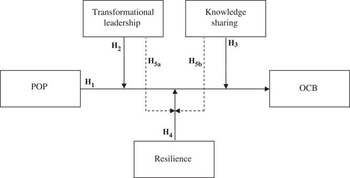
In our attempt to do so, we propose the conceptual framework and hypotheses in Figure 1. First, we link employees’ POP with their OCB. Second, we predict that this relationship is moderated by transformational leadership and knowledge sharing, as two contextual resources, and by resilience, as a personal resource that taps employees’ energy reservoirs. Following the JD-R model (Bakker & Demerouti, Reference Bakker and Demerouti2007), we argue that POP reduces OCB levels, but this effect is attenuated when transformational leadership, knowledge sharing, and resilience are higher. We also predict that the usefulness of resilience as a buffer in the POP–OCB relationship increases when employees cannot rely on transformational leaders or knowledge sharing routines with peers.
Conceptual model. OCB=organizational citizenship behavior; POP=perceptions of organizational politics

Hypotheses
Organizational politics and OCB
We predict a negative relationship between employees’ POP and their engagement in OCB. When employees are convinced that organizational decision making is marked by strong self-serving behaviors, they experience high levels of anxiety, because they fear that these behaviors may compromise their ability to meet their job responsibilities (Chang, Rosen, & Levy, Reference Chang, Rosen and Levy2009; Crawford, LePine, & Rich, Reference Crawford, LePine and Rich2010). This energy-draining effect should diminish the likelihood that they undertake activities that are not part of their formal job descriptions (Chang et al., Reference Chang, Rosen, Siemieniec and Johnson2012). That is, if organizational decision making appears unfair and marked by hidden agendas, employees likely focus on meeting their formal job expectations, leaving little room for career-enhancing activities that go beyond expectations.
In addition to reducing their abilities to engage in OCB, POP should undermine the motivations to undertake such behaviors. Employees who believe that self-serving attitudes dominate organizational decision making likely feel frustration or even anger (Kacmar & Ferris, Reference Kacmar and Ferris1991), which undermines their happiness with their job and career situation in general (Ferris & Kacmar, Reference Ferris and Kacmar1992; Chang, Rosen, & Levy, Reference Chang, Rosen and Levy2009). Therefore, employees’ propensity to engage in OCB should be lower when they are absorbed by negative feelings about how their organization functions. If employees also believe that self-serving decision making will undermine their own performance, they likely sense threats to their personal well-being (Abbas et al., Reference Abbas, Raja, Darr and Bouckenooghe2014). These negative feelings should reduce their enthusiasm for carrying out voluntary activities that extend beyond what is formally required of them.
Hypothesis 1: There is a negative relationship between employees’ POP and their OCB.
Moderating role of transformational leadership
The negative relationship between POP and OCB may be moderated by transformational leadership. According to the JD-R model, the harmful effect of work stressors diminishes when employees have a better understanding of the reasons for them (Bakker & Demerouti, Reference Bakker and Demerouti2007). Supervisors who are transformational leaders tend be open with their followers in describing organizational decision-making processes and their outcomes for the organization (Bass & Avolio, Reference Bass and Avolio1993; Syrek, Apostel, & Antoni, Reference Syrek, Apostel and Antoni2013). In interactions with such supervisors, employees might receive explanations of why the organization engages in politics-based decision making, such as to increase political skill development or decision-making speed (Ferris et al., Reference Ferris, Perrewé, Anthony and Gilmore2000; Kapoutsis, Papalexandris, Nikolopoulos, Hochwarter, & Ferris, Reference Kapoutsis, Papalexandris, Nikolopoulos, Hochwarter and Ferris2011). These insights then help employees comprehend how and why political behaviors are manifest in their work environment (Bouckenooghe, Reference Bouckenooghe2012). Transformational leaders also tend to provide feedback about innovative ways to deal with adverse work situations (Tipu, Ryan, & Fantazy, Reference Tipu, Ryan and Fantazy2012), including how employees can sustain their work performance despite the presence of political games (Bass & Riggio, Reference Bass and Riggio2006), so employees should be better able cope with this adversity and less likely to halt their OCB.
Moreover, because transformational leaders also care about the challenges their followers encounter in undertaking their daily job tasks (Avolio, Reference Avolio1999), employees should believe that their supervisor, and the organization in general, is concerned with their personal well-being (Wang & Walumbwa, Reference Wang and Walumbwa2007; Ghosh, Reference Ghosh2014). This belief then should mitigate negative reactions to unfair political games. Similarly, perceptions that their supervisor is concerned about their well-being can enhance employees’ experience of a shared organizational identity (Chen et al., Reference Chen, Lin, Lin and McDonough2012) and organizational commitment (Huang & Weng, Reference Huang and Weng2012), which may increase their acceptance of some self-serving behaviors as inevitable aspects of the organization’s operations. Because transformational leaders seek to match employees’ personal goals with those of the organization (Bass & Riggio, Reference Bass and Riggio2006), this shared identity should reduce the negative feelings that come with POP and prevent employees from completely halting their OCB.
Hypothesis 2: The negative relationship between employees’ POP and their OCB is moderated by their supervisor’s transformational leadership, such that the relationship is weaker at higher levels of transformational leadership.
Moderating role of knowledge sharing
When employees believe that organizational decision making is characterized by self-serving behaviors, their access to peer knowledge might reduce the associated stress (Miller, Rutherford, & Kolodinsky, Reference Miller, Rutherford and Kolodinsky2008) and mitigate the negative influence of POP on their OCB, because extensive knowledge sharing provides insights into solutions for mitigating the negative consequences of politics-based decision making (Bouckenooghe, Reference Bouckenooghe2012) and maintaining adequate job performance. Access to peer knowledge thus increases employees’ confidence that they can protect themselves against the performance threats of strongly politicized environments (Vigoda, Reference Vigoda2000; Abbas et al., Reference Abbas, Raja, Darr and Bouckenooghe2014). The likelihood that they refrain from OCB then should diminish.
Furthermore, when employees have close knowledge sharing routines with their peers, the negative effects of self-serving behaviors by those same peers should be weaker. Knowledge sharing can help employees understand and appreciate how the self-serving behaviors help their colleagues leverage their personal expertise for organizational effectiveness (Perrewé, Ferris, Frink, & Anthony, Reference Perrewé, Ferris, Frink and Anthony2000). Then they may perceive others’ self-serving behaviors as less threatening to their own performance or career advancement, making them less likely to turn away from OCB. When knowledge sharing is very high, employees even might learn from their colleagues how to turn a political organizational climate into an advantage for themselves (Grant, Reference Grant1996; Ferris et al., Reference Ferris, Perrewé, Anthony and Gilmore2000). Conversely, if their relationships with colleagues are characterized by limited knowledge sharing, employees should feel more threatened by the presence of destructive political games (Bouckenooghe, Reference Bouckenooghe2012) and fear that these behaviors will undermine their job performance. This belief in turn should intensify the negative impact of POP on their willingness to engage in voluntary behaviors.
Hypothesis 3: The negative relationship between employees’ POP and their OCB is moderated by their level of knowledge sharing with organizational peers, such that the relationship is weaker at higher levels of such knowledge sharing.
Moderating role of resilience
Resilience is a personal characteristic that reflects a person’s propensity to bounce back and learn from negative events (Luthans, Reference Luthans2002). To engage in OCB, despite the presence of self-serving behaviors in the organization, employees must be able to recover from the disruptive effects that such behaviors have for their regular job performance (Organ, Reference Organ1988; Podsakoff et al., Reference Podsakoff, Whiting, Podsakoff and Blume2009). Because resilience replenishes employees’ energy levels and improves their ability to find adequate solutions to difficult organizational situations (Youssef & Luthans, Reference Youssef and Luthans2007), the likelihood that resilient employees perceive political games as obstacles to their success should be lower (Crawford, LePine, & Rich, Reference Crawford, LePine and Rich2010), so POP should have a weaker negative effect on OCB.
Employees who exhibit high levels of resilience also may regard strongly politicized decision making as opportunities to learn, in terms of how to sustain their job performance and career advancement in the presence of this source of work uncertainty (Luthans, Reference Luthans2002). The learning motivation that comes with greater resilience might stimulate employees to develop insights into ways to protect their job performance from these behaviors (e.g., Abbas et al., Reference Abbas, Raja, Darr and Bouckenooghe2014). As a result, the negative consequences of POP on their ability to meet their formal job requirements should be mitigated, making it less likely that employees withdraw completely from OCB. Similarly, the possibility of enhanced learning about how to deal with political decision making may reduce resistance to OCB, because resilient employees regard engaging in voluntary behaviors, despite the presence of workplace adversity, as a challenge and route for personal and career fulfillment (Podsakoff et al., Reference Podsakoff, Whiting, Podsakoff and Blume2009; Park, Song, Yoon, & Kim, Reference Park, Song, Yoon and Kim2013). Thus, the negative relationship between POP and OCB should be mitigated when resilience is high, because employees derive some personal joy from undertaking voluntary activities in the presence of strong organizational politics.
Hypothesis 4: The negative relationship between employees’ POP and their OCB is moderated by their resilience, such that the relationship is weaker at higher levels of resilience.
Finally, the buffering role of resilience should be particularly strong when employees cannot rely on transformational leadership or knowledge sharing. That is, we predict three-way interactions among POP, resilience, and the contextual resources of transformational leadership and knowledge sharing. When employees cannot rely on supervisor or peer support to deal with political games, they may suffer a limited understanding of the source or reasons for such decision making (Bass & Riggio, Reference Bass and Riggio2006). Because organizational decision making is not transparent, they likely fear that they will be unable to meet formal work obligations (Larsson, Sjöberg, Nilsson, Alvinius, & Bakken, Reference Larsson, Sjöberg, Nilsson, Alvinius and Bakken2007; Chen et al., Reference Chen, Lin, Lin and McDonough2012), which reduces the likelihood that they take on additional, voluntary activities. Employees’ ability to draw from their personal resilience then should be particularly useful for addressing the performance harms of POP (Abbas et al., Reference Abbas, Raja, Darr and Bouckenooghe2014). When employees cannot rely on the direction or guidance of transformational leaders to deal with organizational politics, or on the insights of organizational peers who may experience the same challenges, the extent to which they can bounce back and learn from the associated setbacks will be particularly useful for mitigating the negative effect of POP on OCB (Luthans, Reference Luthans2002).
Conversely, when employees can draw from the insights of transformational leaders or organizational peers, they already experience personal support in their efforts to cope with the adversity of politicized decision making (Bouckenooghe, Reference Bouckenooghe2012; Chen et al., Reference Chen, Lin, Lin and McDonough2012). The buffering role of resilience in the negative POP–OCB link then should have less incremental importance. Greater energy levels, which stem from strong resilience, are less needed to counter the negative performance consequences of POP when employees can count on mentorship or peers who have had similar experiences. Overall, when they have greater access to relevant contextual resources, employees’ resilience should have a smaller buffering effect on the POP–OCB relationship.
Hypothesis 5: The buffering effect of resilience on the negative relationship between employees’ POP and their OCB is moderated by (a) their supervisor’s transformational leadership, such that the buffering effect is stronger at lower levels of transformational leadership, and (b) their knowledge sharing with organizational peers, such that the buffering effect is stronger at lower levels of knowledge sharing.
Method
Sample and data collection
We collected data from employees working for a smelting company, located in the northern part of Mexico, that was founded in 1979 and manufactures custom-made steel parts for heavy equipment and machineryFootnote *. With this focus on a single organization, we avoided the presence of unobserved differences in various external competitive pressures and environments that may affect the time available for employees to engage in OCB (Hodson, Reference Hodson2002). First, we asked 120 randomly selected employees to assess the extents to which they experienced self-serving behaviors in their organization, their boss adopted a transformational leadership style, they shared extensive knowledge with colleagues, and they were resilient. The organization’s top management offered strong support for this study, which enabled us to obtain 109 responses, for a response rate of 91%. The average respondent was 34 years of age and had worked for the organization for 7 years; 36% were women. Second, we asked the immediate supervisors of each first-round respondent to assess the employees’ OCB.
The original English language surveys were translated into Spanish, then back-translated into English (Brislin, Lonner, & Thorndike, Reference Brislin, Lonner and Thorndike1973). We also pretested preliminary versions of the two surveys with two different sets of employees who did not participate in the actual data collection and incorporated their feedback, which enhanced both the quality of the data and the readability of the survey questions. The instructions in both survey rounds guaranteed the participants complete confidentiality, repeatedly assured them that there were no right or wrong answers, and asked them to answer the questions as honestly as possible, which helped minimize the potential for social desirability or acquiescence biases (Spector, Reference Spector2006).
Measures
The measures of the five focal constructs contained items from previous research and used 7-point Likert scales, ranging from 1=‘strongly disagree,’ to 7=‘strongly agree.’
OCB
To assess employees’ OCB, we relied on the 4-item scale used by De Cremer et al. (Reference De Cremer, Mayer, van Dijke, Schouten and Bardes2009), which is based on a larger scale by Konovsky and Organ (Reference Konovsky and Organ1996). The four items entail voluntary behaviors targeted at improving the organization and resolving problem areas. Sample items were ‘This employee undertakes action to protect the company from potential problems,’ and ‘If necessary, this employee is prepared to work overtime’ (Cronbach’s α=0.85).
POP
We used four items from previous research (Hochwarter et al., Reference Hochwarter, Kacmar, Perrewé and Johnson2003) to assess employees’ perceptions that organizational decision making is marked by self-serving behaviors. Sample items were ‘There is a lot of self-serving behavior going on in the organization,’ and ‘People do what’s best for them, not what’s best for the organization’ (Cronbach’s α=0.81).
Transformational leadership
To gather employees’ perceptions of their supervisor’s transformational leadership, we used a 4-item scale from previous research (Garcia-Morales, Matias-Reche, & Hurtado-Torres, Reference Garcia-Morales, Matias-Reche and Hurtado-Torres2008; Chen et al., Reference Chen, Lin, Lin and McDonough2012). Our choice of this shorter scale, rather than the longer Multifactor Leadership Questionnaire, was informed by previous studies that failed to find consistent factor structures for the longer Multifactor Leadership Questionnaire scale (Antonakis, Avolio, & Sivasubramaniam, Reference Antonakis, Avolio and Sivasubramaniam2003; Yukl, Reference Yukl2006; cf. Chen et al., Reference Chen, Lin, Lin and McDonough2012). Two sample items are ‘My boss paints a clear picture of the company’s future vision’ and ‘My boss acts as the leading force if we encounter dangers.’ The reliability of this shortened scale was acceptable (Cronbach’s α=0.81).
Knowledge sharing
We applied four items to measure knowledge sharing, based on previous research on intraorganizational exchanges (De Clercq, Dimov, & Thongpapanl, Reference De Clercq, Dimov and Thongpapanl2013). For example, respondents indicated whether ‘There is a high level of knowledge sharing between my colleagues and myself’ and ‘My colleagues and I regularly communicate with each other’ (Cronbach’s α=0.89).
Resilience
We used five items from previous research (Stephens, Heaphy, Carmeli, Spreitzer, & Dutton, Reference Stephens, Heaphy, Carmeli, Spreitzer and Dutton2013) to measure employees’ resilience, or the extent to which they easily recover from negative events and regard those events as opportunities to grow and learn. For example, respondents indicated whether ‘I bounce back when I confront setbacks at work’ and ‘Dealing with difficult colleagues or situations enables me to grow’ (Cronbach’s α=0.74).
Control variables
We controlled for age, gender, and organizational tenure (Lee & Allen, Reference Lee and Peccei2002; Cropanzano, Rupp, & Byrne, Reference Cropanzano, Rupp and Byrne2003), to address alternative possible explanations of employees’ engagement in OCB.
The validity assessment relied on a five-factor measurement model with confirmatory factor analysis (Anderson & Gerbing, Reference Anderson and Gerbing1988), which showed good fit: χ2 (165)=268.38, Tucker–Lewis index=0.87, confirmatory fit index=0.90, and root mean squared error of approximation=0.07. In support of convergent validity, the five constructs all revealed significant factor loadings for the respective items (t>2.0; Gerbing & Anderson, Reference Gerbing and Anderson1988). We also found support for discriminant validity. For the 10 pairs generated from the five constructs, we checked for significant differences in the χ2 values of the constrained model (in which the correlation between the two constructs was set to equal 1) versus the unconstrained model (in which the correlation between the constructs was set free). The χ2 differences were significant for each pair (Δχ2 (1)<3.84), in support of discriminant validity (Anderson & Gerbing, Reference Anderson and Gerbing1988).
Results
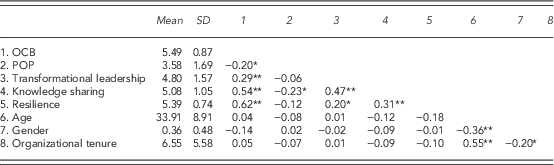
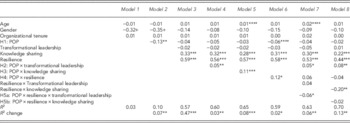
In Table 1, we provide the zero-order correlations and descriptive statistics, and in Table 2, we offer the regression results. Model 1 included the control variables, Model 2 added POP, and Model 3 added the three moderators: transformational leadership, knowledge sharing, and resilience. Models 4–6 added the POP×transformational leadership, POP×knowledge sharing, and POP×resilience interaction terms, respectively. Previous research indicates that it is appropriate to add multiple interaction terms separately, because the simultaneous inclusion of multiple interaction terms into a single model can mask true moderating effects (Aiken & West, Reference Aiken and West1991; Covin, Green, & Slevin, Reference Covin, Green and Slevin2006; Zahra & Hayton Reference Zahra and Hayton2008; De Clercq, Bouckenooghe, Raja, & Matsyborska, Reference De Clercq, Bouckenooghe, Raja and Matsyborska2014).Footnote 1 The three-way interaction terms (POP×resilience×transformational leadership and POP×resilience×knowledge sharing, respectively), together with the two corresponding sets of constitutive two-way interactions, appear in Models 7 and 8 (Aiken & West, Reference Aiken and West1991). For both the two- and three-way interaction terms, we mean centered the product terms (Aiken & West, Reference Aiken and West1991).
Correlation table and descriptive statistics

Note. N=109.
OCB=organizational citizenship behavior; POP=perceptions of organizational politics.
*p<.05; **p<.01.
Regression results (dependent variable: OCB)

Note. N=109; unstandardized coefficients (two-tailed p-values).
OCB=organizational citizenship behavior; POP=perceptions of organizational politics.
+p<.10; *p<.05; **p<.01; ***p<.001.
In support of our baseline prediction that employees’ perceptions of self-serving behaviors in organizational decision making diminish the likelihood that they undertake voluntary activities, we found in Model 2 that POP related negatively to OCB (β=−0.13, p<.01), in support of Hypothesis 1. Model 3 features relationships that were not part of our theoretical focus – namely, direct positive effects of knowledge sharing (β=0.33, p<.001) and resilience (β=0.59, p<.001) on OCB. The direct effect of transformational leadership was not significant.
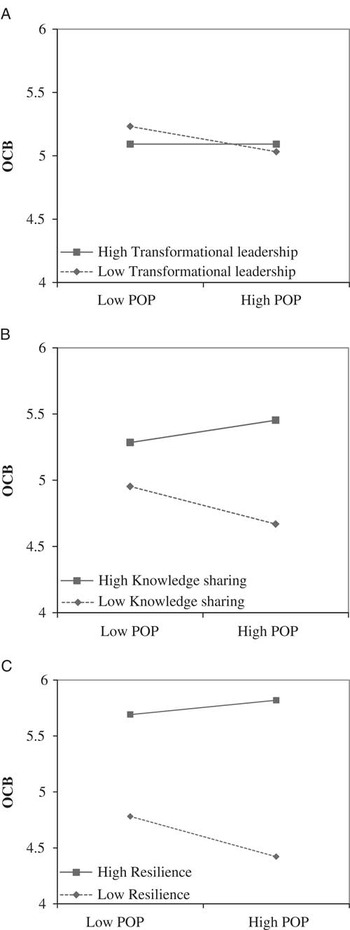
Models 4–6 supported the hypothesized buffering effects of transformational leadership (β=0.05, p<.01), knowledge sharing (β=0.11, p<.001), and resilience (β=0.12, p<.05) on the relationship between POP and OCB. The likelihood that increasing levels of POP diminish OCB thus was lower when employees could draw on transformational leaders (Hypothesis 2), extensive knowledge sharing with organizational peers (Hypothesis 3), and their personal resilience (Hypothesis 4). We depict these results in Figure 2 (Aiken & West, Reference Aiken and West1991).
Two-way interaction effects. (a) Transformational leadership on the perceptions of organizational politics–organizational citizenship behavior (POP–OCB) relationship. (b) Knowledge sharing on the POP–OCB relationship. (c) Resilience on the POP–OCB relationship

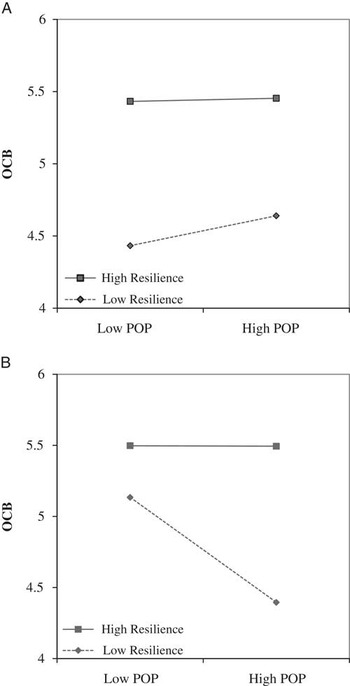
In support of Hypothesis 5a, we uncovered a negative three-way interaction among POP, resilience, and transformational leadership in Model 7 (β=−0.06, p<.05). The buffering (or positive moderating) effect of resilience on the negative POP–OCB relationship thus was stronger at lower levels of transformational leadership. To clarify this interaction, we plotted the moderating effect of resilience on the POP–OCB relationship at high versus low levels of transformational leadership in Figure 3. At low levels of transformational leadership (Figure 3b), the interaction plot showed a pattern similar to that in Figure 2c, POP diminished OCB much less when resilience was high rather than low. However, at high levels of transformational leadership (Figure 3a), the two lines were nearly parallel, indicating a diminished interaction effect between POP and resilience.
Three-way interaction effect. (a) Resilience on the perceptions of organizational politics–organizational citizenship behavior (POP–OCB) relationship at high transformational leadership. (b) Resilience on the POP–OCB relationship at low transformational leadership

In contrast with our prediction in Hypothesis 5b, the buffering effect of resilience on the POP–OCB relationship was not significantly stronger at low levels of knowledge sharing (β=−0.02, ns, Model 8). Thus, resilience mitigates the translation of POP into lower OCB, irrespective of the level of knowledge sharing between employees and their peers.
Discussion
This study contributes to extant research on OCB by elaborating how employees’ access to resources buffers the likelihood that their POP lead them to engage in lower OCB. The paucity of attention to this issue is somewhat surprising, because the uncertainty that comes with beliefs about dysfunctional political games can be countered by relevant resources (Bouckenooghe, Reference Bouckenooghe2012; Abbas et al., Reference Abbas, Raja, Darr and Bouckenooghe2014). Drawing from the JD-R model (Bakker & Demerouti, Reference Bakker and Demerouti2007), we address the important question of the circumstances in which POP is less likely to transform into lower OCB. This theoretical focus on the buffering role of relevant resources considers the incremental importance of POP in reducing OCB, such that organizations can gain better insights into the conditions in which highly politicized environments are less likely to turn employees away from positive work behaviors. We have investigated the buffering roles of two contextual resources (transformational leadership and knowledge sharing) and one personal resource (resilience), while also arguing that the potency of resilience is particularly salient among employees who cannot rely on transformational leaders or extensive knowledge-sharing routines. Our findings mostly support these theoretical arguments.
The direct negative relationship between POP and OCB mimics findings in previous research about the harmful effects of POP on positive work attitudes and behaviors (Miller, Rutherford, & Kolodinsky, Reference Miller, Rutherford and Kolodinsky2008; Chang et al., Reference Chang, Rosen, Siemieniec and Johnson2012; Abbas et al., Reference Abbas, Raja, Darr and Bouckenooghe2014). The mechanisms that underpin this relationship stem from both capability and motivation. First, perceptions of self-serving behaviors in the organization deplete employees’ energy levels. Because employees must focus on meeting their formal job requirements, they have little room or energy for additional work activities (Crawford, LePine, & Rich, Reference Crawford, LePine and Rich2010). Second, negative feelings of frustration or anger in response to unfair, politically based decision making (Ferris & Kacmar, Reference Ferris and Kacmar1992) may undermine employees’ willingness to go out of their way to engage in OCB.
We also find that the negative effect of POP on OCB can be mitigated by transformational leadership and knowledge sharing with organizational peers. These two contextual resources enhance employees’ feelings of confidence that they can meet their formal job obligations, despite the presence of dysfunctional political games (Bass & Riggio, Reference Bass and Riggio2006; Bouckenooghe, Reference Bouckenooghe2012), so they are better positioned to undertake additional voluntary behaviors that contribute to organizational effectiveness. Studies of the moderators of the POP–OCB relationship are rare. Our finding of the mitigating roles of two contextual resources extends prior research that suggests favorable organizational conditions, such as perceived organizational support, actually might invigorate the transformation of POP into reduced OCB, because employees who experience high levels of support have less to gain from engaging in time-consuming OCB that is unlikely to be reciprocated in politicized environments (Lee & Peccei, Reference Lee and Allen2011). Overall, the significant buffering roles of transformational leadership and knowledge sharing, as revealed in this study, are consistent with the JD-R argument that the relative importance of adverse organizational conditions for reducing positive work behaviors diminishes in the presence of relevant resources (Bakker & Demerouti, Reference Bakker and Demerouti2007). Employees are less likely to channel the negative feelings that they might experience due to dysfunctional politics into lower OCB when they benefit from supportive organizational leaders and peers.
Resilience also has a significant role in preventing POP from turning into reduced OCB, because resilient employees recover more easily from the setbacks they experience when organizational decision making has a significant self-serving component (Luthans, Reference Luthans2002), and they even may see the presence of POP as an opportunity for growth. The threat of negative repercussions for the ability to perform adequately in regular job tasks, due to highly politicized environments, is lower if employees can draw from greater physical energy reservoirs, which get filled by their resilience (Youssef & Luthans, Reference Youssef and Luthans2007). The likelihood that they turn away from OCB thus will be lower. Employees who score high on resilience even may derive some joy from engaging in OCB in the presence of dysfunctional politics, because such efforts offer a positive challenge and opportunity for personal growth (Park et al., Reference Park, Song, Yoon and Kim2013). Thus, when their resilience is high, the intrinsic motivation associated with OCB might offset the negative feeling of frustration that tends to arise in employees who confront self-serving behaviors in their work environment, so the translation of negativity into a reduced willingness to help the organization voluntarily is thwarted. This finding about the role of resilience complements previous research into the moderating effects of other personal resources, such as conscientiousness and self-monitoring, on the relationship between POP and OCB (Chang et al., Reference Chang, Rosen, Siemieniec and Johnson2012).
As we show in Figure 3a and 3b, our study also reveals that the buffering role of resilience is even more important when employees cannot rely on transformational leaders. Without significant leader support, employees likely feel insulated (Shin & Zhou, Reference Shin and Zhou2003; Chen et al., Reference Chen, Lin, Lin and McDonough2012), so their resilience is particularly useful for mitigating the negative influence of dysfunctional political games on their OCB. However, we did not find empirical support for the three-way interaction among POP, resilience, and knowledge sharing with colleagues. This finding indicates that the stress caused by unsupportive peer relationships may be less than that caused by an unsupportive leader, who has more power to mitigate workplace adversity (Bass & Riggio, Reference Bass and Riggio2006) and to affect employees’ careers.
Overall, the results establish a more complete understanding of when POP can diminish the likelihood that employees engage in voluntary behaviors that go beyond formal job descriptions. In particular, we extend extant literature by specifying the concurrent influences of POP and different resource types on OCB. We reveal mitigating influences of resources that operate at different levels (context and individual) on the likelihood that perceptions of self-serving behavior diminish OCB.
Limitations and future research
Some shortcomings of this study suggest research opportunities. First, we conceptualized POP as perceptions of dysfunctional organizational behaviors, in line with the JD-R argument that such perceptions constitute an important source of stress (Bakker & Demerouti, Reference Bakker and Demerouti2007). Yet some studies indicate a beneficial role of political behaviors, such as when managers leverage their political skills to ‘get things done’ and advance their agendas (e.g., Ferris et al., Reference Ferris, Perrewé, Anthony and Gilmore2000; Perrewé et al., Reference Perrewé, Ferris, Frink and Anthony2000). To complement our quantitative measures of dysfunctional, self-serving behavior, research might include measures of political skills or apply qualitative approaches to the study of POP. For example, researchers could investigate how employees make sense of organizational politics (Weick, Reference Weick1995) and how this sensemaking process might be informed by their social identity while simultaneously influencing their identity construction (Karreman & Alvesson, Reference Karreman and Alvesson2001). Such studies could add nuance to traditional views of politics as dysfunctional manipulations of organizational decision makers by considering, for example, how political behaviors might help overcome resistance to organizational change (Thomas & Davies, Reference Thomas and Davies2005).
Second, we considered three specific contingency factors but ignored other potential buffers of the negative relationship between POP and OCB. For example, the extent to which employees believe they are fairly rewarded for their job efforts (Colquitt, Conlon, Wesson, Porter, & Ng, Reference Colquitt, Conlon, Wesson, Porter and Ng2001) or organizational peers are trustworthy and not opportunistic (Nahapiet & Ghoshal, Reference Nahapiet and Ghoshal1998) might be meaningful contextual influences. Other personal characteristics also could function as buffers, such as employees’ perceived ability to find creative solutions to adverse work conditions (Tierney & Farmer, Reference Tierney and Farmer2002) or their passion for work, which increases the joy they derive from contesting others’ political behaviors (Baum & Locke, Reference Baum and Locke2004).
Third, an empirical weakness of this study is the relatively small sample size, generated from employees in one manufacturing organization in one country (Mexico). These features might limit the generalizability of the results. Smaller sample sizes provide for a more conservative statistical test of theoretical relationships, particularly for theoretical frameworks that include interaction effects (Bouckenooghe, De Clercq, & Deprez, Reference Bouckenooghe, De Clercq and Deprez2014). However, future research could include larger sample sizes. Although our theoretical arguments are not industry specific, our single-organization design also prevents us from investigating the role of relevant industry factors, such as the level of competitive rivalry in external markets (Porter, Reference Porter1996). Such competitive rivalry could make employees more willing to accept the stress that internal political environments impose (Lahiri, Pérez-Nordtvedt, & Renn, Reference Lahiri, Pérez-Nordtvedt and Renn2008), which in turn could mitigate the harmful effect of such environments on their OCB.
Fourth, cultural factors may be relevant. Our theoretical arguments are not country-specific, but Mexico tends to be risk averse (Hofstede, Reference Hofstede2001), so employees may be particularly sensitive to the stress associated with uncertainty-inducing political behaviors. The usefulness of resources for reducing the negative effects of those behaviors on OCB then may be stronger in our study context than in more risk-prone countries. Moreover, the level of collectivism that marks Mexican culture (Hofstede, Reference Hofstede2001) might interfere with our results: The proposed beneficial role of knowledge sharing with organizational peers for buffering the negative impact of POP on OCB may be more potent in Mexico than in more individualistic countries. Thus, cross-country studies should compare the relative importance of POP for enhancing the propensity to undertake behaviors that are not formally required, as well as the potency of the moderators underlying this process, in various cultural contexts.
Practical implications
This study of the interplay of POP and employees’ OCB has important practical implications. Organizations should be aware that employees are less likely to go out of their way to help other members voluntarily when they experience significant uncertainty, due to their perception that organizational decision-making processes are dominated by hidden agendas or that short-term personal gains take precedence over long-term organizational well-being (Nembhard & Edmondson, Reference Nembhard and Edmondson2006; Abbas et al., Reference Abbas, Raja, Darr and Bouckenooghe2014). Strongly politicized environments enhance employees’ stress levels and undermine their motivation (Kacmar & Ferris, Reference Kacmar and Ferris1991), so their propensity to do more than what is expected gets hampered. To the extent that organizations can discourage self-serving behaviors within their ranks, employees should be more eager to leverage their skill set to benefit the organization and protect it from failures through voluntary actions. For example, organizational policies that ensure transparency and fairness in resource allocation can be instrumental for ensuring that employees volunteer for activities that contribute to organizational effectiveness.
To decrease the likelihood that self-serving behaviors hinder OCB, when such behaviors cannot be avoided completely, organizations also should promote a leadership style that focuses on setting clear goals, providing individual coaching, and helping employees deal with challenging work conditions (Hochwarter et al., Reference Hochwarter, Kacmar, Perrewé and Johnson2003). When employees are supervised by transformational leaders with such skills, they are better prepared to fulfill their job obligations, despite destructive politics, and still have energy left for voluntary activities that benefit both the organization and the employees themselves. Organizations therefore should implement targeted recruitment and training efforts to find leaders who possess transformational leadership skills or are willing to develop those skills.
Organizations also should stimulate open knowledge sharing, because employees can learn from one another how to do their jobs, even in a strongly political organizational culture (Bouckenooghe, Reference Bouckenooghe2012), which will avert their desire to avoid voluntary work behaviors. In some organizations, extensive knowledge sharing can be challenging though, because of desires to protect personal turf, the prevalence of professional identification over organizational identification, or the presence of strict hierarchical lines (Cabrera & Cabrera, Reference Cabrera and Cabrera2002; Ramanujam & Rousseau, Reference Ramanujam and Rousseau2006). Possible interventions to promote effective knowledge sharing, in the face of these challenges, include the installation of cross-functional teams or task forces (McDonough, Reference McDonough2000) or training programs that focus on developing technical and soft skills and then effectively integrating those skills (Kahn, Reference Kahn1996).
Finally, employees’ resilience provides an additional tool that organizations can leverage to mitigate the problems associated with self-serving behaviors. Organizations marked by destructive political climates would benefit from hiring employees who easily bounce back from setbacks and are motivated to learn from them; they also should encourage and develop this personal characteristic among existing employees. To enhance employees’ resilience, organizations can train them to anticipate and prepare for risky work situations or identify different pathways to minimize both the likelihood of these situations and their potential damage (Masten, Reference Masten2001; Luthans, Avey, Avolio, & Peterson, Reference Luthans, Avey, Avolio and Peterson2010). In support of such training initiatives, organizations should highlight how voluntary behaviors that extend beyond formal job requirements can benefit the career development and prospects of their employees. Finally, our findings indicate that the relative value of training that stimulates resilience is greatest when employees cannot rely on transformational leadership from their supervisor.
Conclusion
With this study, we have investigated the question of when employees’ POP are less likely to diminish their OCB. The likelihood that employees’ beliefs that organizational decision making is marked by self-serving behavior lead to lower OCB decreases when those employees can rely on transformational leadership, share knowledge with organizational peers, and are more resilient. These varied resources all increase employees’ ability to meet their regular job requirements even in the presence of strongly politicized environments, leaving them with sufficient energy and motivation to engage in activities that are not formally required. We hope this study serves as a platform for further investigations of how organizations can mitigate the risk that stressful political work environments will keep employees from engaging in positive work behaviors.
Acknowledgements
The authors wish to express their sincere gratitude to the Editorial Team and two anonymous Reviewers for their insightful comments and constructive suggestions, which were instrumental for the quality of this article.