Introduction
By 2030, 24 per cent of the population will be over 65 years of age in the European Union, with 30 per cent of them being older than 80 (Eurostat 2015). Many of them will be community-dwelling older adults who suffer from long-term and complex health problems, for which both informal (e.g. spouses, children, friends) and formal care-givers (e.g. publicly or privately paid home-care professionals) need to be deployed. This will contribute to an increase in the prevalence of mixed-care networks in which multiple informal and formal care-givers will have to collaborate in providing care in the home environment. Policy makers aim for more contact and co-operation between informal and formal care-givers as it may enhance the quality of care (Huber and Hennessy Reference Huber and Hennessy2005). Research shows as well that timely and satisfactory co-operation between these different types of care-givers is a prerequisite for good quality of care (Gittell Reference Gittell2002). Co-operation enables care-givers to know how their tasks fit to tasks of other care-givers, which allows them to adjust their tasks for the overall care delivery. Moreover, discussion of care activities can help to understand the needs of the elderly. Although good co-operation is proven to be indispensable, few studies are conducted on the level of contact and communication between informal and formal care-givers in the home-care context (Sims-Gould and Martin-Matthews Reference Sims-Gould and Martin-Matthews2010). Discussing the care provision among care-givers may serve as a first step to co-operation and is the focus of our study. Our main goal is to examine under which conditions informal and formal care-givers in a care network do discuss the care.
There is an extensive body of literature on the relationship between formal and informal care-givers, but most studies are limited in focus. These studies are performed from a one-sided perspective, like the viewpoint of either the formal or the informal care-giver, are based in nursing home contexts or used qualitative methods to study the subjective experiences and attitudes of the care-giver (Åstedt-Kurki et al. Reference Åstedt-Kurki, Paavilainen, Tammentie and Paunonen-Ilmonen2001; Bauer and Nay Reference Bauer and Nay2011; Guberman et al. Reference Guberman, Lavoie, Pepin, Lauzon and Montejo2006; Haesler, Bauer and Nay Reference Haesler, Bauer and Nay2007). Also, when looking at informal–formal care-giver relationships, studies generally focus on one central informal–formal care-giver dyad and disregard the presence of multiple informal and formal care-givers (Bell and Rutherford Reference Bell and Rutherford2013; Kruijswijk, Da Roit and Hoogenboom Reference Kruijswijk, Da Roit and Hoogenboom2014; Piercy and Dunkley Reference Piercy and Dunkley2004; Wiles Reference Wiles2003). We extend this literature by focusing on the informal–formal dyad in the care network in three innovative ways. First, we acknowledge that the formal–informal care-giver interaction may be dependent on the condition of the care recipient. We argue that a care recipient's needs, wishes and capacities to control the care provision can affect the ‘necessity’ for informal and formal care-givers to discuss the care. Second, we consider the dyad to be part of a larger care network in which linkages may exist between multiple care-givers (Carpentier and Ducharme Reference Carpentier and Ducharme2003; Ryan, Puri and Liu Reference Ryan, Puri and Liu2013). As the linkages to others may be stronger within the formal and within the informal sub-networks than between the two sub-networks, specific formal–informal dyads may serve as bridges between sub-networks, decreasing the need for other formal–informal dyads to discuss the care. Third, we use data from a quantitative study on mixed-care networks of community-dwelling older adults and we are, to our knowledge, among the first to present multivariate analyses on all formal–informal dyads within such networks.
The new perspective thus involves that both care network characteristics as well as the characteristics of the care recipient at stake provide the ‘meeting opportunities’ to discuss the care. Characteristics of individual care-givers may also be relevant for formal–informal care discussion, e.g. the types of tasks they perform or the extent to which they are providing care. Therefore, taking care recipient, care context and the individual care-givers into account, the research question reads: To what extent is discussion of the care between an informal and a formal care-giver in a mixed-care network related to characteristics of the care recipient, the care network at large and the dyads between the three actors involved?
Theoretical framework and hypotheses
Care recipient characteristics
The care recipient is generally viewed as being a ‘user’ of care, which has a rather passive connotation to it. However, many care recipients decide how much care is used, from whom it is received and how the care process is organised. Several studies corroborate that care recipients prefer either formal or informal care (Pinquart and Sorensen Reference Pinquart and Sorensen2002) and are inclined to maintain a certain level of control over the care received (Bastiaens et al. Reference Bastiaens, Van Royen, Pavlic, Raposo and Baker2007). In such cases, the care recipient can posit himself or herself between, for example, an informal and formal care-giver and take care of all communication with both care-givers, decreasing the necessity for both care-givers to discuss the care with each other. However, being in control may require social and organisational skills and care recipients may find it more difficult to do so when their health problems limit their capabilities and energy level. In addition, complex health problems make it more difficult to remain in control of the care process, and increase the necessity for informal and formal care-givers to discuss the care. Prior research shows that with increasing health problems of the care recipient, families and professional care-givers interact more often (Kemp et al. Reference Kemp, Ball, Perkins, Hollingsworth and Lepore2009). The effect of the care recipients’ health on the discussion of care within the formal–informal dyad may thus be either direct (necessitating communication) or indirect (via lower perceived control). We hypothesise that an informal and a formal care-giver are more likely to discuss the care when the care recipient has more impaired health (Hypothesis 1a) and perceives little control over the care provision (Hypothesis 1b).
Care network characteristics
In mixed-care networks consisting of more than two different care-givers, dyadic interaction may also depend on the interaction with and between other care-givers. Both the number and the type of care-givers may be important. When the total number of care-givers is small, it is easier for all care-givers to get in touch with each other than when the number of both informal and formal care-givers is larger. So, we first postulate that discussion of care between an informal and a formal care-giver is less likely when the number of informal and formal care-givers is higher (Hypothesis 2a). Next, both the informal and formal care-giver are embedded to some degree in their own informal and formal sub-network. The contact within the informal and formal sub-networks may affect the likelihood that either one of the care-givers in this sub-network connects with a care-giver from the other type of sub-network. A study by Tucker and Edmondson (Reference Tucker and Edmondson2003) showed that nurses in a hospital were not likely to negotiate aspects of care provision with others besides their fellow formal care-givers providing the same type of care. Informal care-givers, being all socially related to the care receiver, are likely to communicate in particular amongst each other. In both sub-networks a particular care-giver may be appointed as being the one to discuss the care with the other sub-network, serving as the bridge to the other (in)formal care-givers. In this case, the necessity of other informal and formal care-givers to discuss the care is largely decreased. We presume that when there is more contact within the informal and within the formal sub-network, discussion of care between an informal and a formal care-giver is less likely to occur (Hypothesis 2b).
The care-giver–care recipient dyad
Meeting opportunities for two care-givers are larger when they are both frequently in the same social context or within close geographical distance (Argyle Reference Argyle1989; Mollenhorst, Völker and Flap Reference Mollenhorst, Völker and Flap2011). These meeting opportunities may vary for informal care-givers by the social relationship they have with the care recipient. Partners provide more care than children who, in turn, provide more care than other relatives or non-kin (e.g. Keating and Dosman Reference Keating and Dosman2009). In particular, the co-residency of the informal care-giver increases the opportunity to meet other care-givers. For non-residential care-givers (both formal and informal), the frequency of care provision is more decisive for meeting other care-givers, as this reflects how often they are present in the home of the care recipient. For both informal and formal care-givers, the frequency, variety in type of care and duration of care provided increase the time spent in the home and may thus increase the opportunity to meet other care-givers. We expect that when the informal care-giver is residing with the care recipient (Hypothesis 3a) and when the care-giving intensity (as indicated by number of hours of care provision, number of different types of tasks and duration of care in years) for both the informal and formal care-giver is higher (Hypothesis 3b), it is more likely that an informal and a formal care-giver discuss the care.
The informal–formal care-giver dyad
Finally, we take the formal–informal care-giver dyad into account. Feld posits with his ‘focus theory’ that individuals organise their social relations around foci, which are ‘social, psychological, legal or physical entities around which joint activities are organized’ (1981: 1016). Feld assumes that ‘two individuals who share a focus are more likely to share joint activities with each other than two individuals who do not have that focus in common’ (Feld Reference Feld1981: 1016). We translate this to care tasks, theorising that the greater the overlap in type of care tasks the informal and formal care-giver perform, the more compatible the focus is. This is in line with Nembhard and Edmondson (Reference Nembhard and Edmondson2006), who state that the higher the degree of task interdependency, the more opportunities people have to communicate with each other. Likewise, when individuals perform the same tasks, tuning is more necessary (Sims-Gould and Martin-Matthews Reference Sims-Gould and Martin-Matthews2010), implying a need for discussion to organise the care. We hypothesise that the greater the overlap in types of tasks between the formal and informal care-giver, the greater the likelihood that they will discuss the care (Hypothesis 4).
Methods
Sample
Data have been collected in the context of the ‘Care Networks of Frail Older Adults’ study in the Netherlands. Care recipients living at home were identified via eight home-care organisations and three voluntary care organisations in Amsterdam and surroundings in 2012. Team and case managers together with professional care-givers from the home-care organisations and the co-ordinating staff of the volunteering organisations approached care recipients who were in their opinion cognitively able to participate in a face-to-face interview, were aged 65 or older, and received care from at least two types of the following care-givers: informal care-givers, formal care-givers or care volunteers. Of the 119 care recipients approached, 75 participated in the study (62%). Respondents who did not participate were physically not able to participate or found it too burdensome or stressful (N = 22), did not match the inclusion criteria according to the research co-ordinator (N = 21) or died before they were contacted by the research co-ordinator (N = 1). In one network we could not interview any care-giver, therefore the response of 74 older adults is analysed in the current study.
During the interview, the care recipients were asked to identify all the persons by name that helped them with instrumental activities of daily living (IADL), activities of daily living (ADL), nursing, transport and administrative tasks. Receiving help with IADL tasks was described as household work, such as preparing food or drinks, cleaning the house, washing, ironing, sewing clothes, doing the groceries or small jobs in the house or in the garden. Help with ADL tasks was explained as (un)dressing, putting stockings on/off, washing, combing, shaving, helping with going to the toilet, moving indoors, giving food or drinks. Nursing tasks were described as help with wound care, stoma care, insertion of a probe or catheter, giving injections, and distributing or giving medication. Transport was determined as helping moving outdoors, making excursions and visits to family or friends, and facilitating contact with health services (such as the general practitioner or hospital). Administrative tasks were specified as arranging assistance, assistive devices or home modifications, and regulating financial and administrative matters.
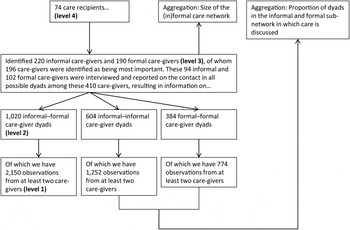
The 74 care recipients identified 220 informal care-givers and 190 formal care-givers (see Figure 1); 75 formal care-givers were representative of a team, i.e. a collection of formal care-givers who performed the same type of task regularly and in alternation. As team representative, the care-giver was chosen who visited the older adults most, or when such a person could not be identified, who had visited the older adult last. We asked the care recipients to identify the most important care-givers of which at least two different types (informal, formal) were approached for an interview. We interviewed 94 informal care-givers (including 11 volunteers) and 102 formal care-givers. In 32 networks two care-givers were interviewed, and in 42 networks more than two care-givers were interviewed, e.g. because several types of care were performed by different care-givers.
Overview of the four levels in the multi-level analysis.

Measurement of discussion on care
Each of the interviewed care-givers was asked about his or her contact with each of the other care-givers identified: ‘How often do you discuss the care provision with…?’ We defined ‘discussing the care’ as involving every exchange of information between two care-givers concerning the care situation of the care recipient. This can be communication in case of an emergency, or consulting one another on how to deal with specific issues concerning the older adult, e.g. on technical, medical or social procedures. A seven-point answering scale varying from ‘never’ (1) to ‘daily’ (7) was offered and we dichotomised the frequency of discussion into ‘no discussion’ (1) and ‘discussion’ (2–7) due to the skewed distribution. In addition, because we could not interview every care-giver who was identified, we asked the interviewed care-givers to serve as a proxy and indicate in a matrix whether each of the other identified care-givers discussed the care between another or not (0, 1, do not know). As investigating the discussion of every single formal care-giver who was part of a team with all other care-givers would become too extensive, we included only the representatives of the teams and the single care-givers who were not part of a team in our study. Hence, the team members were not identified in the network on the dyadic level, but were only used for calculating network size.
Independent variables
Care recipient characteristics
In addition to age (in years) and sex (0 = male, 1 = female), the care recipient was asked who in the care network was in control of the care decisions. Their answers were rearranged into 0 = care-giver only or do not know, 1 = care recipient only or care recipient with care-giver. Further, we assessed the educational level (1 = low, elementary school; 2 = middle, vocational education; 3 = high, higher vocational or university level). As a measure of disability, we included the Instrumental Activities of Daily Living Scale (Lawton and Brody Reference Lawton and Brody1969) and the Index of Independence in Activities of Daily Living Health (Katz et al. Reference Katz, Ford, Moskowitz, Jackson and Jaffe1963) in the interview. We asked the care recipients to indicate on a five-point scale to what extent they could independently perform seven IADL and eight ADL activities (ranging from 1 = without any difficulty to 5 = not at all). The scores of these 15 items were summed (range 15–75) to calculate functional limitations (α = 0.83). A higher score implied more functional limitations. Finally, we asked the older adults whether they experienced memory problems, resulting in 0 = no memory problems and 1 = some memory problems.
Informal and formal care-giver characteristics
Relationship to the care recipient was categorised in six categories for the informal and formal care-givers (resident partner/child, child not living with care recipient, extended family, other informal care-giver, household worker, personal care-giver, nurse or other professional).Footnote 1 For each care-giver, information on care load (hours per week per task) and duration of the care (in years) was asked. We summed the total number of hours of care provided in each of the five tasks by each care-giver, and calculated the maximum duration of the care in number of years. Further, we included the number of different types of tasks of the informal and the formal care-givers (0 = one task, 1 = two or more tasks). Task overlap (0 = no task overlap, 1 = task overlap) was established by identifying whether the two care-givers provided at least one same type of task.
Care network characteristics
The number of informal and formal care-givers identified was counted. For the formal care-givers we included the number of formal care-givers in a team, resulting in a total of 499 formal care-givers. We calculated for both the informal and the formal sub-network whether there was little (less than 50%) or much (50% or more) discussion, or whether there was only one person in the sub-network, in which case no discussion could be determined.
Procedure
Descriptive statistics were provided for the 74 care recipients and network characteristics. We further computed per care network the proportion for type of relationship and the mean for duration, hours and different types of tasks to show the distribution of all variables under study. Next, multi-level logistic analysis was applied using the MLwiN program, with iterative generalised least squares (IGLS), and a second-order predictive quasi-likelihood (PQL) procedure (Rasbash et al. Reference Rasbash, Charlton, Browne, Healy and Cameron2009), to take the multi-level structure (the dependency of observations on different levels) into account. We transformed the hours provided by taking the natural log, because the distribution was skewed to the right.
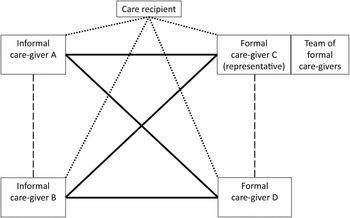
The dyads between the 220 informal care-givers and 190 formal care-givers inform us on the discussion of care; 1,020 informal–formal care-giving relationships are included in the analyses. Information on these relationships was provided by the interviewed care-givers (on average 2.1 observations per dyad), who could be the care-giver in the dyad as well as another care-giver who served as a proxy reporter. Figure 1 illustrates that the 2,150 observations of the dyads (level 1 data in the multi-level analysis) are nested in 1,020 dyads (level 2), which are nested within 410 care-givers (level 3), who at their turn are nested within the 74 care recipients (level 4). Missing values (when the interviewed care-giver did not know whether two others discussed the care) were left out of the analysis. Information on the 410 care-givers were used to assess the size of the informal and the formal network. Next, the data on the 604 informal–informal care-giving relationships and 384 formal–formal care-giving relationships were used to assess discussion within the informal sub-network and the formal sub-network, by aggregating the dyadic information to a network level to establish whether there was little (in less than 50% of the dyads discussion occurred) or much (50% or more) discussion (Figure 1). Figure 2 gives an example of a care network in which two care-givers are interviewed.
Example of a care network with two informal (informal care-giver A and informal care-giver B) and two formal (formal care-giver C, representative of a team and formal care-giver D) care-givers. Care-giver A and C are interviewed. The dotted lines reflect the characteristics of the ties between the care recipient and the care-givers (e.g. type of relationship, type of care provided). The dashed lines represent information on discussion in the informal–informal and formal–formal dyad. The straight lines provide data on the dependent variable: discussion of care between each informal and formal care-giver. Each line represents four observations, resulting from two care-givers reporting on two dyads. For example, consider the tie between care-giver B and D. The four observations are: [B–D]A, [B–D]C, [D–B]A, [D–B]C, in which [B-D]A is the dyad between care-givers B and D as nested in dyad B, as observed by care-giver A. Note that [B–D]A and [D–B]A are identical but included twice in the analysis as they are nested within different care-givers. In most cases there are two observations per dyad, but in cases where more than two care-givers are interviewed, more observations per dyad are present. Within the whole sample there were on average 2.1 care-givers reporting per dyad. Regarding the level structure of the data (see also Figure 1), the case in Figure 2 represents one care recipient on the fourth level, four care-givers on the third level, eight dyads on the second level and 16 observations on the first level.

All independent variables were first added separately to perform bivariate analyses, and second added at the same time in the model. Collinearity statistics were calculated for the set of explanatory variables and were within an acceptable range (highest variance inflation factor = 1.73). As living alone or living with a care-giver largely impacts meeting opportunities, we describe the care networks of two groups: care recipients living alone (N = 56) and care recipients living with a residing care-giver (N = 18), of which 13 were partners and five were children.
Results
Description of the different characteristics
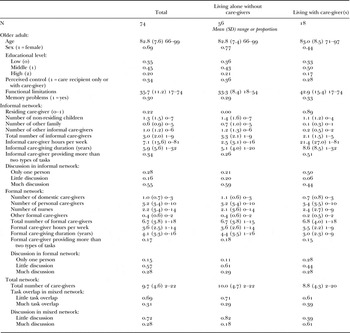
The care recipients were on average 82.8 years old (standard deviation = 7.6) and 51 were female (Table 1). The sample was physically frail, on average scoring 35.7 on functional limitations (range 17–74) and 30 per cent reported memory problems. The majority of the care recipients (N = 49) indicated that a care-giver (either informal or formal) was in control of their care or they did not know who was in control. A minority (N = 25) indicated that they were controlling the provision of care, either themselves or together with a care-giver. On average, almost ten care-givers were involved in the care network, of whom three informal and seven formal care-givers. Most of the informal care-givers were children not living with the care recipient (on average 1.3), and most of the formal care-givers provided help with personal care. In the care networks, the informal care-givers performed 7.1 hours per week care on average, as compared to 3.6 hours of the formal care-givers. Further, most care-givers performed only one type of task. In 55 per cent of the care networks much discussion occurred between informal care-givers. For the formal–formal care networks, the proportion was 28 per cent. In 22 per cent of the care networks, no discussion occurred at all between the informal and formal care-givers, in 7 per cent there was one ‘bridge’, one dyad in which discussion occurred, and in 72 per cent two or more bridges were present (results not shown).
Descriptives of care recipient and network characteristics

Note : SD: standard deviation.
Discussion of care between the formal and informal care-giver
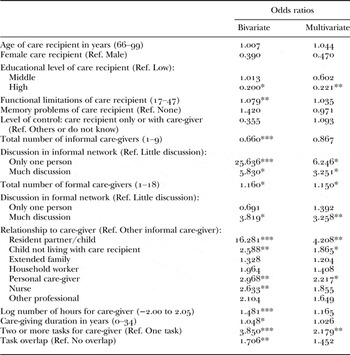
The empty model of the multi-level analysis revealed that the probability for an informal and a formal care-giver to discuss the care was 0.26. Many of the explanatory variables were statistically significant for discussion of care, but their shared level of variance reduced their impact in the multivariate analyses (Table 2). The results of the multivariate model, including all explanatory variables, revealed that control of care decisions by the care recipient and care need did not significantly impact discussion between an informal and formal care-giver, which is in contrast to Hypotheses 1a and 1b. Next, when the educational level of the care recipient was high, the probability that an informal care-giver discussed care with a formal care-giver was low (0.11) compared to care recipients with a low educational level (0.36). Considering network characteristics, the finding is in contrast with Hypothesis 2a: the greater the number of formal care-givers, the higher the likelihood of discussion between an informal and formal care-giver. Especially the contact within the informal and formal sub-networks mattered in two conditions: the more discussion occurred in the sub-network or when an informal care-giver was providing the care by him- or herself without help from others, the higher the likelihood that an informal and formal care-giver discussed the care, in contrast to Hypothesis 2b.
Multi-level logistic regression of discussion between informal and formal care-givers

Notes : N = 2,150. Ref.: reference category.
Significance levels : * p < 0.05, ** p < 0.01, *** p < 0.001.
When focusing on the informal and formal care-giver characteristics (considering Hypotheses 3a and 3b), the results show that type of relationship mattered. When the informal care-giver was residing with the care recipient, the likelihood of discussing the care between a formal and an informal care-giver was higher (probability = 0.46) than for other informal care-givers (0.17). Also non-residing children and personal care-givers discussed the care more than other informal care-givers. In addition to co-residence and type of relationship, the results showed that when a care-giver performed more types of tasks instead of one, the likelihood that the informal and formal care-giver discussed the care was greater (probability = 0.38 versus 0.22). Although support was found for Hypothesis 4 in the bivariate analysis, the results of the multivariate analysis showed that task overlap did not contribute significantly to more discussion.
The analyses showed that residing care-givers are most likely to discuss the care with professional care-givers. In order to get more insight in the care networks of respondents with and without a residing care-giver, we compared the care recipients and their networks on all variables under study. Table 1 shows that in the care networks with a residing care-giver (N = 18), the care recipient was more often male (56% versus 23%), had more functional limitations (42.9 versus 33.3) and experienced less control of the care (28% versus 36%). These care networks held on average two informal care-givers (2.1), consisting of a spouse and a non-residing child, who provided many hours of care (21.4), and for a long period of time (8.6 years). When there was more than one informal care-giver, they were likely to discuss the care with each other. As for the care recipients living without a care-giver, the care networks were larger (3.3 persons), consisting of several types of informal care-givers, providing on average only a few hours (2.5) of care per week. The characteristics of the formal care-givers did not seem to differ that much between the two groups, they did however more often have task overlap with the informal care-giver in networks with a residing care-giver (39% versus 29%). In the case of care networks with a residing care-giver, the small, highly interconnected informal care network was strongly connected to the formal sub-network, as the proportion of the informal–formal dyads discussing the care was much higher than in the care networks of care recipients living alone (61% versus 18%). Without a residential care-giver being present, the linkage between informal and formal sub-networks appears to be less established. Further analyses (not shown) showed that in 27 per cent of the care networks without a residing care-giver no discussion occurred, in 7 per cent there was one bridge and in 66 per cent more than one dyad in which discussion occurred was present. As opposed to the care networks with a residing care-giver, in which 6 per cent (one network) had no discussion, in 6 per cent one bridge was present and 89 per cent had several bridges.
Discussion
In this study, we explored whether and under which conditions an informal and a formal care-giver discuss the care they provide to a frail older adult. Using a network perspective, we added to the current knowledge on informal–formal dyads by taking into account additional information about the care recipient, the informal and formal sub-network, as well as the dyadic characteristics. These different characteristics were shown to be important.
First, regarding characteristics of the older adult and the necessity to discuss the care, it is neither the perceived degree of control of the care recipient that determines discussion nor the need for care as indicated by physical frailty as well as memory problems. Instead, a high educational level appeared more important in this respect, and seemed a better indicator of the older adults’ capabilities to control the care compared to the other two characteristics. A higher education was associated with less discussion, so possibly the higher-educated care receiver serves as a bridge between formal and informal care-givers. As a concept, perceived control does not seem to be a well-known concept to the older adults themselves. As one respondent replied to the question who was in charge of her care: ‘I guess that must be the CEO of [name of care organisation]’.
Second, size of and connection within the sub-networks were shown to matter in two ways. First, when more formal care-givers were involved, more discussion occurred with informal care-givers. Possibly the type of care tasks or the more complex care which is related to the presence of more formal care-givers, ask for more discussion, as it was also the care-giver providing personal care who discussed the care most. Second, adding information about the informal and formal sub-network showed that the more discussion occurred among informal care-givers themselves and formal care-givers themselves, the more discussion occurred within a particular informal–formal dyad. This is in contrast with our hypothesis. Possibly discussing the care within the sub-networks leads to more questions being generated, leading in turn to more discussion between the informal and formal care-givers. Another explanation could be, following Carpentier and Grenier (Reference Carpentier and Grenier2012), that receiving advice and emotional support from their informal support network leads to linkage with professional care-givers. Either way, in most care networks, more than one bridge was present, which suggests that there is not one care-giver reporting to his or her sub-network.
Our study showed that the linkage with formal care-givers is merely maintained by a residential care-giver, who serves an important bridging function doing so. These results also point at the importance of meeting opportunities for informal and formal care-givers to discuss the care, as in particular those who provide multiple types of care for many hours per week discuss the care with each other. This was shown to be specifically important when no residing care-giver was present. As the different types of tasks influenced whether or not an informal and a formal care-giver discussed the care, tuning of the different care tasks seems to matter for discussion. This indicates that a shared focus on care (Feld Reference Feld1981) is determining the need for discussion of care as well.
This research provides a first picture of the functioning of different care-givers in the care networks of older adults, but several limitations of this study have to be identified. As this is a cross-sectional study, it provides a snapshot of the features associated with the discussion of care in mixed-care networks. Our findings suggest that a larger involvement of informal and formal care-givers may increase the discussion of care amongst them. A larger involvement may be due to changes in health or the availability of informal care-givers over time. Earlier qualitative research showed that established relationships with staff could be challenged when the needs of care recipients changed (Bauer and Nay Reference Bauer and Nay2011; Kemp et al. Reference Kemp, Ball, Perkins, Hollingsworth and Lepore2009) and that boundaries between nurses and family care-givers constantly shift (Ward-Griffin and McKeever Reference Ward-Griffin and McKeever2000). Longitudinal investigation of care networks would give insight into how care networks change over time, for example in case of temporary hospitalisation, health deterioration of the older adult or the loss of an important care-giver.
Furthermore, we limited the study to task characteristics of the two types of care-givers, but their personal features, such as years of training, motivation for care provision or role expectations, may also be important in this respect. For example, previous studies show that informal care-givers are more likely to collaborate with formal care-givers when they have confidence in the abilities and communication skills of the staff (Bauer and Nay Reference Bauer and Nay2011; Haesler, Bauer and Nay Reference Haesler, Bauer and Nay2007; Hertzberg and Ekman Reference Hertzberg and Ekman2000) and are less uncertain about what formal care-givers expect them to do (Hertzberg, Ekman and Axelsson Reference Hertzberg, Ekman and Axelsson2001). As developing a trusting relationship usually takes time, stability of the staff enhances linkages between informal and formal care-givers (Carpentier and Grenier Reference Carpentier and Grenier2012). A barrier to communication for formal care-givers may be that informal care-givers may be ‘worn out’, giving the formal care-givers the impression that they do not want to be burdened with discussing the care. Another obstacle arises when formal care-givers prefer to ignore ‘annoying’ informal care-givers, experiencing them as a burden when they are highly demanding (Benzein, Johansson and Saveman Reference Benzein, Johansson and Saveman2004; Hertzberg and Ekman Reference Hertzberg and Ekman2000; Hertzberg, Ekman and Axelsson Reference Hertzberg, Ekman and Axelsson2003). A suggestion for future studies in the domain of communication should thus include individual preferences, motives and experiences of both informal and formal care-givers.
A third limitation is that we could not differentiate between co-resident partners and co-resident children, given the small number of residing children. Communication could, however, be different between these two types of care-givers, as child care-givers might need to combine multiple roles, such as work and caring, for both their own children and their parents (Hansen and Slagsvold Reference Hansen and Slagsvold2014; Keating and Dosman Reference Keating and Dosman2009). Further research could possibly distinguish between those two groups.
Finally, characteristics of the professional's organisation might affect informal–formal discussion of care as well, e.g. whether or not the organisation stimulates active co-operation with informal care-givers or not. Friedemann et al. (Reference Friedemann, Montgomery, Maiberger and Smith1997) showed that informal care-giver-oriented practices can promote informal care-givers’ connectedness to the professional care-givers in nursing homes. Such practices might enhance the formation of informal–formal care-giver relationships and discussion for community-dwelling care recipients as well.
Several recommendations can be done based on this study as the increased understanding about conditions of discussion of care can inform policy makers and health-care professionals about how to deal with mixed-care networks where co-operation is lacking but needed. Overall, we see that in a quarter of all dyads discussion occurred. We propose that not every care-giver needs to discuss the care with each of the others in a care network, but it is important that discussion of the care does occur in at least one dyad between the informal and formal care-giver (i.e. a ‘bridge’), for tuning the care, in cases of emergency situations or when one needs to consult the other in the care network. Our study shows that such a bridge is often available in care networks in which a care-giver is residing. This implies that particular networks, without residing care-givers, are at risk of lacking communication between the informal and formal care-givers, especially when non-residing children are missing. Our findings reveal that such a bridge is missing in 20 per cent of the current networks. That being said, care situations differ in how much discussion is needed. In the current study, 30 per cent of the older adults had some memory problems, but were still capable of participating in an interview. For care recipients with dementia, more discussion among care-givers might be needed. Moreover, a care recipient might wish to retain his or her independence, sometimes even leading to care avoidance. Hence, in every care situation it is important to assess how much discussion is needed for a good quality of care, and who will be the care-givers taking the lead in this.
Stimulating discussing in at least one informal–formal care-giver dyad could be provided for in several ways. A first suggestion could be that formal care-givers should be given the opportunity to perform more types of tasks, instead of several formal care-givers only performing one type of task (i.e. less task differentiation), as care-givers who provide more types of tasks discuss the care more often. Secondly, as the mixed-care networks of community-dwelling older care recipients can be relatively large, one can, next to a central informal care-giver, stimulate the appointment of a central formal care-giver who provides care to the care recipient and who is responsible for communicating with the informal care-givers. Both persons would have to feel the responsibility for signalling transitions in the care situation or in the care need, as well as actively meeting each other. In this way all care-givers in the network can be activated and knowledge can be transferred. Thirdly, to enhance discussion, both care-givers would also need a clear image of what kinds of issues they can approach the other party for. As for the care networks where there are no informal care-givers residing with the care recipient, a co-ordinator of the care for both the informal and formal side seems even more in order.
Acknowledgements
This work was supported by the National Care for the Elderly Programme as commissioned by the Dutch Ministry of Health, Welfare and Sport (grant number 314080302).