INTRODUCTION
Recent studies analyzing religious violence have demonstrated that when states restrict religious freedom, religious violence becomes more likely. This result has been corroborated across multiple studies and across multiple different datasets, making the result all but a certainty. Religious violence is due to, these studies declare, grievances held by religious organizations and groups that are restricted from practicing their religious beliefs. A rising tide of religious intolerance (Grim and Finke Reference Grim and Finke2011) has prompted religious organizations to respond violently to restrictions on their ability to openly practice their beliefs. To the extent that states restrict religious freedom, the argument asserts, they do so at their own peril.
This study contends that this picture of religious violence is incomplete. While religious grievances are indeed part of the story when explaining religious violence, they are only half the story. Current research overlooks the extent to which religious violence is also a product of opportunities offered by weak or inconsistent state institutions. Even though grievances may be constant across different states, not all of these states may experience the same level of religious conflict — if they experience any at all. Scholars of civil violence and civil war have long understood that civil violence is most likely to erupt in states where the central government is weak and unable to stop various social groups from engaging in violence in the pursuit of their own ends. It is likely that religious violence follows a similar logic. Grievances and opportunities for mobilization must both be present for outbreaks of religious violence to occur.
This hypothesis — that weak anocratic states are most at risk for outbreaks of religious violence, just as they are for civil violence — is tested using two datasets. The first is a dataset of 157 countries for the year 2008. The second is a dataset that contains the same variables and units of observation for the years 2001, 2003, and 2005, covering 589 country-years, and is used for robustness checks. The results of this analysis confirm that religious violence is highest in anocratic states. In fact, the results demonstrate that outbreaks of religious violence are nearly 2.75 times more likely in anocratic states than in either democracies or fully consolidated authoritarian regimes. The models presented demonstrate that weak states have an effect on religious violence independent of restrictions on religious freedom.
Rather than viewing religious groups as inherently peaceful unless provoked, the data presented here demonstrate that religious violence always lurks just under the surface, waiting to express itself if the appropriate conditions are met. Religious violence is not a unique category of violence. Previous research has established that a spark must ignite the flames of religious violence. This study demonstrates that, like any other conflagration, religious violence is most destructive when the tinder provides it an opportunity to grow. Weak state institutions are that tinder fanning the flames of religious violence.
A REVIEW OF THE LITERATURE
Religious violence is any type of physical harm inflicted upon an individual because of his or her religious beliefs and can range from physical harassment by police and security forces to imprisonment and even death. Several recent studies have found strong correlations between restrictions on religious freedom and increases in religious violence (Grim and Finke Reference Grim and Finke2006; Reference Grim and Finke2007; Reference Grim and Finke2011; Finke and Harris Reference Finke and Harris2012; Finke and Martin Reference Finke and Martin2012). These studies have all come to the same conclusion: religious violence is higher in countries where religious freedom is denied (Grim 2008). Restrictions on religious freedom can come from multiple sources including official government and state agencies, other religious organizations, and even civil society. Often, governments and other religious organizations attempt to restrict religious freedom by outlawing conversions, limiting missionary activity, and limiting proselytizing (Grim and Finke Reference Grim and Finke2007). Even if social groups, like other religious organizations, are the only ones who attempt to restrict religious freedom, they often have, at the very least, the tacit backing of the state when doing so (Finke Reference Finke and Young1997). Whether they emanate from official state policy or simply from the prejudices of other religious groups, restrictions on religious freedom fuel religious violence.
To the extent that recent studies have examined how various types of political regimes contribute to or inhibit religious violence, they have done so by linking the policies of the political regime to variation in levels of religious freedom throughout a given society. Regimes in this sense range from highly intolerant of religious freedom to very tolerant, while the religious makeup of society ranges from relatively homogenous with one dominant religion, to relatively plural with a great diversity of religions. Regimes are analyzed explicitly according to their relationship with these religious groups. Regimes that are dominated by one particular religion are often very intolerant of religious freedom and seek to limit the freedom of religious groups that do not belong to the socially dominant sect (Grim Reference Grim2012). Religiously plural societies, on the other hand, often vigorously protect religious freedom for all religious groups through official state policies and legislation (Grim and Finke Reference Grim and Finke2011). The relationship between the political regime and religion is analyzed often only through the lens of how much the state interferes with, or regulates, religious freedom (Grim and Finke Reference Grim and Finke2007; Reference Grim and Finke2011; Finke and Harris Reference Finke and Harris2012; Grim Reference Grim2012).
There are only a few studies that have analyzed the relationship between religious violence and more traditional conceptions of regime type — like democracy, anocracy (regimes that are neither fully authoritarian nor fully democratic), and autocracy. The results of these studies, however, are inconclusive, and in one instance methodological problems hamper scholarly understanding of whether the relationship found there is empirically accurate or merely the artifact of an erroneous statistical analysis. The first study (Fox and Sandler Reference Fox and Sandler2003) examined the relationship between regime type — measured according to the traditional categories of autocracy, anocracy, and democracy — and found that religious violence was actually lowest in anocratic regimes compared to democracies and autocracies. This study, however, measured religious violence in 1998 as its dependent variable while measuring regime type in 1994 as its independent variable with no lags. It is difficult to imagine how religious violence in the present can be predicted by a state's political environmental four years previous, and no justification for this mismatch in years is given in the text of the article. Hence, it is hard to trust that this result — that religious violence is lowest in anocratic regimes — is an accurate picture of empirical reality, or just a statistical artifact. The second study (Fox et al. Reference Fox, James and Li2009) again finds such a relationship when measuring state repression against religious minorities, but occasionally finds an opposite inverted U-shaped relationship between the political restrictions a state places on religious minorities, such as freedom of expression or voting rights and a state's regime type. It was not the goal of that study to examine the relationship between regime type and religious violence and so no discussion of this sometimes contradictory result is offered, again leaving scholars to inquire whether which relationship is more empirically supported. It is the goal of this project to explicitly investigate this question.
If weak state institutions exert an effect on religious violence independent of grievances and regulations, it would suggest that the propensity for violence among religious adherents is similar to the propensity for violence among other violent groups such as insurgents or rebels. Some scholarship (Grim and Finke Reference Grim and Finke2007; Reference Grim and Finke2011; Grim 2008; Finke and Harris Reference Finke and Harris2012; Finke and Martin Reference Finke and Martin2012) suggests that religious groups are inherently peaceful unless provoked to engage in violent action — because of grievances for example. Other studies (Huntington Reference Huntington1993; Varshney 2002; Jurgensmeyer 2008) demonstrate that religious groups are as prone to violence as any other social group. Finding an effect of state weakness independent of religious regulation would strongly suggest that religious organizations are no less violence prone than other social organizations. This article tests whether this is the case.
EXPLAINING RELIGIOUS VIOLENCE
As the literature on civil war and civil conflict is already well established, I will not review the totality of theoretical explanations for such conflict here. It will suffice to broadly outline the current accepted thinking on this topic, linking the last decade of scholarship in civil war studies to the more recent development of theories regarding religious violence.Footnote 1
Scholars of civil war have focused on the explanatory power of grievances as a primary causal factor that drives ethnic, religious, and other minority groups to rebel against states (Gurr 1970; Reference Gurr1993; Gurr and Lichbach Reference Gurr and Lichbach1986; Gurr and Moore Reference Gurr and Moore1997; Saxton Reference Saxton2005; Cederman and Girardin 2007; Østby Reference Østby2008; Cederman et al. Reference Cederman, Wimmer and Min2010; Stewart 2010; Cederman et al. Reference Cederman, Weidmann and Gleditsch2011). Mirroring the theoretical developments in the literature on religious conflict, the well established and emerging literature in studies of civil war focus on horizontal inequalities — inequalities that coincide with identity-based cleavages. Following Cederman et al. (Reference Cederman, Wimmer and Min2010), it is possible to speak of the state, or a political regime, as being partial to a particular, or a set of particular, religious, ethnic, kin, or any other differently defined social group. Political office holders, especially those in weak states with weak civil societies, have institutional incentives to favor coethnics or coreligionists with the distribution of patronage whether in the form of public goods or civil service jobs. Such benefits for religions may include state subsidies, status as an official state religion, easier access to state officials, and more favorable legislation. As inequalities among differently situated religious groups grow wider, feelings of ill-will from those disadvantaged groups directed at the more privileged religious groups also increase. Feelings of resentment, anger, hatred, and other grievances can thus be channeled into successful collective action (Petersen Reference Petersen2002), facilitating mobilization by the most aggrieved groups. This leads to the formation of the first hypothesis.
H1:
The probability of religious violence increases as grievances among religious organizations increase in any given state.
Scholarship on civil war has not simply focused its attention on explanations related to grievance — explanations related to greed, opportunity, and state weakness have also driven important theoretical developments in the study of civil conflict (Fearon and Laitin Reference Fearon and Laitin2003; Collier and Hoeffler Reference Collier and Hoeffler2004; Collier Hoeffler, and Rohner Reference Collier, Hoeffler and Rohner2009). Simply put, civil war, according to this line of thinking, is the product of factors that favor the development of insurgency — a technology of military conflict characterized by outbreaks of guerilla warfare (Feaon and Laitin 2003). Outbreaks of civil violence occur because poor, institutionally and politically weak central governments render insurgency more feasible. Such states do not have the capacity to effectively police their populations and cannot militarily halt an insurgency once it is underway. Civil conflicts occur in weak states because the opportunity cost for engaging in insurgent campaigns is lower in such states than in regimes with consolidated governments and well-functioning economies. Poor citizens may decide that joining an insurgency is a worthwhile venture if they are otherwise unemployed. Insurgencies offer opportunities for looting. Natural resources, like diamonds, oil, and exotic timbers fetch high prices on the world market. Looting can also occur on a more local level as armed bands may simply pillage and loot — taking everything from their victims and lining their own pockets (Collier and Hoeffler Reference Collier and Hoeffler2004; Weinstein Reference Weinstein2007).
Anocratic states, which lack the capacity to fully repress their domestic populations or offer credible political commitments to tolerance, are more prone to outbreaks of violence (Hegre et al. Reference Hegre, Ellingsen, Gates and Peter Gleditsch2001; Cederman, Hug, and Krebs Reference Cederman, Hug and Krebs2010). Inconsistent state institutions, like legislatures that are functionally powerless, can provide the illusion that the regime may politically accommodate a host of demands from its citizens, but the ineffective nature of these institutions may raise citizen's hopes only to destroy them later. Combined with an ineffective or corrupt police force and weak state penetration into society, individuals may simply decide that the risk of punishment by the state is low relative to their expected gains from taking violent action. Anocratic states invite violence. As the previously robust security apparatus of the former authoritarian state begins to decay as authoritarian states experience democratic transitions, anocratic states lose their grip on the monopoly of violence within their borders (Huntington Reference Huntington1968; Bellin Reference Bellin2004). Violence of all types increases across anocratic regimes — from domestic violence like crime and murders (Fox and Hoelscher Reference Fox and Hoelsche2012), to ethnic violence (Wimmer, Cederman, and Min 2009), and civil war onset (Fearon and Laitin Reference Fearon and Laitin2003). The weakening of state capacity allows social violence of all kinds to erupt — and religious violence is but one manifestation of that violence. Hence the second hypothesis:
H2:
The probability of experiencing religious violence increases in states that are neither fully authoritarian nor fully democratic.
This study seeks to understand religious violence not as a special category of violence that is caused by unique and exceptional factors, but as a type of violence that can be easily explained by what scholars of civil war already understand. Religious violence, although it involves religious actors and may ostensibly involve conflict over religious issues like places of worship, transcendental worldviews, and deep-seated cultural animosities (Huntington Reference Huntington1993), is ultimately explained by factors that also explain general outbreaks of civil violence. This should not be taken as a call to ignore religious dimensions of conflict — for religious violence is an especially tragic violation of human rights — but as a suggestion that scholars understand that there is nothing inherently pacific about religious groups. Given the appropriate conditions, these groups are equally as likely to engage in violence as any other social organization. This theory of religious violence will now be tested against two datasets — one for the year 2008, and the other a dataset covering the years 2001, 2003, and 2005 that also utilizes an alternative measure of anocracy to examine the robustness of the results discovered for the 2008 data.
THE DATA
This study utilizes measures of religious violence and measures of religious regulation derived from coding of the 2001, 2003, 2005, and 2008 U.S. State Department's International Religious Freedom (IRF) Reports. The data are collected and housed by the Association of Religion Data Archives under the supervision of Brian Grim and Roger Finke (Reference Grim and Finke2006; Reference Grim and Finke2007). The 1998 International Religious Freedom Act requires that every U.S. Embassy collect information related to religious freedom in its host country. The information utilized to write these reports is based on a wide variety of sources including, but not limited to, governmental records, local NGOs, media outlets, and reliable evidence provided by members of society including the clergy, religious leaders, and other individuals. Embassy officials gather data on all religions, from Islam and Taoism to Judaism and Jainism. These reports are then coded by experts into quantifiable measures of governmental, social, and other restrictions on religious freedom, measures of religious violence, and other such measures (Finke and Harris Reference Finke and Harris2012).
The measure of regime type utilized for the 2008 data is taken from the Polity IV database (Marshall et al. Reference Marshall, Jaggers and Gurr2008). The Polity data examines the qualitative aspects of regimes to determine if they govern in a democratic or authoritarian manner. The Polity data range from −10 (fully authoritarian) to 10 (fully democratic). Regimes receiving a score from −5 to 5 on this scale are termed anocratic. All other data measuring control variables, such as gross domestic product (GDP) per capita by country and a state's population are taken from the World Bank. Because the Polity data have been criticized by some researchers (Vreeland 2008; Cheibub, Ghandi, and Vreeland 2010), the robustness of this result is examined in the second dataset using an alternative measure of anocracy that will be explained later.
The Dependent Variable
I utilize a measure of religious killing to determine a country's level of religious violence. While other measures of violence are available in the data, killings due to religious belief represent an especially severe violation of human rights and are thus most likely to be reported on in media outlets, NGO reports, or reported by individuals, even when these killings may not be disclosed by particular state agencies. Killing is also the most severe form of religious violence because it results in the end of a person's life. It is therefore an appropriate yardstick by which to measure a society's level of religious violence. I use as my measure of religious killings a count variable of the number of people killed due to religious issues in a given country for the year 2008. This variable is taken directly from Grim and Finke (Reference Grim and Finke2007), is referred to as numkill, and is located in the International Religious Freedom data stored at the Association of Religious Data Archives, or ARDA.
Independent Variables
Hypothesis 1 predicts that more stringent restrictions on religious freedom should be correlated with a higher likelihood of religious violence. Restrictions on religious freedom fuel grievances that induce religious groups to engage in violent social protest to redress their situation.
The variable measuring government regulation of religion is a scale variable ranging from zero (no instances of state regulation of religion) to 10 (total state regulation). Government regulation is defined as the restrictions placed on the practice, profession, or selection of religion by the official laws, policies, or administrative actions of the state (Grim and Finke Reference Grim and Finke2007; Finke and Harris Reference Finke and Harris2012). The variable measures the government's effort to regulate religion, including the work of missionaries, religious proselytizing, religious conversions and official worship, as well as more general legal and policy actions (Grim and Finke Reference Grim and Finke2006; Reference Grim and Finke2007; Reference Grim and Finke2011; Finke and Harris Reference Finke and Harris2012). The variable utilized is reported in the ARDA data as Government Regulation of Religion.
Social Regulation refers to the restrictions social groups, including other religious organizations, place on religious freedom. Again, this is a 10-point measure with higher values representing more substantial social restrictions. This form of regulation may be tacitly supported by the state, but is not formally sanctioned with official laws or decrees. Social regulation is measured according to five sub-items that focus on social attitudes toward nontraditional religious groups, religious conversions and proselytizing, as well as negative attitudes of civil society organizations towards religious groups — especially religious minorities (Grim and Finke Reference Grim and Finke2007). This variable is described in the ARDA data as Social Regulation of Religion.
It is the main hypothesis of this study that religious violence is higher in anocratic states than in either democracies or autocracies. To test for a significant difference between regime types, I utilize the Polity IV measure of democracy as well as its square to account for differences in religious violence between regime types for the year 2008. If religious violence is indeed higher in anocratic regimes, the sign of the Polity squared coefficient should be negative, indicating an inverted U-shaped relationship between regime type and religious violence. For the years 2001, 2003, and 2005, I utilize an alternative measure of anocracy. Some researchers (Vreeland 2008, Cheibub, Ghandi, and Vreeland 2010) have pointed out that the Polity IV measure itself contains coding rules related to violence within a state. Hence, the result between anocracy and violence may be driven by how the variable is coded and may not reflect an actual empirical relationship. To account for this, I utilize an alternative measure of anocracy for the years 2001, 2003, and 2005 that codes a regime as anocratic if it is defined as a dictatorship in the Dictatorship and Democracy dataset (Cheibub, Ghandi, and Vreeland 2010) and if it has a legislature.
The dictatorship measure in the Dictatorship and Democracy data codes a regime on a six point scale, where the three top values code a regime as a parliamentary, mixed (Parliamentary-presidential) or presidential democracy and a dictatorship as a civilian, military, or royal dictatorship. I collapsed this variable to a binary measure of either democracy or dictatorship, and combined it with a measure of how the state's legislature is appointed. The legislature variable legselec is a three-point measure that records how the legislature is appointed. A value of 0 indicates there is no legislature, 1 indicates the legislature is appointed by the head of state or is hereditary, and a value of 2 indicates the legislature is popularly elected. My measure of anocracy is a combination of these two variables. It is a dummy variable where 0 indicates the regime is either a democracy, or a dictatorship with no legislature. It is coded as 1 if the regime is classified as a dictatorship but has a legislature that is either appointed or elected.
An anocracy is a state with a combination of democratic and authoritarian characteristics (Fearon and Laitin Reference Fearon and Laitin2003). This anocracy variable captures that intuition. A dictatorship with a legislature is an inconsistent polity. It contains both a democratic institution (the legislature) and authoritarian institutions (i.e., it is a dictatorship). This alternative coding is free from the possible contamination of the Polity IV measure and accurately reflects the intuition behind defining anocratic regimes.
Control Variables
Several explanations have been advanced to explain outbreaks of civil conflict. Many of these explanations have been replicated across multiple independent studies and hence are quite robust and well-known to researchers. In order to ensure that the relationship between religious violence and regime type is accurate, rather than an artifact of omitted variables, I control for many of these alternative explanations.
Whether it is explained as weak state capacity or as lower levels of economic development, GDP per capita has been demonstrated to have a strong negative effect on instances of social violence (Fearon and Laitin Reference Fearon and Laitin2003; Collier and Hoeffler Reference Collier and Hoeffler2004). Also, large populations are generally positively correlated with instances of civil violence (Fearon and Laitin Reference Fearon and Laitin2003; Hegre and Sambanis Reference Hegre and Sambanis2006; Raleigh and Hegre Reference Raleigh and Hegre2009). The measure of GDP per capita is based on purchasing power parity and the log of a state's total population is used. Both variables are taken from the World Bank. Some studies (e.g., Fearon and Laitin Reference Fearon and Laitin2003; Collier and Hoeffler Reference Collier and Hoeffler2004) claim that the fractionalization and polarization of ethnic and religious groups in a country has no effect on outbreaks of violence, while other studies show that such measures are indeed correlated with higher levels of ethnic, civil, or religious violence (Garcia-Montalvo and Reynal-Querol Reference Garcia-Montalvo and Reynal-Querol2004; Cederman and Girardin 2007; Cederman et al. 2009, Reference Cederman, Weidmann and Gleditsch2011). To take these considerations into account, I utilize measures of both religious fractionalization and polarization for each country.Footnote 2 Measures of polarization and fractionalization are taken from the International Religious Freedom data (Grim and Finke Reference Grim and Finke2006; Reference Grim and Finke2007), which lists the number of religious adherents of particular faiths as percentages of the total population for each country. Finally, some studies (e.g., Huntinton 1993) claim that certain religions are naturally more violent. The Middle East, with many adherents of Islam, appears to be particularly violent — especially if one listens to nightly news broadcasts. While little empirical evidence has been offered to support the theory that certain religions are more violent (De Soysa and Nordas Reference De Soysa and Nordas2007), I utilize two dummy variables — one to account for if a society is greater than 50% Muslim, and the other to account for if a society is greater than 50% Christian. These variables are also coded from the International Religious Freedom data (Grim and Finke Reference Grim and Finke2006; Reference Grim and Finke2007).
RESULTS AND DISCUSSION
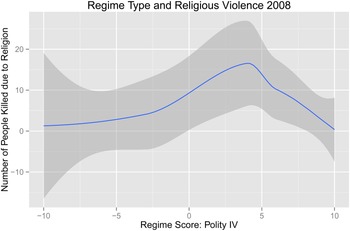
The relationships between regime type, regulation, and religiously motivated killings are described in Table 1 and Figure 1. Table 1 displays the mean level of government regulation and social regulation of religion across authoritarian, anocratic, and democratic regime types. Government regulation of religion declines as regimes become more democratic. Authoritarian regimes tend to heavily regulate religious affairs, while democracies have little such regulation. The same can be said for social regulations against religious groups. While seemingly not as severe as government restrictions, social regulation is also highest in authoritarian regimes, and declines as regimes become more liberal. If religious violence is simply a function of grievances due to restrictions on religious freedom, religious violence should decline across all regime types. Figure 1 shows this is not the case. Figure 1 show a lowess fit line of the number of people killed across all regime types with corresponding 95% confidence intervals in the shaded regions. Figure 1 shows that religious violence is highest in anocratic regimes — regimes spanning the distance from −5 to 5 on the x-axis. This relationship is consistent with a theory of opportunity — the decay of state repressive capacity lowers the opportunity cost of engaging in violence, making outbreaks of religious violence more likely. It is clear from Figure 1 that in anocratic regimes this mobilization is often violent. High levels of repression in autocracies inhibit mobilization. The number of religious killings in authoritarian regimes is near zero. Democracies, with low levels of repression and guarantees or religious freedom, facilitate peaceful mobilization by religious groups. Nearly no one is killed in consolidated democracies according to Figure 1. The anarchic nature of anocratic states provides opportunities for religious violence to erupt.
(Color online) Regime type and religious violence 2008.

Descriptive Means of Religious Regulation across Regime Type for 2008

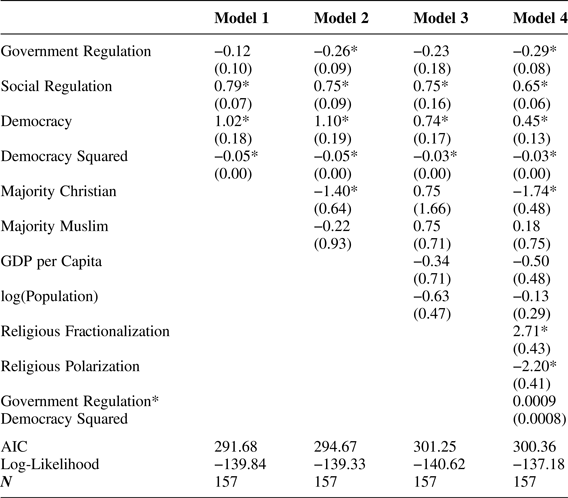
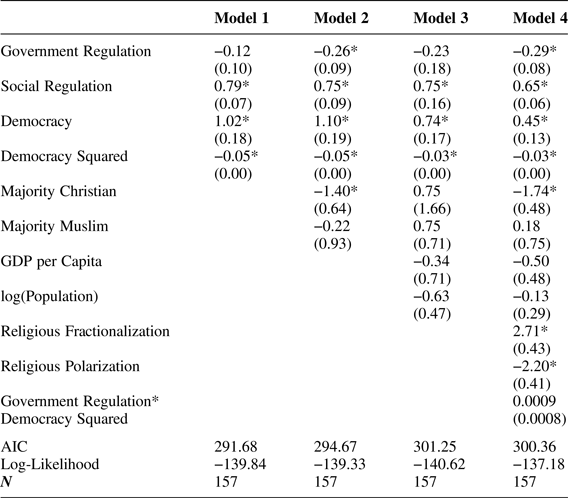
While Table 1 and Figure 1 provide summary evidence indicating that religious violence is highest in anocratic regimes, a more stringent test of this theory relies on regression analysis. To determine if religious conflict is higher in anocratic regimes, I utilized a negative binomial regression model on the count of the number of people killed due to religion in a given country for the year 2008. The result of this regression is reported in Table 2 below.
Negative Binomial Regressions
*p < 0.05.
The Effect of Regime Type on Religious Violence
As can be seen from Table 2, the sign for the Democracy variable measuring regime type is consistently positive while its squared term is consistently negative, indicating that religious violence is highest in anocratic regimes. Both variables remain within the 5% level of statistical significance throughout all of the four regression models. Because these variables demonstrate this relationship regardless of which other control variables are included in the model, there is substantial evidence that, at least for the year 2008, religious violence reached its maximum in anocratic states. Further, given that the variable measuring a country's GDP per capita — usually a strong predictor of the likelihood of conflict (Fearon and Laitin Reference Fearon and Laitin2003) — is not significant, it is possible to conclude that the reason anocratic regimes were more likely to experience religious violence in 2008 was due to their political rather than economic weaknesses.
The unstable and anarchic nature of anocratic states provides a perfect environment for outbreaks of religious violence. As the repressive apparatus of former authoritarian states begin to decay, the opportunity costs of engaging in violence decrease. Simply put, it becomes less likely that violent groups will be punished for their violations of human rights. Whether it is because of historical animosities, or simply opportunistic targeting, religious violence is highest in anocratic states simply because such states lack the corrective mechanisms to halt the spread of violence once it is underway. Aggrieved religious groups may mobilize violently to redress their grievances as they perceive a window of opportunity to do so when the likelihood of punishment remains low. Other religious organization may simply decide to engage in violence because they view other religious minorities as threatening or heretical. Future research can tease these factors out more carefully. But clearly, researchers must pay attention to opportunities offered by weak states as much as they pay attention to issues of grievance and regulation.
The Effects of Religious Grievances on Religious Violence
As reported in previous studies (Grim and Finke Reference Grim and Finke2007; Reference Grim and Finke2011; Grim 2008; Finke and Harris Reference Finke and Harris2012; Finke and Martin Reference Finke and Martin2012) religious grievances are correlated with increased probability of religious violence. According to Table 2, both governmental and social restrictions on religious freedom are correlated with religious conflict. The results are mixed, however. Government regulation of religion is significantly correlated with religious violence in two models, but the sign is in the opposite direction than expected. Restrictions on religious freedom emanating from social groups, such as other religious organization, are positively and significantly correlated with religious violence across all four statistical models. These results partly confirm the findings of previous research conducted that has attempted to explain religious violence primarily as a result of grievances resulting from the denial of religious freedom. More will be explained about the effects of government regulation of religion in Table 3 below.
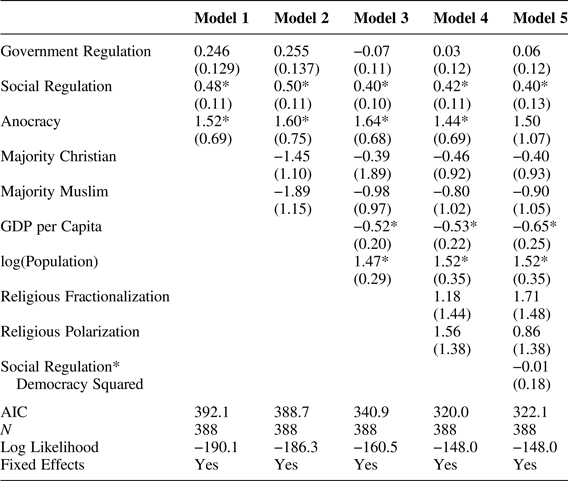
Logistic Regressions
*p < 0.05.
That social regulation of religion is positively correlated with religious violence again demonstrates that the anarchic social conditions present in anocratic states provide excellent conditions for religious violence to occur. As Table 1 shows, official restrictions against religious freedom decline very quickly as regimes transition away from authoritarianism. Social regulations, however, decline at a slower rate. Anocratic states may simply be too institutionally weak to institute or keep onerous restrictions on religious freedom, but social groups within these weak states may not be similarly burdened. Given the weakening coercive structure of the state, violence may simply shift from one source to another. Given that social regulations against religious freedom are often at least tacitly supported by the state (Finke Reference Finke and Young1997), the weakened state may simply outsource its violence to other religious organizations that are willing to engage in violence. That government regulation appears to retard religious violence, at least for the year 2008, suggests that states with larger coercive capacities can keep outbreaks of religious violence in check.
At least for 2008, both grievances and weak state institutions caused religious violence. Does this result hold for out of sample data? To determine in religious violence is consistently highest in anocratic regimes, I utilize logistic regressions for religious violence that occurred during 2001, 2003, and 2005.
Robustness Checks
It is difficult to know if the results obtained in Table 2 are simply the result of analyzing only one year of data, or if these results are indicative of a more general relationship between religious violence and regime type that holds more generally across time. In order to answer this question, I developed a time series cross-sectional dataset containing all the remaining International Religious Freedom data that was collected at two-year intervals for the years 2001, 2003, and 2005. Because the count variable of religious killings utilized for the 2008 regression above was not coded for 2001, 2003, or 2005, I utilize a binary dependent variable that takes a value of 1 if any instance of religiously motivated killing took place in a given country, and 0 otherwise. This variable is a collapsed coding of the lethal variable coded for each year (Grim and Finke Reference Grim and Finke2006; Reference Grim and Finke2007). The lethal variable was originally coded as 0, 1, or 2, where 0 represented no religious killings, 1 represented religious killing, and 2 represented over 10,000 people killed due to religious violence. Because so few instances of widespread violence with 10,000 people killed were present in the data, I collapsed the 1 and 2 levels and recoded the variable as simply 1 if the lethal variable was a 1 or 2, and 0 otherwise.
For the results of the regressions shown in Table 2 to be indicative of a more general relationship between religious violence and regime type, they should make correct out of sample predictions regarding that same relationship across time. If anocratic regimes display higher levels of religious violence than either autocracies or democracies in this data, it is possible to conclude that religious violence follows a similar logic to that of civil violence and civil wars in that it is the product of grievances as well as potential opportunities. The results are displayed in Table 3 below.
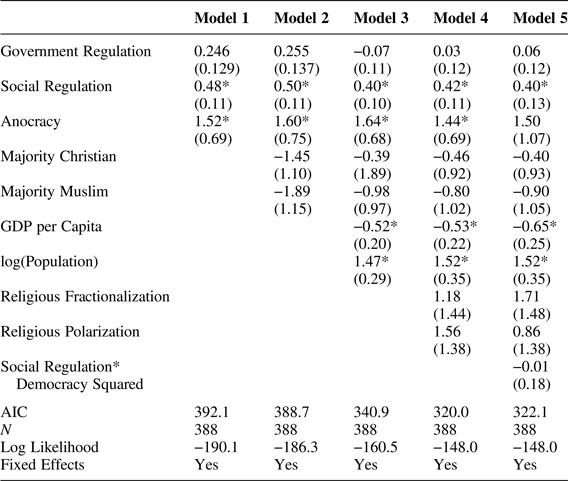
Table 3 presents the results of the regressions using the time series cross-sectional data from the years 2001, 2003, and 2005. To estimate the relationship between religious violence, grievances, and regimes for the additional years I utilized a logistic regression with country and year fixed effects.Footnote 3 Three hundred eighty-eight country-years are analyzed.Footnote 4 Forty-two percent of all country-years reported at least some religious violence, making it a common phenomenon. As with the 2008 data, Hypotheses 1 and 2 receive strong support from the additional years of data. Social restrictions on religious freedom are positively and significantly correlated across all models, just as in Table 2. Government regulation however, is never a significant predictor of religious conflict in the additional years of data. The significance of government regulation in Table 2 drops out of significance once additional years of data are included.Footnote 5 Other variables controlling for weak state capacity — namely GDP per capita and the log of total population — are also statistically significant predictors of conflict across all models in which they are included. Anocratic regimes are also more likely to experience religious violence than either consolidated democracies or authoritarian regimes. Further, this effect is significant across all model specifications but one. Model 5 contains an interaction term between social regulation and anocracy to determine if anocratic regimes have an effect on religious violence independent of grievances. The interaction term is not significant, indicating that the effects of regime type and social regulation are independent of each other. The regime type variable drops out of statistical significance in this model, but additional tests show the interaction term adds no explanatory power. The AIC of Model 3 is lower than that of Model 4 — the complete model — indicating better model fit, showing that the interaction term does not add any explanatory power to the model.Footnote 6
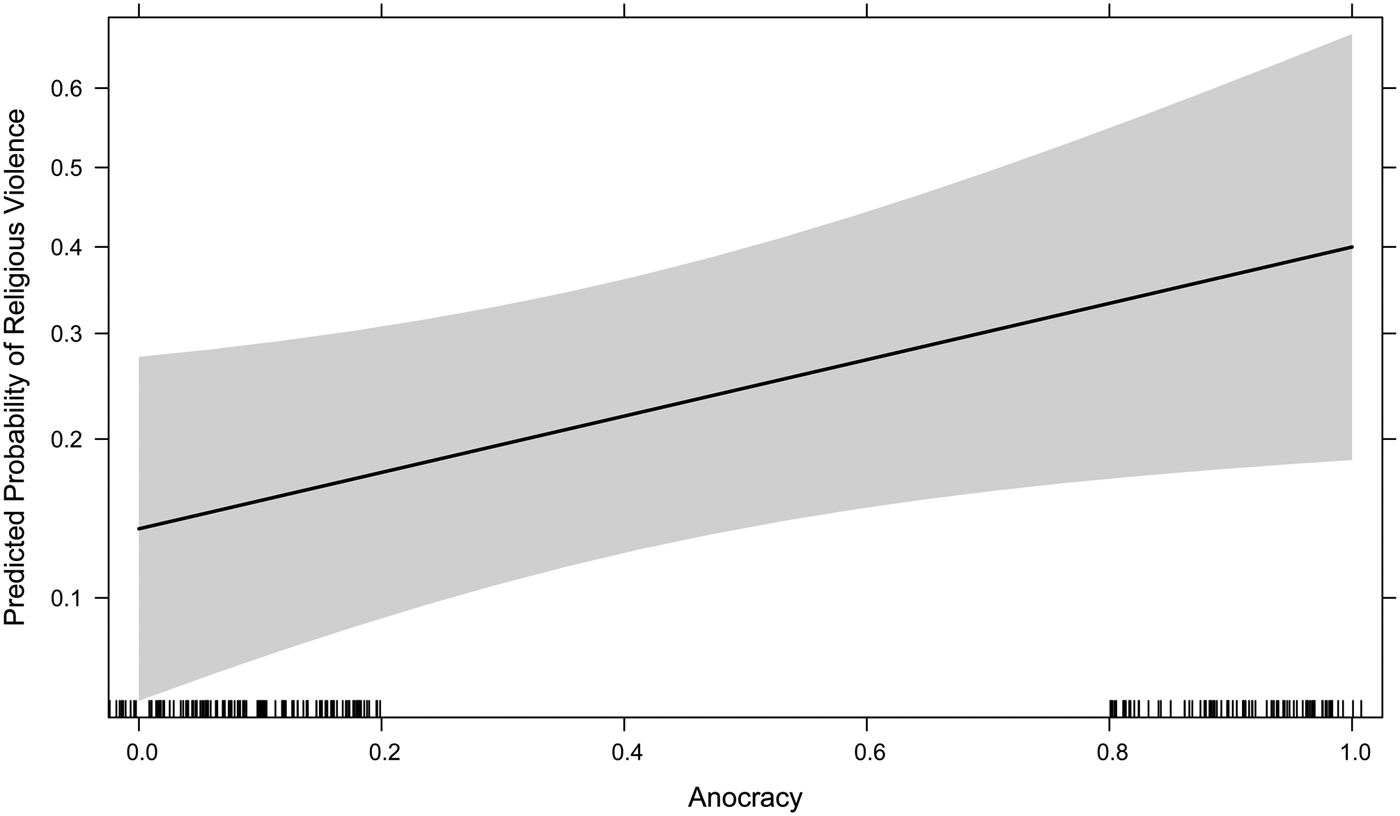
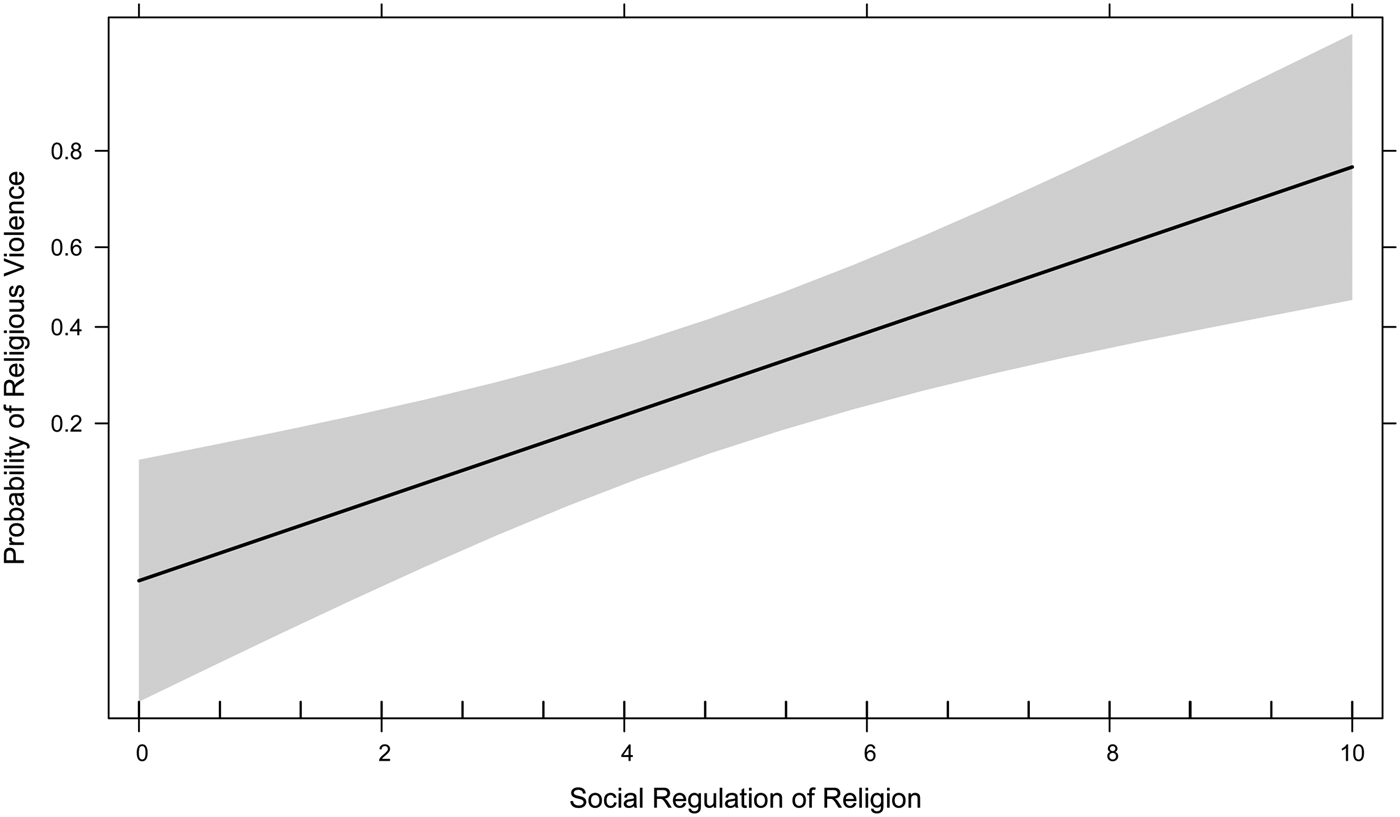
Figures 2 and 3 quantify the effects of regime type and social regulation of religion on religious violence. Figure 2 computes the predicted probability that anocratic states will experience religious violence. Moving from a non-anocratic to an anocratic state increases the predicted probability of any instance of religious violence nearly three times. The probability that a non-anocratic state experiences religious violence in any given country-year is 0.14, while the probability that an anocratic state experiences any reported instance of religious violence is 0.40, an almost three-fold increase in predicted probability. Even controlling for the level of religious regulation, anocratic states are almost three times as likely as either democracies or consolidated authoritarian regimes to experience any outbreaks of religious violence. This result demonstrates the incompleteness of scholarly theories of religious violence. By focusing only on grievances, scholars have overlooked an important contributing factor to religious violence. Anocratic states, because their institutional weakness and inconsistency facilitate a more anarchic society, are more prone to outbreaks of religious violence than any other regime types.
Predicted probability of anocracy on religious violence 2001−2005.

Predicted probability of social regulation on religious violence 2001−2005.

Although the inconsistent mixture of democratic and authoritarian features in anocratic states has an independent effect on outbreaks of religious violence, religious repression, in the form of restrictions on religious freedom, also has large effects on the probability that a state will experience spasms of religious violence. A country that is completely tolerant of all religious faiths will likely never experience outbreaks of religious violence. Countries that completely regulate all aspects of religious life, however, are almost guaranteed to be prone to such violence. Figure 3 shows the predicted effects that increasing levels of social regulation of religion have on the probability of religious violence occurring. A completely tolerant country where no social organizations engage in discrimination against religious groups has almost a 5% chance of experiencing religious violence in any given year, with a predicted probability of 0.048. A country where social organizations engage in the complete and total regulation of all religious organizations is over 16 times more likely to be prone to outbreaks of religious violence, with a predicted probability of 0.77.Footnote 7
Grievances, Opportunities, or Both?
Hypotheses 1 and 2 predicted that religious violence would be more extreme when two conditions were both met. Grievances from religious repression had to be high, and weak state institutions had to offer the possibility for aggrieved groups to organize and engage in sustained, violent collective action. This section demonstrates that a statistical model where both conditions are present is superior in fit to any model where only one of those conditions is present.
To determine if a model emphasizing both opportunities and grievances offers a superior level of explanation than a model that includes only one of these factors, I compared Model 4 in Table 3 to two other models. I compared Model 1 in Table 4 to a “grievance only” model where the only variables in that model were government regulation of religion, social regulation, and a variable that indicates whether governments prohibit individuals belonging to certain religious sects from obtaining jobs. All models have country-year fixed effects. The grievance only model has an AIC of 394.7 and a log likelihood of −191.3. I also compared Model 1 to an “opportunity only” model where the variables in that model were anocracy, the log of total population, log of GDP per capita, religious fractionalization, and religious polarization. That model has an AIC of 337.0 and a log likelihood of −160.5. Model 4 in Table 3, by comparison has an AIC of 320.0 and a log likelihood of −148.0, both lower, and thus a better fit, than either the grievance or opportunity only model. These results demonstrate that a statistical model emphasizing both grievances stemming from regulations of religious freedom and an opportunity arising from inconsistent state institutions explains religious violence better than any of those explanations in isolation.
CONCLUSION
This article has demonstrated the utility of an alternative approach to studying religious violence. Rather than being simply the product of religious grievances deriving from discriminatory policies legislated by governments and implemented by other social organizations including other religions, religious violence appears to be similar to civil violence. While grievances have a role to play in explaining outbreaks of religious violence, sources of opportunity are at least as important in explaining how such conflict develops. Like civil conflict, religious violence is not simply due to inequalities, grievances, or discrimination, but is also explained by moments of opportunity offered by anocratic regimes that can do little to stem outbreaks of any type of violence once it occurs.
Weak state institutions have an effect on the likelihood of religious violence independent of religious grievances. This is an important discovery. Religious violence is driven by four key factors, three of which also correlate with civil violence. Religious violence is a by-product of a society that denies freedom of religion, is institutionally weak and inconsistent, poor, and has a large population. The last three factors are not unique to religious violence. Scholars of civil violence have repeatedly found civil war onset is more likely in large, poor, and institutionally weak countries. Scholars of religious violence need to understand how weak state institutions produce religious violence. To be clear, the violence that erupts in anocratic states is not always religious — but it sometimes is. Future research should begin to focus on why violence sometimes occurs along and across religious cleavages and why it sometimes does not. The factors inherent in weak states that prime the activation of religious identities and mobilizes them for conflict needs to be more clearly understood. The findings presented here are a necessary first step in that direction.
This research provides a new approach to the study of religious violence that, until now, has been explained almost solely as the result of religious grievances and the denial of religious freedom. While this is indeed part of the story, the other part of the story — which until now had been unwritten — provides a clearer picture. Weak state institutions have an effect on religious violence independent of the denial of religious freedom. Grievances are only half the explanation. By narrowly focusing only on grievances, scholars have remained blind to another important source of variation in religious violence. Religious violence is best explained by two factors: grievances and opportunities. While grievances potentially fuel the desire to violently mobilize, politically and economically weak regimes can do little to stop violent mobilization. For these reasons, religious violence, like civil violence, is more likely to occur in anocratic regimes. Scholars of religious violence should pay attention to the effects of political regimes as well as the effects of discriminatory legislation. Only then will a complete picture of religious violence reveal itself.