The first case of the so-called pulmonary arterial vascular sling was reported in 1897, by Glaevecke and Doehle.Reference Glaevecke and Doehle1 The anomaly has a characteristic presentation, and can sometimes produce dramatic obstruction of the airways in neonates and young infants, with up to nine-tenths of afflicted patients dying if manages medically.Reference Gikonyo, Jue and Edwards2 The most common clinical presentation consists of wheezing and stridor, often with marked prolongation of the expiratory phase. It was Willis J. Potts, in 1953, who performed the first successful surgical repair.Reference Potts, Holinger and Rosenblum3 Through a right thoracotomy, he divided the left pulmonary artery, reanastomosing the ends together anterior to the trachea. Despite successful surgical correction of the anomaly, mortality and morbidity remains high postoperatively, and appear to be related to underlying coexistent tracheobronchial abnormalities.Reference Fiore, Brown, Weber and Turrentine4 It was Contro and associatesReference Contro, Miller, White and Potts5 who coined the term vascular sling, thus distinguishing the lesion from a vascular ring. The term ring-sling complex was then introduced by Berdon and associates,Reference Berdon, Baker and Wung6 thus emphasizing the often coexisting tracheal anomalies. Indeed, ongoing experience has shown that complete tracheal rings are present in up to two-thirds of afflicted patients.
Clinically, the association between the pulmonary arterial sling and tracheal stenosis is so strong that the discovery of one of these anomalies is an indication actively to search for the other.Reference Chen, Lee and Lin7 Traditional intervention always focuses on reimplantation of the left pulmonary artery, thus relieving external compression of the lower trachea in expectation of the recovery of the diameter of the stenotic segment. We discovered, however, that the stenotic trachea failed to recover after reimplantation of the left pulmonary artery reimplantation in some of our surviving patients who were monitored with computed tomography imaging after corrective surgery. In this report, therefore, we describe a series of children with pulmonary arterial sling who required reoperation because of tracheal stenosis that was untreated at the initial operation, discussing also those patients who had initial primary intervention to the trachea.
Our purpose is to emphasise that simple decompression of the trachea by reimplanting the left pulmonary artery is usually insufficient. Coexisting initial tracheal pathology is a cause for additional higher risk reoperations.
Patients and methods
Between January, 1992, and November, 2007, we undertook reimplantation of the pulmonary artery, tracheal resection with end-to-end anastomosis, or complex tracheal reconstructions in 13 children, of whom 8 were boys. At the time of the operation, their ages ranged from 1 to 72 months, with weights ranging from 2.4 kilogram to 16.2 kilogram. All had presented with wheezing, stridor, or respiratory distress. Echocardiography, bronchoscopy and multidetecting computer tomography were performed in all cases prior to the operation. Angiography with concomitant tracheobroncography was performed in order to diagnose simultaneously tracheal and cardiovascular pathology. This combination defined well the respective relationships of the vascular and airway segments involved.
Of the patients, 5 had previously undergone surgery elsewhere for repair of the pulmonary arterial sling, in all of them the initial operation consisting only of reimplantation of the left pulmonary artery, with no attempt made to treat associated tracheal pathology. Subsequently, all 5 patients developed severe symptoms of respiratory distress due to persistent tracheal stenosis. Of these five patients, 4 were referred to our hospital with severe respiratory distress, and required preoperative intubation. All 5 underwent resection of the stenotic part of the trachea, with reconstruction with end-to-end anastomosis under cardiopulmonary bypass. In 2 of the patients the initially reimplanted left pulmonary artery was also stenotic, and required re-reimplantation.
All operative procedures were performed through a median sternotomy or resternotomy with the use of cardiopulmonary bypass. The bypass was achieved using an aortic cannula and a single atrial cannula, the patients being cooled to 32°C. All patients remained in sinus rhythm throughout the procedure. Choice of operative technique was based on the length of the tracheal stenosis and the age of the child. If there was an associated intracardiac lesion, bicaval venous cannulation was used, the intracardiac lesion being repaired during a period of aortic cross-clamping prior to the tracheal repair. The cardiac and pulmonary arterial repairs were completed prior to opening the contaminated tracheal lumen.
Tracheal resection with end-to-end anastomosis was performed in all infants and children with tracheal stenosis. When a segmental resection is performed, we initially transect the trachea at the distal point of the stenosis. The portion of the trachea to be resected is then mobilized, along with the entire intrathoracic part of the trachea and both main bronchuses. The pulmonary ligaments are transsected, along with the incisions of the pericardium around the hilums, so as to obtain additional mobilisation. The stenotic segment is then identified bronchoscopically, and the segment with complete tracheal rings resected. The trachea itself is then transsected cranially and caudally at border zones, but in morphologically healthy tissue, under bronchoscopic control. Once the margins for resection are deemed adequate, an end-to-end anastomosis is created between the cranial and caudal margins of the trachea and the carina respectively using interrupted 6-0 polydioxanone sutures. Surveillance bronchoscopy was performed prior to extubation and prior to discharge from hospital.
In 2 of the patients requiring reoperations, we performed modified tracheal bronchial reconstruction. The malacic parts of the carina, together with the proximal parts of the bronchuses, were resected. The carina was reconstructed by bringing the medial walls of both mainstem bronchuses together with interrupted sutures. An end-to-end tracheal anastomosis was then carried out between the neo-carina and proximal trachea. Tracheal resection and anastomosis were performed as guided by intraoperative video-documented bronchoscopy.
In one patient requiring reoperation, the left pulmonary artery was found to originate from the pulmonary trunk relatively far distally and in a rather posterior location. The sling thus formed exerted significant compression at the distal part of the trachea and oesophagus, near the tracheal bifurcation anteriorly and to the right. The left and right pulmonary arteries were extensively mobilized out to the hilums. Both pleural cavities were opened and dissected free of adhesions. The intrathoracic part of the trachea, including the carina and the proximal segments of the main bronchuses, were dissected free from dense surrounding tissue. In another case the right upper lobe bronchus was found to arise as the so-called bronchus suis, or pig bronchus, at a point 2 centimeters proximal to the carina. In this patient, proximal and adjacent to the site of origin of the pig bronchus, we found a diverticulum of peanut size, which was also diagnosed by bronchoscopy.
In another of the patients meeding reoperation, we observed a rare combination of a very long segmented tracheal stenosis of funnel type, a pulmonary arterial sling, and a pig bronchus.Reference Hagl, Sebening, Springer and Loukanov8 In this case, it proved possible to attach the pig bronchus to the entire segment of the dysplastic distal trachea, including the carina and the proximal part of the right bronchus. The distal dysplastic and hypoplastic part of the trachea, 4 centimeters in length, was then incised anterolaterally on the right side in a longitudinal fashion, including the carina and the proximal right bronchus. The lumen of the distal stenotic part of the trachea was inspected, and found to be reduced to a diameter of 2 millimeters. The inspection of the lumen revealed extensive fibrotic changes and complete cartilaginous rings. The pig bronchus was opened with a corresponding longitudinal incision of 4.5 centimeters, starting proximally. The incision of the distal trachea was extended to the carina and right main bronchus. Both structures were anastomosed side to side, using interrupted polydioxanone 5-0 sutures. The anastomosis was free of tension. Using this technique, the internal diameter of the distal trachea was widened to 7 millimeters. Through a slight anterolateral rotation, and with the help of the intact cartilage rings of the pig bronchus, the dysplastic funnel segment was not only enlarged, but also stabilised (Fig. 1).
The technique of repair of a pulmonary arterial sling associated with long-segment tracheal stenosis and a bridging bronchus.Reference Hagl, Sebening, Springer and Loukanov8

Results
There was no operative or late mortality. Efficient decompression and re-expansion of the affected airway segment was confirmed by endoscopy in all patients, providing stable aeration. All of the patients had echocardiography to confirm the adequacy of the repair of concomitant congenital cardiac malformations. The patency of the reimplanted left pulmonary artery was also confirmed by echocardiographic examinations.
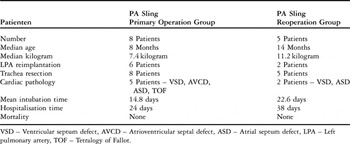
The patients were extubated under bronchoscopic control, with mean periods of intubation subsequent to repair of the airways lasting for 18 plus or minus 8 days. Extubation was performed under bronchoscopic monitoring after a stepwise programme of weaning. None of the patients required tracheostomy. The group of patient requiring reoperations needed longer periods of both intubation and hospitalization (Table 1).
Patients Characteristics for both Groups.

VSD – Ventricular septum defect, AVCD – Atrioventricular septal defect, ASD – Atrial septum defect, LPA – Left pulmonary artery, TOF – Tetralogy of Fallot.
The period of stay in hospital ranged from 3 to 90 days, with a mean of 46 days. The endoscopic examination prior to discharge showed adequate dimensions and patency of the airways in every case. The average follow-up was 8.4 years, with a range from 1 to 14 years, with none of the patients showing signs of tracheal re-stenosis clinically or on bronchoscopy. A stable and complication-free clinical outcome has been achieved for the entire group.
Discussion
The optimal surgical method for repair of the pulmonary arterial sling associated with tracheal stenosis is sternotomy with cardiopulmonary bypass. Traditionally, the surgical intervention focuses on the reimplantation of the anomalous left pulmonary artery, thus relieving external compression on the lower trachea with the expectation of recovery of the stenotic tracheal segment.Reference Pawade, de Leval, Ellitott and Stark9 An alternative technique is translocation of the undivided left pulmonary artery anterior to the trachea at the time of resection of the congenital tracheal stenosis.Reference Jonas, Spevak, Mc Grill and Castaneda16 This technique has the advantage that no sutures are placed in the left pulmonary artery, but has the disadvantage that it cannot be employed in those patients in whom the tracheal stenosis is repaired by pericardial patch tracheoplasty, or in patients without clinically significant tracheal stenosis. There have been at least 2 criticisms raised against the technique of translocation technique. In one experience, when the approach had been used in 5 patients, the procedure resulted in kinking of the proximal left pulmonary artery in 2, necessitating reimplantation into the pulmonary trunk.Reference Castaneda, Jonas, Mayer and Hanley10 On the basis of another experience, Backer and co-workersReference Backer, Idriss, Holinger and Mavroudis11 suggested that placement of the left pulmonary artery in front of the trachea could potentially result in anterior compression of the trachea or main stem of the left bronchus.Reference Backer, Idriss, Holinger and Mavroudis11
Surgical repair approaching only the pulmonary arterial pathology, however, without treating the tracheal component is not justified.Reference Chen, Lee and Lin7 Reimplantation of the anomalously located left pulmonary artery can certainly be achieved without intraoperative mortality, with initial good anatomical and functional results, but morbidity is substantial, and recurrent difficulties with the airway remain a constant threat. Besides the prolonged stay in hospital stay, the need for outpatient and home care places the families of these patients under considerable stress. The long-term quality of life of these patients is as yet unknown.
All of our patients underwent surgery using cardiopulmonary bypass. Surgical repair achieved in this fashion is associated with low mortality, and produces good anatomical and functional results. The technique provides adequate oxygenation, a stable circulation, permits atraumatic handling of the airways, and reduces anastomotic tension during repair. It also facilitates the extensive mobilisation of the entire tracheobronchial tree. In our experience it is the use of cardiopulmonary bypass that makes it possible to mobilize, resect, and reconstructed longer tracheal segments, achieving successful end-to-end anastomoses.Reference Loukanov, Gorenflo, Sebening, Springer, Eichhorn, Ulmer and Hagl12 A slide plasty in cases with long-segment tracheal stenosis has been used by many surgeons.Reference Tsang, Murday, Gillbe and Goldstraw13 In our opinion, this should be reserved for cases in which end-to-end anastomosis is not feasible, albeit that our experience is insufficient to make definitive conclusions about the role of end-to-end anastomosis versus slide tracheoplasty.
Because of the considerable incidence of associated congenital cardiac disease in patients with vascular rings, with this association found in one-eighth according to Backer et al.Reference Backer, Mavroudis, Rigsby and Holinger14, we perform preoperative echocardiography in all patients with this pathology to identify any and all associated congenital cardiac malformations. The procedure of choice to establish the diagnosis of pulmonary arterial sling is also echocardiography. This non-invasive method can define most of coexisting intracardiac abnormality, and is safe to use even in critically ill neonates with compromised airways. We also perform angiography, with concomitant tracheobroncography, when the tracheal or cardiac diagnosis is in doubt. Many authors have abandoned this technique, but in our opinion it contributes to the preoperative planning of the surgical treatment.
The key to accurate diagnosis of tracheal stenosis is bronchoscopy. This was the primary tool used for diagnosis in all of our patients, either preoperatively or intraoperatively. We consider blind intubation to be more dangerous than a controlled bronchoscopic evaluation. The latter evaluation allows not only direct assessment of extent and degree of the obstruction, but also evaluation of the dynamics of the obstruction. Endoscopy, especially in neonates and infants is often considered to carry a high risk, but it provides prognostically relevant information, especially in cases with associated secondary malacia.Reference Sebening, Jakob and Lange15 The localization, length, and structural properties of the walls of the airways, as well as their functional behaviour, are important for choosing the optimal operative strategies. In the presence of malacia, simple decompression often fails to solve the problem of obstruction.
One of the common misperceptions about the pulmonary arterial sling syndrome is that tracheal stenosis occurs secondary to compression by the anomalously positioned left pulmonary artery.Reference Jonas, Spevak, Mc Grill and Castaneda16 This is almost certainly not the case, since others, as well as ourselves, have noted many variations of congenital tracheal stenosis associated with the sling. These can range from a profound degree of hypoplasia of the entire tracheobronchial tree, to a discrete stenosis quite separate from the sling.
Our experience demonstrates that there is some form of tracheal stenosis in most patients with a pulmonary arterial sling. We strongly recommend inspection of associated tracheal pathology by means of intraoperative tracheobronchoscopy before and after reimplantation of the left pulmonary artery. This approach is especially advisable for patients with complete tracheal rings, or funnel trachea. The funnel trachea evolves through progressive stenosis, and in the long term will require surgical repair. Our current experience suggests that the presence of complete tracheal rings is an indication for surgical exploration. On the basis of this experience, we now consider that the stenotic trachea requires reconstruction not only in symptomatic patients, but in all those with a funnel trachea.