INTRODUCTION
Traumatic brain injury (TBI) is one of the most common causes of acquired morbidity and mortality in children (Taylor et al., Reference Taylor, Bell, Breiding and Xu2017). Because these injuries occur at an early age, often before certain skills have emerged, they can result in residual deficits as the individual continues to develop (Anderson et al., Reference Anderson, Brown, Newitt and Hoile2009; Babikian et al., Reference Babikian, Merkley, Savage, Giza and Levin2015), including psychiatric and neurobehavioral problems (Bryant et al., Reference Bryant, O’donnell, Creamer, McFarlane, Clark and Silove2010; Dennis et al., Reference Dennis, Wilkinson, Koski, Humphreys, Broman and Michel1995; Fenwick & Anderson, Reference Fenwick and Anderson1999; Massagli et al., Reference Massagli, Fann, Burington, Jaffe, Katon and Thompson2004). Attention problems are prevalent following injury and can negatively impact school functioning, social relationships, emotional well-being, self-esteem, and quality of life (Anderson et al., Reference Anderson, Brown, Newitt and Hoile2009; Catroppa et al., Reference Catroppa, Anderson, Morse, Haritou and Rosenfeld2007; Kaufmann et al., Reference Kaufmann, Fletcher, Levin, Miner and Ewing-Cobbs1993). Many children with no premorbid diagnosis of ADHD meet diagnostic criteria for ADHD post-TBI. This condition, referred to as secondary ADHD (SADHD), is one of the most common secondary diagnoses in children after TBI (Bloom et al., Reference Bloom, Levin, Ewing-Cobbs, Saunders, Song, Fletcher and Kowatch2001) with approximately 16% of individuals meeting diagnostic criteria 6 months post-injury (Yeates et al., Reference Yeates, Armstrong, Janusz, Taylor, Wade, Stancin and Drotar2005), significantly higher than the estimated prevalence of primary ADHD in the United States of 7.8% (Bonfield, Lam, Lin, & Greene, Reference Bonfield, Lam, Lin and Greene2013).
The use of stimulant medications in children with primary ADHD has been extensively studied, but there is a paucity of studies evaluating the use of stimulants in children with attention problems after brain injury (Pangilinan, Giacoletti-Argento, Shellhaas, Hurvitz, & Hornyak, Reference Pangilinan, Giacoletti-Argento, Shellhaas, Hurvitz and Hornyak2010). Previous studies and clinical trials evaluating the use of stimulants for attention problems in children who sustained TBI have yielded inconsistent results regarding efficacy (Backeljauw & Kurowski, Reference Backeljauw and Kurowski2014; Dougall, Poole, & Agrawal, Reference Dougall, Poole and Agrawal2015; Warden et al., Reference Warden, Gordon, McAllister, Silver, Barth, Bruns, Drake, Gentry, Jagoda, Katz, Kraus, Labbate, Ryan, Sparling, Walters, Whyte, Zapata and Zitnay2006). Research in a variety of neurological conditions (e.g., spina bifida, epilepsy, and among survivors of pediatric brain tumor) has revealed similar attention deficits, as well as mixed findings regarding efficacy of stimulant treatments (D’Agati, Cerminara, Casarelli, Pitzianti, & Curatolo, Reference D’Agati, Cerminara, Casarelli, Pitzianti and Curatolo2012; De la Torre, Martin, Cervantes, Guil, & Mestre, Reference De la Torre, Martin, Cervantes, Guil and Mestre2017; Mulhern, Merchant, Gajjar, Reddick, & Kun, Reference Mulhern, Merchant, Gajjar, Reddick and Kun2004; Parisi, Moavero, Verrotti, & Curatolo, Reference Parisi, Moavero, Verrotti and Curatolo2010; Wasserman, Stoner, Stern, & Holmbeck, Reference Wasserman, Stoner, Stern and Holmbeck2016). Research investigating the use of stimulant medication in primary ADHD has found extensive evidence that long-term treatment with methylphenidate significantly improves attention-related behaviors (Abikoff et al., Reference Abikoff, Hechtman, Klein, Weiss, Fleiss, Etcovitch, Cousins, Greenfield, Martin and Pollack2004) (Shaw et al., Reference Shaw, Hodgkins, Caci, Young, Kahle, Woods and Arnold2012). Side effects, including neurological (e.g., headache and dizziness), psychiatric (e.g., depressed or elevated mood), tic disorders, psychotic symptoms (e.g., hallucination), cardiovascular (e.g., blood pressure and pulse changes, racing heart), gastrointestinal (e.g., loss of appetite, weight loss during prolonged treatment), and dermatological (e.g., hives) events, are typically not disruptive to the child’s overall functioning (Graham et al., Reference Graham, Banaschewski, Buitelaar, Coghill, Danckaerts, Dittmann, Döpfner, Hamilton, Hollis, Holtmann, Hulpke-Wette, Lecendreux, Rosenthal, Rothenberger, Santosh, Sergeant, Simonoff, Sonuga-Barke, Wong, Zuddas, Steinhausen and Taylor2011) and are potentially controlled by so-called “drug holidays” of interrupted use (Graham et al., Reference Graham, Banaschewski, Buitelaar, Coghill, Danckaerts, Dittmann, Döpfner, Hamilton, Hollis, Holtmann, Hulpke-Wette, Lecendreux, Rosenthal, Rothenberger, Santosh, Sergeant, Simonoff, Sonuga-Barke, Wong, Zuddas, Steinhausen and Taylor2011).
Executive dysfunction is one of the most common neurocognitive sequelae after pediatric TBI (Horton, Soper, & Reynolds, Reference Horton, Soper and Reynolds2010). Executive function (EF) has been broadly defined as a superordinate, managerial capacity for directing more modular abilities (e.g., language, memory, psychomotor skills, and perception) with the objective of setting, managing, or attaining goals (Levin & Hanten, Reference Levin and Hanten2005). Deficits in EF differ between children who experience SADHD, those who have pre-injury ADHD, and those who sustain a TBI without SADHD. Particularly, children with SADHD demonstrate greater impairments in attention and working memory compared to those with pre-injury ADHD and TBI-only; these children also showed impaired psychomotor speed at both 6- and 12-month follow-ups, while attention deficits emerged at 12 months, suggesting that deficits in attention are not simply due to slowed cognition (Ornstein et al., Reference Ornstein, Sagar, Schachar, Ewing-Cobbs, Chapman, Dennis, Saunders, Yang, Levin and Max2014). SADHD is associated with slower response times and poorer planning abilities than those with primary ADHD. These findings indicate different underlying mechanisms between pre-injury ADHD and SADHD and suggest that different treatments may be necessary for SADHD (Ornstein et al., Reference Ornstein, Sagar, Schachar, Ewing-Cobbs, Chapman, Dennis, Saunders, Yang, Levin and Max2014). While it may be possible to differentiate between primary and secondary ADHD with neuropsychological testing, studies have found that children with both pre- and post-injury ADHD have increased difficulties with attention, EF (e.g., reaction time, response inhibition) and memory following TBI (De la Torre et al., Reference De la Torre, Martin, Cervantes, Guil and Mestre2017; Sinopoli & Dennis, Reference Sinopoli and Dennis2012; Sinopoli, Schachar, & Dennis, Reference Sinopoli, Schachar and Dennis2011; Slomine et al., Reference Slomine, Salorio, Grados, Vasa, Christensen and Gerring2005). Executive dysfunction may persist up to 10 years post-injury (Muscara, Catroppa, & Anderson, Reference Muscara, Catroppa and Anderson2008) and has been implicated as a factor in negative academic and social outcomes in children after TBI (Biederman et al., Reference Biederman, Monuteaux, Doyle, Seidman, Wilens, Ferrero, Morgan and Faraone2004; Yeates et al., Reference Yeates, Swift, Taylor, Wade, Drotar, Stancin and Minich2004).
The primary goal of this study was to investigate the effects of methylphenidate on long-term executive and neuropsychological functioning in children with attention problems following TBI. Children with ADHD following TBI (either SADHD or primary ADHD plus TBI) have greater problems in these areas compared to those with primary ADHD alone or TBI without SADHD (Ornstein et al., Reference Ornstein, Sagar, Schachar, Ewing-Cobbs, Chapman, Dennis, Saunders, Yang, Levin and Max2014); therefore, it is critical to understand how treatment with stimulants influences EF, which has not previously been examined in this population. Additionally, we wanted to understand the relationship between methylphenidate associated changes in lab-based neuropsychological measures of attentional control, processing speed, and EF and parent- or self-report measures of everyday EF behaviors (i.e., in a real-world setting rather than laboratory-based measures obtained in a controlled environment) (Gioia, Isquith, Guy, & Kenworthy, Reference Gioia, Isquith, Guy and Kenworthy2000) in this population. We hypothesized that methylphenidate will improve everyday EF and that improvements on these dimensions will be associated with lab-based measures of attentional control, processing speed, and EF. Specifically, we hypothesized that improvements in these measures will mediate improvements in everyday EF behaviors.
METHOD
Design
The design was a randomized, double-masked, placebo-controlled cross-over clinical trial. An in-depth description of the intervention and efficacy of methylphenidate for the management of attention problems, based upon parent- and self-report of attention rating scales, after pediatric TBI is reported in a separate paper (Kurowski et al., Reference Kurowski, Epstein, Pruitt, Horn, Altaye and Wade2018). Following a screening interview and completion of informed consent and assent, participants completed a baseline visit and were randomized to the experimental (methylphenidate) or the control (placebo) condition for 4 weeks (period 1). At the end of 4 weeks, participants immediately crossed over to the other condition for another 4 weeks (period 2). Participants were assessed at baseline and weeks 4 and 8 to examine differences in outcomes between the medication and placebo conditions. The total duration of the trial originally planned for 8 weeks, but took up to 12 weeks for some participants due to scheduling issues, with a total of three full assessment visits (i.e., baseline and optimal visits) and six titration visits (Kurowski et al., Reference Kurowski, Epstein, Pruitt, Horn, Altaye and Wade2018). Participants weighing less than 25 kg received 18 mg (low), 27 mg (medium), and 36 mg (high) dosages; participants weighing above 25 kg received 18 mg (low), 36 mg (medium), and 54 mg (high) dosages during the trial. During the placebo condition, participants underwent the same procedures as during the medication condition due to the masked nature of the study. The mean optimal dose of methylphenidate was 40.5 mg (1.00 mg/kg/day) (Kurowski et al., Reference Kurowski, Epstein, Pruitt, Horn, Altaye and Wade2018). Testers were masked to the medication status of the child. Participants were instructed to take their medication at a consistent time in the morning; average time of medication administration was 8:22 a.m. Study visits typically occurred in afternoons and evenings; however, there may have been variation depending on the schedules of participants and their families. Further details of the trial procedures and design can be found in a previously published paper (Kurowski et al., Reference Kurowski, Epstein, Pruitt, Horn, Altaye and Wade2018).
Participants and Recruitment
Children aged 6–17 years, who were hospitalized for a moderate-to-severe blunt head trauma 6 or more months previously, were recruited from a large children’s hospital medical center. Six years of age was chosen as the lower age limit based on clinical practice guidelines, which recommend the use of stimulants as first-line treatment for ADHD at 6 years and older (Subcommittee on Attention-Deficit/Hyperactivity Disorder; Steering Committee on Quality Improvement and Management, Reference Wolraich, Brown, Brown, DuPaul, Earls, Feldman, Ganiats, Kaplanek, Meyer, Perrin, Pierce, Reiff, Stein and Visser2011). To study the efficacy of methylphenidate following pediatric TBI specifically, the upper age range of 17 years was chosen. Consistent with previous investigations, TBI severity was categorized by the Glasgow Coma Scale (GCS) (Teasdale & Jennett, Reference Teasdale and Jennett1974) score and neuroimaging (Kurowski et al., Reference Kurowski, Epstein, Pruitt, Horn, Altaye and Wade2018). The Vanderbilt ADHD parent rating scales (Wolraich, Feurer, Hannah, & Baumgaertel, Reference Wolraich, Feurer, Hannah and Baumgaertel2003) were used to determine eligibility based on a parent report of at least six current symptoms on the inattentive and/or hyperactive subscales. Participants actively receiving medications for attention problems and or other attention related treatments (e.g., attention training) were eligible if treatments were discontinued prior to study enrollment (Kurowski et al., Reference Kurowski, Epstein, Pruitt, Horn, Altaye and Wade2018).
Three hundred and twenty-one participants were assessed for the basic criteria of age, diagnoses of a TBI, and time since injury. Of these, 118 declined to participate. Twenty did not want to start or change medications, 26 were not having attention difficulties per their parent and were not screened, 3 did not want to burden their child, 19 declined due to the time commitment, 7 declined due to the distance to the hospital, 4 were not interested in this study, 23 declined all research, and 16 did not give a reason for refusal. One hundred and sixty-three potential participants were excluded from the study. Eighty-eight of these turned 18 prior to contact, 6 turned 18 after initial contact was made, 54 were ineligible due to Vanderbilt scores, 3 were ineligible due to neurological impairments, 2 were excluded due to pre-injury intellectual disability, and two were excluded due not meeting injury severity criteria.
Demographics and baseline assessments
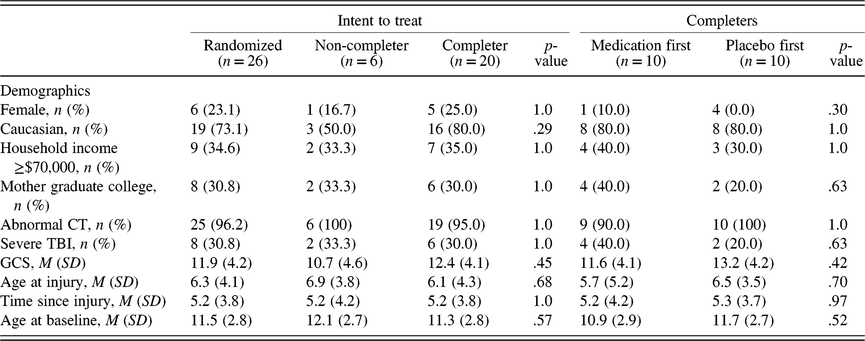
Twenty-six individuals completed baseline assessments and were randomized. Of those randomized, the mean age at injury and baseline visit were 6.3 (SD: 4.1) and 11.5 (SD: 2.8) years, respectively. Mean GCS was 11.9 (SD: 4.2), and 25 (92.6%) of participants had evidence positive neuroimaging findings consistent with brain trauma. Six participants were female and 19 were white. See Table 1 for additional demographics. A consort flow diagram is provided in more detail elsewhere (Kurowski et al., Reference Kurowski, Epstein, Pruitt, Horn, Altaye and Wade2018). Mechanisms of injury for the 20 participants who completed the study were falls (n = 6), bicycle accidents (n = 3), motor vehicle accidents (n = 3), sledding accidents (n = 3), other accidents (e.g., assault, running into another child, accidental hit by a baseball bat, n = 3), and being struck by a car (n = 2). Mechanisms of injury for the six participants who did not complete the study were falls (n = 2), motor vehicle accidents (n = 2), being struck by a car (n = 1), and abusive head trauma (n = 1).
Demographics

To determine ADHD diagnostic status at the time of enrollment, the ADHD portion of the K-SADS-P/L (Kaufman et al., Reference Kaufman, Birmaher, Brent, Rao, Flynn, Moreci, Williamson and Ryan1997) was administered at baseline. At the time of enrollment, 6 participants had combined presentation ADHD, 18 had predominantly inattentive, and 2 had predominantly hyperactive-type ADHD; ADHD subtype did not differ between those with primary versus secondary ADHD. There were no demographic or baseline assessment differences between groups that received medication versus placebo first.
Measures
The executive and neuropsychological outcomes were obtained at baseline and at each optimal dose visit (week 4 and week 8) for a total of three assessments (Kurowski et al., Reference Kurowski, Epstein, Pruitt, Horn, Altaye and Wade2018).
The Behavior Rating Interview of Executive Function (BRIEF) is standardized and validated for use in children ages 5–18 years, including those with pediatric TBI (Gioia & Isquith, Reference Gioia and Isquith2004; Gioia et al., Reference Gioia, Isquith, Guy and Kenworthy2000). Both parent- and self-report (age 11 and older) were used to obtain ratings of everyday EF behaviors. The global executive composite (GEC), behavior regulatory index (BRI), and metacognitive index (MI) T-scores were used in the analyses, with higher scores reflecting poorer EF.
The Continuous Performance Test II (CPT II) was used to assess various aspects of attentional control, including sustained and selective attention/response accuracy, processing speed, reaction time, and inhibitory control (Conners, Reference Conners2004; Conners, Reference Conners1995, Reference Conners2000). The CPT II is recommended as a supplemental pediatric TBI Common Data Elements outcome measure (McCauley et al., Reference McCauley, Wilde, Anderson, Bedell, Beers, Campbell, Chapman, Ewing-Cobbs, Gerring, Gioia, Levin, Michaud, Prasad, Swaine, Turkstra, Wade and Yeates2012) has been used previously to assess attentional control after severe TBI in children age 6–18 years (Galbiati et al., Reference Galbiati, Recla, Pastore, Liscio, Bardoni, Castelli and Strazzer2009) and is relatively unaffected by practice effects (Conners, Reference Conners2004; Conners, Reference Conners1995, Reference Conners2000). The following scores were included in the current analyses: accuracy, coefficient of variation, mean response time, and standard deviation (SD) of response time. Higher accuracy scores reflect better performance; whereas higher scores on the other three measures reflect slower and more variable responses, suggesting difficulties in attention regulation.
The D-KEFS Verbal Fluency (D-KEFS VF) (Delis, Kaplan, & Kaplan, Reference Delis, Kaplan and Kaplan2001) measures both lexical ability (e.g., letter fluency, category fluency) and executive functioning (e.g., category switching accuracy and total number if correct switching). The D-KEFS is sensitive to TBI severity (Strong, Tiesma, & Donders, Reference Strong, Tiesma and Donders2011) and focal left frontal lesions (Levin, Song, Ewing-Cobbs, Chapman, & Mendelsohn, Reference Levin, Song, Ewing-Cobbs, Chapman and Mendelsohn2001). Participants were asked to verbalize words beginning with a designated letter according to specific rules (letter fluency), verbalize exemplars of specific categories (category fluency), and verbalize exemplars of semantic category switches (category switching accuracy and total correct), thus increasing the demand on EF. The D-KEFS Trail Making subtest assesses the ability to shift sets, specifically the Number–Letter Sequencing subtest assesses how quickly individuals switch between connecting numbers and letters (number–letter sequencing). Higher scores on the D-KEFS subtests reflect better function.
The Wechsler Intelligence Scale for Children, 4th Edition Processing Speed Index (WISC-IV-PSI) has been designed for children 6–16:11 years of age and provides a measure of processing speed and sustained attention (Wechsler, Reference Wechsler2003). It is comprised of two subtests: Coding and Symbol Search. The information processing indexes are highly sensitive to TBI and its severity (Allen, Thaler, Donohue, & Mayfield, Reference Allen, Thaler, Donohue and Mayfield2010; Donders & Janke, Reference Donders and Janke2008; McCauley et al., Reference McCauley, Wilde, Anderson, Bedell, Beers, Campbell, Chapman, Ewing-Cobbs, Gerring, Gioia, Levin, Michaud, Prasad, Swaine, Turkstra, Wade and Yeates2012), with higher scores reflecting better processing speed. One child who was 17 was administered the Wechsler Adult Intelligence Scale, 4th Edition Processing Speed Index (WAIS-IV- PSI; (Wechsler, Coalson, & Raiford, Reference Wechsler, Coalson and Raiford2008). Because both measures yield highly correlated standard scores (Wechsler, Reference Wechsler2003), their score was included with the others in a combined WISC/WAIS processing speed variable.
Analysis
Descriptive statistics were used to characterize the sample. Comparisons between groups were assessed with t tests and Fisher’s Exact tests when appropriate. Repeated measures linear mixed models (Cnaan, Laird, & Slasor, Reference Cnaan, Laird and Slasor1997) were used to determine the association of methylphenidate with dependent variables. The dependent variables included the BRIEF (MI, BRI, and GEC), WISC/WAIS PSI (Coding and Symbol Search subtests), the CPT (accuracy, coefficient of variation, mean response time, and SD of response time), and the DKEFS (Trail Making Number–Letter Switching subtest and Verbal Fluency subtests). Other independent variables were the period of the evaluation (week 4 or week 8) and the interaction between period and treatment (this interaction term captures the potential carry over effect). Separate univariate regression analyses were performed to assess potential covariates, including age, sex, time since injury, injury severity (GCS score), race, and socioeconomic status (as measured by maternal education, college graduate or not). Injury factors and socioeconomic status were also considered as covariates because they predict the development of SADHD within the first 24 months after pediatric TBI (Max et al., Reference Max, Lansing, Koele, Castillo, Bokura, Schachar, Collings and Williams2004; Max et al., Reference Max, Schachar, Levin, Ewing-Cobbs, Chapman, Dennis, Saunders and Landis2005; Subcommittee on Attention-Deficit/Hyperactivity Disorder; Steering Committee on Quality Improvement and Management, Reference Wolraich, Brown, Brown, DuPaul, Earls, Feldman, Ganiats, Kaplanek, Meyer, Perrin, Pierce, Reiff, Stein and Visser2011) prior to constructing multivariate models, each potential covariate was examined individually with treatment group and period, as well as the baseline value of the measure of interest in order to determine its relationship with the dependent variable (in the presence of group and period effects). Covariates that had a p-value below .05 in this analysis were to be included in the final model; however, no potential covariates significantly contributed to the models. Given the potential profile differences in children with primary versus secondary ADHD (Slomine et al., Reference Slomine, Salorio, Grados, Vasa, Christensen and Gerring2005), diagnosis type was also explored as a covariate in the models, but it was not found to have a significant effect. Therefore, we did not differentiate between diagnosis type in the current analyses. All analyses were based on intention to treat principles (Gupta, Reference Gupta2011). Effect sizes were derived based on least squares (adjusted) mean differences divided by an adjusted estimate of the SD: the standard error of the difference multiplied by the square root of the adjusted degrees of freedom (Lakens, Reference Lakens2013). The mediation effects of processing speed (WISC/WAIS PSI measures) were examined by fitting a regression model (MacKinnon, Lockwood, Hoffman, West, & Sheets, Reference MacKinnon, Lockwood, Hoffman, West and Sheets2002; Mackinnon, Warsi, & Dwyer, Reference Mackinnon, Warsi and Dwyer1995) of processing speed and treatment effect on responsiveness of parent-reported everyday EF behaviors. The coefficients of the treatment effect in the model were compared and we estimated the effect and the related standard error of the mediation effect. The direct and indirect effects were derived using software that was written specifically for two-treatment two-period crossover designs, as we have in this study (MEMORE for SAS version 1.1, Copyright 2016, AK Montoya and AF Hayes). All analyses were conducted using the SAS ® statistical software package version 9.3 (SAS Institute Inc., Cary, NC, USA). Statistical significance was defined as a p-value of .05. Magnitude of effect sizes are reported to assist with interpretation. Due to the exploratory nature of this medication trial, we did not apply multiple testing corrections.
RESULTS
Neuropsychological Outcomes
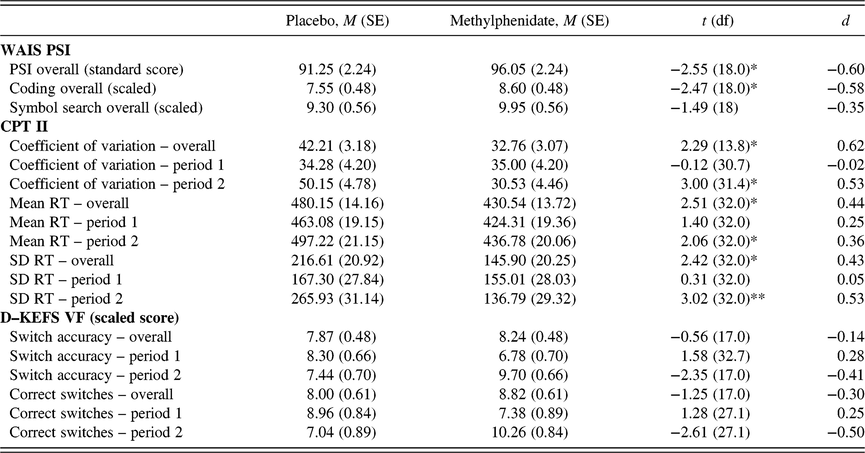
Methylphenidate was associated with significant improvements in processing speed, sustained attention, and EF. WISC/WAIS PSI scores during the optimal dose week of the medication condition were lower than during the optimal dose week of the placebo condition (p = .02, effect size = −0.60; Table 2), driven by the Coding subtest (p = .02, effect size = −0.58; Table 2). No significant differences were found on the Symbol Search subtest (p = .15; Table 2), suggesting that the overall effect was due to improved psychomotor speed rather than visual scanning ability. Similar results were seen on the CPT. The medication condition showed less response variability (Coefficient of Variation; p = .04, effect size = 0.62; Table 2), faster reaction times (p = .02, effect size = 0.44; Table 2), and a lower SD in reaction time (p = .02, effect size 0.43; Table 2).
Neuropsychological outcomes

*p< .05, **p< .01, ***p< .0001, CPT II = Continuous Performance Test II, RT = Reaction Time, STD RT = Standard Deviation of Reaction Time, DKEFS-VF = D-KEFS Verbal Fluency, PSI = Processing Speed Index, and WAIS = Wechsler Adult Intelligence Scale.
Note: “period 1” refers to the first 4 weeks of the study, and “period 2” refers to the final 4 weeks after cross-over.
Three significant treatment-by-period interactions were found on the CPT. When the methylphenidate condition was first, the placebo condition in the second period was associated with higher response variability (coefficient of variation; p = .01, effect size = 0.53; Table 2), slower response times (p = .05, effect size = 0.36; Table 2), and higher SD of response time (p = .005; effect size = 0.53; Table 2). These findings suggest that, after switching from methylphenidate to placebo, participants were slower to respond with more variation in response times, and responded randomly or erratically compared to those treated first by placebo.
While no overall differences were found on the DKEFS measures, there were two significant treatment-by-period interactions. Compared to placebo, the methylphenidate condition in the second period was associated with higher scores on category switch accuracy (p = .03, effect size = −0.30; Table 2) and category switch total correct (p = .01, effect size = −0.50; Table 2) indicating better ability to switch between sets.
Everyday EF Behavior Outcomes
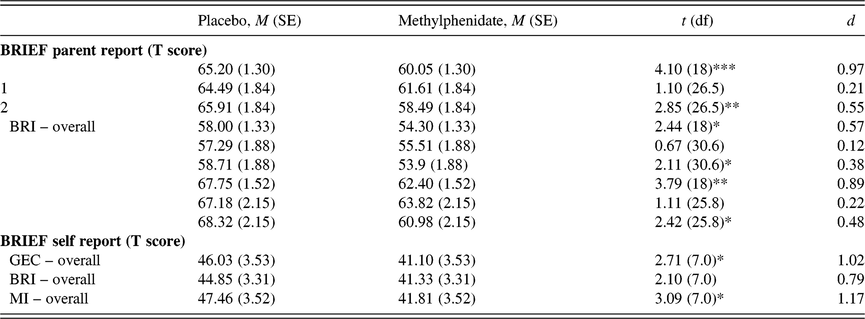
There were overall differences in mean scores between placebo and medication groups at optimal dose visits for the parent-BRIEF GEC (p = .001, effect size = 0.97), MI (p = .03, effect size = 0.57), and BRI scores (p = .001, effect size = 0.89). Three significant treatment-by-period interactions were found on the parent-BRIEF. When the methylphenidate condition was first, the placebo condition in the second period was associated with higher scores on the GEC (p = .01, effect size = 0.55), the MI (p = .04, effect size = 0.38), and the BRI (p = .02, effect size = 0.48), indicating poorer everyday EF behaviors. Overall differences were found on the self-BRIEF GEC and MI scores after controlling for baseline scores, period (i.e., first or second 4 weeks), and interaction term of treatment by period (which was not statistically significant in these cases) (Table 3), with the methylphenidate condition associated with improved EF.
BRIEF outcomes

*p< .05, **p< .01, ***p< .0001, BRI = Behavioral regulation index, GEC = Global executive composite, and MI = Metacognitive index. Individual period results are not given for the self report measures because the treatment-by-period interaction terms were not statistically significant.
Note: “period 1” refers to the first 4 weeks of the study, and “period 2” refers to the final 4 weeks after cross-over.
Mediation outcomes
No significant mediation effects were found in the models exploring processing speed as a mediator of the treatment response of parent- or self-report ratings of everyday EF behaviors to methylphenidate (all p >.05).
DISCUSSION
This study provides a further understanding of the potential influence of methylphenidate on EF and neuropsychological outcomes in children with attention problems after TBI. The results suggest that methylphenidate treatment is beneficial for processing speed, sustained attention, lab-based measures of EF, and everyday EF behaviors. These results also suggest that when switching off methylphenidate, performance on sustained attention tasks may worsen, leading to slower reactions, more variable reaction times, and more random and erratic responses.
Previous studies of methylphenidate treatment for attentional impairments following TBI have revealed similar results. Many studies have found that methylphenidate treatment enhances processing speed in both adult and pediatric TBI populations (Willmott & Ponsford, Reference Willmott and Ponsford2009). Similar results have been found on measures of attention in both adult and pediatric TBI populations (Kim et al., Reference Kim, Whyte, Patel, Europa, Wang, Coslett and Detre2012; Konrad, Günther, Hanisch, & Herpertz-Dahlmann, Reference Konrad, Günther, Hanisch and Herpertz-Dahlmann2004; Mahalick et al., Reference Mahalick, Carmel, Greenberg, Molofsky, Brown, Heary, Marks, Zampella and Hodosh1998). The results of the current study add to the literature by demonstrating the efficacy of using dose titration to determine an optimal dose. Previous studies have utilized only one (Kim et al., Reference Kim, Whyte, Patel, Europa, Wang, Coslett and Detre2012; Mahalick et al., Reference Mahalick, Carmel, Greenberg, Molofsky, Brown, Heary, Marks, Zampella and Hodosh1998; Willmott & Ponsford, Reference Willmott and Ponsford2009) or two (Konrad et al., Reference Konrad, Günther, Hanisch and Herpertz-Dahlmann2004) weight-dependent doses of methylphenidate. As assessments were administered while participants were taking their optimal dose, these results may be more representative of the performance of individuals being treated with methylphenidate in the long term.
A unique finding from this study is that it suggests there may be a negative cognitive “rebound effect” following discontinuation of or a “drug holiday” from methylphenidate. An international literature review revealed that drug holidays were a common practice with 25%–70% of families partaking in one (Ibrahim & Donyai, Reference Ibrahim and Donyai2015). These holidays were more likely to coincide during weekends or school holidays and were thought to help alleviate or mitigate common negative side effects of methylphenidate, such as those affecting growth, sleep, and appetite; however, their effectiveness remains poorly understood (Graham et al., Reference Graham, Banaschewski, Buitelaar, Coghill, Danckaerts, Dittmann, Döpfner, Hamilton, Hollis, Holtmann, Hulpke-Wette, Lecendreux, Rosenthal, Rothenberger, Santosh, Sergeant, Simonoff, Sonuga-Barke, Wong, Zuddas, Steinhausen and Taylor2011). This decline in performance suggests that the estimated 40% of children who do not take medications when they are not in school (Charach & Gajaria, Reference Charach and Gajaria2008) may be at risk for increased impaired attention until treatment is resumed. Furthermore, this study suggests there may be negative cognitive effects that should be considered when families and doctors decide to discontinue medication or take a drug holiday.
In addition, because mediation models were not significant, this suggests that improvements in processing speed performance are not the driving force in reported improvements in everyday EF behaviors. This finding is consistent with other literature in the ADHD population, which suggests performance-based measures account for little unique variance in predicting ADHD status and demonstrates little overlap with behavioral ratings (Toplak, Bucciarelli, Jain, & Tannock, Reference Toplak, Bucciarelli, Jain and Tannock2008). A better understanding of neural mechanisms of recovery and treatment is needed to better understand improvements following medication trials. Future research should consider including neuroimaging and other biological markers as part of an assessment for treatment outcomes (Berridge et al., Reference Berridge, Devilbiss, Andrzejewski, Arnsten, Kelley, Schmeichel, Hamilton and Spencer2006; Hart et al., Reference Hart, Kraut, Womack, Strain, Didehbani, Bartz, Conover, Mansinghani, Lu and Cullum2013; Solanto, Reference Solanto1998; Swanson, Baler, & Volkow, Reference Swanson, Baler and Volkow2011; Volkow, Fowler, Wang, Ding, & Gatley, Reference Volkow, Fowler, Wang, Ding and Gatley2002).
Another promising direction for future research is combining medication and behavioral treatments for children following a TBI. Several studies have demonstrated that interventions targeting parenting skills, family distress, and problem-solving abilities post-injury can improve cognitive and behavioral outcomes for children and families after TBI (Antonini et al., Reference Antonini, Raj, Oberjohn, Cassedy, Makoroff, Fouladi and Wade2014; Wade, Kurowski, et al., Reference Wade, Kurowski, Kirkwood, Zhang, Cassedy, Brown, Nielsen, Stancin and Taylor2015; Wade, Taylor, et al., Reference Wade, Taylor, Cassedy, Zhang, Kirkwood, Brown and Stancin2015). Research from the ADHD population suggests that best practice for treating symptoms of ADHD incorporates both medical and behavioral interventions subcommittee (Subcommittee on Attention-Deficit/Hyperactivity Disorder; Steering Committee on Quality Improvement and Management, Reference Wolraich, Brown, Brown, DuPaul, Earls, Feldman, Ganiats, Kaplanek, Meyer, Perrin, Pierce, Reiff, Stein and Visser2011). Future studies should explore whether a similar approach for children with TBI and SADHD would be beneficial.
Limitations
This study adds to the prior literature on TBI treatment of EF and attentional issues with methylphenidate, but has several limitations to consider when interpreting the findings. Due to the cross-over design of the study, children were given the same neuropsychological measures three times within an 8- to 12-week period. However, the pattern of performance in the current study did not suggest that improvements in scores were due to practice or learning effects because improvement across time, regardless of group, was absent. In addition, the finding that performance on assessments worsened after switching from methylphenidate to placebo would be unexpected if significant practice/learning effects were present. The study does not account for teacher reports of behavior, which may differ from parent report (Lavigne, Dulcan, LeBailly, & Binns, Reference Lavigne, Dulcan, LeBailly and Binns2012). Study participants included children with attention problems after injury; however, these were a mix of children with and without primary ADHD. Prior research suggests that there may be different profiles for each group; however, when pre-injury ADHD status was included as a covariate in the models, we did not find a significant influence on findings. Larger sample sizes are likely needed to explore profile differences between primary and secondary ADHD and between differing subtypes of ADHD. The study demographics should also be considered in interpreting the results as the population consisted of approximately 75% males, 75% whites, and primarily moderate injuries with a mean age of injury of approximately 6 years and time since injury at enrollment of approximately 5 years. Finally, further research is needed to understand how individual (e.g., genetics) and environmental factors (e.g., home environment, parenting) interrelate to influence treatment response and determine who is most likely to benefit from medication versus other treatments.
CONCLUSION
Findings from this double-masked, placebo controlled, upward titration, cross-over clinical trial support the use of long-acting methylphenidate for management of neuropsychological and everyday EF behavior problems long-term after pediatric brain injury. There is currently a lack of evidence-based trials for management of the sequelae of pediatric brain injury, as well as possible interventions to help improve common EF deficits following injury. Due to the high incidence of brain injury in children and the significant impact of executive problems, especially in children with SADHD, on functioning, larger trials of stimulant medications are warranted. Further research is also needed to explore “cognitive rebound effects” and how these may impact doctors’ and families’ decisions around taking medication holidays. The relationship between improvements of neuropsychological and everyday EF behavior assessments following medication treatment is currently poorly understood and further research is warranted to understand the relationship. Furthermore, the neural physiology of EF problems and neural mechanisms of treatments need to be better characterized in childhood brain injury populations.
ACKNOWLEDGMENTS
This project was supported by the Eunice Kennedy Shriver National Institute of Child Health & Human Development (NICHD) grant (grant number REDACTED FOR BLIND REVIEW) and, in part, by the Cincinnati Children’s Research Foundation; the National Center for Advancing Translational Sciences of the National Institutes of Health under Award (grant number REDACTED FOR BLIND REVIEW); and the National Institute on Disability, Independent Living, and Rehabilitation Research, formerly known as the National Institute on Disability and Rehabilitation Research (grant number REDACTED FOR BLIND REVIEW). This study is registered with clinicaltrials.gov, registration number REDACTED FOR BLIND REVIEW. The content is solely the responsibility of the authors and does not necessarily represent the official views of the National Institutes of Health or other supporting agencies. No competing financial interests exist. All authors of this manuscript have no conflicts of interest to disclose.