Introduction
Dementia care is among the most significant social, health, and economic challenges faced by societies. There are currently around 40 million people with dementia (PWD) worldwide, whilst estimates project a doubling of numbers every 20 years, reaching 115 million by 2050. Fifty-eight percent of PWD currently live in low- and middle-income countries, and this number will rise to 71% by 2050 (Alzheimer's Disease International, 2011). Given the scale and urgency of the challenge, healthcare professionals internationally must be sufficiently prepared to care competently for patients with age-related illnesses such as dementia. There is widespread current concern that there are deficiencies in the knowledge, skills, and attitudes of healthcare professionals caring for PWD, both in the community and in hospitals, and that education and training about dementia must be improved at the undergraduate and postgraduate level internationally (Department of Health, 2009; Alzheimer's Disease International, 2011; Royal College of Psychiatrists, 2011; Smyth et al., Reference Smyth2013).
Why measure attitudes toward people with dementia?
The relationship between attitudes and behavior, and the relevance of this relationship to healthcare service, is complex. There is evidence that attitudes predict behavior, including communicative behavior, in certain circumstances. One frequently cited model of the relationship between attitudes, intentions, and behavior is the Theory of Planned Behavior (TPB; Ajzen, Reference Ajzen1991). This model has been previously applied to clinical environments and there is evidence to suggest that healthcare professionals’ attitudes do influence their clinical practice, although the relationship is complex and contextual (Walker et al., Reference Walker, Grimshaw and Armstrong2001; Limbert and Lamb, Reference Limbert and Lamb2002).
There is conflicting evidence as to the nature of attitudes of healthcare professionals toward PWD in different environments internationally, and to what extent those attitudes affect the behavior of staff or the quality of care delivered (Lintern, Reference Lintern2001; Brodaty et al., Reference Brodaty, Draper and Low2003; Turner et al., Reference Turner2004; Macdonald and Woods, Reference Macdonald and Woods2005; Zimmerman et al., Reference Zimmerman2005; Kada et al., Reference Kada, Nygaard, Mukesh and Geitung2009; Kang et al., Reference Kang, Moyle and Venturato2011; Moyle et al., Reference Moyle, Murfield and Griffiths2011). Negative attitudes that impair appropriate communication have been identified as contributing to poor care and stigmatization of PWD internationally (Department of Health, 2009; Alzheimer's Disease International, 2012); therefore, strategies to improve care must include efforts to improve attitudes.
The importance of attitudes in medical education
Recognition of the importance of appropriate professional attitudes toward patients in medical education is reflected by inclusion and assessment of attitudinal learning outcomes in medical school curricula (Martin et al., Reference Martin, Lloyd and Singh2002). Moreover, there is increasing interest in evaluation of medical students’ attitudes and their relationship to behavior in general (Rogers and Coutts, Reference Rogers and Coutts2000; Woloschuk et al., Reference Woloschuk, Harasym and Temple2004; Jha et al., Reference Jha, Bekker, Duffy and Roberts2007). Although previous studies have explored medical students’ attitudes to older people (Reuben et al., Reference Reuben, Fullerton, Tschann and Croughan-Minihane1995; Beer et al., Reference Beer, Watson, Caputo, Hird and Flicker2011), geriatric medicine as a specialty (Robbins et al., Reference Robbins, Forrester-Paton, Cantlay, Gladman and Gordon2011) and to people with mental health problems (Dixon et al., Reference Dixon, Roberts, Lawrie, Jones and Humpreys2008), medical undergraduates’ attitudes toward PWD remain under-explored. Given the imperative to improve medical education and training about dementia, and the relationship between attitudes and behavior, it seems apposite to investigate medical students’ attitudes toward PWD. Improving undergraduate education about dementia will require multiple strategies, including becoming better informed about attitudes. This will facilitate the design and delivery of appropriate teaching and learning that will ultimately contribute to better quality care in practice for PWD.
This study had two main aims. First, to survey and explore the attitudes of medical students in different year groups and in different international locations toward PWD and, second, to compare the findings with attitudes of other groups of healthcare professionals toward PWD as surveyed in previous studies.
Methods
Participants
The study involved students in years 1, 3, and 5 at a medical school with UK and Malaysian sites. The medical school's largest facility is based in the UK, but a smaller branch, medical school in Malaysia, where the same curriculum is delivered, has been recently opened. Study participants were recruited from both sites. Year 1 students in Malaysia were the first entry-level cohort at the new site which opened in 2011, whereas year 3 students in Malaysia had spent their previous two years based in the UK before moving back to Malaysia in 2011 to continue their studies. Year 5 students were only recruited from the UK site as there were no students who had yet reached year 5 at the Malaysian site.
Questionnaire
This study used a modified version of the Approaches to Dementia Questionnaire (ADQ), an instrument previously validated for use with social care professionals (Lintern, Reference Lintern2001). The instrument contains 19 statements related to appropriate care of people with dementia in a care environment, for example “It is important for people with dementia to have stimulating and enjoyable activities to occupy their time” (ADQ 5), and are scored using a five-point Likert scale ranging from “strongly agree” to “strongly disagree.” Higher scores reflect more positive attitudes, and some items are reverse coded to minimize the risk of acquiescence bias. Item scores are added to produce a total score in the range of 19 to 95.
Although qualitative and quantitative measures other than the ADQ have been used to evaluate attitudes toward people with dementia (Brodaty et al., Reference Brodaty, Draper and Low2003; Norbergh et al, Reference Norbergh, Helin, Dahl, Hellzen and Asplund2006; O'Connor and McFadden, Reference O'Connor and McFadden2010; George et al., Reference George, Stuckey, Dillon and Whitehead2011; McParland et al., Reference McParland, Devine, Innes and Gayle2012), the ADQ has been the most frequently applied instrument in healthcare settings. Use of the ADQ has previously been largely limited to groups of healthcare professionals working in “Western” contexts (Lintern, Reference Lintern2001; Macdonald and Woods, Reference Macdonald and Woods2005; Zimmerman et al., Reference Zimmerman2005; Kada et al., Reference Kada, Nygaard, Mukesh and Geitung2009; Bussin, Reference Bussin2010; Moyle et al., Reference Moyle, Murfield and Griffiths2011), this was its first use with medical students to our knowledge.
Medical students at both the UK-based and Malaysian sites speak English, their language of instruction, to a high minimum standard, either as their first language or to at least band 7 in the International English Language Testing System or an equivalent, indicating “fully operational command of the language” (IELTS, 2012). The phrasing of the ADQ statements was reviewed with Malaysian staff and minor amendments were made where socioculturally specific colloquial usage might be confusing. For example, phrasing of item 10 “Once dementia develops in a person, it is inevitable that they will go down hill” was modified to “Once dementia develops in a person, it is inevitable that they will deteriorate.” UK- and Malaysia-based students answered the same amended questionnaire. Students were also asked for demographic data including year of study and gender.
Procedure
Students at all sites were counseled that participation was voluntary and anonymous. UK-based year 1 students were approached at the end of a lecture for the whole year group and invited to complete a paper-based questionnaire. UK-based year 3 and year 5 students were widely dispersed at hospitals across the region and thus cohorts of students undertaking mandatory psychiatry rotations were approached during tutorials and similarly invited to complete the same paper-based questionnaire. The questionnaire was converted to an electronically administered instrument and all year 1 and 3 students based in Malaysia were contacted by email to invite them to complete the questionnaire online. Appropriate ethical approval of the project as whole was given by the relevant Medical Board of Studies and by the ethics committee of the University's School of Education.
Statistical analysis
Data derived from the ADQ were entered into IBM SPSS 19. Kolmogorov–Smirnov analysis was used to test for normality. Group comparisons were made using non-parametric tests including Kruskall–Wallis and Mann–Whitney U.
Results
Group demographics
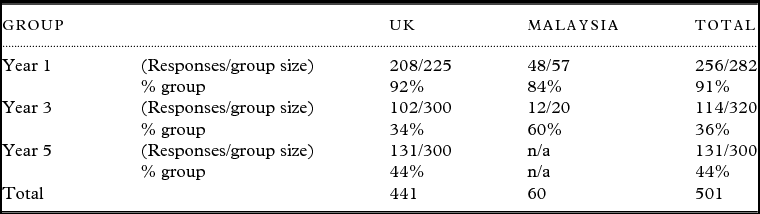
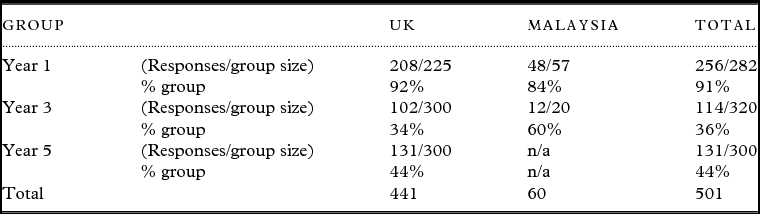
A total of 501 questionnaires were collected from the UK and Malaysian sites. Two hundred and fifty-six were collected from year 1 students representing 91% of the year group at the two sites. One hundred and fourteen were completed by year 3 students representing 36% of the year group at the two sites.Footnote 1 One hundred and thirty-one were completed by year 5 students representing 44% of the year group. For practical reasons associated with collecting data from geographically spaced cohorts of students on clinical rotations, samples sizes of year 3 and year 5 students were smaller, but these samples were still representative of the medical school as a whole in terms of demographics. Fifty-four percent of the respondents were female. For a summary of sample sizes and responses rates see Table 1.
Summary of sample sizes and response rates by year group and location
Missing data, normality, and descriptives
Not all respondents answered every item – 40 questionnaires had at least one missing ADQ data item. For analysis of total ADQ scores and group comparisons, only the data from fully completed questionnaires were included. Percentages of incomplete questionnaires for years 1, 3, and 5 were 9.8%, 7%, and 5.3%, respectively
Kolmogorov–Smirnov indicated that the data distribution tended to normal, but that year 1 data fell outside of the assumption of normality. Non-parametric tests were therefore used for group comparisons.
The median ADQ score for all participants was 73 (range 52–88).
Relationship between year group and ADQ score
Comparison of total ADQ score between whole year groups using Kruskall–Wallis test suggested a significant difference in scores (p 4.50E-10). Year 5 students scored more highly than year 3 students who scored more highly than year 1 students (Table 2), thus attitudes were shown to be more positive in more senior year groups. A post hoc pairwise test using Mann–Whitney U with Bonferroni correction (p value considered as significant reduced from 0.05 to 0.016) showed that the difference in ADQ score between year 1 and year 3 students was significant (p 5.44E-5) but the difference in scores between years 3 and 5 did not reach significance (p 0.055). In other words, year 3 students expressed significantly more positive attitudes than year 1 students, but year 5 students did not express significantly more positive attitudes than year 3 students
Kruskall–Wallis comparison of ADQ scores by year group

Relationship between international location and ADQ score
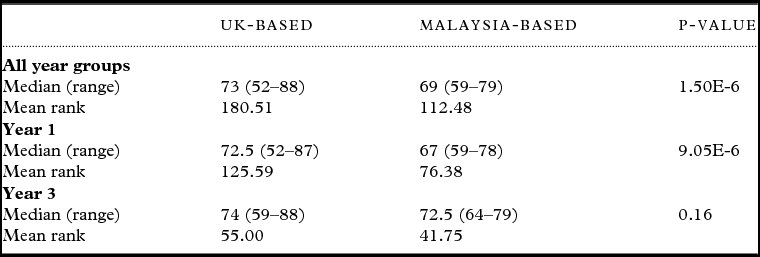
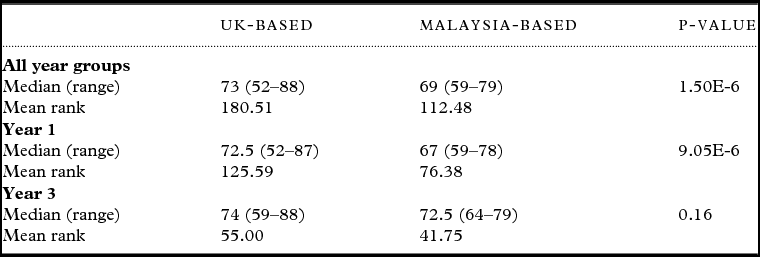
Comparison of ADQ scores between students based in different locations using the Mann–Whitney U test showed a significant difference (p 1.50E-6) – students based in the UK scored more highly, demonstrating more positive attitudes, than students based in Malaysia. However, when the groups were sub-divided and analyzed separately by year group, a significant difference was found only between year 1 students. Whilst year 1 students based in the UK expressed more positive attitudes than students based in Malaysia, in year 3 this difference was not significant (Table 3). There were no year 5 students in Malaysia so a comparison for this year group could not be made.
Mann–Whitney U comparison of ADQ scores by geographical location and year group
Comparison with healthcare professionals from other studies using the ADQ
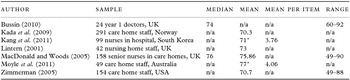
A review of the literature yielded seven other studies measuring healthcare professionals’ attitudes toward PWD using the ADQ (Table 4). Although all of the studies used the same tool, scores were reported in different ways. None of the studies reported whether data collected were normally distributed but chose to use mean or median or both to report average total ADQ score. Two papers reported mean score per ADQ item allowing an estimate of total ADQ to be made.
Summary of studies using the ADQ to measure healthcare professionals’ attitudes toward people with dementia

*Estimated mean score based on mean score per ADQ item.
Discussion
This study demonstrates that this group of medical students’ attitudes toward PWD are generally positive – the median score of 73 is comparable with previously surveyed groups of health and social care professionals where scores have ranged from 70 to 77. Given the likely relationship between professional attitudes and behavior in practice, it is encouraging that medical student attitudes toward PWD tend to the positive. Moreover, it appears that student attitudes become significantly more positive between entry as year 1 students and progression to year 3. It remains unclear why this is the case, but it may be that teaching and learning during this time does engender a person-centered approach that corresponds to more positive attitudes toward individuals with conditions such as dementia. Other explanations include increasing maturity of students or a growing awareness of the type of response expected as a professional.
The trend was for scores to improve between year 3 and year 5, although this did not reach significance. Given international concerns about negative attitudes of qualified healthcare professionals, this begs the question as to why attitudes might erode in the time between undergraduate training and clinical practice. Alternatively, if attitudes of junior doctors are indeed positive (as per the small study by Bussin, Reference Bussin2010), there may be a discrepancy between the translation of attitudes to behavior in clinical practice. The TPB proposes a number of influencing factors in the translation of attitudes to behavior including intentions and perceived social norms (Ajzen, Reference Ajzen1991). In the light of our findings here, it would be worthwhile to extend the quantitative evaluation of attitudes to year groups in later stages of training, and across national and international locations. Furthermore, qualitative research could usefully explore the basis of attitudes toward dementia amongst medical students, and the relationship between attitudes, intention, and clinical behaviors such as communication.
Our finding that entry-level Malaysian students have a significantly more negative (if still largely positive) attitude to dementia is likely to be of interest to medical educators and to policy makers. Little previous work had explored attitudes to dementia from an international/intercultural perspective, with most biomedical and psycho-social research being conducted in and for the “West” – largely North America, Western Europe, and Australasia (Prince, Reference Prince, Krishnamoorthy, Prince and Cummings2010). Nevertheless, some work in China, India, and Japan has suggested high levels of societal stigmatization and attitudinal negativity toward mental health conditions such as dementia (Kua, Reference Kua, Krishnamoorthy, Prince and Cummings2010). In low- and middle-income counties, and among ethnic minorities in the West, elderly PWD exhibiting confusion and behavioral difficulties may more likely to be perceived as a burden, promoting a negative view of dementia (La Fontaine et al., Reference La Fontaine, Ahuja, Bradbury, Phillips and Oyebode2007). A survey of dementia in Malaysia suggested that the greatest challenges in dealing with dementia there are awareness, stigma, and a lack of resources (Nikmat et al., Reference Nikmat, Hawthorne and Al-Mashoor2011). In the West, on the other hand, where resources are more readily available relative to low- and middle-income countries, it has been suggested that social stigma has reduced in recent years (Young and Manthorp, Reference Young and Manthorp2009). It should also be acknowledged that the ADQ was designed for the Western social care environment. Efforts to validate the scale for our sample included changes to reduce ambiguity of socioculturally specific colloquial phrasing, but the difference in ADQ scores between nationalities may be a result of applying a scale that recognizes positive attitudes as corresponding to “Western,” person-centered beliefs about appropriate approaches, attitudes, and care. Future research could usefully address in more detail the issue of the intercultural applicability of Western person-centered dementia care models to non-Western contexts.
The study has a number of limitations. It is possible that social desirability in answering the ADQ may have been a source of bias, but this was mitigated by anonymity. The practical difficulties of collecting data from year 3 and year 5 students – here, widely dispersed – meant that sample sizes were smaller than for year 1 students. In particular, the smaller population of year 3 students in Malaysia may have resulted in insufficient statistical power to detect a difference in ADQ score between year 3 students in the UK and Malaysia. The fact that students in years 3 and 5 were undertaking a psychiatry rotation may have produced a recency effect, although it should be noted that all year 3 medical students in both the UK and Malaysia completed this rotation. Limited demographic information collected from students meant that we were unable to quantify differences between international cohorts in terms of family structure or previous contact with people with dementia, which may have influenced responses.
Our findings have implications for medical education and training. Recent concerns about dementia care have highlighted a deficiency in knowledge, skills, and attitudes of healthcare professionals. However, this study amongst others cited, suggest that health and social staff attitudes toward PWD are largely positive. A deficiency in attitudes may not be the primary cause of poor quality care for PWD in the health and social care environment, but rather the influence if other factors on the translation of positive attitudes to effective behavior such as person-centered communication. Although psycho-social aspects of medical education about dementia should clearly aim to nurture existing positive attitudes that predispose to helpful behavior (as per George et al., Reference George, Stuckey and Whitehead2013), positive attitudes alone are unlikely to automatically result in successful person-centered care for PWD. Teaching about dementia must also aim to equip students with the knowledge and skills to sensitively interact with PWD in the clinical environment. In international settings, teaching may need to be adapted to respect the prevailing care models in that particular cultural environment. Improving medical education about dementia is a complex task. However, finding positive attitudes toward PWD amongst students internationally should encourage teachers that the task is possible.
Conflict of interest
Ellen StClair Tullo is supported by the National Institute for Health Research (NIHR) Newcastle Biomedical Research Centre based at Newcastle upon Tyne Hospitals NHS Foundation Trust and Newcastle University. The views expressed are those of the authors and not necessarily those of the NHS, the NIHR, or the Department of Health.
The research was facilitated by funding from Newcastle University's Centre for Research in Linguistics and Language Sciences.
Description of authors’ roles
Ellen StClair Tullo and Tony Johnstone Young designed the study, collected and analyzed the data, and wrote the paper
Acknowledgments
Authors thank Nina Wilkinson of the Institute for Ageing and Health, Newcastle University for assistance with statistical analysis, and Ellen StClair Tullo's PhD supervisors Louise Robinson, Louise Allan, and Julia Newton