Introduction
The increased prevalence of pre- and perinatal complications in schizophrenia patients is supportive of a neurodevelopmental origin of the illness (Lewis & Murray, Reference Lewis and Murray1987; Weinberger, Reference Weinberger1987; Marenco & Weinberger, Reference Marenco and Weinberger2000). Subtle deviances from normal brain development may be reflected in altered brain morphology (Fatemi & Folsom, Reference Fatemi and Folsom2009). In schizophrenia patients, smaller hippocampi, larger ventricles and reduced cortical thickness and volume have relatively consistently been reported (Honea et al. Reference Honea, Crow, Passingham and Mackay2005; Steen et al. Reference Steen, Mull, McClure, Hamer and Lieberman2006; Glahn et al. Reference Glahn, Laird, Ellison-Wright, Thelen, Robinson, Lancaster, Bullmore and Fox2008). In animal models, various obstetric complications (OCs) have been demonstrated to cause both brain morphological alterations and behavioural aberrances that parallel those observed in schizophrenia (for review, see Boksa, Reference Boksa2004). In magnetic resonance imaging (MRI) studies of schizophrenia patients, OCs have been related to smaller hippocampi (van Erp et al. Reference van Erp, Saleh, Rosso, Huttunen, Lonnqvist, Pirkola, Salonen, Valanne, Poutanen, Standertskjold-Nordenstam and Cannon2002; Schulze et al. Reference Schulze, McDonald, Frangou, Sham, Grech, Toulopoulou, Walshe, Sharma, Sigmundsson, Taylor and Murray2003; Ebner et al. Reference Ebner, Tepest, Dani, Pfeiffer, Schulze, Rietschel, Maier, Traber, Block, Schild, Wagner, Steinmetz, Gaebel, Honer, Schneider-Axmann and Falkai2008), larger lateral ventricles (McNeil et al. Reference McNeil, Cantor-Graae and Weinberger2000; Falkai et al. Reference Falkai, Schneider-Axmann, Honer, Vogeley, Schonell, Pfeiffer, Scherk, Block, Traber, Schild, Maier and Tepest2003) and reduced cortical volume (Cannon et al. Reference Cannon, van Erp, Rosso, Huttunen, Lonnqvist, Pirkola, Salonen, Valanne, Poutanen and Standertskjold-Nordenstam2002). Taken together, these findings suggest that early somatic trauma such as OCs may exert an influence on neurodevelopment, detectable in the brain decades later. However, the brain morphological alterations reported in schizophrenia may also reflect medication use (Smieskova et al. Reference Smieskova, Fusar-Poli, Allen, Bendfeldt, Stieglitz, Drewe, Radue, McGuire, Riecher-Rossler and Borgwardt2009), illness progression (van Haren et al. Reference van Haren, Hulshoff Pol, Schnack, Cahn, Mandl, Collins, Evans and Kahn2007; Tanskanen et al. Reference Tanskanen, Ridler, Murray, Haapea, Veijola, Jaaskelainen, Miettunen, Jones, Bullmore and Isohanni2008), genetic variation (van Haren et al. Reference van Haren, Bakker and Kahn2008) or other illness-related factors.
Alterations in cortical folding patterns may be a brain morphological correlate of aberrant neurodevelopment. The process of cortical gyrification is under genetic control (Piao et al. Reference Piao, Hill, Bodell, Chang, Basel-Vanagaite, Straussberg, Dobyns, Qasrawi, Winter, Innes, Voit, Ross, Michaud, Descarie, Barkovich and Walsh2004), but environmental factors have also been demonstrated to be of importance (Bartley et al. Reference Bartley, Jones and Weinberger1997). The early stages of gyrification appear around gestational week 16, with a rapid increase in cortical gyrification in the third trimester of pregnancy (Armstrong et al. Reference Armstrong, Schleicher, Omran, Curtis and Zilles1995). The gyrification index (GI), defined as the ratio between the pial and the arachnoideal surface as observed in coronal slices of post-mortem brains or MRI scans (Zilles et al. Reference Zilles, Armstrong, Schleicher and Kretschmann1988), demonstrates a steady increase until postnatal week 6, from which the GI remains by and large stable (Armstrong et al. Reference Armstrong, Schleicher, Omran, Curtis and Zilles1995). The human gyrification process may be a result of tension-based mechanisms. Visco-elastic tension exerted by cortical fibres draw regions with greater connectivity closer together (forming gyri) and thereby reduces the transit time of the action potentials (van Essen, Reference van Essen1997; White et al. Reference White, Su, Schmidt, Kao and Sapiro2010). Cortical folding patterns may thus convey information on underlying cortical organization and complexity. As a consequence, gyrification measures demonstrate properties related to both neurodevelopment and cortical organization, aspects that are of importance in schizophrenia.
Several studies on gyrification abnormalities in schizophrenia have been conducted with heterogeneous findings as a result. Prefrontal hypergyria (higher GI) (Vogeley et al. Reference Vogeley, Schneider-Axmann, Pfeiffer, Tepest, Bayer, Bogerts, Honer and Falkai2000, Reference Vogeley, Tepest, Pfeiffer, Schneider-Axmann, Maier, Honer and Falkai2001; Falkai et al. Reference Falkai, Honer, Kamer, Dustert, Vogeley, Schneider-Axmann, Dani, Wagner, Rietschel, Muller, Schulze, Gaebel, Cordes, Schonell, Schild, Block, Traber, Steinmetz, Maier and Tepest2007; Harris et al. Reference Harris, Moorhead, Miller, McIntosh, Bonnici, Owens, Johnstone and Lawrie2007), lower prefrontal (Bonnici et al. Reference Bonnici, William, Moorhead, Stanfield, Harris, Owens, Johnstone and Lawrie2007) and global (Sallet et al. Reference Sallet, Elkis, Alves, Oliveira, Sassi, Campi, Busatto and Gattaz2003; Cachia et al. Reference Cachia, Paillere-Martinot, Galinowski, Januel, de, Bellivier, Artiges, Andoh, Bartres-Faz, Duchesnay, Riviere, Plaze, Mangin and Martinot2008) GI, as well as negative findings (Highley et al. Reference Highley, DeLisi, Roberts, Webb, Relja, Razi and Crow2003) have been reported. Gyrification abnormalities have been reported to be present before adult illness onset (Harris et al. Reference Harris, Whalley, Yates, Miller, Johnstone and Lawrie2004a, b). A flattening of sulcal curvature together with peaking of gyral curvature has been reported in childhood- and adolescence-onset schizophrenia patients (White et al. Reference White, Andreasen, Nopoulos and Magnotta2003). It is, however, uncertain if early somatic trauma such as OCs influences the gyrification process in schizophrenia. To our knowledge, thus far only one scientific study (Falkai et al. Reference Falkai, Honer, Kamer, Dustert, Vogeley, Schneider-Axmann, Dani, Wagner, Rietschel, Muller, Schulze, Gaebel, Cordes, Schonell, Schild, Block, Traber, Steinmetz, Maier and Tepest2007) has examined the relationship between OCs and gyrification in schizophrenia. Falkai et al. found no effect of OCs on a two-dimensional (2D) based GI in schizophrenia patients (n=29) and their relatives (of which 21 relatives were healthy and 13 had psychosis) (Falkai et al. Reference Falkai, Honer, Kamer, Dustert, Vogeley, Schneider-Axmann, Dani, Wagner, Rietschel, Muller, Schulze, Gaebel, Cordes, Schonell, Schild, Block, Traber, Steinmetz, Maier and Tepest2007).
The human brain cortex is a highly complex three-dimensional (3D) structure. Measuring cortical folding from 2D coronal MRI slices might lead to loss of information related to buried sulci and gyral anomalies in sublobar regions. In the present study, we used a 3D surface-based automated algorithm to calculate the local GI (lGI) in each vertex across the whole cortical mantle (http://surfer.nmr.mgh.harvard.edu/fswiki/LGI) (Schaer et al. Reference Schaer, Cuadra, Tamarit, Lazeyras, Eliez and Thiran2008). With this method, subtle localized deviances in cortical folding may be detected with submillimetre precision.
Hypotheses
Based on findings from the previous scientific literature, we hypothesized: (1) that OCs would be related to cortical folding, as measured by a 3D surface-based lGI; (2) that this relationship would be different in schizophrenia patients and healthy control subjects; (3) that the hypothesized difference would correspond to areas where schizophrenia patients demonstrate altered cortical folding as compared with healthy controls.
Method and materials
Subject characterization
This study was part of the Human Brain Informatics Project (HUBIN) at the Karolinska Institutet, Stockholm, Sweden. HUBIN is a comprehensive database of genetic, brain morphological, neuropsychological and clinical information obtained from schizophrenia patients and healthy subjects. The subject inclusion took place between 1999 and 2003. All participants gave written informed consent. The project was approved by the Research Ethics Committee at Karolinska Institutet and the Swedish Data Inspection Board (‘Datainspektionen’). The study was performed in accordance with the Helsinki Declaration.
The subject sample consisted of unrelated Caucasian men and women currently resident in the Stockholm area and has previously been thoroughly described (Jonsson et al. Reference Jonsson, Edman-Ahlbom, Sillen, Gunnar, Kulle, Frigessi, Vares, Ekholm, Wode-Helgodt, Schumacher, Cichon, Agartz, Sedvall, Hall and Terenius2006; Haukvik et al. Reference Haukvik, Lawyer, Bjerkan, Hartberg, Jonsson, McNeil and Agartz2009). Briefly, invited patients from three out-patients clinics underwent a comprehensive clinical assessment protocol including structured interviews (Spitzer, Reference Spitzer1988; Wing et al. Reference Wing, Babor, Brugha, Burke, Cooper, Giel, Jablenski, Regier and Sartorius1990) and reviews of medical records to obtain a DSM-III-R and DSM-IV diagnosis as previously described (Ekholm et al. Reference Ekholm, Ekholm, Adolfsson, Vares, Osby, Sedvall and Jonsson2005; Vares et al. Reference Vares, Ekholm, Sedvall, Hall and Jonsson2006). The patients fulfilled DSM-IV criteria for schizophrenia (n=50) or schizoaffective disorder (n=4). Handedness was ascertained by means of asking the patients which hand they used when writing, using scissors and throwing/catching a ball. Control subjects were recruited from hospital staff, their relatives or from a population register. The control subjects included in the present study were interviewed by the same trained psychiatrist (E.G.J.) and had no previous or current psychiatric disorders according to a semi-structured diagnostic interview. They were matched to the patients by age and gender (on a group level).
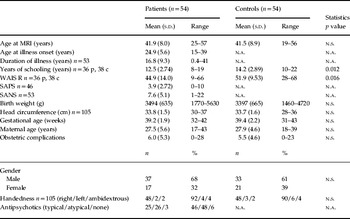
Exclusion criteria for all subjects were a history of head trauma with loss of consciousness >5 min, current treatment for substance abuse and/or somatic disorders affecting brain function. Demographic characteristics, duration of illness, age at onset and use of antipsychotic medication are described in Table 1.
Demographic, clinical, and obstetric characteristics in schizophrenia patients and healthy control subjects

MRI, magnetic resonance imaging; p, patients; c, controls; WAIS, Wechsler adult intelligence scale; SAPS, Scale for the assessment of positive symptoms; SANS, Scale for the assessment of negative symptoms;n.a., not applicable; n.s., not significant.
MRI acquisition
Magnetic resonance images were obtained at the MR Research Centre at Karolinska Institutet, Stockholm, Sweden, using a 1.5 T GE signa Echo-speed (USA) scanner. T1-weighted images were obtained using a 3D spoiled gradient recalled pulse sequence with the following parameters: 1.5 mm coronal slices; no gap; 35 flip angle; repetition time 24 ms; echo time 6.0 ms; number of excitations=2; field of view 24 cm; acquisition matrix 256×192. All scans included were visually judged to be without obvious motion artefacts. A trained neuroradiologist evaluated all scans to be without gross pathology.
MRI post processing
Cortical reconstructions were obtained from T1-weighted images using the automated computer software FreeSurfer version 3.0.2. We used the lGI algorithm (http://surfer.nmr.mgh.harvard.edu/fswiki/LGI) to compute vertex-wise measurements of local gyrification at more than 150.000 vertices in each hemisphere across the cortical mantle. In addition, measurements of the average lGI were calculated in 34 pre-defined anatomical cortex parcellations (Desikan et al. Reference Desikan, Segonne, Fischl, Quinn, Dickerson, Blacker, Buckner, Dale, Maguire, Hyman, Albert and Killiany2006) in each hemisphere, which together cover the whole cortex (Supplementary Table S1). The lGI method is adapted from the classical GI (2D-GI), which is the ratio of the total pial cortical surface over the perimeter of the brain delineated on coronal sections. The present method, lGI, iteratively quantifies GI in circular 3D regions of interest (ROI). After the creation of an outer envelope that tightly wraps the pial cortical surface, local measurement of circular GI is computed for each vertex of the outer surface as the ratio of corresponding ROI on the hull and pial meshes is created (http://surfer.nmr.mgh.harvard.edu/fswiki/LGI). Delineation of the ROI on both the outer surface (ROIO) and pial surface (ROIP) uses a matching algorithm based on geodesic constraints, so that the ROIP takes into account the entire patch of the cortical surface delineated by the ROIO circular perimeter. This means that, at the end of the computational process, individual lGI cortical maps reflect the amount of cortex buried within the sulcal folds in the surrounding circular region. The method has been thoroughly described and validated (Schaer et al. Reference Schaer, Cuadra, Tamarit, Lazeyras, Eliez and Thiran2008).
Assessment of OCs
Information on OCs was collected from hospital birth records. Subjects were born between the years of 1943 and 1982. Obstetric care in Sweden has been of high quality for all this period and the birth records were very detailed. The information was scored according to the McNeil–Sjöström scale (McNeil & Sjostrom, Reference McNeil and Sjostrom1995) by a physician (U.K.H.), who was blinded to patient/control status and MRI results. The McNeil–Sjöström scale rates OCs according to severity at an ordinal scale from 1–6, where severity level 1 signifies a ‘not harmful or relevant’ event and level 6 signifies ‘very great harm to or deviation in offspring’. The scale has been constructed for the use in studying the effect of OCs in clinical case–control studies, in which individual complications (e.g. low birth weight, prematurity or placental abruption) occur too infrequently to be assessed separately (McNeil et al. Reference McNeil, Cantor-Graae and Sjostrom1994). In the present study, the number of OCs with severity scores of ⩾3 was calculated for each individual subject to form one continuous variable. Scores <3 are considered not to be harmful to the foetus (McNeil & Sjostrom, Reference McNeil and Sjostrom1995; Haukvik et al. Reference Haukvik, McNeil, Nesvag, Soderman, Jonsson and Agartz2010). Obstetric characteristics are presented in Table 1.
Statistical analyses
Statistical differences in demographic and obstetric variables between patient and control groups were evaluated using χ2 tests, independent-sample t tests and Mann–Whitney non-parametric tests in SPSS version 16.0 (SPSS Inc., USA). The main analyses were performed vertex-wise as well as with predefined cortical areas (parcellations).
At first, vertex-wise analyses of case–control differences in lGI across the whole cortical mantle were conducted contrasting schizophrenia patients and healthy controls, with lGI as the dependent variable, with age and gender as covariates. Thereafter, vertex-wise analyses with OCs as independent variable (with age and gender as covariates) and lGI as the dependent variable were conducted in patients and control subjects both separately and combined. The vertex-wise analyses were conducted using a general linear model within the FreeSurfer program and a false discovery rate (FDR) of 0.05 was applied to adjust for multiple comparisons (Genovese et al. Reference Genovese, Lazar and Nichols2002).
Second, case–control differences of average lGI-values for 34 pre-defined cortical parcellations in each hemisphere (total number of parcellated regions were 68), which together cover the whole cortical mantle, were investigated using multiple linear regression analyses with average lGI-values for each parcellation as the dependent variable and diagnosis, age and gender as independent variables. Thereafter, the relationship between OCs and average lGI in each of the 68 parcellations was explored using multiple linear regression analyses with OCs, age, gender and diagnosis as independent variables and average lGI-values for each parcellation as the dependent variable. The analyses were performed in patients and control combined. The diagnosis*OCs interaction term was added to the analysis for the parcellations in which OCs were related to the lGI at p<0.05. All parcellation regression analyses were performed in SPSS, and Bonferroni correction was applied to adjust for the number of multiple regression analyses (α level=0.05/68 parcellations, Bonferroni corrected p value=0.00076).
Results
Demographic and obstetric variables
Demographic variables were similar in patients and control subjects, with the exception of years of schooling and IQ. There were no differences between patients and control subjects regarding number of OCs or any of the other obstetric variables (Table 1).
Local gyrification in patients versus controls
There were no significant differences in lGI between patients and controls after adjustment for multiple comparisons. Uncorrected results (at p<0.05) demonstrated lower lGI in patients than in healthy controls in several regions across both hemispheres (for details, see Supplementary Information and Supplementary Fig. S1).
Local gyrification in relation to OCs in patients and controls
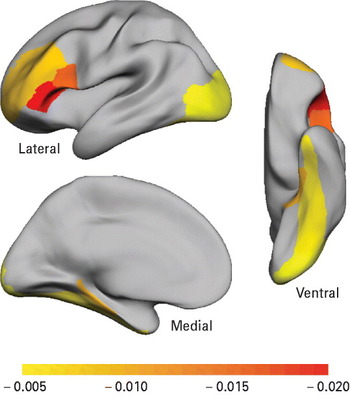
In both schizophrenia patients and healthy controls, increasing number of OCs was significantly related to lower lGI in the left pars triangularis (p<0.0005) from the parcellation analyses (Fig. 1). This result remained significant after Bonferroni correction (Supplementary Table S1). Five other parcellations in the left hemisphere (fusiform, lateral occipital, parahippocampal, rostral middle frontal and pars opercularis) displayed a similar relationship to OCs (Fig. 1), equally in both groups, but these findings did not remain significant after Bonferroni adjustment for multiple testing (Supplementary Table S1). There was no diagnosis×OCs interaction effect (data not shown). There were no significant relationships between OCs and lGI in the right hemisphere (Supplementary Table S1). Current antipsychotic medication (standardized as Haloperidol equivalent dosages) did not have a statistically significant effect on lGI and neither did the use of typical versus atypical antipsychotic medication (data not shown). From the vertex-wise analyses, no significant relationships between lGI and OCs remained after adjustment for multiple comparisons using FDR (see Supplementary Information and Supplementary Fig. S2 for uncorrected results).
The effect of increasing number of obstetric complications (OCs) on average local gyrification in pre-defined cortical areas in the left hemisphere significant at p<0.05, from the linear regression model with age, diagnosis, gender and continuous OCs. The red area remains significant after Bonferroni correction for multiple tests. The colour map represents B values for OCs, with the corresponding p values listed in Supplementary Table S1.

Discussion
This is the first scientific study to investigate the relationship between OCs and a 3D lGI in schizophrenia. The main finding was that increasing number of OCs in a dose–response fashion was significantly related to lower lGI in the left pars triangularis in both schizophrenia patients and healthy control subjects. A similar trend, also for both groups, was demonstrated in five other parcellations in the left hemisphere, whereas no relationship between OCs and lGI was demonstrated in the right hemisphere.
Effects of OCs on cortical folding
Studies of gyrification in premature infants have demonstrated increased temporal gyrification bilaterally as compared with term infants (Kesler et al. Reference Kesler, Vohr, Schneider, Katz, Makuch, Reiss and Ment2006) and higher sulcation index (a measure of cortical folding), when related to brain surface, in preterm intra-uterine growth restriction infants compared with ‘normal’ preterm infants (Dubois et al. Reference Dubois, Benders, Borradori-Tolsa, Cachia, Lazeyras, Ha-Vinh, Sizonenko, Warfield, Mangin and Huppi2008). Although the present subject sample included three subjects born prematurely, the results are not directly comparable, as the range of obstetric severity is much larger in the present sample. However, previous findings suggest that gyrification deviances may be related to adverse conditions during foetal brain development.
Only one previous study has investigated the effect of OCs on gyrification in schizophrenia (Falkai et al. Reference Falkai, Honer, Kamer, Dustert, Vogeley, Schneider-Axmann, Dani, Wagner, Rietschel, Muller, Schulze, Gaebel, Cordes, Schonell, Schild, Block, Traber, Steinmetz, Maier and Tepest2007). From the 2D GI in six coronal MRI sections (three in the frontal and three in the parietal lobe), Falkai and colleagues did not find any relationship between OCs and gyrification in schizophrenia patients. The methodological differences may explain why the results in the present study differ from those of Falkai and colleagues. In the present study, the 3D surface-based approach allowed searching for multiple local alterations in gyrification across the whole cortical mantle. It is worth noting that the same definition and categorization of OCs were applied, OCs being scored with the McNeil–Sjöström scale in both studies. This increases the comparability of the studies and furthermore supports the present use of a surface-based local gyrification method to investigate cortical folding patterns.
Smaller prefrontal and temporal cortical volumes have been reported in schizophrenia patients with a history of foetal hypoxia (Cannon et al. Reference Cannon, van Erp, Rosso, Huttunen, Lonnqvist, Pirkola, Salonen, Valanne, Poutanen and Standertskjold-Nordenstam2002). Both cortical folding patterns and cortical thickness affect cortical volume, but their relationship is uncertain. We have previously investigated the present subject sample for association between OCs and cortical thickness and found no association in schizophrenia patients or in healthy controls (Haukvik et al. Reference Haukvik, Lawyer, Bjerkan, Hartberg, Jonsson, McNeil and Agartz2009) for the entire cortex, or for frontotemporal regions specifically. Moreover, Schaer et al. (Reference Schaer, Glaser, Cuadra, Debbane, Thiran and Eliez2009) have reported that congenital heart disease (presumed to cause lower oxygen delivery to the brain) in patients with 22q11 deletion syndrome was related to altered cortical folding patterns in the brain but not to cortical thickness. Janssen et al. (Reference Janssen, Reig, Aleman, Schnack, Udias, Parellada, Graell, Moreno, Zabala, Balaban, Desco and Arango2009) reported more widespread cortical thickness reductions than gyrification abnormalities in adolescent onset psychosis and concluded that the cortical thickness reductions in schizophrenia appear to be caused by factors occurring after cortical folding development is finished. Taken together, the previous and the current findings suggest that cortical folding patterns may be a more robust brain morphological correlate or even a marker for early neurodevelopmental aberrances than are measures of cortical thickness.
Pars triangularis
The relationship of OCs and lGI in the left pars triangularis is of particular interest, as pars triangularis together with pars opercularis are included under Broca's area. Broca's area is important to different aspects of neurocognitive functioning such as language formation (Bhojraj et al. Reference Bhojraj, Francis, Rajarethinam, Eack, Kulkarni, Prasad, Montrose, Dworakowski, Diwadkar and Keshavan2009), semantic encoding (Demb et al. Reference Demb, Desmond, Wagner, Vaidya, Glover and Gabrieli1995), semantic retrieval (Badre & Wagner, Reference Badre and Wagner2007), syntactic processing (Friederici et al. Reference Friederici, Ruschemeyer, Hahne and Fiebach2003) and syntactic working memory (Fiebach et al. Reference Fiebach, Schlesewsky, Lohmann, von Cramon and Friederici2005). Aberrations in neurocognitive domains related to Broca's area have been reported in schizophrenia (for review, see Mesholam-Gately et al. Reference Mesholam-Gately, Giuliano, Goff, Faraone and Seidman2009). Language impairments have been reported in populations with a history of OCs. Children who have suffered preterm birth or had a very low birth weight demonstrate reduced verbal fluency as measured by the controlled word association test and the animal naming test (Arnoudse-Moens et al. Reference Arnoudse-Moens, Weisglas-Kuperus, van Goudoever and Oosterlaan2009). Very low birth weight children have impaired language skills when compared with a term-born control group as measured by recalling sentences and word fluency test (Taylor et al. Reference Taylor, Minich, Klein and Hack2004). In children suffering from perinatal asphyxia, verbal IQ has been found to be related to initial arterial pH (Stevens et al. Reference Stevens, Raz and Sander1999). Thus, schizophrenia patients as well as otherwise healthy subjects who have suffered OCs may have impaired cognitive function related to Broca's area.
Increased metric distortion (as an indirect measure of cortical displacement and convolution) in the left pars triangularis (Wisco et al. Reference Wisco, Kuperberg, Manoach, Quinn, Busa, Fischl, Heckers and Sorensen2007) and reduced sulcal index in Broca's area (Cachia et al. Reference Cachia, Paillere-Martinot, Galinowski, Januel, de, Bellivier, Artiges, Andoh, Bartres-Faz, Duchesnay, Riviere, Plaze, Mangin and Martinot2008) have been described in schizophrenia patients as compared with healthy controls. In contrast, Janssen et al. (Reference Janssen, Reig, Aleman, Schnack, Udias, Parellada, Graell, Moreno, Zabala, Balaban, Desco and Arango2009) have reported no relationship between lGI and adolescent-onset psychosis and control status in the pars triangularis by using the same lGI algorithm as in the present study. In the pars opercularis, which is located adjacent to the pars triangularis, post-mortem findings demonstrated no abnormalities in laminar neuronal densities, glial density, cortical thickness or somal size in schizophrenia patients as compared with healthy controls (Selemon et al. Reference Selemon, Mrzljak, Kleinman, Herman and Goldman-Rakic2003). In the present study, the same relationship between higher number of OCs and lower lGI was found in pars triangularis and in pars opercularis, but for pars opercularis the p value of 0.021 did not remain significant after adjustment for multiple comparisons. The cytoarchitecture in pars opercularis and pars triangularis has been reported to be more alike than between other cortical parcellations (Amunts & Zilles, Reference Amunts, Zilles, Grodzinsky and Amunts2006), but it is uncertain if the post-mortem findings reported by Selemon et al. (Reference Selemon, Mrzljak, Kleinman, Herman and Goldman-Rakic2003) in the pars opercularis are identical with the cytoarchitecture of the pars triangularis. Nevertheless, the relationship between OCs and cortical folding in pars triangularis was equal in patients with schizophrenia and healthy controls and, accordingly, reflects alterations that are independent of a diagnosis of schizophrenia.
Limitations
The time window between birth and MRI scanning at adult ages allows for confounding effects on the brain from different environmental or disease-related factors. One such factor may be medication use. In the present study, we found no effect of dosage or type of current antipsychotic medication on lGI. In addition, since the significant effect of OCs on lGI found in the left pars triangularis of the brain was also found in control subjects, illness-related confounding effects can be ruled out.
In the current study, we used cerebral MRI with a voxel-size of 1 mm in plane and 1.5 mm thickness. The slice thickness of the MRI does, however, not constitute a large limitation, since preprocessing involves the construction of 1 mm isotropic voxels. The cortical surfaces were then reconstructed at submillimetre levels using validated protocols implemented in the FreeSurfer software and served for the computation of lGI using previously published algorithms (Schaer et al. Reference Schaer, Cuadra, Tamarit, Lazeyras, Eliez and Thiran2008).
Conclusions
The results from the present study demonstrate a statistically significant relationship between OCs and the lGI, with a higher number of OCs related to a lower GI in the pars triangularis of the left hemisphere of the brain in both schizophrenia patients and healthy control subjects. A similar trend was found for five other cortical anatomical areas in the left hemisphere, alike for both groups. The findings suggest that a relationship between OCs and cortical folding may be caused by factors shared by schizophrenia patients and healthy controls rather than factors related to schizophrenia alone.
Note
Supplementary information accompanies this paper on the Journal's website (http://journals.cambridge.org/psm).
Acknowledgements
The authors thank all patients and controls for their participation and all health professionals involved. We thank Dr Pontus Strålin (MD, PhD) for excellent collaboration and research nurses Monica Hellberg and Gunilla Lilja for technical assistance. The staff at the MRI laboratory at the Institute of Psychiatry section Vinderen, University of Oslo, are acknowledged for the pre-processing of MR images. This study was supported by the Swedish Research Council (2003–5845, 2007–3687, K2004–21X-15078–01A, K2008–62P-20597–01–3, K2009–62X-15077–06–03), the Karolinska Institutet, the Wallenberg Foundation, the HUBIN project, the Research Council of Norway (160181/V50, 167153/V50), the Swiss National Research Funds (grant 323500–111165 to MS and grants 3200–063135, 3232–063134, and PP00B-102864 to SE) and the South-Eastern Norway Regional Health Authority (2005-A135). The funding sources had no further role in the design of the study, in the collection, analysis and interpretation of the data, in writing the manuscript and in the decision to submit the paper for publication.
Declaration of Interest
None.