Habitat fragmentation may affect essential ecosystem processes, such as pollination, causing negative effects on plants and pollinators (Aizen & Feinsinger Reference AIZEN and FEINSINGER1994, Jennersten Reference JENNERSTEN1988, Lennartsson Reference LENNARTSSON2002, Liow et al. Reference LIOW, SODHI and ELMQVIST2001, Murcia Reference MURCIA, Schelhas and Greenberg1996). Effects of fragmentation on plant–pollinator interaction were evaluated in several studies (Aguirre & Dirzo Reference AGUIRRE and DIRZO2008, Dauber et al. Reference DAUBER, BIESMEIJER, GABRIEL, KUNIN, LAMBORN, MEYER, NIELSEN, POTTS, ROBERTS, SÕBER, SETTELE, STEFFAN-DEWENTER, STOUT, TEDER, TSCHEULIN, VIVARELLI and PETANIDOU2010, Dick Reference DICK, Bierregaard, Gascon, Lovejoy and Mesquita2001, Donaldson et al. Reference DONALDSON, NANNI, ZACHARIADES, KEMPER and THOMPSON2002, Dunley et al. Reference DUNLEY, FREITAS and GALETTO2009, Fuchs et al. Reference FUCHS, LOBO and QUESADA2003, Ghazoul & McLeish Reference GHAZOUL and MCLEISH2001, Lopes & Buzato Reference LOPES and BUZATO2007). The Brazilian savanna, called cerrado, has been fragmented due in large part to extensive agricultural activity (Carvalho et al. Reference CARVALHO, DE MARCO and FERREIRA2009). Studies with the main objective of evaluating the influence of fragment size on ecosystem processes and on plant reproductive output has not been determined in cerrado. The plants of this type of vegetation seem to produce generally low number of fruits per flower (Gribel & Hay Reference GRIBEL and HAY1993, Munin et al. Reference MUNIN, TEIXEIRA and SIGRIST2008, Ortiz et al. Reference ORTIZ, ARISTA, OLIVEIRA and TALAVERA2003). This may be due to the low soil fertility (Franco Reference FRANCO, Oliveira and Marquis2002, Haridasan Reference HARIDASAN2000). But the recent fragmentation of this biome may reduce even more their plant reproductive success because it can increase the effect of pollination limitation and inbreeding caused by the habitat isolation and degradation.
Cardiopetalum calophyllum Schltdl. (Annonaceae) is an allogamous species. It has a system of dichogamy that promotes cross-breeding, making its reproductive output pollinator-dependent (Gottsberger & Silberbauer-Gottsberger Reference GOTTSBERGER and SILBERBAUER-GOTTSBERGER2006). This species is pollinated by a single species of beetle, Lobiopa insularis (Castelnau 1840), that belongs to the family Nitidulidae. It is small (5–7 mm in length), flattened, and is attracted to C. calophyllum flowers by their smell. During anthesis, it penetrates into the flower chamber to feed on pollen and tissues and to reproduce, accomplishing pollination during this process (Gottsberger & Silberbauer-Gottsberger Reference GOTTSBERGER and SILBERBAUER-GOTTSBERGER2006). Given this intrinsic relationship with its pollinator agents, it is expected that C. calophyllum be susceptible to the effects of fragmentation. Therefore, the aim of this study is to test if smaller fragments exhibit lower reproductive output and pollinator abundance of C. calophyllum than larger fragments. Also, assuming beetles fly short distances among plants and have small foraging areas, we collected data on plant density surrounding the study plant to test if pollinator abundance is related to the mean number of reproductive plants of C. calophyllum within fragments.
This study was carried out in populations of C. calophyllum during one reproductive season, between July 2009 and January 2010, in the municipality of Hidrolândia (16°55′44″S, 49°16′35″W) in the State of Goiás, Brazil. Of the 30 fragments previously selected, ten were chosen for this study because they present the same types of vegetation and occurrence of C. calophyllum. The study fragments vary between 2 and 928 ha (Table 1) and are embedded in a pasture matrix. Ten C. calophyllum plants were marked in each of these fragments at the beginning of their flowering period. Each plant was located at least 50 m from the edges of the fragment. The plants were monitored during their flowering and fruiting periods. In each plant, ten branches were marked, and all open flowers on these branches were counted during the flowering season. The number of developed fruits and seeds per fruit on these branches were counted. Because C. calophyllum has flowers with an apocarpic gymnoecium and each carpel develops into a separate follicle, the number of follicles was also counted to verify the number of fertilized carpels per flower.
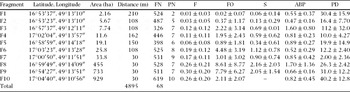
Data on Cardiopetalum calophyllum within ten savanna fragments in the municipality of Hidrolândia, Goiás State, Brazil: geographic coordinates; area of each fragment; distance of each fragment to the nearest neighbour; total number of marked flower in each fragment (FN); number of marked plants that produced fruit (PN); mean and standard deviation (SD) of fruit set per flower (F), follicles set per flower (FO), seed set per flower (S), pollinator number per flower (ABP), reproductive plants within a 30 × 30 m plot (plant density – PD) in each fragment.

To estimate pollinator abundance, three to eight flowers per plant of C. calophyllum were collected at anthesis, and the floral visitors inside the floral chambers were counted and identified. These data were collected in ten C. calophyllum plants of each fragment study. The beetles were identified by specialists, and the specimens were deposited in the Coleção Zoológica da Universidade Federal de Goiás. The pollinator abundance per fragment is the total number of beetles collected in the flower chambers divided by the total number of flowers collected in each fragment.
To estimate plant density per fragment, ten plots of 30 × 30 m were established in each fragment. Each one of the marked plants was located in the centre of the respective plot. All reproductive individuals within the plot were counted. Reproductive plants were defined as the adult plants that produced at least one flower during the flowering period. The reproductive plant density in each fragment is the total number of reproductive plants in all plots divided by the number of plots per fragment.
Multiple regression (Zar Reference ZAR2009) was used to test the effect of fragment size and isolation, plant density and pollinator abundance on fruit, follicle and seed set. This test was used also to check if pollinator abundance is related to fragment size and isolation, and plant density. The assumptions of normality and homoscedasticity were tested for all analyses, and if they were not met, logarithmic transformations (natural log (x+1)) were carried out for the variables.
The two smallest sampled fragments, F1 (2.16 ha) and F2 (5.67 ha), had the lowest fruit and follicle set (Table 1). In general, small fragments (< 20 ha) showed lower fruit and follicle set than medium (20–100 ha) and large fragments (> 100 ha) (Table 1). Our data showed a high and significant correlation between fragment size and fruit and follicle set (r = 0.925; P < 0.001 and r = 0.743; P = 0.01; respectively). A high and significant correlation between fragment size and seed set was found as well (r = 0.932; P < 0.001). Due to tag loss, it was not possible to sample ten plants in all fragments (Table 1). Also, it was not possible to estimate the seed set in fragment F10 because the fruits sampled in this fragment rotted, making seed counting impossible.
Most of the multiple regression analyses were significant (Table 2). However, the partial coefficients showed that only the fragment size variable affected significantly the reproductive success of C. calophyllum. The pollinator abundance was not affected by fragment size, neither by fragment isolation, nor by plant density (Table 2).
Multiple regression analyses testing the effect of fragment size and isolation, plant density and pollinator abundance on fruit, follicle and seed set. The effect of fragment size and isolation, and plant density on pollinator abundance was tested as well. Beta is the standardized coefficient and SE is the standard error of the coefficient.

In Brazil, few studies have been conducted on the relationship between plant reproductive output and fragmentation. One study carried out in the Atlantic Forest biome and another in salt marshes did not show any relationship between these variables (Dunley et al. Reference DUNLEY, FREITAS and GALETTO2009, Lopes & Buzato Reference LOPES and BUZATO2007). In other tropical regions, different studies have found conflicting results regarding the effects of fragmentation on plant reproduction (Aguilar et al. Reference AGUILAR, ASHWORTH, GALETTO and AIZEN2006, Aizen & Feinsinger Reference AIZEN and FEINSINGER1994, Cascante et al. Reference CASCANTE, QUESADA, LOBO and FUCHS2002, Dick Reference DICK, Bierregaard, Gascon, Lovejoy and Mesquita2001, Fuchs et al. Reference FUCHS, LOBO and QUESADA2003, Herrerías-Diego et al. Reference HERRERÍAS-DIEGO, QUESADA, STONER and LOBO2006, Reference HERRERÍAS-DIEGO, QUESADA, STONER, HERNÁNDEZ-FLORES, LOBO and SANCHEZ-MONTOYA2008; Quesada et al. Reference QUESADA, STONER, LOBO, HERRERÍAS-DIEGO, PALACIOS-GUEVARA, MUNGUÍA-ROSAS, SALAZAR and ROSAS-GUERRERO2004, Wolf & Harrison Reference WOLF and HARRISON2001). It has been suggested that allogamous species, such as self-incompatible and of specialized pollination system, would be more likely to have their reproductive success affected by habitat fragmentation (Aguilar et al. Reference AGUILAR, ASHWORTH, GALETTO and AIZEN2006, Aizen et al. Reference AIZEN, ASHWORTH and GALETTO2002). Cardiopetalum calophyllum is an allogamous species. Its flowers have dichogamy, showing strong temporal separation of the male and female phases (Gottsberger & Silberbauer-Gottsberger Reference GOTTSBERGER and SILBERBAUER-GOTTSBERGER2006). This avoids selfing and makes reproduction dependent on pollinator visits. However, no significant correlation of fragment size on pollinator abundance (r = 0.256; P = 0.474) was detected. Only individuals of L. insularis (n = 348) were found within the floral chambers (n = 441). No correlation was observed between plant density and pollinator abundance in the study fragments either (r = 0.385, P = 0.270).
The absence of effects of fragment size and plant density on the abundance of L. insularis can be due to the generalist feeding strategy of Lobiopa insularis, which feeds on the tissues and pollen of flowers, plant sap and decaying fruits (Ellis et al. Reference ELLIS, DELAPLANE, CLINE and MCHUGH2008). Besides, pollinator resources may not decline linearly with the reduction in fragment size, and even small fragments (< 1 ha) can maintain or attract a diversity of pollinator insects (Donaldson et al. Reference DONALDSON, NANNI, ZACHARIADES, KEMPER and THOMPSON2002). Additionally, if pollinators stay in the fragment, they can avoid the energetic costs of travelling among fragments.
The lower production of fruits and seeds of C. calophyllum in small fragments may result from the population reduction and isolation, which decrease the pollen exchange among plants, especially among different populations and demes, and increase pollen exchange among genetically similar plants within fragments. The small fragments in this study have higher degrees of isolation than the large ones (Table 1), making difficult pollen exchange among plants of different fragments. Beetles, such as L. insularis, have short flights and probably rarely fly between fragments. Thus, pollen exchange could occur more frequently among closer plants inside the study fragments, limiting gene flow for C. calophyllum. This feature could lead to greater inbreeding within a population, especially if these populations are genetically substructured.
Several studies show a positive relationship between fragment size and the reproductive success of plant species in fragments smaller than 5 ha (Aizen & Feinsinger Reference AIZEN and FEINSINGER1994, Becker et al. Reference BECKER, MOURE and PERALTA1991, Donaldson et al. Reference DONALDSON, NANNI, ZACHARIADES, KEMPER and THOMPSON2002, Dunley et al. Reference DUNLEY, FREITAS and GALETTO2009, Jennersten Reference JENNERSTEN1988, Valdivia et al. Reference VALDIVIA, SIMONETTI and HENRÍQUEZ2006). In the present study, this relationship was stronger in fragments up to 10 ha. Besides, fragments smaller than 20 ha also showed a decrease in reproductive success. Cardiopetalum calophyllum can be more sensitive to fragment size, requiring areas greater than 20 ha to maintain its fitness. This factor is probably due to the low movement of L. insularis among plants of C. calophyllum and to the reduction of genetic variability within the populations in small fragments. In addition, C. calophyllum and other species of cerrado can be more sensitive to fragment size; requiring large areas to maintain its reproductive success and population growth rate because they seem to have naturally low fertility (Gribel & Hay Reference GRIBEL and HAY1993, Munin et al. Reference MUNIN, TEIXEIRA and SIGRIST2008, Ortiz et al. Reference ORTIZ, ARISTA, OLIVEIRA and TALAVERA2003). Fragmentation may have a stronger effect in habitat of low nutrient availability such as in cerrado.
Cardiopetalum calophyllum was chosen for this study because it is a common species. If the negative effects of habitat fragmentation are detected in a common species of cerrado, which could be less likely to suffer these effects, the projection of these effects to rare species or species with restricted range can be stronger.
ACKNOWLEDGEMENTS
We are grateful to M. Z. F. Santos, D. B. Silva and P. E. Oliveira for their comments and suggestions and to M. Pepper and A. P. C. Melo for their assistance with beetle identification.